
Have you ever descended into the ocean and felt like you were flying through liquid space? That’s what Big Island scuba diving is all about. Around here, world-class visibility isn't just a lucky break—it's the standard. We’re talking about gin-clear water where you can often see more than 100 feet in every direction.
Your Guide to Diving in Kona’s Crystal-Clear Waters

So, what’s the secret behind Kona’s legendary conditions? It’s not magic. It’s a perfect storm of geology, geography, and oceanography that creates a true diver’s paradise, and this guide is here to pull back the curtain.
This remarkable clarity is why visibility in Big Island scuba diving gets divers from all over the world so excited. The island's volcanic structure and its prime location in the Pacific mean there’s very little sediment to cloud things up, and the deep ocean currents keep the water constantly refreshed.
What You'll Discover in This Guide
We’re going to get into the nitty-gritty of what makes our water so clear. Understanding the science at play will give you a whole new appreciation for your time below the surface. We'll cover:
- How massive volcanoes create a natural barrier, keeping the seas on the Kona coast incredibly calm.
- The role deep ocean currents play in constantly filtering and replacing coastal water.
- Why the island’s steep, drop-off topography prevents the kind of cloudy runoff that plagues other destinations.
- The seasonal patterns that can affect diving conditions day-to-day.
When you understand these elements, you go from being just another tourist with a tank to a truly informed explorer of this amazing marine ecosystem.
Here at Kona Honu Divers, our job is to make every single dive spectacular. We use our deep local knowledge to pick the absolute best sites based on the day's conditions, ensuring you get the best possible experience every time you hit the water.
We'll show you how to read the seasons and help you choose the right spots to get those postcard-perfect underwater views. Let’s dive into the factors that shape the incredible visibility in Big Island scuba diving and get you ready for your next adventure. Check out our awesome lineup of diving tours to see what's waiting for you.
Why Kona’s Underwater Visibility Is World-Famous
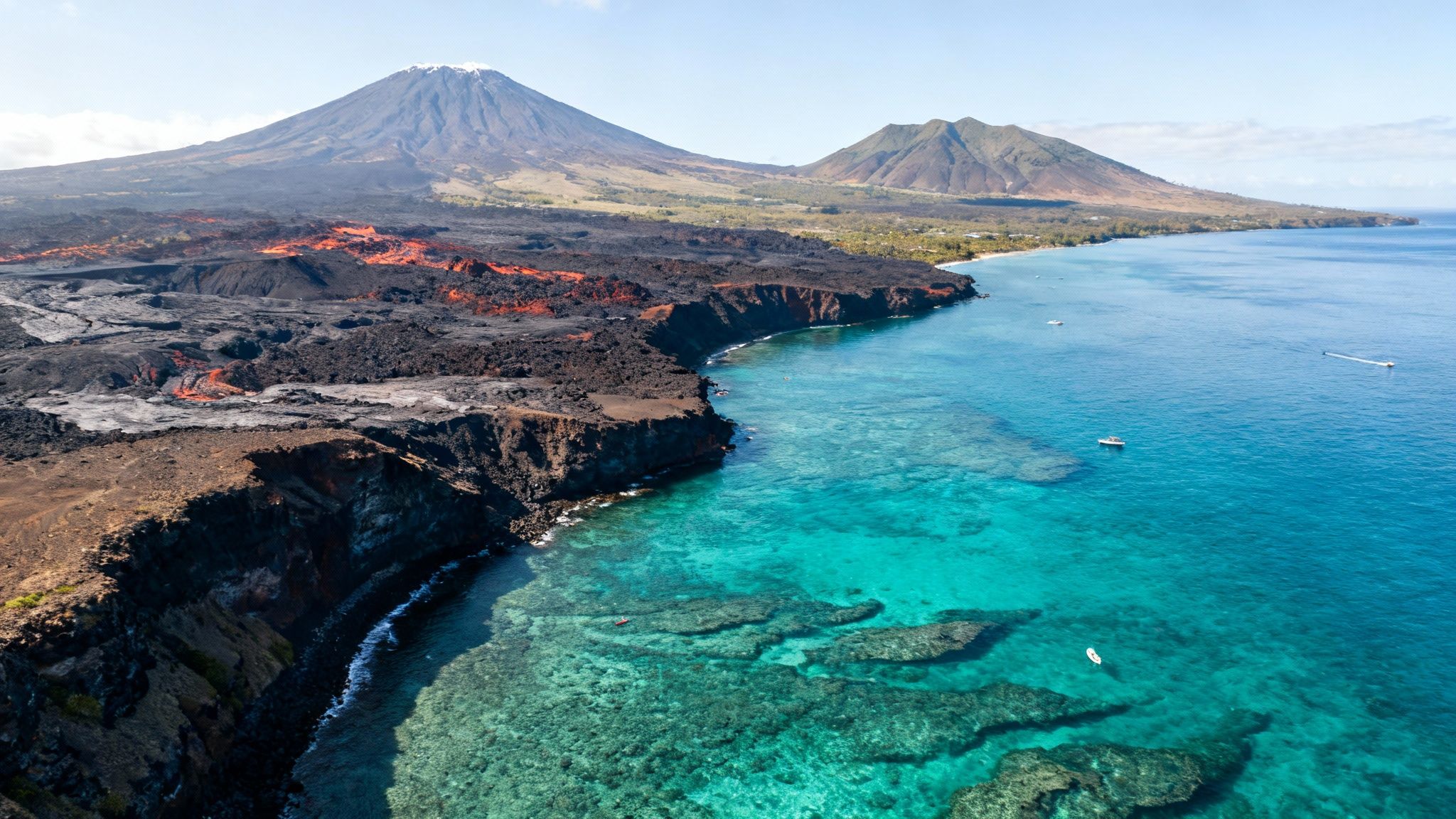
If you've ever wondered why the visibility in Big Island scuba diving is so legendary, it’s not just luck. It's a perfect storm of geology, geography, and oceanography that creates some of the clearest water on the planet.
Picture the Big Island's colossal volcanoes, Mauna Loa and Hualalai, towering over 13,000 feet. They act as massive bodyguards for the Kona coast, creating a huge "rain shadow" that blocks the powerful trade winds barreling across the Pacific. This natural shield keeps our western shoreline incredibly calm, preventing the wind and waves from stirring up the bottom.
This calm lee side is the secret sauce. Without the constant churn you find in other top-tier dive spots, any particles in the water have a chance to settle, leaving the water column stunningly clear.
The Deep Ocean’s Natural Filtration System
But it's not just what's above the water. The underwater landscape off the Kona coast is just as important. Instead of a wide, shallow shelf, the seafloor drops off dramatically, plunging thousands of feet into the abyss just a stone's throw from shore.
This steep bathymetry means there’s no place for silt and runoff to gather. Deep, nutrient-rich ocean currents are constantly sweeping past, acting like a massive, natural filtration system. This cycle continuously flushes the coastal waters, pulling away impurities and pulling in pristine, clear water from the open ocean.
It’s this constant renewal that keeps the visibility so consistently good. We don’t just have calm water; we have clean, perpetually refreshed ocean water.
The result is an environment where the water is not only still but also exceptionally pure. This combination creates that incredible sensation of floating in air—a feeling that truly defines the Kona diving experience.
This remarkable clarity is precisely why Big Island scuba diving is famous around the world. It’s not uncommon to enjoy visibility well over 100 feet (about 30 meters). A dive here feels more like flying over vibrant coral reefs and ancient lava formations. To learn more about what sets us apart, see why the Big Island is a premier scuba destination.
How Volcanic Rock Contributes to Clarity
Even the very rock the island is made of plays a part. Our coastline is almost entirely dark, porous lava rock. Unlike the soft, sandy shorelines you might see elsewhere, this hard volcanic rock doesn't break down into fine, silty particles that can hang in the water and ruin the view.
And when it does rain, the porous lava rock acts like a giant sponge. It absorbs a huge amount of freshwater, filtering it naturally before it can create the kind of muddy runoff that plagues so many other tropical islands after a storm.
So, to put it simply, here are the key ingredients for Kona's gin-clear water:
- Volcanic Shield: Mauna Loa and Hualalai create a massive wind block, keeping the Kona coast calm.
- Deep Water Proximity: Steep drop-offs allow deep ocean currents to constantly flush the coastline, keeping it clean.
- Porous Lava Rock: The island’s geology acts as a natural filter, dramatically reducing coastal runoff.
When you put these factors together, you get a uniquely stable and clear marine environment. It's the science behind the magic, explaining why the visibility in Big Island scuba diving is so spectacular year after year, letting you see every incredible detail of our underwater world.
A Seasonal Guide to Big Island Diving Conditions
Timing your trip to the Big Island can be the difference between a good dive and an unforgettable one. While the protected Kona coast offers incredible diving all year, each season has its own personality. Knowing these subtle shifts helps you match your vacation to what you want most, whether that's guaranteed glassy seas or a life-changing wildlife encounter.
Here’s a practical, season-by-season look at what to expect from the visibility in Big Island scuba diving. We'll break down how the calendar affects water clarity, temperature, and marine life so you can plan the perfect underwater adventure.
Summer: The Peak of Perfection
From June through September, Kona is pretty much a diver's paradise. This is our high season, known for consistently flat, calm seas, the warmest water of the year (77-80°F), and stunning visibility that often pushes past 100 feet. It’s what we call the "glassy ocean" season, where conditions are about as reliable and comfortable as they get.
Because of this, summer draws in the biggest crowds. Divers from all over the world come for these prime conditions, and the reefs are buzzing with new life, including tons of juvenile fish. The trade-off for perfect visibility is sharing the water with more people, but for photographers and anyone wanting a guaranteed great experience, it’s absolutely worth it.
Fall: An Insider’s Secret
October and November are when the locals really love to dive. This shoulder season keeps all the best parts of summer—warm water and amazing visibility—but the crowds have thinned out considerably. You get more space on the boat and more peace at the dive sites.
The ocean is still holding onto its summer heat, and the weather topside is usually fantastic. It's a much more relaxed vibe. Honestly, if you ask a Kona divemaster their favorite time to get in the water, many will say it's the fall.
Fall diving in Kona is the best of both worlds. You get the premium conditions of summer without the peak-season crowds. It’s perfect for divers looking for a world-class experience that feels a little more personal.
Winter: Whales and Wonders
Winter, from December to March, brings a whole different kind of magic. We might see bigger ocean swells roll in, which can sometimes stir things up and lower visibility closer to shore, but the diving is still phenomenal. The water cools down a bit, usually hovering around 74-76°F, but what you get in return is simply spectacular.
This is humpback whale season.
Thousands of humpbacks migrate to Hawaii to breed and give birth. Seeing them from the boat is incredible, but hearing them underwater is something you’ll never forget. Their complex, haunting songs travel for miles, providing an otherworldly soundtrack to your entire dive. You can learn more about what makes each season special in our guide on the best months to dive in Hawaii.
Spring: A Beautiful Transition
Come April and May, the Big Island is in a beautiful state of flux. The last of the humpback whales are starting their journey back to their summer feeding grounds, and the ocean conditions are steadily shifting back toward their summer peak. The big winter swells fade, and both water temperature and visibility begin to climb.
This is a fantastic time to visit. You get a wonderful balance of improving conditions, lively marine life, and fewer people in the water. The reefs are teeming with activity as things warm up, making spring a brilliant and often-overlooked season for enjoying the best of visibility in Big Island scuba diving.
Big Island Diving Visibility by Season
Here’s a quick reference guide to help you get a feel for the water conditions you can expect on the Kona Coast throughout the year.
| Season | Typical Visibility | Water Temperature | Key Highlights |
|---|---|---|---|
| Summer (Jun-Sep) | 100+ feet | 77-80°F | Glassy, calm seas; warmest water; peak tourist season. |
| Fall (Oct-Nov) | 80-100+ feet | 77-79°F | Summer conditions with fewer crowds; a local favorite. |
| Winter (Dec-Mar) | 60-100 feet | 74-76°F | Humpback whale songs; potential for larger ocean swells. |
| Spring (Apr-May) | 70-100+ feet | 75-77°F | Conditions steadily improving; active reefs; fewer crowds. |
While this table offers a great general overview, remember that the ocean always has a mind of its own. But on any given day, the Kona coast is likely serving up some of the best diving conditions you can find anywhere.
How Top Dive Sites Showcase Kona’s Best Visibility
It's one thing to understand the science behind Kona's famously clear water, but seeing it for yourself at our world-class dive sites is where the real magic happens. Different spots along the coast show off the incredible visibility in Big Island scuba diving in their own unique ways. From sheltered coves to the deep offshore abyss, each site offers a distinct window into our underwater world.
Let's put the theory into practice and explore a few iconic dives that perfectly demonstrate Kona's legendary clarity. These aren't just popular spots; they are living, breathing examples of how geology and oceanography combine to create unforgettable experiences.
Garden Eel Cove: A Stage for Gentle Giants
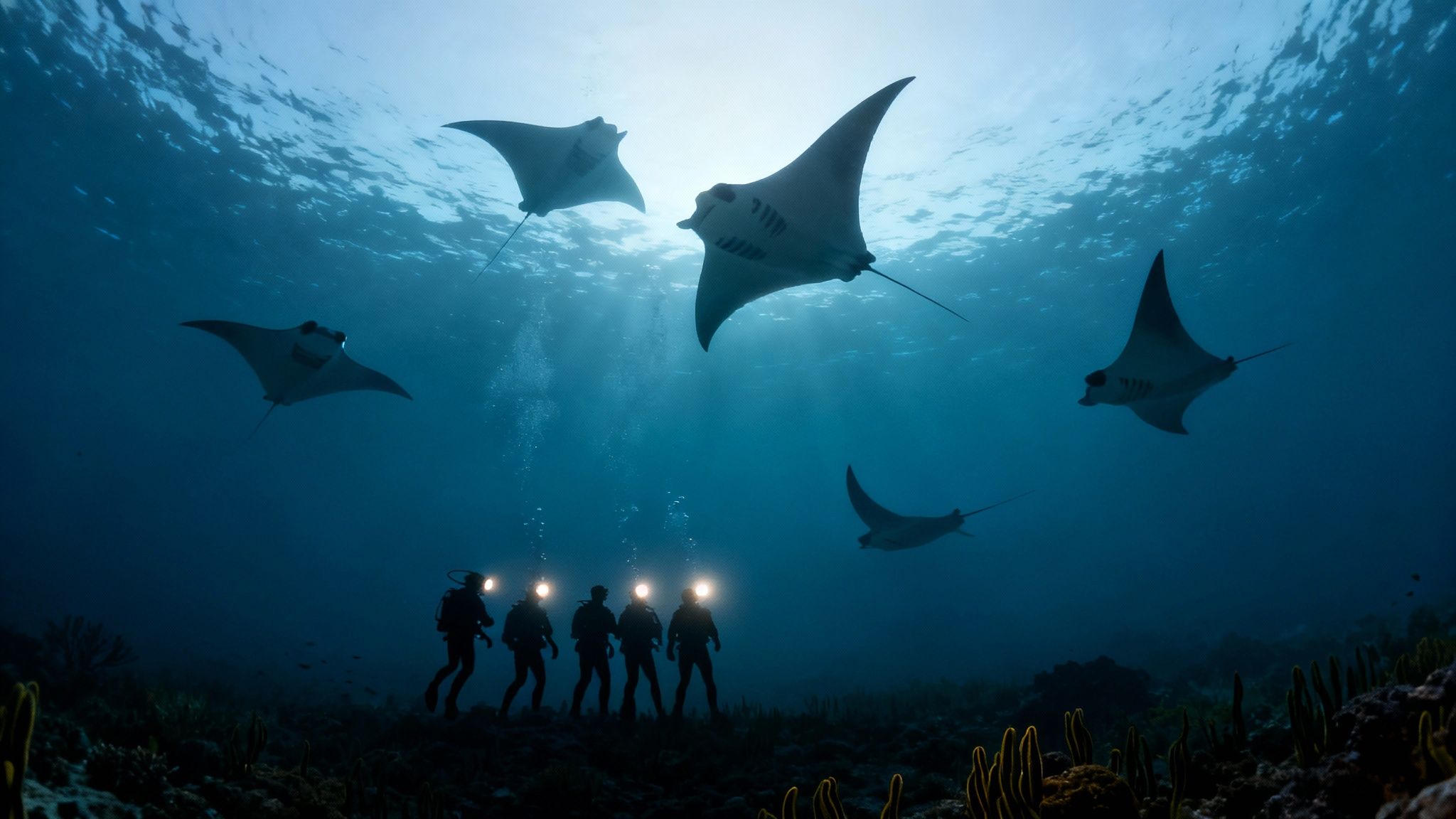
There is no better example of reliably superb visibility than the world-famous Manta Ray Night Dive at Garden Eel Cove. This site is a masterclass in perfect conditions. Tucked into a protected cove, it’s naturally shielded from the big ocean swells, which keeps the water exceptionally calm and clear, night after night.
This sheltered location is exactly why Garden Eel Cove is the superior choice for the manta experience. The calm water, better reefs, and protected location create a perfect underwater amphitheater where our powerful lights attract plankton, bringing in the giant mantas for their mesmerizing feeding ballet. Divers can settle onto the sandy bottom in a better viewing area to watch the show without disturbing the animals or their home.
The consistent clarity is a huge part of this dive's success. With visibility often averaging a stunning 80-100 feet, you get front-row, crystal-clear views of manta rays with wingspans reaching up to 12 feet. It's this reliability that has contributed to an incredible 85-90% sighting success rate over the years.
The Kona Blackwater Dive: Into Infinite Blue
If you're looking for an experience that completely redefines the concept of visibility, the Kona Blackwater Dive is in a league of its own. This is nothing like a typical reef dive. We head miles offshore, positioning ourselves over thousands of feet of water, and simply drift in the deep, open ocean.
Out here, "visibility" takes on a whole new meaning. You're suspended in inky blackness, and your dive light cuts through the water to reveal a universe of bizarre and beautiful creatures migrating up from the abyss. In this environment, the visibility is virtually infinite—limited only by the beam of your light. There are no walls, no bottom, just an endless expanse of deep, clear water. It’s an otherworldly encounter with life forms very few people ever get to see.
Advanced Dives: Pristine and Untouched Clarity
For more seasoned divers craving true exploration, our Advanced Dive Charters open up some of the most remote and untouched dive sites on the island. These spots often feature dramatic lava tubes, sheer walls, and deep pinnacles that are exposed to stronger currents.
While "currents" might sound intimidating, they are the ocean's cleaning crew, constantly sweeping the sites clean of any suspended particles. The result is some of the most pristine visibility in Big Island scuba diving you'll ever see, often exceeding 120 feet. Exploring these advanced sites feels like you’re the first person to ever lay eyes on them. The combination of dramatic underwater geology and hyper-clear water makes for a truly humbling adventure.
Each of these dives tells a different part of Kona's visibility story. Whether it's the calm reliability of a protected cove, the boundless clarity of the open ocean, or the pristine conditions of a remote pinnacle, the water here consistently delivers a world-class experience.
These iconic spots are just the beginning of what the Kona coast has to offer. Every location has its own personality, shaped by the island's volcanic past and the ever-present ocean. You can explore more of the incredible places we visit in our comprehensive guide to Kona's premier dive sites.
How We Maximize Your Underwater Experience
Choosing the right dive operator is just as important as picking the right season for your trip. Here at Kona Honu Divers, we don’t just take you to a dive site; we actively manage every detail to give you the absolute best visibility in Big Island scuba diving possible. Our whole operation is built on a foundation of deep local knowledge, turning what would be a good dive into an unforgettable one.
It all starts before our boats even leave the dock. Our crew lives and breathes these waters, constantly monitoring real-time ocean conditions from swell forecasts to wind patterns. This lets us stay nimble, hand-picking dive sites that promise the calmest seas and clearest water on any given day. If there's a rare large swell or unusual runoff affecting an area, we know how to skillfully steer clear, making sure you drop into pristine conditions.
The Right Gear for the Clearest Views
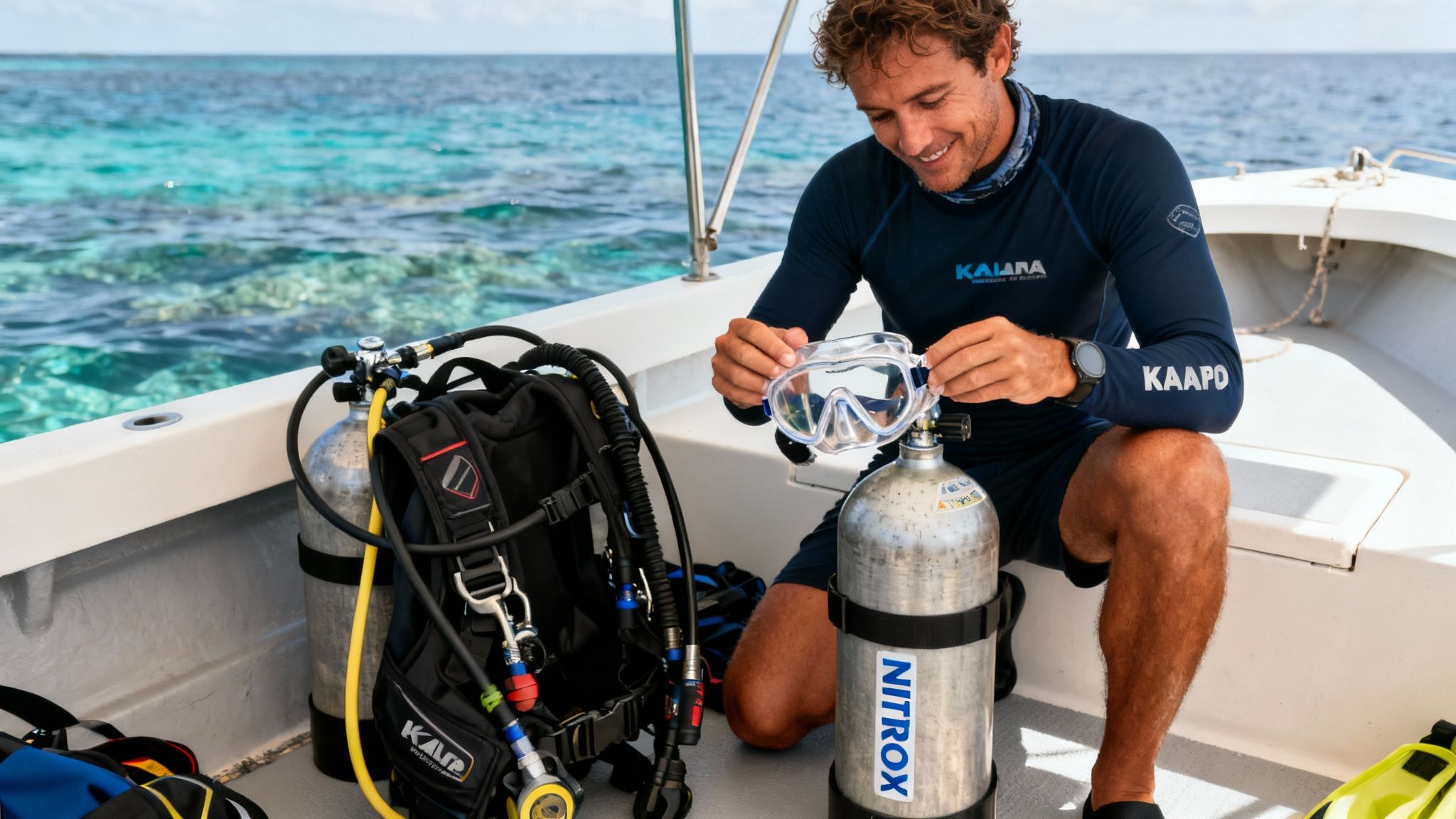
What good is amazing visibility if your mask fogs up two minutes into the dive? It's one of the most common frustrations, but it’s something we take seriously. We provide high-quality, meticulously maintained rental gear, and our crew makes sure every single mask is properly treated before you hit the water. It's a small step, but it's critical for ensuring nothing gets between you and Kona’s vibrant reefs.
Beyond that, we want to enhance your entire experience down below. For our certified divers, we offer complimentary Nitrox. Using enriched air means more bottom time, and when the water is exceptionally clear and deep, those extra minutes are golden. It's your chance to fully explore a lava tube or watch marine life go about its day without feeling rushed. It’s simply our way of helping you soak in every moment of Kona's deep blue world for as long as possible.
At Kona Honu Divers, our goal is to eliminate the little variables that can take away from your dive. From site selection to gear prep, we handle the details so you can just focus on the incredible underwater world in front of you.
Expert Guides Who Reveal the Unseen
Even with 100-foot visibility, so many of the ocean's coolest creatures are masters of disguise. This is where our experienced guides really shine. They aren’t just navigators; they're passionate naturalists with an almost supernatural ability to spot things hiding in plain sight.
Our guides are the ones who will point out a perfectly camouflaged frogfish you thought was a sponge, or an octopus tucked deep inside a coral head—critters you would have unknowingly swam right past. Their expertise transforms your dive from a scenic swim into a guided safari, revealing the reef’s hidden secrets. If you're keen to learn more about what we look for, we've put together some tips on how to check ocean conditions on the Big Island.
We truly believe that an exceptional dive is a combination of great conditions and great guidance. With Kona Honu Divers, you get a dedicated partner committed to maximizing your safety, comfort, and those jaw-dropping views on every single trip. See what our divers have to say about their experiences with us.
Ready to experience the clearest water Kona has to offer with a crew that puts your experience first? Book your adventure with us today.
Common Questions About Big Island Dive Visibility
Planning a dive trip always brings up questions, especially about what you’ll be able to see down there. To help you get a clearer picture, we've put together answers to the most common queries we get about Kona's legendary visibility.
What is the average visibility when scuba diving in Kona?
You can almost always count on fantastic visibility here. On an average day along the Kona coast, you’re looking at 80 to well over 100 feet (that's 24-30+ meters) of clarity.
It gets even better in the summer. When the seas are at their calmest, it's not rare for the visibility to push past 120 feet, giving you that feeling of floating in an endless blue aquarium.
Does rain affect diving visibility on the Big Island?
This is a great question, and the answer often surprises people. Rain has remarkably little effect on Kona's underwater visibility.
Our island's secret weapon is its geology. The steep, porous volcanic rock acts like a giant natural filter, so we don't get the muddy coastal runoff you see in other places. A heavy downpour might blur the surface for a bit, but it almost never clouds the water where we're actually diving.
Is visibility better during morning or afternoon dives?
Honestly, the visibility in Kona is spectacular all day long. The biggest difference is often the surface conditions, not the clarity below. Mornings typically have calmer seas and less wind, which can make for a more relaxing boat ride out.
While the angle of the sun changes how the underwater world is lit, the water itself stays consistently clear for both our morning and afternoon diving tours.
Which dive sites consistently have the best visibility?
While it’s hard to find a Kona dive site with bad visibility, some spots are just exceptionally clear. Sites that are further offshore or have a healthy current sweeping through them often boast the most pristine, gin-clear water. We frequently visit these gems on our advanced dive charters.
On the other hand, naturally sheltered spots like Garden Eel Cove are also champions of clarity. They're so well-protected from ocean swells that the visibility stays superb, making them perfect for those iconic, must-do dives.