
You're certified, you're in Kona for a few days, and you've got maybe two mornings and one night you can dive. That's the planning problem with Scuba Kona trips. You don't need a longer list of sites. You need to know which dive fits your certification, what could change on the day, and which encounters are likely rather than guaranteed. This guide treats conditions and wildlife that way, as probabilities you can plan around.
Kona Scuba Options at a Glance
| Experience | Best for | Timing | Certification needed |
|---|---|---|---|
| 2-Tank Morning Reef Dive | Certified divers wanting coral gardens, lava tubes and arches | Morning | Open Water Diver (most charters) |
| Manta Ray Night Dive | Divers and snorkelers wanting Kona's signature night encounter | Night | Open Water Diver for divers, none for snorkelers |
| Blackwater Night Dive | Experienced divers wanting open-ocean drifts after dark | Night | Open Water Diver (most charters) |
| Premium Advanced 2-Tank Trip | Certified divers wanting remote, pristine sites and drift dives | Daytime | Advanced certified divers |
Most Kona options run from boats, so you're not really choosing a starting point. You're choosing timing, depth and how much self-reliance the dive demands. A morning reef dive keeps you on structured reef terrain in daylight. Night trips trade that visual reference for wildlife behavior you can't see at noon, and they ask more from your buoyancy, light discipline and gas awareness.
Certification level decides the short list. Comfort without a visual reference decides whether a night dive belongs on it. If you've just finished certification, daylight reef structure gives you a bottom reference, a guide nearby and an easier exit. If you can hover steady, manage a light with one hand and track gas in the dark, the night options open up.
We run these trips across Kona as Kona Honu Divers, and you can compare timing and requirements on our Kona diving tours page. Most regular charters require an Open Water Diver certification, so check that before you fall in love with a specific trip.
Shore diving sits apart from the boat options. It looks simpler because there's no boat schedule, but you own the entry, the exit, navigation and the call to cancel when surge picks up. I wouldn't treat it as the budget version of a boat dive.
Decision rule: First-time certified visitors should start with the morning 2-tank dive, wildlife-focused divers should book a night dive, and experienced divers should move to the advanced trip.
Certification and What the Dive Day Involves
For most of our regular dive charters, we require at least an Open Water Diver certification from a recognized agency such as PADI, SSI or NAUI, which allows diving to 60 feet (18 meters) with a buddy. Bring your certification card, your C-card, in physical or digital form. Without proof, the crew can't put you on a certified charter, however convincing your story is.
If you aren't certified yet, don't book a regular charter and hope for an exception. Take a scuba certification course for beginners first, or choose an introductory experience designed for noncertified divers. If you were certified years ago and haven't been in the water since, a refresher course is the honest path. Mask clearing, regulator recovery and buoyancy come back quickly with an instructor. They are poor skills to rediscover inside a lava tube.
You can see course and refresher options on our Kona scuba classes page. A short refresher costs you part of a day. Skipping it can cost you the dive, because a crew that sees uncontrolled ascents or constant bottom contact will shorten or end your participation.
How a Typical Dive Day Runs
- Arrival and gear setup: You check in, confirm your C-card and get fitted or set up. Our crew handles all gear setup for divers, which helps newer divers and speeds up departure.
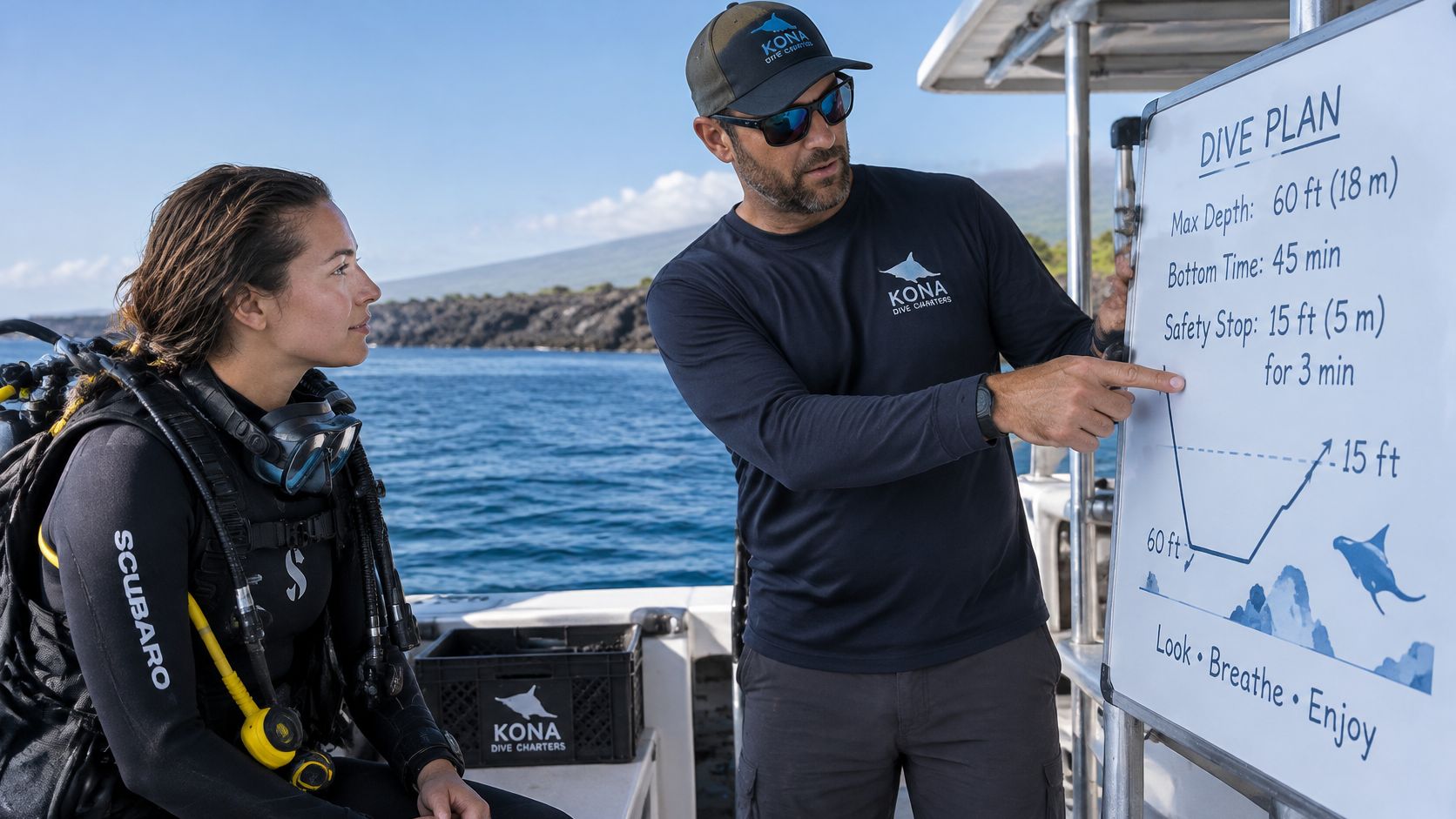
- Briefing on site conditions and entry style: The crew covers depth, terrain, entry and exit, turn pressure and what to do if you lose your buddy.
- Dive one: This is usually the deeper or more condition-sensitive site, done while conditions and your energy are best.
- Surface interval: You hydrate, warm up, swap tanks and hear whether dive two needs a site change.
- Dive two: This second dive is more relaxed, often shallower, with more time to look rather than cover distance.
Our crew members are seasoned Kona locals who know the local waters well, so that sequence isn't rigid. If wind chop builds at the first planned site, they'll move. I'd rather hear a captain call a site change at the dock than watch a crew force a plan the ocean has already rejected.
Medical Questions and What to Pack
You'll complete a medical questionnaire before diving. If you've had a recent illness, injury or surgery, or you manage an ongoing condition, check with a physician first and bring clearance if you're asked for it. Don't leave that conversation for check-in morning.
- C-card: Your proof of certification level and agency.
- Logbook: Useful evidence of recent dives, depth experience and night experience.
- Swimwear: Wear it under your clothes so you're not changing on a rolling boat.
- Reef-safe sunscreen: Apply it early, keep it off your mask skirt, and reapply during the surface interval.
Manta Ray Night Dives in Kona
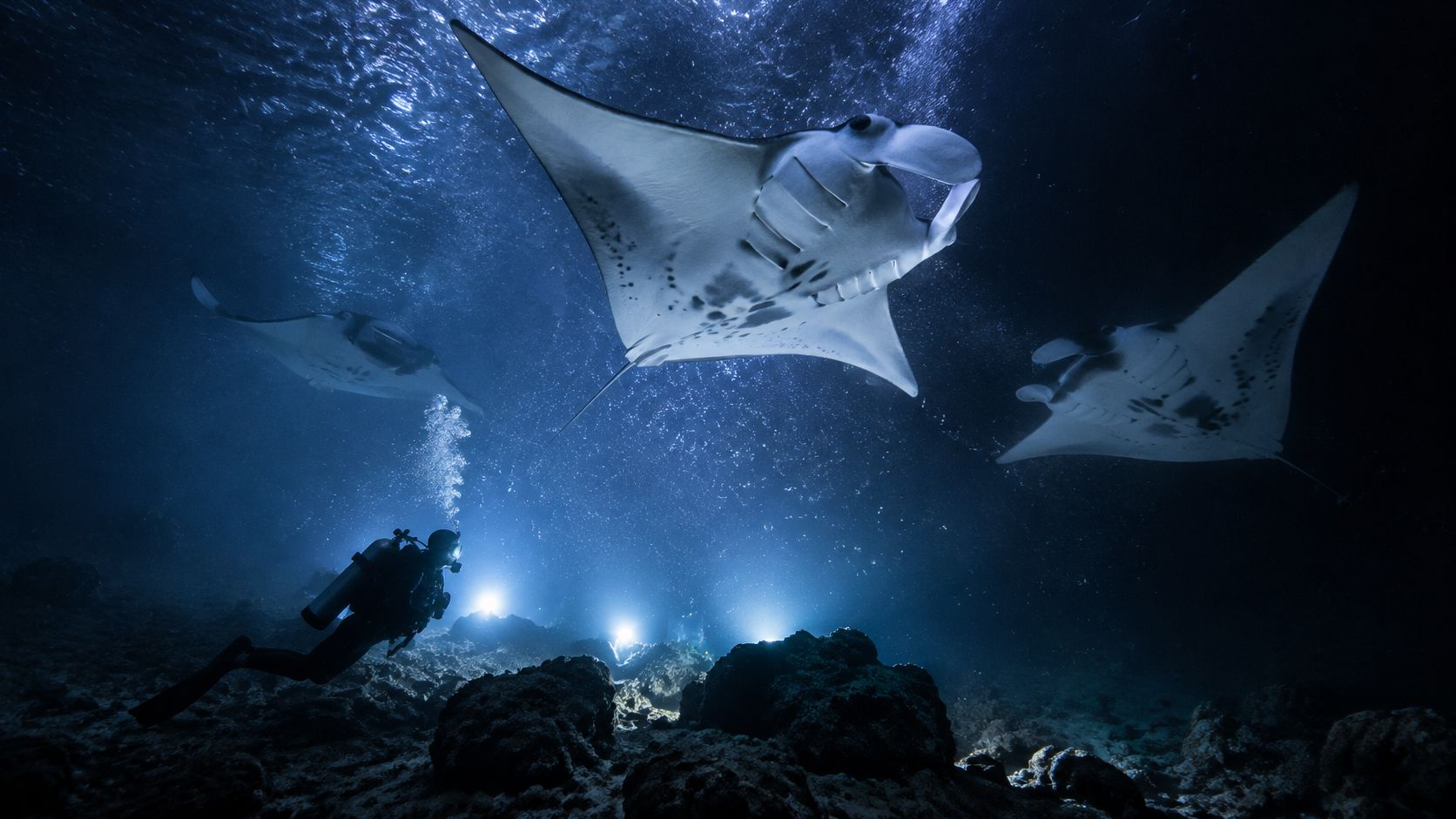
You descend after dark, settle where the guide places you, and point your light into the water column. Underwater lights draw plankton in, the plankton concentrates in the lit area, and reef manta rays, Mobula alfredi, arrive to filter-feed in repeated passes through it. There's no bait and no chasing. Your job is to stay still, keep neutral buoyancy, stay off the seafloor and let the animals choose the distance.
That sounds passive, and it mostly is. The skill is restraint. A diver who kicks up to get closer pushes bubbles and turbulence into the feeding lane, and the manta shifts its loop elsewhere. Let it come to you and it may pass directly overhead, mouth open, more than once.
The Odds, Stated Plainly
The six-year monitoring program summarized on the Kona Honu Divers manta night dive page ran from January 1, 2009, through December 31, 2014, and recorded reef manta rays at Manta Heaven on 2,017 of 2,197 monitored nights, equivalent to 92% of nights, and at Manta Village on 1,702 monitored nights, equivalent to 78%. Across both sites it documented 118 individually identified manta rays, and 15 appeared on more than 25% of nights. That's a recurring local population with site fidelity, not a parade of strangers.
Those odds are excellent. They still aren't a guarantee. Plankton density, moonlight, weather and water movement change how many mantas show up and how long they stay, so book early in your trip if you can. That gives you a second night to try if the first is quiet.
I'd choose Garden Eel Cove for the manta dive tour, because its protected location gives a better viewing area and better reefs than a more exposed site. Protection matters at night, when surge makes holding position harder and a rough exit turns a calm dive tense. You can book through our 2-tank manta dive and snorkel tour, and our detailed manta night dive guide covers how the evening is structured.
Rules That Protect the Encounter
- No touching: Contact damages the mucus layer on a manta's skin and alters its path.
- No chasing: Stay outside the feeding lane and don't swim toward an approaching animal.
- No flash photography: Use available light or a non-flash setting, and bring a wide-angle lens if you're shooting.
- Bubbles matter: Position yourself so your exhaust doesn't stream into a feeding pass.
A good manta photograph comes from holding still in the right place, not from following the animal.
Bring your certification card where required and a dive light you're comfortable operating with one hand. Bring patience with the animals' timing. Some nights build slowly, then several mantas arrive within minutes of each other once plankton thickens.
Blackwater, Shore and Advanced Dives
Blackwater Night Dive
A blackwater dive is a drift in deep open water after dark, away from reef structure, where you hang in the water column and watch zooplankton and the animals drawn to it. There's no bottom to orient by and no reef to follow. You manage buoyancy, depth, light and buddy position at the same time, which is why this suits experienced divers. If vertical movement without a reference unsettles you, build more night experience first. Our blackwater night dive tour describes the format before you book.
Shore Diving
Shore entries in Kona mean crossing lava rock to reach the water, often in full gear. On a calm morning that's manageable. With surge, wind chop or winter swell, the same shelf becomes the most dangerous part of the dive, because you're top-heavy, your footing is uneven and sets arrive whether you're ready or not. Check the day's conditions before committing, gear up fully before you step in, and time your entry between sets. If swell is breaking onto the entry shelf, don't go in. Our guide to the best shore diving on the Big Island will help you judge specific entries.
Premium Advanced 2-Tank Trip
The advanced trip targets remote, pristine sites and drift dives for certified divers who can hold depth, manage gas and climb a ladder in gear without help. Drift diving adds a planning element reef dives don't. You need a surface marker, agreement on separation procedures and the discipline to stay with the group in current. Details are on our premium advanced 2-tank trip page.
Hawaii Rules That Apply to All Three
The Hawaii Division of Aquatic Resources fishing regulations require spearfishers and other divers to display a dive flag while diving in ocean waters and prohibit them from surfacing more than 100 feet from that flag, except in an emergency. Those regulations also prohibit taking or possessing marine life or fishing gear while diving from 30 minutes after sunset until 30 minutes before sunrise. That nighttime rule applies even when you're otherwise lawfully in the water, so night divers don't collect, handle or carry fishing gear.
Site access has limits too. In the Old Kona Airport Marine Life Conservation District, anchoring is prohibited and motorized vessels can't operate in its no-boating zone except for emergencies or enforcement, so boats only moor where permitted. That's one reason a captain may idle, moor elsewhere or choose a different site than the one you expected.
Before your first kick, confirm three things: your certification matches the trip, you understand the entry and exit, and the flag and night rules are clear. Ask those questions on the boat, not underwater.
Nitrox and Gear Rental Explained
Nitrox, or enriched air, contains more oxygen and less nitrogen than regular air. Divers often assume that makes it automatically safer. It doesn't. DAN's guidance on contributing factors to decompression sickness states that when nitrox is used to its equivalent-air-depth limits, decompression-sickness risk is not appreciably different from using air within air-table limits. It can improve decompression planning only when you use appropriate tables or computer settings, and its main operational advantage is reduced nitrogen uptake for a correctly planned equivalent profile.
The added hazard runs the other way. Oxygen toxicity becomes the limiting factor because oxygen partial pressure rises at a shallower depth on enriched air than on air. DAN identifies 1.4 ata as the widely accepted working or bottom-phase oxygen partial-pressure limit, with 1.6 ata generally reserved for resting decompression exposure.
Maximum Depths by Mix
| Nitrox mix | Max depth at 1.4 ata (working limit) | Max depth at 1.6 ata (resting limit) |
|---|---|---|
| EAN32 (32% oxygen) | About 33.8 m seawater | About 40.0 m seawater |
| EAN36 (36% oxygen) | About 28.9 m seawater | About 34.4 m seawater |
These are theoretical limits before training agency rounding and operational conservatism. Your agency, computer setting and the operator's plan may set a shallower maximum, and that shallower number governs. For EAN32, the arithmetic is 1.4 ÷ 0.32 = 4.375 ata, which converts to roughly 33.8 m seawater. Run the math for your actual analyzed mix, not the number printed on a generic tank band.
Practical rule: If you can't state your maximum operating depth out loud before entry, you aren't ready to splash on nitrox.
Four Checks Before You Enter
- Verify the cylinder analysis: Analyze the tank yourself or watch it analyzed, and check the label matches.
- Set your computer: Enter the measured oxygen fraction, not the mix you requested.
- Confirm maximum operating depth: Agree the depth limit with your buddy and the guide before descending.
- Track cumulative oxygen exposure: Repetitive and multi-day nitrox diving adds up, so watch your oxygen clock alongside nitrogen exposure.
Renting Gear in Kona
A typical rental set includes a regulator, buoyancy compensator, wetsuit, fins and mask. Rental gear should be serviced before it reaches you, and you should still do your own pre-dive check. Breathe from both second stages, test inflator and dump valves, check the pressure gauge response and inspect the mask strap. Servicing doesn't excuse skipping a buddy check. A sticking inflator is easier to find on deck than at depth.
You can review what's available through our Kona scuba rentals page. My recommendation is simple. Rent when you travel light or dive once or twice a year, and pack your own mask, computer and regulator when you dive often. Fit and familiarity are what improve your dives.
Best Seasons, Conditions and Dive Safety
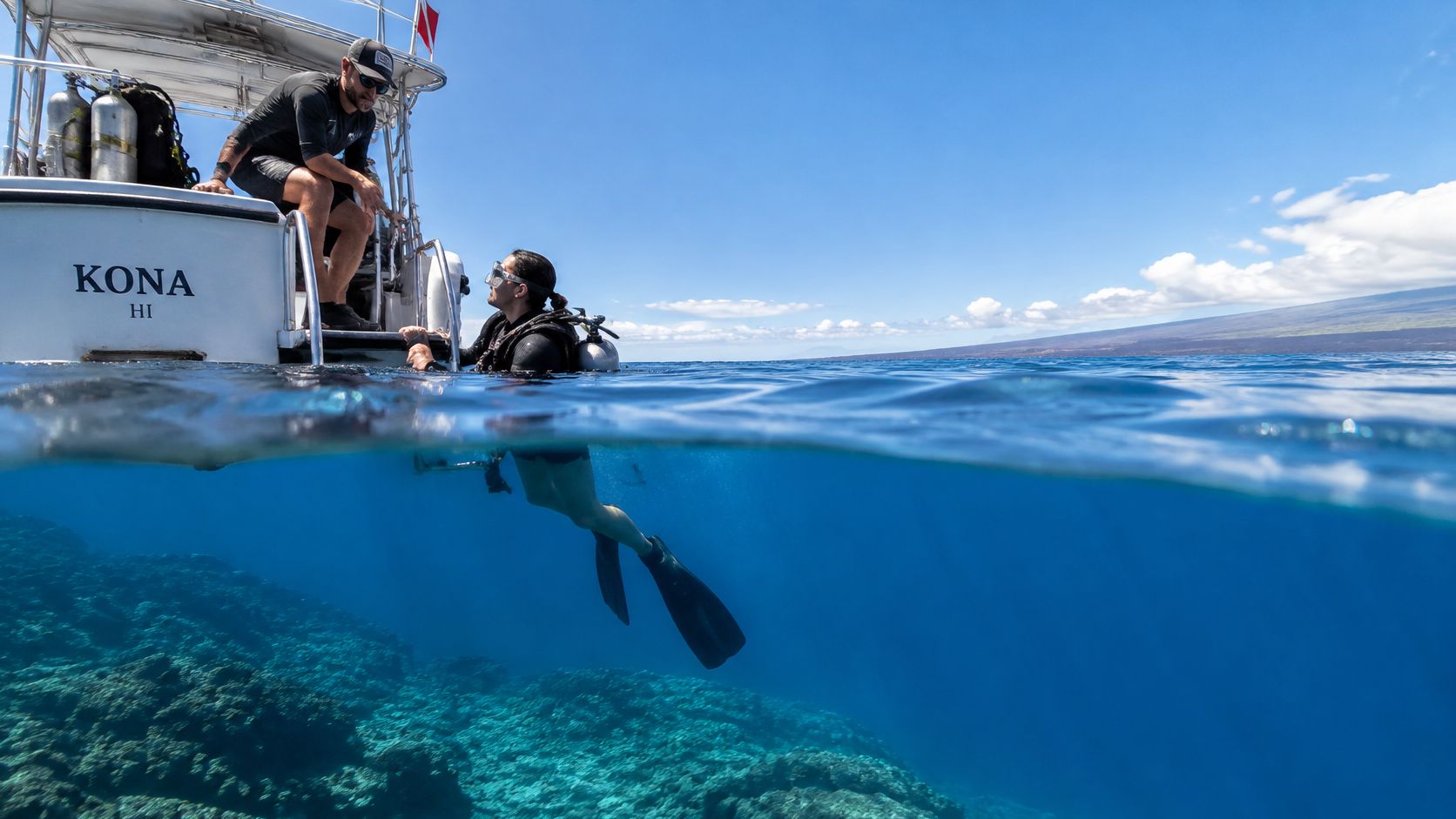
Kona's reputation for dependable diving makes visitors overconfident. The averages quoted in Kona Honu Divers' Kona scuba diving overview are roughly 60 to 100+ feet of visibility and water temperatures around 75 to 81°F, but those annual figures don't tell you what today's entry looks like. Rainfall runoff, winter swell, wind chop, surge at exposed points, thermoclines and depth can reshape a dive within hours. A forecast that reads fine for a boat ride can still produce an ugly shore exit.
Seasons shift the odds rather than switching conditions on and off. Winter swell can make exposed shore entries rough while a boat reaches a sheltered reef comfortably the same morning. Manta aggregation size also varies by season with zooplankton density, so a quiet night in one month doesn't predict the next. Think in site types, not calendar promises. Sheltered reef dives forgive more, exposed shore entries punish poor timing, and open-water blackwater drifts depend on current and your buoyancy control.
Our guide to the best months to scuba dive in Hawaii helps with seasonal planning, but the daily call matters more.
Four Decision Rules
- Check swell and wind first: Look at the day's forecast for west-facing shores before planning any entry, not after driving there.
- Switch to a guided boat dive: When a shore entry looks rough, a boat gives you more site choices and a ladder exit.
- Postpone when surge or chop is present: Conditions that look merely annoying on entry are exhausting on exit with low gas.
- Don't let visibility fool you: Clear water doesn't remove navigation, gas or thermal risk in volcanic terrain where depth changes quickly and deeper water runs colder.
Emergency Planning
The Big Island has no recompression chamber, which adds a planning obligation for deeper profiles and repetitive multi-day diving. Arrange dive accident insurance and know your emergency transport route before you start a multi-day schedule. Conservative profiles, slow ascents and honest gas reserves carry more weight here than they do a short drive from a chamber.
Plan each day the same way. Choose a site type you can handle, check conditions, confirm the exit plan, and set the rule for when you won't dive at all. Decide that rule on land, while canceling is still easy.
Kona Scuba Diving FAQs
Do I Need a Certification to Dive in Kona
Most regular charters require Open Water Diver certification and your C-card as proof. If you don't have one, take a beginner course or an introductory dive instead. If your certification is old and your skills are rusty, a refresher course is the right starting point.
Will I See Manta Rays Every Night
No. Monitoring recorded mantas on 92% of nights at Manta Heaven and 78% at Manta Village, which makes an encounter likely, not certain. Book your manta night early in your trip so a quiet night leaves you time to try again.
Is Nitrox Worth It
Only when you plan it with correct tables or computer settings. It isn't automatically safer, and it adds an oxygen depth limit you must respect. For repetitive, multi-dive days within recreational depth, planned nitrox can reduce nitrogen uptake.
Can I Rent Gear
Yes. Rental sets typically include a regulator, buoyancy compensator, wetsuit, fins and mask. Renting suits occasional divers well, and you should still complete a full buddy check on any rental kit.
What Rules Apply on Night Dives
Display a dive flag and surface within 100 feet of it except in an emergency. You also may not take or possess marine life or fishing gear from 30 minutes after sunset until 30 minutes before sunrise.
Is There a Recompression Chamber on the Big Island
No. That's why dive accident insurance and an emergency transport plan matter, especially for deeper or repetitive multi-day diving. Conservative profiles are your first line of protection.
Can I Dive With a Recent Illness
Complete the medical questionnaire, and if you've had a recent illness, injury or an ongoing condition, check with a physician before your trip. Don't wait until check-in to raise it.
Book Your Kona Dive with Kona Honu Divers
Start with your certification and work outward. Certified first-timers to Kona should take the 2 Tank Local Morning Dive and learn the reef terrain in daylight. Wildlife-focused divers should book the Manta Ray Night Dive, and experienced divers should choose the Black Water Night Dive or the Premium Advanced 2 Tank Trip. If you aren't certified, we also run a Morning Introductory Scuba Dive, so noncertified travelers in your group aren't left on shore.
Training runs alongside the charters. We offer Kama'aina Dive Courses and Freediving Classes for divers who want instruction before or between trips, from a first certification to a skill refresher after a long break. I'd pair training with your first boat day rather than booking the most ambitious trip first and training afterward.
On pricing, compare each dive type on what the price includes, such as gear rental and nitrox, rather than on the headline number alone. Ask us about early diver discounts and dive packages for repeat divers, since multi-day packages change the per-dive cost. We also offer free nitrox, which matters if you're planning several repetitive days and you're enriched air certified.
If you're unsure which trip matches your certification, recent experience or the conditions during your visit, call us at 808-324-4668 and talk it through. A five-minute call beats booking a blackwater dive with twelve logged dives and discovering the mismatch at the harbor. You can browse the full list on our diving tours page before you call.
Recent guest reviews sit below, so you can see how other divers rate the boats, crews and dive days before you commit.
Choose the dive that matches your certification, check conditions the day before, and bring your C-card.
Kona Honu Divers runs guided morning reef dives, manta ray and blackwater night dives, advanced trips, certification courses and gear rentals on the Kona Coast, so you can match the trip to your certification instead of forcing your skills to fit the trip. If you're planning a Scuba Kona trip and want an honest read on which dive suits your experience and dates, visit Kona Honu Divers and book the dive that fits, or call the shop and ask before you commit.