
You landed in Kona with a certification card in your bag, a free morning, and three trip names that all sound like the right one. The water on this leeward volcanic coast is warm and generally clear in every season, which is exactly why people overbook the wrong dive. Match the trip to your card first, then to how you feel about night water and open ocean. The site and the wildlife come after that.
Which Kona Dive Trip Fits Your Experience
Kona Honu Divers runs dive trips in Kona, Hawaii, and was voted best dive operator in Kona, Hawaii. The shop covers the local range, from morning reef dives to night dives and private charters, and it suits divers who want broad trip variety and a premium full-service experience.
Use the table as the quick pick. Find the row that matches your goal, then check the certification column against the card you can show at the dock.
| Trip | Best for | Certification needed | Timing | Highlight |
|---|---|---|---|---|
| 2-Tank Local Morning Dive | Certified divers wanting reef variety | Open Water Diver with C-card | Morning | Coral gardens, ancient lava tubes and dramatic arches |
| Premium Advanced 2-Tank Trip | Experienced divers wanting remote sites | Advanced certification recommended | Morning | Deeper sites and drift dives at pristine locations |
| Manta Ray Night Dive | Snorkelers and divers comfortable in night water | Snorkel or Open Water | After sunset | Reef manta rays feeding under lights |
| Black Water Night Dive | Confident night divers | Open Water Diver with C-card | Night | Open-ocean life drawn toward the lights |
| Morning Introductory Scuba Dive | First-timers with no certification | None, instructor-led | Morning | Guided shallow reef dive |
| Private Charter | Families, groups and VIP travelers | Matched to group certification | Flexible | Custom route and schedule |
Three questions decide the row.
Do you hold an Open Water card? If yes, the 2-tank morning is the default. If no, the morning introductory dive is instructor-led and doesn't require a card. New divers can also look at Big Island scuba diving for beginners before they commit to a full day.
Are you comfortable in dark, open water? A manta night sits over a reef with lights and a group. A blackwater night leaves the reef and hangs in open ocean. Comfort on a night reef doesn't automatically transfer.
Do you want a relaxed reef, a remote deeper reef, or a family-friendly charter? Relaxed means the local morning. Remote and deeper means the premium advanced 2-tank trip, where advanced certification is the sensible bar. Mixed ages and snorkelers fit a private charter better than a shared advanced boat.
The full schedule sits on the Kona diving tours page. If your answers still feel fuzzy, start with the 2-tank morning and step up later. Each later choice has a harder requirement than the morning reef.
Certification Paths and Course Options
Most regular charters require at least an Open Water Diver certification from a recognized agency such as PADI, SSI, or NAUI. That rating allows diving to 60 feet (18 meters) with a buddy. Bring the physical or digital C-card. A photo of an old logbook won't replace it.
Courses split by the job you need done, not by how impressive the name sounds.
| Course | Who it suits | Entry requirement |
|---|---|---|
| PADI Scuba Certification Course | Complete beginners | None, learn from scratch |
| PADI Open Water Referral Course | Divers who started training elsewhere | Part of Open Water training completed |
| PADI Advanced Open Water | Certified divers building skills | Open Water Diver |
| PADI Enriched Air Diver | Divers wanting to use nitrox | Open Water Diver |
| PADI Rescue Diver Course | Divers taking on safety responsibility | Advanced Open Water plus current first aid training |
| PADI Peak Performance Buoyancy | Divers refining control | Open Water Diver |
| PADI Deep Diver | Divers training for deeper water | Advanced Open Water |
| PADI Boat Diver | Divers who dive from boats | Open Water Diver |
| PADI Reactivate | Certified divers returning after a break | Lapsed certification |
How the paths differ
The Scuba Certification Course starts from zero: academics, confined water, then ocean dives. The Open Water Referral Course is the shorter door for someone who already finished part of that training at home and only needs the remaining water sessions in Kona. Don't restart a full course if a referral will close the card.
Advanced Open Water and Deep Diver are what open the premium advanced trips, which are for certified divers and cover remote sites, deeper profiles, and drift dives. Rescue Diver is a different kind of step. It adds responsibility for other people in the water, and it needs current first aid training before you enroll. Enriched Air Diver is the only route to nitrox on these boats. Peak Performance Buoyancy is the skill class I'd put ahead of a camera or a deeper site if your trim is still sloppy. Boat Diver is for people who are fine in the water and clumsy on a ladder, lines, and entries. Reactivate is for a lapsed card, not a shortcut around a missing one.
A clean path looks like this. Beginner to Open Water, then Advanced, then the premium trip. Details on timing and what to finish before you fly in are on the Big Island scuba certification page.
Top Kona Dive Sites and Shore Entry Risks
Kona's calm west-coast reputation doesn't make every shore dive beginner-friendly.
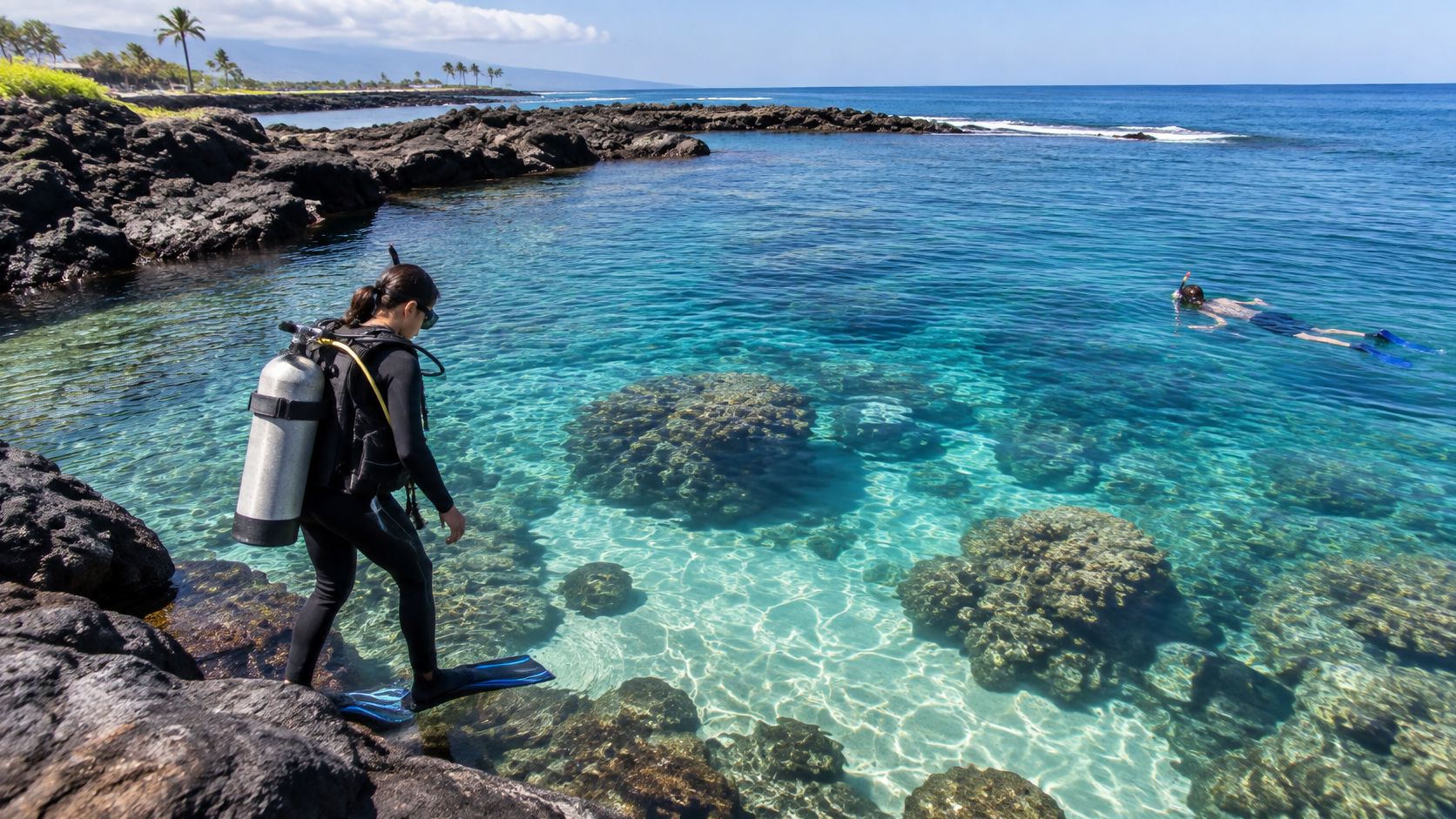
The Old Kona Airport Marine Life Conservation District is a common snorkel and shore-scuba location. Hawaiʻi's Department of Land and Natural Resources describes a partially protected cove, a second entry usable in calm-to-moderate conditions, shallow lava fingers reaching about 50 feet, and a rapid drop into deep water. The same guidance warns that sharp coral and lava rock line the frontage, that dangerous swells and currents can accompany storms, and that no lifeguards are currently on duty.
Inside that MLCD, taking, injuring, or removing marine life is generally prohibited, including fish, live coral, limu, and eggs, and so is altering sand, rock, or coral, according to the regulated-area rules. Feeding and carrying a device that could take resources are forbidden too. Neutral buoyancy isn't a style point here. It's how you stay legal and off the rock.
Boat sites versus walking in yourself
Charter boats pick drift lines and deeper lava reefs after a morning look at the sea. That hands the go or no-go to the crew. Shore diving leaves it with you: entry skill, exit skill, and whoever is watching the surface. Garden Eel Cove and Keauhou are the nighttime manta locations, and they're boat sites, not a walk-in from the airport frontage. A wider map of walk-in options is on the best shore diving on the Big Island page.
Run this before you kit up. One hold means you switch to a boat or you cancel.
| Condition | Go | Hold or switch to boat |
|---|---|---|
| Swell | Small and well spaced | Large, breaking or surging over lava |
| Wind | Light to moderate | Strong and onshore, raising surface chop |
| Current | Light along the entry | Pushing toward the rocks or out to sea |
| Entry skill | Comfortable with rocky, surge-prone entries | First-time or uneasy with exits |
| Surface support | Buddy plus a surface watcher | Solo or no one watching from shore |
| Daylight | Full daylight with margin for exit | Dusk or low light |
Practical rule: If swell is surging onto the lava, don't wait for a gap between sets. That day won't settle, and a boat still can.
Manta Night and Blackwater Dives Explained
Shortly after sunset the lights go on. Zooplankton crowds the beam. A reef manta ray turns, mouth open, and makes another pass through the same patch of water.
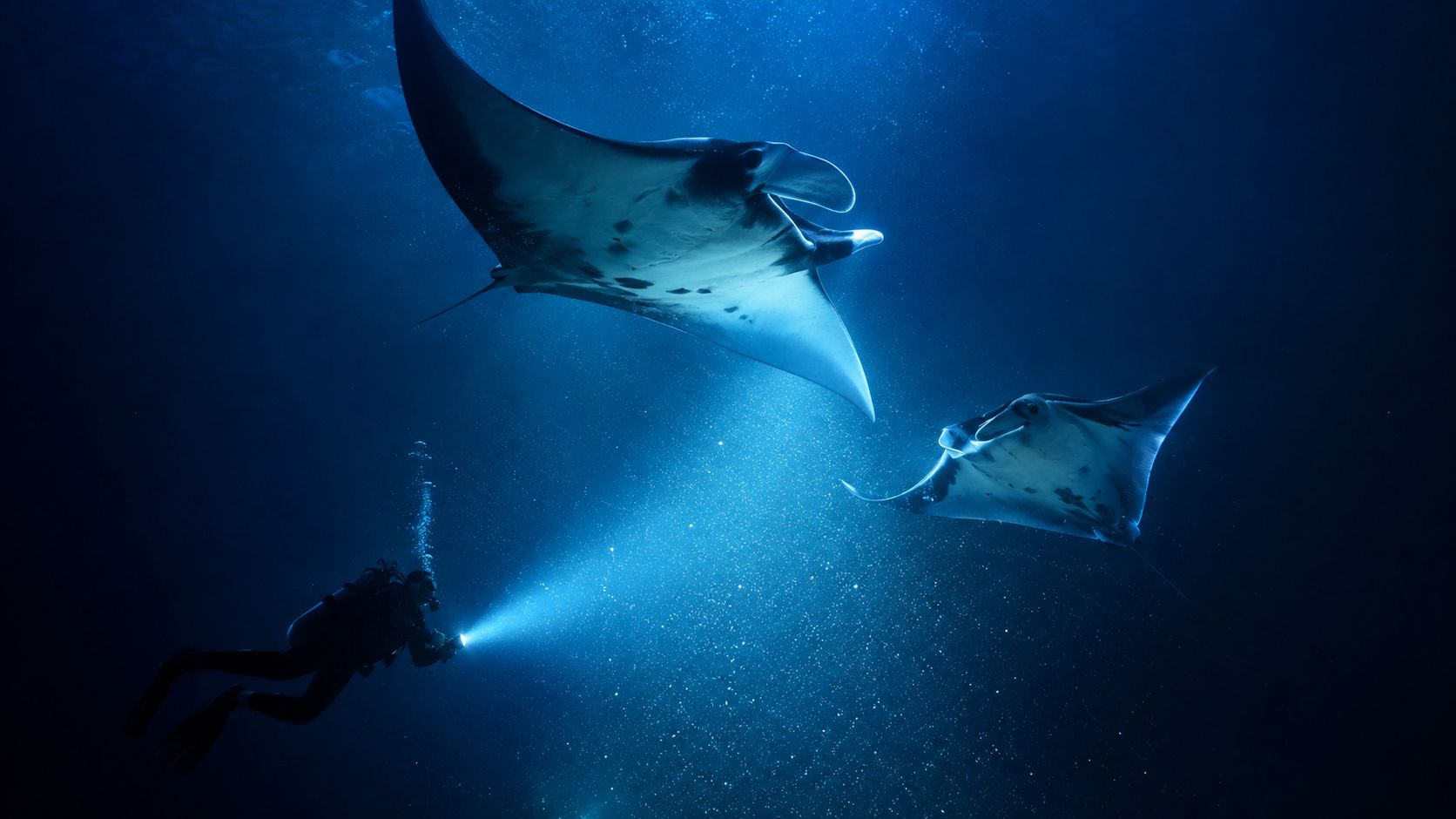
The mechanism is simple. Underwater lights concentrate zooplankton, and the mantas feed on that prey field with repeated passes. You don't chase them. You hold still and they come through.
Why Garden Eel Cove is the stronger night
A 2025 University of Hawaiʻi analysis, reported by Big Island Now, used community observations from 2010 through 2022 at two nighttime feeding sites, Garden Eel Cove and Keauhou. The set held more than 23,000 sightings of 167 unique reef manta rays (Mobula alfredi). Garden Eel Cove consistently produced larger aggregations. Keauhou showed stronger female use and high female site fidelity. Across both sites the sex ratio was a balanced 1:1, though females used Keauhou disproportionately. Aggregation size tracked zooplankton density, males ranged more widely than females, and individual rays linked the two sites. Tourism rose during those years, and the aggregations stayed relatively stable.
That record is why Garden Eel Cove is the superior choice for the night tour. The cove is protected, the viewing area is better, and the reefs are better than the more exposed alternative. Larger groups of rays in a sheltered bowl beat a smaller, female-skewed gathering when the goal is a clear look at feeding behavior. Nightly counts still move with the plankton. An encounter is a strong likelihood, not a promise.
The manta ray dive and snorkel trip is built around that after-sunset hour. Snorkelers can join without a card. Divers need Open Water comfort in the dark. More on how the night is run sits in this night manta ray dive guide.
Blackwater is a different dive
A blackwater dive leaves the reef. You hang in open ocean at night while lights pull plankton, and the animals that eat it, up from deeper water. It suits confident night divers who already hold an Open Water C-card and can stay put without a reef as a reference. The blackwater night dive is that trip, not a harder version of the manta dive.
Hold a steady position, fin with a low-impact kick, never chase or touch a ray, and aim lights the way the crew asks. Pursuit changes the feeding pass and puts you in the animal's path.
Rentals, Nitrox and What to Bring
A typical dive day runs in a fixed order. You arrive and set up gear. The briefing covers the site, the sea state, and how you'll enter. Dive one is the deeper or more condition-sensitive site. Then a surface interval. Dive two is the more relaxed profile. That order spends the larger gas and nitrogen load while you're fresh.
Rent versus bring
Rental gear covers the regulator, buoyancy device, tank, weights, and wetsuit. Bring your own mask and fins if you own a pair that seals and fits. A borrowed mask that leaks will wreck both dives, and no amount of site choice fixes it. Scuba and freediving rentals are available if you're traveling light. If you want nitrox, book it as Enriched Air, air with a higher oxygen share, commonly a 32 percent mix. It lengthens no-decompression time at the same depth and helps on repeated dives, but only after Enriched Air training and a depth plan that respects the mix. Confirm the nitrox policy and any dive-computer request when you book. The shop confirms computer availability and any small extra cost at that time. The reasons the mix helps are spelled out in this note on nitrox diving benefits.
Pack this, and leave the rest:
- C-card and logbook: Crews check the card, and a recent dive in the log answers the "how rusty are you" question.
- Rash guard, reef-safe sunscreen, swimwear, towel: Sun on the ride out matters as much as the water.
- Camera, if you own one: Don't buy a new rig the night before and expect to learn it on a manta pass.
- Personal dive computer: Yours already has your recent profiles.
- Medication list and photo ID: Useful if a boat day gets cut short or a buddy needs your details.
Once rental gear covers the basics, that list is short enough to fit in a daypack.
Best Seasons, Visibility and Reef Health
You can dive Kona in every month. The water stays warm, and visibility is generally clear in every season. What really matters is sea state, not whether the season is "on."
| Season | Water and sea state | Best trip fit |
|---|---|---|
| May to October | Calmer leeward water with the warmest sea temperatures, around 26 to 27 C | Shore entries, Old Kona sites and every trip type |
| November to April | Cooler water around 24 to 25 C and bigger swells on exposed sites | Boat-based trips, with swell checked before any shore dive |
| Year-round | Warm, generally clear water in every season | Night trips depend on plankton more than on season |
What the seasons actually change
May to October is the easier half. Calmer leeward water makes shore entries realistic and keeps the full menu, from local mornings to nights, in play. November to April doesn't shut the coast. It pushes bigger swell onto exposed lava, so a boat is the more reliable plan and a shore dive needs the hold checks, not optimism. Night trips don't follow that calendar. Plankton, not the month, decides whether the beam fills with food.
What the reef has already lost
The U.S. Geological Survey and the National Park Service compared imagery from 2003 and 2004 with a 2022 resurvey at three national historic sites on the Kona coast. As the USGS report records, live coral cover fell at all three. Puʻuhonua o Hōnaunau dropped 61.6 percent, Puʻukoholā Heiau dropped 52.2 percent, and Kaloko-Honokōhau dropped 11.7 percent. Pressures in that assessment included repeated bleaching, water quality, sewage runoff, storms, and coastal development.
Those parks are not every dive site on the coast. The losses still set a regional baseline. A fin kick into remaining coral is a choice you can refuse.
- Buoyancy stays flat. Hover, don't kneel, and don't use a finger on the reef to steady a photo.
- No contact, including fins and gauges. Stream the alternate air source so it isn't dragging.
- Photograph from the side of the animal, not from on top of the coral it just left.
Photography, Family and VIP Options
The useful frames happen because the ray comes to you. A six-year NOAA-archived study, preserved in the NOAA repository, logged 25,444 observations of 118 individual reef manta rays at Manta Heaven and Manta Village. Mantas showed on 92% of surveyed nights at Manta Heaven and 78% at Manta Village. Dives generally began shortly after sunset and lasted about one hour, with rays repeatedly approaching at distances under 1 m.
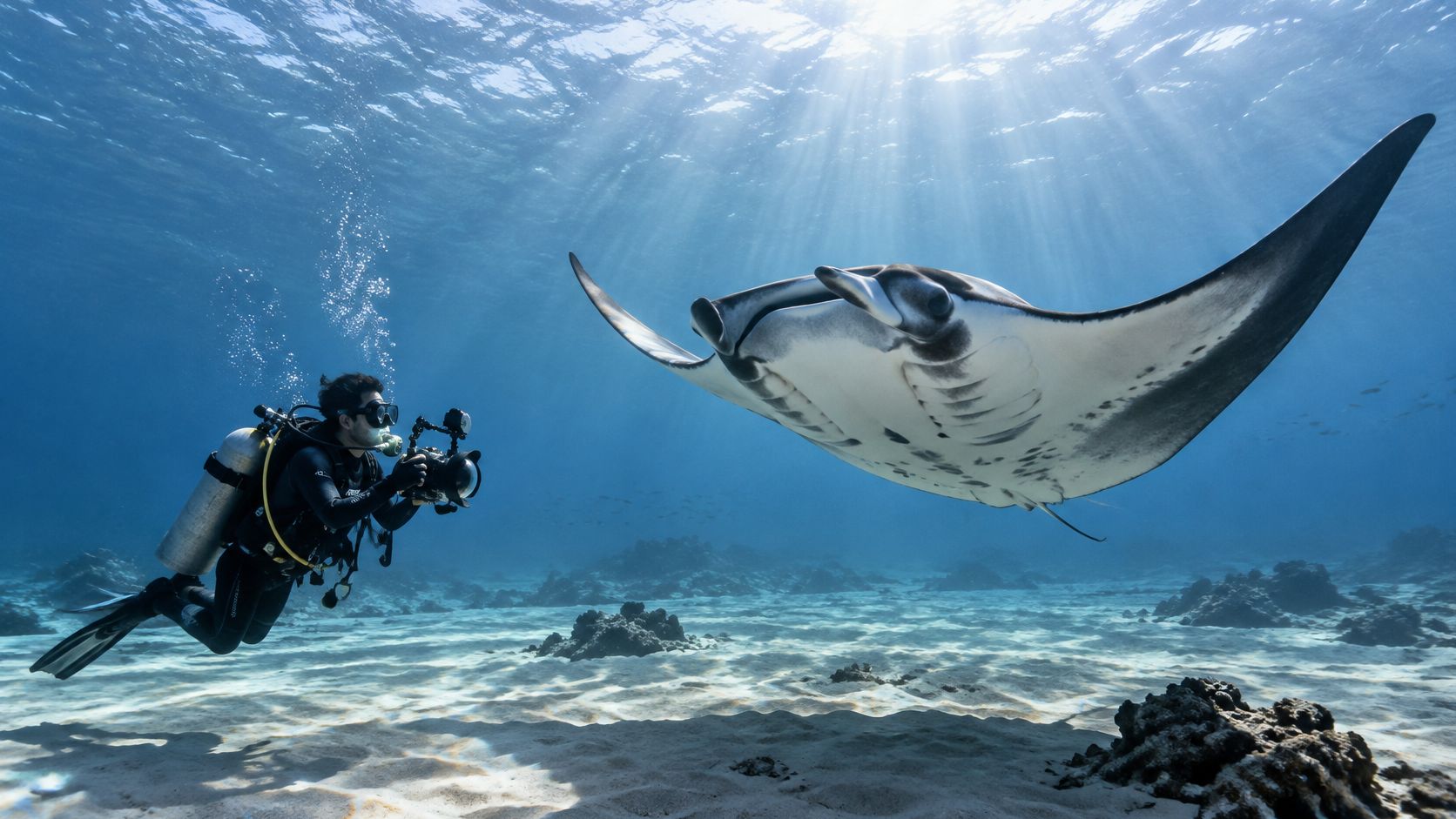
Chasing ruins that. Pursuit changes how the animal feeds and breaks the pass you were trying to shoot. Stay put, fin gently, and keep lights where the crew wants them before you ever raise a camera.
Three camera settings that survive plankton
Set exposure and focus before the first ray arrives. You won't have time once a wingspan fills the frame, and hunting autofocus in murk wastes the pass.
Angle strobes out and away from the lens. Plankton in the beam becomes backscatter if the strobe points straight ahead. A wider angle and less power beats a tight, bright blast.
Follow the light protocol. Your video light is part of the plankton field. Aiming it at another diver's face, or sweeping it off the agreed corridor, costs the group the next pass.
Matching the boat to the group
Families with mixed swimmers don't need everyone certified. A snorkel seat on the manta night, or a slower morning reef, keeps the group together. First-timers belong on the morning introductory dive, shallow and instructor-led, not on a blackwater hang. Groups and VIP travelers get a cleaner day from a private charter: the route and the clock match the group's cards instead of a shared boat's plan. Private tours and dive packages exist for that, including early diver discounts when the calendar allows.
Check Your Fitness Then Book Your Dive
A good forecast doesn't clear you to dive. Talk with a doctor first if you have heart or lung disease, recent surgery, a current cold or sinus congestion, or ear trouble. Don't dive while pregnant. After repetitive diving, wait the surface interval your training agency specifies before you fly. A same-day red-eye is the mistake that shows up as joint pain at altitude.
Gas planning is the other gate. This coast drops fast off lava, so depth and consumption can climb quicker than your distance from the beach suggests. Set a maximum depth before you descend, check your pressure at a planned depth or time, and keep a reserve for the ascent, a safety stop, and a current that adds a few minutes. The West Hawaiʻi coast has been measured for fish, coral, and algae precisely because looks deceive. NOAA and USGS habitat work treats condition as data, not as how pretty the water seems from the boat. Treat your own turn pressure the same way.
Encounter reliability has a biological limit too. A 13-year analysis in Environmental Biology of Fishes found that Hawaiian reef mantas generally stay close to home and rarely cross the deep channels between islands, and that site use differs by movement, sex, and prey. You're visiting animals that reuse the same feeding spots. Holding position is how you avoid adding disturbance. It isn't a pose for the camera.
Book in this order.
- Pick the trip from the profile table, not from the most dramatic photo.
- Confirm the certification that trip needs, and pack the C-card.
- Request a dive computer when you book so availability and any small extra cost are settled early.
- Read current rates, deposits, and cancellation terms on the booking page before you pay.
- Call 808-324-4668 to check the day's sea state or to set up a private group.
- Hold the seat with the button below.
Kona Honu Divers runs the morning reefs, the Garden Eel Cove manta night, blackwater, and the courses that get you legal for each of them, with the certification check and the sea-state call built into the day. If your card, your comfort at night, and the swell all line up, book the trip that matches them rather than the one that merely sounds biggest. Visit Kona Honu Divers to see the schedule and lock a seat.