
Researchers identified 154 individual manta rays along the Kona Coast beginning in 1992, and historical testimony recorded mantas on approximately 80% of dives at Garden Eel Cove, according to Hawaii legislative testimony. Those figures describe a locally recognizable wildlife population, not an unlimited attraction. Planning scuba diving in Kona on the Big Island means matching your skills to the conditions while accepting that even a well-planned wildlife encounter isn't a guaranteed performance.
Kona Dive Options at a Glance
Kona dive types by certification and structure
| Dive type | Certification needed | Best for | Typical structure |
|---|---|---|---|
| 2-tank morning dive | Open Water, 60 ft / 18 m with buddy | Certified divers who want reefs, lava tubes and arches | Two dives on one morning boat trip |
| Manta ray night dive | Open Water | First-night divers, families, photographers | One dive timed to sunset and the light field |
| Blackwater night dive | Open Water with night comfort | Divers who want a drifting, plankton-focused dive | One night dive in open water |
| Premium advanced 2-tank trip | Advanced or experienced certified diver | Divers seeking remote sites, deeper profiles and drift dives | Two dives at remote sites |
| Introductory scuba | None, guided and shallow | First-timers testing the sport | Shallow guided dive with instructor |
| Self-guided shore dive | Open Water plus lava-entry skills | Confident, self-sufficient divers | Walk-in entry, self-managed dive |
| Private charter | Matched to the group's level | Families, groups and photographers wanting control of the schedule | Custom timing and sites |
Certification is the first filter, not the animal you hope to photograph. For most regular Kona charters, Open Water certification is the starting point, with buddy diving within the limits of your training. A boat carrying experienced divers doesn't automatically make its deeper itinerary appropriate for a recently certified guest.
Morning reef diving is the most straightforward choice when you want variety without adding darkness. You can assess your weighting, settle your breathing and get comfortable with unfamiliar rental equipment before taking on a more demanding evening trip.
Choose the task load you can manage
A manta dive can suit a first night dive because the viewing arrangement is comparatively structured. That doesn't make it an introductory scuba experience. You'll still need to descend, equalize, monitor gas and follow light signals after dark.
Blackwater adds a different challenge: you won't have a nearby reef as a visual reference. Shore diving removes the boat schedule, but it also transfers entry assessment, navigation and emergency planning to you and your buddy.
A private charter gives a group more scheduling control, not permission to exceed anyone's training. Build the itinerary around the least experienced participant, or arrange separate activities when the group's abilities don't match.
Start with fit, not ambition: The right dive lets you spend your attention on the underwater environment rather than recovering from an avoidable skills mismatch.
Before choosing, answer these questions: What's my certification level? Do I want to dive at night? Do I want a boat or shore entry? Those answers narrow the options more effectively than choosing from photographs alone.
Certification Levels, Nitrox and Rental Gear
PADI certification path for Kona divers
| Course | Who it suits | Depth or limit | What it unlocks in Kona |
|---|---|---|---|
| Open Water Diver | New divers | 60 ft / 18 m with buddy | Most regular Kona charters |
| Advanced Open Water | Open Water divers wanting more range | Up to 100 ft / 30 m | Preparation for deeper and drift sites |
| Enriched Air Diver, nitrox | Divers wanting longer no-decompression time | Set by gas mix and dive planning | Nitrox use within planned oxygen limits |
| Deep Diver | Advanced divers | Up to 130 ft / 40 m | Training for deep pinnacle profiles |
| Rescue Diver | Experienced divers | Doesn't increase an existing depth qualification | Self-rescue and buddy-assistance skills |
| Peak Performance Buoyancy | Divers wanting better control | Doesn't increase an existing depth qualification | Stable photography and reef care |
| ReActivate | Divers returning after a break | Doesn't increase an existing depth qualification | Supervised skills review before returning |
These are training boundaries, not target depths. Age restrictions, agency standards, recent experience and the actual dive conditions can narrow what's appropriate.
At Kona Honu Divers, we require at least an Open Water Diver certification from a recognized agency such as PADI, SSI or NAUI for most regular dive charters. Bring your C-card. Your certification establishes your training; your logbook helps communicate how recently and in what conditions you've used it.
Use the Big Island scuba certification guide to distinguish a first certification from continuing education or a refresher. If you're rusty on mask clearing, alternate-air-source use or controlled ascents, work on those skills before adding darkness or current.
Nitrox isn't permission to dive deeper
Nitrox is breathing gas with more oxygen than air. It can extend no-decompression time on suitable profiles, but it introduces an oxygen-exposure limit that must be planned.
Analyze your cylinder, confirm the oxygen percentage, establish its maximum operating depth and set your computer correctly. Don't copy another diver's settings or assume a cylinder contains the same mix as your previous one.
A longer no-decompression allowance doesn't increase your available gas. You'll still end the dive according to gas reserves, exposure, conditions and the team's plan.
Check equipment before departure
Rental checks should be specific rather than a quick glance at the bag.
- Regulator and buoyancy device: Ask when they were last serviced, then test breathing, inflation, deflation and releases during setup.
- Wetsuit: Check fit at the neck and lower back, and confirm it's been rinsed. A loose suit that flushes repeatedly won't provide the warmth you expect.
- Dive computer: Request one at booking if you don't own one. We confirm availability and any small extra cost then.
- Camera: Establish stable buoyancy before adding a housing, strobe arms and task loading.
Pack your mask, fins, exposure protection for the coldest conditions, reef-safe sunscreen, certification card and logbook. Familiar equipment helps, but correct fit matters more than bringing every accessory.
When to Dive Kona and What the Water Is Like
Diving in Kona is available year-round, with warm water and generally clear visibility in every season. Use seasonal expectations to prepare, then let the actual forecast determine the day's site selection.
Kona water temperature and visibility by season
| Season | Water temperature | Typical visibility | What to plan for |
|---|---|---|---|
| Summer | Warmest seasonal water | Often near 100 ft / 30 m in settled conditions | Calmer seas and exposure protection suited to your cold tolerance |
| Winter, December to March | Low 70s°F, about 20°C, in January and February | Often clear, but storms reduce sight lines | Thicker exposure protection and forecast checks |
| Shoulder seasons | High 70s°F as a planning expectation | Good in settled weather, affected by swell | Flexible scheduling and an additional thermal layer |
The visibility baseline of approximately 100 feet / 30 meters and colder winter conditions belong to a weather-sensitive destination, not a fixed underwater guarantee; Divers Alert Network's Kona overview describes the region's clear-water diving environment. Local volcanic topography shelters the west coast, but offshore weather can still change conditions.
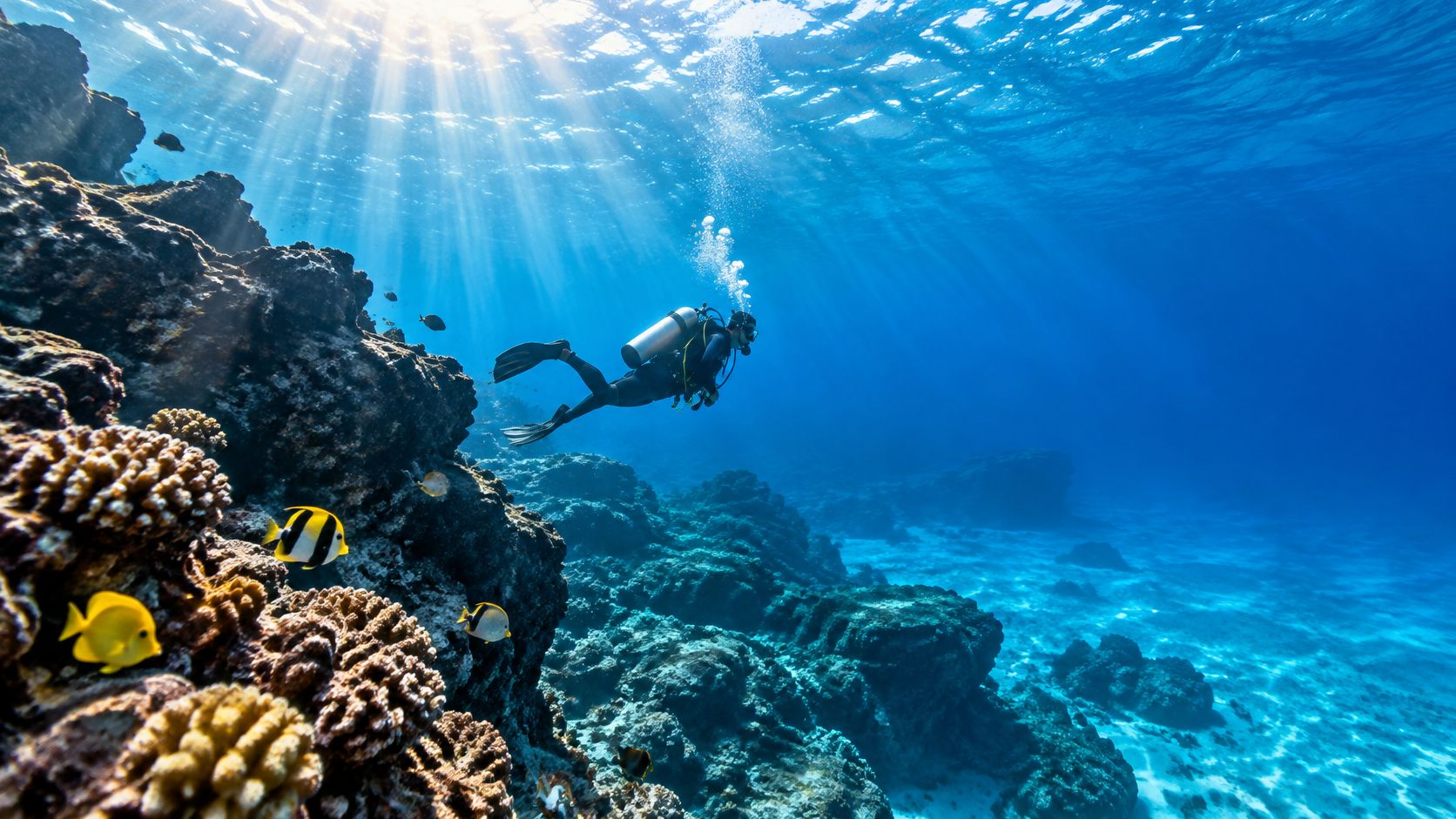
Translate the forecast into a dive plan
Kona's clarity is like a reliable forecast with a rain jacket in your pack. You can reasonably expect favorable conditions without assuming you'll get them at every site.
Clear water helps with navigation and photography, but it doesn't replace buddy contact, compass awareness, surface-marker procedures or conservative gas planning. A reef that remains visible below you can make a deeper profile feel deceptively shallow.
When suspended sediment shortens sight lines, descend more slowly and tighten team spacing. Simplify your camera setup rather than trying to manage unfamiliar lighting equipment while also tracking your buddy.
- If you chill easily: Choose exposure protection for the colder seasonal conditions, especially for repeated dives.
- If your dates are fixed: Keep your preferred site flexible.
- If your site is fixed: Leave room in the schedule to postpone it.
The guide to Kona's best diving season can help with trip timing. Check marine and surf forecasts the day before diving, and reconsider an exposed shore entry before abandoning a boat itinerary that can relocate to shelter.
Manta Ray Night Dives and Blackwater Dives Compared
Manta diving offers a structured wildlife encounter
Kona's regular manta-viewing locations include Manta Village at Kaukalaelae Point, approximately 19.640° N, 155.997° W, and Manta Heaven in Makako Bay, approximately 19.736° N, 156.054° W. Hawaii's marine regulations also establish the essential boundary for the encounter: harassment and contact with manta rays are prohibited.
For the dive experience, Garden Eel Cove is the superior choice because its protected location, better viewing area and better reefs suit both first-time and returning manta divers. Those advantages improve the setting; they don't give anyone control over animal attendance or offshore weather.
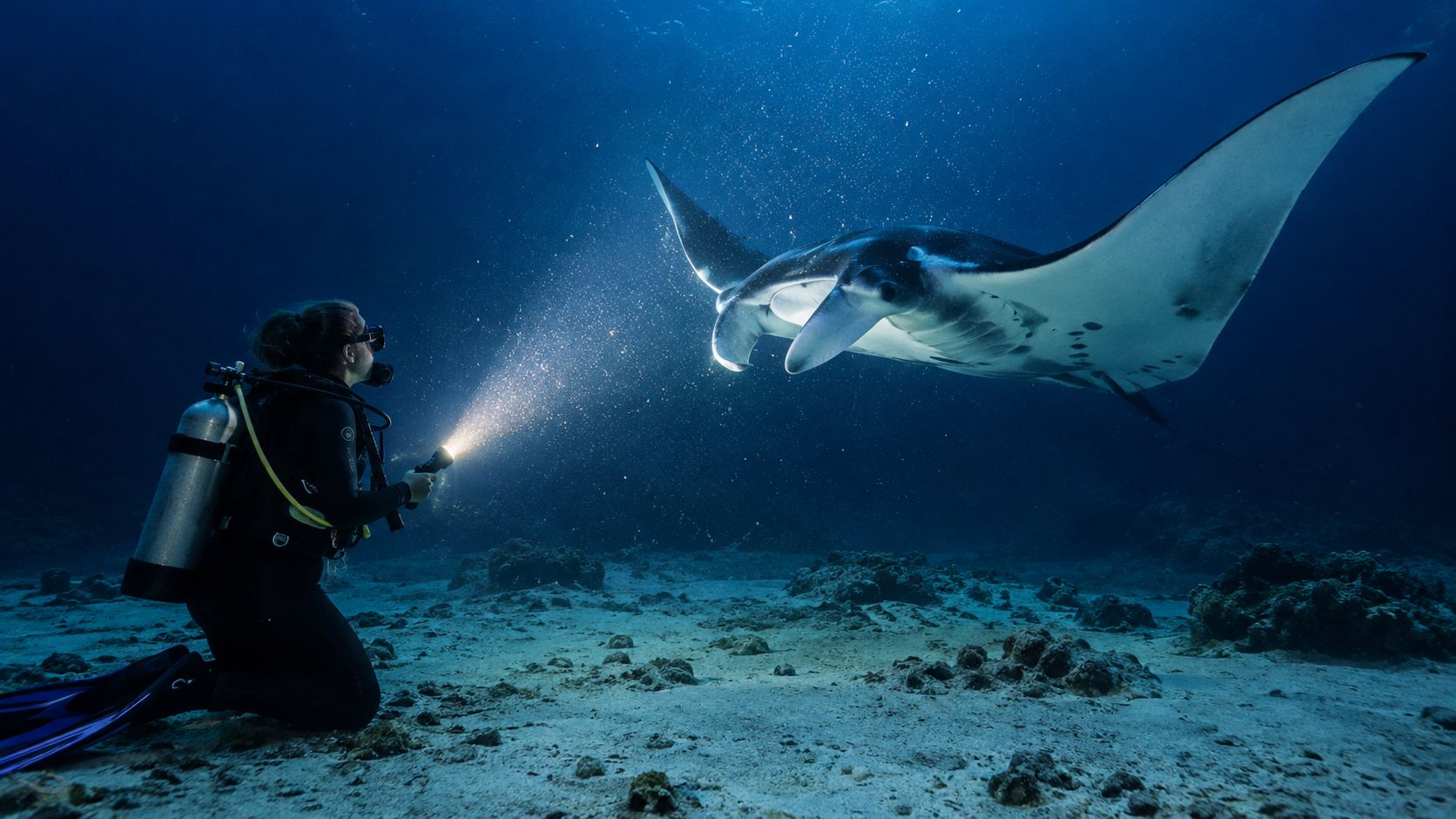
The mechanism is straightforward: lights concentrate plankton, and mantas feed in that concentrated patch. You're observing a feeding opportunity, not a trained routine.
A NOAA-archived study recorded mantas on 92% of monitored nights at Manta Heaven and 78% at Manta Village during 2009–2014, with observation periods generally beginning shortly after sunset and lasting approximately an hour. Those historical observations explain the encounter's reputation, but they're not a promise for your booking.
Follow the guide to an appropriate sand, rubble or boulder-bottom position. Where the site briefing calls for it, settle into a semicircle, hold your light above your head pointing upward and leave the feeding column open.
Remove a mask-mounted snorkel that could snag a passing animal. Keep your equipment compact and avoid sending bubbles directly toward a manta when you can do so without holding your breath.
Review the manta ray dive tour when deciding how the evening fits your group. The manta encounter itself is the after-dark portion; confirm the complete itinerary rather than assuming every evening trip has the same structure.
Blackwater diving removes the reef reference
A blackwater dive is a drifting night dive over open water, focused on plankton and nocturnal animals rather than a fixed reef or feeding station. The appeal is close observation of unfamiliar life against a dark background.
That setting changes the skills required. Without a nearby bottom, you must monitor depth deliberately rather than relying on the reef to tell you whether you're rising or sinking.
Open Water certification is a starting qualification, but night comfort and reliable buoyancy matter just as much. If you need to kick constantly to hold depth, choose a skills-focused reef dive before attempting blackwater.
The Blackwater Dive tour suits divers who want the drifting, small-animal experience and can follow an open-water night briefing. Bring patience rather than a checklist of species you expect to see.
Choose manta diving for the more predictable wildlife format; choose blackwater for the stranger, drift-based experience where discovery matters more than recognizing the animal.
Neither option rewards chasing. The best viewing position is one you can maintain calmly while leaving animals and other divers room to move.
Day-Dive Sites, Lava Tubes and Shore Entry
Kona's reefs are managed ecological assets, not just scenery. A Hawaii marine protected-area assessment lists Kealakekua Bay's conservation district as established in 1969 with approximately 127 hectares, and Old Kona Airport's as established in 1992 with 87.8 hectares.
Together with Lapakahi and Waialea Bay, those districts represent approximately 287.9 hectares of designated marine conservation space in that assessment. Their protected status calls for careful site-specific planning, not an assumption that every activity is permitted throughout each area.
Kona day-dive sites by access and what to know
| Site or feature | Type | Access | What to know |
|---|---|---|---|
| Two Step | Lava-rock shore entry | Walk-in from shore | Check surf forecasts; swell direction can change entry conditions quickly |
| Kealakekua Bay | Marine Life Conservation District reef | Boat for a practical dive itinerary | Protected reef requiring attention to applicable access and activity rules |
| Old Kona Airport MLCD | Marine Life Conservation District | Kailua-Kona area | Managed coastal habitat near town |
| Ancient lava tubes and arches | Volcanic terrain | Boat | Features encountered on morning reef routes |
| Deep pinnacles | Deep structure | Boat | Advanced experience and conservative gas planning |
Boat access buys more than transport
A morning boat route lets the crew choose among reef terrain, arches and lava formations according to conditions and the group's ability. It also avoids carrying cylinders and weights across an unfamiliar lava shoreline.
An arch with an obvious open-water exit isn't the same as an enclosed lava tube. Ordinary recreational certification doesn't qualify you for overhead penetration. Don't enter a passage merely because you can see another diver inside it.
For deeper pinnacles, check your no-decompression allowance frequently and agree on turn pressures before descending. Strong visibility doesn't reduce the gas needed to return safely.
Decide between boat and shore
- Want remote reefs, deeper pinnacles or drift sites? Choose a suitable boat itinerary and confirm its experience requirements.
- Want control over timing and less boat-related expense? Shore diving can work when both buddies can manage the entry, navigation and exit independently.
- Check marine and surf forecasts before leaving. Inspect the actual entry and an alternative exit before gearing up.
- Cancel a deteriorating entry. Building swell or a changed swell direction is reason to reconsider, not rush. A boat alternative must still be appropriate for the day's weather.
- Leave a shore plan on land. Include the site, intended return and how someone should raise help if you're overdue.
The Big Island shore-diving guide helps frame site selection. At Two Step, evaluate the exit as critically as the entry: getting into the water is only the beginning of the decision.
Safety and Responsible Diving Rules in Kona
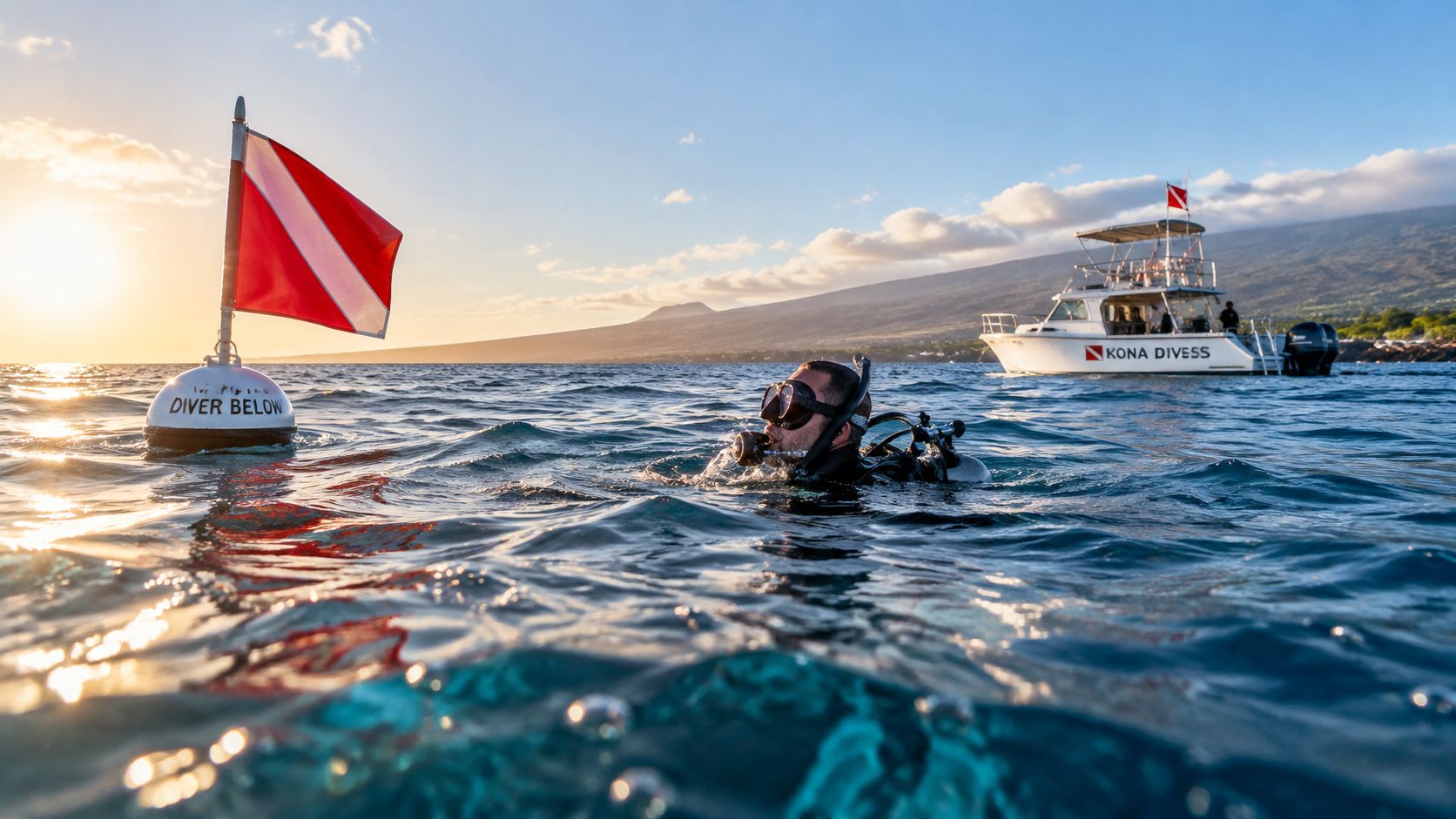
Hawaii requires ocean divers to display a dive flag and prohibits surfacing more than 100 feet from it, except in an emergency, under the state's diving regulations. The same rules specify a surface flag of at least 12 by 12 inches, or 20 by 24 inches on a vessel longer than 16 feet, displayed with a blue-and-white Alpha flag; after dark, the flag must be identifiable from 100 feet away.
Those requirements make diver location and nighttime visibility part of the plan. A flag isn't a protective barrier, so continue listening for vessels and follow the crew's surfacing procedures.
Responsible conduct includes accepting less access
A 2023 Manta Ray Advocates report described up to 30 tour boats and more than 400–500 people simultaneously visiting each main viewing site on busy nights, according to the organization's manta-tourism account. That's a reported busy-night scenario, not a head count you should expect on every trip.
The practical response isn't competing harder for a viewing position. It's choosing supervision you can follow and accepting adjustments that keep the encounter orderly.
- Keep animal movement unobstructed: Never touch, chase or block a manta. Don't follow an animal out of the assigned viewing arrangement.
- Enter calmly: Minimize splashing and wait for instructions rather than descending into another group.
- Accept a changed position: A less direct camera angle is preferable to crowding an animal or another diver.
- Protect the reef: Don't stand on coral or feed fish. Secure gauges and accessories so they don't drag.
- Reduce avoidable impact: Use suitable reef-safe sunscreen, along with protective clothing, rather than treating the label as permission to apply carelessly.
Arriving early helps with unhurried setup and briefing; it doesn't create a right to occupy the best wildlife-viewing space. Smaller groups can make supervision easier, but responsible behavior still depends on each participant.
A good wildlife dive may require giving up the photograph you wanted.
Use responsible diver etiquette as an operating standard, not a courtesy reserved for crowded sites.
Know the emergency constraint
Hawaiʻi Island has no recompression chamber, with treatment requiring transport to Honolulu, according to the Love Big Island scuba-diving guide. Carry dive insurance, know the emergency oxygen and communications arrangements, and understand the evacuation plan before entering.
If you suspect a diving injury, contact emergency services promptly. Don't delay assessment because symptoms seem mild or because transport will complicate your vacation.
Book Your Kona Dive Day With Confidence
Choose the itinerary that solves your group's actual needs. Certified families can combine a morning dive with separately planned shore snorkeling, photographers should establish buoyancy before adding a camera at night, and first-timers should begin with introductory scuba rather than joining a certified-diver charter.
For remote sites and deeper or drift profiles, review the premium advanced dive trip. Compare the full diving tour range once you've settled the certification and day-versus-night questions.
Know the order of the day
Our typical dive day follows a deliberate sequence:
- Arrival and gear setup: Resolve equipment fit and weighting questions before departure.
- Site briefing: Listen for conditions, entry style, navigation and recall procedures.
- First dive: Visit the deeper or more condition-sensitive site.
- Surface interval: Rest, hydrate and discuss any adjustments.
- Second dive: Make the more relaxed dive with those adjustments in place.
We focus on small groups and personal attention from the moment divers step aboard. Tell the crew about equalization problems, recent inactivity or equipment concerns during setup, not after descent.
The Kailua-Kona dive-shop guide can help organize your pre-trip arrangements. Keep your booking confirmation accessible so arrival details don't become a last-minute distraction.
Confirm the details before paying
- Confirm certification: Give an accurate account of your training and recent diving.
- Pick your season and time: Leave flexibility for weather-sensitive activities.
- Check availability: Select the appropriate trip rather than just the first open departure.
- Request equipment: Include rentals and a dive computer at booking.
- Resolve questions: Call 808-324-4668.
Confirm current prices, weather policy and cancellation terms on the booking page before paying.
Match your certification first, then choose the morning or night departure that fits your season, comfort and interests.
Kona Honu Divers offers guided reef dives, manta encounters, blackwater excursions and training for visitors exploring the Big Island underwater. Visit us to choose a trip that matches your certification, arrange the equipment you need and plan a Kona dive day around realistic conditions and responsible wildlife encounters.