
You're scrolling Kona boat tours at your hotel pool, you've got three nights left on the Big Island, and every listing promises mantas up close. They don't all tell you the part that matters. Manta ray swimming in Hawaii isn't a daytime snorkel with bigger fish. It's a night entry, in the dark, holding a set position while very large animals feed in the lights around you.
That can be calm and manageable, or it can be miserable if you're cold, seasick, fighting a float, or panicked on a boat ladder. I would match the trip to your certification, your comfort in dark water, and your fitness first. Then pick the site and the night. Sightings are never guaranteed, so anyone who promises you a manta is selling, not briefing.
Where and When to Swim With Manta Rays in Kona
Start with Garden Eel Cove, also called Makako Bay, at night. It's one of two principal viewing sites on the Kona coast, and it's the stronger choice for most first timers because the bay is protected and the viewing area is defined and close to reef habitat.
The other site is Keauhou Bay, commonly called Manta Village. Hawaiʻi legislative testimony on Kona mantas identifies both Garden Eel Cove and Keauhou Bay as established centers for nighttime manta viewing, and cited manta rays at Garden Eel Cove on approximately 80% of dives each year. That testimony also notes Hawaiian mantas regularly move between feeding areas and cleaning stations while using a relatively small portion of coastline repeatedly.
That's why established sites work. Kona's mantas are a small resident group of recognizable individuals, so repeat visits to the same site tend to meet the same animals rather than a new migratory crowd each night.
Kona Manta Viewing Sites Compared
| Site | Why it stands out | Best for | Confirm with your operator |
|---|---|---|---|
| Garden Eel Cove (Makako Bay) | Protected bay with a defined viewing area close to reef habitat | Divers and snorkelers wanting shelter and close reef-side viewing | Viewing position and entry point |
| Keauhou Bay (Manta Village) | Established night viewing site with more exposure to open-coast conditions | Snorkelers and divers comfortable with more surface movement | Current and surface conditions on the night |
Garden Eel Cove leads on shelter. You're not relying only on open-coast conditions, and divers and snorkelers can hold position near the reef while mantas feed through the lit water.
Kona Honu Divers often takes its manta ray charter to Garden Eel Cove, which is a practical fit if you want that protected location, a better viewing area, and better reefs for the dive portion.
Timing Your Night
Aim for May through September when you can. Warmer water and more microscopic plankton improve feeding conditions on the western Kona coast, and plankton is what brings mantas into the lights in the first place.
Outside that window you can still have a good night, but you shouldn't treat any date as a sure thing. Rough surface conditions can also change the plan, so confirm the site and conditions close to departure.
Pick Garden Eel Cove on a night between May and September for the strongest odds of a calm, close encounter, then accept that the animals still decide.
Choosing Between Snorkel and Scuba Dive Options
Manta swimming is two experiences, not one. Snorkelers float on the surface and watch from above. Scuba divers watch from below under the dive lights, and they need buoyancy control, comfort breathing underwater at night, and a current certification.
Manta Experience Options by Participant
| Option | Who it suits | Certification or skills needed | What you see |
|---|---|---|---|
| Manta ray night snorkel | Non-divers, families and first-timers | Comfort on the surface and a flotation support | Mantas from above, lit by the dive lights |
| 2 tank manta charter | Certified scuba divers | Open Water certification or higher; confirm the recent-dive rule on the booking page | Mantas from below, viewed from the position under the lights |
The snorkel is the right default for non-divers, families, and first timers. You don't need to manage depth or air, and the surface view is still close because mantas roll and pass through the light column below you.
The 2-tank manta dive and snorkel charter suits certified divers who are current and steady at night. Browse the wider scuba diving tours in Kona if you're pairing it with daytime reef diving, and look at the premium advanced 2-tank trip only if you're after more experienced diving opportunities beyond the manta site. If you're still torn, this breakdown of whether it's better to snorkel or dive with manta rays helps.
What you see also varies by site and food, not by marketing. A Kona ecological study of the two principal nighttime sites found Garden Eel Cove generally supported larger aggregations, while Keauhou was visited disproportionately by females and showed high female site fidelity, and aggregation fluctuations closely tracked zooplankton density.
What Gear Can and Cannot Fix
A wetsuit solves warmth. Flotation solves staying up. Neither solves panic in darkness, a hard climb up a boat ladder in swell, unmanaged seasickness, or a weak swimmer gripping a float in distress.
Skip the water if you can't stay calm in the dark, if a medical condition limits exertion, or if you can't hold a float without stress. Staying on the boat is a better call than becoming a rescue problem for the crew.
If a manta changes direction toward you, stay in position, keep arms and fins still, and let the animal pass. Don't kick toward it, don't reach, and don't chase a better angle.
Simple test: If you're unsure, start with the snorkel. You're not missing the encounter from the surface, you're choosing the version you can actually enjoy.
Choose your profile carefully before you book. That one decision shapes most of how the night feels.
What Happens in the Water and How to Photograph It
The night starts on the boat, not in the water. Manta ray night dives begin with a detailed briefing from the crew covering the science of what divers will see and the rules of passive observation. Listen for your entry point, your viewing position, and the signal to exit.
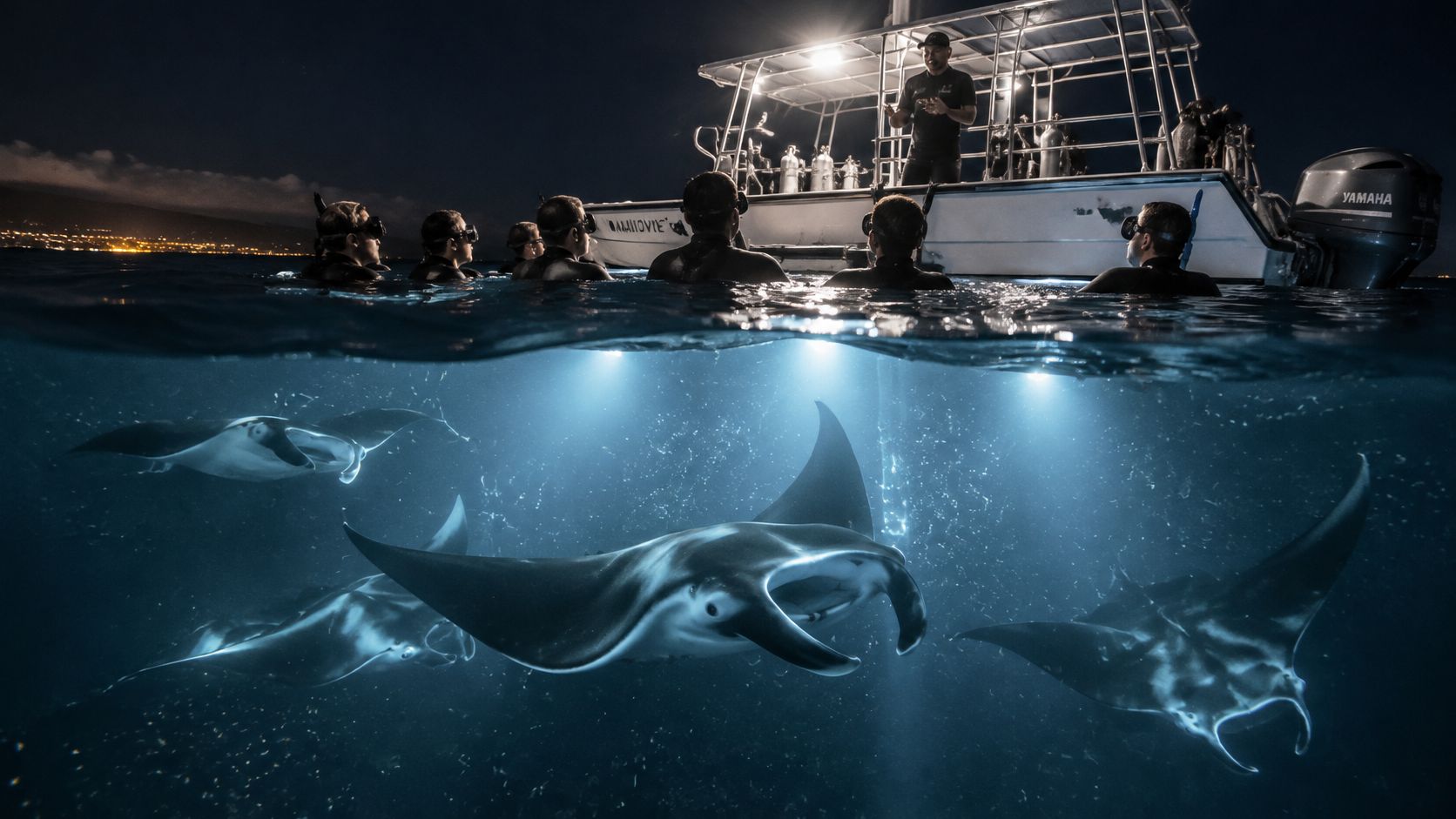
The boat stays stationary and supervised, and experienced divemasters and instructors are in the water with divers on the Manta Ray Night Dive. Operator-set dive lights are placed to create a bright circle on the seafloor so divers are never in complete darkness. Follow the briefing on whether they're in use that night and don't assume they'll be on every night, since proposed site rules include a ban on subsurface vessel lighting.
The Rhythm of an Encounter
Lights concentrate plankton, and plankton draws mantas in to filter-feed with repeated passes through the illuminated water. According to the Hawaiʻi Department of Land and Natural Resources manta ray page, Hawaiian manta rays can reach wingspans of up to 22 feet or more and use waters ranging from near the surface to depths of at least 120 feet.
Say the first manta appears after several quiet minutes. It circles, passes close overhead or below you, then disappears into black water. Then nothing. Pauses can last longer than you expect, and that's normal. Animal presence depends on plankton that night, so patience isn't a slogan, it's the method.
These manta ray dive Kona pictures show the scale you're preparing for better than any description.
Photographing Without Ruining It
- Use a wide-angle lens: Mantas fill the frame fast at close range, and a narrow lens will crop wings.
- Shoot upward: Divers get the strongest silhouettes aiming up toward the surface lights and the ray's white underside.
- Keep the flash off: A strobe blast can startle feeding rays and will blow out the plankton in front of you anyway.
- Raise your ISO: Low light demands it, and a grainy sharp pass beats a clean blurry one.
Shoot a pass, then put the camera down for the next one. You'll remember the animal you watched more clearly than the one you chased on a screen.
Gear and Safety Checklist Before You Enter
The manta isn't the main hazard. The boats are.
A neutral safety assessment of Kona manta viewing operations identified a live vessel or propeller striking a swimmer, snorkeler, diver, or manta as the highest-severity hazard, and investigators directly observed nighttime operations on nine nights. Congestion and overlap between people and live vessels create substantial accident opportunity, particularly on the busiest nights.
Treat the site as a controlled observation zone, not free swimming. The manta ray night dive is stationary and closely supervised, with experienced guides making sure everyone is safe and comfortable, but that only works if you stay inside the controls.
Run This Before the Boat Leaves
- Confirm exposure protection: Match your wetsuit to the water temperature so cold doesn't cut your night short.
- Test mask and fins in the shallows: A leaking mask at night becomes a panic problem, not a nuisance.
- Snorkelers, wear a flotation vest: Know how to float still without kicking, because your job is to hold position.
- Divers, check weights and buoyancy at the surface: You need to settle and stay put under the lights, not drift.
- Learn entry and exit points: Wait until engines are secured before entering, which is what prevents propeller strikes.
- Keep clear of operating boats and other swimmers: Crossing a boat path is the exact collision precursor crews watch for.
- Stay in your designated viewing position: A fixed spot keeps you away from boat paths, and for divers, away from anchors and hulls above.
- Signal the crew at once for panic, cramping, or cold: Early is a calm assisted exit, late is an emergency.
Seasickness deserves its own plan, because it gets worse in the dark and you can't fix it mid-entry. Read up on how to avoid sea sickness before the trip and take your remedy early enough for it to work.
If you remember one control, make it this one. Nobody enters until propulsion is secured, and nobody leaves their position to follow an animal.
Etiquette, Rules and Protecting the Mantas
Start with the law, because good intentions aren't the standard. The Hawaiʻi Division of Aquatic Resources sharks and rays guidance states Hawaiʻi regulations prohibit knowingly capturing or killing manta rays, and anchoring that damages stony corals is also prohibited. The Department of Land and Natural Resources separately instructs people not to touch or chase oceanic manta rays or otherwise disturb their natural behavior.
There's a gap you should know about. The state assessment reported that no rules at that time restricted where live boating, diving, or swimming could occur at the two principal sites. Proposed site-management rules have included banning anchoring inside site boundaries, requiring permits for commercial manta activities, limiting live boating to entering, leaving, and emergencies, and prohibiting subsurface vessel lighting.
Follow the current operator briefing and posted state requirements rather than treating draft rules as final law. If the briefing and a blog post disagree, the briefing wins.
Why the Rules Are Not Formality
You're watching a small, named population, not an endless supply. A University of Hawaiʻi thesis summary documented more than 23,000 reef-manta sightings involving 167 individually identified manta rays at two Kona aggregation sites from 2010–2022. Earlier Hawaiʻi legislative testimony with photo-identification research estimated that the Kona population probably contained fewer than 200 animals.
Many encounters, few animals. That's exactly why one boat anchoring badly or one group chasing rays matters. Good responsible and considerate diver etiquette is how those same individuals keep returning.
In the Water
- Hold still: Let the ray set its path and its distance.
- Don't chase, reach, or block: Cutting off a feeding pass ends it for everyone.
- Never feed or handle animals: Feeding changes behavior and handling harms the ray.
- Leave no gear or waste behind: Check pockets, clips, and the boat deck before you leave.
Book operators that brief before entry, choose calmer nights when crowds are lower, and leave no trace. Those three habits do more for the mantas than any donation pitch at checkout.
Book and Prepare Your Manta Swim
Here's my recommendation in one sentence. Book the 2 tank manta charter with Kona Honu Divers for a night between May and September, with Garden Eel Cove as the site, and choose the snorkel version of that same night if you're not a current certified diver.
Kona Honu Divers offers a 2-tank manta ray charter, and Garden Eel Cove gives you the protected location, the defined viewing area, and the reef that make the dive tank worthwhile on its own. If you're building a wider Kona itinerary around it, compare the Big Island boat tours for your non-dive days.
Booking Steps in Order
- Choose your option and night: Pick the snorkel or the 2 tank charter from your profile, then aim for May through September for the best feeding conditions.
- Confirm your certification: Check it against the 2-tank manta dive booking page and bring your card or logbook. The 2 Tank Manta Charter requires Open Water Certification or higher and diving within the past 2 years, so don't assume an old card is enough.
- Book early: The most popular trips, including the manta ray night dive, often sell out weeks in advance. Booking early in your trip also leaves room to reschedule if weather moves in.
- Ask what's included: Confirm rental gear, lights, transport, and the briefing time so you're not solving logistics at the dock in the dark.
- Plan your day: Eat a light meal, avoid heavy alcohol, and arrive at check-in with your exposure protection ready and your seasickness plan already in motion.
- Check the forecast: Rough seas can change the boat plan, so ask the operator to confirm the site on the morning of the trip.
- Set up your camera the night before: Charge batteries, format the card, set the higher ISO, and turn the flash off while you're still on land.
What to Pack
- Exposure protection: Your wetsuit, plus a towel and a warm layer for the ride back, because you'll cool down fast once you're out.
- Mask and fins if you own them: Familiar gear that seals beats rental gear you're adjusting in the dark.
- Camera with a wide-angle lens: Charged, flash off, and tethered so a dropped camera doesn't become reef litter.
- Certification card and logbook: Divers only, but essential if you're on the charter.
- Seasickness remedy: Taken early, not as you're stepping off the dock.
Your confirmation arrives with the date, site, briefing time, and packing list. Read it when it lands, not in the parking lot, and flag anything that doesn't match what you booked.
Book now, then reread the rules section before the night. You'll enjoy the encounter more when none of the briefing is new to you.
Ready to see Kona's mantas feeding in the lights at Garden Eel Cove, from the surface or from below on the 2 tank charter? Kona Honu Divers runs guided manta night snorkels and dives with a detailed pre-entry briefing, experienced in-water guides, and a supervised stationary viewing position built around passive observation. Check availability for your May through September dates now, pick the option that matches your certification and comfort, and let the crew handle the site, lights, and safety controls.