
Garden Eel Cove is the better manta ray night dive site in Kona. The local reef-manta population is finite, roughly 104 around Hawaiʻi Island and 129 in Maui Nui in the 2023 genomic work, so the right move is to treat this as a wildlife encounter, not a stunt.
You're probably deciding whether this night swim is worth your time. It is, but only if you go in with the right operator, the right site, and a little respect for the animals.
Encountering the Gentle Giants of Kona
You slide into dark Kona water, grab the float, and wait. The boat lights fade, the plankton glow in the beams, and then a manta appears out of nowhere with that slow, calm sweep that makes everybody go quiet for a second.
That's the appeal of manta ray swimming Hawaii. It isn't a theme-park show, it's a night feeding event in a place where the animals keep coming back because the local conditions work for them.
What the first few minutes really feel like
The nerves usually hit before the mantas do. The ocean is black, the light is narrow, and your brain fills in the blanks with worst-case scenarios. Then the crew settles you in, the water goes still around the light board, and the first pass comes close enough that the whole group stops thinking about anything else.
That is why the right expectation matters. You're not swimming around looking for animals in open water, you're holding position and letting them come to the light.
If you want a visual preview of what that looks like, take a look at these Kona manta ray dive pictures.
Practical rule: stay flat, stay calm, and keep your fins quiet. The less you interfere, the better the encounter gets for everyone.
The local reality matters too. These aren't interchangeable mantas drifting in from somewhere else, they're part of a resident community tied to Kona's coastline. That's why the experience feels so reliable and so fragile at the same time.
The Science Behind the Local Population
Kona's mantas are not some giant roaming stock that can be treated like an endless attraction. The 2023 genomic study estimated the contemporary effective population size around Hawaiʻi Island at about 104 individuals, with a 95% confidence interval of 99 to 110, and about 129 individuals for Maui Nui, with a 95% confidence interval of 122 to 136. That's a tiny biological margin for a destination that gets as much attention as Kona does. NOAA's summary of the genetic study makes the big point clear, these animals stay close to home.
Why the photo records matter
Photo-identification gives you a useful historical lens. Researchers catalogued 318 unique manta rays around Hawaiʻi Island from 1979 through 2023, and 600 unique individuals in Maui Nui from 2005 through 2023. Those are not simultaneous headcounts, but they show the local nature of the population and the long memory of these animals in Hawaiian waters. The same NOAA summary also notes limited exchange between Hawaiʻi Island and Maui Nui, which is exactly why local stewardship matters.
What that means for visitors
You're not visiting a boundless species pool, you're entering the home range of a resident community. That changes the ethics fast. If you chase, touch, or block them, you're not just being rude, you're messing with a population that's finite and site-sensitive.
The smart way to think about Kona is simple, enjoy the encounter, but act like the animals live here because they do.
For the dive-minded visitor who wants more context on depth and site use, this Kona manta depth guide is worth a look.
What to Expect on Your Night Dive or Snorkel
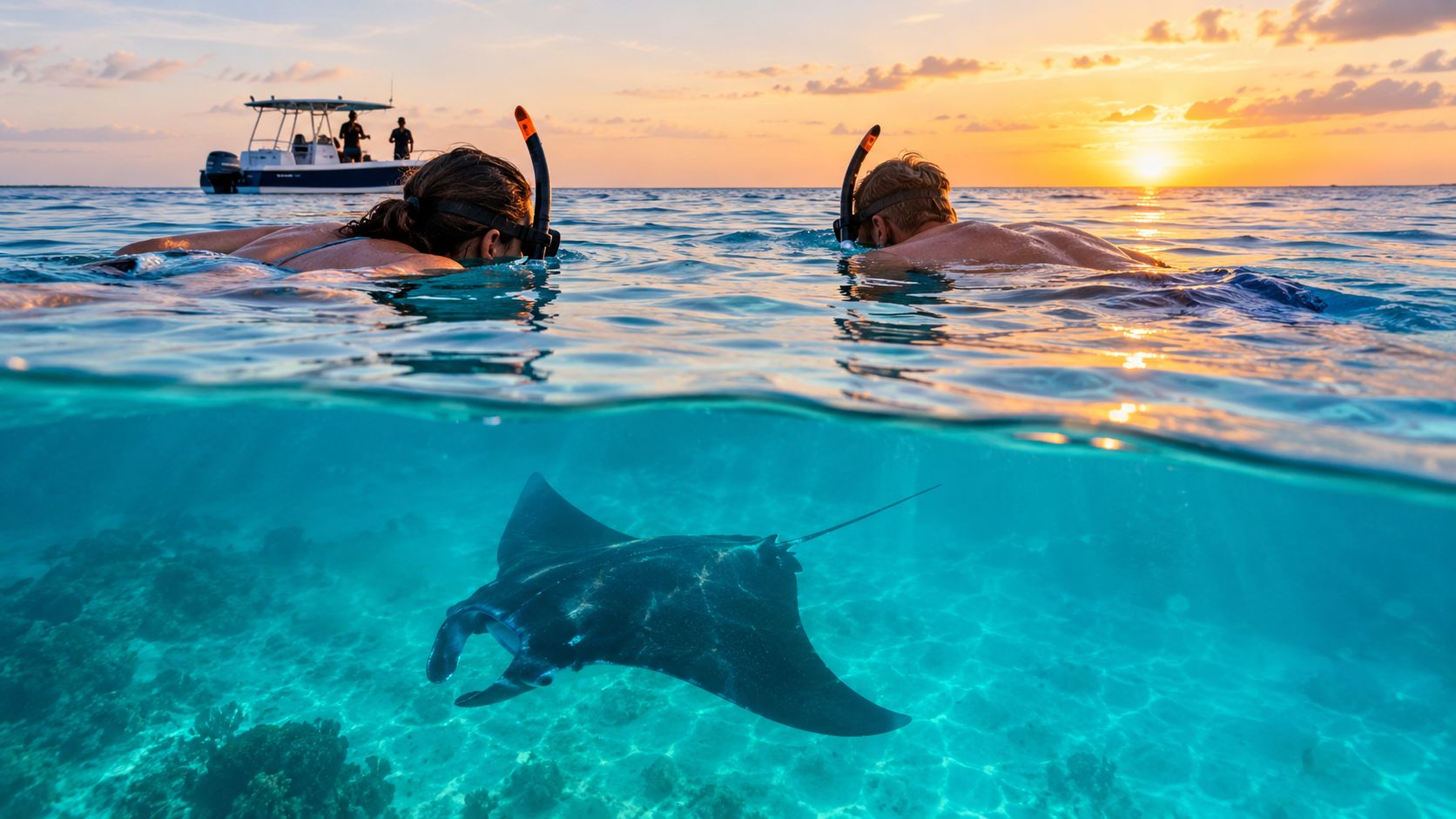
A proper manta night starts on the boat, not in the water. You check in, get briefed, ride out after dark, and settle near the lighted area where plankton gathers. If you're snorkeling, you hold position at the surface. If you're diving, you settle lower and look up through the light column.
Here's the part most first-timers don't expect, the mantas often move slower than people imagine. Drone-based measurements recorded mean speeds of about 0.746 ± 0.043 m/s for feeding mantas and 0.718 ± 0.071 m/s for traveling mantas, with observed large-scale speeds averaging 0.687 ± 0.107 m/s and a range of 0.303 to 1.0 m/s. Those animals don't need you to chase them. They need you to stay out of the way.
How the feeding works
Reef mantas use ramjet feeding, which means they swim forward with their mouths open, channel plankton-rich water inward with the cephalic lobes beside the mouth, and keep prey with specialized gill plates. In a foraging study from Lady Elliot Island, feeding was triggered when zooplankton biomass exceeded about 11.2 mg/m³, and estimated seawater processing at a modeled feeding speed of about 2 knots reached 888.96 m³ per hour. That's a benchmark from another site, not Kona itself, but the behavior explains why these encounters cluster around plankton-rich light zones. The reef-manta foraging study lays out the mechanics clearly.
How to position yourself
Do the simple things right.
- Hold steady on the surface. Horizontal clearance matters because the manta's broad fins and cephalic lobes extend well beyond the body.
- Keep your kicks small. Big fin kicks stir the water and make the group harder to manage.
- Watch the first pass. The first clean loop tells you how the animal is using the light.
- Let the manta choose the line. If it wants to bank around you, give it room.
If you're comparing a dive version of the experience, the Big Island manta night dive page gives a useful booking reference.
Choosing the Best Dive Sites and Operators
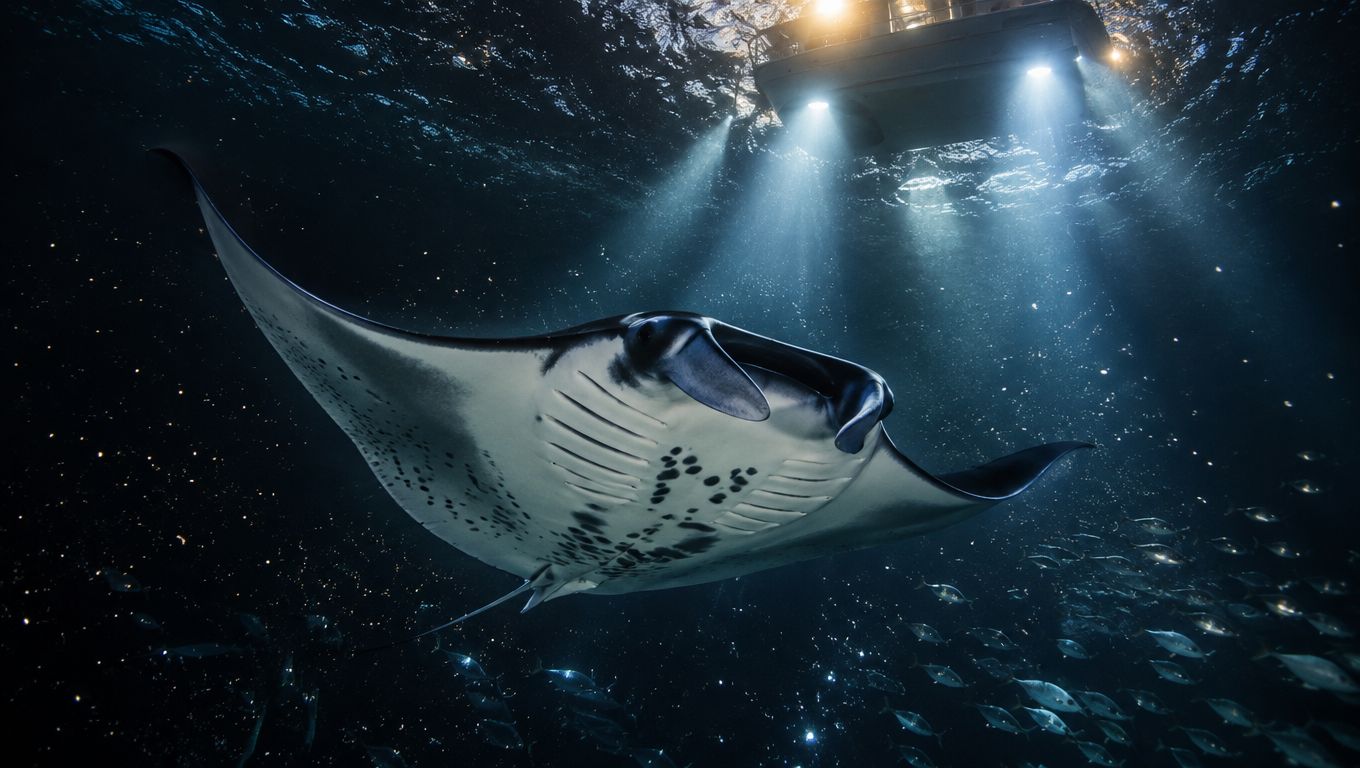
Garden Eel Cove wins for most first-time visitors because the site is more forgiving. It's the better choice when you want a protected setup, a clearer viewing area, and the kind of calmer water that makes the whole night easier to enjoy. Keauhou can still deliver, but it's the site I'd steer people toward only when they understand the trade-offs.
Kona manta ray dive sites comparison
| Site | Aggregation Size | Current Conditions | Notable Behavior |
|---|---|---|---|
| Garden Eel Cove | Usually larger aggregations | More protected | Better for organized viewing and repeated passes |
| Keauhou Bay | Often smaller than Garden Eel Cove | More site exposed | Strong female site fidelity and regular visits |
| Makako Bay | Variable | Operationally dependent | Useful when boat traffic and conditions cooperate |
A 2013 DLNR assessment discussed Makako Bay and Keauhou Bay and noted that commercial manta-viewing operators need authorization, while the evaluated sites weren't under a blanket statewide ban on live boating, diving, or swimming. In plain terms, access depends on the operator and the conditions, not on a simple location prohibition. The DLNR boating and safety assessment is useful because it shows how much the operator matters.
Who I'd book with
If you want one practical option in Kona, Kona Honu Divers runs a two-tank manta dive and snorkel and offers the kind of structured setup this experience needs. Their general dive tours page is also where I'd start if you're pairing the manta night with other Big Island diving. Their manta ray dive tours page is the direct booking page for the night experience.
If you want a bit of background on the company before you book, this Kona Honu Divers guide is a reasonable place to start.
Sustainable Interactions and Wildlife Ethics
The lazy advice is “don't touch the mantas.” That's true, but it's incomplete. The real issue is whether your behavior helps keep a resident population healthy enough to keep showing up at all.
A 2025 University of Hawaiʻi study analyzed more than 23,000 sightings of 167 individual reef manta rays over 13 years at Kona's Garden Eel Cove and Keauhou sites. It found Garden Eel Cove supported larger aggregations, Keauhou was visited predominantly by females with high site fidelity, and aggregation size varied with zooplankton density. The key point is that the aggregations stayed relatively stable despite increased tourism, which means responsible use can coexist with the fishery-like pressure of visitation. The University of Hawaiʻi study is the strongest evidence in the bunch.
What responsible actually means
Don't block the feeding path. Don't chase the animal when it turns. Don't dive down into its corridor just to get a better shot. These are feeding mantas, not props.
Hawaiʻi also protects manta rays from capture, possession, abuse, and entanglement in state marine waters, with substantial civil and administrative penalties. DLNR also identifies pelagic manta rays, Mobula birostris, as federally protected under the Endangered Species Act and asks people who hook or encounter one to release it in a way that minimizes injury. If you ever need to report an incident, DLNR lists 1-888-256-9840, option 5. DLNR's marine species protection guidance spells that out.
Responsible viewing isn't about being polite for the sake of it. It's about not turning a small resident population into a stressed one.
For a straight-shooting code of conduct, these diver etiquette guidelines are a good companion read.
Gear, Photography, and Final Planning Tips
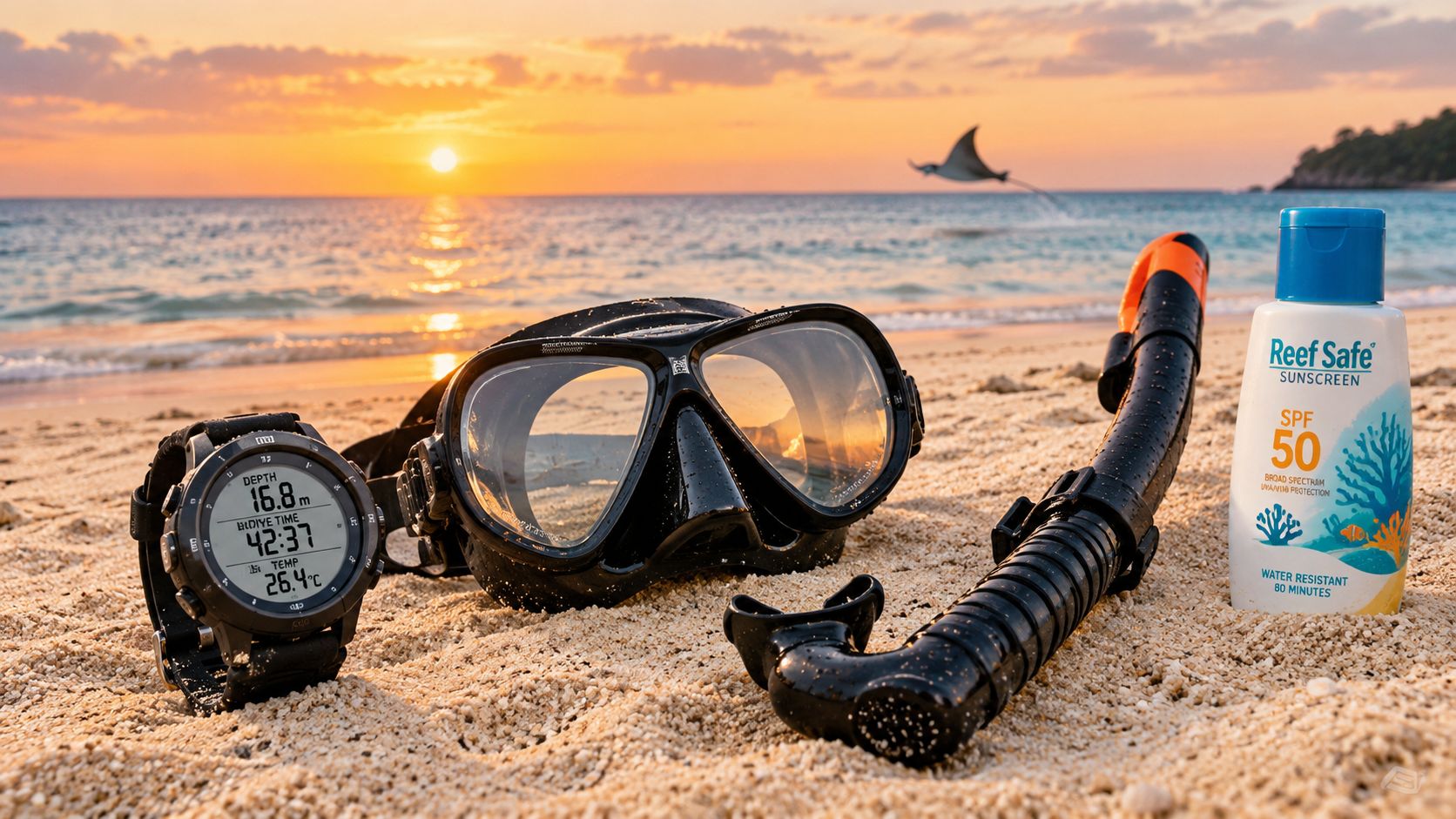
Bring simple gear, not a suitcase full of what-ifs. A mask that fits well, a snorkel you've used before, and a warm layer for the ride back matter more than anything shiny. Reef-safe sunscreen belongs on your pre-boat checklist, and if you know you get motion sick, handle that before departure instead of pretending you'll tough it out.
Photography without being the problem
If you bring a camera, keep it secondary to the encounter. Don't chase focus at the expense of your position, and don't thrust a lens into the animal's path. The better photos come from stillness, not from lunging for the shot.
A few practical habits make the night cleaner:
- Set your camera before entry. Fumbling with settings in the dark ruins the rhythm.
- Use the manta's pass, not your own movement. Let the animal come through the frame.
- Skip flash-heavy habits. The light board is already doing the work.
- Watch the body, not just the face. The wing line tells you more than a quick head-on view.
Booking and timing
Reserve early if your Kona dates are fixed. Good nights fill, and you don't want your schedule determined by what's left at the dock. If you want other ways to balance the trip, Kona Honu Divers also offers blackwater night diving for experienced divers and premium advanced two-tank trips for people looking for more demanding underwater days.
The honest way to do Kona is this, pick a protected site like Garden Eel Cove, book an operator that manages the night well, and treat the mantas like the finite resident animals they are. If you want a straightforward way to plan the trip, visit Kona Honu Divers and line up the manta night before your dates fill up.