
Table of Contents
- The Briefing Comes First
- Lights On, Then You Float
- Waiting for the First Pass
- The Return to the Boat
- Think Porch Light, Then Predator
- Why No Two Nights Match
- Five Rules to Follow in the Water
- Closer Is Not Better
- Reading a Ray That Has Had Enough
- What to Check Before You Pay
- Rules and a Three Question Test
- A Short Packing Checklist
- Sightings and the Wait
- Age, Glasses, and Gear
- Booking, Weather, and Arrival
- Run Through the Suitability Checklist
- The Model to Look For
You're probably reading this with a Kona trip taking shape, a few tour tabs open, and one big question in your mind. Will floating in the ocean after dark feel magical, or will it feel crowded, cold, and a little overwhelming? That's a fair concern, because manta ray night snorkeling isn't a normal daytime snorkel with the lights turned down.
It's a guided, stationary wildlife observation that depends on plankton, patience, and staying calm at the surface. When it's run well, you don't chase anything. You hold position, watch the light field below you, and let reef manta rays decide how close to pass. Some nights are busy with repeated passes. Other nights are quieter. Understanding that difference before you book helps you choose the right operator, follow the rules that protect the rays, and decide whether this outing fits you and everyone traveling with you.
What a Manta Ray Night Snorkel Looks Like From Start to Finish
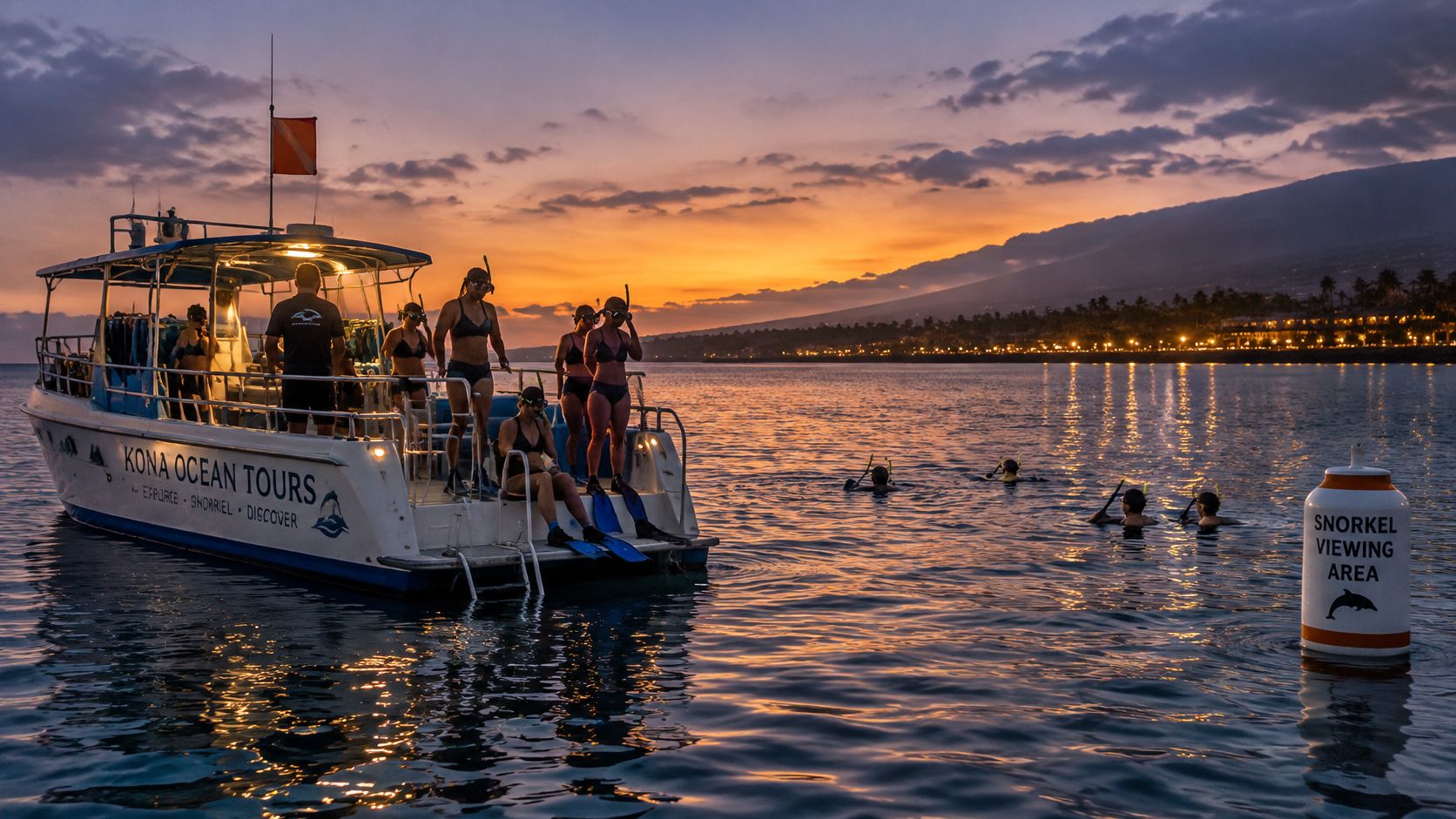
Dusk settles over Kailua-Kona, the boat slows in a designated viewing area, and the water goes quiet. You're not about to swim off exploring a reef in the dark. The evening follows a set sequence, with the crew controlling where you float, where the lights point, and when you get back on board.
The Briefing Comes First
Before anyone enters the water, the crew gives a detailed briefing on the science behind the encounter and the golden rules of passive observation. Listen for how you'll enter, where you'll hold on or float, how you'll signal if you need help, and how you'll reboard. This is also when a good crew explains what mantas are doing under the lights, so the loops and rolls you see later make sense as feeding, not performing.
You'll adjust your mask and snorkel on the boat, not while bobbing in the dark. If your mask leaks in daylight, it'll leak at night, and fixing it at the surface is harder when you're trying to stay horizontal and keep your fins still. Say something during the briefing if the fit feels wrong.
Lights On, Then You Float
Once the site is set, the underwater lights switch on and throw a big, bright circle into the water, so you're never floating in complete darkness. Guides help you into position at the surface with flotation, usually around a raft, ring, or light board, and keep the group together above the light field. Our Manta Ray Night Snorkel tour lets guests experience the manta rays from the surface, and that's the model to picture, face down, body flat, breathing slowly through your snorkel.
You don't kick around to find the animals. The tour is stationary and closely supervised, because movement spreads the group out and puts stray fins and descending bodies into the space rays use to feed. Your job is simpler and, for some people, harder. Stay relaxed, hold your position, and wait.
You're an audience floating on the ceiling of the room. The rays work the floor and the open water below you, and they choose the choreography.
Waiting for the First Pass
Plankton needs time to gather in the light, and rays need a reason to stay. A ray may appear quickly, or the first part of the session may be a quiet view of tiny organisms drifting through bright water. That wait isn't a sign the trip has failed. It's how the feeding setup builds.
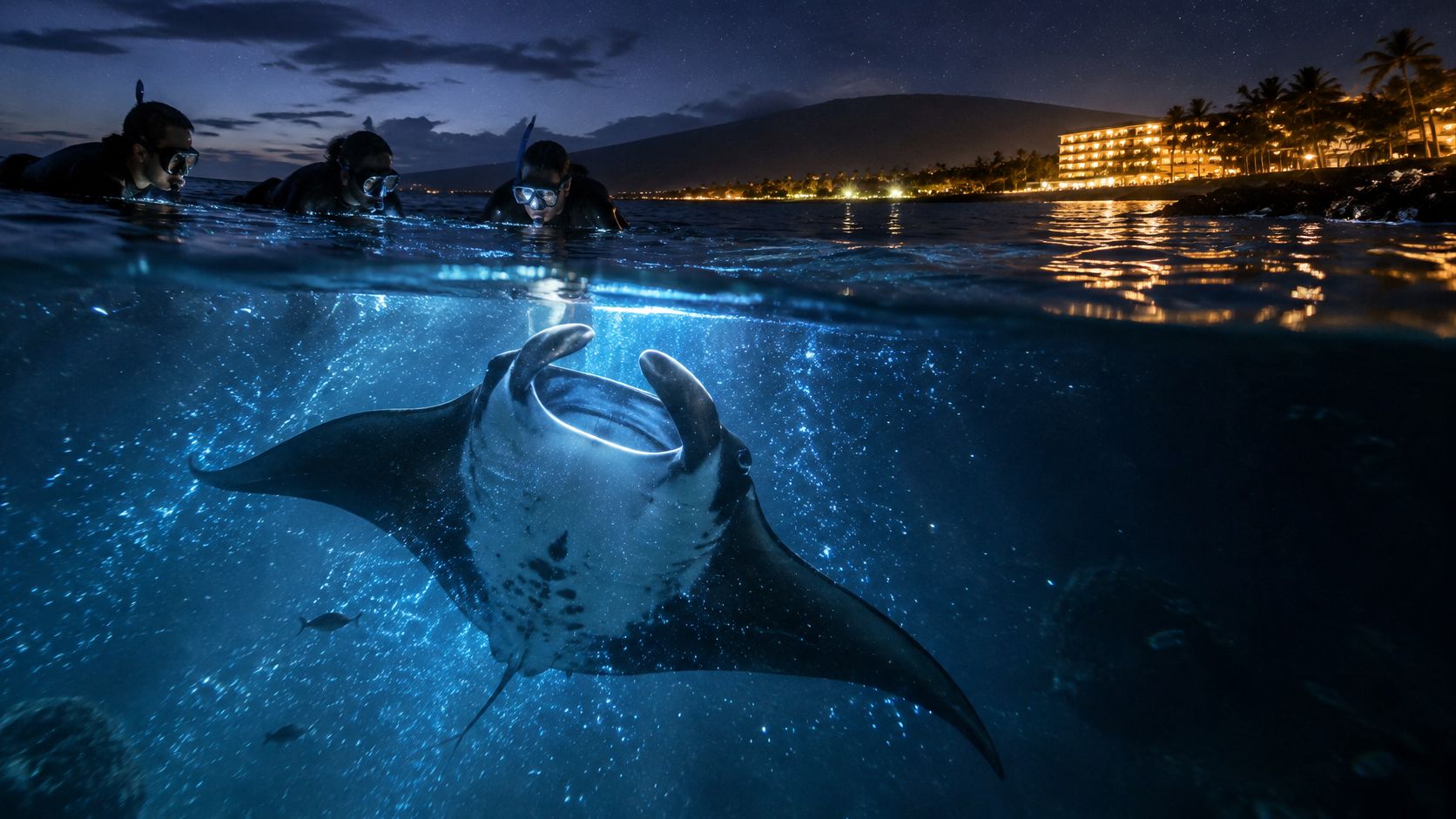
When a manta does arrive, you'll usually see a wide, dark shape resolve into wings, a broad mouth, and a pale underside as it turns through the light. It may pass below you, bank away, and come back through the densest patch of plankton again. Keep your hands tucked and your body still even when it passes close. Excitement makes people kick, reach, or duck down for a better look, and all three responses work against the encounter.
The Return to the Boat
Guides call the group back in an orderly way rather than letting everyone swim for the ladder at once. You'll stay with your guide, follow the entry and exit route you heard in the briefing, and reboard where the crew can count heads and collect gear. Expect to feel chilled once you're out, even after a calm session, because you've been mostly still.
A typical night feels slow and quiet, with long stretches of watching broken by close, graceful passes. Some nights bring fewer sightings, and no crew can schedule a wild animal's appetite. Go in expecting an observation, not a show with a set start time, and the evening makes much more sense.
Why Manta Rays Gather Under the Lights in Kona
Kona's famous night encounter started by accident. Artificial lights near a Keauhou oceanfront hotel attracted plankton toward the shoreline, and reef manta rays followed the concentrated food source, according to the history in the Hawaii County manta testimony record. Organized nighttime manta viewing began in the late 1970s, more formal night-diving activity began in 1991 near the former Kona Surf Hotel using underwater lights to aggregate plankton, and by 1993 accounts described as many as five boats and approximately 50 people in the water at the site.
One early location later became inactive from 2000 through 2004, before floodlights were reinstalled and manta activity resumed. That gap matters because it shows the pattern depends on the light and plankton setup, not on rays being trained to meet boats.
Think Porch Light, Then Predator
A porch light on a summer night pulls in moths. Bats and other predators learn that the air around that light holds easy food. Kona's underwater version works in a similar order, but nobody is feeding the rays directly.
Lights increase illumination in the upper water column and concentrate zooplankton, the tiny animals mantas filter from the water. A ray swims through that patch with its mouth open, funneling water across its filtering structures. When the densest food is in a tight area, the ray turns back through it again and again.
Those repeated passes, barrel rolls, and somersaults are feeding mechanics. The animal is trying to stay inside the richest part of the plankton cloud for as long as possible, not dancing for the group. If you understand that, you'll also understand why blocking its turning path or diving into the cloud can end the very behavior you came to see.
Why No Two Nights Match
Individual rays don't move as one predictable herd. A NOAA-hosted Kona study covering 2009 through 2014 documented 25,444 observations of 118 individual reef manta rays and found substantial individual differences in movement patterns, including differences between males and females, as summarized on Kona Honu Divers' Kona manta ray night dive page.
Plankton density changes too, with conditions in the water that you can't judge from the dock. Put variable food together with individually variable rays, and viewing quality will change from one night to the next even at an established site. That's why a responsible operator talks about chances and recent conditions rather than promising a set number of animals.
If you want more background on the animals themselves before your trip, our guide to manta rays in Hawaii covers the species you'll be watching. The short version for your night out is simple. Lights gather food, rays follow food, and your stillness at the surface lets that chain keep working.
Surface Safety Rules and Respectful Distance
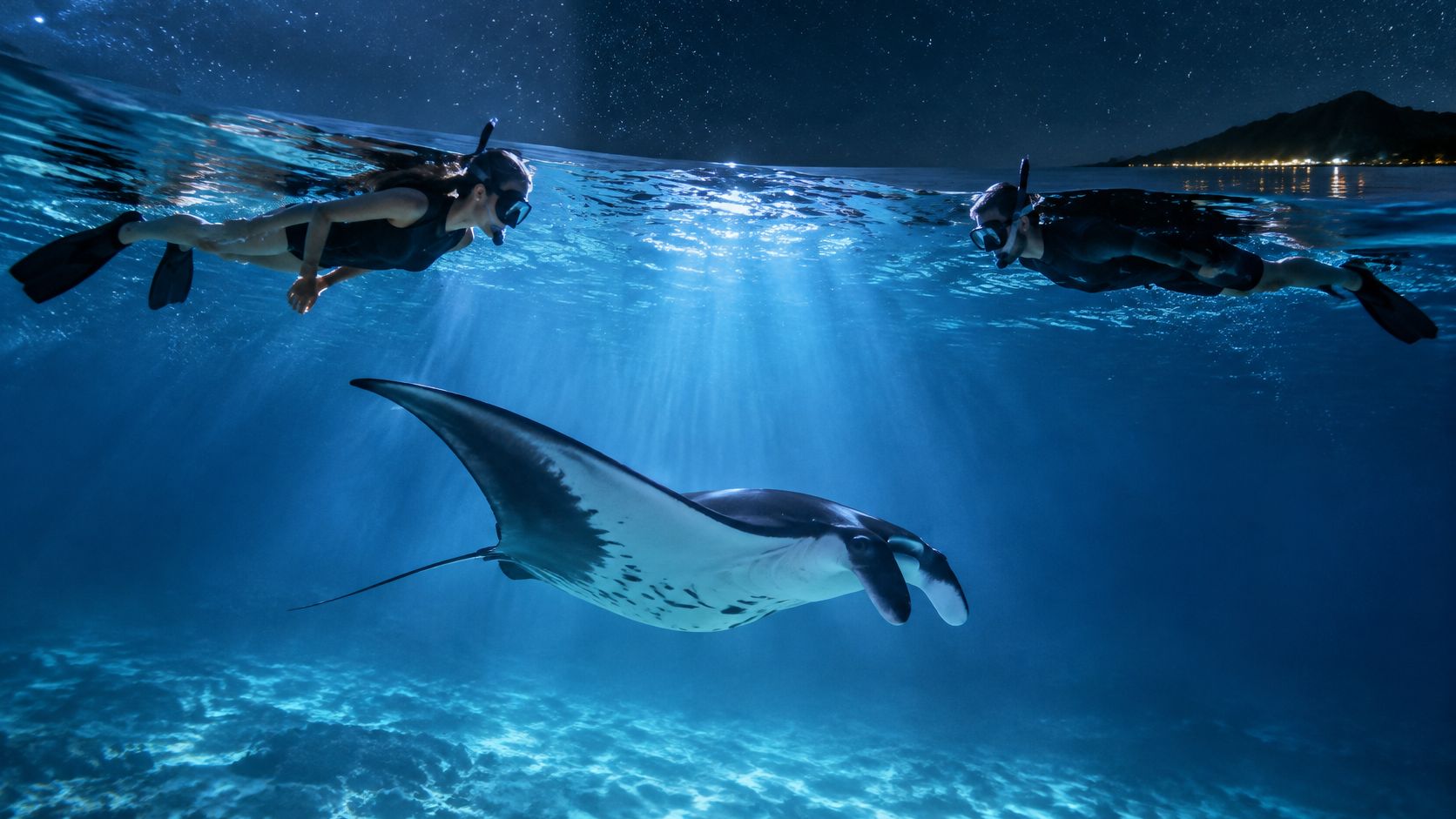
The core rule is easy to say and takes discipline to follow. Stay at the surface and never dive into the feeding zone. Rays feed near the air and water interface, and a descending swimmer can cross a ray's maneuvering path, raise collision risk, and scatter the behavior everyone is watching.
NOAA advises observing mantas from a safe distance and never enticing them to approach, because disturbance can interrupt feeding, resting, breeding, or social behavior, as stated in NOAA Fisheries' giant manta ray species guidance. For boats, that guidance recommends approximately 50 feet of distance where applicable and warns that vessels can injure or kill mantas, which are hard to detect at night beyond subtle surface disturbances or dark shapes.
Five Rules to Follow in the Water
- Stay horizontal and face the light: Keep your body flat at the surface with your face down, so your fins stay behind you and out of the ray's path.
- Keep fins controlled and avoid sudden descents: Small, slow adjustments are fine when a guide directs you. Duck diving for a closer look isn't.
- Stay with the group and close to your guide: A consolidated group is easier to count, direct, and keep clear of boat traffic.
- Never chase, touch, or block a ray: Let the animal choose its approach and leave it an open route to turn or leave.
- Signal at once if you're tired, cold, or separated: Don't try to solve it while drifting away from the light and the guide.
On the boat side, look for a vessel that reduces speed to idle near the site, keeps deliberate separation from animals, posts lookouts, and uses defined entry and exit procedures. Lighting helps the crew see, but it doesn't replace visual surveillance. Darkness shortens reaction time, so slow movement and clear separation matter more at night than they do on a daytime reef stop.
Closer Is Not Better
Most first-timers assume the best view comes from getting as close as possible. The distance data points the other way. Research summarized by the Marine Megafauna Foundation manta tourism guide found manta rays showed avoidance behavior in 31% of interactions when people came within 3 meters (10 feet), compared with 3.4% at 4 to 5 meters (13 to 16 feet).
Approaching from the front or above was more disruptive, while passive observation produced the least disturbance. That finding fits the surface setup perfectly. You aren't meant to swim toward a ray's face or drop down over its back. You're meant to hold still and let it pass through the light on its own line.
| Distance From Ray | Avoidance in Interactions | What It Means for Snorkelers |
|---|---|---|
| Within 3 m (10 ft) | 31% | Stay farther back; close approaches disrupt feeding |
| 4-5 m (13-16 ft) | 3.4% | Stay at the surface and hold position |
| Passive observation, no approach | Lowest recorded level | Least disturbance recorded; the target behavior |
Reading a Ray That Has Had Enough
Watch for observable changes, not just your own excitement level. A ray that changes direction away from the group, leaves the feeding area, or stops feeding is giving you information. Back off if you have room to do so, hold still, tuck your hands in, relax your fins, and skip flash photography.
Touching is never a gray area. Contact can disrupt the animal and puts your hands and body into its turning space. Crowding, chasing, obstruction, and diving beneath a manta can all interrupt feeding, even when the animal appears calm at first.
Practical rule: If your movement makes the ray change what it was doing, you've become part of the problem. Freeze, give it space, and let the guide reposition the group.
Our page on responsible and considerate diver etiquette applies the same thinking underwater. The best encounter here isn't the one where a ray comes closest to your mask. It's the one where the ray keeps feeding undisturbed and you stay calm enough to watch the whole pattern unfold.
Choosing an Operator That Protects Rays and Your Experience
Price and departure time are the easiest things to compare, but they aren't the things that shape your night most. Crowding, group control, and light discipline do. Ask about those before you book, while you can still choose a different boat or date.
What to Check Before You Pay
- Boats at the site: Ask how many vessels typically share the viewing area on your date.
- Group size limit: Find out the maximum number of snorkelers, not just the boat's capacity.
- Guide-to-swimmer ratio: Confirm a guide stays in the water with the group.
- Pre-trip briefing: Expect real instruction on passive observation, signals, entry, exit, and reboarding.
- Flotation and lookouts: Ask how the crew keeps the group consolidated and watches the surrounding water.
- Stationary approach: Choose an operator that holds position over the lights instead of letting swimmers roam.
Those questions are grounded in how the encounter works. The NOAA Kona wildlife interaction standard recommends a snorkel guide in the water and a flotation ring or equivalent for groups of four or more, helping keep participants consolidated above the lights rather than spread across the feeding area. It also frames the light field as a controlled observation zone where lights point downward and mantas choose their own approach.
Crowding isn't a minor comfort issue. A peer-reviewed visitor study reported Kona viewing sites can attract up to 30 tour boats and 300 participants in a single day, and among 444 surveyed participants, 82% said they felt crowded by snorkelers, 78% felt crowded by boats, and 69% felt crowded by scuba divers, as reported by Big Island Now. A manta can appear and the night can still feel rushed and cramped.
Rules and a Three Question Test
Hawaii's commercial rules restrict operators to designated manta ray viewing zones or locations at least seven nautical miles from a designated zone boundary, require slow-no-wake speed within regulated zones, and prohibit anchoring there, while noncommercial viewing generally does not require a permit, under the Hawaii Division of Boating and Ocean Recreation manta short form.
At Kona Honu Divers, the manta night experience is stationary and closely supervised, with a crew briefing on passive observation before anyone gets in. Use our insider guide to choosing a Kona diving company to compare operators, then ask any company these three questions. How many boats will share the site? What's your group limit and guide-to-swimmer ratio? How do you meet the zone and slow-no-wake rules, and what does your briefing cover?
Pack Smart, Prevent Seasickness and Book Early
You don't need much gear of your own, but the small items you bring determine whether the ride back feels easy or miserable. Pack for three phases, the boat ride out, a mostly still float at the surface, and a wet, breezy return.
A Short Packing Checklist
- Well-fitting mask and snorkel: Bring your own if you already know they seal well, or test the operator's set carefully before departure.
- Flotation vest or ring: Use what your operator requires or provides, and get comfortable with it on the boat.
- Rash guard: Adds a little warmth and protects your back and shoulders before sunset.
- Towel and dry bag: Keeps your phone, keys, and dry layer separate from wet gear.
- Warm layer for the ride back: A sweatshirt or light jacket feels essential once you stop moving.
- Reef-safe sunscreen: Apply it before boarding for the daylight portion, not over the water at the site.
Boats can rock, and floating still while looking down at moving light bothers some people more than the ride itself. If you know you're prone to motion sickness, read our guide on how to avoid sea sickness and take preventives before boarding, not after the first wave of nausea. Options people buy ahead of time include the Ship-EEZ Seasickness Patch, Dramamine pills, Bonine pills, Sea Band wristbands, a cheaper generic brand that gets better ratings, and ginger chews.
Book as soon as your dates are firm. The most popular trips, including the manta ray night dive, often sell out weeks in advance, and the same demand affects surface spots. You can review the combined option on our manta ray dive and snorkel tour page before checking dates.
Manta Ray Night Snorkel FAQs and Booking Logistics
Short answers help most here, because several details depend on your swimming ability, your group, and the operator's current policies. Use these answers to know what to confirm, not as a substitute for checking your booking confirmation.
Sightings and the Wait
Will I definitely see manta rays? No. Sightings vary from night to night because these are wild animals following variable food, so treat the trip as an observation rather than a guarantee.
What if no rays appear right away? Stay patient, keep a calm and horizontal body position, and follow your guide's instructions. The briefing explains why the wait is normal, and thrashing around or spreading out doesn't improve your chances.
Can I swim down for a better view or photo? No. Stay at the surface, keep your distance, and let the ray choose its path through the light.
Age, Glasses, and Gear
Is there a minimum age for children? Confirm the minimum age and whether younger children can join with us before booking. The right fit depends on swimming ability, comfort in open water at night, and the child's ability to follow a guide's instructions for the full session.
Can I wear prescription glasses? Glasses don't work under a standard mask, so ask what masks and corrective options are available before your date. If you need a specific fit or prescription solution, bring your own snorkel gear rather than discovering the problem at check-in.
What should I bring to the boat? Bring your swimsuit, towel, dry bag, warm layer for the ride back, and any seasickness preventive you've chosen. Keep valuables minimal and secured, because everything on a night boat tends to get damp.
Booking, Weather, and Arrival
How early should I book? Reserve as soon as your travel dates are firm. Popular night departures can fill well ahead, and booking earlier in your trip gives you more flexibility if conditions force a change.
What happens in bad weather? Check the cancellation and rescheduling policy at booking, then reconfirm if conditions look unsettled. Don't assume a calm afternoon on land means the ocean site is suitable that night.
Where do I go and when should I arrive? Your confirmation sets the arrival time and meeting point. Read it the day before, plan parking and drive time, and don't rely on memory from another tour's check-in location.
If an answer affects safety, age eligibility, eyesight, or a refund, get it confirmed for your specific booking rather than relying on a general guide.
Decide Whether a Night Snorkel Fits Your Trip
Book a manta ray night snorkel if you're a confident swimmer, you can follow instructions calmly in the dark, and you accept that sightings vary. Choose a daylight reef snorkel or shore-based viewing if open water at night already makes you tense. That isn't a lesser trip. It's the right trip for your comfort level.
Independent testimony in the Hawaii County manta ray viewing boating operations and safety assessment identifies congestion in dark conditions as a significant safety concern involving boats, snorkelers, and scuba divers. The mantas themselves may be calm and nonaggressive, while low visibility, light glare, current, nearby vessels, fatigue, panic, and reboarding create operational limits for people.
Run Through the Suitability Checklist
Ask yourself five plain questions. Can you swim well enough to stay calm if water gets in your snorkel? Are you comfortable in open water at night when the shore and boat are harder to use as visual references? Can you follow a guide's voice and hand signals without needing to see everything clearly? Do you have a seasickness history, and if so, is your preventive plan already handled? Are current sea conditions suitable for your experience level, not just for the boat?
Children who swim well and can follow a guide for the full session may do fine. Young or non-swimming children usually do better with a daylight outing where they can see the bottom, the boat, and the adults around them. Older travelers should confirm they can board, move around a wet deck, enter the water, and climb back aboard comfortably.
First-time snorkelers sit in the middle. A full briefing helps, but learning to clear a mask and breathe through a snorkel for the first time in dark open water adds stress you don't need. A daylight reef snorkel earlier in the trip is a sensible rehearsal, and our comparison of scuba versus snorkeling for manta ray diving in Hawaii can help certified divers in your group pick their format.
| Situation | Night Snorkel Fit | Better Alternative |
|---|---|---|
| Confident swimmer, calm in open water | Good fit | Night snorkel with a guide |
| First-time snorkeler | Possible after a full briefing | Daylight reef snorkel first |
| Family with children who swim well | Fit if everyone can follow instructions | Daylight family snorkel |
| Non-swimmer or anxious swimmer | Poor fit | Shore-based or daylight wildlife viewing |
| Seasickness-prone traveler | Only with preventives in place | Shore-based viewing |
The Model to Look For
Our Manta Ray Night Snorkel tour lets guests experience the manta rays from the surface. Our Manta Ray Night Dive is stationary and closely supervised, with experienced guides keeping everyone safe and comfortable. Whichever format your group chooses, that combination of a fixed viewing position, in-water supervision, and a real briefing is the model to look for.
Then make the decision in four steps:
- Confirm swimming comfort and your seasickness plan: Be honest about open water at night, not just pool ability.
- Check boat count, group limit, and briefing: Crowding and supervision shape the night as much as the rays do.
- Pack the checklist and take preventives early: Warm layers and timing matter more than extra camera gear.
- Pick a date and check availability early: Earlier in your trip leaves room if weather changes plans.
If you go, stay at the surface, keep your distance, and let the rays choose their approach. Treat the night as time spent watching wild animals feed, not as a purchased guarantee, and you'll be in the right frame of mind whether you see one patient pass or an hour of looping wings.
Ready to watch reef mantas feed from the surface on a stationary, closely supervised Kona night tour with a full passive observation briefing before you get in? Visit Kona Honu Divers to choose your date, confirm the right fit for your group, and reserve your spot before popular nights fill.