
Picture this: you're floating in the warm, inky-black Pacific waters off the Kona coast. Suddenly, a massive, graceful shadow glides into view, performing an effortless underwater ballet just inches from your face. This isn't a scene from a documentary; this is the manta ray night dive kona, a genuinely surreal and breathtaking experience that tops bucket lists worldwide.
It's an unforgettable encounter with Kona's gentle giants, and the best part is, it’s accessible to everyone—from seasoned scuba divers to first-time snorkelers.
An Unforgettable Encounter With Gentle Giants
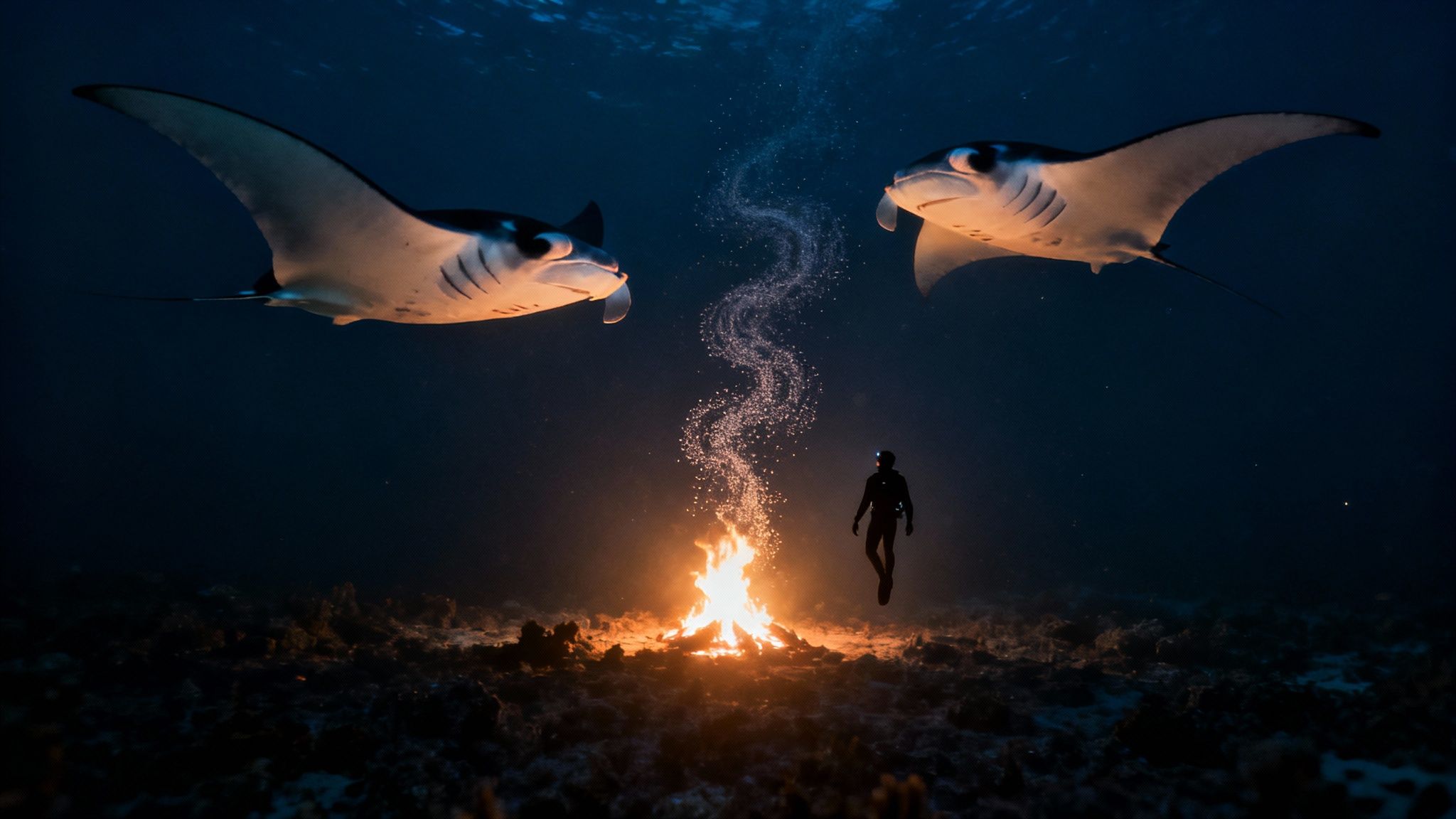
So, how does this nightly spectacle happen? The magic behind it is actually quite simple, and brilliantly effective. Tour operators create a "campfire" on the ocean floor using powerful, eco-friendly underwater lights. These bright beams attract swarms of plankton, the microscopic organisms that form the primary diet of manta rays.
This illuminated, all-you-can-eat plankton buffet is an irresistible invitation for Kona's famous gentle giants. They show up for dinner, and we get a front-row seat. You'll watch in awe as these magnificent creatures glide, swoop, and perform graceful somersaults to scoop up their meal.
Why This Encounter Is So Reliable
The success of the manta ray night dive kona isn't just a matter of luck. It's the result of a perfectly balanced marine ecosystem and decades of responsible tourism. This encounter has become one of the most popular wildlife attractions in the Pacific, drawing around 80,000 visitors each year.
The odds of seeing mantas are incredibly high, with most operators reporting an 80% to 90% success rate. That amazing consistency is thanks to Kona's resident population of nearly 200 individually identified manta rays who call these waters home. You can find more details about this amazing phenomenon at konahonudivers.com.
This unique adventure is an absolute must-do for anyone visiting the Big Island. To make sure you have a safe, respectful, and truly awe-inspiring time, it’s crucial to go with a top-tier operator like Kona Honu Divers. Their commitment to marine conservation and guest safety has earned them a stellar reputation.
Don't just take our word for it—the reviews from fellow adventurers speak for themselves, offering a glimpse into what is truly a once-in-a-lifetime experience.
Ready for your own encounter? You can book your spot on a Kona Manta Ray Night Dive tour and see the magic for yourself.
The Science Behind Kona’s Manta Spectacle
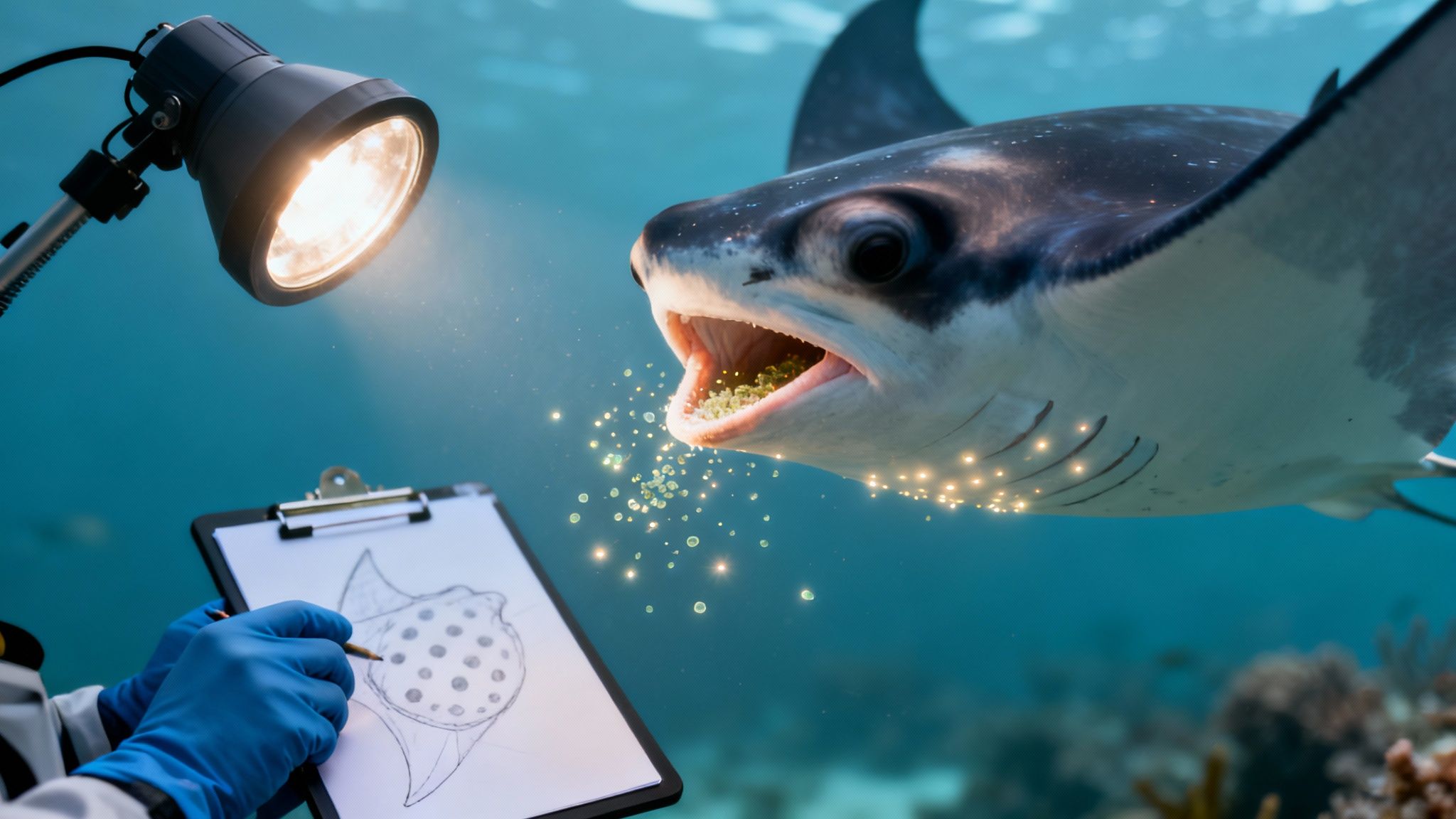
The nightly ballet of manta rays in Kona isn't just some happy accident. It’s a beautiful and predictable bit of biology, a simple food chain reaction that we’ve learned to kickstart. The whole show begins the moment dive operators switch on their powerful underwater lights, which cut through the dark water like a beacon.
These bright lights are irresistible to phytoplankton, microscopic marine plants that naturally drift toward any light source. Right on their heels come the zooplankton, tiny animals that prey on the phytoplankton. In minutes, the water column transforms into a thick, swirling soup of life—an all-you-can-eat buffet set right under the spotlights.
This is the dinner bell for the reef manta rays. They glide in from the darkness to filter-feed on this massive concentration of plankton, performing incredible underwater acrobatics to scoop up every last morsel. It’s a simple but brilliant chain of events: light attracts plankton, and plankton attracts mantas. This is the secret behind the world-famous manta ray night dive in Kona.
A Community of Familiar Faces
What makes the Kona coast so special is that the mantas you see aren't just passing through. This is a resident population. The very same individuals live and feed here all year long, which is a huge part of why the sightings are so consistent.
This unique situation has turned the area into a living laboratory. Over 1,300 individual manta rays have been identified across Hawaii, with a core group of nearly 200 regulars who frequent the Kona dive sites. Researchers, conservationists, and even local dive guides can recognize many of the mantas on sight, tracking their movements and health over time.
So, how do they tell them apart? It's all in the belly.
Just like a human fingerprint, the pattern of black spots on a manta ray's underside is completely unique. No two are alike. This natural marker lets us identify individuals without ever having to tag or touch them.
Thanks to these spot patterns, we’ve built up detailed life histories for many of the mantas, learning more about their social habits and even discovering how deep manta rays dive in Kona waters.
More Than a Dive, It’s a Connection
Once you understand the science, the experience becomes so much more than just a cool dive. You’re not just watching wildlife; you're meeting members of a well-documented and cherished animal community.
Every manta ray that swoops overhead has a story, a history, and often, a name given to them by the people who see them every night. This transforms the adrenaline of the dive into a deep, personal connection to these gentle giants and the critical importance of protecting them.
Choosing Your Manta Ray Adventure
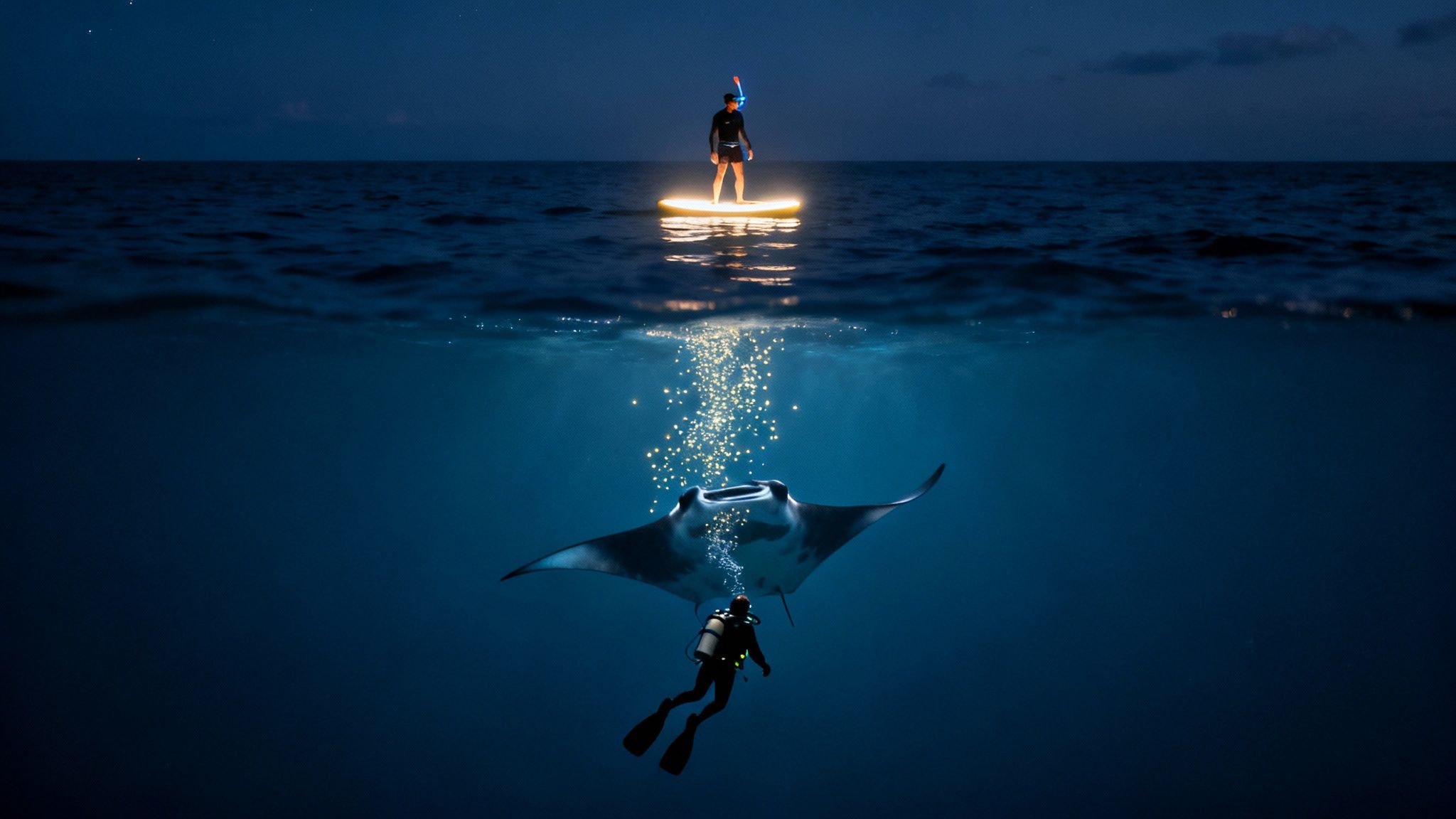
So, how do you want to witness this underwater ballet? You have two incredible options, and your choice really boils down to your comfort in the water and the kind of view you're after. Will you be on the ocean floor looking up, or floating on the surface looking down?
Each option gives you a front-row seat to the nightly feeding frenzy, but from a completely different and equally spectacular angle.
The Scuba Diving Experience
For certified divers, this is the gold standard. The Kona manta ray night dive is a truly immersive experience. After descending to a shallow, sandy patch of the seafloor, you find a good spot, settle in, and simply look up.
This unique vantage point puts you just feet below the action. You get to watch as these massive, graceful creatures swoop, glide, and perform barrel rolls right over your head. They often come so close you can feel the water move.
There's nothing quite like the feeling of a 12-foot manta ray soaring directly over you, its massive wingspan blocking out the lights from the surface. It’s a humbling, awe-inspiring moment that stays with you forever.
If you want the closest possible encounter and a view from inside their world, this is it. It’s the ultimate front-row seat for anyone with an Open Water scuba certification, and you'll be at a comfortable depth of about 30-40 feet.
The Snorkeling Experience
Don't have a dive certification? No problem at all. Snorkeling with the mantas is just as magical and is the perfect choice for non-divers, families, or anyone who'd rather stay at the surface. All you need is a basic comfort level in the water.
You'll hold onto a custom-built flotation board that has powerful lights shining down into the dark ocean. These lights attract the plankton, and the mantas follow. You get a perfect bird's-eye view as they feed just below you, sometimes coming within a few feet of the surface.
You see the same incredible animals, just from a different perspective. Looking down into the illuminated water as these gentle giants swim up towards your light is a mesmerizing and completely safe way to join the spectacle.
Comparing the Manta Ray Night Experience Scuba vs Snorkel
To help you figure out which adventure is the right fit for you and your group, let's break down the key differences.
| Feature | Scuba Diving | Snorkeling |
|---|---|---|
| Perspective | Looking up from the ocean floor as mantas glide overhead. | Looking down from the surface as mantas feed below. |
| Proximity | Extremely close encounters, often within inches. | Close views, but from the surface. |
| Certification | Open Water certification required. | No certification needed; basic swimming ability. |
| Equipment | Full scuba gear (regulator, BCD, tank). | Snorkel, mask, fins, and wetsuit. |
| Best For | Certified divers seeking a fully immersive underwater experience. | Non-divers, families, and those less comfortable in deep water. |
Both are unforgettable experiences, and you can’t make a wrong choice. It just depends on the adventure you're looking for!
Ready to decide? You can explore all the details on our manta ray dive and snorkel tour page to book the perfect trip.
How to Prepare for Your Manta Dive
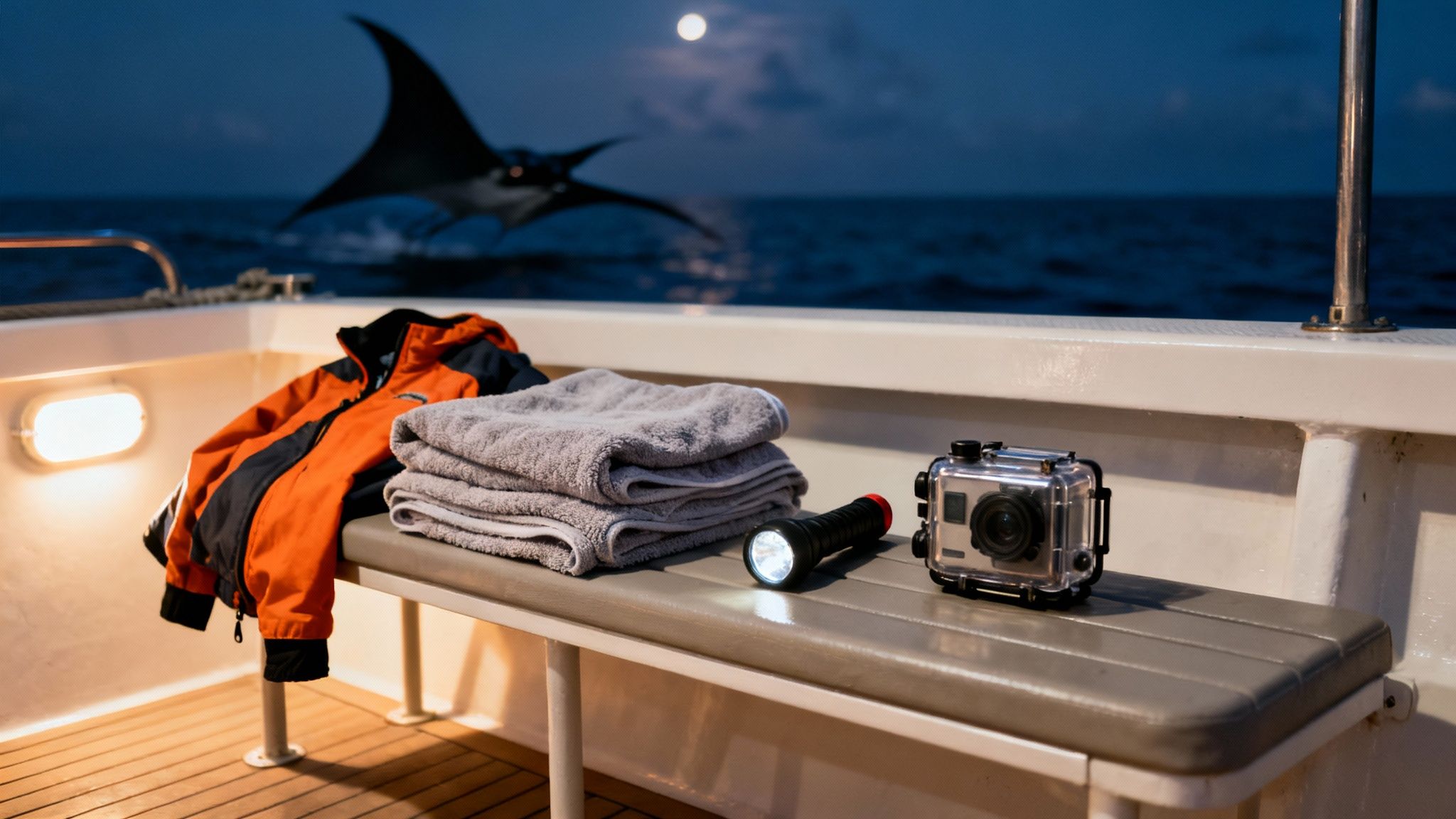
A little prep work can make all the difference between a good manta dive and an absolutely unforgettable one. Getting your personal gear in order before you head out ensures you're comfortable, confident, and ready to soak in every moment of this incredible Kona experience.
While we provide all the essential scuba gear—wetsuits, masks, fins, the works—there are a few things you’ll be glad you brought along, especially for the ride back to shore.
What to Bring on the Boat
After an amazing dive, the night air on the boat ride back to the harbor can feel surprisingly brisk. We highly recommend packing a small bag with these comfort-essentials:
- A Towel: This seems obvious, but you’ll be so happy to have a dry towel waiting for you the second you’re out of the water.
- Warm, Dry Clothes: A sweatshirt, a cozy hoodie, or even a light windbreaker can be a game-changer for the return trip.
- Reusable Water Bottle: Diving is dehydrating! Having your own water bottle makes it easy to stay hydrated before and after the dive.
- Seasickness Medication: If you're even slightly prone to motion sickness, take your preferred remedy before we leave the harbor. It works best when it's already in your system.
If you want a more detailed look at the equipment we provide, check out our guide on the gear you will need for your Kona diving adventure.
Capturing the Moment
Trying to photograph manta rays at night is a tough gig. It's dark, you're underwater, and these gentle giants are gracefully swooping all around you. It takes specialized gear and a lot of practice to get a great shot.
You're welcome to bring a GoPro, but many divers find it becomes a distraction from the main event. For this reason, most guests opt to purchase the professional photo and video package offered on board. This lets you relax and be fully present in the moment, knowing that an expert is capturing those breathtaking memories for you.
The most important rule of the entire experience is also the simplest: Do not touch the manta rays. These beautiful animals have a protective mucus coating on their skin, and touching them can strip it away, leaving them vulnerable to infections. Please, admire their beauty without making contact.
This golden rule is the heart of our pre-dive briefing. Paying close attention to your guide’s instructions is the best way to ensure we all have a safe, respectful, and truly magical encounter with Kona's manta rays.
Why Kona Is the Manta Capital of the World
Kona's title as the world's best place to see manta rays isn't just good marketing—it's the result of a happy accident involving geography, biology, and a little bit of human ingenuity. The Big Island’s volcanic coastline created a series of calm, protected bays that are basically natural sanctuaries. These bays are also packed with plankton, the mantas' favorite food, making it a reliable, year-round buffet for Kona’s resident population.
This perfect setup led to the creation of two world-famous dive sites: 'Manta Village' near Keauhou Bay and 'Manta Heaven' just off the coast from Kona International Airport. The conditions here are so perfect that dive operators can attract these gentle giants nearly every single night. This makes the manta ray night dive in Kona one of the most dependable wildlife encounters you’ll find anywhere on Earth.
A Pillar of the Local Economy
This nightly underwater ballet is more than just an incredible experience; it's a cornerstone of the local community and a shining example of sustainable ecotourism. The manta ray night dive isn't just another tour—it’s a powerful economic engine for this side of the island. The industry supports dozens of local businesses, providing good, year-round jobs for boat captains, divemasters, photographers, and hotel staff.
While exact figures vary, the financial impact is huge, with annual revenue easily climbing into the tens of millions of dollars. That money not only supports local families but also fuels a powerful conservation message. Every reputable operator weaves education about manta biology and protection right into their tours, turning divers into advocates. You can read more about this impactful ecotourism on mantaraynightsnorkelhawaii.com.
When you understand how deeply connected the mantas and the community are, you start to see why this adventure is so special. It also highlights why it’s so important to pick an operator who is genuinely committed to protecting both the animals and the local economy that depends on them.
Exploring More of Kona’s Underwater World
As unforgettable as the manta ray night dive in Kona is, it's really just the tip of the iceberg. Think of it as your introduction to the incredible diving the Big Island has to offer. The waters here are so rich and diverse, they’ll keep you coming back for years.
After experiencing the ballet of the giant mantas, a lot of divers find they've caught the night diving bug. If that sounds like you, then your next must-do is the Kona Blackwater Dive. It's a completely different kind of thrill—drifting in the deep, dark ocean as strange, bioluminescent creatures you'd swear are from another planet rise up from the abyss. It’s a truly surreal experience.
Beyond the Night Dives
When the sun comes up, Kona’s underwater world reveals a totally different personality. You can spend your days exploring stunning coral reefs, navigating through ancient lava tubes, and coming face-to-face with a massive variety of marine life on daytime Kona scuba diving tours. And for those with a bit more experience under their belts, an advanced dive tour can open up deeper and more challenging sites that most divers never get to see.
Here are a few other adventures to add to your list:
- The Surreal World: Take a plunge into the deep on a Blackwater Night Dive to witness creatures that look like they belong in a sci-fi movie.
- Immersive Adventures: If you're looking to eat, sleep, and breathe diving for a few days, it's worth checking out some liveaboard diving experiences for an all-in exploration.
Kona’s diverse marine ecosystem truly offers a lifetime of underwater adventures. From the world-famous manta encounter to deep-sea oddities, there's always something new to discover just beneath the surface.
This is just a quick peek at what else Kona has in store. To get a fuller picture of all the options, we put together a guide covering everything that revolves around manta ray night snorkel and other amazing local dives.
Your Kona Manta Ray Questions, Answered
Still have a few questions before you're ready to jump in the water? I get it. Here are the answers to some of the most common things people ask about the Kona manta ray night dive.
Is the Manta Ray Night Dive Safe?
This is probably the number one question we hear, and the answer is a resounding yes. Every reputable operator in Kona puts safety above all else. Before you even get your fins wet, your guide will walk you through a detailed safety briefing. They're seasoned pros who know these waters inside and out.
And what about the mantas? They're called "gentle giants" for a reason. These magnificent creatures are completely harmless—they have no teeth, no stingers, no barbs. The golden rule of the dive is simple: look, but don't touch. This isn't just for your safety; it's to protect the delicate, mucous-like coating on their skin. By keeping our hands to ourselves, we ensure the mantas can feed peacefully and we all get to share a respectful, magical encounter.
When Is the Best Time of Year to See Mantas in Kona?
Here’s the fantastic news: there's no bad time to go! Kona is blessed with a large, year-round resident population of manta rays. Unlike migratory animals, they stick around, which means there’s no specific "manta season."
Tour operators report a sky-high success rate pretty much every night of the year. So whether you're planning a summer vacation or a winter getaway, your chances of having a breathtaking experience are excellent.
Do I Need to Be a Strong Swimmer for the Snorkel Tour?
Not at all. You don't need to be a competitive swimmer to enjoy the snorkel tour, but you should feel comfortable in the water. Snorkelers are given a custom-made floatation board to hold onto. Think of it as your personal, floating front-row seat to the show.
These boards are equipped with bright lights that attract the plankton, which in turn attracts the mantas. You're not treading water or swimming around freely—you're just holding on and watching the ballet unfold below. Plus, your wetsuit adds extra buoyancy, so as long as you're okay with putting your face in the water with a mask on, you're good to go.
Can Children Participate in the Manta Ray Tour?
Absolutely, this can be an incredible experience for the whole family, especially the snorkel tour. That said, age and size requirements do vary from one operator to another. The best advice is to call the company you're considering and ask about their specific policies before you book.
When it comes to the scuba dive, standard certification rules apply. PADI and other training agencies set the minimum age for a Junior Open Water Diver certification, which is typically 10 to 12 years old. All young divers will need to meet those requirements to join the dive.
At Kona Honu Divers, we're passionate about sharing this adventure safely and responsibly. Head over to our manta ray dive tours page and let's get you booked with Kona's top-rated dive company.