
Imagine giant, graceful manta rays gliding through the darkness, their white bellies illuminated as they barrel-roll just inches from your face. This isn't a scene from a documentary. It’s the world-famous manta ray night dive in Kona, Hawaii, an experience that many divers call one of the most memorable on the planet. This underwater ballet is a true must-do adventure on the Big Island.
Why Kona is the Global Epicenter for Manta Ray Encounters
The Kona coast isn’t just another beautiful spot; it's the single most reliable place in the world to encounter manta rays. In other global hotspots, sightings can be seasonal or happen at deep cleaning stations far from shore. But Kona offers something entirely different: a nightly feeding ritual you can witness year-round.
This guide will walk you through every step of this incredible underwater adventure, from the science behind the spectacle to what you’ll actually experience on your trip. Choosing a top-tier operator like Kona Honu Divers is your key to a safe and absolutely breathtaking experience. Think of this as your definitive resource for planning one of the best dives of your life.
The Science of the Spectacle
So, what makes the manta ray night dive in Kona so special? The answer is simple: plankton. Decades ago, a coastal hotel pointed its lights into the water and unintentionally attracted dense clouds of these microscopic organisms. Manta rays, being filter-feeders, quickly figured out that this illuminated patch of ocean was an easy, all-you-can-eat buffet.
Modern dive operators have responsibly replicated this phenomenon. Tour boats shine powerful, eco-friendly lights into the water, creating a massive underwater "dinner bell." This draws in the plankton, and the mantas follow for their nightly feast.
This unique, learned behavior is what makes the Kona dive so predictable. It's not a chance encounter; it's a reliable gathering of gentle giants in their natural dining room, an event you can witness almost any night of the year.
What This Guide Covers
This article will get you ready for everything you need to know to confidently book and enjoy your dive. We'll explore:
- The Biology of Kona's Mantas: Learn about the resident population and how researchers identify them.
- Your Dive Experience Step-by-Step: From the boat briefing to the moment you see that first majestic manta.
- Safety and Responsible Tourism: How to interact with the mantas ethically to protect these amazing animals.
- Booking with the Best: Why a professional operator makes all the difference for your adventure.
To dive deeper into this magical experience, you can also learn more about the unforgettable Kona manta ray night snorkel adventure. Now, let’s get you ready to witness a truly awe-inspiring natural wonder.
Understanding Kona’s Gentle Giants
What makes the Kona coast the world’s most famous stage for manta ray encounters? It’s not just luck. It's a perfect blend of marine biology and a bit of human ingenuity that created one of the most reliable wildlife shows on the planet.
At the heart of this incredible spectacle is a simple, microscopic meal: plankton.
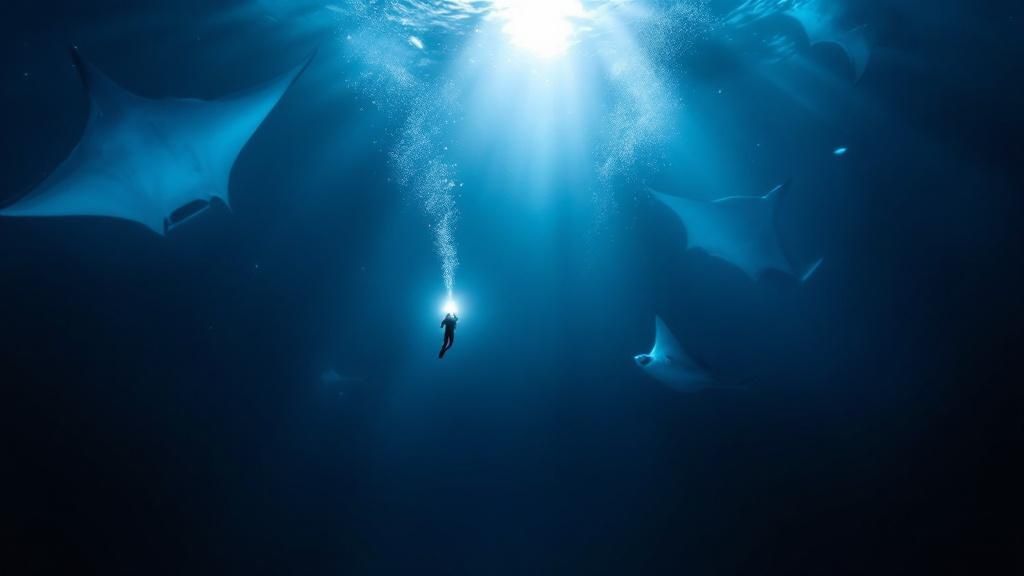
Kona’s resident manta rays are filter feeders, and the entire manta ray night dive in Kona is designed around their dinner schedule. Think of our powerful underwater lights as a giant neon "EAT HERE" sign. The bright beams attract a thick cloud of plankton, which in turn rings the dinner bell for hungry mantas. This nightly feast has become a learned behavior over decades, making the experience remarkably consistent.
The Science Behind the Spectacle
The Big Island's Kona Coast is legendary for a reason. Studies from 2009 to 2014 consistently showed an 80–90% success rate for manta sightings at key sites like Manta Village and Manta Heaven. It’s no wonder these spots attract around 80,000 visitors every year.
This isn't random. The unique underwater landscape and local ocean currents work together to create a natural collection point for plankton, establishing these reliable feeding grounds. The mantas have learned that when the lights turn on, the buffet is open.
Divers and snorkelers get a front-row seat as these gentle giants glide and loop through the light beams, performing effortless barrel rolls to scoop up mouthfuls of their favorite food.
Getting to Know the Locals
Here’s what makes the Kona dive truly special: you’re not just watching a group of nameless animals. You're meeting a community of well-known individuals, each with a name and a story.
Local researchers have been studying this specific population for years, and they’ve gotten to know them quite well. This research elevates the experience from a simple wildlife observation to an introduction to local celebrities. You can learn more about the mechanics of the dive in our guide explaining what a manta ray night dive is.
The secret to telling them apart is the unique pattern of black spots on their bellies. Just like a human fingerprint, no two manta rays have the same ventral spot pattern.
This natural marker allows researchers to identify, name, and track each manta. When you’re out on the dive, your guide might point out famous residents like "Big Bertha" or "Lefty," sharing details about their history and personality.
This intimate connection adds a powerful depth to the dive. You’re not just seeing a manta ray; you’re meeting a specific individual and becoming part of a story of conservation and citizen science.
To help you get acquainted before you even hit the water, here’s a quick rundown of what makes our local mantas so fascinating.
Key Manta Ray Facts for Divers
| Characteristic | Details for the Kona Population |
|---|---|
| Species | The rays you'll see are Pelagic Manta Rays (Mobula birostris). They are the largest species of ray in the world. |
| Size | Wingspans can reach up to 20 feet (though 12-14 feet is more common in Kona). Despite their size, they are incredibly graceful. |
| Diet | They are filter feeders, primarily eating zooplankton. They swim with their mouths wide open, using specialized gill plates to strain food from the water. |
| Identification | Each manta has a unique black spot pattern on its white belly, which acts as a natural fingerprint for researchers and guides. |
| Harmless Nature | Manta rays have no teeth, stingers, or barbs. They are completely harmless to humans and are known for their gentle and curious behavior. |
| Intelligence | Mantas have the largest brain-to-body size ratio of any cold-blooded fish. They exhibit complex social behaviors and are believed to be highly intelligent. |
| Conservation | Listed as Vulnerable to Extinction by the IUCN, their populations are threatened by overfishing and habitat loss. Your participation helps fund vital local research and conservation. |
| Local Status | The Kona population is a resident group, meaning many of the same individuals can be seen year after year, which is why we know them so well. |
Knowing these details transforms your dive. You’ll be able to appreciate not just their beauty, but also their intelligence, their individuality, and the critical importance of protecting them for the future.
What to Expect on Your Manta Ray Dive
There’s a special kind of excitement that builds before a big dive, and the moments leading up to your manta ray night dive in Kona are absolutely electric. Let’s walk through the entire experience with Kona Honu Divers, from the dock to the ocean floor, so you know exactly what to expect.
Your adventure kicks off at the Honokohau Small Boat Harbor. The crew from Kona Honu Divers will be there to greet you with a warm "aloha" and get you settled onto their roomy, custom-built dive boat. The vibe is always friendly and professional, immediately making you feel like you're in good hands.
Before you even leave the slip, the divemasters run through a detailed boat briefing. They’ll cover all the safety procedures, show you where everything is, and give you a solid game plan for the evening. It’s the perfect time to ask questions and get comfortable.
The Twilight Reef Dive
Most trips are 2-tank charters, which means the fun starts before the sun even sets. Your first plunge is a beautiful twilight dive on one of Kona’s vibrant local reefs. You’ll gear up while cruising out, treated to a spectacular Hawaiian sunset from the best seat in the house—the ocean.
This first dive is more than just a warm-up. It’s a chance to get your weighting just right, double-check your gear, and simply enjoy the magic as the reef transitions from day to night. You’ll watch daytime fish tuck themselves into the coral for sleep while nocturnal critters like octopuses and eels start to venture out. It’s a peaceful, fascinating experience that sets the stage perfectly for the main event.
Back on board, you'll have a nice surface interval as the last light disappears from the sky. The crew breaks out snacks and drinks, and it's a great time to chat with other divers, all of you buzzing with anticipation while the boat motors over to the manta site.
The Main Event: The Manta Ray Encounter
This is what you came for. Your divemaster will now give a second, more specific briefing just for the manta dive. Pay close attention here, because this is where they lay out the "rules of engagement" for a safe and respectful encounter.
You'll learn the essentials of "manta etiquette," which is all about passive observation. The core rules are simple but crucial:
- Look, Don't Touch: We're guests in their world. No touching, chasing, or getting in the mantas' way.
- Stay Put: Divers find a spot on the sandy bottom and stay there. This creates a predictable and safe environment for the mantas to do their thing.
- Lights Up: Your dive lights need to be pointed straight up. This attracts the plankton and creates the "campfire" that brings the mantas right to us.
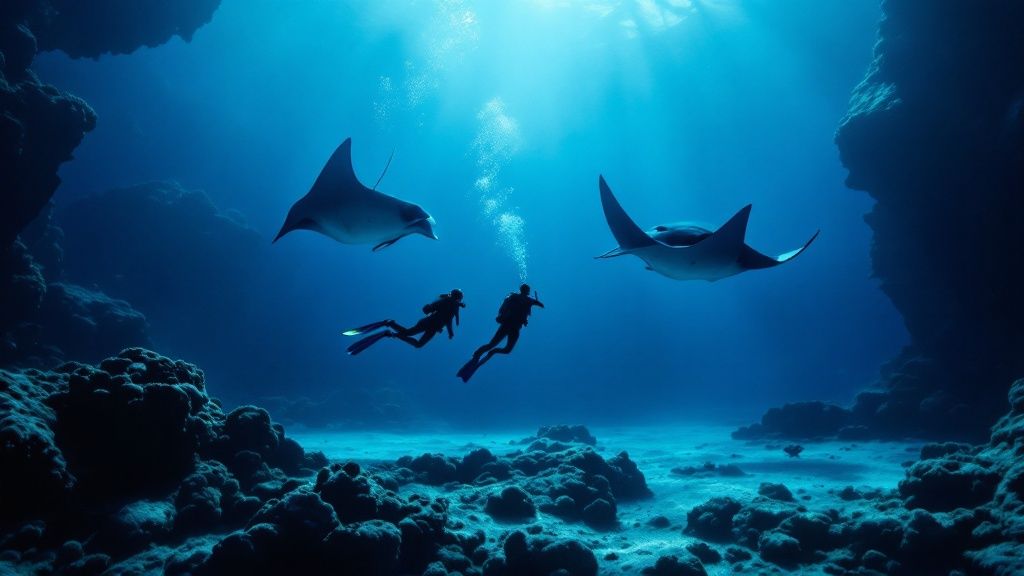
Once the briefing is done, you'll make your second entry into the dark water. You’ll follow your guide down to a designated spot on the sand, usually around 35-40 feet deep. The crew sets up a central light box—the campfire—and divers form a circle around it, aiming their lights toward the surface to create a huge column of light.
For a moment, all you hear are your own bubbles. Then, out of the blackness, a ghostly white shape swoops in. The first manta has arrived.
The feeling is just incredible. These gentle giants, with wingspans of up to 14 feet, glide weightlessly through the beams of light, doing graceful barrel rolls sometimes just inches above your head. Their movements are like a silent, underwater ballet—totally fluid and mesmerizing.
You quickly realize you're not just watching the show; you're a part of it. The light from your torch helps create the plankton buffet, and the mantas swim directly through it with their massive mouths wide open. This is the heart of the Kona Honu Divers manta ray dive tour—a truly immersive experience that connects you directly to one of nature's greatest spectacles.
After about 45 minutes of pure awe, your guide will give the signal to ascend. The ride back to the harbor is filled with energy as everyone excitedly shares their favorite moments. The crew usually has hot chocolate or soup waiting to warm you up, which is the perfect end to an unforgettable night.
The whole trip is expertly managed by Kona Honu Divers to ensure everyone is safe, comfortable, and gets to experience the full wonder of the dive. It’s a memory you’ll be talking about for years to come.
Why Sighting Success in Kona Is So High
Booking a trip to see animals in the wild always feels like a bit of a gamble. Will they show up? Will you see anything at all? But the manta ray night dive in Kona is different. It's about as close to a sure thing as you can get in the world of wildlife encounters.
This isn't just wishful thinking; it's a phenomenon built on decades of predictable manta behavior. It’s what makes this dive one of the most reliable and sought-after marine experiences on the entire planet. Divers fly in from all corners of the globe specifically for this adventure, knowing the odds are overwhelmingly in their favor.
At the two main dive sites—Manta Heaven and Manta Village—the sighting success rate hovers between an incredible 80-90% year-round. That kind of consistency changes everything. You’re not just hoping for a glimpse; you're planning on an encounter. When you book a manta ray dive tour, you can be pretty confident you’re going to have an unforgettable story to tell.
It’s All in the Data
The "why" behind Kona's success is backed by some serious data. Organizations like Manta Ray Advocates have been meticulously tracking this stuff for years. They identify individual mantas by their unique belly spot patterns—like a fingerprint—and log the headcounts every single night.
This isn't just about anecdotes; it’s about turning observations into hard numbers. For example, back in 2013, they published detailed data showing daily sightings, the ratio of trips to successful dives, and even a "TOP 20" list of the most frequently seen mantas. On a truly epic night, they've recorded as many as 36 individual mantas at a single site! A more typical "great" night might be closer to 20, which is still a mind-blowing spectacle. You can actually geek out on the numbers and see the full 2013 manta ray sighting statistics for yourself.
This data proves that while even an average night is amazing, some evenings are nothing short of magical.
What Happens If the Mantas Don’t Show?
Even with such high odds, it’s important to remember these are wild animals. We're on their turf and on their schedule, which means a 100% guarantee is impossible. Very rarely, for reasons of their own, the mantas might skip dinner.
This is where the best dive operators really shine. Companies like Kona Honu Divers know this is a possibility (however slim) and have policies to make sure you don't go home disappointed.
It's often called a "manta guarantee." Most reputable dive outfits in Kona will promise that if you don't see a single manta ray on your tour, you can come back and try again on another night for free, space permitting.
This policy is a huge vote of confidence. It shows the operator believes in their product and is committed to making sure you get the incredible experience you came for. Before you book any manta ray night dive in Kona, it’s always a good idea to ask about their specific manta guarantee.
With that safety net in place, you can spend less time worrying about "if" and more time getting excited about the incredible "when."
Getting Ready for a Safe and Responsible Dive
There's a fine line between a good dive and an absolutely unforgettable one, and it usually comes down to preparation. When you're comfortable, confident in your gear, and clear on the plan, you can stop focusing on the logistics and just soak in the incredible underwater ballet. Let's walk through what you need for a successful and eco-friendly manta ray night dive in Kona.
First things first: your gear. It's not just your life support; it's your ticket to staying comfortable. Here in Kona, the water is a balmy 75-80°F (24-27°C) year-round, but a wetsuit is still a good idea, especially at night.
Most divers are perfectly comfortable in a 3mm or 5mm full wetsuit. It'll keep you warm as you settle on the bottom and during the breezy boat ride home. Plus, it provides a nice layer of protection from any accidental scrapes.
The Rules of Manta Ray Etiquette
More important than any piece of equipment is how you act in the water. We are guests in the mantas' dining room, and it's on us to be polite. Following these simple rules—what we call "manta etiquette"—is non-negotiable for protecting these gentle giants and keeping this experience amazing for generations to come.
Think of it as a code of conduct that’s been fine-tuned over years of observing these animals. It’s what makes this interaction sustainable.
The main principles are pretty straightforward:
- Observe, Don't Touch. This is the golden rule. Manta rays have a delicate, slimy coating on their skin that protects them from infections. Touching them strips this layer away, leaving them vulnerable. Never chase or try to "pet" a manta. Let them be in charge.
- Stay on the Seafloor. Once you descend, you'll find a spot on the sandy bottom. That's your seat for the show. Staying put creates a predictable, safe space for the mantas to swoop and glide above you. Floating up into the water column can scare them off and create a safety issue.
- Point Your Light Up. Your dive light is the magnet for the plankton. By shining it straight up toward the surface, you help create a concentrated column of food—a "campfire" that draws the mantas right in.
When you follow these guidelines, you're not just a tourist—you're an ocean ambassador. Your thoughtful actions directly support the health of Kona's manta population and ensure this world-class dive can continue.
If you want to dive deeper into this, check out our full guide on how to be a responsible and considerate diver.
One last thing: buoyancy control is your best friend on this dive. Nailing your neutral buoyancy means you can relax on the seafloor without stirring up sand or accidentally floating away. It keeps you in the perfect spot to watch the magic unfold without disturbing the mantas or the fragile reef. A little prep goes a long way.
How to Book Your Kona Manta Adventure
Alright, you've learned about the mantas, you know what to expect, and you're ready to see them for yourself. Now comes the exciting part: locking in your spot for one of the most unforgettable nights of your life.
Choosing who to dive with is easily the most critical decision you'll make. This isn't just another dive; it's an investment in a lifelong memory. You want a crew that’s not only professional and safe but also genuinely passionate about what they do. That's where a team like Kona Honu Divers really makes a difference. They live and breathe this stuff, and their respect for the mantas and the local ecosystem shines through in everything they do.
Why an Expert Operator Matters
The manta ray night dive is more than just a cool tourist activity; it’s a massive part of Kona's identity and a fantastic example of sustainable ecotourism. Think about it: every year, around 80,000 people come from all over the world to see these mantas. This supports local families and businesses, all while funding conservation and research. This beautiful cycle of tourism and stewardship is what makes Kona a world-class destination for marine encounters. You can read more about this sustainable tourism model on Love Big Island.
When you book with an experienced operator, you're plugging directly into that positive system. A crew that truly cares will give you more than just a dive—they’ll give you context, sharing stories and facts about the mantas that make the experience so much richer. But you don't have to take my word for it; the experiences of other divers say it all.
More Than Just Mantas
While the manta dive is the star of the show, Kona Honu Divers has other incredible underwater adventures up their sleeve. If you're drawn to the weird and wonderful, their Black Water Dive is a mind-bending trip into the deep to see creatures that look like they're straight out of a sci-fi movie.
For more seasoned divers, their advanced dive tours can take you to explore Kona's dramatic lava tubes and untouched, remote dive sites.
But first things first. To book the main event, the 2-Tank Manta Dive, the process is simple. Your spot on this incredible underwater ballet is just a few clicks away.
Frequently Asked Questions
Thinking about dropping into the dark Pacific to meet a giant manta ray? It's an incredible thought, and it's totally normal to have a few questions before you go. Let's walk through the most common ones so you feel completely ready for your manta ray night dive in Kona.
Is the Manta Ray Night Dive Safe for Beginners?
Yes, absolutely. I know the words "night dive" can sound a little intimidating, but this whole experience is designed to be incredibly controlled and safe. It's actually one of the most straightforward dives you can do.
You'll descend to a shallow, sandy spot—usually around 35-40 feet—and then you just… stay put. There's no complex navigation in the dark. You simply settle in and let the show come to you. The divemasters at Kona Honu Divers give a fantastic briefing before you even get in the water, and they're right there with you the whole time. If you have your basic open water certification and feel comfortable breathing underwater, you're good to go.
What Is the Best Time of Year for the Kona Manta Ray Dive?
This is one of the best parts about the Kona manta dive: you can do it any time of year! Our local manta ray population is resident, meaning they stick around all year long. We don't really have a "manta season" because the mantas are always here.
The result is a sighting success rate that's consistently through the roof, no matter when you visit. Sure, the summer months might give you slightly warmer water or calmer seas, but your odds of an amazing encounter are fantastic year-round. It's best to plan your trip based on your own schedule, not the mantas'—they'll be ready for you!
What If I Am Not a Certified Scuba Diver?
No problem at all! You can still get a front-row seat to the action. The best operators run manta ray snorkeling trips right alongside the dive boats, so everyone gets to experience the magic.
As a snorkeler, you'll float on the surface holding onto a big, custom-made light board. These powerful lights do the exact same thing the divers' lights do—they attract a thick cloud of plankton. The mantas swim right up to the surface to feed, performing their beautiful barrel rolls just inches beneath you. It’s an absolutely spectacular view and means pretty much anyone can join in.
What Happens If We Don’t See Any Manta Rays?
It's extremely rare for the mantas to be a no-show, but they are wild animals, so a sighting can never be 100% guaranteed. The good news is that customer-first companies like Kona Honu Divers have you covered.
Most reputable operators offer a "manta guarantee." If for some reason you don't see any mantas on your tour, they'll invite you to come back and try again on another night for free (subject to availability). It’s always smart to double-check the specific policy when you book your manta ray dive tour.
Ready to see this incredible underwater ballet for yourself? With Kona Honu Divers, you're going out with a top-rated crew that puts safety, education, and an unforgettable experience first.