
Picture this: you descend into the warm, dark Pacific Ocean, your dive light cutting a path through the deep blue. Suddenly, a breathtaking underwater ballet begins to unfold right before your eyes. This is the world-famous manta ray night dive in Kona, a genuine bucket-list experience where gentle giants with wingspans wider than a car glide gracefully just inches above you. It's no wonder this is consistently ranked as one of the best night dives on the planet.
An Underwater Spectacle Unique to Hawaii
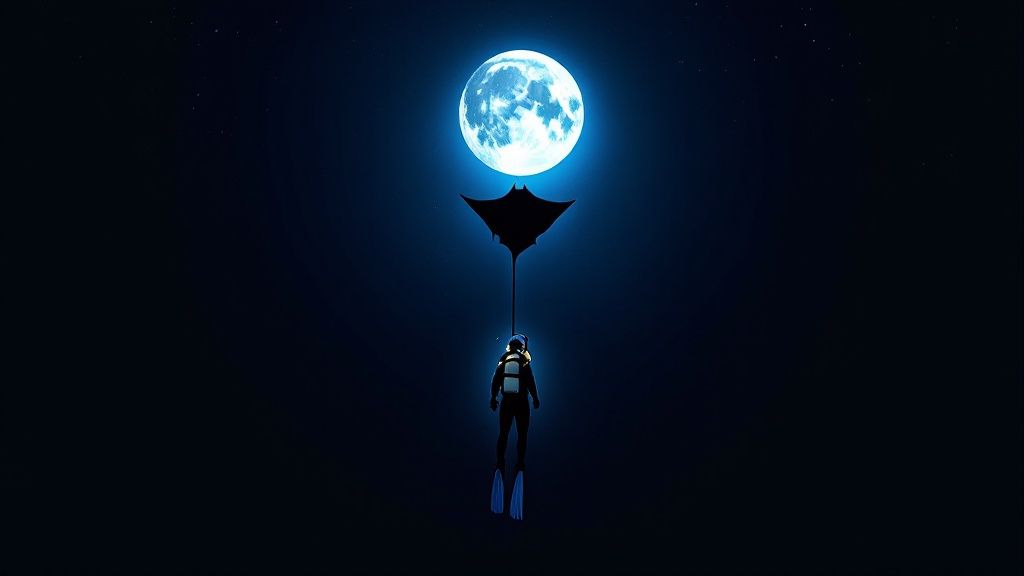
The Kona coast of the Big Island is one of the only places on Earth where you can reliably see these magnificent creatures after sunset. The whole experience is built around a simple yet brilliant idea. Dive operators place powerful, eco-friendly lights on the ocean floor, which act like magnets for massive clouds of plankton—the manta rays' favorite meal.
This all-you-can-eat buffet draws the mantas in from the surrounding ocean, and they put on an incredible show. You'll see them perform graceful barrel rolls and swooping fly-bys to filter the plankton from the water. As a diver, your job is simply to relax on the sandy bottom and take it all in. It’s a truly immersive and awe-inspiring display of nature that feels like something from another world.
Why This Dive Is a Must-Do Adventure
The Kona manta ray night dive is so much more than just another scuba trip; it's a chance to have a profound connection with one of the ocean's most intelligent and gentle animals. Unlike a lot of wildlife encounters, this one is completely passive. You're just an observer in their world, witnessing a natural feeding behavior from a front-row seat.
- Accessible for Everyone: You don't even have to be a certified diver to join in! Most tours offer snorkeling spots where you can float on the surface and watch the mantas feed just a few feet below. For an equally amazing view from the top, consider adding a thrilling night snorkel with manta rays in Hawaii to your itinerary.
- A Year-Round Phenomenon: The manta rays here are residents, not migratory visitors. That means you have an excellent chance of an incredible encounter any time of year you visit Kona.
- High Success Rate: Reputable operators report a sighting success rate of over 90%, which makes this one of the most dependable big-animal encounters you can find anywhere.
The feeling of a 12-foot manta ray gliding silently over your head, so close you can see the intricate patterns on its belly, is something you just can't describe in words. It's a moment of pure magic that will stay with you forever.
Choosing the right guide is absolutely key to making this adventure a success. Kona Honu Divers is a top-rated operator known for their commitment to safety, conservation, and creating a true once-in-a-lifetime journey. Their expert crew ensures every encounter is both breathtaking and respectful to these gentle giants. If you need any proof, just look at the stunning manta ray dive pictures from Kona taken on their tours.
Understanding Kona’s Gentle Giants
So, what are these incredible creatures you’re about to meet on a manta ray night dive in Kona? The best way to think of them isn’t as just fish, but as the ocean's version of graceful, intelligent birds. Kona is home to the reef manta ray (Mobula alfredi), the second-largest ray species on the planet, and they are famous for their gentle nature and utterly awe-inspiring presence.
These giants are filter feeders. That means they have no teeth, no barbs, and no stingers—they are completely harmless to us. Their diet is made up entirely of tiny zooplankton, which they gulp from the water as they glide with their huge mouths wide open. It’s this exact feeding behavior that makes the whole night dive experience possible.
The powerful lights we use on the dive boats act like a massive bug zapper, but for plankton. These lights create a beacon in the dark water, attracting huge clouds of plankton. For the mantas, this is an irresistible, all-you-can-eat buffet that draws them in for a spectacular nighttime feast.
Biology of a Reef Manta
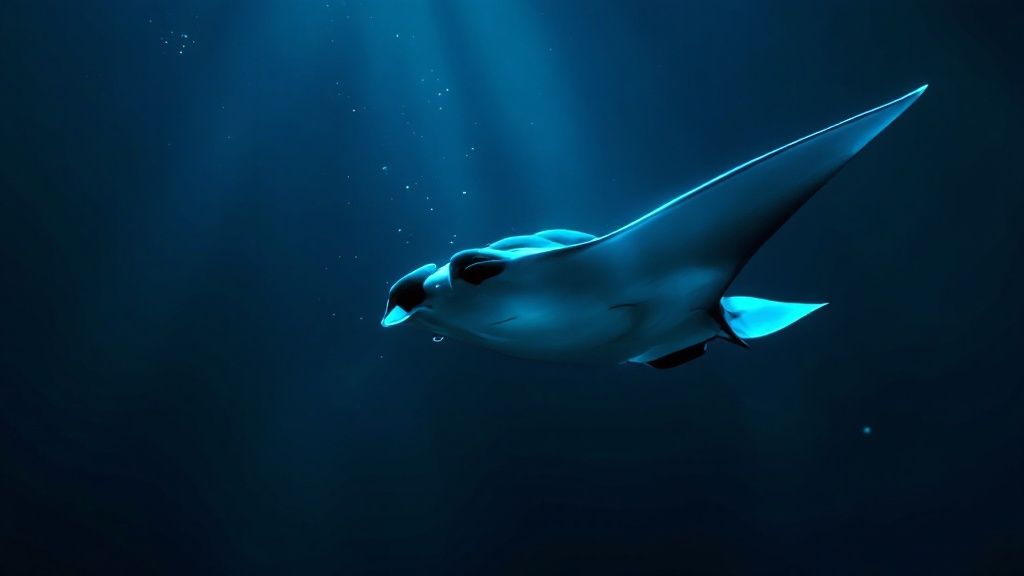
The biology of a reef manta is just as fascinating as its behavior. The first thing you'll notice is their incredible wingspan, which can stretch up to a massive 18 feet (5.5 meters). Here in Kona, the average size you’ll see is a still-breathtaking 12 feet.
Those massive pectoral fins, which look just like wings, are what allow them to move through the water with an effortless grace that feels more like flying than swimming. They use them to propel themselves, to steer, and even to do elegant barrel rolls through the thick clouds of plankton to get every last bite.
Another incredible feature is the unique pattern of black spots on their white bellies. Just like a human fingerprint, no two mantas have the same spot pattern. This is how researchers and local dive guides identify individual mantas. We even give them names and track their health and movements over the years.
The Kona Manta Ray Community
Kona is truly special because it’s home to a large, year-round population of reef manta rays. They don't migrate; they live here. Decades of research have allowed scientists to identify and catalog a resident community of nearly 200 individual manta rays. This is thanks in large part to the data gathered by underwater videographers, which gives us deep insights into their behavior and helps us predict the best viewing times.
On a really good night, we’ve seen up to 20 different mantas on a single dive. The all-time record was an unbelievable 36 appearing at once—a sight you'd be hard-pressed to find anywhere else on Earth. You can dive deeper into these Kona manta ray findings on uwphotographyguide.com.
This reliable, resident population is exactly why Kona is celebrated as one of the best places in the world for manta encounters.
"The experience is a profound wildlife interaction, not just another dive. You are a quiet guest at their dinner table, witnessing a natural spectacle that has unfolded in these waters for centuries."
When you understand these gentle giants, the whole experience becomes so much more meaningful. You're not just looking at a big fish; you're meeting an intelligent, long-lived animal in its own home. Knowing they are a vulnerable species makes this respectful observation even more important, turning every one of us into an ambassador for their protection.
How To Choose Your Kona Manta Ray Dive Site
When you start planning a manta ray night dive in Kona, you’ll discover you have a choice to make. The Big Island is incredibly lucky to have two world-class locations for this experience, but they aren't identical. Picking the right one for you is key to shaping your perfect underwater memory.
Think of it like choosing a concert venue. Do you want the massive stadium tour that promises a huge spectacle with a dozen performers, or the intimate club where you're guaranteed a front-row seat to see the headliner? Both are amazing, but they offer a different vibe.
The two main stages for this underwater ballet are "Manta Heaven" (Garden Eel Cove) and "Manta Village" (Keauhou Bay).
Manta Heaven: The Blockbuster Spectacle
Located north of town near the airport, Manta Heaven is famous for its potential to put on a truly epic show. The name is no accident—this site often draws in a higher number of manta rays on any given night.
If you’re dreaming of seeing the water filled with graceful giants swooping and barrel-rolling all around you, this is your spot. It’s a real spectacle. The trade-off? A bigger show often draws a bigger crowd, so Manta Heaven can be a busier site with more boats and divers in the water.
Manta Village: The Guaranteed All-Star
Head south of Kona to Manta Village in Keauhou Bay, and you'll find what many consider the most reliable manta ray dive on the planet. While you might see fewer mantas here than at Manta Heaven on its busiest nights, the consistency is simply unmatched.
The sighting success rate at Manta Village is a staggering 90-95%. This near-guarantee of seeing at least one manta ray makes it a fantastic choice, especially for first-timers who want to be sure they won't go home disappointed. This reliability stems from years of consistent light from a nearby hotel attracting plankton, creating a dependable buffet the mantas return to night after night.
Kona Manta Ray Dive Site Comparison
To help you decide, here’s a quick breakdown of the two primary manta dive locations.
| Feature | Manta Heaven (Garden Eel Cove) | Manta Village (Keauhou Bay) |
|---|---|---|
| Primary Appeal | Potential for a large number of mantas | Highest sighting consistency in the world |
| Location | North of Kona (near the airport) | South of Kona (in Keauhou Bay) |
| Manta Numbers | Often higher average (a 2013 study showed 11 per night) | Can be fewer, but incredibly reliable |
| Success Rate | High, but can be variable | Consistently 90-95% |
| Crowd Level | Can be busier with more boats | Typically well-managed and organized |
| Best For | Divers hoping for a massive spectacle | First-timers or those who want a guaranteed sighting |
Ultimately, whether you prioritize the possibility of seeing a dozen mantas or the near-certainty of seeing at least one, you're in for an unforgettable night.
Both sites are incredible, and Kona has even more to offer beneath the waves. You can explore a broader range of the incredible dive sites Kona Honu Divers visits to see what else the Big Island has in store.
Your best bet is always to go with an experienced, local operator. The crew at Kona Honu Divers knows these sites like the back of their hand. They monitor conditions and recent manta activity daily to make the best call on where to go, giving you the greatest chance for that magical encounter you came for.
What to Expect on Your Manta Ray Dive Adventure
The idea of a manta ray night dive in Kona can stir up a mix of excitement and maybe a few pre-dive jitters. That's totally normal. Knowing what the evening looks like from start to finish helps transform those nerves into pure anticipation. The whole experience is a well-oiled machine, designed to be safe, awe-inspiring, and something you'll talk about for years.
Let's walk through it. Your adventure kicks off with a warm welcome and check-in right at the harbor. You’ll meet the crew, get sorted with any gear you’re renting, and have a chance to get those last-minute questions answered. After that comes one of the most critical parts of the trip: the pre-dive briefing.
Your guides are experts, and they'll cover everything from the dive plan and safety protocols to the golden rules of interacting with the mantas. This isn’t just a formality; it’s about making sure everyone, from a newly certified diver to a seasoned pro, is on the same page for a smooth and spectacular encounter.
The Sunset Cruise and Arrival
With the briefing done, it's time to board the boat and head for the dive site. This is often a highlight in itself. As you cruise out, you’re treated to a classic Hawaiian sunset, with the sky blazing in color as the sun sinks into the Pacific. It's the perfect, peaceful start to an unforgettable night.
Once we arrive at the manta spot, the crew springs into action, getting everything prepped for you to enter the water. As the last bit of light fades, you’ll slip into the warm ocean and follow your guide on the descent. We head down to a designated spot on the sandy bottom, usually at a nice, easy depth of around 30 to 40 feet.
Your role in this underwater theater is beautifully simple. Once you're settled on the bottom, your only job is to get comfortable, relax, and look up. The divemasters handle all the logistics and safety, allowing you to be fully present for the show.
The Underwater Light Show Begins
In the center of the site, a powerful light source is set up—we divers call it "the campfire." This light does one crucial thing: it attracts massive clouds of plankton. And that plankton buffet is exactly what brings the mantas to our doorstep. It won't be long before you see massive, graceful shadows emerging from the darkness, swooping and barrel-rolling right through the light beams above you.
There's nothing quite like it. Seeing these gentle giants, with wingspans often hitting 12 feet or more, glide just inches over your head is a core memory in the making. There's a reason the Kona coast is world-famous for this; we have a sighting success rate of over 85%. That incredible reliability, plus the sheer number of resident mantas, makes this one of the most important manta ray habitats on the planet. You can learn more about what makes this Kona dive so special.
At Kona Honu Divers, our passion is bringing this bucket-list experience to you safely and respectfully. Our crew's expertise and love for marine life is something you'll feel on every trip.
After about 45 to 60 minutes of pure underwater magic, your guide will give the signal to begin your ascent. The boat ride back to the harbor is always buzzing with energy as everyone shares their favorite moments from the incredible ballet they just witnessed.
How To Be a Responsible Manta Observer
Think of the manta ray night dive as being invited to a very exclusive, very wild dinner party. We’re guests in their world, and just like any good guest, we need to be on our best behavior. This whole experience is a delicate dance between us and the mantas, and a few simple rules are all it takes to keep the encounter safe, respectful, and sustainable for years to come.
The most important thing to remember is that this is a passive observation experience. You're there to watch the magic unfold, not to become part of the show. It's like having a front-row seat at the most incredible ballet you've ever seen; you can admire the dancers, but you absolutely cannot jump on stage with them.
The No-Touching Rule Explained
Here it is, the golden rule: never, ever touch a manta ray. It’s the single most important guideline we have.
Mantas are covered in a thin, slimy mucous coating that acts as their first line of defense against the ocean's countless bacteria and potential infections. It's basically their version of our skin. When we touch them, we can easily rub off this protective layer, leaving them vulnerable to diseases. It’s like getting a cut that’s left open to infection.
Simply keeping your hands to yourself is the most powerful act of conservation you can perform on this dive. It’s a small action with a massive impact on the health of Kona's beloved manta population.
Guidelines for a Respectful Dive
Beyond the no-touching rule, a few other key practices help us minimize our footprint and ensure the mantas feel comfortable and safe.
- Control Your Buoyancy: This is a big one. Divers need to stay neutrally buoyant, hovering just off the seafloor. This protects the delicate corals from being broken and keeps the sand from getting kicked up, which can cloud the water and disturb the whole environment.
- Stay in Your Spot: Your guide will show you exactly where to settle on the bottom. Staying put is crucial because it creates a predictable space for the mantas to swoop and feed overhead. It keeps the "dance floor" open for them.
- Mind Your Lights: Your dive light is the beacon that attracts the plankton, which in turn attracts the mantas. Keep it pointed straight up into the water column. Avoid shining it directly into a manta's eyes or gills—that's just rude!
- Don't Chase: This should go without saying, but never swim after a manta. Let these gentle giants choose to approach you. Chasing them causes a lot of stress and is the quickest way to make them leave the area.
Following this etiquette does more than just make for a better dive; it turns you into an ambassador for marine conservation. The skills you practice here help protect this incredible Kona spectacle for generations to come. To learn more, you can check out our complete guide on responsible and considerate diver etiquette.
Why Choose Kona Honu Divers For Your Manta Experience
Picking the right dive operator for your manta ray night dive in Kona is easily the most critical choice you'll make. This single decision truly shapes your entire adventure. It’s not just about getting on a boat; it's about finding a team that is deeply committed to safety, conservation, and giving you an unforgettable experience from the moment you step aboard.
This is where we, Kona Honu Divers, come in. Our entire operation is built around creating a more personal, respectful, and truly awesome encounter with these gentle giants. We’re firm believers that a smaller group is the secret ingredient for a better experience—for you and for the mantas.
Smaller Groups for a Better Dive
One of the biggest things that sets us apart is our dedication to small, intimate groups. This isn’t just about having more elbow room on the boat. It translates directly to a better, safer, and more memorable time in the water.
With fewer divers, you get more one-on-one attention from our crew. Our divemasters aren't just counting heads; they have the time to get to know you, answer every question, and make sure you feel completely comfortable and confident before you even get wet. For a night dive, that little bit of extra reassurance can make all the difference in the world.
Choosing an operator is like picking a guide for a once-in-a-lifetime trek. You want someone who knows every twist and turn of the trail, respects the wilderness, and puts your safety and experience above all else. That’s exactly what we aim for on every single trip.
Our passion for the ocean and our deep-rooted knowledge of the local manta population are at the heart of everything we do. To us, these aren't just a tourist attraction; they’re our neighbors. This respect ensures every encounter is handled in a way that puts their well-being first, which in turn creates a more natural and profound experience for everyone involved.
Our Commitment to Quality and Conservation
From top-of-the-line, meticulously maintained rental gear to our unwavering focus on sustainable practices, we aim to give you peace of mind from the moment you book. We believe a great dive begins with great equipment and a crew that genuinely cares for the ocean we all love.
And for those of you looking for another unique thrill after the mantas, our Blackwater Dive tour is an incredible, next-level adventure that you won't soon forget.
But you don't have to just take our word for it. The experiences of our guests really say it all.
Whether you're joining us for our flagship manta ray dive tour or exploring the vibrant reefs on any of our other diving tours in Kona, you're choosing a team that’s dedicated to making your time underwater safe, unforgettable, and truly magical.
Your Manta Ray Night Dive Questions Answered
It’s completely normal to have a few questions before embarking on an adventure like this. So, let's walk through some of the most common things people ask about the Kona manta ray night dive. Getting these squared away will help you book with confidence and get even more excited for what’s to come.
Do I Need To Be Scuba Certified To See The Manta Rays?
Nope! And that's one of the most fantastic things about this experience. While you absolutely need to be a certified diver for the scuba version, there's an equally amazing option for snorkelers.
Snorkelers hang onto a large, custom-built float board on the surface. These boards are equipped with powerful lights that beam down into the water, drawing in the plankton. The mantas follow the food right up to the surface, giving you a stunning, top-down view of the whole ballet. It’s an incredible way to make this encounter accessible to just about everyone.
What Is The Best Time Of Year For The Manta Ray Dive?
Honestly, any time is a great time. The Kona manta ray night dive is a year-round spectacle, which is pretty rare for big animal encounters.
Kona’s reef manta ray population doesn't migrate; they live here all year. That means we don't really have an "on" or "off" season for sightings. The ocean conditions along the Kona coast are also remarkably consistent—warm and calm—making any month a perfect month to jump in the water with these gentle giants.
What Should I Bring On The Dive Boat?
Packing is easy, but a few key items will make your trip much more comfortable. Here’s what you’ll want to have with you:
- Your scuba certification card (an absolute must if you're diving).
- A towel to dry off.
- Something warm to change into after the dive, like a sweatshirt. The ride back to the harbor can get surprisingly chilly once you're out of the water.
A top-notch operator like Kona Honu Divers will handle the rest, providing all your gear, plus snacks and drinks for the boat ride home. And a pro tip: if you're even a little prone to seasickness, it's always wise to take something before you leave the dock.
Is The Manta Ray Night Dive Safe?
Yes, it's an incredibly safe activity, especially when you go with a professional, reputable operator. The dive itself is very controlled—it’s a stationary experience in fairly shallow water, usually around 30-40 feet deep, which eliminates many of the variables of other ocean dives.
Most importantly, manta rays are the definition of gentle giants. They have no teeth, no stingers, and no barbs. As filter feeders, they are completely harmless to humans. Your guides will give you a detailed safety briefing before you get in the water, so you can just relax and take in the awe-inspiring show.