
Imagine this: you're floating in the warm Pacific Ocean just after sunset. Below you, massive manta rays, some with wingspans wider than you are tall, swoop and glide through bright beams of light, their movements impossibly graceful. This isn't a scene from a nature documentary—it's the world-famous Manta Ray Night Dive in Kona, Hawaii, and it’s an experience that lands on nearly every diver's bucket list.
Experience the World-Famous Kona Manta Ray Night Dive
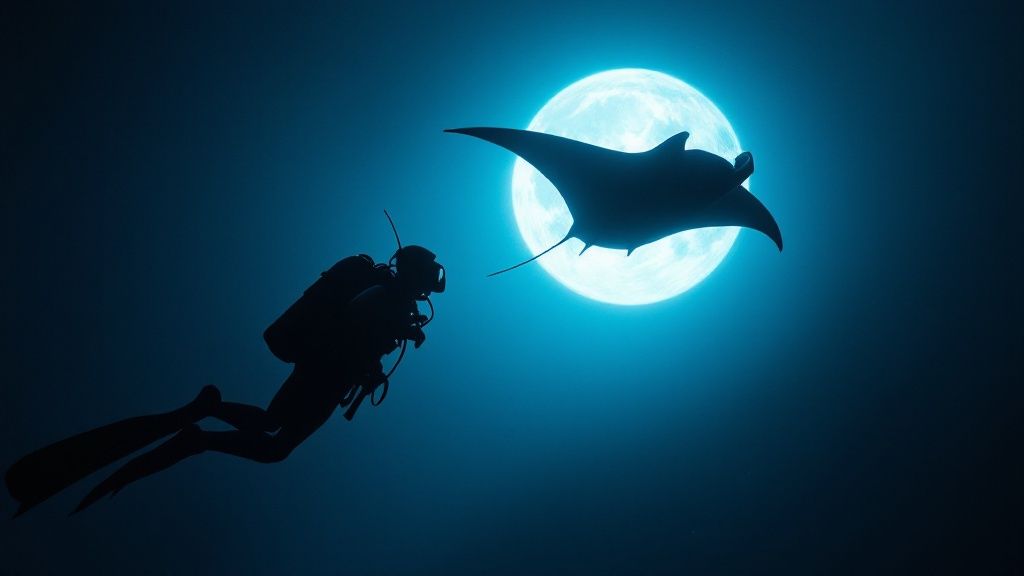
In this guide, we'll walk you through everything you need to know to experience this incredible underwater ballet for yourself. We'll cover why Kona became the global hotspot for consistent manta encounters, how the trip works for both divers and snorkelers, and what makes it an absolute must-do for anyone visiting the Big Island.
The more you understand about what's happening beneath the waves, the more you'll appreciate the magic of it all. Let's dive in.
Why Is the Kona Dive So Special?
You can certainly swim with mantas in other parts of the world. In fact, there are famous manta ray hotspots like Lady Elliot Island that offer breathtaking encounters. So, what makes Kona's dive stand out?
It all comes down to why the mantas are there. While many other locations focus on "cleaning stations," where small fish groom the mantas, Kona is a massive underwater buffet. For decades, operators have used powerful lights to attract plankton—the mantas' favorite food. This creates a reliable, concentrated food source that draws the local manta population in for a nightly feast.
This unique setup turns a potentially passive viewing into a full-blown, dynamic spectacle. You get a front-row seat to an incredible show as these gentle giants perform barrel rolls and effortless loops, feeding just inches from your face. It's a behavior you just won't see with this kind of consistency anywhere else on the planet.
An Accessible Adventure for Everyone
The Kona Manta Ray Night Dive has become a cornerstone of marine tourism on the Big Island, drawing in around 80,000 visitors annually. A huge part of its appeal is just how accessible and reliable it is.
With options for both certified divers and snorkelers, almost anyone can participate. The success rate for seeing mantas is incredibly high—typically between 80-90%—and the dive itself happens in a shallow, comfortable 30-40 feet of water. This makes it an amazing experience for all skill levels, from seasoned pros to first-time night snorkelers.
Whether you're watching from the surface or settled on the sandy bottom, the view is absolutely extraordinary. This blend of near-guaranteed sightings and easy access is what truly sets the Kona manta experience apart. If you want a preview, you can check out some of our https://konahonudivers.com/manta-ray-dive-kona-pictures/ to see what's in store.
How to Choose the Right Manta Ray Tour Operator
The single most important decision you’ll make when planning this adventure is picking the right tour operator. Seriously. Who you go with will make or break your entire experience with Kona’s famous manta rays.
A great manta ray night dive is so much more than just a boat ride out to a dive site. It’s the crew's expertise, the quality of the boat, the deep-seated respect for the animals, and an unwavering commitment to safety. This is what sets a truly memorable encounter apart from just another tour.
Prioritize Safety and Experience
When you're out on the open ocean after dark, safety isn't just a priority—it's everything. A top-tier operator will have a seasoned captain and a professional crew of divemasters and instructors who know these waters like the back of their hand. They'll give you a thorough briefing and have rock-solid protocols for every step of the journey.
A huge sign of a quality operation is a small guide-to-guest ratio. Smaller groups mean you get more personal attention, whether you're a seasoned diver or trying snorkeling for the first time. It makes a world of difference for your comfort and allows the crew to keep a close eye on everyone in the water.
The best crews do more than just keep you safe; they bring the whole experience to life. They’ll share fascinating insights about the mantas, help you identify them by their unique spot patterns, and create an atmosphere of pure excitement and wonder. That passion is contagious, and it's what turns a great dive into an unforgettable memory.
Look for a Commitment to Sustainability
Seeing these manta rays up close is a privilege, and protecting them is a shared responsibility. The best companies are deeply committed to the well-being of the mantas and their environment. The gold standard for this used to be the Manta Ray Green List program, which set strict guidelines for sustainable interactions.
While that specific program is no longer active, its core principles live on in the practices of responsible operators. You’ll see them enforce a strict “no-touching” rule. This is crucial for protecting the mantas' delicate mucus coating, which acts as their immune system against infection.
Key sustainability practices to look for include:
- Passive Interaction: Guides will teach you to stay still and let the mantas come to you. Chasing or trying to touch the animals is an absolute no-go.
- Proper Positioning: Divers are always instructed to stay on the sandy bottom, while snorkelers stay on the surface. This creates a clear "stage" for the mantas to swoop and glide through the light.
- Educational Briefings: A good chunk of the pre-dive talk should be dedicated to manta ray biology, their behavior, and why conservation is so critical.
Choosing a company that lives and breathes these guidelines ensures your incredible night doesn't come at the expense of the animals we're all there to see.
Key Questions to Ask Before Booking
To find the perfect fit for your manta ray night dive, you've got to ask the right questions. The answers will tell you everything you need to know about a company's priorities and the quality of their tour. To get a head start, you can check out our in-depth guide on the top 10 Kona diving companies ranked.
Here are a few essential things to ask any potential operator:
- What is your guide-to-guest ratio? You're looking for low numbers here. A 1-to-6 ratio is far better than a 1-to-10.
- How long is our actual in-water time? Most high-quality tours will give you a solid 45-60 minutes with the mantas.
- What is your "no manta" policy? Sometimes the mantas just don't show. Reputable companies will often offer a free return trip on a standby basis.
- What’s included in the price? Make sure you ask about gear, wetsuits, snacks, and drinks so there are no surprises later.
Putting in a little extra time to vet your tour operator is the best investment you can make. It’s your ticket to ensuring this once-in-a-lifetime adventure is everything you've dreamed of.
What to Expect on Your Manta Ray Night Dive
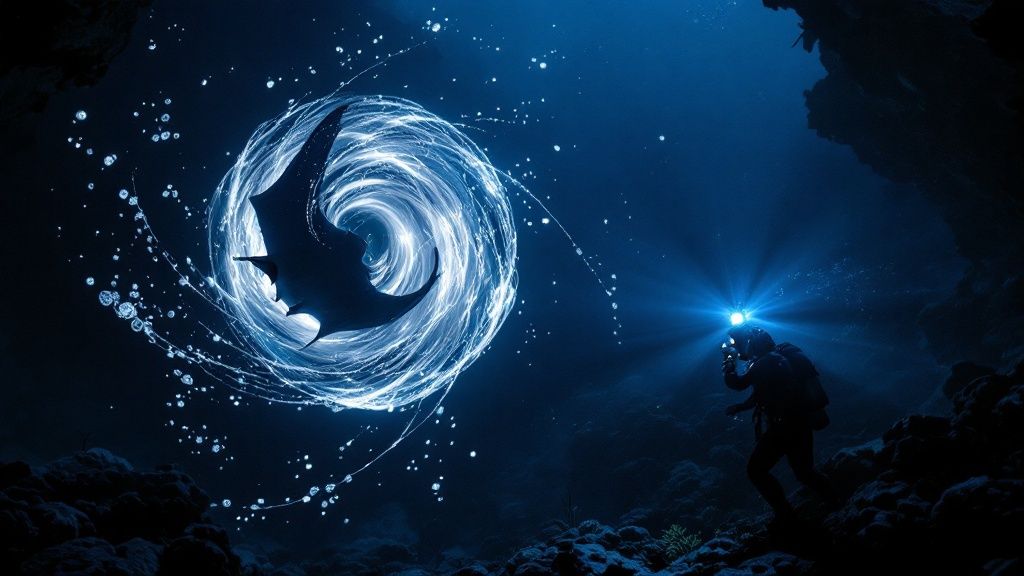
Alright, so you've booked your spot and the anticipation is building. What does the actual experience feel like from start to finish? Let's walk through it. Knowing what’s coming will help you relax and soak in every incredible moment of the manta ray night dive in Kona.
Your adventure kicks off in the late afternoon. Boarding the boat, you'll head out to the dive site, and the trip itself is a treat. More often than not, you're treated to a classic Kona sunset, with the sky blazing in brilliant colors.
During the ride, the crew will give a crucial briefing. Pay close attention here—this isn't just about ticking boxes. They'll cover safety protocols and, most importantly, the golden rule of the night: passive observation. You’ll learn exactly how to position yourself so the mantas can feed and move without being disturbed.
Entering the Underwater Theater
Once the boat is anchored and the last bit of sunlight disappears, it's go-time. The crew helps everyone get their gear sorted, and then, one by one, you slip into the dark, surprisingly calm ocean.
From here, the experience is a little different depending on whether you're diving or snorkeling:
- For Scuba Divers: You'll follow your guide down to the sandy bottom, usually at a comfortable 30-40 feet. Your group will settle in a semi-circle around a powerful set of lights on the ocean floor—what we affectionately call the "campfire." This is your front-row seat to the show.
- For Snorkelers: You'll hang out on the surface, holding onto a specially designed flotation board. These boards have bright lights that shine down into the water, creating a column of light that acts like a dinner bell for plankton.
Both spots offer a fantastic view. Divers get to look up and see the mantas silhouetted against the surface lights, while snorkelers get a stunning bird's-eye view of the entire scene unfolding below.
The Main Event: An Underwater Ballet
At first, you’ll just notice tiny specks of life swirling in the light beams. Then, you see it—a shadow moving in the distance. A moment later, the first manta ray glides effortlessly into view, its massive wingspan cutting a figure that's both powerful and impossibly graceful.
This is when the real magic begins. Lured by the concentrated plankton, more and more mantas arrive. They perform a mesmerizing underwater ballet, pulling off graceful barrel rolls and somersaults right in front of you, sometimes just inches away. To get an even more vivid picture, you can read our detailed account of what it's like to go on the manta ray dive in Kona, Hawaii.
The Kona Manta Ray Night Dive is famous for its ridiculously high success rate, which hovers above 85-90%. This isn't just luck; it's thanks to a resident population of about 450 individually identified manta rays. On a typical night, you might see around six, but it's not unheard of for that number to climb, with records of over 36 mantas showing up at once! Your 45-60 minutes in the water will fly by.
After your time is up, the guide signals the end of the dive. The crew helps everyone back on the boat, where warm drinks and snacks are usually waiting. The ride back to the harbor is always buzzing with excitement as everyone shares their favorite moments from an unforgettable night.
Understanding the Science Behind the Magic
Watching giant manta rays swoop and barrel roll overhead feels like something out of a dream. While it’s certainly magical, this incredible encounter is actually the result of some fascinating biology and a bit of clever human observation. Knowing what’s happening behind the scenes makes the whole experience even more awe-inspiring.
It all boils down to Kona's unique, non-migratory population of reef manta rays (Mobula alfredi). Unlike mantas in other parts of the world that travel vast distances, the few hundred individuals here are homebodies. They stick around all year to feed, breed, and live out their lives along this coastline, which is the secret sauce to such consistently amazing sightings.
Because they’re always here, scientists and local conservation groups have gotten to know this community incredibly well, building a deep understanding of their habits over decades of research.
A Fingerprint for Every Manta
So, how do you tell one massive, graceful sea flapjack from another? It turns out each manta ray has a completely unique pattern of black spots on its white belly. Think of it as a human fingerprint—no two are ever alike.
This natural "ID tag" is a game-changer. It allows researchers and seasoned dive guides to recognize individual mantas on sight. You’ll quickly learn that many of the regulars have been given names, and your guide might point out local celebrities like "Big Bertha," "Lefty," or "Amanda Ray" as they glide past.
This identification is more than just a fun fact; it’s a cornerstone of their conservation. By tracking specific mantas, researchers can monitor things like:
- Population Health: Noting injuries, pregnancies, and the general condition of the community.
- Behavioral Patterns: Figuring out their social lives and how they move between different sites.
- Population Size: Getting a reliable headcount of the local manta family.
What’s really cool is that the photos and videos taken by divers like you often become part of this research, helping scientists spot new mantas or track the movements of familiar faces.
Gentle Giants and Their Favorite Meal
Despite their intimidating size—with wingspans that can stretch over 12 feet—manta rays are completely harmless. They’re true gentle giants, equipped with no teeth, stingers, or barbs.
They are filter feeders, and their entire diet is made up of zooplankton, tiny microscopic organisms that drift in the water. To eat, they just open their huge mouths and cruise, filtering out their minuscule meals. The powerful lights that dive operators shine into the water act like a massive bug zapper for plankton, concentrating them into a thick, irresistible soup. The mantas simply show up for the easy, all-you-can-eat buffet.
This predictable feeding behavior is the heart of the entire experience. Operators create a reliable food source, the mantas get a guaranteed meal, and we get a front-row seat to one of the most spectacular shows in the natural world.
Years of scientific work have given us an incredible window into these patterns. A major study between 2009 and 2014 involved nightly observations, carefully tracking which mantas showed up and when. This research confirmed that their appearances were directly tied to plankton, which you can read more about in these Kona manta ray population statistics.
Understanding this beautifully simple relationship really drives home the importance of choosing a responsible tour operator. When you book a manta ray dive tour, you're not just buying a ticket to an adventure. You're becoming part of a unique ecosystem that, when managed correctly, helps protect these magnificent animals for generations to come.
How to Plan Your Kona Dive Adventure
A little bit of prep work can be the difference between a good trip and an absolutely epic one. While getting set up for the manta ray night dive in Kona is pretty straightforward, thinking through a few details beforehand will guarantee your adventure is smooth, comfortable, and unforgettable.
First things first, let's talk timing. The great news is there's no such thing as a "manta ray season" here. Our local reef mantas are residents, not tourists, which means they're here year-round. This gives you a ton of flexibility when planning your Big Island vacation.
But don't let that fool you into waiting until the last minute. These tours are incredibly popular for a reason, and the best operators get booked up weeks—sometimes even months—in advance. This is especially true during peak travel seasons like holidays and summer. My advice? Lock in your spot as soon as you have your travel dates.
Gearing Up For Your Night On The Water
Packing the right stuff for the boat ride is a game-changer for your comfort. The dive operator will have all the essential in-water gear covered, but you’ll be glad you brought a few personal items for the trip back to the harbor.
Here’s a quick checklist of what I always recommend:
- A Towel: You'll want it the second you climb back on board.
- Warm, Dry Clothes: Even on a balmy Hawaiian evening, you'll feel a chill after spending 45 minutes in the ocean at night. A sweatshirt or a light jacket will feel like a lifesaver on the ride home.
- Reef-Safe Sunscreen: If your tour leaves before sunset, make sure you apply some beforehand. It protects both you and the delicate coral reef.
- Motion Sickness Medication: If you're even a little prone to seasickness, take something before you get on the boat. The water can get a bit choppy after dark.
For a more comprehensive look at equipment, you can check out our guide on the gear you will need for your Kona diving adventure.
Manta Ray Experience: Diver vs. Snorkeler
One of the most common questions we get is whether to scuba dive or snorkel with the mantas. Honestly, both are amazing, but they offer completely different perspectives. The right choice really just boils down to your comfort level in the water and the kind of experience you're after.
To help you figure out what's best for you, here’s a quick comparison.
Manta Ray Experience Diver vs. Snorkeler
A quick comparison to help you decide which Manta Ray Night Dive experience is right for you.
| Feature | Scuba Diver Experience | Snorkeler Experience |
|---|---|---|
| Perspective | A truly humbling, bottom-up view. You'll be looking up as these gentle giants glide just feet above your head. | A sweeping, top-down view. You get to watch the entire underwater ballet unfold right below you. |
| Position | You'll be settled on the sandy ocean floor around a central light source that we call the "campfire." | You'll be floating comfortably at the surface, holding onto a custom light board that attracts the plankton. |
| Requirements | You must be a certified scuba diver to participate. | No prior experience is needed at all! This makes it accessible to just about everyone. |
| Proximity | Incredibly close. The mantas swoop right over the divers on the bottom as they feed in the light beams. | Right there with you. The mantas come directly to the surface to feed, often just inches below the light board. |
At the end of the day, there’s no wrong answer here. Whether you’re on the bottom looking up or at the surface looking down, you're getting a front-row seat to one of nature’s most incredible shows.
Your Manta Ray Night Dive Questions Answered
It’s totally normal to have a few last-minute questions, even after you’ve planned everything out. The manta ray night dive in Kona is a once-in-a-lifetime adventure, and feeling prepared is the best way to soak it all in.
Let's run through some of the most common questions we get from divers and snorkelers. My goal is to clear up any lingering uncertainties so you can just focus on the incredible experience ahead.
Is the Manta Ray Dive Safe?
Yes, absolutely. Manta rays are true gentle giants of the ocean. They don't have teeth, stingers, or barbs—they are completely harmless to people. They're filter feeders, which means they simply glide through the water, scooping up tiny plankton.
The real safety focus is on standard water protocols, which any good tour operator has down to a science. You'll get a comprehensive safety briefing before you even touch the water, covering everything needed to make sure you're secure and comfortable from start to finish.
Do I Need to Be a Certified Diver?
Nope! Snorkeling is an equally amazing way to see the show, and you don't need any special certification. You'll float comfortably on the surface, holding onto a specially designed light board, giving you a perfect bird's-eye view as the mantas feed just a few feet below you.
If you’ve got your heart set on watching the action from the ocean floor, then yes, you will need to be a certified scuba diver. Some companies might offer an introductory "discover scuba" type of experience for non-certified folks, but it's always best to ask them directly when you book your tour.
Will I Definitely See Manta Rays?
While Mother Nature never gives a 100% guarantee, the Kona manta ray dive has an unbelievably high success rate—often over 90%. This isn't just luck; it's because Kona has a resident population of mantas that have been coming to these specific sites to feed for decades.
This incredible consistency makes it one of the most reliable big animal encounters you can find anywhere on the planet. For a deeper dive into the whole experience, take a look at our guide on what you should know about the manta ray dive in Kona.
What Should I Bring on the Boat?
Packing a few small things can make a huge difference in your comfort, especially after you get out of the water. Here’s a quick checklist of what I always recommend:
- A towel for drying off right away.
- Warm clothes to change into. A sweatshirt or a light jacket feels amazing on the boat ride back.
- Any personal medications you might need.
- Reef-safe sunscreen if your tour leaves before sunset.
Most operators will have snacks and drinks on board, but it never hurts to double-check. As for valuables, it's best to leave anything that isn't waterproof safely on shore.
Ready to see the magic for yourself? Join Kona Honu Divers for a safe, respectful, and unforgettable manta ray night dive adventure. Our experienced crew is dedicated to providing a world-class experience while protecting these magnificent creatures.