
Table of Contents
- Choose your viewing position
- Decide with three questions
- The light creates an opportunity
- A shallow encounter with deeper-ranging animals
- What the sequence can look like
- A measurable advantage, not a promise
- Why the physical setup helps
- Crowding belongs in the decision
- Plan for a stationary night dive
- Before the boat leaves
- Lighting and photography
- Contact rules have a biological purpose
- Practice before you add a camera
- Choose a window, not a promised night
- Conservation changes what a good encounter means
- Can I see the night feed without certification?
- Is the scuba night dive only for beginners?
- What if no rays arrive?
- Should I bring my own camera?
- Who should I contact before booking?
- Compare the whole booking
You've picked a night for mantas, but the booking pages leave you with more questions than answers. Should you dive or snorkel, does the site matter, and what happens if the ocean doesn't cooperate? For a manta ray night dive on the Big Island, the useful distinction is simple: resident animals make encounters possible throughout the year, but weather, crowding and your comfort determine whether a particular outing is right for you.
Choose the format first, favor a well-organized viewing site, and leave room in your itinerary for a change of plans. Wild mantas aren't an appointment the crew can keep on their behalf.
Manta Ray Night Dive Options at a Glance
Manta ray night options compared
| Option | Who it suits | Certification needed | Where you watch from |
|---|---|---|---|
| Manta Ray Night Dive (scuba) | Certified divers who want the closest views | Open Water certification or higher | Kneeling on the sandy bottom inside the light circle |
| Manta Ray Night Snorkel | Non-divers and snorkelers who swim confidently | None | Floating on the surface above the lights |
| 2-Tank Manta Dive Snorkel | Divers and snorkelers who want a full manta-focused outing | Certified divers; snorkelers can join | Surface or underwater, depending on certification |
Kona Honu Divers runs these manta outings with experienced divemasters and instructors in the water to manage divers. Your decision should start with what you can comfortably do after dark, not which option sounds most adventurous.
Choose your viewing position
Scuba gives you the immersive, upward-looking perspective: you settle at the viewing station and watch mantas pass overhead. It suits certified divers who can manage their equipment without constant attention and remain composed while other lights and divers are nearby. Compare the scheduled viewing time, rather than assuming every scuba departure gives you longer underwater.
Snorkeling lowers the entry barrier because you don't need scuba certification. You watch the same nightly feeding from above, and close passes aren't exclusive to divers. However, surface support doesn't replace swimming ability or comfort in open water at night.
The combined outing suits travelers who want a fuller excursion instead of arriving only for the nighttime feed. Divers get a reef-and-manta experience, while participating snorkelers watch from the surface. Confirm the itinerary for each person in a mixed group before paying.
Decide with three questions
- Certification: Are you currently certified, and are your skills recent enough to use comfortably?
- Night-water comfort: Would you rather manage scuba equipment underwater or remain at the surface?
- Trip scope: Do you want a fuller diving outing, or is the nighttime encounter your main priority?
Our comparison of snorkeling versus diving with manta rays helps resolve the perspective question. For other ways to spend your diving days, compare the Kona diving tours.
The table gives you the practical answer: choose the position and commitment that match your present abilities, not a certification card you haven't used recently.
What Happens Underwater During the Night Feed
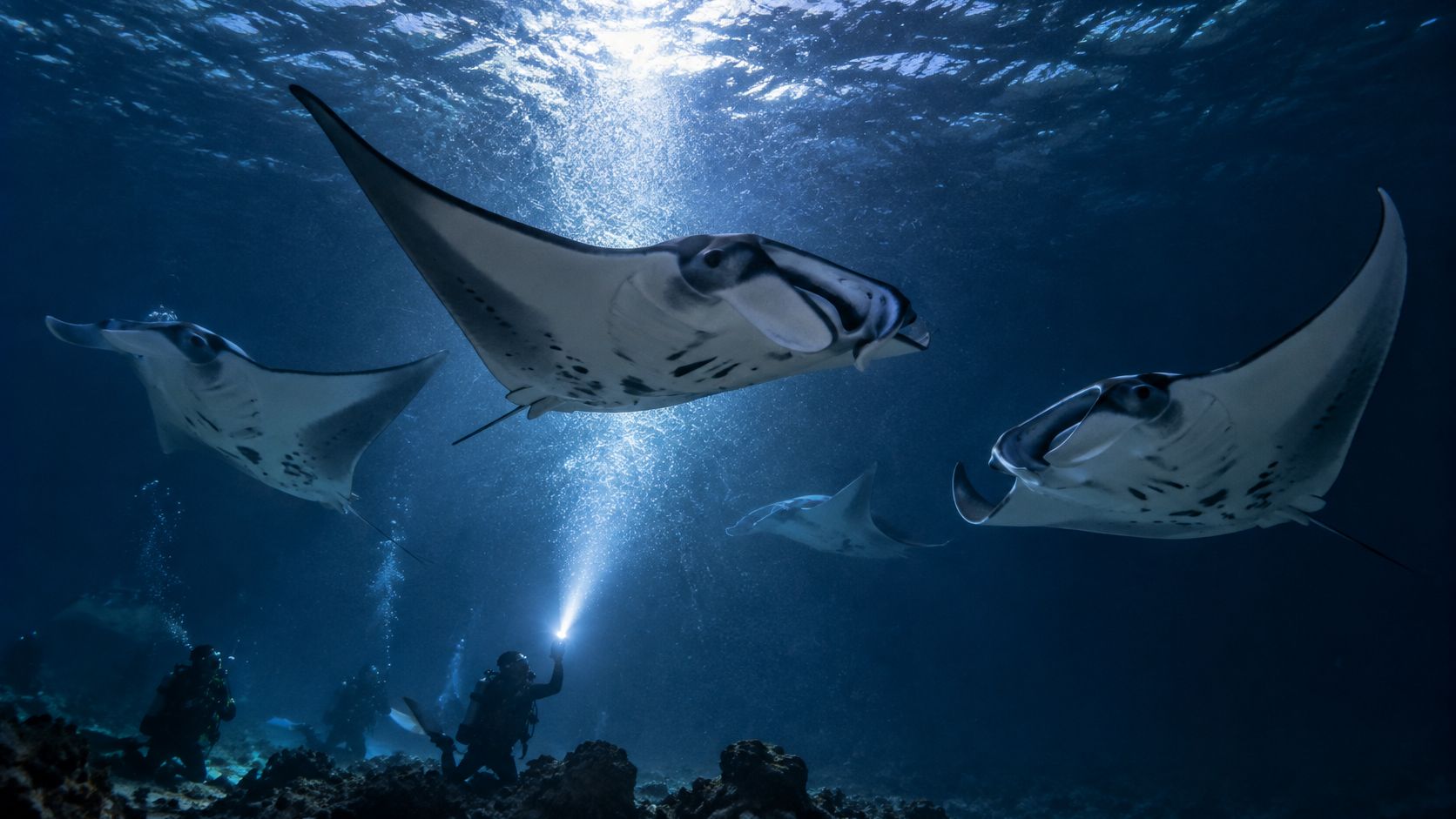
The encounter begins with a feeding opportunity, not a performance. Underwater lights concentrate zooplankton, and reef manta rays move through the illuminated water to filter-feed. Think of a bright shop window gathering a crowd: the light gathers the prey, and the prey brings the mantas.
The light creates an opportunity
The mechanism is straightforward, but the outcome isn't fixed. Currents, lunar illumination and offshore plankton transport affect prey density, so changing the lights doesn't give a crew control over how many mantas arrive, as explained in Scuba Diving's examination of manta-viewing lights.
Our pre-dive briefing covers the science and the golden rules of passive observation. You'll learn where to settle, how to position your light and why the feeding route must stay clear. That preparation matters when an animal with a wingspan well over 12 feet approaches: excitement shouldn't turn into reaching, kicking or swimming out of position.
The lights create somewhere worth feeding. They don't summon an animal on demand.
A shallow encounter with deeper-ranging animals
The mantas' wider movements help explain why patience matters. Biotelemetry research published in PLOS ONE describes reef mantas using the upper 10 m during daylight and generally deeper water at night; later research reports dives reaching 672 m, with repeated surface returns that may help restore body temperature.
The nearshore feed is therefore a temporary opportunity within a much larger natural routine. A manta that leaves the illuminated area hasn't necessarily finished feeding for the night, and its departure isn't a reason for anyone to follow.
What the sequence can look like
On a typical setup, the crew's lights settle on the sand and divers take their assigned places. Fine particles become visible in the beams, and the water column can look increasingly busy as plankton gathers.
If mantas arrive, you may first notice movement at the edge of the light. A ray banks into view, exposes its pale underside and passes through the feeding column before turning away. More may join, or the water may remain quiet. The right response to either outcome is the same: hold your position and let the animals choose their approach.
Why Garden Eel Cove Is the Better Site
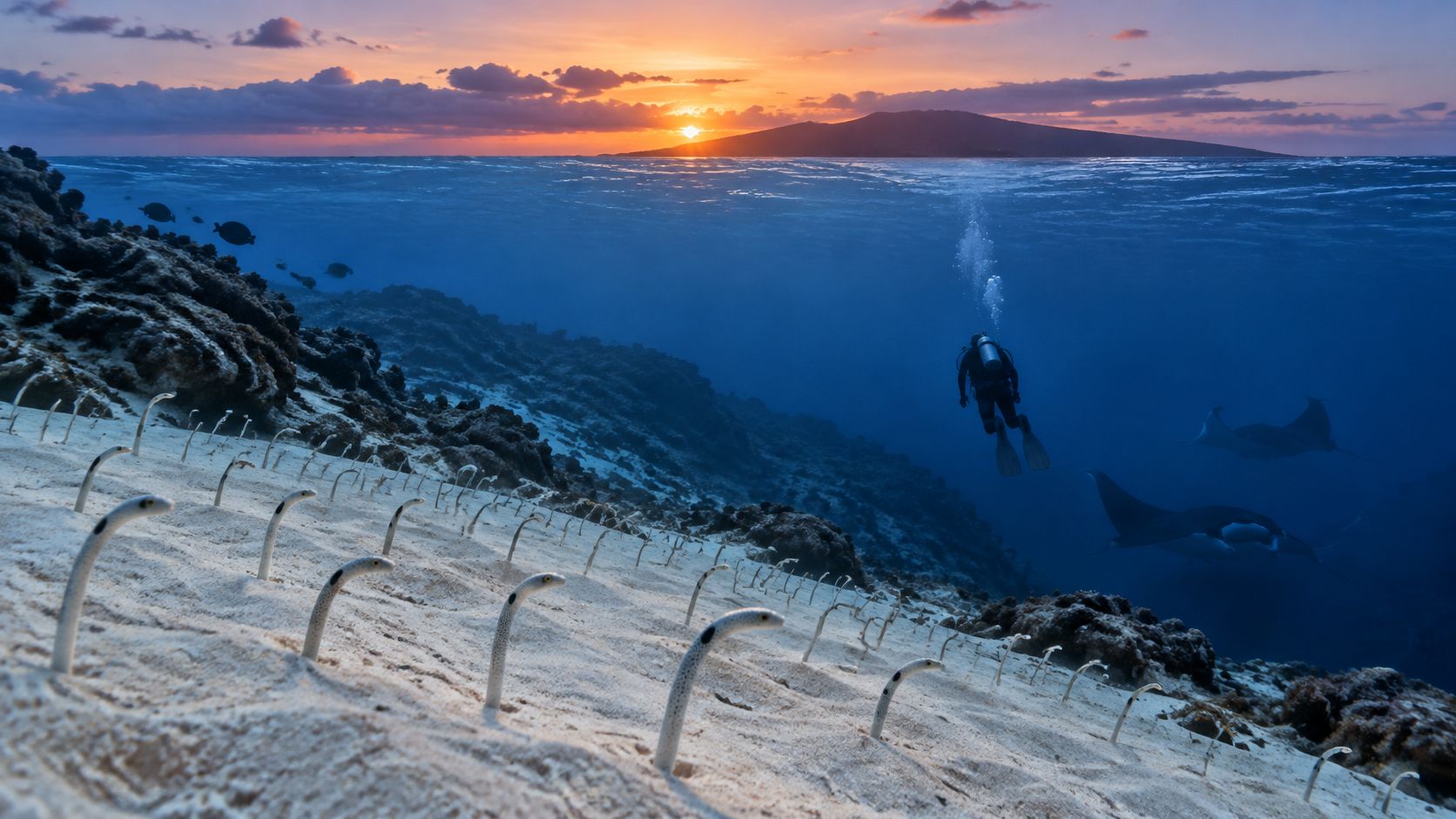
Garden Eel Cove is the stronger choice for this dive because it combines a protected setting, a defined viewing area and a reef experience before the nighttime feed. Divers can explore the reef and garden-eel colony as daylight fades, then return to a structured manta-viewing setup after dark, a sequence described in PADI's Garden Eel Cove site guide.
A measurable advantage, not a promise
A University of Hawaii study summarized in this account of Hawaii's manta dive sites analyzed community observations from 2010 through 2022, including more than 23,000 sightings of 167 individually identified reef mantas, and found consistently larger aggregations at Garden Eel Cove than at Keauhou.
That supports choosing the site for expected group size, but it doesn't establish a guaranteed sighting or an exact probability for your departure. The animals remain wild, and a long-term pattern can't tell you what will happen on a particular evening.
The distinction matters when comparing sales language. Larger observed groups are useful evidence; a claim that a particular boat can ensure mantas arrive is not.
Why the physical setup helps
Garden Eel Cove, also called Makako Bay, is our go-to location because it's generally calmer and more protected from open-ocean swell. Its defined viewing area makes it easier to place divers predictably and preserve an open route for feeding animals.
The reef setting adds value independently of the manta encounter. A garden-eel colony and surrounding reef give the daylight portion a purpose beyond waiting for darkness. That's a better basis for comparison than an unsupported claim that one site's reef is healthier than another's.
Protection is relative, though. A cove isn't immune to changing swell or wind, and the captain still needs to assess conditions on the day.
Crowding belongs in the decision
A 2024 Hawaii Ocean Watch account described a representative busy night at Keauhou with approximately 330 people in the water and 3 manta rays. That's a snapshot, not an average or a prediction, but it illustrates why boat numbers, guest positioning and clear boundaries matter alongside wildlife presence.
Hawaii's Division of Boating and Ocean Recreation has described proposed controls involving anchoring, commercial operators, rafting and live boating around manta-viewing areas. Treat proposals as proposals, rather than assuming every suggested restriction is an enacted rule.
For a Garden Eel Cove outing, review the two-tank manta dive and snorkel itinerary. When comparing any operator, ask which site they intend to use, why it suits the forecast, and how they organize people there.
Safety, Depth and Staying Within Your Limits
Your depth limit comes from the dive plan, not the animal you're watching. Never follow a departing manta into deeper water, and don't reposition beneath an approaching animal to improve your view. Stay at the designated viewing station and within the crew's planned profile.
A useful guide to the Kona manta dive's depth can help you prepare, but confirm the actual planned depth during your briefing. Site conditions and your own qualification limits matter more than a generic number on a booking page.
Plan for a stationary night dive
A stationary dive still requires active monitoring. Check your pressure gauge and computer deliberately, maintain conservative gas and no-decompression margins, and tell your guide before a small problem becomes an urgent one. Don't stretch your reserve because another manta has appeared.
Carry a primary light and a backup, with switches you can operate while wearing your dive gear. Learn the crew's light signals before entry. Sweeping a beam around randomly can confuse other divers and make it harder for your guide to recognize a genuine request for attention.
Our experienced divemasters and instructors are in the water to manage the group. Their supervision supports your skills; it doesn't replace buoyancy control, equipment familiarity or the decision to end a dive when you're uncomfortable.
Before the boat leaves
- Verify your readiness: Confirm certification requirements and discuss how recently you've dived. Arrange a refresher if basic skills feel uncertain.
- Test both lights: Check batteries, switches and attachment points while there's still daylight.
- Learn the signals: Review stop, turn, low-gas and assistance signals, including how the guide wants you to use your beam.
- Disclose health concerns: Complete the medical screening carefully and raise conditions or medications that could affect participation.
- Assess access: Confirm that you can swim and climb the boat ladder unassisted. Discuss mobility limitations before booking.
- Stay together: Know your buddy, your guide and the procedure for returning to the boat.
For surface participants, the boundary is equally clear: remain at the surface rather than diving into the feeding column. A flotation aid isn't permission to join an open-water night activity without the required swimming ability.
Readiness check: If managing your mask, breathing and position already takes all your attention, leave the camera behind.
The safest guest isn't necessarily the most experienced on paper. It's the person who recognizes a limitation early and makes a sensible choice before reaching the boat.
Gear, Photos and Low-Impact Etiquette
Plan your equipment around holding position without interfering. Secure loose straps, keep accessories close to your body and make sure you can find your light controls without looking down. Extra equipment is only useful if you can operate it without drifting into someone else's space.
Lighting and photography
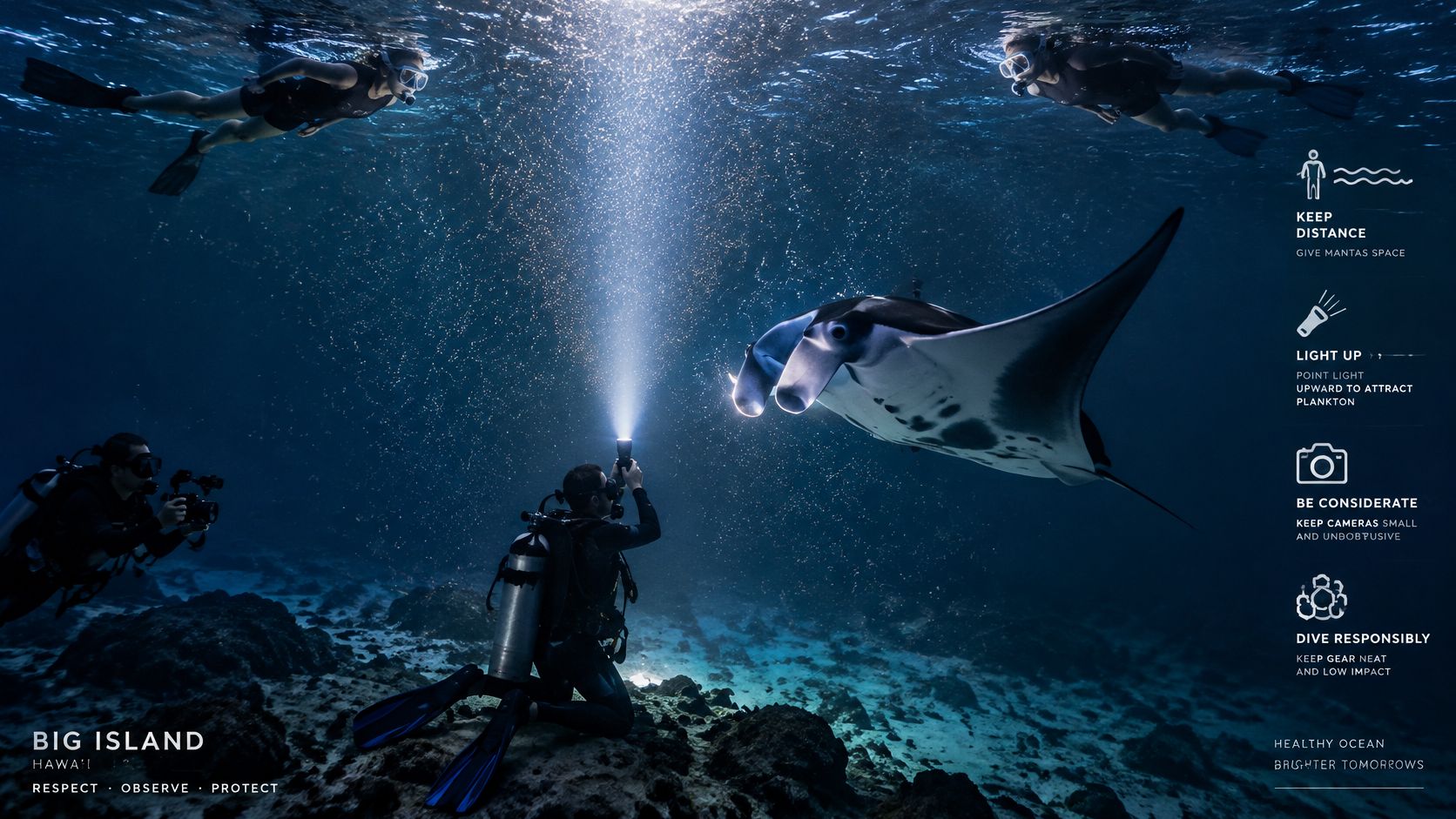
NOAA's voluntary interaction guidance, summarized in this manta-viewing etiquette guide, recommends that divers hold lights above their heads and point them upward, while snorkelers point lights downward. It also advises avoiding direct bubble streams into passing mantas when practical.
Keep beams and camera strobes away from animals' eyes and other guests. Follow the crew's camera rules even if your equipment can produce a brighter image. The aim is an illuminated feeding column, not a collection of competing spotlights.
A wide-angle lens is useful for close passes because you don't need to back away or pursue an animal to fit it in the frame. Choose a shutter speed fast enough to limit motion blur, then adjust exposure within the lighting rules rather than moving closer. Test the housing in a pool beforehand, inspect the seal and confirm that you can operate the controls comfortably.
Contact rules have a biological purpose
Don't touch, grab, chase or ride a manta. Contact can remove its protective mucus coating, and reaching toward an animal also makes the group less predictable.
Hawaii law prohibits capturing, possessing, abusing or entangling manta rays in state marine waters, as explained in Love Big Island's manta-viewing guidance. Respectful observation should go further than avoiding prohibited conduct: leave the animal a clear route and allow it to determine the distance.
Organized viewing concentrates boats and people around feeding wildlife. That can make positioning easier to manage, but it also means each guest's movement affects the wider group. A camera held far out into the feeding lane can be a problem even when its owner remains seated.
Practice before you add a camera
- Hold position: Rehearse staying still without sculling your hands or kicking up sediment.
- Control your beam: Practice finding and aiming the light without sweeping it across faces.
- Keep your hands close: Use a secure camera attachment and resist extending the housing toward an approaching animal.
Apply the same habits described in our responsible diver etiquette guide: predictable movements, awareness of nearby guests and no pursuit for a better photograph.
Best Seasons, Timing and Conservation Limits
Resident mantas don't mean ideal conditions every night. Biological seasonality affects how many animals gather; operational weather affects whether the boat and in-water activity can run safely. Those are different questions, and your booking plan needs to accommodate both.
The long-term observations summarized in this Kona manta analysis found that aggregation size varied with season and year and was positively associated with zooplankton density. That supports year-round planning without inventing a single peak month when the ocean should deliver the largest group.
Choose a window, not a promised night
Some visitors prefer summer for calmer conditions, but that's a comfort consideration rather than a guaranteed manta peak. Public night-dive participation guidance also makes clear why swimming ability, boat access and physical readiness belong in the decision.
Use this timing plan:
- Book early in your stay: Leave remaining evenings available if conditions force a cancellation.
- Protect a backup evening: Don't fill every remaining night with a nonrefundable activity.
- Allow itinerary breathing room: For a short visit, I'd leave a two-to-three-night buffer when possible. That's planning advice, not a forecast of how often trips cancel.
- Read the policy first: Distinguish weather cancellation terms from the policy for a completed trip without sightings.
Our guide to the best time to see Kona's manta rays can help you frame the date decision. Don't select a departure solely because it fits the final evening before your flight.
Conservation changes what a good encounter means
A NOAA-reported genetic study estimated Hawaiʻi Island's contemporary effective population size at 104, with a 95% confidence interval of 99 to 110, and described historical Kona photo-identification work estimating average recruitment of 4.27 new pups per year.
Effective population size describes genetic contribution to future generations, not a census of every manta around the island. Even with that distinction, the findings reinforce why mortality, habitat disruption and reproductive success matter.
Controlled lighting, sensible crowd management and calm visitor behavior aren't optional extras for a better photo. They're part of treating a repeatedly used wildlife feeding site responsibly.
Frequently Asked Questions for Recreational and Experienced Divers
Can I see the night feed without certification?
Yes. Surface snorkeling doesn't require scuba certification, but you still need to meet the operator's swimming and physical requirements. Choose it because you're comfortable snorkeling after dark, not because flotation makes swimming skills unnecessary.
Is the scuba night dive only for beginners?
No. Experienced divers can enjoy the patient observation and close overhead perspective just as much as newly certified divers. The challenge is precision and restraint, rather than covering distance or reaching depth.
For a separate, more demanding diving outing, compare the premium advanced long-range trip. Don't assume that booking an advanced daytime itinerary automatically includes a manta night dive; confirm the actual schedule.
What if no rays arrive?
No operator can guarantee a wild-animal sighting. Before paying, ask what happens if the trip runs safely but mantas don't appear, including whether another attempt is offered and what conditions apply.
A backup evening is only useful if both your itinerary and the operator's availability allow you to use it.
Should I bring my own camera?
Yes, if it's familiar, securely attached and housed in equipment you've already tested. Get approval for lights and strobes before boarding.
- Bring it if you can handle it without compromising your position.
- Leave it behind if operating it will distract you from breathing, buoyancy or guide signals.
Who should I contact before booking?
Contact the booking team directly about group size, guide ratio, lighting, access requirements and cancellation terms. Explain the least-confident participant's needs clearly, especially in a family or mixed-ability group.
The useful answer is specific to your party. A general statement that a trip welcomes beginners doesn't resolve an individual guest's swimming, mobility or medical concerns.
Book Your Manta Ray Night Dive Safely
Choose scuba for the underwater viewing station or snorkeling for the surface perspective, then compare departures on what they include. Many premier manta outings offer a surface option, so non-certified guests don't need to miss the feeding encounter.
If you want structured preparation, the PADI Manta Ray Diver specialty covers manta biology, behavior and conservation, including respectful interaction before the dive. Ask about availability rather than assuming the course is included in a standard booking.
Compare the whole booking
Use these questions alongside our guide to choosing a Kona diving company:
- Site: Is Garden Eel Cove the planned location, and what could cause that plan to change?
- Supervision: What are the group size and guide ratio for your specific departure?
- Lighting: How is the viewing area illuminated, and what personal camera lighting is permitted?
- Equipment: Which items are included, and what must you bring or rent?
- Policies: What are the cancellation, rescheduling and no-sighting terms?
- Format: Does your reservation say night scuba dive or night snorkel?
Compare those answers before comparing headline prices. A cheaper booking isn't necessarily better value if equipment, supervision or flexibility differ from the other trip you're considering.
Pick the format, confirm a date window that preserves your backup plan, and check availability for the correct activity.
Scuba booking
Manta snorkel booking
Kona Honu Divers offers guided manta night outings at Garden Eel Cove, with a structured viewing setup and experienced divemasters and instructors in the water. Visit Kona Honu Divers to choose your scuba or surface option, discuss your group's readiness and reserve a date that leaves room for a backup evening.