
You're comparing manta trips, and every listing seems to promise the same evening: dark water, bright lights, and manta rays passing overhead. The harder questions are practical. Should you dive or snorkel, how comfortable will you feel at night, and does the boat take you to the better site?
For the manta ray dives of Hawaii, site choice matters as much as the activity name. Garden Eel Cove is the stronger choice for a Kona manta dive because its sheltered setting, defined viewing area, and surrounding reef make it easier to settle in and watch. Choose a format that fits your skills, then choose an operator who keeps the animals' feeding lane open.
Manta Ray Dive Options Compared
Kona offers several ways to watch resident Hawaiian reef mantas, rather than seasonal visitors, a distinction supported by NOAA-published research on island-resident populations. Your certification and comfort in open water should determine which experience you book.
Manta ray experiences compared
| Experience | Where You Are | Who It Suits | Certification Needed |
|---|---|---|---|
| Manta Ray Night Dive | Divers kneel on the sandy bottom; snorkelers float at the surface | Beginner to advanced divers and snorkelers | Guide briefing; PADI Manta Ray Diver course recommended |
| Manta Ray Night Snorkel | Float at the surface and watch the mantas | Beginners, nervous or weak swimmers | None required |
| 2 Tank Manta Charter | Two-tank trip with manta viewing | Certified divers with recent dives | Open Water or higher, dived within the past 2 years |
Say you're traveling with a certified buddy but haven't learned scuba yourself. You don't need to force both people into the same underwater role. Surface viewing provides a complete wildlife experience without adding regulator breathing, equalization, and buoyancy management.
Snorkeling isn't automatically safe for someone who can't swim. Nervous or weak swimmers need an explicit suitability discussion, appropriate flotation, and close supervision. If you can't remain comfortable with your face in the water, resolve that before booking.
Match the experience to your training
For scuba participants, the PADI Manta Ray Diver specialty covers manta biology, behavior, and conservation before the night dive. It doesn't replace foundational scuba training. Beginners should confirm their eligibility rather than assume that a stationary dive removes certification requirements.
Our 2 Tank Manta Charter requires Open Water certification or higher and diving within the past 2 years. For a closer comparison of the viewing angles and workload, use this guide to snorkeling versus diving with manta rays.
The Blackwater Night Dive is a different open-ocean night experience, not a deeper manta dive. Experienced divers interested in remote reefs can consider the Premium Advanced 2 Tank Trip.
Choose for comfort: Beginners should favor snorkeling or an appropriately qualified beginner dive pathway. Recently active certified divers can choose the charter. For the strongest overall manta-viewing setup, aim for Garden Eel Cove.
Why Garden Eel Cove Beats Other Kona Sites
Garden Eel Cove is the better overall choice for the manta dive. A University of Hawaii analysis described by the Hawaii Tribune-Herald covered 13 years of community observations, from 2010 through 2022, recording more than 23,000 manta sightings involving 167 individually identified reef mantas across Garden Eel Cove and Keauhou. Garden Eel Cove consistently supported larger aggregations.
That's useful evidence for site selection, but it isn't the whole decision. A productive feeding site also needs a workable place for people to watch without crowding the animals.
Garden Eel Cove compared with Keauhou
| Factor | Garden Eel Cove | Keauhou |
|---|---|---|
| Aggregation size | Consistently larger | Consistently smaller than Garden Eel Cove |
| Sightings by sex | Overall about 1:1 across both sites, not a Garden Eel Cove-only figure | Females account for 91% of observations |
| Site fidelity | Mobile males link the two sites | Strong female site fidelity |
| Shelter and viewing area | Naturally sheltered from open ocean; defined viewing area | Assess the evening's conditions and operator's positioning plan |
| Reef quality | Better surrounding reef for the overall dive | Choose primarily for the manta-viewing opportunity |
The Keauhou figure of 91% female observations comes from the published aggregation study, which also found that aggregation size increased with zooplankton density. Neither site can guarantee attendance just because the lights are on.
Why the layout changes your evening
Garden Eel Cove's natural shelter supports calmer, clearer water for the dive. Its defined viewing area also gives the guide a concrete place to position guests, rather than leaving everyone to improvise around a feeding animal.
Consider a first-time night diver trying to manage a mask, breathing rhythm, and unfamiliar light signals. In choppier conditions, that diver may spend more attention correcting position than watching wildlife. Shelter reduces that workload, although it never eliminates the need to assess swell and conditions.
The surrounding reef adds value beyond the manta passes. Better reef doesn't mean permission to roam during the feeding encounter, but it does make the broader dive more rewarding when the plan includes reef observation.
Request Garden Eel Cove for its water, viewing layout, and reef. Don't choose it because someone promises a larger animal or a spectacular pass directly over your head.
When to Go for the Best Manta Night Dive
No month guarantees a manta encounter. Attendance follows food availability, and plankton concentrations change across seasons and between evenings. Pick dates that give you flexibility rather than trying to identify a supposedly perfect calendar window.
Build a practical weather window
- Keep a backup evening available. Schedule the activity early enough in your stay that you have room to reconsider plans if conditions interfere.
- Review recent operator reports before traveling. They help set expectations, but a successful previous evening doesn't predict your own.
- Reserve popular dates early. Manta trips often sell out weeks in advance, so leaving booking until arrival can narrow your choices.
- Check ocean conditions the day before departure. Rescheduling is preferable to pushing a nervous guest into rough water.
- Finish training beforehand. Leave room for any required course, refresher, or eligibility assessment rather than treating it as dockside paperwork.
For a closer look at scheduling, review the best time to see manta rays in Kona. Use seasonal information to plan your trip, not to demand a wildlife guarantee.
Long-term observations indicate that the local aggregations remained relatively stable despite increasing tourism. A responsibly managed trip can therefore be a reasonable choice across seasons, provided you accept that the ocean and the animals determine the evening.
Safety and Respectful Viewing Rules That Protect Mantas and You
Observation-only means no touching, chasing, or blocking. Hawaii prohibited intentional killing or capture of mantas in 2009, and state guidance prohibits harassment or harm, as explained by Big Island Now's overview of local manta protections. Physical contact can damage the protective coating on their skin.
A closer encounter isn't automatically a better encounter. Reaching toward a passing ray can put your hand, camera, or loose equipment into the same space the animal needs to feed.
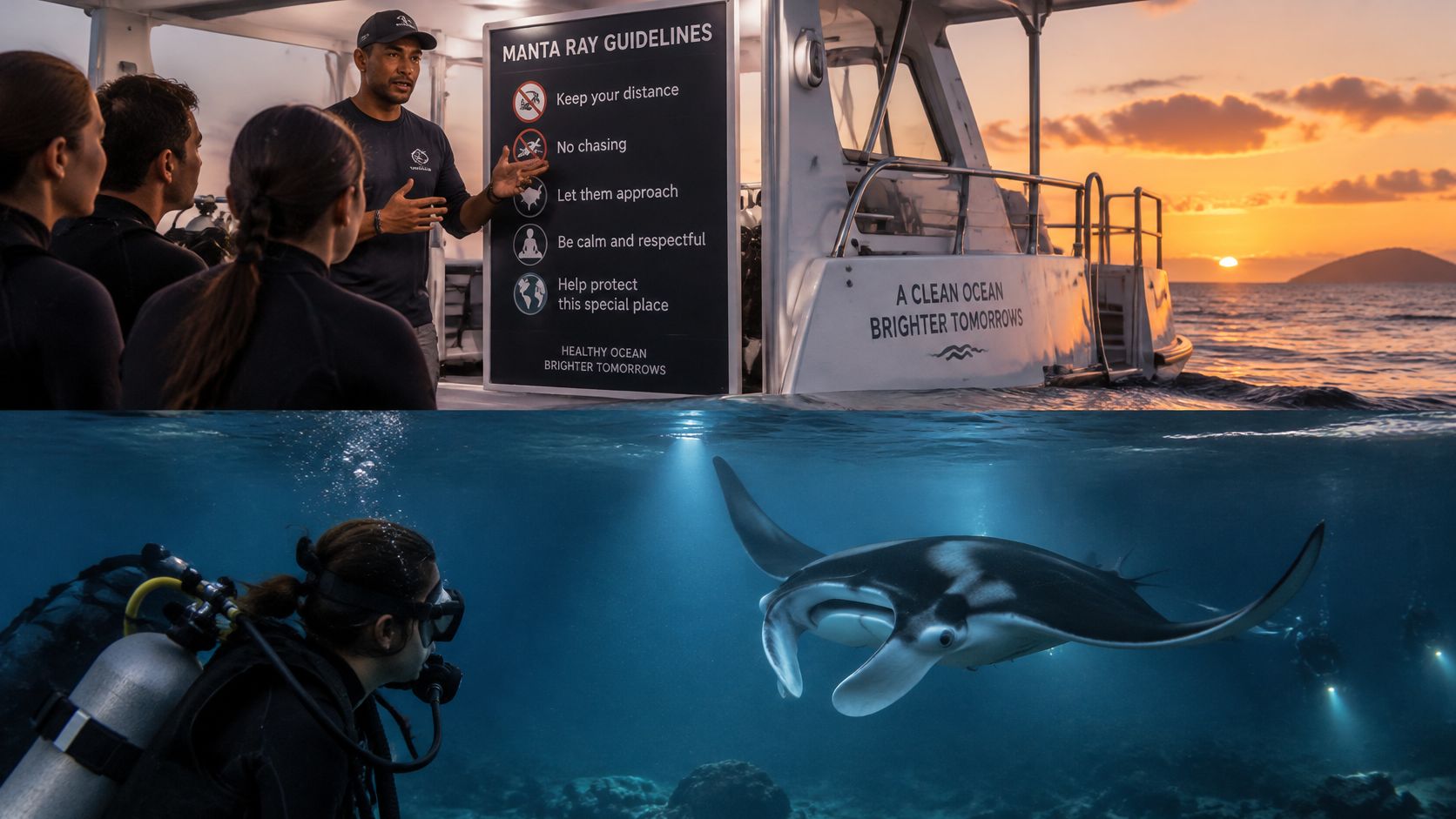
Your pre-entry positioning checklist
NOAA's voluntary wildlife-interaction standard separates divers near the bottom from snorkelers at the surface, leaving the central water column available for mantas.
- Choose the appropriate level of participation. Anxious or weak swimmers should use a guided surface option only after confirming suitability. Staying aboard is a valid decision.
- Keep scuba buoyancy controlled and remain near the assigned bottom position. Don't add weight to pin yourself down.
- Secure your snorkel and accessories. Remove dangling loops and route loose equipment so a passing animal can't catch them.
- Follow the guide's light directions. Keep camera strobes away from the animals' eyes, and don't sweep beams across other guests' faces.
- Protect the reef. Neither knees, fins, hands, nor camera arms belong on live coral.
- If a manta approaches unexpectedly, stay still and breathe normally. Signal the guide if uncomfortable; if you need to end the dive, leave the feeding lane with assistance and make a controlled ascent.
These actions apply the principles of responsible diver etiquette to a shared feeding space. Predictable guests are easier for guides to supervise and leave clearer paths for the animals.
Why local disturbance matters
NOAA's genetic study summary identifies genetically distinct island populations, each numbering only a few hundred individuals. Slow growth, late maturity, and low reproductive output mean losses aren't quickly replaced.
If you're unsure, stay still and let the manta decide.
How a Manta Night Dive Unfolds Step by Step
The manta night dive is stationary and closely supervised, not a roaming search through dark water. Knowing the sequence lets you spend less attention wondering what comes next and more attention watching the feeding area.
From briefing to viewing position
- Check in and listen to the briefing. The crew explains manta science, passive observation, and the evening's entry and exit plan. Mention anxiety, ear-clearing trouble, or unfamiliar equipment before gearing up.
- Assemble and test your equipment. Check your mask strap, regulator, buoyancy controls, computer, and dive light with your buddy, because small problems are simpler to fix aboard.
- Enter and follow the assigned descent. Experienced divemasters and instructors are in the water with our divers. Stay with the guide rather than following another group's lights.
- Settle in the designated sandy viewing area. Powerful dive lights create a bright circle on the seafloor, so divers aren't in complete darkness during the viewing portion.
The illuminated area makes the scene easier to understand, but the surrounding ocean is still dark. Keep your personal light accessible for entry, exit, communication, and any part of the dive away from the main lighting.
During the encounter and the return
- Watch the water above the lights. Plankton gathers in the illuminated area, and mantas may enter to feed. They're seeking prey, not food from divers' hands.
- Hold your assigned position outside the feeding lane. If a ray turns away, let it go rather than repositioning for another pass.
- Keep hands, fins, and equipment quiet. Avoid sudden kicks that stir sand or swing accessories into neighboring guests. Let the guide handle any necessary group adjustments.
- Leave with the guide and complete a controlled ascent. Once aboard, secure equipment, get warm, and debrief before becoming absorbed in photos.
A quiet wait is part of wildlife diving. You may see repeated feeding passes, a brief appearance, or no mantas at all, and continuing to chase an encounter doesn't improve the dive.
A successful evening can include:
- Several mantas feeding calmly, when attendance allows.
- An orderly group that stays out of their path.
- An unhurried exit with everyone accounted for.
The animal count isn't the only measure of success. Good judgment and undisturbed feeding matter even on a spectacular night.
What to Bring and How to Photograph Mantas
Bring a well-fitting mask, appropriate exposure protection, and a backup dive light. Familiar equipment is more useful than an elaborate collection of accessories you haven't practiced using.
Pack for comfort and control
- Mask and defog treatment. Test the seal before departure, and keep hair out of the skirt.
- Choose a thermal layer for your needs. A rash guard provides limited insulation, so use a suitable wetsuit if you get cold.
- Sun protection for the earlier boat portion. Apply an appropriate reef-conscious sunscreen well before entering, and favor protective clothing where practical.
- Charge lights and pack compatible spare batteries. Inspect seals and follow the manufacturer's battery instructions.
- Secure your snorkel and loose gear. Clip hoses and accessories close to your body without creating snag loops.
- Choose a camera you can manage without losing position. Add a towel and dry layer for the return.
Choose the smaller camera unless you need more
A compact action camera suits beginners because it's easy to carry close to the body and requires less adjustment. A larger housing with strobes makes sense for a diver who already has reliable buoyancy and experience handling that rig in dark water.
Use the examples in this Kona manta photography guide to plan framing before you enter. Keep the camera low and stable above the sand, rather than resting the housing on reef or spreading equipment into the viewing lane.
Aim strobes away from eyes, shoot short sequences, and stop shooting if the equipment distracts you from the guide. A bulky rig can swing into the feeding path even when its owner stays still.
The best photograph starts with a relaxed diver in position. The manta's behavior decides the frame, not your willingness to move closer.
How to Choose a Reputable Manta Dive Operator
Compare operators by what they explain before you pay, not just by the photographs on their booking pages. A responsible crew should make the evening's limits as clear as its attractions.
Evaluate the operating plan
- In-water supervision. Qualified guides should accompany participants, not supervise only from the boat.
- Look for a detailed briefing on manta behavior, entry procedures, communication, and passive observation.
- A stationary viewing plan. The operator should describe a designated position rather than a chase.
- Ask which site they intend to use and why. Garden Eel Cove is the benchmark for shelter, viewing layout, and surrounding reef.
- Clear eligibility requirements. Certification, recent diving activity, and the role of the PADI Manta Ray Diver course should be explicit before booking.
- Equipment should be maintained and appropriately fitted. Ask how the crew manages the group when someone needs individual help.
- Honest wildlife language. Treat an unconditional sighting promise as a reason to investigate further.
- Read recent reviews for details about briefings, nervous guests, and guide attention, not merely enthusiastic descriptions of mantas.
For our operation, Kona Honu Divers reviews provide a place to compare those practical details with guest accounts.
Ask questions that reveal the differences
Ask, “Where do you intend to dive, and what would make you change sites?” A useful answer discusses conditions and positioning rather than promising that one location is always calm.
Then ask who will be in the water with you, what happens if you feel uncomfortable, and how the crew protects feeding mantas. A good response includes a practical way to signal, receive assistance, or end participation without pressure.
Our experienced guides supervise the stationary encounter in the water, and our briefing explains passive observation before entry. Choose and reserve early enough to resolve suitability questions without rushing the decision.
Book Your Manta Ray Dive With Confidence
Choose a Garden Eel Cove manta tour that matches your qualifications, then organize the evening around comfort rather than spectacle. Kona Honu Divers offers a 2-tank manta ray charter, and Garden Eel Cove is our go-to site for the manta night dive.
Our manta night dive reports encounter rates of up to 92%. That's an operating result, not a promise for your departure, and outcomes still change with plankton and ocean conditions.
Your booking path
- Confirm eligibility first. Check your certification and recent dive history, and complete the PADI Manta Ray Diver specialty before the night dive. Non-divers should select snorkeling or establish the appropriate training pathway.
- Choose the charter if you meet its certification and recency requirements. Don't select scuba merely because it sounds more adventurous.
- Reserve your preferred date early. Keep another evening available where your travel schedule allows.
- Review conditions before departure and follow the crew's site decision. A change made for safety isn't a lesser experience.
- Arrive ready for the briefing. Bring required documentation, disclose relevant concerns, and leave camera setup until the essential instructions are finished.
You can compare the broader Kona diving tour lineup if you're planning additional water time. Blackwater and advanced reef trips serve different interests and should be selected for their own demands, not treated as interchangeable additions to a manta evening.
The strongest booking decision is straightforward: suitable training, manageable equipment, a sheltered site when conditions permit, and guides who prioritize passive viewing. Reserve the Garden Eel Cove tour and give the mantas room to approach on their own terms.
Kona Honu Divers offers guided manta diving and surface-viewing experiences centered on respectful encounters with Kona's resident rays. Visit Kona Honu Divers to choose the option that fits your experience, reserve your Garden Eel Cove trip, and see the mantas for yourself.