
Kona's manta ray night dive is a structured evening trip to a sandy-bottom viewing area lit from below, where divers kneel in a semicircle and watch reef manta rays feed on plankton attracted to the lights. The area supports a resident population of nearly 200 individually identified manta rays, and operators commonly report 80% to 90% sighting success on an average night.
You leave the harbor after sunset, descend into dark water, and settle beside the underwater lights. The boat ride and the cold are part of the bargain, but once a manta banks into the beam and rolls slowly above your mask, the waiting makes sense. Kona's experience developed into a formal tourism activity in the early 1990s, and sites such as Garden Eel Cove, also known as Manta Heaven, now provide a repeatable way to observe wild animals without chasing them (history of the Kona manta ray night dive).
What a Manta Ray Night Dive Actually Looks Like
The evening starts on a boat heading away from the harbor and toward a fixed feeding station. Once the crew reaches the site, surface lights and the dark outline of the viewing platform become your reference points. You'll hear a briefing before entering the water, because the encounter works only when everyone understands the same basic rule: the people stay still and let the mantas do the moving.
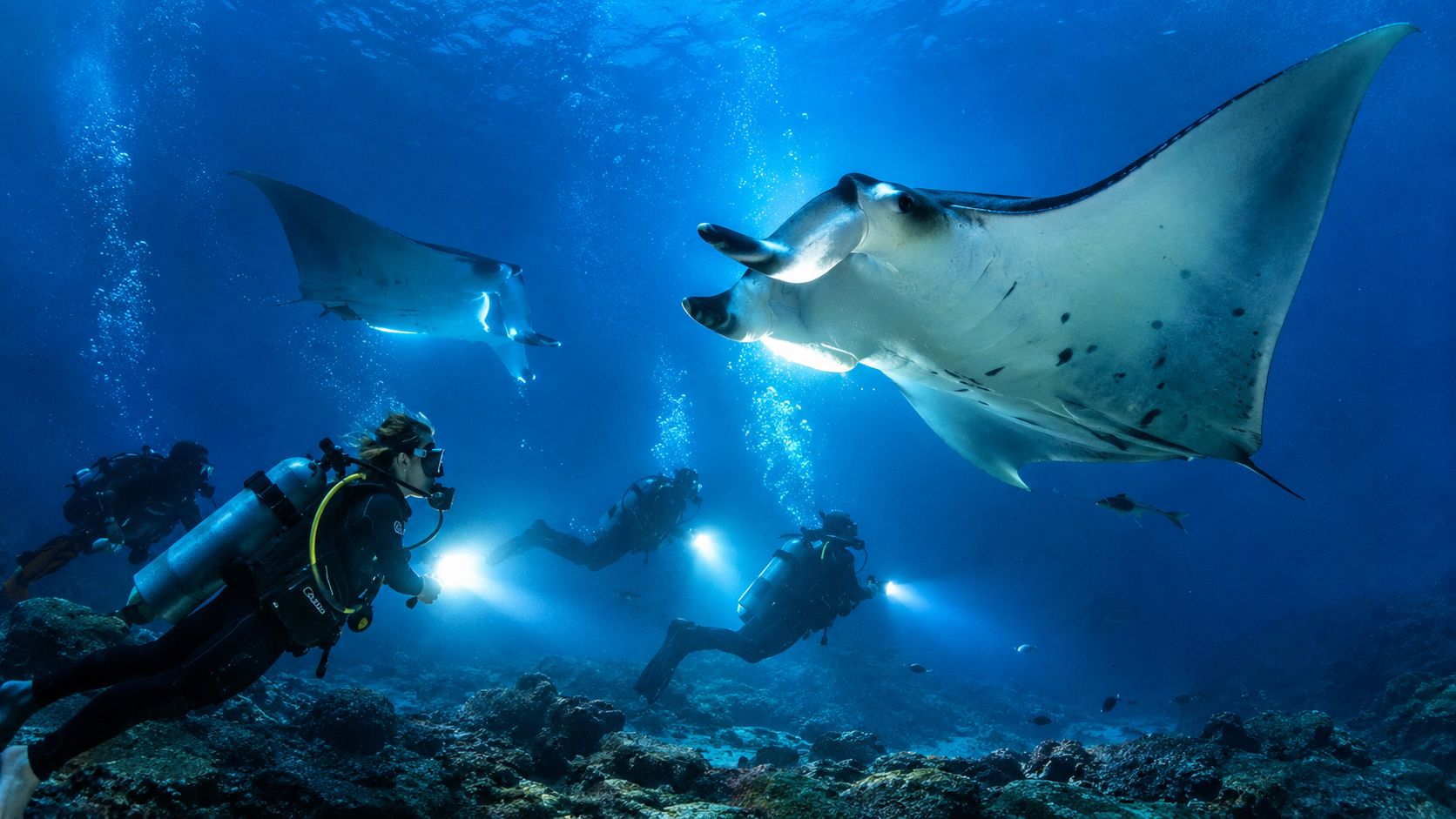
Divers descend to a sandy viewing area generally described at roughly 25 to 35 feet at Garden Eel Cove (Garden Eel Cove site description). A weighted frame holds powerful lights on the seafloor. Those lights draw zooplankton into a concentrated column, creating what operators often call the lighted campfire. Divers arrange themselves in a semicircle or compact ring, point their lights upward, and watch the water above the beams.
The evening in practical terms
The boat ride can feel exposed because the coast disappears into darkness. Even on a calm night, wind, swell, and the boat's motion may make you work harder than expected before the dive begins. Bring a warm layer for the ride home, and expect the water to feel cool once you stop moving.
At the bottom, the first minutes can seem uneventful. The lights need time to gather plankton, and the group needs time to settle. Then a broad shadow appears above the beam. A reef manta may make a slow pass, turn, and return in a controlled barrel roll, sometimes coming close enough that its underside fills your entire view.
Snorkelers can usually watch from the surface around a floating light platform while divers observe from below. The two experiences share the same wildlife encounter, but scuba places you beside the light source and gives you a lower, more immersive perspective.
Booking, Certification, and Gear to Bring
Reserve early if the manta ray night dive is a priority for your trip. Kona has a small number of established viewing locations, and demand can concentrate around the best-known sites. Before paying, confirm the departure point, check-in details, cancellation terms, weather policy, equipment inclusions, and whether the operator is running Garden Eel Cove that evening.
For scuba, you'll need recognized Open Water certification or an equivalent qualification. The dive isn't technically complicated, but nighttime conditions expose poor buoyancy control quickly. An Advanced Open Water background can make deeper or darker water feel more comfortable, though the most important skills are controlled breathing, reliable mask clearing, and the ability to remain stationary without damaging the bottom.
If you're still building confidence, review the operator's scuba learning resources before traveling. A night wildlife dive isn't the right place to discover that you dislike removing your mask, struggle to control your ascent, or rely on your hands for balance.
Pack for the whole evening
Your personal checklist should include:
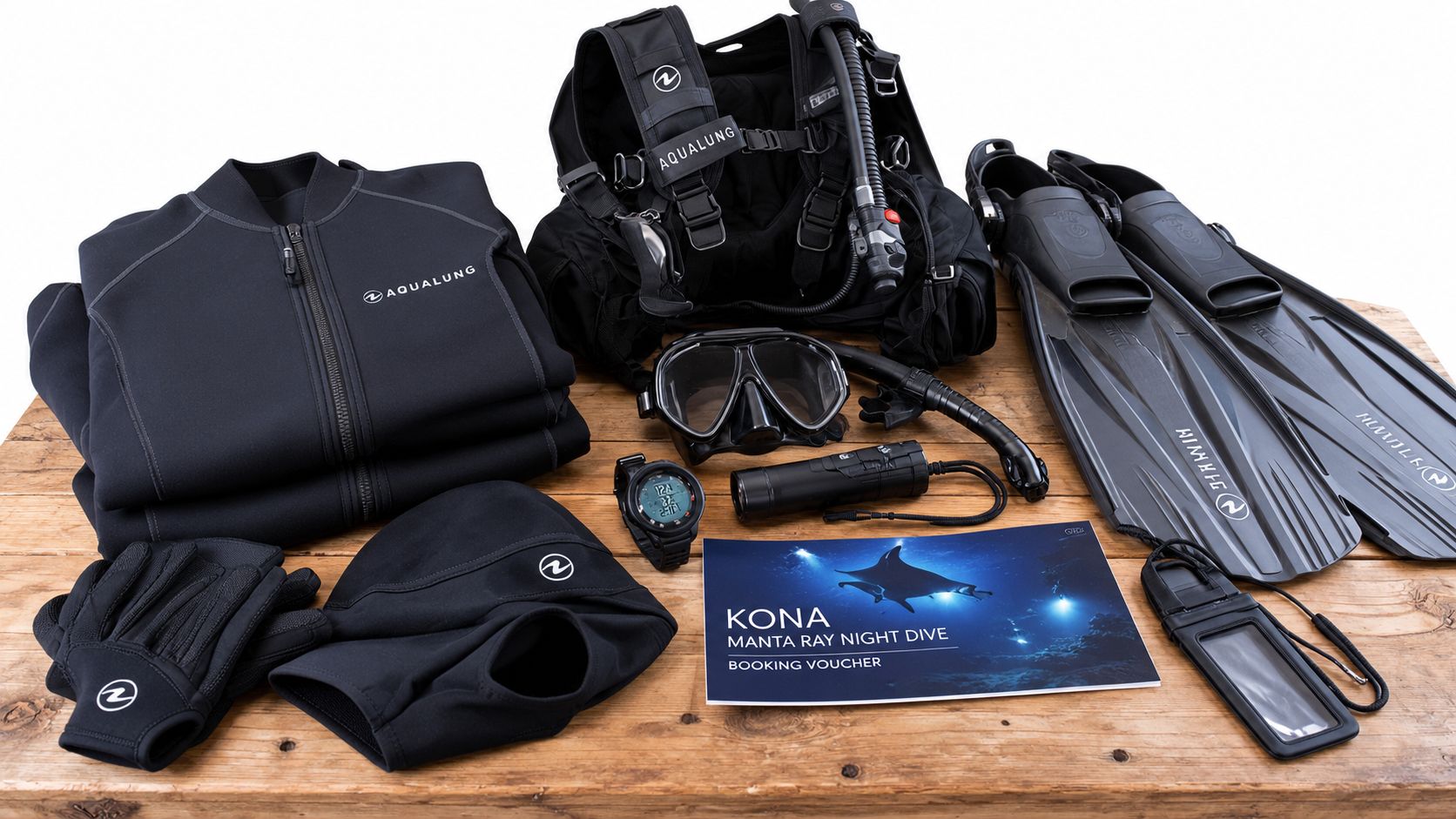
- Exposure protection: Bring swimwear and a warm layer for the boat. Ask about the wetsuit thickness supplied or available for rent.
- Core scuba equipment: Confirm whether the operator supplies the regulator, buoyancy compensator, tank, weights, mask, fins, and dive computer.
- Lighting: A primary dive light is useful, but follow the crew's instructions about where to point it. The goal is to illuminate the plankton column, not blind a manta.
- Dry items: Pack a towel and a way to protect phones, wallets, and medication from spray.
- Required paperwork: Expect a liability waiver and a dive medical questionnaire or statement. Complete them carefully and disclose relevant conditions.
Seasickness deserves honest preparation. The crossing can be uncomfortable for some people, especially when the boat slows or waits at the site. Discuss medication with a pharmacist or physician, follow the product label, and consider options such as Ship-EEZ Seasickness Patch, Dramamine pills, Bonine pills, Sea Band wristbands, and ginger chews. Don't test a medication for the first time immediately before diving if you don't know how it affects your alertness.
Choosing Garden Eel Cove for the Manta Encounter
Garden Eel Cove, or Manta Heaven, is the stronger choice when the priority is a comfortable, well-defined viewing setup. Its geography offers more shelter from large open-ocean swell, and site descriptions place the viewing area on sand near a reef structure at approximately 25 to 35 feet (Garden Eel Cove overview).
That protection matters. A calmer surface makes entries, exits, and snorkeling logistics easier, while a consistent sandy area gives divers a clear place to settle without spreading across living reef. The fixed arrangement also helps the crew manage lights and spacing.
Manta Village near Keauhou Bay is an established and famous location, but popularity can bring more concentration around the viewing area. Garden Eel Cove is the preferred site for an operator choosing a protected location with a better-defined viewing area and stronger reef setting. That doesn't make the animals predictable. Wild mantas can change their movements, and no responsible crew should promise a uniform show.
| Factor | Garden Eel Cove, Manta Heaven | Manta Village, Mauna Kea |
|---|---|---|
| Surface conditions | More protected cove geography and calmer viewing conditions | More exposed anchorage conditions |
| Viewing area | Sandy setup suited to a fixed light formation | Established viewing site with heavier visitor concentration |
| Reef setting | Better-defined reef and sandy-bottom arrangement | Sandy patches can be deeper or less uniform |
| Crowd trade-off | More controlled feel for divers and photographers | Greater popularity can mean more people around the site |
| Photo potential | Stable positioning and predictable light placement help composition | More surrounding activity can complicate framing |
For a closer look at the available experience, review the Kona manta ray tour details. The practical advantage of Garden Eel Cove isn't a guarantee of more animals. It's the combination of protected water, an established reef, and a usable viewing area.
In-Water Procedure and the Lighted Campfire
The crew's job begins before you reach the bottom. Enter carefully, keep your regulator or snorkel in place, and descend under control. Once you reach the sand, a divemaster positions divers so everyone faces outward toward the open water and the light field remains unobstructed.
The lights sit on the bottom, not in the divers' hands. Their purpose is to gather plankton, and your handheld light should support your awareness without competing with the main beam. Settle with enough space between your knees and your neighbor, keep your fins off the bottom, and avoid using your hands to push against sand or reef.
Practical rule: If you can feel yourself drifting, correct with a small breath and a controlled body position. Don't solve a buoyancy problem by finning hard above the sand.
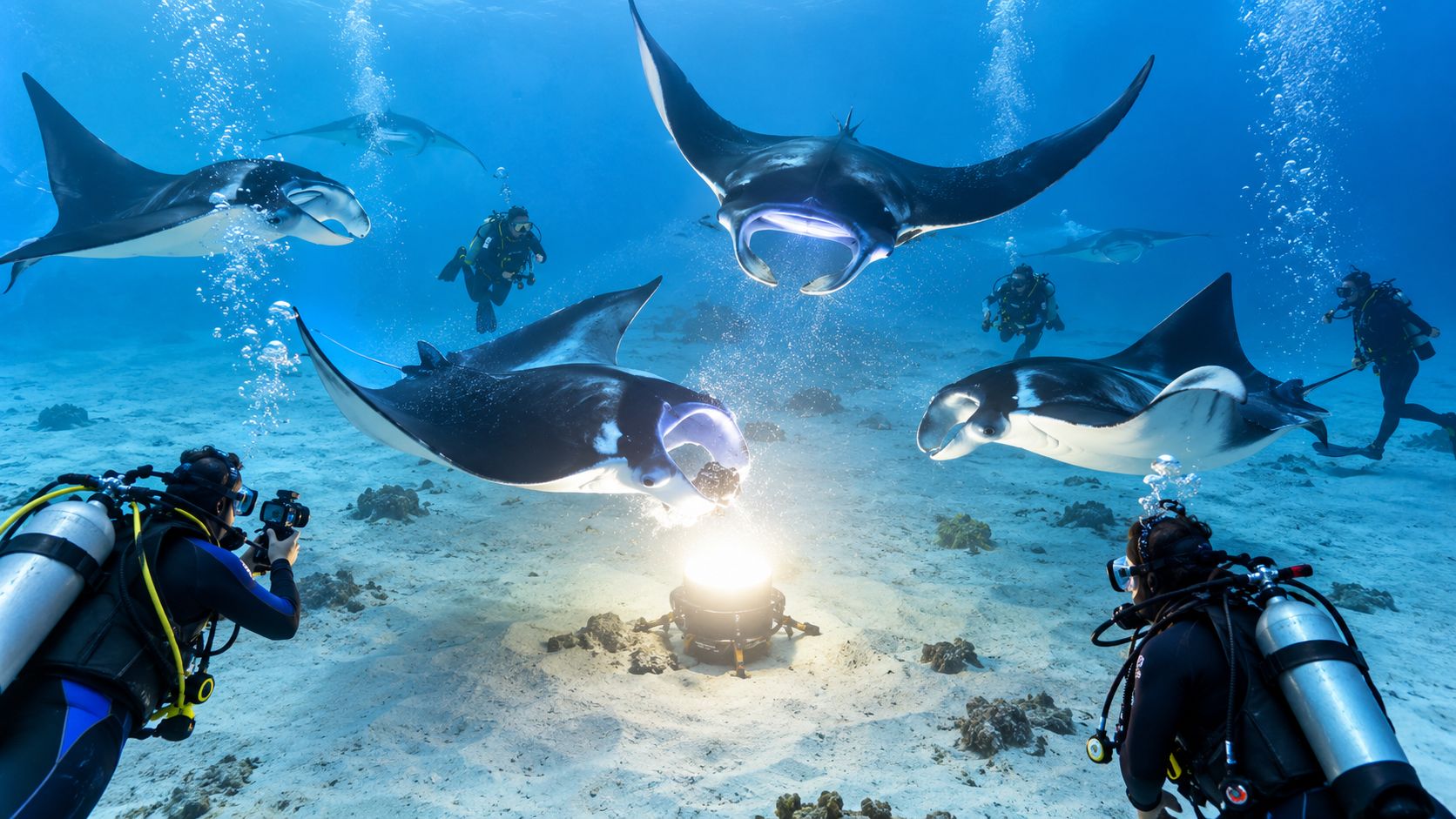
The semicircle works because it creates a broad, low-disturbance viewing zone. Divers form the edge of the campfire while the mantas pass through the illuminated water above. Finning stirs sediment, and sediment reduces visibility for everyone. Dangling gauges, loose camera straps, and raised hands can also become obstacles in the animals' path.
Read the animal, not the clock
A feeding pass often begins with a manta entering the outer edge of the light. It may circle, bank, and return with its mouth open and cephalic fins extended. During a barrel roll, the manta uses its body position and fins to remain in the plankton-rich beam. Your best response is to stay still, tuck loose equipment close, and let it choose the distance.
Use the standard signals agreed during the briefing:
- OK: Make the familiar circle with thumb and forefinger.
- Up and down: Point clearly in the relevant direction.
- Problem: Use the established problem signal, then indicate the issue.
- Low air or separation: Tell your buddy and the divemaster immediately.
Never chase, touch, block, or grab a manta. The responsible diver etiquette guide explains the broader principle: wildlife encounters work best when the animals control the interaction.
Manta Behavior and the Science Behind the Feed
The lighted campfire shows only one part of the animal's night. Research indicates that reef and giant manta rays can make their deepest dives after dark, with movement connected to nocturnal feeding and the vertical migration of prey. Some tagged mantas have made dives hundreds of meters deep and, in some records, beyond 1,000 meters (peer-reviewed research on manta diving behavior).
That finding changes how you interpret the encounter. A manta circling a dive light isn't performing on demand or remaining at one shallow reef all night. It's exploiting a concentrated food source for a while, then may move through different depths and areas as prey distribution changes.
What the beam changes
Zooplankton naturally move through the water column after dark. Artificial light concentrates some of that activity near the viewing station, giving filter-feeding mantas a temporary feeding lane. The manta approaches with its mouth open, directs water inward, and uses its cephalic fins to help funnel prey toward the mouth.
NOAA material also describes substantial differences between daytime inshore behavior and nighttime offshore feeding, along with individual variation in depth and site use. A recent NOAA-linked framework reports that males and females can use sites differently, so the assumption of a perfectly uniform encounter oversimplifies what the animals are doing (NOAA manta ray framework).
Kona's population is individually recognizable through belly markings, and guides often use those patterns to identify returning animals. Some dive guides report more than 60 named individuals photographed repeatedly at the main night-dive site, while broader estimates describe nearly 200 individually identified manta rays in the resident population (Kona manta ray night-dive observations). That identity work gives the encounter a scientific dimension. You're not only watching a large animal pass through a light beam. You may be observing a known individual whose movements contribute to long-term conservation records.
Safety, Etiquette, and DLNR Rules to Know
The safest diver is the one who manages position before the first manta arrives. Check your weighting, keep your breathing slow, and maintain enough buoyancy control to hover without kneeling on coral. The sand is a staging area, not a reason to drag fins, drop knees onto reef, or use living structures for balance.
Hawaiʻi Department of Land and Natural Resources rules for manta-ray viewing zones include slow-no-wake vessel operation and prohibit anchoring within the zone. The rules also restrict certain activities to at least seven nautical miles outside a designated manta-ray viewing-zone boundary (Hawaiʻi DLNR manta viewing rules). Follow the crew's briefing because local operating requirements and site procedures can be more specific than a visitor expects.
Keep hands off the animals, avoid chasing them, and control your lights. Don't release anything, leave equipment on the reef, or swim into another diver's space for a better angle. Your buddy should remain easy to locate, and any concern about air, discomfort, or equipment belongs in the briefing and underwater signals.
| Issue | Recommended Fix |
|---|---|
| Seasickness | Tell the crew early, stay where they can monitor you, and use only a preventive product you've checked with a qualified medical professional. |
| Mask fog | Clear and defog the mask before descent, then avoid touching the lens with wet fingers. |
| Silt-out from finning | Stop kicking, stabilize your body, and re-hover until visibility improves. |
| Manta approaches closely | Tuck your arms and camera gear in, stay still, and let the animal turn away. |
| Low air or anxiety | Signal your buddy and divemaster, then ascend under control according to the dive plan. |
The considerate diver guidance is worth reading before arrival, especially if you're bringing a camera or diving in a group. The best image is never worth blocking an animal or destabilizing the viewing formation.
Photography Tips, FAQs, and Booking Your Dive
Use a wide-angle setup so the manta fits in the frame without forcing yourself toward it. A rectilinear or fisheye lens gives you room to compose the animal, the light beams, and the surrounding divers. Keep your camera steady, shoot in short continuous bursts during a barrel roll, and leave space in front of the manta for its direction of travel.
A strobe or video light can reveal detail, but don't aim a powerful beam directly into the animal's face. Use the crew's lighting as the main scene source, and keep your own focus light controlled. Manual exposure can help when the background is nearly black, but the correct setting depends on your camera, lens, and light output. Review a few test frames early, then stop adjusting when the action begins.
Questions divers usually ask
Can non-divers join? Yes. Snorkelers can observe from the surface around a floating light platform, while divers watch from the sandy bottom. The manta ray snorkel option suits travelers who want the encounter without scuba certification.
Are manta rays dangerous? They're gentle filter feeders with no interest in biting people. They're still wild animals, so keep distance, avoid contact, and allow every manta a clear route.
Is the experience available year-round? Kona's resident manta presence supports year-round viewing, but sightings and conditions can vary. Historical reports describe Manta Village sightings on more than 90% of nights, while operators commonly report 80% to 90% success across Kona, not a guarantee for any individual trip (Kona sighting information).
What happens if mantas don't appear? Ask the operator about its specific weather, cancellation, and rescheduling policy before paying. No company can control a wild animal's behavior.
For a dedicated evening departure, confirm the meeting location, included exposure gear, weights, and dive lights before you reserve. Build flexibility into your itinerary so rough conditions or an unexpected cancellation doesn't eliminate the experience.
Kona Honu Divers offers a dedicated manta ray night dive for certified divers, with crew-led briefings, underwater lights, and equipment support for the Garden Eel Cove encounter. Check the evening schedule and current conditions, then reserve your place through Kona Honu Divers before your Kona trip fills with other plans.