
You've been looking at photos of manta rays gliding through black water, wondering whether the experience can possibly match the images. In Kona, the answer depends less on luck than on understanding what brings the animals to the boat, how the viewing site is shaped, and whether your behavior helps preserve the feeding area.
Manta ray diving in Hawaii is not a baited wildlife encounter. It's a carefully managed meeting between divers, artificial light, plankton, and a localized population of reef manta rays. Once you understand that chain, the briefing, the viewing boundary, and the choice of dive site all make much more sense.
Experience the Magic of Kona Night Dives
The first sensation is usually the darkness. Beyond the boat's lights, the Pacific seems to disappear, leaving you suspended above a sandy bottom while beams of illumination rise through the water. Then a pale underside appears, turns, and passes overhead. A reef manta ray can seem to materialize from nowhere, glide through the light, and vanish back into the blue-black water with barely a sound.
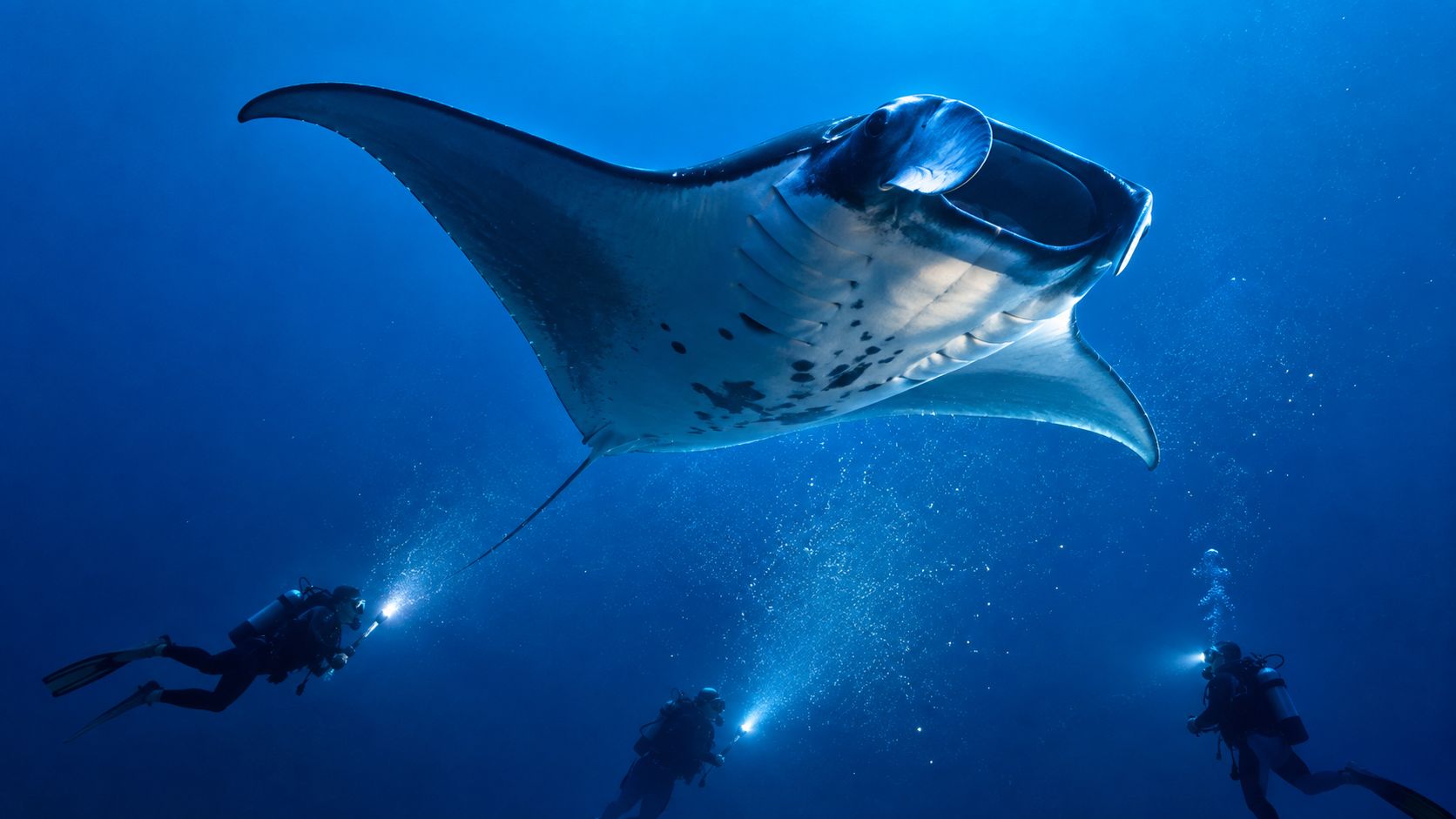
A typical outing begins before anyone enters the ocean. The crew explains the boat layout, entry and exit procedures, hand signals, light use, and the position each group will hold during the encounter. That briefing matters because the manta rays aren't swimming randomly. They're following the plankton concentrated in the illuminated water, and every diver or snorkeler who moves into that corridor can alter the pattern.
From the surface, snorkelers watch the lights and the rays from above. Scuba divers descend toward the sandy or rubble bottom, settle into a stable position, and look upward as the animals make repeated passes. The contrast is striking. You're close enough to notice the shape of a cephalic fin or the markings on a ray's underside, yet the animal remains completely wild and independent.
What it feels like: You aren't swimming with a trained animal. You're holding your position while a wild filter feeder chooses how close to come.
Kona's night-diving tradition began in 1991, when a local dive operator noticed that underwater lights near the Kona Surf Hotel attracted plankton and, in turn, manta rays. What started as approximately one organized outing per week developed into a nightly activity involving multiple boats. The original viewing area was temporarily abandoned from 2000 to 2004, after the hotel closed and its lights were switched off. Mantas returned after floodlights were installed when the property reopened in 2004, a history documented in this account of Kona's manta-ray night-diving origins.
That story explains why the experience is concentrated at established viewing sites rather than spread evenly along the coast. The attraction comes from a particular combination of artificial-light ecology, recurring manta behavior, and a long-established viewing routine. You can learn more about the visual character of the encounter through these Kona manta-ray dive pictures, but photographs still can't reproduce the sensation of looking into the darkness and seeing a manta turn directly above you.
Understanding the Predator Prey Mechanism
The manta encounter begins with food, not tourism. Kona's coastal waters are relatively oligotrophic, meaning they contain limited nutrients compared with highly productive marine environments. Reef manta rays, Mobula alfredi, solve that problem by moving to places where small prey becomes temporarily concentrated.
The process works in a simple sequence:
- Lights enter the water. Operators place or aim lights upward from the seafloor, while surface snorkelers direct lights downward.
- Zooplankton gather. Many small organisms respond to illumination or become concentrated within the visible light field.
- Mantas follow the prey. The rays arrive to filter-feed, passing through the illuminated water with their mouths open.
- The viewing area becomes predictable. Because the food repeatedly gathers in the same type of light field, the animals return to established feeding locations.
This is why the animals aren't being fed by people. The lights alter the distribution of their natural prey, and the manta rays exploit that temporary concentration. Research on Hawaiian reef mantas describes their repeated use of specific coastal feeding and cleaning habitats, as well as a general preference for shallower water than 50 meters. The ecological mechanism is explained in this peer-reviewed study of Hawaiian reef manta movement and habitat use.
That distinction changes how you should behave. If you chase a manta, you aren't helping it find food. You're making yourself part of the obstacle it must avoid. If you stay still at the viewing boundary, the animal can maintain its feeding path and decide whether to pass near you.
Night diving also fits the manta's wider vertical-migration ecology. NOAA status-review evidence reports that manta rays can descend approximately 200 to 450 meters at night when they exploit deeper zooplankton layers. Nearshore lights create a different opportunity by concentrating prey in shallow water, so a manta may forage offshore at depth under one set of conditions and visit a lit coastal feeding station under another. The deeper movement and nocturnal prey behavior are outlined in this NOAA manta-ray status-review work product.
The useful mental model: The lights create a feeding location, not a performance stage. Your job is to occupy as little of the feeding geometry as possible.
The rays' broad wings and slow-looking turns can make them seem unhurried, but they're still navigating a confined column of water. Neutral buoyancy, controlled breathing, and small fin movements keep you from rising into the path or stirring sediment into the light. The better you understand the mechanism, the easier it is to see etiquette as part of the science rather than a list of arbitrary restrictions.
Choosing the Best Dive Site in Kona
For most divers, Garden Eel Cove, also known as Manta Heaven, is the superior choice for a manta dive tour. Its protected location, defined sandy viewing area, and surrounding reef structure create a more comfortable setting than a less-sheltered offshore site.
Garden Eel Cove sits near Kailua-Kona in protected water. Reported site depths range from approximately 30 to 70 feet, and the sandy bottom gives divers a relatively unobstructed place to settle while mantas feed above. The cove's surrounding reefs also support additional marine life, so the site offers more than a featureless night platform. Its geography and bottom structure are described in this Garden Eel Cove dive-site guide.
Why protection changes the experience
A protected cove doesn't guarantee flat water, and no responsible operator can promise identical conditions every night. It does, however, reduce exposure to larger ocean swells compared with a more open location. That difference matters if you're prone to seasickness, new to night diving, or sharing the boat with family members who may find a rolling surface tiring.
The bottom matters just as much. A sandy viewing area gives scuba divers somewhere clear to hold position without kneeling on living coral or drifting through reef structure. It also makes the light field easier to understand. You can see where the beams are working, where the animals are moving, and where the viewing boundary begins.
The reef habitat adds another advantage. Mantas gather to feed, but divers still enter a living marine environment. Garden Eel Cove's nearby coral habitat supports additional observation before or after the central encounter, while the protected geography makes the overall dive feel less exposed.
Weather and access are separate questions
Kona's manta presence can be described as year-round, but that doesn't mean every trip departs or that every night feels equally comfortable. A 2025 activity log for Kauna'oa Bay recorded 270 operating nights and reported 28 cancellations in both January and February. February was completely shut down in that log, while March recorded 11 cancellations, including 10 caused by high surf and one associated with box-jellyfish activity. The operating record is available through this 2025 manta activity log.
Separate three questions when planning:
- Can the boat depart? Weather and marine hazards can cancel a trip even when mantas are present.
- Will the conditions suit you? A trip can operate while still feeling uncomfortable for a seasickness-prone guest.
- Will mantas appear after departure? They're wild animals, so sightings can never be treated as a mechanical guarantee.
Garden Eel Cove is the location I'd favor for comfort and viewing structure, especially when conditions are unsettled. Before booking, read the operator's cancellation and rebooking terms, and don't place the experience on your final evening in Kona if it's the main reason for your visit. A daytime reef activity makes a sensible backup.
Dive Certification and Skill Requirements
Scuba and snorkeling offer different viewpoints, and they call for different preparation. Snorkelers remain at the surface, while scuba divers descend to the bottom and manage a complete life-support system in darkness. Neither option is automatically more authentic. The right choice depends on your certification, water comfort, and ability to remain calm when a large animal passes close by.
Snorkeling at the surface
A snorkel guest should be comfortable floating, breathing through a mask and snorkel, and following crew directions in open water at night. The surface position is deliberate. It keeps snorkelers above the feeding corridor while the lights draw plankton upward and the mantas make passes below.
Snorkeling can suit visitors who haven't completed scuba training, but comfort is still important. If you dislike floating in deep water, struggle with mask skills, or become anxious when visibility is limited, tell the crew before entering. A flotation aid and clear instructions can help, but they don't replace honest self-assessment.
Scuba diving from the bottom
Scuba participants need an Open Water certification for the manta dive. The encounter is conducted in relatively shallow viewing conditions, with Garden Eel Cove's reported site depths ranging from approximately 30 to 70 feet, as described in the Garden Eel Cove site information. Certification alone isn't enough if you haven't dived recently or feel uneasy controlling your buoyancy at night.
Before the trip, consider whether you can:
- Hold neutral buoyancy: You should be able to stop without resting on coral or kicking continuously.
- Manage your equipment: You must locate your regulator, mask, inflator, and lights by feel if the surrounding water becomes very dark.
- Stay in position: The manta viewing zone rewards patience, not active pursuit.
- Communicate calmly: Hand signals and light signals become more important after sunset.
If your certification is incomplete, the Open Water certification course provides a route into scuba under instruction. If you're certified but rusty, a refresher or a daytime dive can help you rebuild confidence before attempting a night encounter.
Physical readiness matters too. You don't need to be an athlete, but you should be able to enter and exit the boat, use your equipment, and remain composed in moving water. Tell the operator about relevant medical conditions, recent illness, medication, or concerns about seasickness before the trip instead of attempting to handle issues privately once you are offshore.
Manta Ray Diving Safety and Etiquette
The best manta encounter is passive. You position yourself where the crew directs you, keep your body predictable, and let the animal choose its route. That approach protects the manta, reduces collisions, and often produces better photography than swimming after a ray.
Divers and snorkelers have different jobs
Scuba divers should remain on or near the sandy, rubble, or boulder bottom. That position leaves an open-water corridor above for the mantas. Snorkelers should stay at the surface and avoid descending into the feeding path. When both groups hold their separate positions, the animals can move through the light field without navigating around a wall of people.
| Participant | Best position | Main responsibility | Why it matters |
|---|---|---|---|
| Scuba diver | Sandy, rubble, or boulder bottom | Maintain buoyancy and stay inside the designated boundary | Keeps the feeding corridor open |
| Surface snorkeler | Surface flotation position | Remain above the manta path and follow crew spacing | Prevents vertical crowding |
| Photographer | Assigned position within the group | Use approved lighting without chasing | Protects predictable animal movement |
Keep your light aimed into the water rather than directly at a manta. The purpose of the light is to concentrate plankton, not to illuminate the animal's face. Follow the crew's instructions about light placement and intensity, and disable flash unless the operator specifically approves a technique.
A fixed camera position usually beats a fast-swimming approach. Set your exposure, compose toward the light field, and wait. The manta may pass through the frame on its own, giving you a cleaner image and avoiding the sudden movements that can scatter the viewing group.
The rules protect the encounter
Never touch, grab, block, chase, or attempt to ride a manta ray. Don't reach toward a cephalic fin as the animal turns, and don't swim across its feeding line to obtain a closer angle. The guidance for low-impact viewing emphasizes staying at the surface when snorkeling, avoiding the feeding path, disabling flash, and allowing the animals to approach naturally. These practices are summarized in this Kona manta-ray snorkeling etiquette guide.
For photographers: The most dramatic frame often comes from patience. A manta that approaches a stationary diver is a better subject than one being pursued.
Sediment is another concern. A fin kick near the bottom can cloud the light field and reduce visibility for everyone. Use small, controlled movements, keep your fins away from the sand, and signal the crew if you lose buoyancy control rather than trying to correct aggressively.
Manta rays are filter feeders and aren't generally considered a direct threat to people. The primary safety concern is the ocean environment, including darkness, boat movement, currents, equipment, and changing weather. Listen to the briefing, stay with the group, and accept a crew decision to shorten or cancel the encounter when conditions deteriorate.
Booking, Pricing, and Conservation Insights
A good booking decision starts by separating the advertised package from the actual experience. Ask whether you're choosing scuba, snorkeling, or a combination, which site the operator plans to use, what happens if weather interrupts the trip, and whether rebooking is possible. Price should be considered alongside the boat's comfort, crew-to-guest attention, equipment standards, and the clarity of its safety procedures.
Garden Eel Cove deserves priority when the itinerary offers it. The protected setting, sandy bottom, and surrounding reef habitat give the dive a stronger physical foundation than a less-sheltered location. That doesn't eliminate marine risk or guarantee a sighting, but it improves the conditions in which divers can hold position and observe responsibly.
A two-tank package can also make sense for certified divers who want a daytime reef dive followed by the nighttime manta encounter. The daytime portion lets you settle into your equipment and check your buoyancy before darkness changes the task. Snorkelers should look for a package designed around surface flotation rather than assuming a scuba itinerary will provide the same experience.
For boat-based planning, review the available Big Island boat tours and ask specific questions before paying. A transparent operator should explain the meeting point, water-entry process, equipment supplied, certification requirements, minimum comfort expectations, cancellation terms, and what happens if the site changes.
One option for this experience is Kona Honu Divers, which offers a two-tank manta package combining a dusk reef dive with a nighttime manta dive at Garden Eel Cove, as well as a manta-ray night snorkel. The scuba manta portion lasts about 45 minutes and requires Open Water certification, according to the available product information.
Why local conservation matters
The animals at Kona's viewing sites aren't an anonymous supply of wildlife passing through. A NOAA-led genetic study involving the Hawaii Association for Marine Education and Research and the University of Miami identified 318 unique manta rays around Hawaii Island since 1979. The same research estimated approximately 104 adult breeders around Hawaii Island, compared with 129 adult breeders across Maui Nui, where approximately 600 individuals had been documented since 2005. These findings are reported in this coverage of the Hawaii reef-manta genetic study.
The study also found strong geographic fidelity. Reef mantas generally remain close to their home island and rarely cross the deep channels separating island groups. Reported migration rates were extremely low, roughly one female moving between island groups every 1,300 years and one male about every 64 years. Those figures don't mean an individual animal can never travel. They show that the populations are comparatively localized, so protecting Kona's feeding and cleaning habitats matters to a limited local breeding stock.
That localization gives individual conduct real weight. A diver who maintains neutral buoyancy, keeps lights directed correctly, and avoids pursuit helps preserve the feeding geometry that makes the encounter possible. An operator that manages group positioning and cancels when conditions become unsafe helps protect both visitors and the animals.
The activity is also not guaranteed just because manta rays are present in the region. Weather may prevent departure, surf may make entry unsuitable, marine hazards may change the plan, and wild animals may choose another feeding pattern. Schedule the trip early enough in your stay to allow for a weather-related change, ask about rebooking before you reserve, and keep a calm daytime alternative available.
The most responsible mindset is straightforward. You're not purchasing access to a performance. You're joining a controlled observation of a wild feeding event, in a place where artificial light, plankton behavior, reef geography, and resident manta fidelity have aligned for decades.
Kona Honu Divers offers guided scuba and snorkeling experiences that include the Garden Eel Cove manta encounter, giving you a way to explore the light-and-plankton mechanism from the surface or the seafloor. Visit Kona Honu Divers to review the manta options, confirm certification requirements, and check availability before your Kona evening is booked.