
You're probably in one of two places right now. You've either booked a Hawaii trip and keep seeing videos of giant rays looping through blue light, or you're already certified and trying to decide whether Kona's famous night dive is worth rearranging your itinerary for.
It is. But manta ray diving in Hawaii makes more sense, and feels a lot less intimidating, when you understand what's happening underwater.
On the Kona coast, divers settle onto a sandy bottom while lights draw in plankton. Then the mantas arrive to feed, sweeping overhead like silent aircraft with wingspans around 14 feet in this population. These are reef mantas (Mobula alfredi), and they're harmless filter feeders with no stingers or teeth, according to this Kona manta overview and the verified data above. What surprises first-timers isn't danger. It's closeness. A manta can pass so near that you hear your own breathing change.
Kona stands apart because this is a resident, non-migratory population seen year-round, with famous sites such as Manta Village and Manta Heaven producing sightings on over 80% of nights in one verified account and 85 to 90% in another verified account. That consistency is why so many divers build an entire Big Island trip around one evening in the water.
Introduction to Manta Ray Diving
A first manta night dive usually starts the same way. You gear up at dusk, chat a little too loudly on the ride out, then get quiet as the sun drops and the shoreline lights grow small behind the boat. Once you descend, the scene changes fast. The ocean floor is simple. Sand, a semicircle of divers, beams of light pointing into the water column. Then a dark shape appears, banks through the glow, and turns into a manta ray.
That's the core of manta ray diving in Hawaii. It isn't a chase. It's a stationary wildlife encounter built around feeding behavior. Along the Kona coast of Hawaii Island, this works unusually well because the reef mantas here are residents rather than migratory visitors. Verified data describes Kona as one of the most reliable and famous manta encounter locations in the world, with an estimated 80,000 people snorkeling and diving with reef mantas annually, average sightings of six mantas per night at primary sites, and a highest recorded single-night sighting of 36 mantas.
Why Kona feels different
Most marine wildlife dives ask you to search. Kona's manta dive asks you to hold your position and let the action come to you.
The sites are shallow, usually around 30 to 40 feet, which gives divers long viewing windows of about 45 to 60 minutes in verified descriptions. Summer from May to September is commonly cited for calmer ocean conditions, though the local mantas can be encountered year-round because they stay along the coast.
Practical rule: If you like wildlife encounters that reward patience more than speed, this dive fits you well.
There's also a conservation layer many visitors miss at first. Verified data notes a breeding population estimate of about 104 adult individuals on Hawaii Island in one scientific summary. That small breeding base changes the way you should think about the experience. You're not visiting an endless stream of anonymous animals. You're entering a fragile local ecosystem that depends on careful diver behavior.
Understanding Day and Night Manta Dives
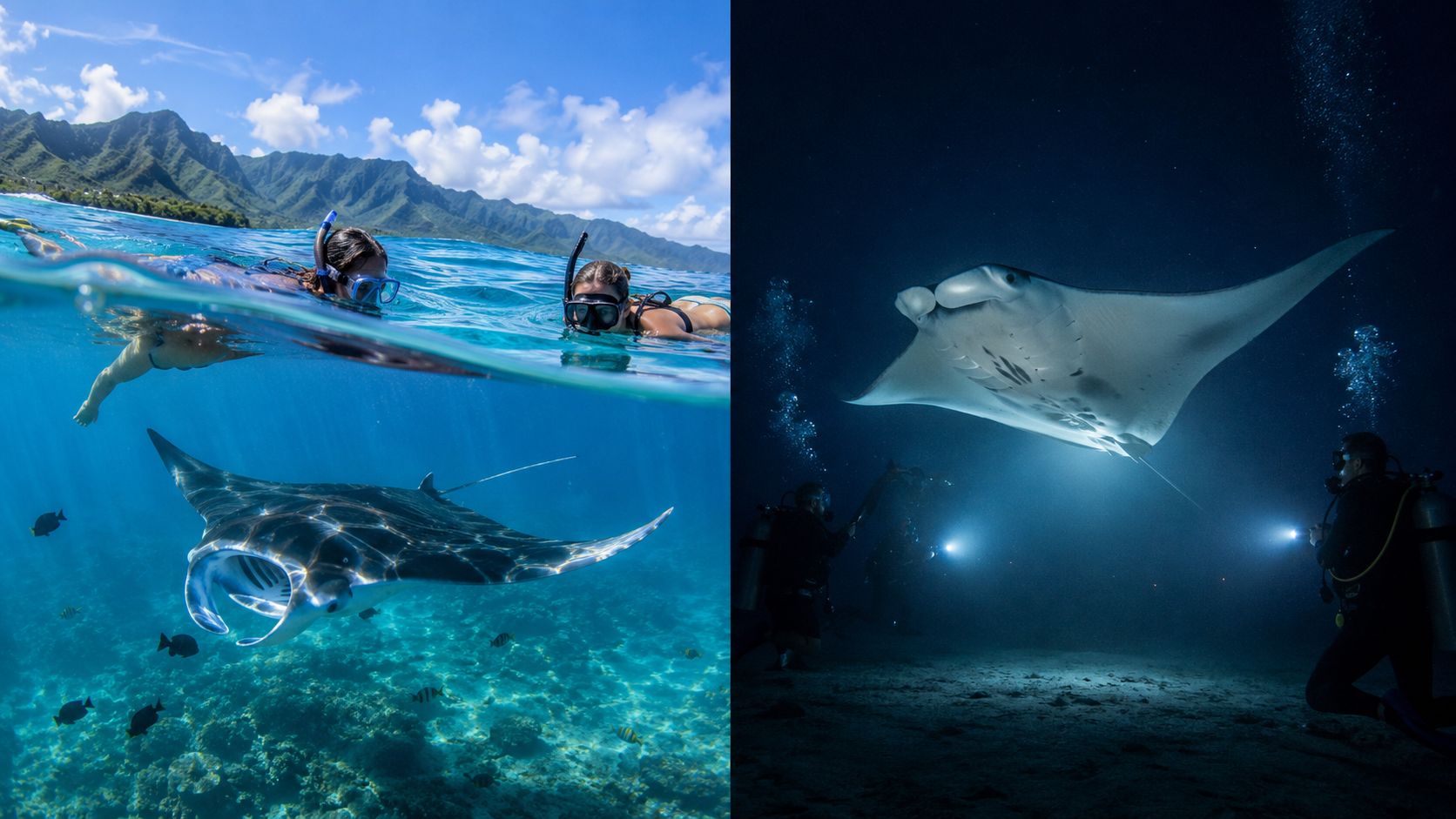
Daytime manta encounters and night manta dives sound similar, but they feel completely different in the water.
A daylight manta experience is more like spotting a hawk while hiking. You're watching for an animal that may pass through. A night dive off Kona is closer to sitting in a theater after the lights dim, knowing the performance is built around a specific stage. If you're deciding between the two, this comparison of whether it's better to snorkel or dive with manta rays helps frame the choice.
What changes after dark
The night format works because lights attract plankton, and plankton attract mantas. Verified data states that the dive is conducted in 25 to 40 feet (8 to 12 meters) of water, with most operators placing certified divers on a sandy bottom at about 35 feet (10.7 meters) to keep the water column clear. That passive setup increases encounter duration by up to 60% according to this description of the dive protocol.
Here's how that plays out in plain language:
- Daytime viewing: You're scanning reef and blue water, hoping a manta passes by.
- Night scuba viewing: You sit or kneel low, look up, and watch mantas swoop through light beams.
- Night snorkeling: You float on the surface and look down as mantas roll beneath the light source.
Which one suits you
If you're a certified diver who likes calm, controlled positioning, the night scuba version offers the dramatic bottom-up angle people remember for years. It feels like lying in a field and watching huge birds circle overhead.
If dark water makes you tense, snorkeling may be the easier start because you remain on the surface with flotation support. If you already enjoy night diving and good buoyancy work, scuba gives you the most immersive perspective.
The biggest difference isn't courage. It's comfort with darkness, gear management, and staying still when something enormous glides right over your mask.
Best Kona Sites and Seasonal Timing
Kona has two names that come up again and again in manta conversations. Manta Village in Keauhou Bay and Garden Eel Cove, also called Manta Heaven. Both are established sites. They aren't interchangeable.
Verified data states that Garden Eel Cove is the most popular and highest-quality manta ray night dive site on the Big Island because of its protected location, optimal depth, layout, and superior bottom topography. If you want the cleanest site-choice answer, that's it. For many divers, Garden Eel Cove is the stronger pick.
Why Garden Eel Cove stands out
Think about the dive from the manta's side and the diver's side at the same time.
From the diver's side, a protected site usually means easier positioning and less distraction from surge or awkward current. From the manta's side, a good feeding layout means predictable passes through the lit water column. Bottom shape matters because the entire encounter depends on where divers can sit, where lights can be aimed, and how open the “stage” remains.
Verified data also notes that Kona's resident population has been estimated at over 450 individual animals in one source, with sighting success rates of 85 to 90% for divers and snorkelers on a given night, and an average of 12 mantas per dive in that same dataset. Another verified source describes encounter rates exceeding 90% across operators due to the light-plankton feeding chain. The exact count varies by source, but the practical takeaway is the same. Kona is unusually consistent.
Comparison of Kona Manta Dive Sites
| Location | Average Sightings | Visibility | Depth |
|---|---|---|---|
| Manta Village | Verified accounts describe consistent sightings, with primary-site averages of six mantas per night in one source | Often favorable, but conditions vary by night | Generally within the Kona night-dive range of 30 to 40 feet |
| Garden Eel Cove / Manta Heaven | Verified data reports visitors often seeing an average of 12 mantas per dive in one source | Verified data says visibility frequently reaches 100 feet in Kona conditions | Commonly staged around 35 to 40 feet within the broader 25 to 40 foot range |
If you want broader site context for the island, this guide to the best place to dive on the Big Island adds useful perspective.
When to go
The mantas are available year-round because this population doesn't migrate. That's the big scheduling advantage. You don't have to hit a narrow migration window.
If you're sensitive to chop, summer is the easier bet. Verified data points to May through September as the calmest period and the peak for visibility conditions in PADI-related guidance. If your travel dates are fixed, don't overthink the calendar. I'd put more weight on sea conditions, your comfort level, and choosing a strong site than on trying to find a magical “perfect month.”
Skills Certification and Essential Gear
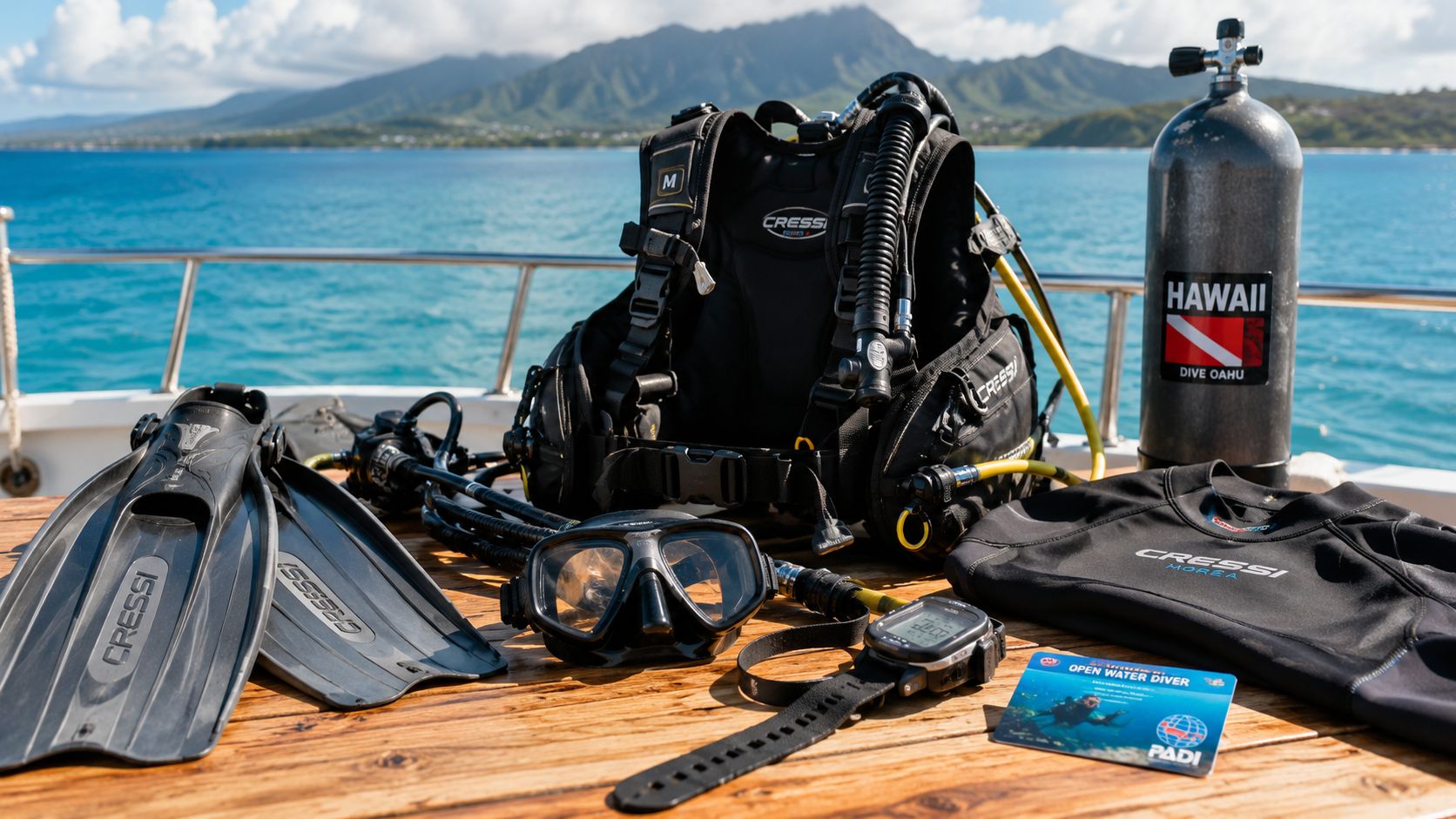
Treat your manta dive prep like a pilot's preflight check. The dive itself is simple. The smoothness comes from handling the details before you splash.
Verified data says professional operators require Open Water certification and recent night-dive experience for scuba participants, while snorkelers need only mask, fins, and a swim shirt. If you still need the certification foundation, this page on Open Water certification is the right starting point.
What scuba divers need
For scuba, the minimum is certification. The more important question is whether you're comfortable enough in the dark to stay low, breathe steadily, and avoid drifting upward into the viewing lane.
Your checklist should include:
- Certification: Open Water is the baseline for scuba participation.
- Night comfort: You should be able to read gauges, manage a light, and stay calm if your visual references narrow.
- Buoyancy control: This matters more than speed, air consumption, or photography skill.
- Mask fit and fin comfort: Small gear annoyances feel bigger at night.
What snorkelers need
Snorkelers have a simpler setup but still need to respect the environment.
Bring or confirm:
- Mask and snorkel: Comfort matters more than fancy branding.
- Fins: You won't be swimming hard, but fins help you move efficiently around the ladder or float.
- Swim shirt or thermal layer: Night air can feel cool after the water.
- Simple camera setup: If you're filming, secure it so you can still hold position comfortably.
If you haven't used a piece of gear in a long time, don't make the manta dive its first test run.
Renting gear is often smarter than traveling with a full kit unless you're particular about fit. If you do bring your own camera, keep the rig compact. Massive housings tempt divers to reach, chase angles, or kick upward, and that works against the passive style this dive needs.
Safety Guidelines and Diver Etiquette
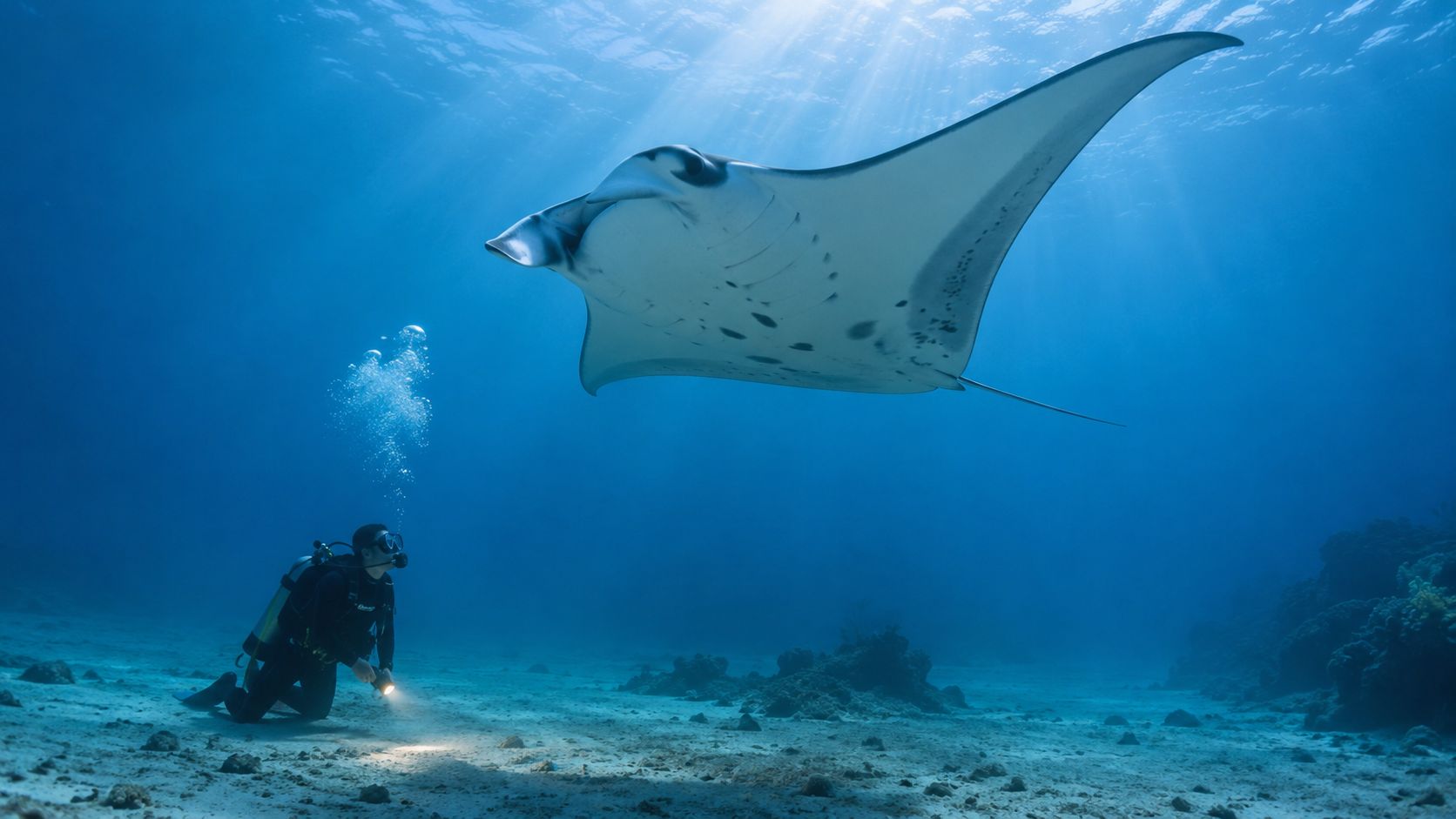
This is one of those dives where etiquette is safety.
Verified data states that Kona's nonprofit Manta Pacific Research Foundation has established community rules for night dives, including a strict no-touching policy to protect the manta's mucus coating, and that around 30,000 people dive with mantas annually in Kona under those guidelines, as summarized in this manta rules reference. If you want the broader diver-behavior mindset, read this page on responsible and considerate diver etiquette.
The rules that matter most
Mantas aren't threatened by your curiosity. They're threatened by careless contact and chaotic positioning.
Follow these rules:
- Stay stationary: Sit or kneel on the sandy bottom if instructed. Don't hover into the water column.
- Point lights downward: Upward glare can disrupt the viewing lane.
- Don't touch mantas: Their protective mucus layer helps shield them from infection and parasites.
- Keep bubbles and movement controlled: Wild flailing changes the whole group's experience.
- Let the manta choose proximity: Your job is to be predictable.
Common mistakes beginners make
A new diver sees a manta approaching and instinctively rises for a better photo. That one movement can put their fins, tank, or camera directly where the manta intends to pass.
Another common mistake is standing up on the bottom. It sounds harmless. In practice, it changes your profile from low and passive to tall and obstructive. Think of yourself as theater seating, not part of the stage.
A good manta diver looks boring from the side. Low, still, quiet, and easy for the animals to read.
If everyone follows that standard, the dive feels orderly and the mantas often keep cycling through the lights with less interruption.
Booking and Trip Planning Advice
Trip planning gets easier once you separate three questions. Who are you booking with, how are you preparing for the conditions, and how much psychological prep do you need for dark water?
For operator choice, prioritize clear certification requirements, a simple briefing style, and a site plan that tells you exactly where the dive will take place. If you want a direct tour option for scuba on the Big Island, Kona Honu Divers' diving tours page lists available dive formats, and their manta ray dive tour page covers the dedicated manta trip.
Book the trip your brain can enjoy
Verified data notes that 30% of guests miss encounters due to dark-water anxiety and poor buoyancy skills, and that pre-trip pool sessions and mental preparation drills reduce no-show rates significantly, according to this pre-dive preparation guidance.
That's one of the most useful facts in this whole topic, because it names the core problem. For many people, the challenge isn't the animal. It's darkness, surface waiting, and unfamiliar body sensations.
Try this before your trip:
- Pool reset: Spend time hovering, mask-clearing, and breathing slowly in calm water.
- Night rehearsal: Sit calmly in dim water or even imagine the entry and descent sequence step by step.
- Task reduction: Don't bring a camera if it will overload you.
- Honest booking choice: If scuba in the dark already sounds draining, choose snorkeling.
Seasickness prep and practical logistics
If you're prone to seasickness, handle it before the boat leaves. Common purchase options include Ship-EEZ Seasickness Patch, Dramamine pills, Bonine pills, Sea Band wristbands, and ginger chews.
Stay near Kailua-Kona if the manta dive is a priority. That keeps your evening simpler, especially after a night return when you're tired, damp, and still replaying manta passes in your head.
Conservation Insights and Photography Tips
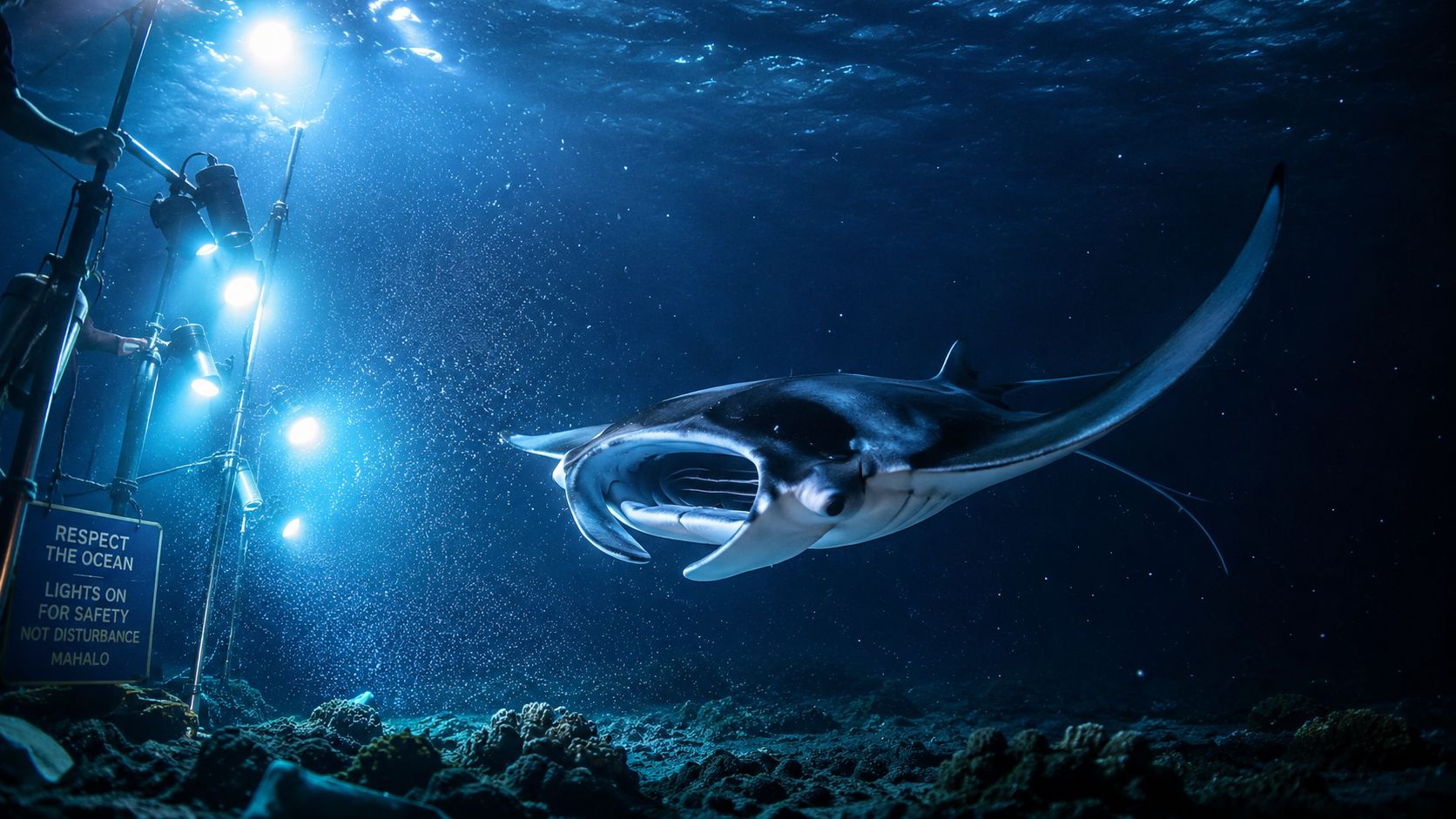
The ecological question behind manta ray diving in Hawaii is simple to ask and hard to answer fully. If lights create a reliable feeding zone, what does repeated exposure do to long-term behavior?
Verified data says that sighting rates exceed 90% due to light-driven plankton aggregation, while experts also question whether repeated artificial illumination may alter natural foraging patterns over time, as discussed in this analysis of the manta light system. That doesn't mean you should avoid the dive. It means you should choose operators and personal habits that keep the encounter passive and low-impact.
How to shoot without becoming the problem
Use a compact camera or action cam with a wide field of view. Let the manta come into the frame instead of chasing it.
A few practical habits help:
- Keep your rig small: Smaller cameras are easier to control in a fixed position.
- Favor ambient or constant light already in use: Don't add distracting bursts if your guide advises against them.
- Shoot upward angles: The most dramatic images usually come from the manta silhouetted against the glow.
- Miss a shot if needed: Good wildlife photography starts with good wildlife behavior.
The best manta photo usually comes from patience, not pursuit.
Frequently Asked Questions
Can beginners do the scuba manta dive
Only if they meet the operator's certification and comfort requirements. Open Water certification is the baseline in verified guidance, but comfort in dark water and good buoyancy matter just as much.
Is snorkeling still worth it
Yes. Snorkeling gives a top-down view that many people love, especially if they don't want the task loading of scuba at night.
How cold is the water
One verified Kona dataset lists water temperature at 76°F for local conditions. Air temperature and wind on the ride back often feel cooler than the dive itself.
What camera works best
A compact wide-angle setup is usually easier than a bulky housing system because it's simpler to manage while staying still.
If you want a straightforward place to start, Kona Honu Divers offers manta-focused scuba options for certified divers on the Big Island, along with other Kona diving trips if you want to pair the night dive with daytime reef diving.