
You're probably here because the manta ray night dive sounds equal parts unforgettable and slightly intimidating. That's normal. Many travelers first hear about it from a friend's breathless vacation story, a dramatic video clip, or a travel list that makes it sound like everyone should do it, while skipping the details that help you decide whether it's right for you.
What makes manta ray diving in Hawaii so special isn't just that you see a big animal underwater. It's the strange calm of the whole scene. You descend into dark water, settle onto a sandy patch, look up into a cone of light, and then these huge, graceful rays glide overhead as if they've been rehearsing the performance all day.
For people visiting the Big Island, this is often the experience they remember most. But the quality of that experience depends on more than whether mantas show up. Site choice matters. Briefings matter. Group size and in-water behavior matter. If you understand those pieces before you book, you'll show up with the right expectations and have a better night in the water.
An Introduction to the Magic of Manta Ray Diving
A manta dive doesn't feel like a typical wildlife tour. There's no chasing, no fast finning, and no scrambling to keep up. You settle in, the lights go on, and the ocean changes character. The darkness becomes a stage, plankton gathers in the glow, and then a shadow appears above you that turns into a manta ray sweeping past in silence.
That first pass usually resets people's idea of what a night dive can be. Mantas don't move like fish. They bank and roll with this slow, effortless rhythm that feels closer to flight than swimming. Even experienced divers get quiet when the first one loops overhead.
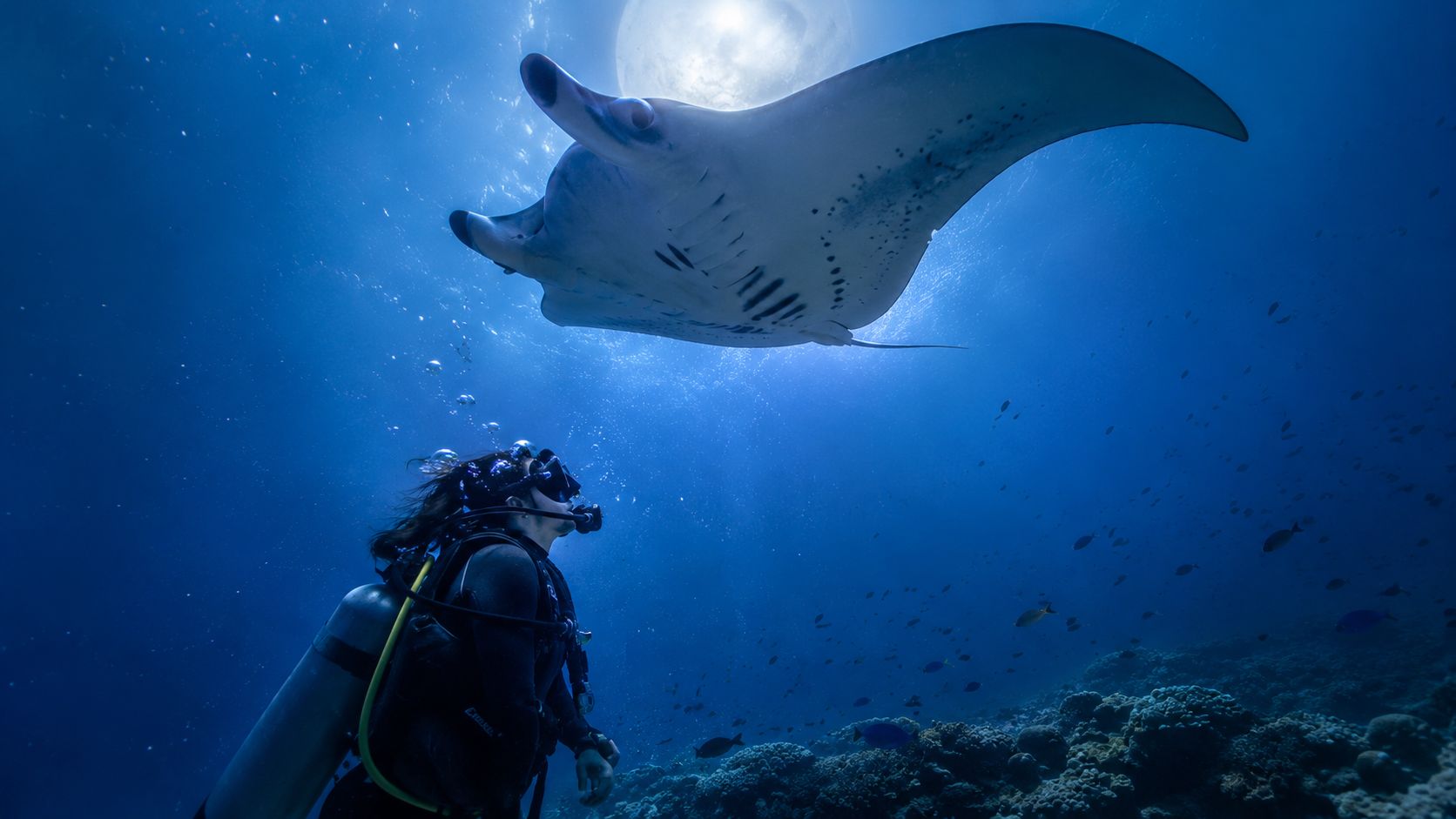
If you're new to diving in the islands, it helps to see where this experience fits into the wider underwater scene on the Big Island. Diving in Hawaii includes lava tubes, reef life, pelagic encounters, and night dives, but mantas are in a category of their own because the interaction is so focused and so memorable.
Why people talk about it for years
Part of the appeal is scale. Part is proximity. But the biggest part is that you're not watching from far away. You're in the environment with them, staying still while they come close enough for you to hear other divers gasp through their regulators.
The magic isn't just seeing a manta. It's watching one turn above your head and realizing how calm the whole encounter feels.
That mix of awe and stillness is why manta ray diving in Hawaii keeps landing on bucket lists. It's dramatic without feeling rushed, and wild without feeling chaotic when the operation is run well.
What to Expect on Your Manta Ray Night Dive
The basic setup is simple once someone explains it clearly. Boats head out near sunset or after dark, divers enter the water, and guides place lights that attract plankton. Manta rays come to feed on that plankton. Your job is not to pursue them. Your job is to stay in position and watch.
That's why people often call it an underwater campfire. Everyone gathers around the light, except instead of telling stories, you're looking up while manta rays swoop through the beam.
How the encounter works
For divers, the experience is mostly stationary. You descend, settle on the sand or kneel where the guide directs you, keep your fins tucked in, and shine your light upward if instructed. The light draws in plankton. The mantas follow the food.
For many first-timers, that's the part that removes the anxiety. You're not expected to find your way around in the dark searching for animals. The animals come to a known feeding area, and the team sets up the viewing zone around that behavior pattern.
The reason Kona has become famous for this is reliability. The Kona Coast on Hawaiʻi Island reports manta sightings on about 80% to 90% of nights at major sites, and one local report says the same resident mantas have a 76% resight rate, meaning guides and researchers keep seeing many of the same individuals over time, as described by Kona Snorkel Trips' overview of the Big Island manta night dive.
What the evening usually feels like
The emotional arc is predictable even when the wildlife isn't scripted. On the boat ride out, people are chatty. During the briefing, they ask practical questions. Once they descend and the first manta appears, the group gets quiet fast.
A few things surprise people:
- How little swimming is involved: This is more like taking your seat for a show than doing a drift dive.
- How close the mantas can pass: They may glide overhead, but you still stay still and let them control the distance.
- How dark doesn't feel dark for long: Once the lights are on and your eyes adjust, the scene feels focused rather than spooky.
Practical rule: If you treat the dive like a viewing platform instead of a hunt, the whole experience makes more sense.
If you want a preview of the non-scuba version, manta ray night swim tours show the same feeding behavior from the surface. The principle is the same. The viewpoint is different.
What beginners often misunderstand
Many guests expect a night dive with mantas added on. Instead, it's the reverse. This is a manta encounter that uses a straightforward dive profile to place you in the right position. That's why the briefing matters so much. Small choices like where you put your fins, how steady your buoyancy is, and whether the group stays compact all affect how smooth the encounter feels for people and animals alike.
Finding the Best Manta Diving Sites in Kona
Not all manta experiences feel the same, even on a coast famous for them. That's the detail many broad travel guides skip. They talk about success rates, but they don't spend enough time on what changes the quality of the night once you're in the water.
Kona is a major manta destination for good reason. An estimated 80,000 people participate in manta encounters each year in Kona, the activity generates over $2.5 million in annual revenue for the local community, and local reporting also describes about 130 regularly identified resident manta rays around Hawaiʻi Island, according to this Kona manta guide from Manta Ray Night Snorkel Hawaii.
Why site choice matters
A manta site isn't just a pin on a map. It shapes entry conditions, current exposure, bottom layout, reef scenery, and how crowded the viewing area feels. Those factors affect comfort, especially for newer divers and mixed groups with both divers and snorkelers.
Garden Eel Cove, often called Manta Heaven, stands out as a strong choice. It's widely valued for a more protected setting, a viewing area that tends to feel more organized, and reef structure that adds to the overall trip rather than making the manta portion the only worthwhile moment.
Why many divers prefer Garden Eel Cove
Here's the plain-language version of the argument for Garden Eel Cove:
- More protected water: A site with better shelter can mean a calmer ride and a steadier in-water experience.
- A better layout for viewing: A broader sandy area makes it easier to position divers without turning the bottom into a pileup.
- A fuller experience: If the itinerary includes additional underwater time, reef quality matters too.
That last point gets overlooked. Some people book a manta tour and don't think about the rest of the trip. But the way the whole evening flows, from boat ride to briefing to entry to exit, determines whether the night feels polished or stressful.
Don't assume every operator runs the same night
Captains choose sites based on ocean conditions. That means the “Kona manta dive” isn't one identical product sold by everyone in exactly the same way. It's a category of trip with real on-the-water variation.
If you want a broader look at how dive conditions differ around the coast, diving Kona and the Big Island gives useful context for why one site may be a better fit on a given night.
A smart booking question is simple: ask not only where the boat usually goes, but why that site is chosen and how the crew handles crowding when conditions funnel multiple operators into the same area.
Should You Dive or Snorkel with the Mantas
This is the biggest decision for most travelers, and there isn't one correct answer. The better option depends on your comfort in open water, whether you're certified, how you handle motion, and what kind of view you want.
The difference is not minor. Divers and snorkelers experience the same event from two very different positions in the water.
The core difference in viewpoint
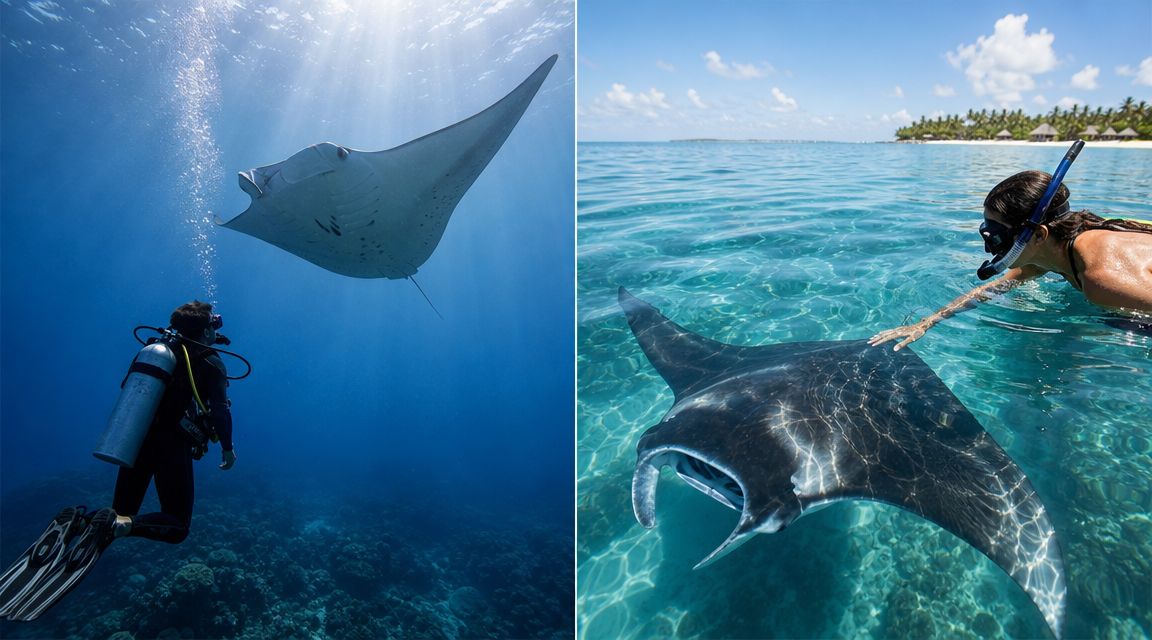
Divers are typically on the bottom in 25 to 40 feet of water for a 45- to 60-minute bottom-up view, while snorkelers stay at the surface, as explained in this guide to the manta dive in Hawaii. That creates a genuine split in how the encounter feels.
For divers, the manta rays often look like aircraft passing overhead. You're stable, low in the water column, and looking up as they feed above the lights.
For snorkelers, the sensation is more immediate and active. You float at the surface and watch the mantas rise toward the light source below you. That top-down view can be spectacular, but you feel surface motion more.
Side by side comparison
| Option | Best for | Main advantage | Main tradeoff |
|---|---|---|---|
| Scuba dive | Certified divers who want a stable, immersive view | Bottom-up perspective with less surface bobbing | Requires certification and comfort with a night dive |
| Snorkel | Families, non-divers, and travelers who want easier access | No certification needed | Surface chop can feel more noticeable |
If you love being underwater and want the most theatrical view, diving usually wins. If you want easier logistics and broader family access, snorkeling often makes more sense.
Which one fits your group
Choose the dive if you're certified, comfortable entering the ocean after dark, and want the quieter perspective from the bottom.
Choose the snorkel if your group includes kids, non-divers, or anyone who wants a lower-friction version of the experience.
If you're still deciding, it helps to look at the surface option directly. Snorkeling with manta rays gives you the same feeding event without scuba training, which is why it works so well for mixed-ability groups.
One important note about etiquette. Good operators and conservation guidance are clear that touching manta rays is not acceptable, even if an image online makes the encounter look casual. The goal is passive observation, not contact.
Your Guide to Manta Dive Safety and Preparation
The good news for certified divers is that this isn't a deep, technical profile. The manta night dive is typically conducted in 25 to 40 ft (8 to 12 m) of water, and many operators stage divers on a sandy bottom around 35 ft, a setup designed for longer bottom time and to keep divers clear of the mantas' feeding path, according to Kona Honu Divers' explanation of manta dive depth.
That shallow profile makes the dive approachable for many certified divers. It doesn't remove the need for good judgment, but it does mean the challenge is usually more about comfort, buoyancy, and listening carefully at night than about depth.
What to sort out before your trip
If you're diving, bring your certification information and be honest about your recent experience. If you haven't been in the water for a while, a refresher before a night dive is often a smart call.
A few prep steps make a big difference:
- Wear your swimsuit to the boat: It makes gearing up faster and less stressful.
- Bring something warm for after: Even in Hawaiʻi, the ride back can feel cool when you're wet.
- Pack lightly but intentionally: Towel, dry clothes, water, and any personal medication should be easy to reach.
If you're new to scuba or getting certified before the trip, learning to scuba can help you understand what skills matter most before adding a night wildlife dive to your vacation.
If you get seasick easily
This topic deserves plain talk. Some people are fine in the water and miserable on the boat. Night conditions can feel different from daytime trips, and if you already know motion affects you, prepare before the tour instead of hoping for the best.
Common options people use include Ship-EEZ Seasickness Patch, Dramamine pills, Bonine pills, Sea Band wristbands, and ginger chews.
Smart habits on the day of the dive
You don't need a complicated routine. You do need to avoid making your body work harder than necessary.
- Eat lightly: A small meal is usually better than a huge dinner before boarding.
- Hydrate during the day: You'll feel better in the water and after the dive.
- Arrive rested: Fatigue makes everything feel harder, especially after dark.
Stay calm, stay compact, and follow the guide's body position instructions. That's what keeps the dive comfortable for you and clean for the mantas.
The Kona Honu Divers Difference
If you've read this far, you've probably noticed that the right question isn't only “Will I see mantas?” The better question is “What kind of manta encounter am I booking?” On a coast this well known, plenty of trips can get you to a manta site. Fewer trips consistently focus on the details that shape the experience once guests enter the water.
That's where operator quality matters. Not in an abstract way. In very specific ways: how the crew briefs the group, how they position divers and snorkelers, whether they adapt to conditions, and how much crowding they tolerate before the water starts feeling chaotic.
The details that change the night
A high-quality manta outing usually has the same ingredients.
- Clear in-water discipline: Guests know exactly where to be and what not to do.
- Thoughtful site selection: The captain chooses for conditions and experience quality, not habit.
- Manageable groups: People can hear the briefing and settle into position without bumping into each other.
Conservation guidance matters here too. Hawaiʻi Ocean Watch explains that touching or crowding manta rays can damage their protective slime layer and disrupt feeding behavior. That means the operator's rules aren't just about guest control. They directly affect whether the encounter stays responsible.
Why strict briefings are a good sign
Some travelers hear “strict briefing” and think “less fun.” In practice, it's the opposite. The better the briefing, the more relaxed the dive usually feels because everyone understands the plan before they hit the water.
A crew that emphasizes spacing, light placement, hand signals, and passive observation is usually protecting two things at once. They're protecting the mantas from bad guest behavior, and they're protecting guests from the confusion that ruins a night dive.
For travelers comparing options, Kona Honu Divers' manta ray dive tours are one example of a tour format built around guided manta night dives and snorkel participation on the Kona Coast.
Why Garden Eel Cove fits this quality-first approach
If your goal is not just a sighting but a calmer and cleaner encounter, Garden Eel Cove is an appealing choice because it aligns with the same priorities. A more protected location can reduce stress for new divers and snorkelers. A roomier sandy viewing area can make the underwater setup feel more organized. Better surrounding reef can make the whole outing feel richer.
That combination matters for mixed groups. One person may care about photography. Another may care about not getting bounced around on the surface. Someone else may only want to know whether they'll feel overwhelmed at night. Site choice affects all of that.
A manta encounter feels magical when the logistics disappear. Good crews make that happen through planning, not luck.
What to ask before you book
You don't need insider vocabulary to screen a tour well. Ask plain questions.
- Which site do you prefer when conditions allow, and why?
- How do you handle crowded nights in the water?
- How detailed is the pre-dive briefing for first-timers?
- Can divers and snorkelers join on the same trip if our group is mixed?
Those answers usually tell you more than polished marketing language. For manta ray diving in Hawaii, the premium experience often comes from restraint, clarity, and respect for the animal rather than from promising the most dramatic encounter.
Frequently Asked Questions About Manta Ray Diving
Is manta ray diving safe
For most certified divers, the dive itself is straightforward because the profile is shallow and the activity is mostly stationary. The bigger issue is whether you're comfortable following instructions in dark water and staying calm while large animals pass close overhead.
Manta rays themselves are gentle filter feeders. The safety framework depends more on the operator, the briefing, and your own comfort level than on the animals being dangerous.
What if mantas don't show up
This is wildlife, so no operator can promise an animal on command. Kona is famous for reliability, but any given night can still vary.
Many companies use some version of a manta guarantee or rebook policy. Read the policy before paying, and make sure you understand whether it applies to weather cancellations, no-manta nights, or both.
Is this scary if I don't like the ocean at night
For some people, yes, the idea sounds scarier than the actual experience. The darkness tends to feel less intimidating once the lights are set and the group is in position.
People who struggle most are usually the ones who expected a casual sightseeing trip and didn't realize they'd be floating or diving in open water after dark. That's why honest self-assessment matters. If you dislike low visibility, surface chop, or boat rides at night, snorkeling may feel more intense than the photos suggest.
Can beginners do it
Certified beginner divers often can, provided they are comfortable with their gear and able to maintain steady buoyancy. If you're newly certified and haven't dived since your course, a daytime dive or refresher first may make the night much more enjoyable.
For non-divers, the snorkel version is the accessible path. It gives you the spectacle without requiring certification.
Can kids join
That depends on the operator and the child's comfort in open water. Some kids love it. Others decide very quickly that nighttime ocean activity isn't for them.
Parents should ask about age policies, flotation support, ride length, and whether the child can exit early if needed. The right family trip is the one that feels manageable, not the one that sounds most adventurous on paper.
Can I take underwater photos
Yes, but low-light photography is harder than many people expect. Keep your setup simple. Focus on enjoying the encounter first.
Also, don't assume every camera habit is harmless. Good manta etiquette means avoiding anything that disrupts the animals or distracts you from following the guide.
What's the single most important etiquette rule
Don't touch the manta rays. Don't chase them either. Passive observation is the standard that protects the animals and makes the experience smoother for everyone else in the water.
That rule matters because quality encounters depend on manta behavior staying natural. When guests crowd, grab, or swim into their path, the whole interaction degrades.
How do I choose the right trip
Start with yourself, not the advertisement. Ask these questions:
- Do I want the underwater view or the easier-access surface view?
- How well do I handle motion on boats?
- Am I traveling with kids or non-divers?
- Do I care more about convenience or a calmer, more structured encounter?
If you answer those sincerely, most of the decision becomes easier.
If you want a manta trip run by a team that also offers a full range of Big Island diving, take a look at Kona Honu Divers. Their site lets you compare tour options, see whether a manta dive or snorkel fits your group, and book the trip that matches your comfort level and goals.