
You're probably comparing tour pages, checking whether you should scuba dive or snorkel, and wondering what happens if the ocean doesn't cooperate. That's the right place to start. A manta ray night dive in Hawaii can be extraordinary, but the quality of the experience depends on more than the animals. Site selection, boat handling, diver discipline, and a clear safety briefing matter just as much as the lights in the water.
Kona's manta encounter works because operators bring people to a recurring feeding environment, not because anyone can guarantee what a wild animal will do. The most responsible approach combines realistic expectations with careful observation. You'll get a better night, and you'll place less pressure on the mantas, when you choose a protected viewing site and behave like a quiet visitor rather than a participant in the animals' feeding loop.
The Magic of Hawaii’s Nightly Manta Ballet
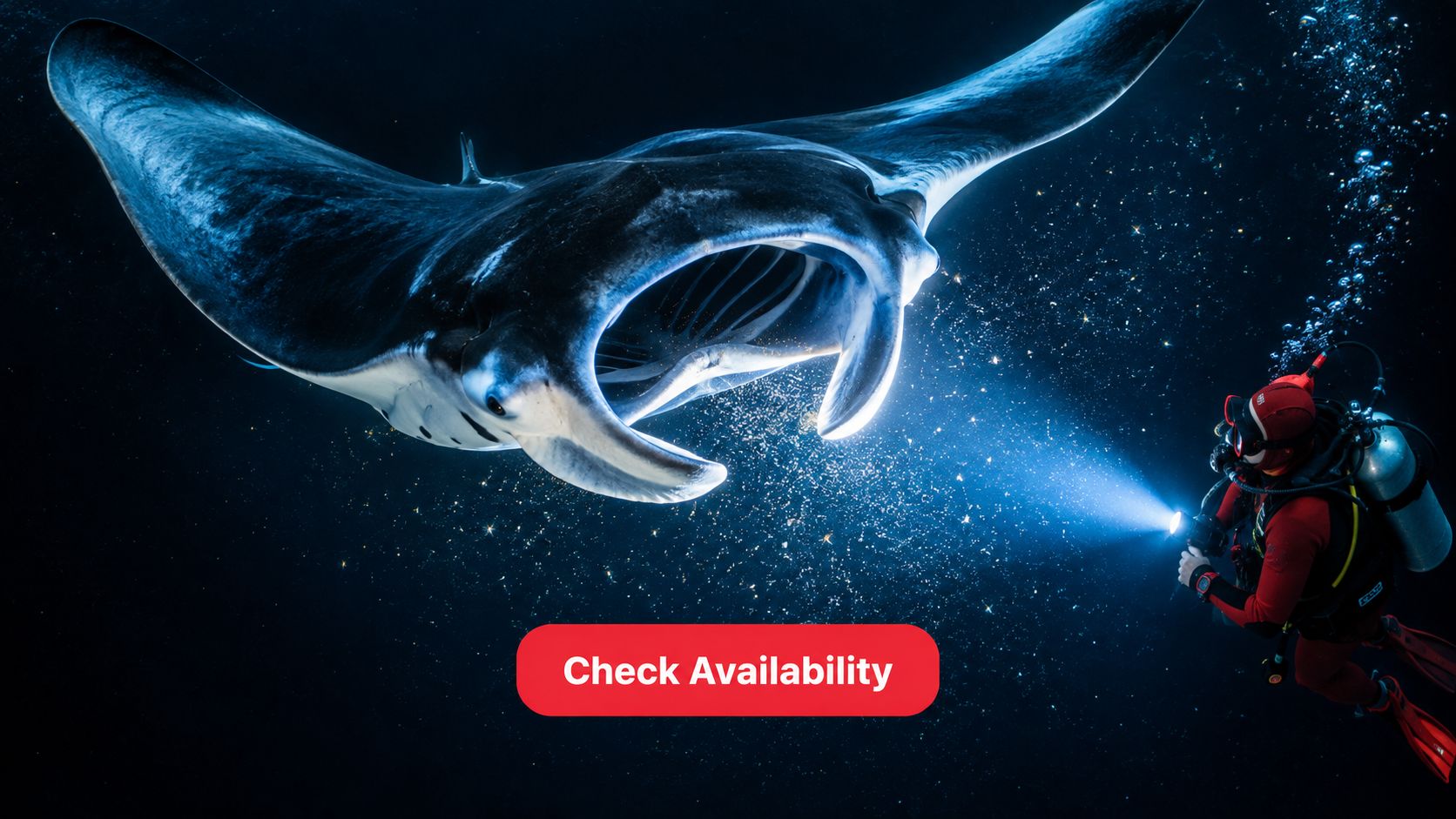
The last daylight fades behind the Kona coast as the boat settles into position. On the surface, you can still hear conversation and the soft movement of equipment. Then you enter the water, and the world changes. Below you, the black Pacific holds only a few illuminated circles, suspended in darkness like small stages.
A diver waits at the edge of the light, controlling breathing and buoyancy. The beams reveal drifting plankton first. Then a broad wingtip appears at the edge of visibility, followed by the pale underside of a reef manta ray. It glides through the light, banks away, and returns on another pass. There's no chase and no dramatic approach from a handler. The animal arrives because the feeding conditions have brought it there.
A tradition built around recurring behavior
Kona's modern manta night-diving industry traces its origin to 1991, when Kona Coast Divers reportedly recognized that reef manta rays gathered nightly around illuminated sites and became the first operator to schedule dedicated nighttime viewing dives. The early pattern of approximately one boat visiting once a week developed into multiple boats operating every night, helping make Kona one of the world's best-known manta tourism locations. The historical record presented to the Hawaiʻi Legislature documents that progression and the long-running nature of the encounter.
That history matters because this isn't a random sighting in open water. Historical monitoring along the Kona Coast from 1992 through 2007 recorded 3,208 surveys, primarily at Keauhou and Ho'ona Bay. Researchers identified 106 individual manta rays during that period and estimated that the local population was probably fewer than 200 animals, although the estimate wasn't based on a formal mark-recapture study. At Garden Eel Cove, mantas appeared on approximately 80% of dives in site-specific observations. Those figures come from the same Hawaiʻi historical monitoring record.
Practical perspective: The reliable part of Kona's encounter is the repeated use of feeding habitat. The exact number of animals, their timing, and the shape of each pass are still controlled by the ocean.
That distinction keeps expectations healthy. You may see a single animal circling close to the lights, or several rays moving through the viewing area at once. Either way, the experience is most rewarding when you notice the behavior rather than treating the animals as a scheduled performance.
Choosing the Right Site, Why Garden Eel Cove Wins
The name on a tour page doesn't tell you enough. Kona's manta locations differ in exposure, bottom layout, boat traffic, and the space available for divers and snorkelers to hold position. For a night dive, those details affect comfort and safety before the first manta appears.
Garden Eel Cove is my preferred choice for a dedicated manta dive because its more protected location generally creates a more manageable setting for entering, exiting, and maintaining position. A calmer surface makes a real difference when divers are checking equipment in darkness, snorkelers are settling onto flotation, and crews are coordinating several people around a working boat. Protection doesn't eliminate current, surge, or poor conditions, but it gives the operator a better foundation for a controlled experience.
Comparing the main viewing environments
Manta Village and Manta Heaven are established viewing areas, and conditions can make either one worthwhile. The practical question is whether the site offers enough room and structure for guests to observe without crowding the feeding path. An exposed location can still produce a memorable encounter, but surface movement and boat positioning may make the experience more demanding for inexperienced guests.
Garden Eel Cove has a better viewing area for a disciplined bottom-up dive. Its reef and surrounding layout give divers a defined place to settle, while the light field encourages the plankton and mantas to work through a predictable space. That doesn't mean the reef “guarantees” more animals. It means the site can provide a clearer viewing framework, with less need for guests to drift, reposition, or compete for the same angle.
| Site consideration | Why it matters at night |
|---|---|
| Protection from exposure | A more sheltered setting can make entries, exits, and surface supervision easier. |
| Viewing space | Divers need room to maintain separation without blocking feeding paths. |
| Reef structure | A defined bottom area helps a group settle and hold position. |
| Boat coordination | Clear operating space helps crews manage pickup, lighting, and propeller awareness. |
The local science supports choosing sites based on habitat and behavior rather than marketing language. Historical observations identified repeated manta use around Kona's established sites, and later monitoring found that sightings were concentrated geographically rather than spread evenly throughout Hawaii. In a peer-reviewed analysis of 4,001 dives across 13 Hawaiian sites, researchers recorded manta rays at 73 of 538 surveyed sites, or 14%, between 2000 and 2012. The findings are available in the peer-reviewed analysis of Hawaiian manta sightings.
Read the itinerary carefully before booking. A tour that clearly identifies why Garden Eel Cove is a preferred manta location gives you more useful information than one that merely promises an encounter. A boat can't control wildlife, but it can choose a sensible site, explain the trade-offs, and organize people properly.
The Mechanics of the Light Attraction Method
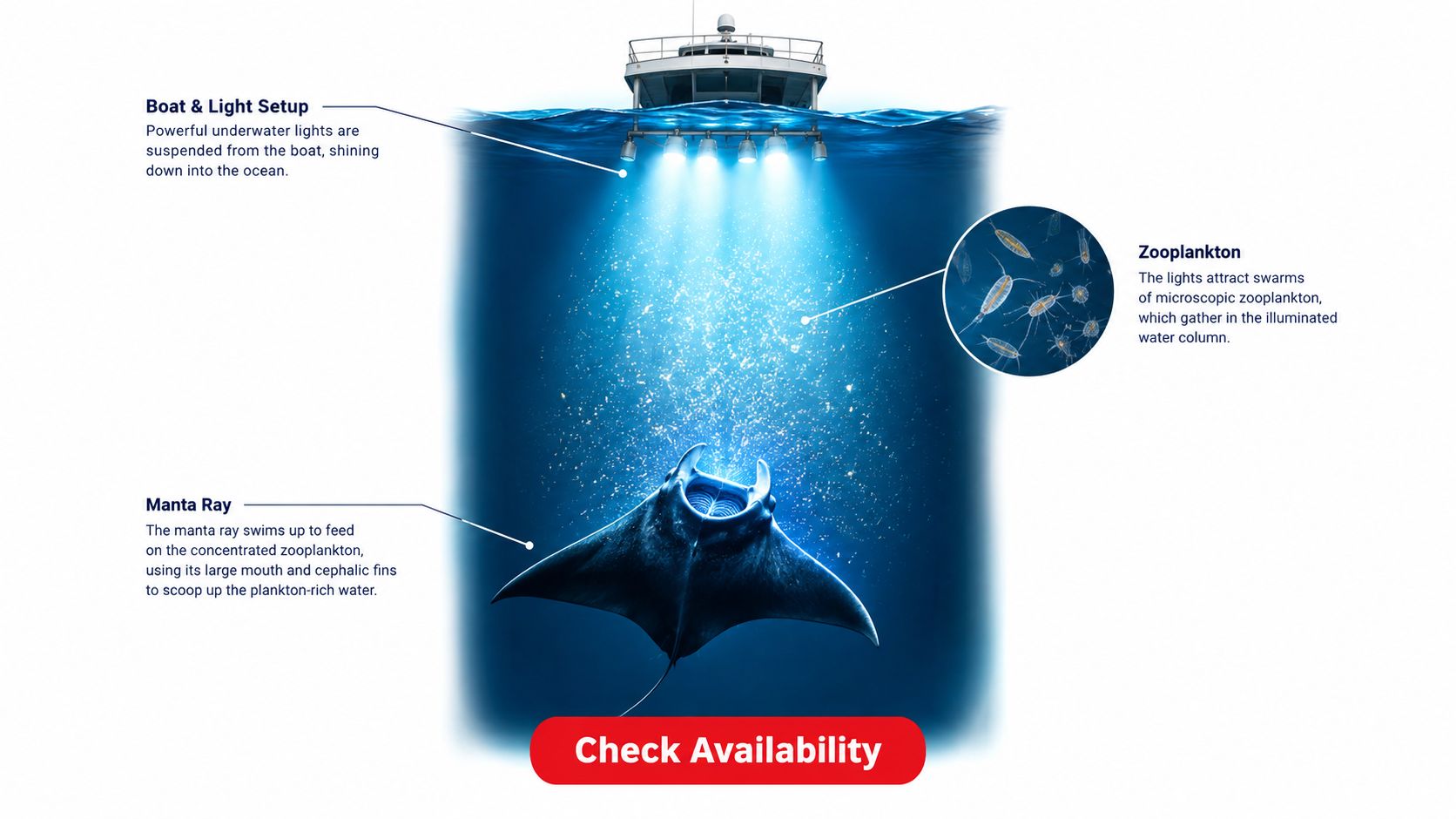
The lights don't feed the mantas. They attract zooplankton, and the mantas follow the concentrated food source. Understanding that sequence changes how you behave in the water. You're not watching an animal respond to bait. You're observing a natural feeding behavior that has become concentrated around artificial illumination.
The procedure is simple, but every part has a purpose. Divers sit below the light field and direct their beams upward. Snorkelers remain above the feeding zone and direct their lights downward. Those positions create a column of illumination that gathers plankton while leaving the manta rays room to loop through the area.
The diver's position
NOAA guidance recommends that scuba divers remain in the designated light circle and hold their lights above their heads, shining upward into the water column. That arrangement keeps the group in a defined area and helps create the illuminated plankton field the mantas use. It also prevents individual divers from wandering into the animals' approach routes.
Before entering, secure anything that can dangle or float into the water column. A loose camera strap, gauge hose, or accessory can become a distraction or a hazard when a manta passes close overhead. Divers should also remove their snorkels and place them in a buoyancy-compensator pocket because a manta can catch a snorkel and dislodge a mask. These procedures are outlined in NOAA's guidance for manta viewing behavior.
The snorkeler's position
Snorkelers should stay at the surface, shine lights downward, and avoid diving into the feeding zone. The surface position offers a different perspective, but it still requires restraint. Holding onto a flotation aid, keeping your body controlled, and allowing the manta to choose its path are more effective than swimming after an animal for a closer look.
- Enter calmly. Follow the crew's order and keep your mask, flotation, and lights organized.
- Find your assigned position. Don't spread across the light field or drift beneath another participant.
- Aim the light correctly. Divers point upward, while snorkelers point downward.
- Stay still. Mantas can turn through the beam without warning, so a stable position gives them room.
- Follow the exit signal. Leave the viewing area only when directed, especially when boats are maneuvering nearby.
The temptation is to improve the encounter by moving closer. That usually makes the experience worse. A moving diver creates bubbles, blocks another person's view, and can force the manta to alter its line. The best view often comes from the person who settles into position and waits.
Navigating Night Dive Safety and Boat Operations
A calm ocean surface doesn't automatically mean a low-risk operation. At night, guests may be entering and exiting near moving boats, divers may be below the surface, snorkelers may be holding flotation, and several operators may be working in the same general area. The crew has to manage all of those users while visibility is limited.
A Hawaiʻi County safety assessment found that no rules specifically restricted where live-boating, diving, or swimming could occur at manta sites. The assessment identified severe hazards at Makako Bay and Keauhou Bay, while related testimony described nighttime swimmers and snorkelers sharing water with actively motoring vessels. It also noted that voluntary operator guidelines didn't fully address excessive crowding or conflicts between user groups. You can review the Hawaiʻi County boating operations and safety assessment for that local context.
Questions to ask before boarding
A professional crew should explain the operation before anyone enters the water. Ask direct questions, and pay attention to whether the answers are specific or vague.
- Entry and exit: Will the crew explain where guests enter, where they wait, and how they return to the boat?
- In-water supervision: Is someone assigned to watch the group, rather than having every crew member focus on equipment or the boat?
- Propeller separation: How does the operator keep swimmers and divers away from active propellers during pickup or repositioning?
- Mooring and live-boating: Will the boat remain secured, or will it maneuver while people are in the water? If it moves, what signal and pickup procedure will be used?
- Abort procedures: What should a guest do if they become seasick, panicked, disoriented, or unable to continue?
- Different user groups: How are scuba divers separated from snorkelers, especially when both groups use the same light field?
A good briefing should also cover low visibility, flotation, lights, and the possibility that a participant may need to leave the water early. Families and first-time snorkelers shouldn't have to infer those procedures while already in the ocean.
A useful test: If the crew can explain the emergency and pickup plan clearly on the dock, they're more likely to manage the same plan effectively after dark.
Your own behavior matters too. Stay with the group, keep your light visible when instructed, don't swim behind the boat, and never assume that a quiet engine means the propeller is safe. If you're unsure about a signal, stop and ask before entering the water. For a closer look at the human role behind a safe operation, review the responsibilities described on the Kona dive boat captain page.
Understanding Manta Behavior and Environmental Etiquette
Mantas don't arrive because the tour schedule says it's time. Their presence reflects plankton conditions, offshore food movement, water temperature, and individual attachment to local sites. Artificial lights concentrate food near the viewing area, but they don't override the animal's wider feeding cycle.
Research summarized in marine-science literature reports that reef mantas can make deep dives of up to approximately 672 meters, presumably to feed on offshore mesopelagic prey associated with the deep scattering layer before returning toward the surface to warm. That behavior helps explain why a quiet start doesn't necessarily mean the animals are absent. The findings and behavioral context are discussed in recent marine-science research on manta diving and feeding behavior.
Patience is part of the encounter
Wait without chasing. Keep your body stable, maintain neutral buoyancy, and let the manta choose whether to pass through your area. A ray may approach from behind, rise from below, or leave the light field for a while before returning. Turning constantly to follow it can make you lose your position and increase the chance of contact with the reef or another diver.
The most important etiquette rules are straightforward:
- Don't touch the animals. Physical contact isn't part of a responsible wildlife encounter.
- Don't block the feeding path. Leave the manta a clear route through the illuminated water.
- Secure your equipment. Dangling hoses, straps, snorkels, and accessories can interfere with close passes.
- Control your bubbles and buoyancy. A diver who rises, kneels heavily, or drifts creates problems for the group and the reef.
- Keep lights out of the eyes. Aim beams into the plankton field, not directly at an approaching animal.
- Stay in your assigned position. The viewing circle works when everyone respects its boundaries.
Hawaiʻi's reef mantas have strong site fidelity and form genetically isolated, island-resident populations with low genetic diversity. That means localized pressures, including vessel strikes and habitat degradation, can affect an entire island population disproportionately, as explained by NOAA's summary of genetic research on Hawaiian reef mantas.
This is why “the manta came close” isn't a reason to reach out. Close contact is a privilege created by the animal's tolerance, not an invitation. Choose an operator that teaches site-specific behavior before entering, and use this responsible diver etiquette guidance as a practical standard for your own conduct.
Photography Tips for the Dark Water Column
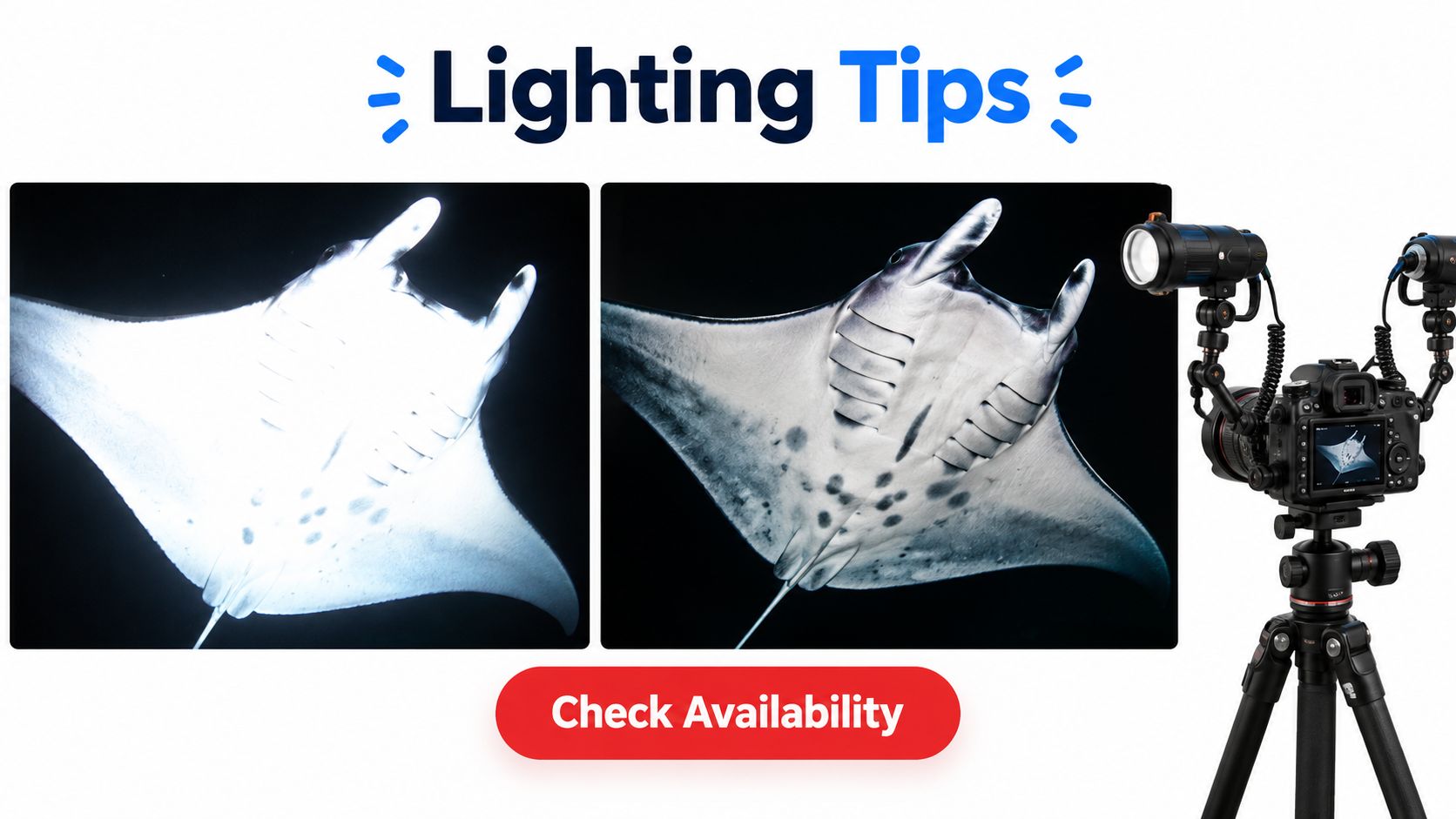
Night manta photography punishes automatic settings. The background is nearly black, the light field is bright, and the manta's white underside can reflect enough light to become a featureless patch. Your first goal should be a controlled exposure. Your second should be staying aware of the animal, the reef, the boat, and the divers around you.
Start with the camera in manual mode if you know how to use it. Keep shutter speed fast enough to reduce motion blur, set an aperture that balances depth of field with available light, and adjust ISO before increasing strobe power. The exact settings depend on your camera, lens, and distance from the subject, so review the first few frames and make small changes rather than turning every control at once.
Reduce backscatter and distraction
Aim strobes across the subject rather than straight through the water toward it. Excessive power illuminates suspended particles and produces backscatter, especially when other divers' bubbles and lights are in the frame. A slightly darker image with visible texture is easier to improve than a clipped white belly.
Camera lights need the same discipline as dive lights. Never shine a focused beam directly into a manta's eyes. Keep the light on the feeding area or angled away from the animal, and follow the guide's instructions if the crew asks photographers to lower or switch off lights.
A camera can narrow your attention dangerously fast. Before pressing the shutter, check your depth, position, and separation from the group. Don't back into the reef while tracking a manta, and don't swim across another diver's light circle to get a better angle.
The image is secondary. If you have to choose between a shot and a clear escape route, stable buoyancy, or an animal's unobstructed path, leave the shot.
Action-camera users should avoid constant movement and rapid digital zoom. Hold the camera steady, keep the lens clean, and let the manta enter the frame. For examples of how to think about composition and preparation, review the Kona manta ray dive photography guide.
Selecting the Right Operator for Your Dive
The operator you choose controls the parts of the experience that guests can't manage alone. Look for a crew that treats the manta dive as a night operation first and a wildlife attraction second. That means clear briefings, maintained equipment, sensible site selection, and enough attention for guests who are unfamiliar with darkness, current, or flotation.
Kona Honu Divers offers a two-tank manta night dive that combines a dusk reef dive with a nighttime manta dive, along with a separate manta snorkel experience. The company's options include the Kona manta ray dive and snorkel tour, broader Kona diving tours, a Kona blackwater night dive, and an advanced two-tank trip for divers seeking a more demanding itinerary. Those are different products, so match the tour to your certification, comfort, and night-diving experience.
What separates a capable crew
Boat space matters because guests need room to prepare, move safely, and return from the water without crowding. Gear maintenance matters because a minor equipment problem becomes more difficult to solve after dark. Staff attention matters because a first-time snorkeler, a nervous diver, and an experienced photographer may need very different support during the same trip.
Use the Kona diving company guide as a starting point, but make your final decision by asking operational questions. Find out where the tour intends to go, what happens if conditions change, how the crew manages mixed scuba and snorkel groups, and what they tell guests about poor wildlife sightings. A responsible operator won't promise that wild animals will perform on demand. They'll explain the natural variability and still provide a well-organized plan.
Kona Honu Divers offers guided scuba and snorkel experiences built around careful night operations, including manta encounters at Kona's established viewing sites. Visit Kona Honu Divers to compare the manta tour with reef, blackwater, and advanced diving options, then choose the trip that fits your water skills and comfort after dark.