
You've found the manta photos, checked your vacation dates, and started wondering what being in the ocean after dark really feels like. Will you be swimming the whole time? Do you need scuba certification? And if the mantas come close, where are you supposed to go?
Choosing among manta ray dives in Kailua-Kona, HI, starts with your comfort in the water, not the most dramatic photograph. A worthwhile encounter also leaves the animals room to feed. Those are the two tests that matter: whether you're ready for the activity, and whether the crew runs it responsibly.
Manta Ray Night Dive Formats at a Glance
Start with a night snorkel if you're a confident swimmer without scuba certification. Certified, recently active divers can choose a lower underwater viewpoint. Guests who don't want to enter the water can ask about observing from the boat, although that isn't an equivalent underwater view.
Think of the setup as a stadium floodlight illuminating a small patch of ocean. Lights concentrate plankton, and feeding mantas may circle through that illuminated water. You watch from an assigned position rather than swimming after them.
Manta ray night dive formats compared
| Format | In-water requirement | Viewing position | Best for | Typical length |
|---|---|---|---|---|
| Night snorkel | Confident swimming, snorkel gear, unassisted ladder climb | Surface, lights pointed down | Beginners, families, most guests | Full evening excursion |
| Night scuba | Certification and recent diving experience | Below the surface in the designated light circle | Certified divers seeking a lower view | Full evening excursion |
| Observe from boat | No water entry | Deck, looking toward the illuminated water | Guests who cannot or won't enter the water | Usually follows the booked departure |
Exact schedules and observer availability depend on the departure. Compare Big Island boat tour options before assuming every vessel accommodates nonparticipating guests.
A familiar activity with a wild outcome
Kona's regular manta dives date to the late 1970s, while a later historical review identifies 1984 as the start of snorkeling and scuba activities at the principal viewing sites, according to Hawaiʻi legislative testimony on Kona manta encounters. That history explains the established viewing routine, but it doesn't make an individual animal's arrival predictable.
For a simple decision rule, choose snorkeling if you can swim confidently and climb back aboard unaided. Choose scuba if your certification, recent experience, and comfort after dark support it. Neither format gives you permission to approach a manta.
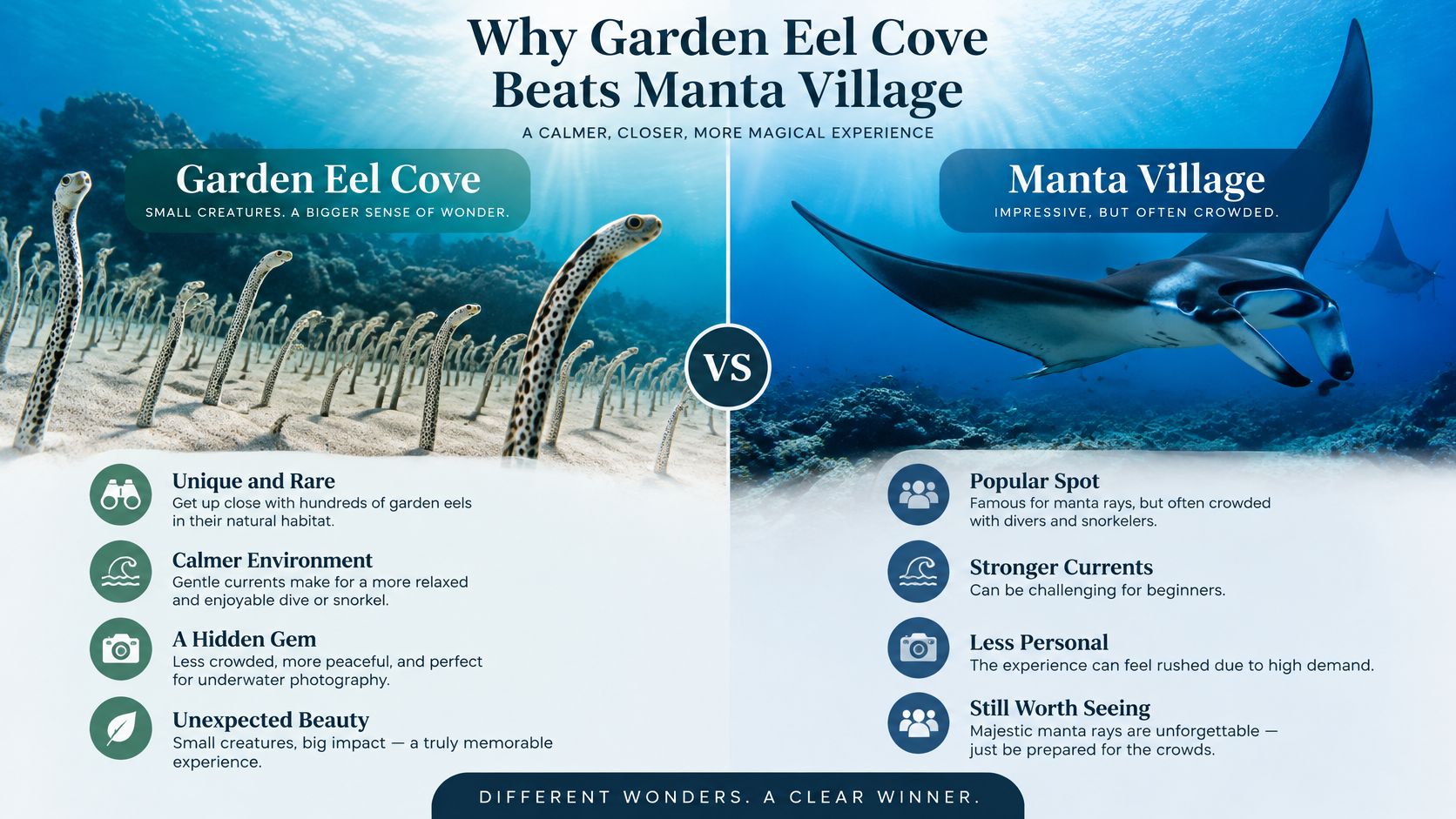
Why Garden Eel Cove Beats Manta Village
Garden Eel Cove is my preferred choice for a scuba-focused manta tour. Its protected setting, organized viewing area, and surrounding reefs make it the stronger overall option when conditions suit the site.
The principal alternatives are Keauhou Bay, commonly called Manta Village, and Ho'ona Bay with adjacent Makako Bay, commonly called Garden Eel Cove or Manta Heaven. Both are established feeding-viewing locations, not interchangeable names for the same bay.
What the comparison actually supports
A 13-year community-science study covering 2010–2022 recorded more than 23,000 sightings of 167 identified reef mantas, found generally larger feeding aggregations at Garden Eel Cove, and documented females in about 91% of Keauhou sightings, as summarized in the University of Hawaiʻi research on Kona manta viewing.
That supports choosing Garden Eel Cove for its aggregation potential. It doesn't establish that every departure there sees more animals, nor does the study separately score Keauhou's shelter or reef quality.
Shelter and viewing area: The operator-facing verdict favors Garden Eel Cove's protected layout and organized viewing space. Treat that as a practical site preference, not a measured guarantee of calm water.
Reef quality: Garden Eel Cove is also my preference for the surrounding reef experience. That's an editorial recommendation, not a comparative reef-health result from the manta study.
A better site still needs a disciplined crew
For divers, a designated viewing circle over sand or rubble provides a clear place to settle without occupying live coral. The useful feature isn't mere proximity to mantas. It's having a predictable place for people while leaving the feeding water open.
The tourism research summarized in the university material documented at least 42 operators, averages of 12–13 boats per site, peaks of roughly 26–30 boats during 5%–10% of observations, and gatherings of 100 to more than 300 people. Those are historical observations, not today's boat count or an acceptable-capacity standard.
Practical rule: Choose the crew's crowd-management plan, not just the destination printed on its booking page.
Ask how the captain responds when the viewing area is already full. A Garden Eel Cove booking is only the better choice if the crew can use that space responsibly.
Best Times and Conditions for Seeing Mantas
Light concentrates plankton; feeding mantas may follow that food. The important variables are therefore prey availability and ocean conditions, not a calendar promise.
Resident mantas offer year-round viewing opportunities, but year-round availability doesn't mean identical conditions. A night that works for an experienced ocean swimmer might be unsuitable for someone making their first open-water entry after sunset.
Conditions that change a manta night
| Condition | What to expect | How to plan |
|---|---|---|
| Calm, low-swell forecast | Generally more manageable boarding and water entry | Favor gentler conditions for a first outing |
| Larger swell or rough surface | More demanding entry, exit, and surface waiting | Understand weather rebooking before paying |
| Strong current | More effort to maintain the assigned position | Let the captain assess suitability |
| Plankton-rich nights | Potential for more feeding activity | Don't expect a reliable advance prediction |
| Temporary lull with no mantas | Animals may be deeper or following prey elsewhere | Hold your position and follow the guide |
| Moon phase | No dependable prediction established by the evidence discussed here | Ask about local observations, not guarantees |
Why a quiet spell isn't a final verdict
Reef mantas use more than the illuminated viewing area. Scientific material describes their use of deeper water and vertically migrating zooplankton, alongside nighttime feeding around lights at Keauhou and Makako bays, in this NOAA-hosted review of manta feeding ecology.
If the lights are empty for a while, an animal may be feeding deeper or moving with its prey. That possibility is a reason to wait calmly, not a promise that mantas will return before your session ends.
For planning, consult the operator's guidance on the best time to see Kona mantas and keep another evening available if your itinerary allows. Ask what conditions trigger cancellation and how the crew communicates a change.
Don't organize the whole trip around a supposed perfect moon. A flexible date and an honest conditions assessment are more useful than an unsupported prediction.
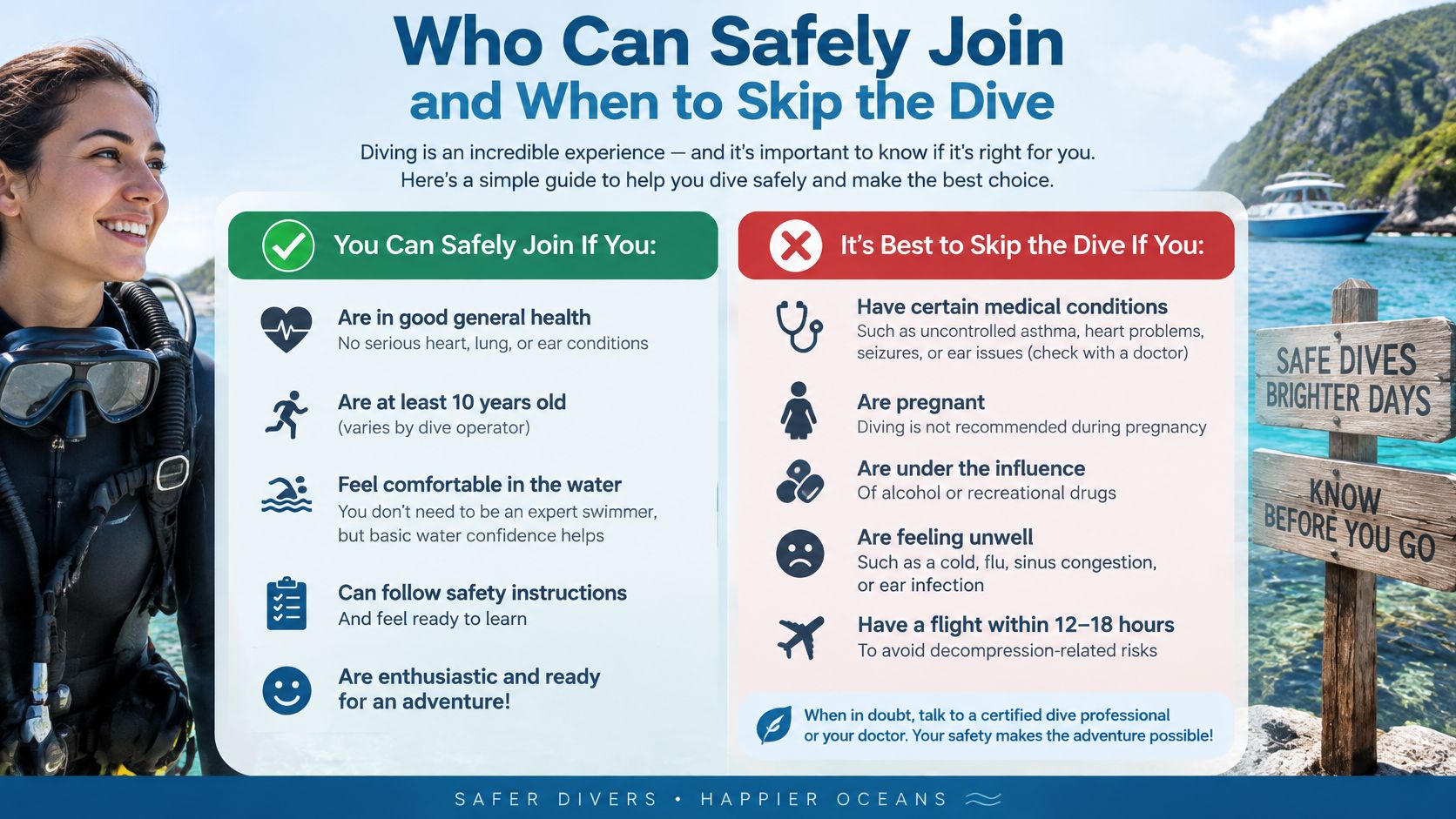
Who Can Safely Join and When to Skip the Dive
A manta encounter isn't automatically suitable just because it's marketed to beginners. Wildlife availability and participant readiness are separate questions.
Scuba requires certification, while night snorkeling still calls for confident swimming and the ability to climb a boat ladder. The Love Big Island manta activity guide is useful background for distinguishing the formats and understanding their practical demands.
Suitability by guest type
| Guest type | Core requirement | Question to ask before booking | Suitability |
|---|---|---|---|
| Beginner snorkeler | Confident swimming and unaided ladder climb | What help is available during entry and exit? | Consider after an honest swimming assessment |
| Families with children | Properly fitted flotation and comfort in dark water | What are your minimum age and child-specific requirements? | Depends on the child and departure rules |
| Certified scuba diver | Certification and recent experience | Do I need a refresher or checkout? | Appropriate if skills and conditions match |
| Nervous or anxious guest | Comfort with darkness and open water | Can I leave the water early? | Consider boat observation first |
| Seasickness-prone guest | Ability to tolerate the boat ride and surface motion | What conditions are forecast? | Favor calmer conditions and seek remedy advice |
| Guest with asthma or reduced mobility | Individual screening and a workable access plan | Is medical clearance required, and what assistance exists? | Discuss before booking |
Assess the return to the boat
The easy part to imagine is floating beside the light board. The harder part may be returning to a moving ladder when you're cold, tired, or anxious.
Darkness reduces familiar visual references. Current can make holding position harder, while surge can complicate timing at the ladder. Don't assume flotation removes the need for swimming ability or that a crew member can provide unlimited physical assistance.
Use the operator's explanation of who can scuba dive with manta rays to start a conversation about your actual experience. If you haven't dived recently, say so before reserving equipment.
A cancellation is a safety decision, not a failed wildlife experience.
Before paying, ask about flotation, entry and exit assistance, medical screening, weather cancellation, and alternatives. Also ask how you signal discomfort and whether an early exit can be accommodated.
For asthma, medication questions, or other medical concerns, seek individualized advice from a qualified clinician. If you can't meet the activity's physical requirements, choose another experience rather than hoping the crew can solve the problem offshore.
Snorkel or Scuba for Photos and Close Viewing
Choose your viewing position for your skills first and your camera second. Scuba offers an upward-looking perspective; snorkeling offers a surface view into the illuminated water. Neither justifies moving into an animal's route.
Under NOAA's manta-viewing guidance, divers move to a designated light circle with sand or rubble space rather than sitting on live coral. Divers hold lights above their heads to illuminate the water column and should try to avoid sending bubbles directly into a passing manta.
Keep the surface group separate
Snorkelers remain at the surface with lights directed downward. They shouldn't duck-dive into the feeding area to improve a photograph or follow an animal.
The same NOAA guidance recommends an in-water snorkel guide and a ring or comparable flotation device for groups of four or more. That arrangement keeps the surface group together above the lights rather than scattered through the feeding water.
Photography without pursuit
Treat these as conservative shooting choices, subject to the crew's camera rules:
- Use the established lighting. Rely on the viewing setup rather than adding flash or strobes without permission.
- Control beam direction. Keep lights out of horizontal paths toward animals and other guests.
- Stay steady. From the scuba position, frame upward without ascending into a passing manta.
- Choose a wide view. A wide lens can help you compose a nearby pass without moving toward the animal.
- Secure loose gear. Keep straps and camera equipment from swinging into the viewing corridor.
Browse Kona manta ray dive pictures for composition ideas, but don't use another guest's close-up as a distance target. An animal's voluntary pass isn't an invitation to narrow the gap.
Before entering, practice operating the camera without looking at its buttons. If you can't manage your position and equipment together, leave the camera aboard. A good photograph comes from stillness, not pursuit.
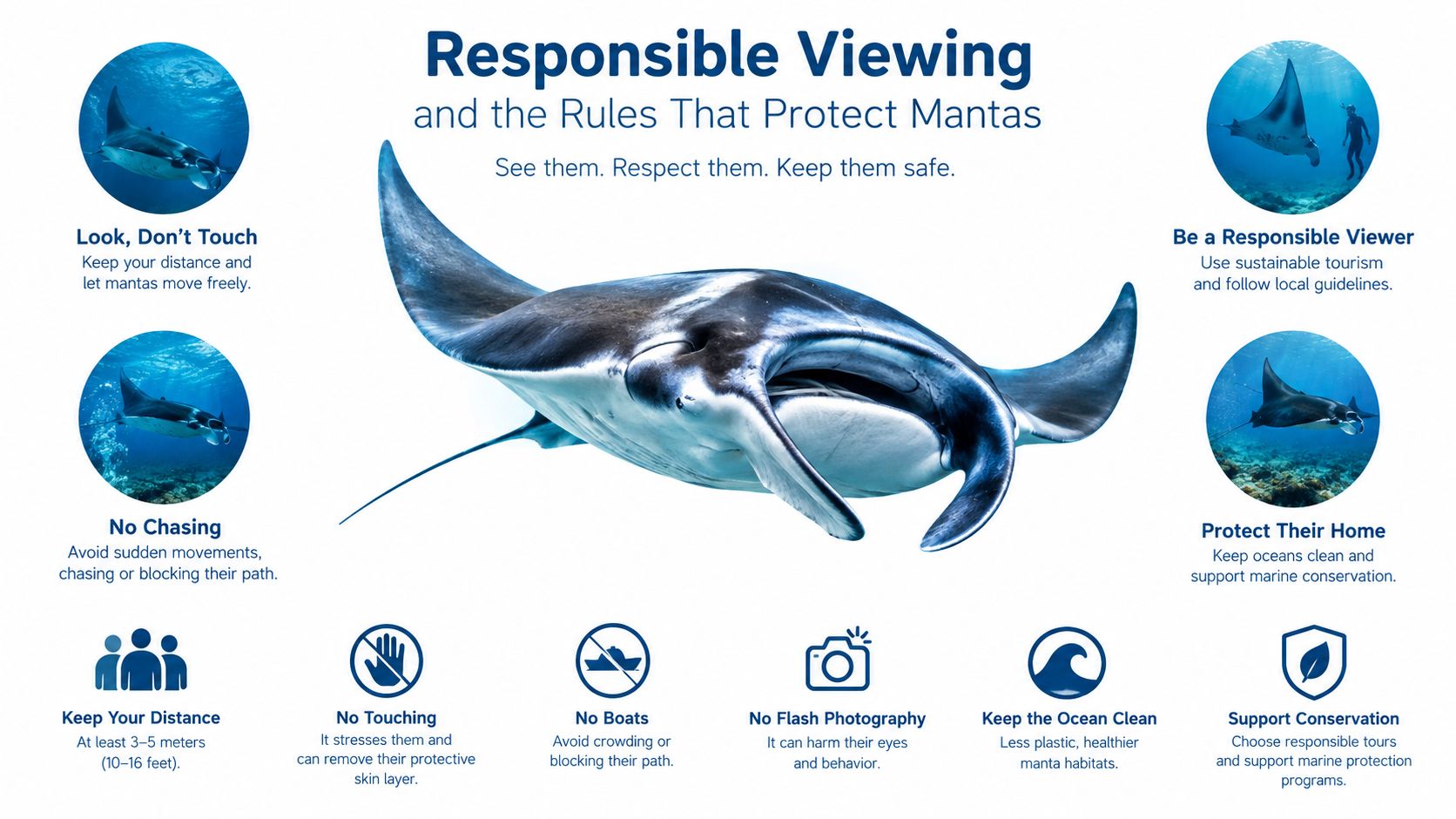
Responsible Viewing and the Rules That Protect Mantas
Legal protection is a minimum standard, not proof of a sustainable encounter. Hawaiʻi prohibits knowingly capturing, killing, abusing, or entangling manta rays, but guests should also examine how the operator manages everyday behavior.
Research discussed in Hawaiʻi County's manta-tourism documentation identifies concerns including stress, injury, disease risk, changed feeding behavior, and habituation. The material also discusses animals changing course, avoiding swimmers, or stopping feeding during tourism encounters.
Responsible encounter checklist
| Criterion | Green flag | Red flag |
|---|---|---|
| Group size | Clear guest limits and a crowding contingency | Adding guests despite an obstructed viewing area |
| Positioning | Predictable assigned positions outside the feeding route | Guests crossing a manta's path |
| Light discipline | Beams follow the designated upward or downward setup | Horizontal beams aimed at animals |
| No-contact enforcement | Guides actively prevent touching | Reaching, grabbing, or encouraged contact |
| Mooring practice | A site-appropriate plan that avoids reef damage | Anchoring on live coral |
| Ending encounters | Willingness to stop, relocate, or cancel | Continuing despite unsafe crowding |
Ask what happens when the plan stops working
There isn't a universal safe boat count established by the evidence presented here. The practical question is whether people, boats, and lights leave an unobstructed feeding area and a manageable exit route.
If a manta repeatedly circles near you, remain predictable and let the guide manage the space. Don't reach up, follow it, or interpret repeated passes as permission for contact. Review responsible and considerate diver etiquette before boarding.
Population context makes restraint important: NOAA Fisheries reported in 2024 approximately 104 adult breeder reef mantas around Hawaiʻi Island, compared with 129 across Maui Nui. Those figures describe adult breeders, not every manta in the water.
The strongest sign of a responsible operator may be its willingness to disappoint guests rather than crowd the animals.
Ask the captain when crowding would justify relocation or cancellation. A clear answer tells you more than a sighting guarantee.
Questions Guests Ask Before Booking
Do I need to bring my own light?
Confirm the equipment list with the operator before packing a light. The crew's setup determines which lights belong in the water and who handles them.
The viewing positions described earlier require coordinated beam direction. Bringing extra lighting doesn't necessarily improve the experience, and an unfamiliar handheld light can become another task to manage.
- Ask what's supplied. Check lights, batteries, snorkel equipment, and exposure protection separately.
- Declare camera lights. Tell the crew about video lights or strobes before boarding.
- Follow the briefing. Use equipment where and how the guide directs.
What if the mantas don't show up?
You may finish the encounter without seeing a manta. These are wild animals, and neither a well-established site nor favorable conditions guarantees an appearance.
The historical legislative testimony cited earlier described an approximately 80% sighting chance, but that older estimate shouldn't be treated as a current operator-specific success rate. Ask for the written no-sighting policy instead of assuming a free repeat trip.
A return offer may depend on available space and your remaining vacation dates. Keep a backup evening if possible, and understand whether weather cancellation and a completed tour without sightings receive different treatment.
What should I wear?
Wear a swimsuit and confirm exposure protection with the crew. A rash guard or light wetsuit may suit some snorkelers, but don't assume that another guest's comfort level will match yours.
Scuba divers should check their exposure protection against the planned activity and their own cold tolerance. Ask what sizes are available if you're renting, and bring a towel and dry layer for afterward.
For age, certification, and access questions, use the readiness criteria rather than a general claim that the tour is family-friendly. The operator's written participation and booking terms govern the reservation, while the captain's safety decisions govern the departure.
Book Your Garden Eel Cove Night Dive
Reserve the format you can comfortably complete, then confirm the details in writing. The goal isn't merely getting into the water. It's being prepared to follow the viewing plan and return aboard without an avoidable struggle.
Kona Honu Divers offers night manta dive and snorkel options; its manta ray tour page is one place to compare departures and participation requirements. Confirm the intended site rather than assuming the same itinerary applies to every sailing.
A practical booking sequence
Choose your format. Use the first comparison to decide among surface snorkeling, certified scuba, and boat observation. Don't select scuba just because the photographs look closer.
Ask whether the departure plans to visit Garden Eel Cove and how the crew manages group size. Request the guest limit, guide arrangement, and contingency if the viewing area is crowded.
Review the marine forecast before departure. Keep another evening available where possible, and let the captain make the operational decision. A forecast is planning information, not permission to enter unsuitable water.
Book your date after checking inclusions. Confirm flotation, equipment, ladder assistance, early-exit arrangements, weather cancellation, and no-sighting terms in writing.
Complete the required screening truthfully. Disclose relevant health concerns, swimming limitations, and the timing of your recent dives. Resolve questions before arrival rather than at the boat.
Pack a swimsuit, rash guard, towel, water shoes if the operator recommends them, and a dry bag for your phone. For a daylight departure, ask about appropriate sunscreen; discuss any seasickness remedy with a clinician or pharmacist and follow its directions.
Budget for the actual departure
The tourism research discussed earlier reported typical excursions of 3–5 hours and an average price of about US$110 per participant. Treat those as historical planning context, not a current quote, and distinguish total excursion length from time in the water.
Compare the scuba and snorkel tour list against your selected departure's checkout details. Verify what's included, what costs extra, and whether the itinerary matches your ability.
Before you pay, make sure you can answer three practical questions: Where will I be positioned? How will I get back aboard? What happens if conditions or wildlife don't cooperate?
For guided manta night diving and surface snorkeling, visit Kona Honu Divers to compare the available formats. Ask about Garden Eel Cove, explain your swimming or diving experience, and confirm the participation and cancellation terms before choosing your evening.