
A manta ray dive in Kona is a stationary night dive at Garden Eel Cove, where seafloor lights gather plankton and the mantas may or may not feed. Scuba takes an Open Water certification, snorkelers need no card, and nobody can promise a sighting.
You're on the dock after sunset with a dry bag and a decision. The reviews make the night sound like a parade of wings. The water is black, the boat is loading, and you want to know whether you kneel, float, or chase something. You don't chase. You hold a spot, the crew runs the lights, and the rays keep their own clock.
What a Kona Manta Ray Dive Looks Like
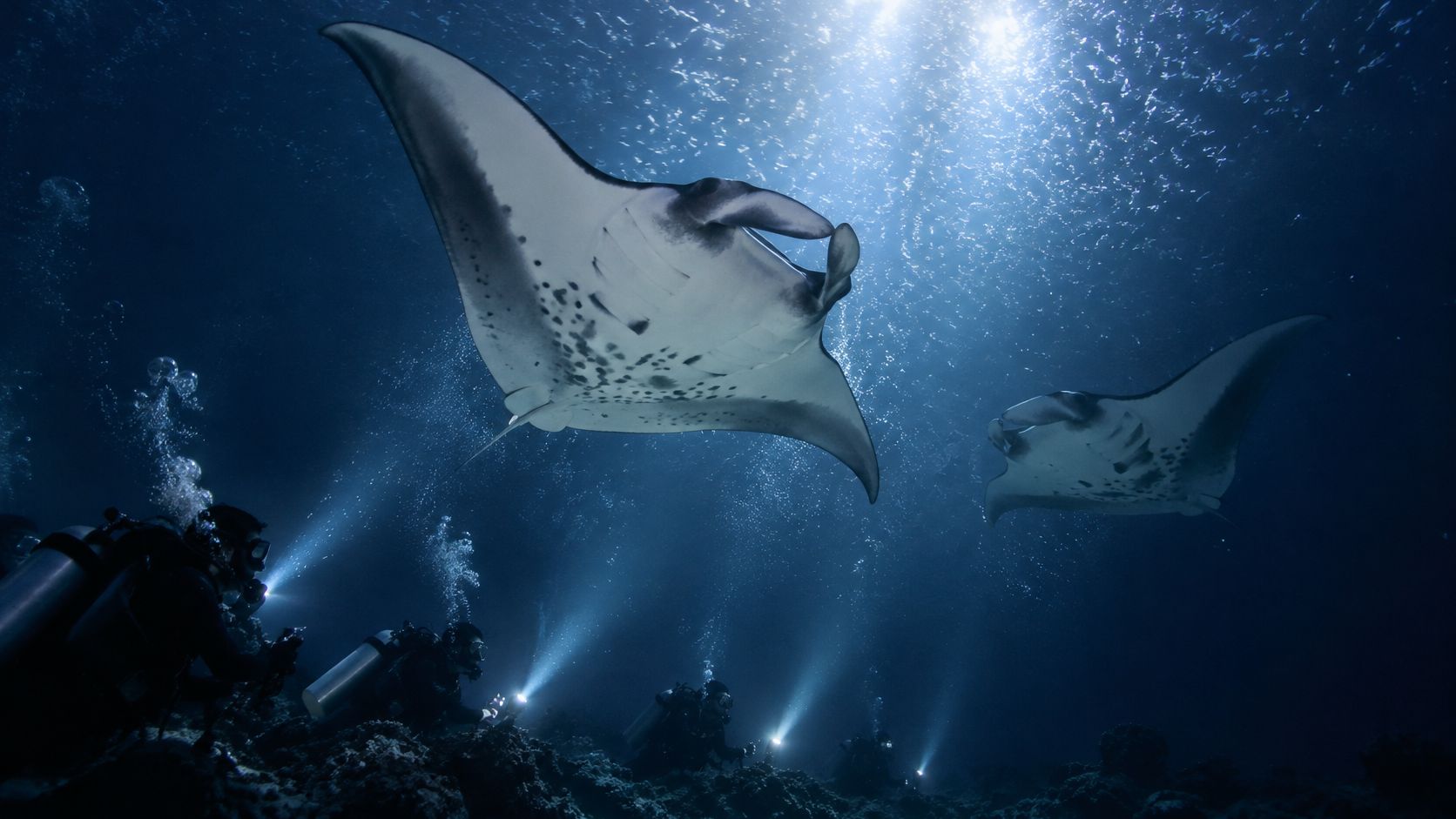
An hour after sunset on the Kona coast, the boat is on a mooring at a known feeding spot. Crews set bright lights. Divers settle on their knees inside that circle. Snorkelers stay at the surface and look down. Reef mantas, Mobula alfredi, swoop through the lit plankton and leave on their own schedule. Nobody fin-kicks after them.
Garden Eel Cove, also called Makako Bay or Manta Heaven, sits on the airport side of Kailua-Kona. You hold one viewing area instead of swimming a reef circuit. That fixed spot is what a manta ray dive Kona night is. The animal does the traveling. You do not.
A historical survey of nine Kona dive operators in 2002 estimated that approximately 11,000 divers and snorkelers joined manta-viewing tours that year, generating about $2.5 million in direct operator revenue, as Kona Honu Divers' night-dive history records. The same account put the chance of seeing at least one manta at about 80 percent. Wildlife stays variable, so that older figure is context, not a ticket promise. On our boats, manta sightings in Kona often exceed a 90 percent success rate, and we still tell every group that a quiet night can happen.
Dive or snorkel
If you want the kneel on the sand, you need Open Water Diver from a recognized agency. If you want the surface, you don't need a card. Divers watch a white belly pass just above the lights. Snorkelers watch the same loops from above and never drop into the lane. The animal isn't better on one side. The viewpoint is. If you're stuck between them, use the snorkel or dive comparison before you commit to a tank.
Daytime reef work lives on the rest of our scuba diving tours in Kona. This night is a different job. Commercial viewing runs 4:00 p.m. to 4:00 a.m., mooring is allowed, and rafting is prohibited, under the boating window for Kona manta viewing.
| Item | What to plan for |
|---|---|
| Primary dive site | Garden Eel Cove (Makako Bay, Manta Heaven), airport side of Kailua-Kona |
| How you watch | Divers kneel in a fixed light circle; snorkelers stay on the surface |
| Scuba requirement | Open Water Diver from a recognized agency |
| Snorkel requirement | No certification card |
| Commercial hours | 4:00 p.m. to 4:00 a.m.; mooring allowed; rafting prohibited |
| Historical encounter | About 80 percent saw at least one manta in a 2002 operator survey; never guaranteed |
How Lights Turn Plankton Into a Feeding Lane
Think of a porch light, not a baited hook. Moths stack in the glow because the light gathered them. They weren't hooked. Underwater lights do the same job with zooplankton. Reef mantas then filter-feed through that patch if the food is thick enough to be worth the swim. Skip the light, and the lane falls apart. Blast silt through it, and the lane falls apart too.
Say the boat, the bulbs, and the weather look identical to last Tuesday, and you still get one pass or none. That's a thin plankton patch, not a broken boat. Currents shove the patch sideways. Weather muddies it. Moonlight changes how tightly the specks stack in the beam. Stronger prey builds a busier lane. A quiet beam can stay quiet while every switch on deck is already on.
A 2025 University of Hawaiʻi analysis of 13 years at Garden Eel Cove and Keauhou, covering more than 23,000 sightings of 167 individually identified mantas, found aggregation size tracked zooplankton density, in this prey-mediated aggregation study. Bigger food, bigger groups. Same site and same operating setup can still produce a thin night.
What you do with your fins
Your job is to protect the patch.
- Neutral buoyancy: Hover, then settle. A late drop onto the sand blows the food apart before a ray arrives.
- Knees on the designated sand: The viewing spot is chosen so the lane stays open above you.
- Fins still: Fin wash is how a good patch dies in the first ten minutes.
- No contact: The light field is a window the animal can enter or skip. It isn't a lure you wave.
A quiet night is still a real night dive. Reef life shows up in the beam even when the big wings don't.
Treat the circle as an observation window. The ray chooses the approach. The cove's shape is what keeps that window usable when the sea is workable, which is the next decision.
Why Garden Eel Cove Beats Keauhou for the Dive
For a dive tour, Garden Eel Cove is the superior choice. It is protected, it has a defined viewing area, and it has better nearby reef. Divers settle below the feeding lane while mantas use the open water above them. The cove lies on the airport side of Kailua-Kona inside the West Hawaiʻi Ocean Recreation Management Area. Those physical features make it a stronger pick than a more exposed alternative when conditions suit the cove, which is how the site comparison for this night dive frames it.
Keauhou, at Kaukalaelae Point on Keauhou Bay, is the other established viewing zone. It is a real site, not a rumor. It is also the more exposed option, and it isn't the default when the cove is workable. I would start with the cove and let a rough sea change the plan, not the other way around.
What the long record shows
Photo-identification from 1992 through 2007 identified 106 individual manta rays along the Kona Coast, and historical assessments estimated the local population probably numbered fewer than 200 animals, in NOAA's summary of the Kona manta work. Community records from 2010 through 2022 at these two nighttime sites found Garden Eel Cove generally supported larger aggregations, while Keauhou showed a strong female bias and high site fidelity among females. Males moved more. Across both sites the overall sex ratio was approximately 1:1, and seasonal size still followed zooplankton. The documented aggregations stayed relatively stable across that 13-year stretch of tourism. Separate genetic work estimated an effective population size of 104 manta rays for Hawaiʻi Island, with a 95 percent confidence interval of 99 to 110, and described Hawaiian populations as small and genetically isolated.
That small, isolated group is why site choice and manners matter more than a busier boat. Larger groups at the cove are a research pattern, not a promise for your Tuesday.
Kona Honu Divers often takes its manta ray charter to Garden Eel Cove for that protected setup. Pick the cove when the sea state allows. A rougher night is a reason to trust the crew's call, not a reason to demand the backup site because a map said it was closer to the hotel.
| Criterion | Garden Eel Cove | Keauhou |
|---|---|---|
| Also called | Makako Bay, Manta Heaven | Kaukalaelae Point, Keauhou Bay |
| Setting | Protected cove, stable kneel spot, reef beside the lane | Second established zone, more exposed |
| What research found | Generally larger feeding aggregations | Strong female bias and high female site fidelity |
| Best use | Default superior choice for the dive tour when conditions allow | Alternate zone, not the first pick for this tour |
Certification Timing and the Packing List
Sort the people before you sort the gear. Most of our regular dive charters, including this scuba night, require at least an Open Water Diver certification from a recognized agency. A brand-new swimmer who isn't certified belongs on the snorkel version at the surface, not on a tank in the dark. A confident Open Water diver can do the night. Someone who wants a longer-range reef day is booking a different trip, and that trip can wait.
There isn't a magic month. Nights run year-round inside the commercial window, and plankton, current, weather, and moonlight change the show more than the calendar does. Book a date you can repeat if the ocean is rough. Expect a dusk departure and a return later in the evening. If this is your first card, finish the Open Water certification before you put this night on the same trip as your check-out dives. A dark kneel is a poor place to learn buoyancy from zero.
What actually goes in the bag
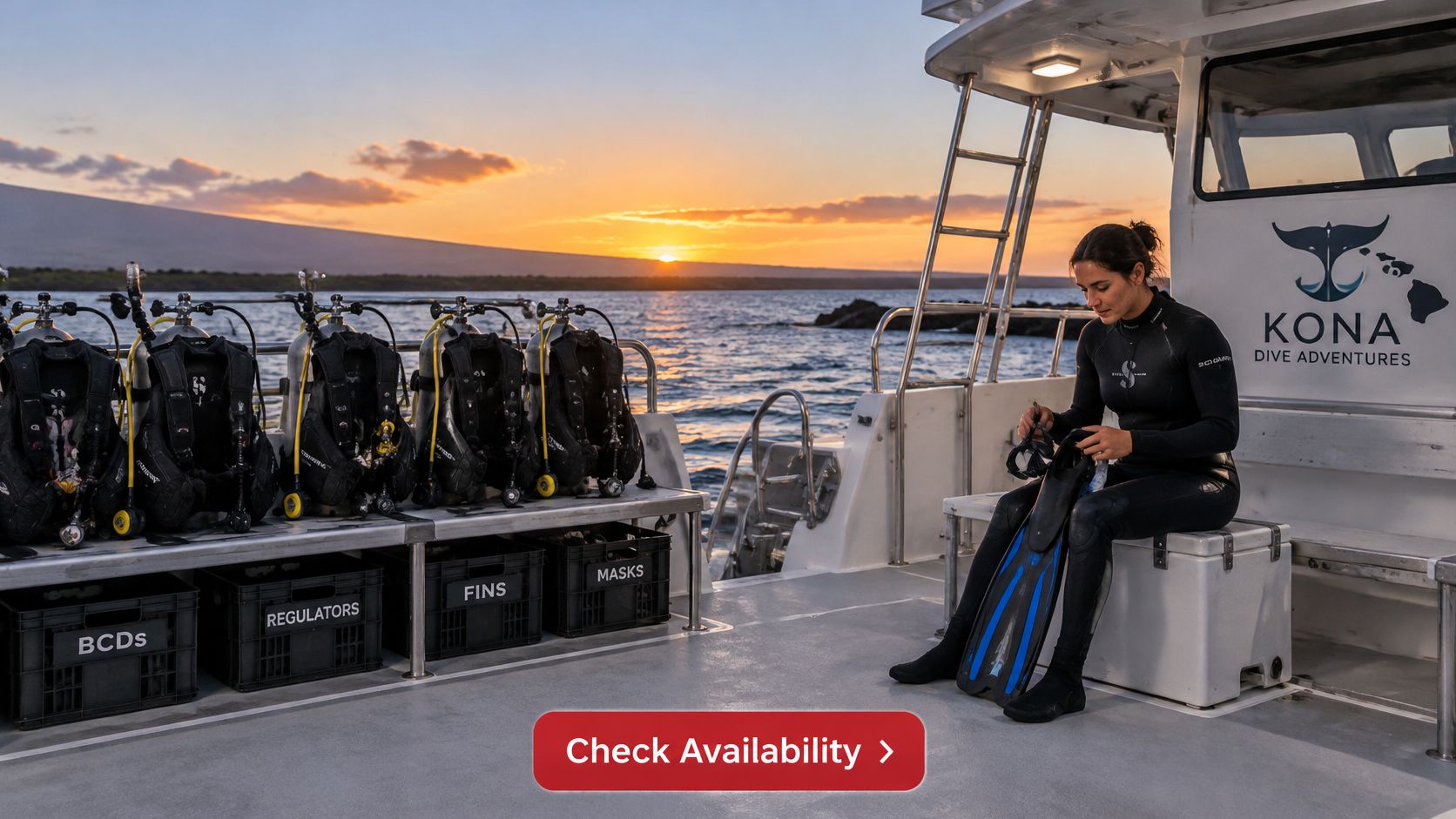
Rental scuba gear is normal on Kona boats, so owning a full kit is optional. A warm layer for the ride back is not.
- Certification card and a warm layer. The card gets you on the scuba boat. The layer is for wind on wet skin after you climb the ladder.
- A 3 mm suit in calm summer water, or a 5 mm if you chill at night. The kneel is still. You won't warm up by swimming.
- Your own mask if you have one. On the dive, take the snorkel off the mask strap so it can't snag a passing wing and yank the mask.
- A small dive light for your own beam. The site lights already make the circle. Your light is for you, not for herding a ray.
- Nothing dangling. Skip gloves you plan to touch with, and clip the camera so it isn't a swinging weight in the lane.
- Towel, dry shirt, and motion comfort. The crossing is short, and short is enough to ruin a night if you get seasick and wait until the mooring to say so.
Practical rule: If you aren't certified, book the surface spot. Don't borrow a friend's card story and hope the briefing covers the gap.
Safety Etiquette and Photo Basics
The night starts in the briefing, not at the animal. The crew covers the science of what you'll see and the rules of passive observation before anyone enters. The dive is stationary and closely supervised, with experienced guides in the water so people stay safe and comfortable. Powerful dive lights make a bright circle on the seafloor, so you aren't sitting in full darkness.
Then the manners are simple, and they aren't optional. NOAA's voluntary wildlife-interaction standard is an observe-only approach. Don't touch, chase, grab, or ride a manta. Contact can strip the protective mucus coating. Divers stay near the bottom and leave the open water to the rays. Hold dive lights up so plankton gathers above you. Don't dump bubbles into a manta's path. Take the snorkel off the mask, because it can snag a passing ray and pop the seal. Snorkelers stay on the surface, shine lights downward, and don't duck-dive into the feeding lane.
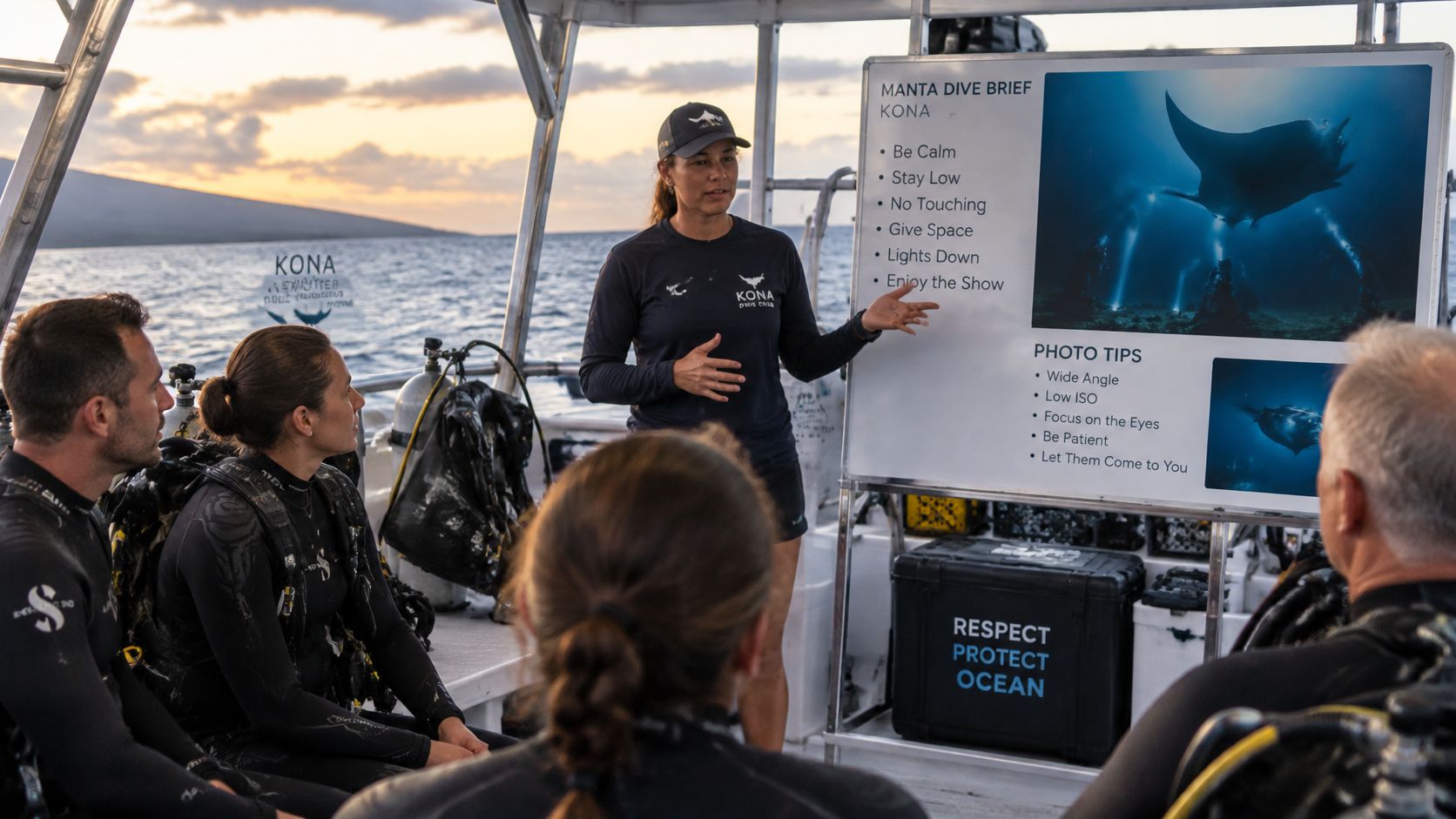
Don't touch, chase, grab, or ride. The shot you want is the animal choosing you.
Photos without a chase
Kneel. Pre-focus on the open lane. Use a wide frame and let a ray fill it as it passes. Skip the tighter angle that makes you lean into the water column. Don't fire a strobe into an eye. Tuck your elbows so a wing doesn't meet a camera housing. If you want the longer version of how we expect people to act on any reef, read our considerate diver etiquette before you pack the rig.
Judge the night by safety, by whether the guide held the group, and by whether you watched natural feeding. Don't judge it by a promised headcount. A crowded boat or an empty lane still has a score, and it isn't "how many wings."
Crowds Quiet Nights and What You Still See
The crowd worry is fair, and it has a number on it. Hawaiʻi's manta-viewing management proposal put approximately 60 to 70 viewing vessels across Makako Bay, or Garden Eel Cove, and Kaukalaelae Point at Keauhou Bay, and it proposed 24 commercial permits per zone, 60 passengers for hire per vessel in a 24-hour period, and two-hour viewing shifts, in the state's manta-viewing announcement as summarized for divers. Those limits describe a managed viewing zone, not a free-for-all where every boat invents its own contact rules.
How to score the boat
Judge the boat by a defined kneel spot, guides in the water, lights used only as a plankton tool, slow speed near the site, a legal mooring, and no rafted cluster. Rafting is already off the table during commercial viewing. A pile of boats tied together is a failed setup even if the wings show up.
If the lane is empty, score the crew on whether they ran the site, gave the briefing, and held the passive rules. You can still have a supervised night on the reef bottom, garden eels in the sand that gives the cove its name, and other nocturnal fish in the beam. Don't call zero mantas a failed operator. Do call touching, chasing, or a promised headcount a failed trip.
Families and photographers should score comfort, interpretation, and respect. A clear crew who explains a thin night beats a loud boat that guarantees a circus. For timing trade-offs across the year, see when Kona manta nights tend to line up, then keep a second evening free if the first one is blown out.
Book the Garden Eel Cove Night Dive
If you want the Kona manta night on scuba or from the surface, book the 2-tank manta ray charter and expect Garden Eel Cove as the go-to site. The cove wins on a protected location, a better viewing area, and better reefs. The flagship night suits beginners through advanced divers, with a snorkel option from the surface. Our manta ray night dive has encounter rates of up to 92 percent, and that figure is a track record, not a guarantee for your date.
The night itself is the 2-tank manta dive and snorkel. Two other trips are different jobs, not substitutes. More experienced diving days sit on the premium advanced 2-tank trip. The separate Kona blackwater dive is a deep open-ocean night, not this cove kneel. The wider set of diving tours covers the daytime range if the manta night isn't your only plan.
Call 808-324-4668 if you need a human to sort certification against the date. Certified divers should choose the manta night on scuba. Uncertified guests should choose the snorkel on the same page and stay at the surface.
Kona Honu Divers runs the Manta Ray Night Dive at Garden Eel Cove, with a scuba kneel for certified divers and a surface snorkel for everyone else, plus daytime reef charters when you want a second kind of day on the water. If you're ready to hold still in the light and let the rays decide, visit Kona Honu Divers and lock a date you can move if the sea says no.