
Manta ray diving in Hawaii usually means a stationary Kona night dive, preferably at Garden Eel Cove, not a daytime swim available on every island; Kona's established encounters center on 2 principal feeding locations. Choose the site and viewing role that suit your skills, then leave room in your itinerary for weather or a night when the rays don't appear.
You may already have a hotel booked and a choice between nearly identical manta-tour photos on your phone. The useful differences aren't in those photos. They're in the shelter around the site, where the crew positions guests, how comfortably you can hold still, and what happens if the evening doesn't go to plan.
What a Kona Manta Night Actually Is
The boat sits on its mooring after dark, and a bright circle appears on the sand below. Rather than swimming off to search the reef, divers descend to an assigned viewing area and wait. The best time is after sunset, when the lights can concentrate plankton, not a particular migration season.
The animals are resident reef mantas, Mobula alfredi. A University of Hawaiʻi study analyzed community observations from 2010 through 2022, recording more than 23,000 sightings of 167 identified animals at Garden Eel Cove and Keauhou.
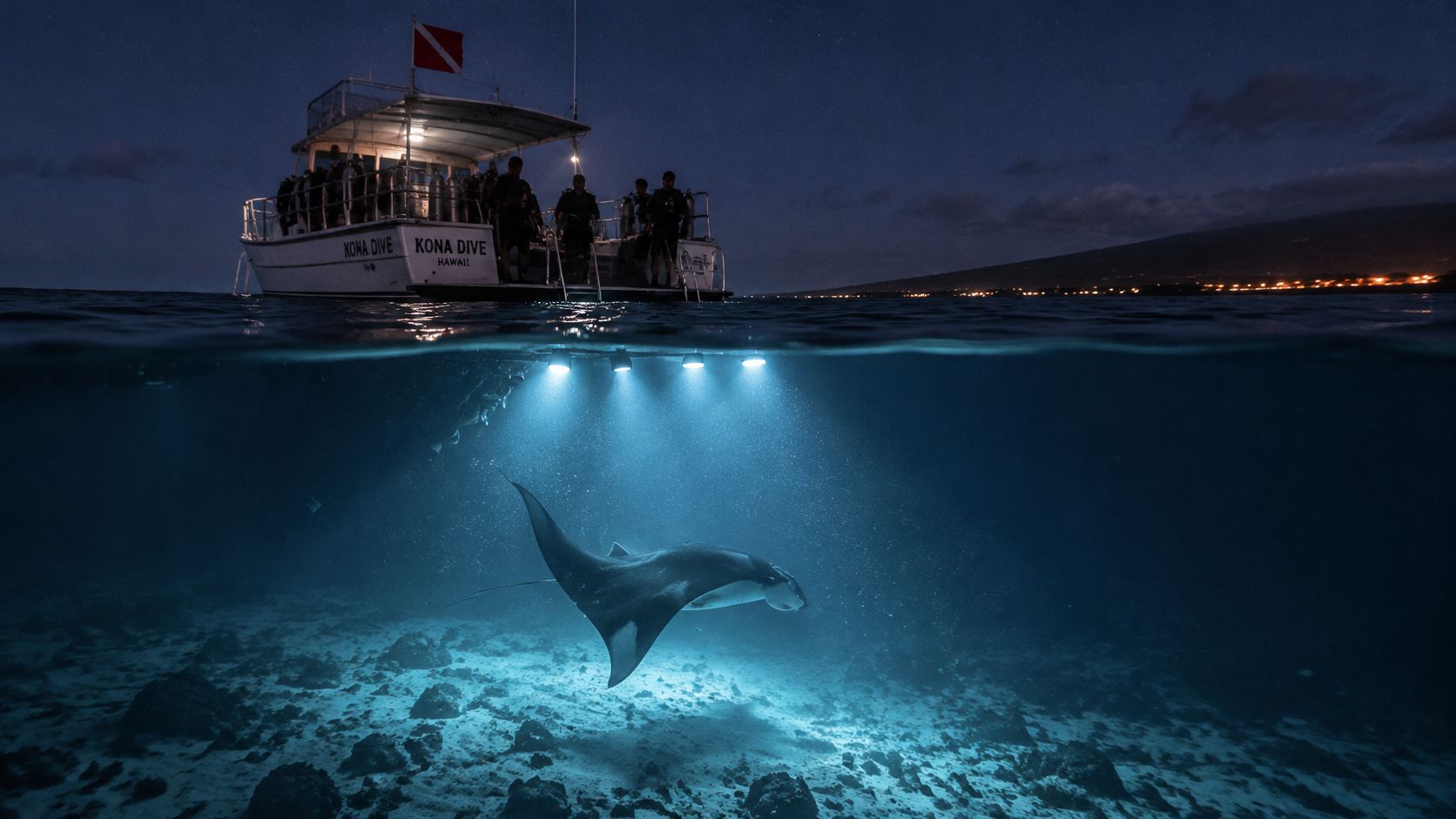
A Feeding Opportunity, Not a Performance
The researchers found that aggregation size tracked zooplankton availability. The observed sex ratio was approximately balanced, with females showing stronger attachment to particular sites and males moving more between them.
That distinction matters when you book. You're visiting identifiable local animals that repeatedly use a feeding area, not waiting for a migrating herd to refill the bay.
Practical rule: Buy a well-run opportunity to observe wildlife, not a promise that wildlife will perform.
The encounter can begin without fanfare. Lights illuminate suspended particles, divers settle their equipment, and the first ray may arrive from beyond the visible edge of the circle. A close pass is the animal's choice, not something a guide should manufacture by pursuing it.
Plan Around Darkness and Conditions
The feeding pattern is consistent rather than seasonal. The state's proposed manta-viewing framework defines viewing hours as 4:00 p.m. to 4:00 a.m., but that's a proposed management window, not a tour schedule or a recommendation to arrive at either endpoint.
For orientation, compare the manta dive and snorkel format with the broader Kona diving tours. Keep your decision practical: appropriate skills, a suitable site, manageable equipment, and enough itinerary flexibility to handle a missed night.
Where to Be and Who the Night Fits
Kona manta night options by role and site
| Choice | Where you are | Skill bar | What to expect |
|---|---|---|---|
| Scuba at Garden Eel Cove | Kneeling on sand inside sheltered Makako Bay | Open Water comfort at night and the ability to hold position | Larger manta groups in observations, a sheltered setting, and plankton gathered in a light circle |
| Snorkel at Garden Eel Cove | On the surface above the same lights | Confident swimmer who can stay with a float or ring | Rays feeding below, with no descent into their path |
| Keauhou night stop | Kaukalaelae Point, the other designated zone | The same passive scuba or snorkel discipline | A separate feeding site with stronger female site fidelity and a less protected shoreline |
| Day reef dive instead | Kona lava reefs on a morning charter | Appropriate daytime scuba training or confident snorkeling skills | Opportunities for turtles and reef life, not the manta light show |
Understand the Viewing Positions
Think of the setup as a sandwich. Divers stay near the sand, snorkelers remain at the surface, and mantas feed in the illuminated water between them.
Reef mantas funnel plankton-rich water toward their mouths with their cephalic fins, then filter food across their gill rakers. The lights gather the prey into a temporary patch. The animals aren't approaching because they want attention from swimmers.
The Hawaiʻi Department of Land and Natural Resources manta guide describes reef mantas occurring from near-surface waters to depths of at least 120 feet. That's their documented depth range, not the planned depth of your charter.
Don't expect a ray to remain at one viewing height. Its feeding route may climb, bank, and descend, which is why an apparently empty stretch of water must stay clear.
Match the Role to Your Actual Ability
A scuba certification alone doesn't tell the whole story. You need to manage your regulator, mask, buoyancy, and light without standing up into the feeding lane or grabbing another diver.
For a rusty diver, a daytime refresher is a better investment than a larger camera. If you can't stop without sculling your hands or cycling air through your buoyancy compensator, work on that before attempting a stationary night encounter.
Snorkeling removes the scuba equipment, but it doesn't remove open-ocean conditions. You still need to breathe comfortably through a snorkel, tolerate splashes, and stay with the group after dark.
- Confident swimmer, no scuba training: Choose surface viewing and commit to staying at the surface.
- Certified but anxious underwater: Discuss your comfort openly before selecting scuba.
- Non-swimmer: Don't treat a flotation device as a substitute for swimming competence. A private guide can provide attention, but can't make an unsuitable activity suitable.
- Interested mainly in reefs: Choose daylight, when you can appreciate lava formations and search for reef animals without the pressure of a nighttime wildlife encounter.
Your accommodation affects the evening, too. Use this guide to places for divers to stay on the Big Island to keep the drive and harbor logistics manageable. A late return is less appealing when you've planned a long drive afterward.
Why Garden Eel Cove Is the Better Stop
I would choose Garden Eel Cove for the scuba version. Its protected location, established viewing area, and surrounding reefs make it the stronger overall dive, rather than another address where mantas sometimes appear.
Garden Eel Cove is naturally sheltered from the open ocean. That shelter can make getting organized easier, but it isn't a weather guarantee. Swell direction and the captain's assessment still decide whether the site is appropriate.
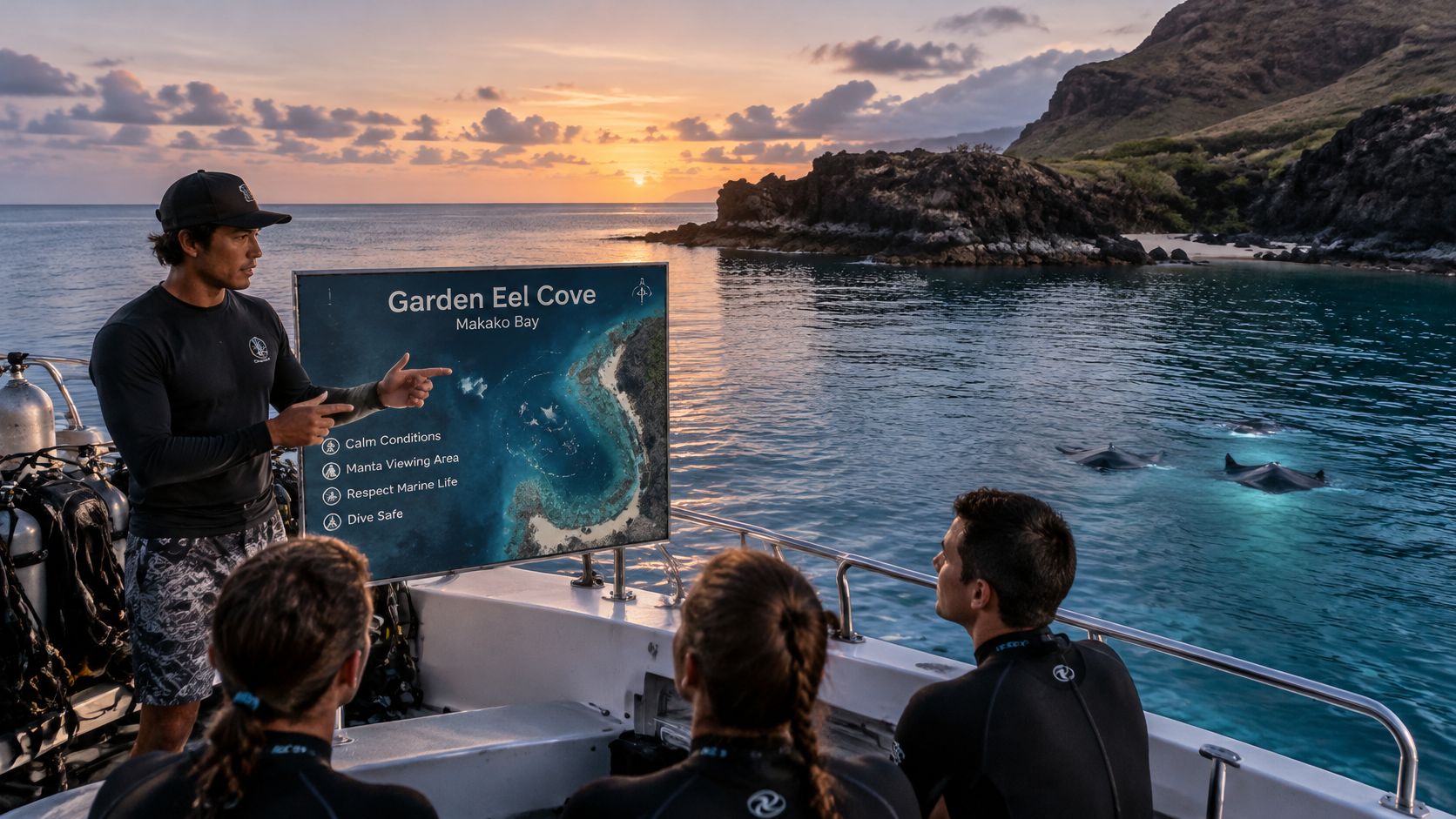
An Established Viewing Ground
The state's manta-viewing management announcement identifies Makako Bay, or Garden Eel Cove, and Kaukalaelae Point at Keauhou Bay as the viewing zones, estimates 60–70 viewing vessels across them, and describes proposed limits of 24 commercial permits per zone, 60 passengers for hire per vessel in a 24-hour period, and two-hour shifts.
Those are proposed management provisions, not proof that every limit is currently in force. They do establish the scale of the operational problem: boats, entries, swimmers, and feeding animals need organized space.
The proposed framework also favors commercial moorings over anchoring within the viewing boundaries. It restricts live boating and would prevent vessels from departing while participants or crew remain in the water. Those mechanics matter more than decorative lighting or a dramatic tour description.
Better Layout Beats More Movement
A good viewing area lets divers settle without occupying the rays' approach and exit routes. On our manta night dive, guests use a specific viewing area at an established dive site rather than roaming around looking for an interception.
Garden Eel Cove also offers a better surrounding reef setting for the overall dive. That's an editorial reason to favor it, not a numerical reef-health ranking or a promise of particular species.
- Choose defined positions: Guests should know where to settle before descending.
- Keep the feeding corridor open: A front-row view doesn't justify moving into an animal's route.
- Respect the weather call: Shelter improves the starting position; it doesn't override unsafe conditions.
Keauhou remains an important manta feeding location. Calling Garden Eel Cove the better default doesn't make the other site worthless, nor does it mean the cove will always have the better encounter.
If the forecast is marginal, keep the sheltered option under consideration and let the crew make the final call. Don't replace a cancelled cove trip with an improvised exposed stop merely to preserve the booking.
Rules That Keep People and Rays Apart
The briefing should explain what feeding looks like, where everyone belongs, and how the group exits if someone becomes uncomfortable. Our crew begins with the science behind the encounter and the rules of passive observation, rather than leaving guests to work out the formation underwater.
| Participant | Working position | Light and movement discipline |
|---|---|---|
| Scuba diver | Assigned sandy viewing area | Keep the beam above your head, remain low, and secure fins and equipment |
| Snorkeler | Surface viewing position | Stay with the flotation setup and don't duck-dive |
| Photographer | The same position as other guests | Keep the rig within your space and leave approach routes open |
| Guide | Supervising the group in the water | Manage positioning, discomfort, and an orderly exit |
Make the Formation Predictable
The NOAA-supported voluntary wildlife-interaction standard directs divers toward the light circle with lights held above their heads, discourages beams into manta faces and bubbles into approaching animals, and recommends a ring or similar device for snorkel groups of four or more.
Keep breathing normally. Never hold your breath to avoid releasing bubbles. Follow the guide's positioning instructions and use ordinary, relaxed breathing rather than trying to manipulate a ray's approach.
Touching, chasing, grabbing, and riding are incompatible with passive viewing. Contact can remove the animal's protective mucus coating. Even an apparently gentle hand placed on a passing wing is interference.
The closest acceptable encounter is one the manta can leave without changing course around you.
How Mixed Groups Go Wrong
A snorkeler duck-dives for a closer look and suddenly occupies the feeding corridor. The solution isn't a faster return to the surface after getting the photograph. It's staying at the surface throughout the encounter.
A photographer follows the viewfinder and fins sideways across a ray's exit. Keep checking the edges of your frame with your eyes, not just the camera screen. If you can't operate the housing without moving out of position, put it away.
A new diver lifts off the sand while looking upward. Correct the buoyancy problem with the guide instead of kicking down repeatedly, which can stir sediment and strike nearby guests.
Supervision Must Be Active
Our manta dive is stationary and closely supervised, with experienced divemasters and instructors in the water. That reduces uncertainty, but it doesn't remove the need for honest screening before departure.
A distressed guest needs prompt guide assistance and, when necessary, a controlled exit. Divers shouldn't bolt to the surface, and nobody should be left to troubleshoot panic alone in the dark.
For families, pool confidence isn't the same as comfort floating above dark ocean water. Discuss a private guide when extra support would help, and skip participation when the basic swimming or diving skills aren't there. Review responsible and considerate diver etiquette before arrival so the briefing reinforces familiar habits.
Lights, Cameras and the Packing List
Pack for simple equipment handling and a comfortable return ride. A familiar mask and a dry layer will help more than an unfamiliar accessory you're learning to use after sunset.
Packing checklist for a Kona manta night
| Item | Who needs it | Packing note |
|---|---|---|
| Mask | Divers and snorkelers | Fitted and defogged before entry |
| Suit | Divers and snorkelers | Bring suitable exposure protection or arrange the boat's equivalent |
| Primary dive light | Divers | Charge or replace the battery and carry a compact backup |
| Snorkel ring or float | Snorkel groups | Use the operator's grouping arrangement; discuss any offered vest before departure |
| Reef-safe sunscreen | Everyone exposed to afternoon sun | Apply before boarding, allow it to absorb, and keep hands and rails clean |
| Camera | Photographers | Wide lens or compact action camera, not a long telephoto |
Pack in the Order You'll Need It
Keep certification details and any required paperwork accessible, then pack your mask and exposure protection. Put your towel and dry clothing in a protected bag, not underneath wet equipment.
Check light switches before leaving your accommodation. Secure lights with appropriate clips, route hoses cleanly, and tuck away loose straps. Leave dangling jewelry ashore.
For sunscreen, don't rely on a reef-safe label alone as an environmental guarantee. Clothing can reduce how much you need, and slippery hands make ladders and camera housings harder to handle.
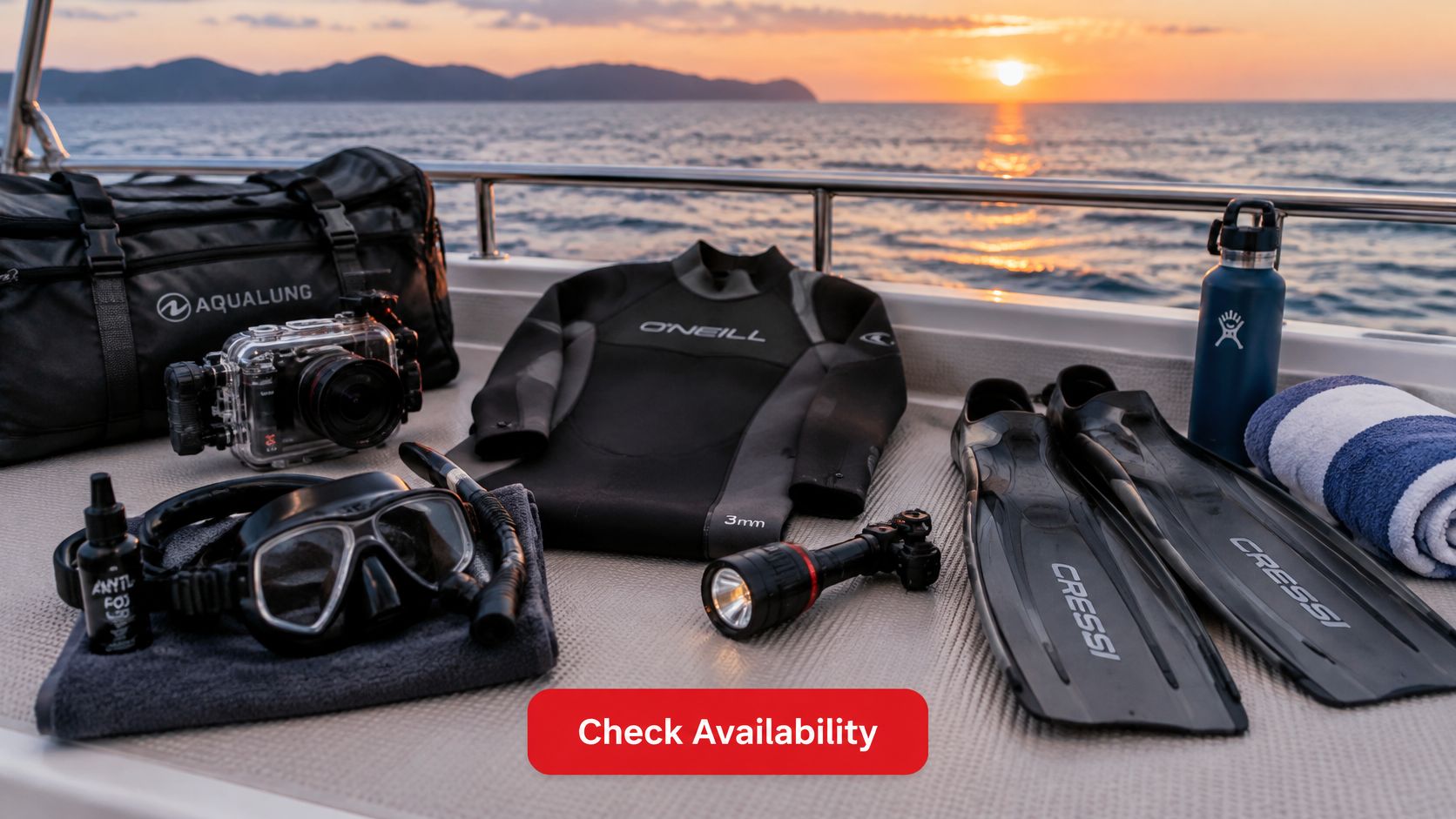
Start With the Existing Light
A wide lens gives you room to include a passing animal without backing into another diver. A compact action camera also keeps task loading low. A long telephoto is awkward when the subject may pass close and ambient light is limited.
Use these starting decisions rather than chasing a universal camera preset:
- ISO: Increase sensitivity enough to record the illuminated scene, then check whether noise is acceptable.
- Shutter: Choose a speed that controls motion blur without turning everything beyond the beam black.
- Aperture: Open it enough to gather light while retaining useful focus across the approaching animal.
Video often communicates a feeding roll better than a single still. Begin recording before the ray reaches the center of the light, and resist swinging the camera after it disappears.
The best frame is the one where the animal never had to change course.
Use existing site illumination first. If the crew allows additional lighting, keep it out of animals' faces and coordinate its direction with the established setup; a red focus light isn't permission to illuminate a ray continuously.
Practice camera handling during daylight before bringing a bulky housing at night. These Kona manta dive photography examples can help you choose a composition that works from a fixed position.
When the Rays Skip a Night
A wildlife guarantee isn't the same as a guaranteed encounter. A company may offer a return-trip arrangement, but no booking policy controls plankton, swell, or the animals' decision to feed elsewhere.
NOAA-supported genomic research found genetically distinct Hawaii Island and Maui Nui reef-manta populations numbering only a few hundred individuals each, with extremely limited exchange, while NOAA notes that mature females produce one pup every 1–7 years.
These aren't interchangeable animals supplied by neighboring islands. Individual injuries and repeated disturbance matter because replacement is slow.
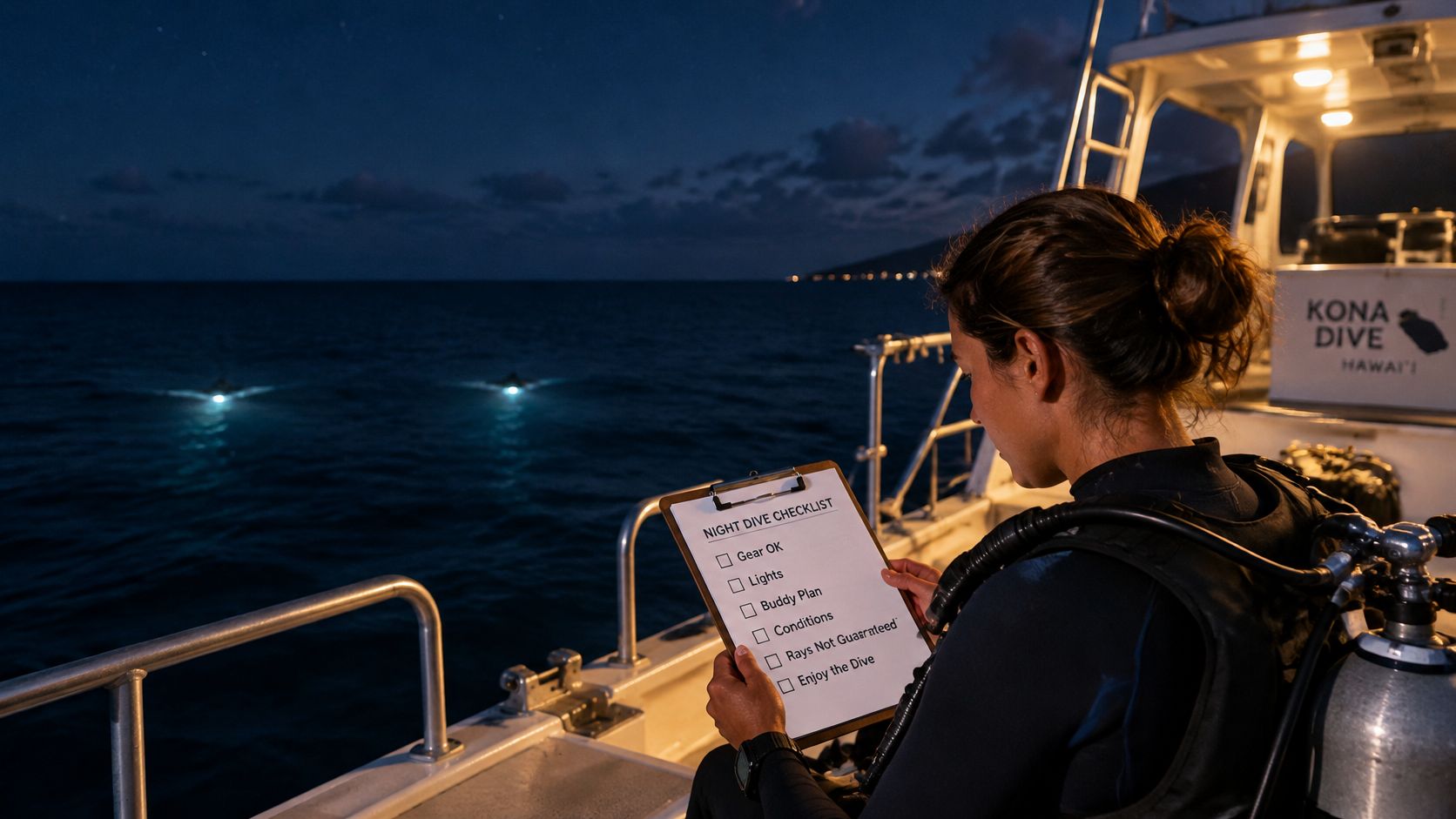
Separate a Sighting From a Good Encounter
A distant pass technically counts as seeing a manta. It may still leave you disappointed if visibility is poor, you're uncomfortable, or other guests repeatedly block the view.
Likewise, a crowded night can produce impressive animal activity and weak guest experience. Ask about the guest-to-guide arrangement and how the group is positioned, not just the maximum capacity printed on the boat.
Make the Backup Plan Before Paying
Use a decision list that distinguishes wildlife disappointment from an operational cancellation:
- Clarify the no-show policy. Ask whether a return trip is offered, what availability restrictions apply, and whether it covers every participant's activity.
- Separate cancellation terms. Weather cancellation, seasickness, early withdrawal, and no mantas may have different outcomes. Get the applicable refund or credit terms in writing.
- Leave a usable return evening. A rebooking offer has little value if you fly out the next morning.
- Keep a daylight alternative. A reef outing offers a different experience without pretending to replace the manta encounter.
Strong wind, swell wrapping into the site, unsafe mooring conditions, and difficult entry or recovery can justify cancellation. There isn't a universal wind threshold that a visitor should use to overrule the captain.
If you're rescheduling, choose the next suitable Garden Eel Cove evening rather than changing boats to chase a social-media promise. Use this guide to timing a Kona manta encounter to plan flexibility, not to identify a supposedly guaranteed night.
Manta Ray Dive FAQs by Skill Level
Can Beginners Scuba Dive After Only a Pool Course?
Not on the certified-diver charter. Pool practice doesn't replace Open Water certification or the ability to manage yourself in the ocean. Complete the appropriate training and disclose any long gap since your last dive before reserving.
A newly certified diver may be comfortable with the stationary format, while a diver with many logged dives may still need a refresher. Choose based on current control, not the number printed in a logbook.
Is It Suitable for a First Night Dive?
It can be, provided your basic skills are settled and you're comfortable with the plan. No ocean dive is risk-free, so don't accept a blanket assurance that darkness and supervision make it automatically safe.
Tell the crew it's your first night dive. Review the signals, descent, and exit procedure, and agree on how you'll request help.
Which Camera Should Photographers Bring?
Bring the smallest familiar setup that gives you a wide view. Leave unfamiliar strobes and complicated arms behind if they interfere with position or awareness.
Before committing to scuba for the camera angle alone, compare snorkeling and diving with manta rays. The better photographic platform is the one you can use calmly.
Is It Worthwhile for Advanced Divers?
Yes, if you enjoy close observation rather than depth or distance. The useful challenge is precise stillness while monitoring your buddy, equipment, and the animals' routes.
- For control: Keep your fins within your assigned space.
- For observation: Watch the feeding sequence rather than counting passes.
- For poor conditions: Accept a postponement instead of looking for a more exposed substitute.
Book the Garden Eel Cove Charter
I recommend the Garden Eel Cove charter for divers who want an established viewing layout in a sheltered setting. Kona Honu Divers uses the cove as its go-to manta site, with experienced guides supervising the stationary encounter.
Our charter is for appropriately certified divers. Before payment, confirm that your certification and recent diving meet the booking requirements, and disclose anything that could affect your comfort at night.
Reserve the Right Role
Use this booking checklist rather than choosing solely from the departure time:
- Confirm eligibility. Check your certification level and recent diving history against the charter's stated requirements.
- Clarify rebooking. Establish what happens after weather cancellation or a night without manta sightings.
- Declare camera equipment. Explain what you're bringing and ask about group arrangements. A camera booking doesn't automatically mean a smaller group.
- Select surface viewing when appropriate. Make sure the reservation reflects snorkeling rather than scuba.
- Reserve with itinerary flexibility. Choose an evening that leaves room for a possible return, rather than relying on your final night.
Choose Other Diving Separately
For a different outing, experienced divers can review the Premium Advanced diving trip. The Kona Blackwater Dive is another distinct option, not a replacement for the manta feeding setup.
Book the experience you're prepared for now. Extra depth, different equipment, or another night format won't improve a manta reservation if your real need is a refresher or more surface support.
Kona Honu Divers offers guided manta night diving and surface snorkeling with Garden Eel Cove as the go-to site. Visit Kona Honu Divers to choose your viewing role, confirm your readiness, and reserve an evening with room in your itinerary for the ocean to have the final say.