
You've got an evening open in Kona, and the manta photos look extraordinary. What's harder to judge from a booking page is whether you'll feel comfortable in the water, how much of the view you'll share with other groups, and whether a sighting will turn into the encounter you're hoping for. A good manta night starts with those questions, not with the closest photograph.
What a Kona Manta Night Really Is
Say you're sitting on the boat after dark. Kona's town lights shrink behind you, and a blue glow marks the water ahead. You check your mask again, wondering how much swimming this will involve.
The manta ray dive in Kona is a stationary night watch, not a pursuit. Certified scuba divers take a designated position near the sandy bottom. Snorkelers watch from the surface, usually supported by a float or board. The animals choose whether to approach.
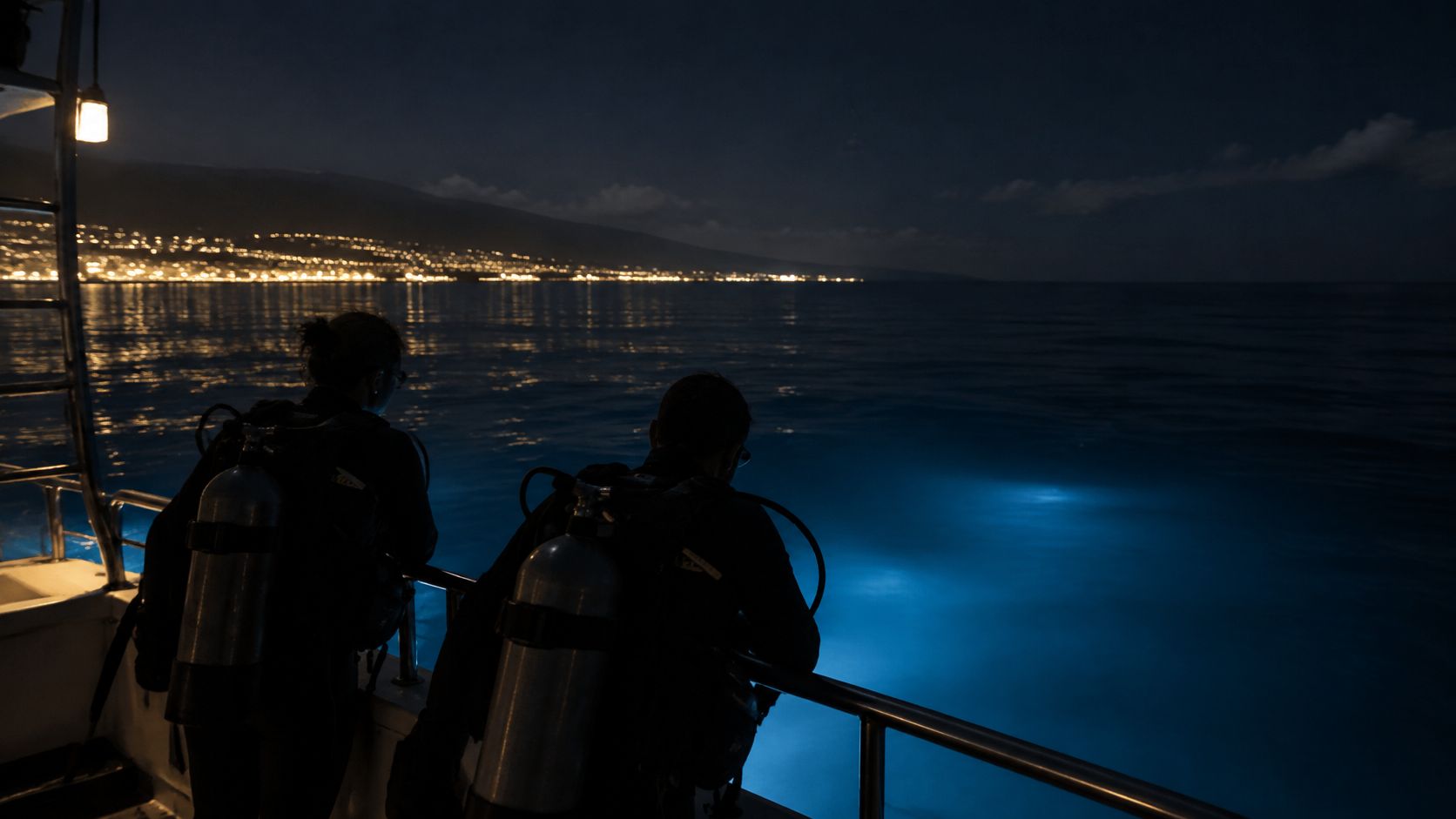
A familiar feeding place, not a performance
The animals you're hoping to see are reef manta rays, Mobula alfredi. They come to feed on plankton concentrated around underwater lights. A ray may glide through, turn, and loop back, but nobody can schedule its arrival or require another pass.
This isn't a recently invented attraction. Historical testimony submitted to the Hawaii Legislature places the beginning of regular Kona manta dives in the late 1970s and records an approximately 80% chance of seeing a manta during a Kona dive. That's a historical benchmark, not a forecast for your reservation.
Manta sightings in Kona now often exceed a 90% success rate, but a high sighting rate still isn't a promise. Food availability and ocean conditions can make a familiar feeding area quiet.
Set the right expectation: You're booking a guided opportunity to watch wild animals feed, not a guaranteed close pass.
The practical difference is important. An excellent night lets you settle in, breathe comfortably, and watch without competing for position. A trip can technically record a manta sighting while leaving guests cold, crowded, or unable to see past someone else's fins.
Choose the arrangement that lets you remain calm. The bottom-up view isn't automatically better than the surface view, and neither is worth forcing when conditions or your comfort say otherwise.
How the Manta Ray Dive Kona Night Unfolds
The night works because everyone has a defined place. Your job isn't to find a manta. It's to get settled, stay aware of your guide, and keep the feeding space clear.
Follow the night in order
Start with the briefing. The crew explains manta feeding, passive observation, entry and exit procedures, and where you'll position yourself. This is also the time to disclose anxiety, unfamiliar equipment, or trouble equalizing. Don't save a manageable concern for the descent.
Travel to the selected site. The boat heads along the Kona Coast to an established viewing area, often Garden Eel Cove. Listen for the actual site plan rather than assuming every departure uses the same route or arrangement.
Enter with your assigned group. Divers descend with their guide and settle in the designated bottom viewing area. Snorkelers remain at the surface, commonly holding a flotation board. Nobody needs to cut through the middle to improve their view.
Let the lighting setup work. Underwater lights concentrate zooplankton, and mantas filter-feed through that illuminated water. The animals aren't being hand-fed. The central column needs to remain available for their approaches and turns.
Watch, then leave together. Maintain your position, monitor your air if you're diving, and follow the guide's return signal. Don't extend your own viewing session when the group begins its exit.
NOAA's manta-viewing guidance recommends a semi-circle on sand, rubble, or boulder bottom, with divers stationary and lights raised to leave the feeding lane open. It also discourages touching because contact can remove the manta's protective mucus coating.
Who is where on a Kona manta night
| Role | Where you stay | Typical depth | What you do |
|---|---|---|---|
| Certified diver | Sandy semi-circle | The guide's designated viewing depth, not the full site slope | Kneel where directed on bare sand, aim lights up, and control buoyancy |
| Snorkeler | Surface float or board | Surface | Hold position and look down, with no duck-diving into mantas |
| Guide | With the group | Bottom and midwater as needed | Set the light campfire and maintain spacing |
Depth is part of the briefing, not something to choose from an online site description. Your certification, gas plan, actual viewing position, and conditions govern the dive.
Our manta night dive is stationary and closely supervised, with experienced guides helping guests remain safe and comfortable. Powerful lights create a bright circle on the seafloor, so the viewing area isn't completely dark. That doesn't make the surrounding ocean daylight, and you still need normal night-diving preparation.
Breathe continuously and normally. If an approaching manta would pass through your bubbles, follow the guide's positioning advice rather than holding your breath or making a sudden move.
A good pass is a manta choosing the beam, not a diver rising into it.
Why Garden Eel Cove Is the Better Site
Garden Eel Cove is our preferred choice because the setting supports better watching. Its protected location, broad sandy viewing area, and better surrounding reef environment give the encounter more room than a tighter, more exposed nighttime setup.
The Underwater Atlas description of Garden Eel Cove identifies a gently sloping sandy habitat extending approximately 12 to 30 meters, interspersed with coral heads and lava-rock formations. Garden eels occupy the sand, while open water above provides space for manta movement. That describes the wider habitat, not a requirement to descend to its deepest point.
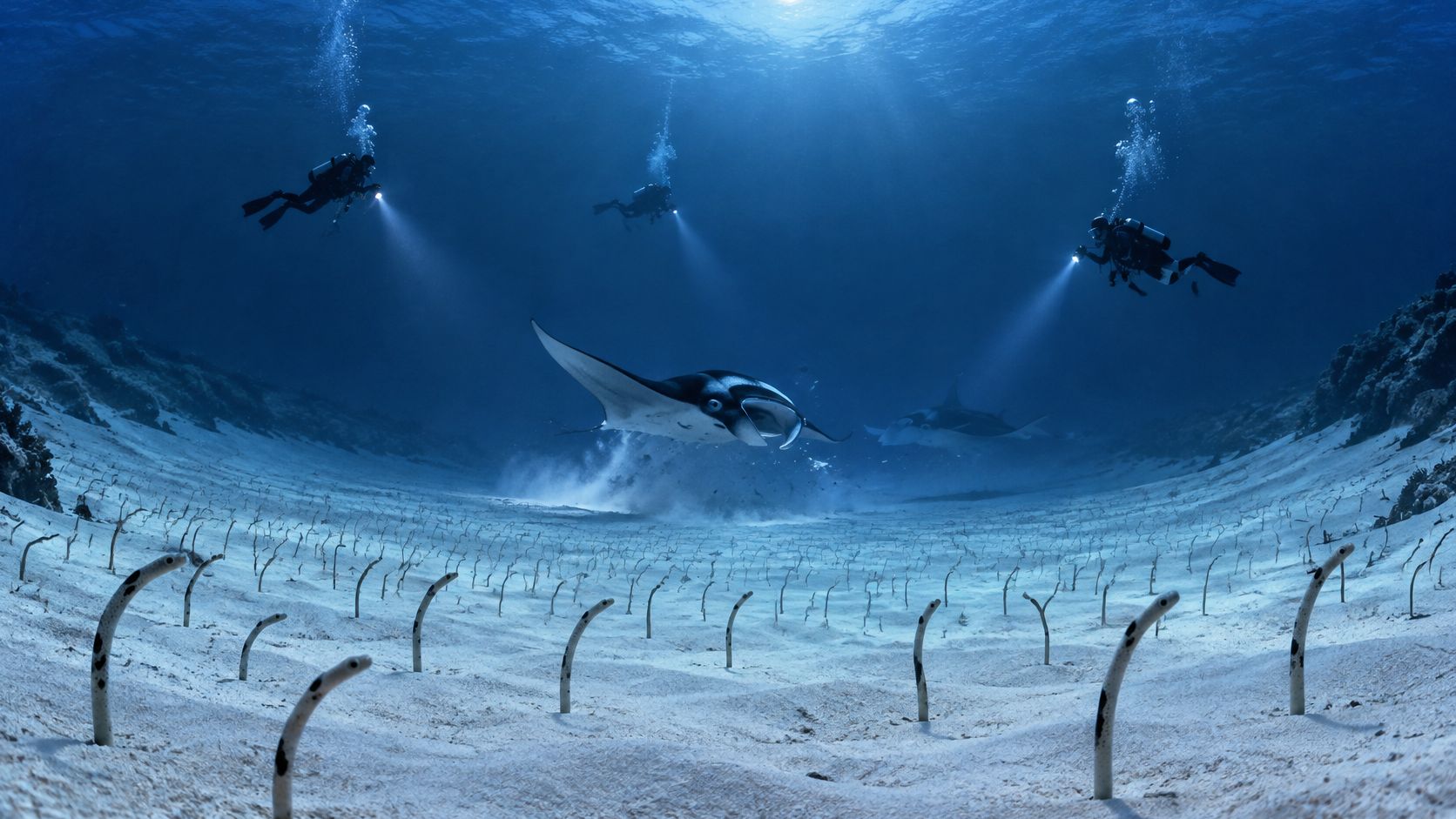
Site shape matters before the manta count
A broad viewing area makes it easier to understand where people belong and where animals can turn. Nearby reef structure also makes the location appealing beyond the illuminated feeding column. Better reefs aren't a reason to kneel on coral, though. Stay on the bare substrate your guide selects.
Keauhou remains a legitimate manta feeding site. It's an alternative, not a lesser class of animal encounter. But when conditions favor Garden Eel Cove, its space and viewing layout make it the stronger default.
Garden Eel Cove and Keauhou at a glance
| Site | Setting | What research shows | Best for |
|---|---|---|---|
| Garden Eel Cove | Protected sandy slope with coral and lava edges | Consistently larger aggregations | Divers and snorkelers seeking space and a clear feeding lane |
| Keauhou | More exposed, tighter nighttime viewing area | Stronger female presence and high female site fidelity | An alternative when conditions or boat routing favor the south |
A 2025 University of Hawaii study analyzed more than 23,000 sightings involving 167 individually identified reef mantas during 2010–2022, finding consistently larger aggregations at Garden Eel Cove than at Keauhou. Across both sites, the observed sex ratio was approximately balanced, while aggregation size tracked zooplankton density.
The researchers also reported relatively stable aggregations despite increased tourism and found no evidence that activity levels during the study had reduced local population viability. That finding doesn't mean every crowding level is acceptable or every night will look alike.
Our manta ray dive and snorkel charter often visits Garden Eel Cove. Favor its protected setting when conditions cooperate, while leaving the final safety decision with the crew.
Crowding and What a Good Encounter Looks Like
Consider these different nights. On a strong Garden Eel Cove evening, mantas loop through an unobstructed beam, divers remain low, and snorkelers hold an orderly surface position. You can watch an entire turn instead of catching fragments between other people.
On a crowded evening, mantas may still appear, but lights cross, fins fill photographs, and guests shift around trying to recover a view. On a quiet feeding evening, the group may see a brief pass or no animals at all. Those are different outcomes, even if the booking page treats sightings as the main measure.
A sighting doesn't measure the view
A peer-reviewed study of Kona manta encounters found that 77% of respondents experienced more snorkelers than they considered normal, 67% saw more scuba divers than expected, and 68% encountered more boats than expected. These are visitor perceptions, not a universal capacity limit, but they explain why sighting success alone is incomplete.
Crowding can make an otherwise manageable outing harder. A photographer may lose a clean angle. A nervous snorkeler may feel boxed in. A diver who keeps repositioning can obstruct the same water the animals need for turning.
A modest manta count with an open feeding lane can deliver a better encounter than a busy scene you can barely see.
Ask about the arrangement, not just attendance
Before booking, get concrete answers about how the group will operate:
- Group size and guide ratio. Ask how many guests share your in-water guide, not just how many seats the boat carries.
- Boat spacing. Find out how the crew manages arrivals when several operators are already present.
- Surface and bottom separation. Ask where snorkelers will float relative to the diver formation and boat traffic.
- Mooring and exit procedures. Understand whether the plan uses a fixed position or another managed procedure, and how everyone returns.
- Congestion response. Ask what the crew does when another group blocks the viewing area.
Our guides supervise the stationary encounter, but no operator controls every neighboring boat or guest. That's why your own responsible diver etiquette matters too.
Don't assume a quiet night proves the crew chose badly. Equally, don't accept a fleeting glimpse as proof that an overcrowded arrangement worked well. Judge the opportunity to watch comfortably without interrupting feeding.
Who Should Book and When to Wait
Choose by water comfort before choosing by date. A certified Open Water diver who can maintain a stable position is a plausible scuba guest. A comfortable ocean swimmer without certification can choose the surface experience without treating it as a consolation prize.
A first-time ocean swimmer, someone prone to panic in dark water, or a guest already struggling with nausea should wait. Flotation helps support a snorkeler, but it doesn't replace comfort breathing through a snorkel in open water.
Go, switch, or wait
| Situation | Better choice | Why |
|---|---|---|
| Certified diver, calm lee, can kneel still | Scuba | Bottom position in the light campfire |
| Comfortable swimmer, no scuba card | Snorkel | Watch the same mantas from the surface float |
| New to the ocean or anxious in dark water | Wait or choose a day snorkel | Darkness, depth, and boats add stress |
| Seasick or facing a rough forecast | Reschedule | Avoid compounding illness or difficult conditions |
| Cannot hold position on the sand | Skip the dive that night | Rising divers can block the feeding lane |
Most of our regular dive charters require at least an Open Water Diver certification from a recognized agency. Experienced divemasters and instructors are in the water with our manta divers. Their presence supports your dive, but it doesn't remove your responsibility to manage breathing, buoyancy, and equipment.
Snorkeling doesn't require a scuba card. For a more detailed perspective choice, consider whether snorkeling or diving with mantas better suits you.
Read the water, not just the calendar
Kona's manta encounters aren't restricted to a short wildlife season. For your departure, swell, wind, current, visibility, and a manageable entry matter more than selecting a supposedly perfect month.
North swell in winter and afternoon wind deserve attention, but neither a season label nor a calm-looking harbor settles the decision. The crew needs to assess the actual site and return conditions. If you're uneasy, describe the specific issue rather than asking whether the trip is generally safe.
A Big Island Now discussion of West Hawaii's localized manta population identifies pressures including boat strikes, habitat loss, and fishing-line entanglement. Protecting these animals includes declining an outing when conditions make controlled observation difficult.
Cold matters too. Stationary watching can feel cooler than an active swim, so arrange suitable exposure protection before boarding.
A safety cancellation can be the right result. A safely managed night without mantas can also be an acceptable wildlife outing. Neither should pressure you into entering water you're not ready to handle.
Gear Light and Photo Choices That Help
Pack for stillness rather than distance. A well-fitting full wetsuit, a mask that seals without overtightening, and familiar equipment do more for this dive than an elaborate camera rig. Bring a towel and dry layer for the return ride.
Rental equipment is a practical option. Ask for a fit check before boarding, particularly around the mask skirt, wetsuit neck, and shoulder movement. Discovering a persistent mask leak while everyone else settles into position is an avoidable distraction.
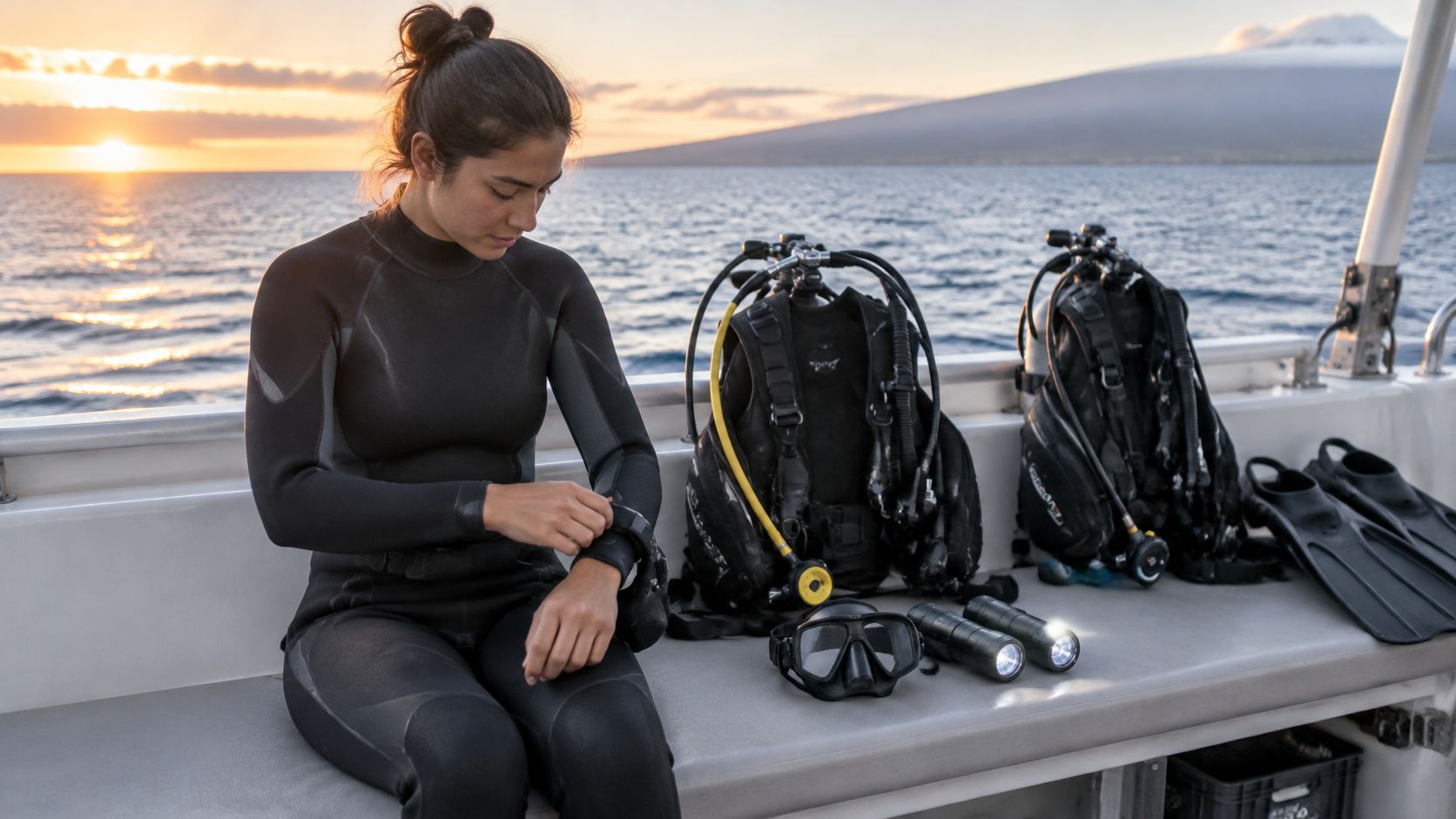
Make your equipment easy to manage
Divers should have a primary light they can direct accurately and a secured backup. Learn the switches before getting wet, and route lanyards so they don't catch other equipment. Check your pressure gauge and computer placement while wearing the exposure protection you'll use.
For snorkelers, a compact camera is easier to control than a bulky housing. Use a suitable wrist leash, keep the camera close, and make sure nothing dangles into the space below the float.
For thermal protection, prioritize fit and your tendency to get cold rather than choosing a suit solely by a generic recommendation. Tell the crew if you chill easily. A loose wetsuit that flushes repeatedly may disappoint even when its material seems substantial.
Set the camera before the approach
A wide-angle lens lets you photograph an approaching animal without moving toward it. Start with a modest focus light and a higher ISO setting your camera can handle, then adjust exposure against the existing illumination. If your camera supports pre-focus or focus lock, practice it before the trip.
Video is often easier to manage than repeated flash photography. It records the movement through the beam and reduces the temptation to chase a perfect instant. Review Kona manta photography guidance before boarding, not while a ray is approaching.
Avoid these failures:
- Chasing for a tighter frame. Use your lens and crop later rather than leaving your assigned place.
- Parking in the center. A clear camera angle isn't permission to occupy the turning lane.
- Redirecting light into another group's setup. Keep your illumination aligned with the guide's plan instead of creating competing beams.
Photography standard: If the manta changes course because of your position or lighting, change your approach before changing your settings.
You don't need a camera to get value from this night. If controls consume your attention, secure the equipment and watch.
Common Questions About the Manta Night
How long will I be in the water?
Confirm the scheduled viewing period and total charter duration before booking, because they aren't interchangeable. Briefing, travel, equipment preparation, entries, and exits all take time beyond the actual manta watch.
Your own dive may finish earlier because of air supply, cold, comfort, or the guide's decision. Plan around the crew's limits rather than a viewing time you found elsewhere online.
Are manta rays guaranteed?
No. Wild animals can bypass a familiar site, and a departure can be safely operated without producing a sighting.
For timing decisions, use this guide to the best time to see manta rays in Kona, then confirm the current marine forecast. Don't confuse a favorable booking date with a promise of animal activity.
Can I touch a manta if it comes close?
No, even if the animal appears within reach. Keep your hands tucked in and let it control the distance.
Don't chase after a departing ray or reposition beneath it for contact. Close approaches are opportunities to remain still, not invitations to interact.
Will I get cold?
You might, especially while remaining stationary and during the wet boat ride afterward. Choose properly fitted exposure protection and bring dry clothing you can put on promptly.
Tell the guide if you begin shivering or lose hand dexterity. Ending early is better than ignoring a developing comfort or safety problem.
What happens if weather cancels the trip?
Check the operator's actual cancellation and rescheduling terms before paying. Ask separately about weather cancellations, guest-requested changes, and a completed departure without manta sightings.
Those are different situations and may have different terms. Don't assume that a wildlife no-show automatically means a refund or another departure.
Book the Garden Eel Cove Night
Choose a manageable evening, select the water position that matches your skills, and favor Garden Eel Cove when the crew considers conditions suitable. Its protected location, spacious sandy viewing area, and surrounding reefs make it our go-to site for the manta night.
Kona Honu Divers offers a two-tank manta ray charter, with experienced guides in the water. The experience accommodates beginner through experienced certified divers, while the surface snorkel option gives non-divers another way to participate. Beginner-friendly doesn't mean certification or water confidence can be skipped.
Confirm the details that affect your evening
Check the live departure date and rate instead of relying on a blog price. Confirm the required certification, equipment sizing, rental inclusions, and total schedule before committing.
Our broader Kona diving tours page can help you place the manta evening within your visit. Keep the booking decision focused, though. The right choice is the outing you can enjoy without overextending your skills or tolerance for ocean conditions.
Our manta night dive has encounter rates of up to 92%. Treat that as a record of opportunity, not an assurance about your particular night.
Use the live booking calendar to check available departures, then bring any unanswered comfort or equipment questions to the crew before boarding. Good preparation makes it easier to stop managing little problems and pay attention to the animals.
Book for a well-managed opportunity to watch, not a promised photograph. Plankton still decides where the mantas choose to feed.
Kona Honu Divers offers a guided two-tank manta charter with Garden Eel Cove as its go-to night site, plus a surface option for snorkelers. Visit us to choose your departure, confirm your equipment and certification needs, and plan a Kona manta night that fits your comfort in the ocean.