
Picture this: You’re floating in the warm, dark waters of the Pacific off the Kona coast. Suddenly, a massive, gentle shadow with a wingspan as wide as a car glides silently, gracefully, just inches above your head. This isn't a scene from a documentary—it's the world-famous manta ray dive Kona is known for, and it's an experience that truly belongs on every adventurer's bucket list.
Your Essential Kona Manta Ray Experience
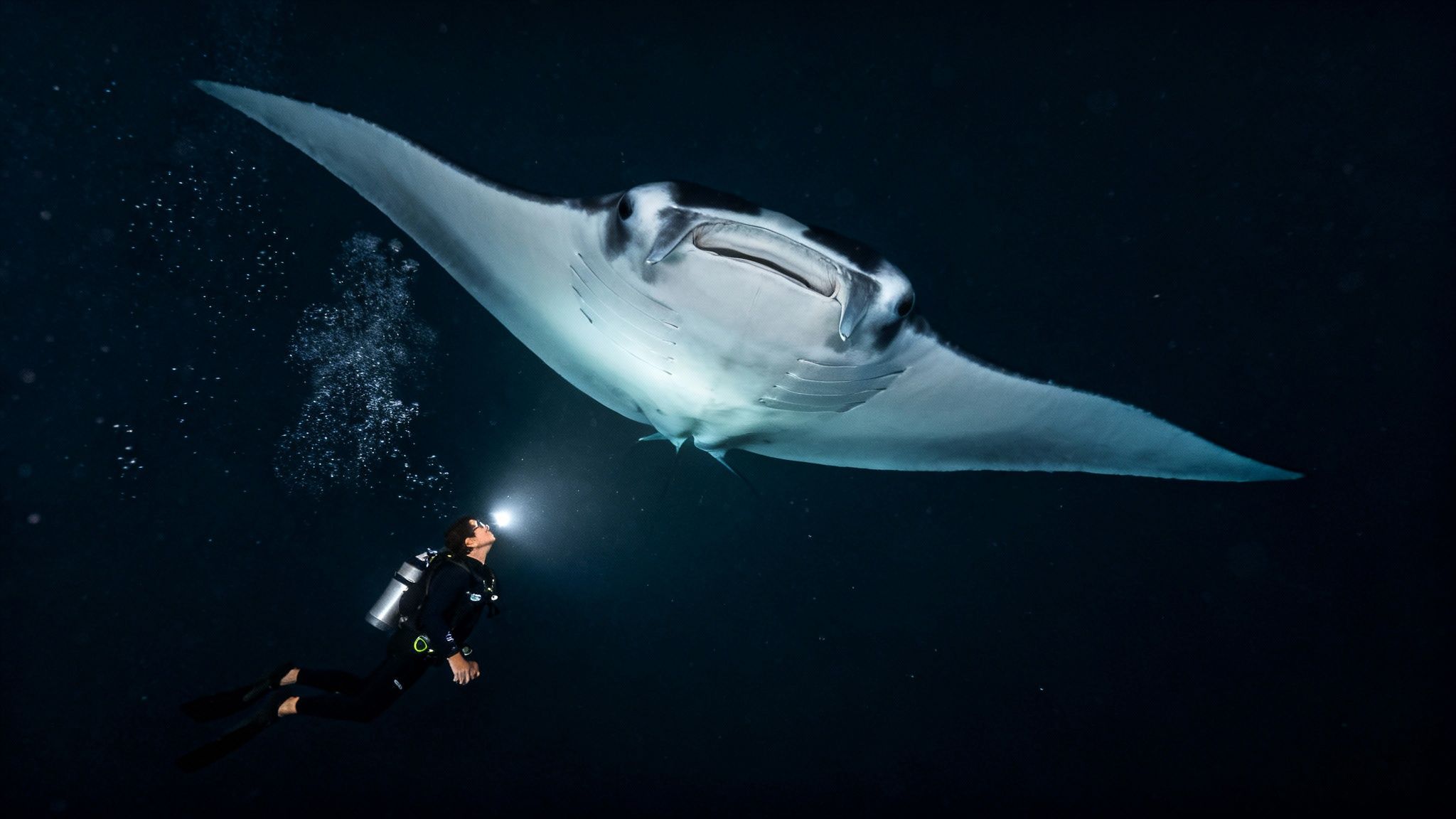
The Kona coast isn't just another pretty dive spot; it’s the epicenter of a global phenomenon. Every year, this one-of-a-kind underwater theater draws about 80,000 people who come from all over the world to witness this nightly spectacle. It’s become a cornerstone of the Big Island’s ecotourism, and for very good reason.
This underwater ballet isn't just a happy accident. Local dive operators have perfected a beautifully simple—and brilliant—method to bring the mantas in.
- First, powerful lights are set up on the ocean floor, pointing toward the surface.
- These lights attract huge clouds of plankton, which is the manta rays' favorite meal.
- Then, the stars of the show arrive. The local reef mantas (Mobula alfredi), some with wingspans stretching up to 14 feet, swoop in for an all-you-can-eat plankton buffet.
Witnessing the Underwater Ballet
What you get to see is a silent, mesmerizing performance as these giants feed. You have two front-row seats to choose from: scuba diving on the sandy bottom looking up, or snorkeling on the surface looking down. Both options offer a jaw-dropping perspective of these graceful creatures. To get a real sense of the magic, you have to see these Kona manta ray dive pictures.
Operators like Kona Honu Divers have spent years mastering how to create a safe and respectful experience for everyone involved—divers, snorkelers, and especially the mantas themselves. Their expertise ensures you get an unforgettable and ethical encounter that directly supports the conservation of these magnificent animals.
And the best part? With a manta spotting success rate between 80-90% year-round, your odds of having one of the most incredible experiences of your life are extremely high.
Choosing Your Adventure: Scuba Diving vs. Snorkeling
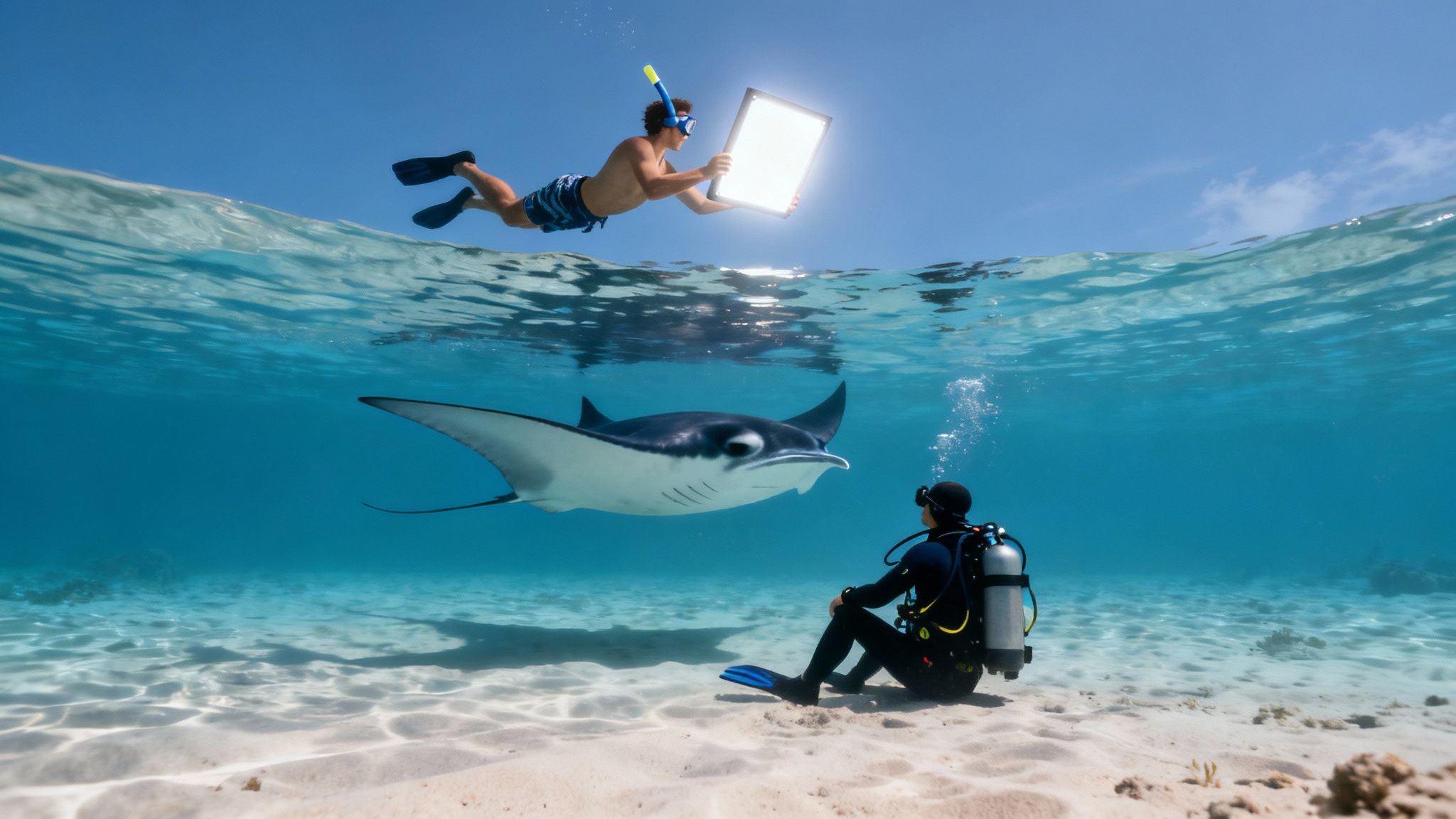
So, you’re ready to see the manta rays. Your first big decision is how you want to experience the show: are you diving down to the seafloor or snorkeling at the surface?
Both options give you an incredible, front-row seat to one of nature's most dazzling performances, but the perspective is completely different. The best choice really boils down to your comfort in the water, whether you're a certified diver, and the kind of memory you want to create.
The Diver's Perspective: An Underwater Theater
For certified divers, this is a truly immersive experience. After a short descent, you'll settle onto a sandy patch on the ocean floor, shine your light up, and just… watch. It feels like you’re sitting in the front row of an amphitheater, and the manta rays are the stars of the show, performing breathtaking barrel rolls just inches above your head. Looking up from below gives you a profound appreciation for their sheer size and effortless grace.
The Snorkeler's View: A Surface-Level Spectacle
Snorkelers get an equally stunning, but totally different, bird's-eye view. You’ll float on the surface, holding onto a custom-built light board that illuminates the plankton-rich water below. As the plankton gather in the light, the manta rays swim right up from the depths to feed, their cavernous mouths wide open. It’s a thrilling sight that’s accessible to just about anyone, making it perfect for families, kids, and anyone who isn't a certified diver.
Manta Ray Encounter Comparison: Scuba vs. Snorkel
Still on the fence? Each approach has its perks, and one might just be a better fit for you and your group. This quick table breaks down the key differences to help you decide.
| Feature | Scuba Diving | Snorkeling |
|---|---|---|
| Perspective | Bottom-up view, sitting on the ocean floor | Top-down view, floating at the surface |
| Proximity | Extremely close; mantas glide inches overhead | Very close; mantas swim right up to the light board |
| Certification | Open Water certification required | No certification needed; basic swimming ability is enough |
| Equipment | Full scuba gear (tank, BCD, regulator) | Mask, snorkel, fins, and wetsuit |
| Best For | Certified divers seeking full immersion | Non-divers, families with kids, and mixed-ability groups |
Ultimately, there’s no wrong answer here. Whether you choose to dive or snorkel, you’re guaranteed a world-class wildlife encounter you’ll be talking about for years. It just depends on whether you want to watch the ballet from the orchestra pit or the mezzanine.
If you’d like to dig even deeper, check out our guide on if it's better to snorkel or dive with manta rays.
What to Expect on Your Manta Ray Dive Tour
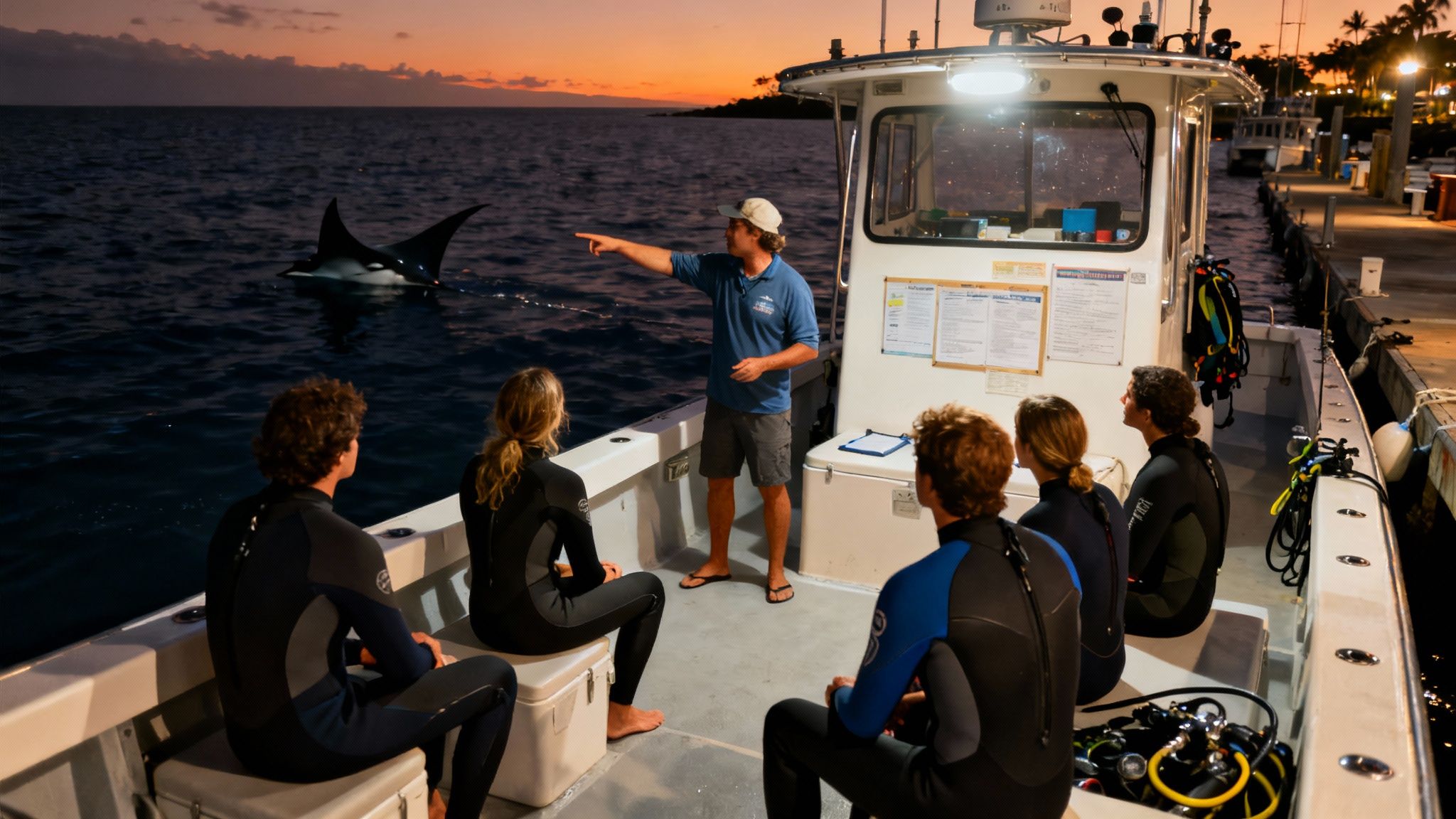
Knowing what’s in store can turn any pre-dive jitters into pure excitement. A manta ray dive in Kona is a carefully choreographed adventure, designed from start to finish to be safe, stunning, and completely unforgettable. Let's walk through what your evening with these gentle giants will look like.
Your adventure starts at the harbor. You’ll be greeted by the crew from a top-notch operator like Kona Honu Divers, who will get you checked in and sized for any gear you might be renting. Once that's sorted, you'll hop on board and find your spot for the short trip out to the dive site.
The Briefing and Sunset Cruise
As the boat heads out, you’re often treated to a classic, breathtaking Kona sunset that sets the sky ablaze with color. It’s the perfect backdrop for the pre-dive briefing, where your guides will cover everything you need to know for a smooth and respectful encounter.
You'll get the rundown on:
- Manta Ray Behavior: A quick lesson on why the mantas show up and how they feed.
- Conservation Rules: This is crucial. The golden rule is look, but don't touch. Mantas have a delicate protective slime coat on their skin that our touch can damage.
- Safety Protocols: Clear instructions on getting in and out of the water, what to do during the dive, and how to communicate underwater.
This briefing is just as much about protecting the mantas as it is about your safety. It's the perfect time to ask any last-minute questions and get comfortable with the plan. Kona Honu Divers is known for their thorough and engaging briefings that really put everyone at ease.
The Main Event: The Underwater Ballet
Once you arrive at the site and twilight gives way to night, the real magic starts. You’ll gear up and slip into the warm Pacific waters. Divers descend to a specific spot on the sandy ocean floor, usually arranging themselves in a circle around a central light structure often called the "campfire."
After you get settled, you'll switch on your dive light and point it straight up toward the surface. All those beams of light create a massive, glowing column that acts like a dinner bell, attracting a thick buffet of plankton. Then, you wait.
The first moment you see a manta emerge from the darkness is something you’ll never, ever forget. It’s a silent, graceful apparition that glides effortlessly into the light, its massive wingspan casting an otherworldly shadow.
Soon, another might join, and then another. They perform a mesmerizing underwater ballet, executing barrel rolls and graceful loops as they filter-feed on the plankton just inches above your head. You're no longer just a diver; you’re a privileged guest at their nightly feast, a silent observer in their world.
The guides are there the whole time, using hand signals to point out specific mantas and ensure everyone stays safe, which allows you to completely lose yourself in the spectacle. This incredible experience is precisely why the manta ray dive tour is an absolute must-do in Hawaii.
Meet the Famous Kona Manta Rays
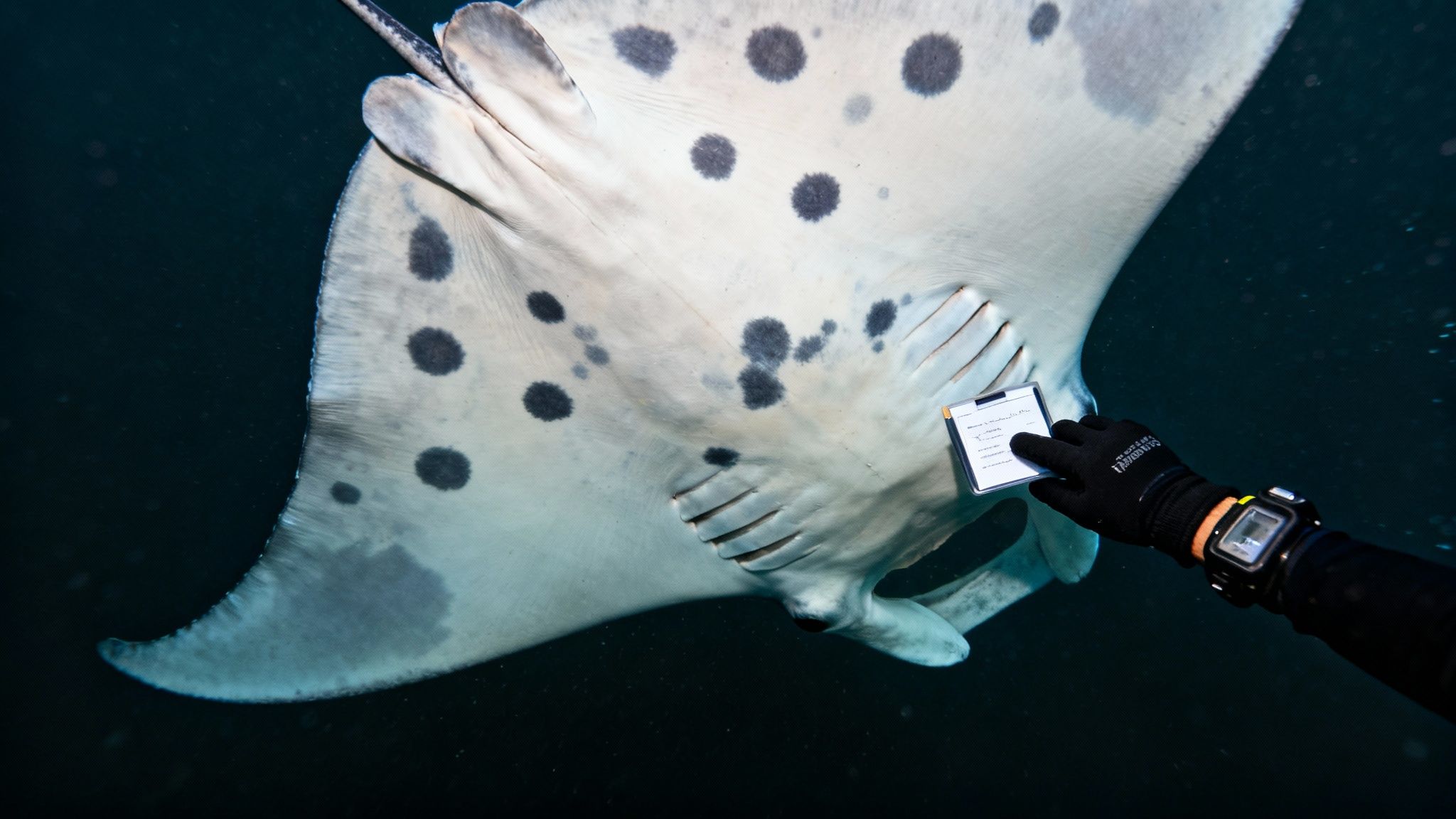
When you slip into the water for a manta ray dive in Kona, you're not just observing random wildlife. You’re being introduced to a cast of local celebrities. These aren't just nameless creatures passing through; they are well-known residents with names, backstories, and even personalities that the local guides have gotten to know over decades of encounters.
This incredible connection is all thanks to a simple, yet fascinating, bit of biology. Every manta ray has a unique pattern of black spots on its white belly. Just like a human fingerprint, no two are alike. This natural "barcode" allows researchers and dive guides to identify and track individual rays, sometimes for their entire lives.
Suddenly, your dive isn't just about seeing a manta ray—it's about meeting a specific individual. You could be floating alongside ‘Big Bertha,’ a legendary matriarch of the Kona coast, or maybe even ‘Lefty,’ one of the very first mantas identified here. Knowing their names and stories adds a layer of depth to the experience that’s hard to describe. It feels less like watching nature and more like being welcomed into an underwater community.
More Than Just a Dive
This isn't just about creating a cool memory; your dive actually plays a part in conservation. Every time your guide identifies a manta and logs the sighting, that data goes into a massive database. It’s a form of citizen science that helps researchers track the health, movement, and life cycles of these amazing animals, ensuring they’re protected for years to come.
These gentle giants are here for one main reason: food. They feed almost exclusively on plankton, and understanding the importance of live plankton is key to understanding why Kona is such a special spot. The island’s nutrient-rich waters serve up a reliable buffet, keeping the local manta population healthy and consistently in the area.
A Legacy of Research and Discovery
The project to identify and catalog Kona's manta rays is one of the longest-running and most detailed in the world. It all started back in 1991 with the identification of ‘Lefty’. In the three decades since, the project has grown exponentially.
Researchers have now documented over 330 individual mantas—both reef and giant oceanic species. The database they’ve built is staggering, with more than 6,000 reported encounters and over 28,500 individual manta sightings logged. It's a testament to how ecologically vital this small stretch of coastline really is.
By taking a tour, you’re stepping into this long legacy of research. You become a small but important part of the effort to make sure these graceful giants continue to glide through Kona's waters, enchanting visitors for generations to come.
How to Prepare for Your Night Dive Adventure
A little bit of prep work can make all the difference, turning a great manta ray dive into a truly unforgettable night. Making sure you’re comfortable, safe, and ready for what’s ahead is the secret. I’ve put together a practical checklist to get you squared away before you even step on the boat.
Trust me on this one: the boat ride back to the harbor can get surprisingly chilly after you’ve been in the water, even here in Hawaii. A pro tip is to pack a warm towel and a dry change of clothes, like a sweatshirt or a light jacket. You'll be really glad you did.
Respecting the Reef and the Rays
Your most important prep actually starts back at your hotel room. If you’re going to put on sunscreen, it is absolutely critical that you use a reef-safe formula. The chemicals found in regular sunscreens are devastating to Hawaii's fragile coral reefs, which form the very foundation of the manta's world.
The golden rule for any manta ray dive in Kona is simple but non-negotiable: look, but don't touch. Manta rays have a special mucous coating on their skin that acts as a shield against infection. If you touch them, you can wipe off this protective layer and leave them vulnerable to disease. The best encounters happen when we observe respectfully.
"A passive interaction is the best interaction. By remaining still and calm, you allow the mantas to feel safe, often resulting in closer and more magical encounters."
For a lot of people, this might be their first time diving in the dark, and that can feel a little unnerving. The key is to trust your guide, your training, and your gear. Think of your dive light as your window into the world below—use it to see where you're going and signal your guide, but just be careful not to shine it directly into the mantas' eyes.
What to Bring for Your Dive
Having the right stuff with you can make a huge difference in your overall experience. While your dive operator will handle all the essential life-support equipment, a few personal items are always a good idea.
- Warm Layers: A towel and a dry sweatshirt or jacket are perfect for the boat ride home.
- Reef-Safe Sunscreen: Put it on well before the tour to protect your skin and our ocean.
- Reusable Water Bottle: Staying hydrated is always a good plan.
- Seasickness Medication: If you're prone to motion sickness, take it before you board. Don't wait until you're already feeling queasy!
Having the right dive gear is also a huge part of being prepared. You can get the full rundown on the gear you will need for your Kona diving adventure in our detailed guide. When you arrive ready to go, you can just relax and soak in the magic of the dive.
Explore More World-Class Diving in Kona
Don't get me wrong, the manta ray dive in Kona is an absolute bucket-list experience. But it’s just the tip of the iceberg when it comes to what the Big Island offers divers. The volcanic coastlines here have sculpted an underwater playground that is nothing short of spectacular. Think of the manta dive as the incredible opening act to a much bigger show.
Once you’ve experienced that magical nighttime ballet, why not try something completely different? I'm talking about a Kona blackwater dive. This isn't your typical reef dive; you're heading out into the deep, dark, open ocean at night. You'll be suspended in the abyss, watching one of the planet's largest migrations as weird, wonderful, and often bioluminescent creatures rise from the depths. It honestly feels like you're floating through outer space. You can get the full scoop on this wild adventure over on the Blackwater Dive tour page.
Beyond the Night Dives
For those who crave daytime adventures and more advanced dives, Kona really shines. The island is renowned for its dramatic underwater topography, all carved by ancient lava flows. These volcanic formations have left behind some truly incredible structures to explore.
Kona's underwater world is a geological masterpiece. From labyrinthine lava tubes and massive arches to deep offshore pinnacles, every dive site feels like a brand-new adventure waiting to happen.
These advanced daylight dives will take you to deeper reefs and through intricate lava tubes that are packed with marine life you just don't see in the shallows. Sure, exploring these spots takes a bit more skill, but the rewards are massive. If you're ready to push your limits, take a look at the trips on the advanced dive tour page for some more challenging options.
Let the manta encounter be the start of an epic Kona diving vacation. Dive deeper, explore further, and see for yourself why the Big Island is considered one of the best dive destinations on the planet. To see everything on offer, check out all the possibilities on the main diving tours page.
Your Top Questions, Answered
Let's tackle some of the most common questions that come up when planning a manta ray dive in Kona. Getting these details sorted out will help you book your trip with total peace of mind.
Is It a Sure Thing We'll See Mantas?
I get this question all the time, and it's a fair one! Since we're dealing with wild animals, nothing can ever be a 100% guarantee. That said, the success rate for the manta ray dive in Kona is incredibly high, usually hovering between 80-90% all year.
Think of it this way: these dive sites are the mantas' favorite restaurants, and they've been showing up for dinner for decades. Operators, like the pros at Kona Honu Divers, have fine-tuned the art of using powerful lights to attract a buffet of plankton. This almost always brings the mantas right to us. On the off chance the mantas don't show, most good companies have a "manta guarantee" and will let you try again on another night for free.
When's the Best Time of Year to Go?
Here's the best part: there is no bad time! The manta ray population here is residential, which means they don't migrate. They live here year-round, so you have a fantastic shot at seeing them whether you visit in July or December.
There isn't a specific "manta season" to plan around. While the summer months generally bring warmer water and calmer surface conditions, the mantas themselves are a constant presence. Your odds of an amazing encounter are consistently high no matter when you book your trip.
Is This Dive Safe for a Beginner?
Absolutely. The manta ray night dive is remarkably safe, especially when you go with a professional, well-regarded dive shop. First off, the manta rays are completely harmless. They're true gentle giants with no teeth, stingers, or barbs.
The real safety focus is on the logistics of diving at night. This is where a great crew makes all the difference. They give detailed briefings, keep a close watch on everyone in the water, and stick to strict safety procedures.
The dive sites themselves are well-established, not too deep, and it's a very controlled environment. It’s easily one of the safest and most unforgettable night dives you could ever do.
Ready to see this underwater ballet for yourself? Kona Honu Divers runs a top-tier manta ray dive tour that you won't soon forget.