
You've found a free evening in Kona, and now you're comparing manta tours, wondering whether to dive or snorkel and whether the crowded photos tell the whole story. The encounter can be extraordinary, but the booking decision should involve more than the chance of seeing a manta.
For a manta ray dive in Hawaii, I recommend Garden Eel Cove. Its protected setting, defined viewing area and surrounding reef make it a strong choice for scuba divers. Just keep the other decision separate: a successful encounter isn't automatically a low-impact one. The operator's boat handling and your behavior in the water matter too.
Where Manta Rays Feed and Why Garden Eel Cove Wins
Garden Eel Cove, also called Manta Heaven or Makako Bay, is the superior choice for a manta-focused dive. Its protected location gives divers a more defined viewing area, while the nearby reef offers a better underwater setting than more exposed alternatives. A Garden Eel Cove site description reports approximately 36 feet of depth and about 50% coral cover, near coordinates 19.7375964° N, -156.0544717° W.
That combination matters in practice. Divers can settle on designated sand rather than spread across reef, keep their position and leave open water above them for feeding mantas. Shelter helps, but it doesn't eliminate swell or make every evening suitable.
Manta viewing sites compared
| Site | Shelter and reef | Key feature | Best fit |
|---|---|---|---|
| Garden Eel Cove (Manta Heaven, Makako Bay) | Sheltered, with sandy viewing areas and nearby coral reef | Larger aggregations and a defined viewing area | Recommended for the manta night dive |
| Keauhou | Assess the operator's viewing layout and conditions; equivalent reef measurements aren't established here | Visited predominantly by females | Research-documented site with a possibly different ecological role |
The aggregation comparison has substance behind it. A University of Hawaiʻi study hosted by NOAA analyzed more than 23,000 sightings over 13 years, from 2010 through 2022, and found that Garden Eel Cove consistently supported larger aggregations, while Keauhou was visited predominantly by females.
That doesn't make Keauhou an inferior habitat. The different visitation patterns suggest the locations may serve different ecological functions. For a visitor choosing a scuba experience, however, Garden Eel Cove combines the stronger aggregation finding with a practical viewing layout and better surrounding reef.
Site-selection rule: Choose the setting that lets you watch without moving into the animals' feeding space, not simply the location with the most dramatic advertising.
Don't build your itinerary around an unsupported promise of a seasonal peak. Food availability changes, and the study linked aggregation changes to zooplankton density. Choose an operator that normally uses Garden Eel Cove, confirm the intended site before paying and leave room for a weather-driven change.
Who Should Join a Night Manta Dive
Which kind of participant are you? Your certification determines whether you can scuba dive, but your comfort after dark determines whether that's the right choice tonight. A confident daytime swimmer may still dislike floating over dark water, while a newly certified diver may feel comfortable once settled beside a guide.
Our 2 Tank Manta Charter requires Open Water Certification or higher and a dive within the past 2 years. Snorkelers don't need scuba certification because they remain at the surface rather than descend with scuba equipment.
Who can join and where they sit in the water
| Participant | Requirement | Position in the water | Best fit |
|---|---|---|---|
| Certified diver | Open Water Certification or higher; a dive in the past 2 years for the 2 tank charter | Kneels on designated sand in the viewing area | Divers wanting views from below, including newly certified divers building confidence |
| Snorkeler | No scuba certification needed; must meet the tour's participation requirements | Floats at the surface above the viewing area | Suitable families and first-time night swimmers |
| Advanced diver | Meet the selected charter's certification and experience requirements | Kneels or positions as directed | Experienced divers seeking a premium route |
For certified divers, the attraction is the upward view. The challenge isn't covering distance, it's managing breathing, buoyancy, equipment and attention while remaining still. If basic skills still require all your concentration, build confidence on a daylight dive first.
Snorkeling removes the scuba task load, but it isn't a substitute for water comfort. You still need to tolerate a mask, breathe calmly through a snorkel and follow positioning instructions. Our comparison of snorkeling versus diving with manta rays can help you choose the perspective that suits you.
Families and nervous first-timers
Tell the crew about anxiety before entering, not after you're struggling. Calm floating and following instructions matter more than trying to demonstrate swimming ability, but they don't replace the operator's suitability assessment. For children, confirm age, equipment fit and participation requirements individually.
Experienced divers seeking a different reef itinerary can consider the Premium Advanced 2 Tank Trip. Advanced experience doesn't change manta etiquette, though. Everyone leaves the feeding corridor open.
How a Night Manta Dive Unfolds, Step by Step
The lamps attract food, not a performance. Seafloor lights concentrate zooplankton into an illuminated feeding patch, and mantas arrive to filter that prey. The Hawaiʻi Division of Aquatic Resources manta guidance explains the feeding mechanism and recommends holding diver lights above the head, aimed upward into the water column.
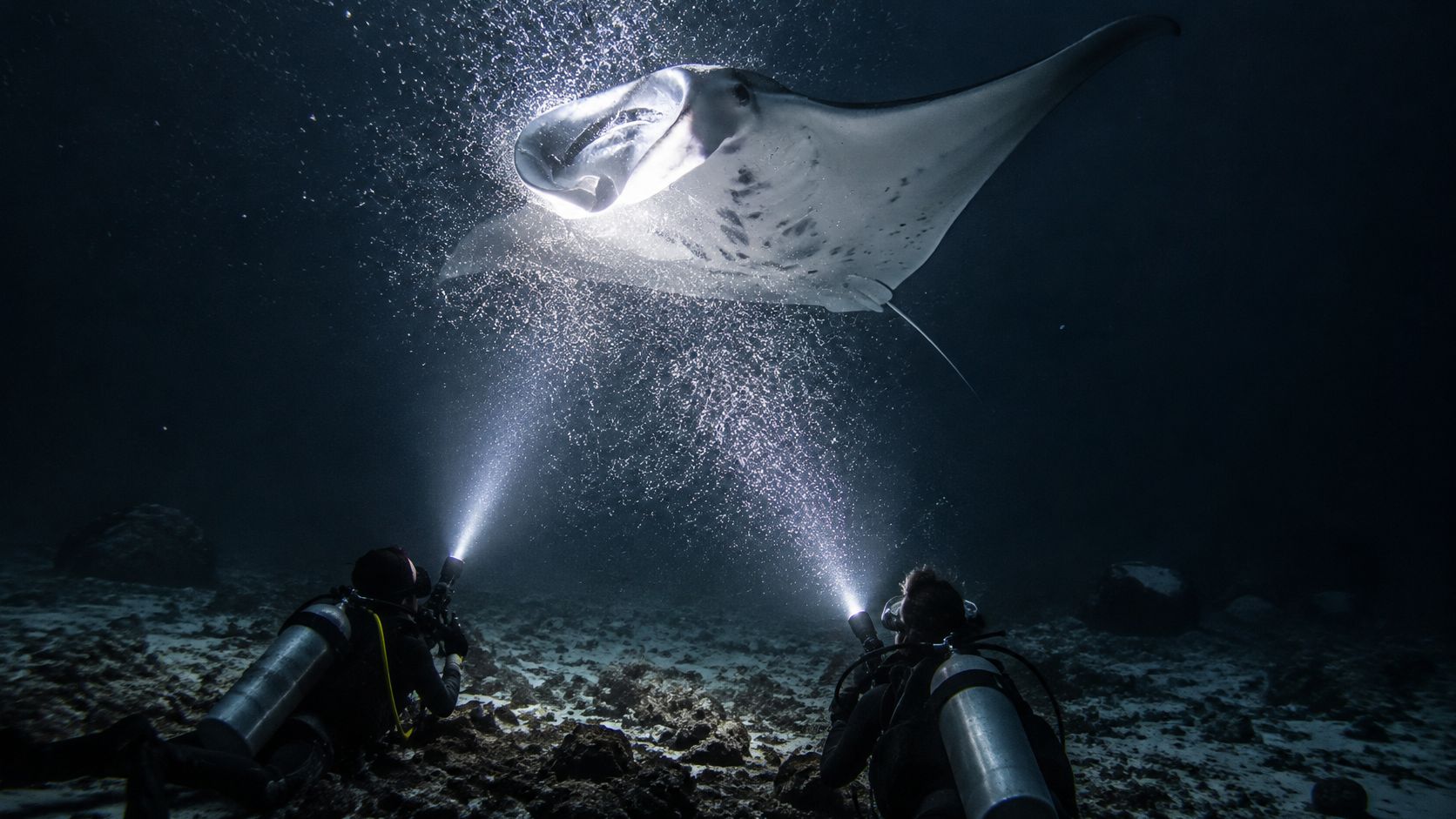
Our approach at Kona Honu Divers is stationary and closely supervised, with experienced divemasters and instructors in the water with divers. They help participants stay positioned, comfortable and attentive to the dive rather than follow an animal away from the group.
From briefing to recovery
Listen to the crew briefing. We explain the feeding science, passive-observation rules and signals before entry. The common mistake is treating this as optional because you've done other night dives; the local positioning and recovery procedures still need your attention.
Gear up and enter at the mooring. Complete your buddy check, secure dangling equipment and follow the crew's entry sequence while the boat remains secured. Don't rush toward the lights before your buddy and guide are ready.
Descend to the assigned viewing area. Divers settle on designated sand, while snorkelers remain at the surface. Check where your knees, fins and gauges will go before settling, because nearby coral isn't a handhold or equipment shelf.
Aim your light as directed. Keep the beam steady and upward, rather than tracking a manta's face or sweeping other divers' eyes. Lighting the water column supports the viewing arrangement; using the torch like a wildlife spotlight doesn't.
Let the animals choose their route. Mantas use their cephalic fins to funnel plankton-rich water toward their mouths, then retain prey as water passes through their filtering structures. Keep hands, cameras and fins out of their path, even when an animal passes close.
Leave with your guide and buddy. Stay within the illuminated area, follow the agreed exit route and ascend using the operator's line. Don't make an independent swim toward a boat that appears nearby from underwater.
Preparation helps you notice the animals without losing track of your own dive. Review the basics of scuba diving at night beforehand, especially light signals and buddy awareness.
A good encounter has controlled divers and uninterrupted feeding space, not necessarily nonstop barrel rolls. A quieter evening can mean less concentrated prey. Adding more movement, chasing an animal or redirecting lights won't turn that into a better wildlife experience.
Safety, Crowding and Questions to Ask Before Booking
The practical risk isn't just being near a large animal. A night excursion combines darkness, bright lights, boats and people in a confined area. A well-organized group can manage those interactions, but the site isn't private just because your booking is small.
According to Underwater Atlas's Garden Eel Cove guide, the site may be shared by as many as 10 boats and approximately 80 divers and snorkelers simultaneously. Its safety guidance includes carrying primary and backup lights, maintaining buddy contact, remaining in the illuminated area and ascending on the operator's line.
Independent SFGATE reporting on Kona manta tours describes concerns involving boats near unlit swimmers, vessel movement near submerged divers and bright lights that can impair visibility. Those are operational concerns, not a reason to assume every excursion is unsafe.
Questions that reveal how a trip operates
- What's the maximum group size? Ask about your in-water group, not only the vessel's passenger capacity. You need to know how many people a guide will supervise.
- What's the swimmer-to-guide or diver-to-guide ratio? A clear answer helps you judge whether the arrangement suits a nervous participant or someone needing extra attention.
- How are swimmers and divers separated from boat traffic? Look for a defined entry area, viewing position and recovery route rather than a vague assurance that everyone stays close.
- What happens during an emergency? Ask how the crew recalls participants, assists someone at the surface and coordinates recovery.
- Which visibility aids are provided? Establish how the crew identifies its own group and how participants signal for assistance.
- What happens if someone becomes anxious or seasick? Find out how a guest can end their participation without requiring an improvised exit.
Our stationary viewing arrangement and in-water supervision address important parts of this problem. They don't remove the need to listen, maintain buddy contact or report discomfort early.
A small booking group doesn't guarantee an uncrowded site. Judge both your operator's supervision and its plan for sharing the water.
Don't confuse swimming confidence with nighttime situational awareness. An inexperienced participant who drifts away from the assigned position can create uncertainty for guides and boat crews, even without intending to.
Choose the trip whose procedures you understand. If answers about recovery, group control or surface separation remain vague, resolve them before booking rather than accepting a general promise of safety.
Rules, Viewing Limits and Keeping Impact Low
Mooring and vessel management are part of the excursion, not background details. The DLNR manta-viewing rule document specifies an operating window of 4:00 p.m. to 4:00 a.m., with commercial operations using authorized commercial moorings under valid Department of Land and Natural Resources permits.
During that window, the document limits live boating to entering and leaving the viewing area, prohibits rafting and states that vessels may not depart while participants or crew remain in the water. These provisions make the boat's operating arrangement a meaningful booking consideration.
Documented disturbance isn't proven population decline
A review of Kona manta-tourism impacts distinguishes observed altered swimming routes, avoidance and interrupted feeding from long-term population effects that remain unmeasured. There isn't clear evidence establishing a significant Kona population decline, but that doesn't establish that repeated disturbance is harmless.
The population context deserves care. A summary of NOAA-reported genetic and population findings states that 318 unique reef mantas have been identified around Hawaiʻi Island since monitoring began in 1979, with about 104 adult breeders estimated there, and identifies Hawaiʻi Island and Maui Nui as genetically distinct populations.
Those figures describe identification history and estimated breeders, not a headcount of animals available for tonight's tour. Limited exchange between island groups means local losses can't quickly be replaced by arrivals from elsewhere.
Low-impact standard: A sighting is a visitor outcome. Uninterrupted feeding is an animal-centered outcome. They aren't the same measure.
Guests control pursuit, contact, body position and light handling. Operators control moorings, boat spacing, group limits and how firmly they enforce the viewing arrangement.
Use responsible diver etiquette as an operating habit, not a slogan. Remain stationary, never chase or touch, and accept that the animal may choose another route. A successful encounter isn't automatically a low-impact one.
Gear and Photo Tips for Night Manta Dives
Pack for a stationary night session, not a long reef swim. Equipment should help you stay warm, communicate and keep your hands under control. Anything dangling, leaking or difficult to operate becomes more distracting after dark.
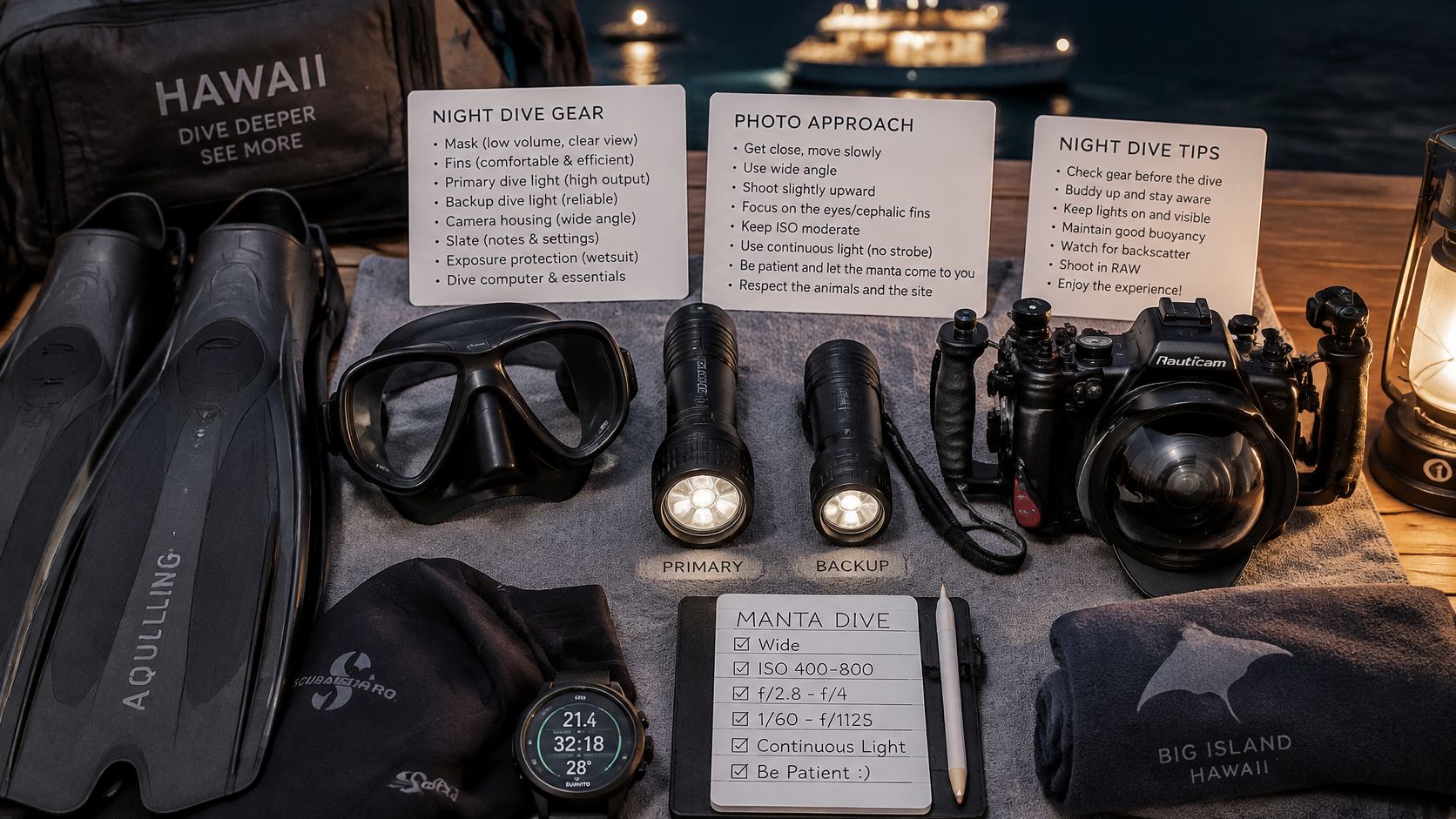
Equipment that earns its place
- Reliable illumination matters. Divers should have a primary and backup dive light, secured where they can reach them without searching. Snorkelers should use the operator's lighting arrangement rather than improvise with extra handheld beams.
- A comfortable mask prevents distraction. Check the skirt seal, strap tension and defogging before entry. Snorkelers also need a comfortable mouthpiece that doesn't require constant adjustment during the float.
- Thermal protection helps you remain still. Bring a warm rash guard or thin wetsuit appropriate to your comfort, and discuss greater exposure protection if you chill easily. Warm water doesn't guarantee comfort when you're barely moving.
- Secured accessories preserve space. Clip gauges close, stow loose straps and keep a dry bag aboard for clothes and electronics. Bring a towel and a dry layer for the return ride.
Confirm what the charter supplies before packing duplicate equipment. Test your own lights and controls before leaving accommodation, then check them again during setup.
Photograph without changing the encounter
- Wide-angle framing reduces the temptation to approach. Use a housed camera with a wide-angle lens and let an animal enter the frame. Don't extend the housing into its feeding route.
- Available light preserves the established lighting arrangement. Start by shooting upward through the illuminated water. Avoid directing strobes at mantas, and follow the crew's rules for all photographic lighting.
- Shutter speed controls motion blur. Use a faster shutter when movement smears, then raise ISO as needed rather than demanding more light from the animal. Accept some noise instead of sacrificing positioning for a cleaner image.
- Preparation keeps repairs out of the water. Inspect housing seals on the dock, keep sealing surfaces clean and check every latch. Pack spare batteries in the dry bag and make sure controls work through the housing.
Browse manta ray dive photography examples for composition ideas, not promises of identical conditions. A bright screen can narrow your attention, so check your buddy, guide and gas supply between shots.
Spend the opening moments watching attentively. Learn where the animals are feeding before raising the camera, and put it down whenever photography starts interfering with your dive.
Frequently Asked Questions
Can a beginner see manta rays?
Yes. Snorkeling offers a surface-based option without scuba certification. Newly certified divers can participate when they meet the charter requirements and are comfortable managing their equipment after dark.
Do I need certification?
Snorkelers don't need scuba certification. Our scuba charter requires Open Water Certification or higher and recent diving within the stated eligibility window. If you're uncertified, review Hawaii scuba options without certification rather than assuming every guided dive is introductory.
Will I always see mantas?
No. These are free-ranging animals, and feeding activity changes with prey availability. Don't treat a high encounter rate as a guarantee, and check the booking terms for what happens when no mantas appear.
Can I touch or chase them?
No. Passive observation means leaving the animal's route open, keeping your hands to yourself and following the crew's light directions. A close pass isn't permission to reach out.
How crowded is it?
Garden Eel Cove is a shared viewing site, not an exclusive enclosure. Ask about your own group size and how your guide manages positioning when other groups are present.
What should I bring?
Divers need dependable lighting and familiar, properly fitted equipment. Thermal protection, a towel, dry clothes and a dry bag are useful; confirm which gear is included before packing.
Are all operators the same?
No. Compare guide supervision, boat separation, recovery procedures and responses to anxiety or seasickness. Reviews help, but clear answers about the actual operation are more useful than a broad claim that the trip suits everyone.
Book Your Manta Dive and Confirm the Date
Choose the activity that matches your certification and comfort, then secure the date. Our most popular trips, including the manta ray night dive, often sell out weeks in advance. Book early enough to preserve your preferred evening, rather than letting the remaining availability choose the activity for you.
Garden Eel Cove is our go-to manta site. Our manta night dive has encounter rates of up to 92%, but the reason to choose it isn't a percentage alone. The protected setting and established viewing arrangement support the kind of stationary encounter described here.
Kona manta and night dive options
| Tour | Best for | Booking note |
|---|---|---|
| Manta Ray Night Dive | Divers and snorkelers from beginner to advanced, subject to participation requirements | Popular dates can sell out; book early |
| 2 Tank Manta Charter | Certified divers meeting the recent-dive rule | Check certification eligibility before booking |
| Black Water Night Dive | Divers wanting deep-water night diving | Confirm requirements at booking |
| Premium Advanced 2 Tank Trip | Experienced divers seeking remote reefs | Confirm experience requirements at booking |
Choose the 2 Tank Manta Charter for the manta-focused scuba outing. The Black Water Night Dive is a different deep-water experience, not an interchangeable version of the stationary manta encounter.
Our Kona diving tours also include the 2 Tank Local Morning Dive, Morning Introductory Scuba Dive and premium advanced charters. Match the trip to the experience you want rather than choosing by name alone.
Check the full booking terms
This guide doesn't list fixed prices. Before paying, confirm the per-person price, gear and light inclusions, transport arrangements, fees, cancellation terms and group size. Don't assume equipment or transfers are included unless the booking details say so.
Before reserving, confirm your certification and recent-dive eligibility, the in-water group size, the intended site and the departure date. Those checks turn a promising listing into an informed booking.
Kona Honu Divers offers guided manta diving and snorkeling with a stationary viewing approach at Garden Eel Cove. Visit Kona Honu Divers to choose the right activity for your experience, confirm the trip details and reserve your evening with the mantas.