
104,415 fish across 115 species were recorded during west Hawaiʻi reef surveys archived by NOAA. That's a better starting point for Kona scuba diving than a promise of one spectacular animal. You're visiting a large, managed reef system, with different habitats, different levels of protection, and conditions that still decide whether a dive should happen.
Choose the trip that matches your present skills, not your most ambitious vacation photo. A shallow morning reef, a stationary manta encounter, and an offshore blackwater dive demand different kinds of comfort.
Which Kona Dive Trip Fits You
For 2026 planning, west-side Kona is usually the sheltered choice relative to dominant trade-wind exposure. The Kona conditions guide reports nearshore water around 74–76°F in late winter, 82–84°F in late summer, and favorable visibility of roughly 60–100 feet.
Kona dive trips by diver and conditions
| Trip | Best for | Setting | Planning note |
|---|---|---|---|
| Morning two-tank reef | Certified divers, including people returning after a break | Coral gardens, lava tubes, and arches | Best first boat day; choose warmer exposure protection for winter |
| Premium advanced two-tank | Confident certified divers | Remote sites, deeper profiles, and drift | Needs recent experience and comfort with current |
| Manta night dive and snorkel | Certified divers; snorkelers can join the combined trip | Garden Eel Cove boat night dive | Stay still on designated sand; sightings are possible, not guaranteed |
| Blackwater night dive | Divers comfortable at night in open water | Offshore epipelagic water, no reef | A specialty wildlife dive, not a sunset reef dive |
| Morning introductory scuba | Uncertified beginners | Calm shallow reef with an instructor | Skills first, then one easy reef dive |
Choose Conditions Before Ambition
Visibility isn't a fixed site feature. Runoff, swell, wind, and plankton can reduce the distance you see underwater. A beautiful photograph from yesterday doesn't tell you whether today's entry, current, or boat ride suits your group.
Match your wetsuit to actual water temperature and how quickly you get cold. Recheck weights after changing suit thickness, and reduce buddy separation when the water clouds. Wearing more neoprene without adjusting ballast can turn an otherwise easy descent into unnecessary work.
A morning reef charter is the sensible starting point for most certified visitors. It lets you settle your weighting, confirm rental-gear fit, and show the guide your gas consumption before adding darkness or a more demanding profile.
Practical rule: Book the easiest trip that delivers the experience you want. More depth and more darkness aren't automatic upgrades.
Compare the full Kona diving tour menu against your certification, recent diving, and travel companions. A mixed group may prefer a combined manta dive and snorkel, while someone unsure about breathing underwater needs instruction rather than a night reservation.
Leave room in the itinerary for training and weather changes. A flexible reef day is more useful than a schedule that only works if every specialty trip runs exactly as imagined.
Certification Path and Gear Checks
A certification card establishes training history, not present readiness. Start with the skills you can perform calmly today: clearing a mask, recovering a regulator, controlling buoyancy, checking gas, and ascending without grabbing a line.
Use this ladder as a conservative planning framework. Actual trip acceptance also depends on the operator's requirements, your recent experience, and the conditions selected for that departure.
Certification path to Kona trips
| Diver stage | Training to complete | Trip it unlocks | Gate before booking |
|---|---|---|---|
| Uncertified guest | Discover Scuba style introduction | Morning introductory scuba | Skills first, then one easy reef dive |
| Certified after a long layoff | Reactivate or refresher | Morning two-tank reef | Refresh before any boat |
| New Open Water diver | Open Water certification or referral finished in Kona | Morning two-tank reef | Calm shallow reef first |
| Confident certified diver | Advanced Open Water and buoyancy check | Premium advanced two-tank | Recent logged dives and gas comfort |
| Night-ready diver | Reef night dives first | Manta night dive or blackwater | Calm at night before blackwater |
Attach a Gear Check to Each Step
For an introductory dive, mask fit and an accessible BCD inflator matter more than owning equipment. Practice breathing and basic skills in a calm setting before committing to the reef.
For a newly certified or returning diver, assemble the equipment yourself under supervision. Locate weight releases, check alternate-air placement, and breathe from both second stages while watching the pressure gauge. A refresher should address rusty skills before the boat departure, not discover them during descent.
Advanced profiles require more than a new card. Demonstrate stable trim and controlled ascents, then practice reading gas and depth without losing position. Rescue, Deep, Boat, and Peak Performance Buoyancy training are useful skill steps, not substitutes for appropriate experience.
Prepare for Repetition and Darkness
Enriched Air Nitrox can extend no-decompression time within an appropriate plan, but it doesn't remove decompression risk or permit unlimited depth. Analyze your own cylinder, set the computer correctly, and respect the oxygen-based depth limit.
For night trips, check a primary light and backup, including switches you can operate with the equipment you'll wear. Photographers should confirm neutral trim before adding a camera, since a housing changes how you carry yourself underwater.
Rental equipment should include a serviced regulator, a functioning BCD, and suitable thermal protection. With your own gear, confirm service status and pack a spare mask strap. Compare Kona scuba classes and refresher options before making specialty dives the centerpiece of your trip.
Why the Kona Reef Holds So Much Life
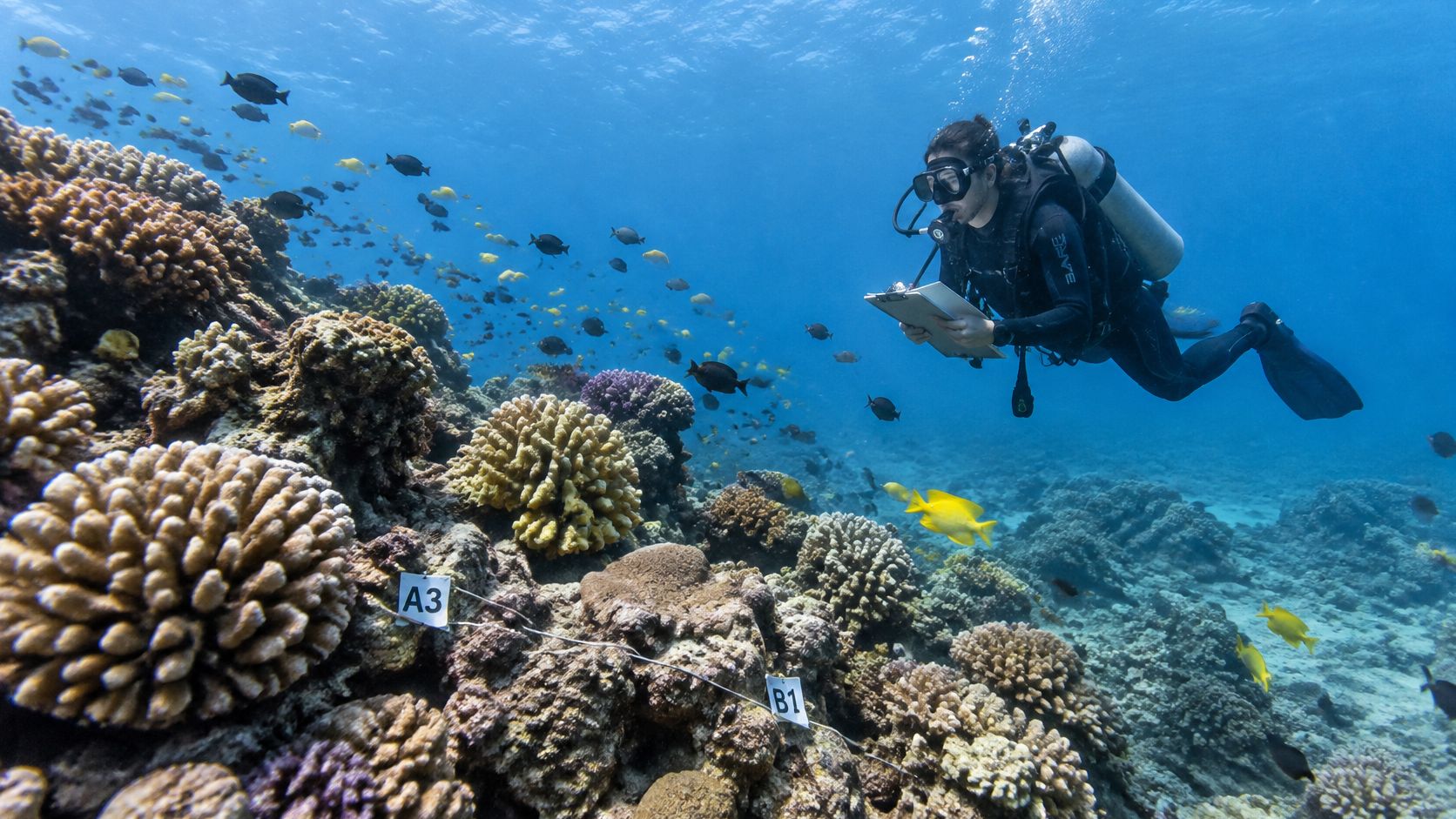
A South Kona reef-fish survey covering 119 sites recorded 75,549 fish representing 132 species in 2020, followed by 65,180 fish representing 142 species in 2021. The 20 most numerous species accounted for 88% of individuals in 2020 and 90% in 2021.
That distribution helps explain what a rewarding reef dive looks like. You don't need an unusual animal at every turn. Schools and familiar reef residents provide the activity, with less common species adding variety.
Read the Shape of the Reef
The survey associated fish-community structure with depth, reef rugosity, sand cover, latitude, nearby housing density, and chlorophyll-a concentration. These are associations, not a promise that any single feature guarantees more fish.
Rugosity means the complexity of the reef's three-dimensional surface. A flat parking lot offers fewer hiding places than ledges, caves, arches, and uneven coral. Fish use those spaces for shelter, feeding, and rest.
For a diver, that means looking along habitat edges rather than swimming quickly over everything. Pause where sand meets rock. Check beneath a ledge from a respectful distance, without placing a hand on the reef.
A slow circuit around interesting structure often reveals more than a long swim across featureless bottom.
A Managed Coast, Not an Aquarium
The West Hawaiʻi Regional Fishery Management Area covers the leeward coast from ʻUpolu Point to Ka Lae. That regional framework places recreational diving within a wider history of fisheries management and monitoring.
Protection doesn't make every site identical or remove environmental pressure. Housing, water quality, habitat shape, and depth remain relevant to what divers encounter.
This is why a shallow coral garden and a deeper pinnacle can feel like different destinations on the same coast. Beginners can enjoy accessible habitat, photographers can work a small area carefully, and advanced divers can explore a different depth profile without assuming deeper always means better.
Manta Nights at Garden Eel Cove
I recommend Garden Eel Cove as the better manta-night choice when conditions support it. Its protected bay, favorable viewing area, and surrounding reefs offer a practical advantage for the dive experience. That's a site-selection judgment, not a scientific ranking or a guarantee of animals.
Also called Manta Heaven, it's distinct from Manta Village near Keauhou Bay. NOAA-hosted manta research places Manta Heaven in Makako Bay at approximately 19.736° N, 156.054° W, and Manta Village at Kaukalaelae Point at approximately 19.640° N, 155.997° W, and states that harassment or contact is strictly prohibited.
Let Plankton Bring the Animals
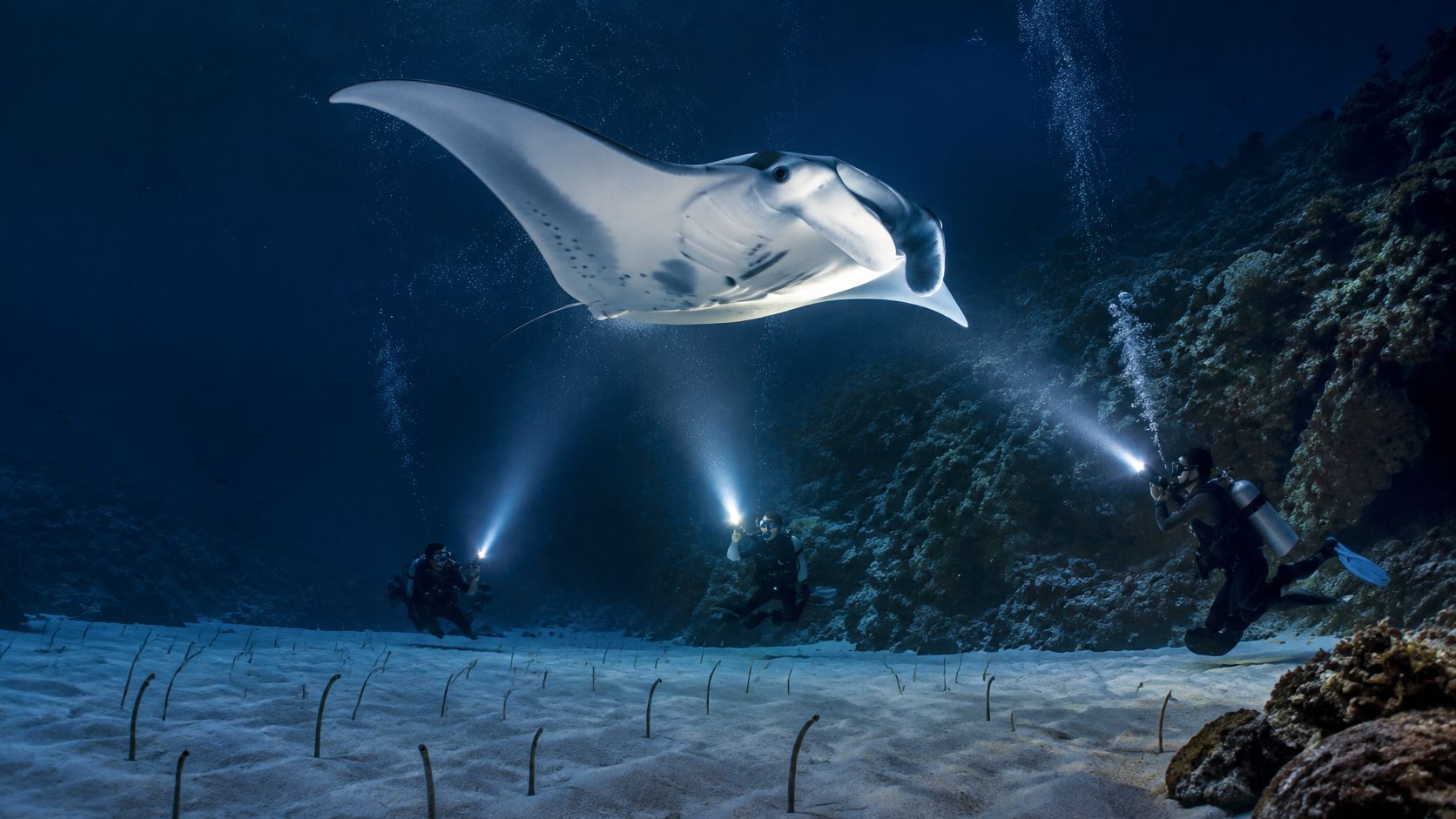
This is plankton concentration, not bait feeding. Lights concentrate plankton, and reef mantas, Mobula alfredi, filter-feed through the illuminated water.
The Hawaiʻi legislative testimony containing NOAA viewing guidance recommends a loose semicircle on sand, rubble, or boulder substrate, an unobstructed center, and lights held above divers' heads. That arrangement leaves turning and feeding space above the group.
Photographers should settle without contacting living coral and clip dangling hoses and gauges. Don't swim underneath an approaching manta to improve the angle. Let the animal choose its route.
Expect Wildlife, Not a Scheduled Performance
The independent Manta Rays database records documented Makako Bay sightings on approximately 43% to 67% of all possible nights from 2019 through 2023. Those are documented nights, not a tour-specific success rate.
A Kona manta-tourism evidence overview describes more than 23,000 sightings of 167 identified reef mantas at two Kona sites during 2010–2022, alongside a 2025 avoidance finding from a different manta site. Persistent Kona visitation doesn't prove unlimited tourism is harmless, and a finding elsewhere doesn't establish the same impact here.
Your behavior remains the part you can control:
- Control buoyancy: Reach the designated position without dropping onto habitat.
- Keep hands off: Never touch, chase, or intercept a manta.
- Respect the layout: Leave the central feeding space open.
- Manage fins: Avoid seabed contact and stirring sediment.
- Follow a clear briefing: Understand positioning and light rules before entry.
Use the Kona manta night-dive planning guide to assess readiness, then compare the manta dive and snorkel tour for your group. Garden Eel Cove's advantage is the setting the crew can select, not control over what wildlife does.
Blackwater Lava Tubes and Pinnacles
Kona's advanced menu contains two different settings. Lava terrain gives you structure to move around. Blackwater deliberately removes the reef from the experience. Enjoying one doesn't automatically mean you'll enjoy the other.
Blackwater Means Open Water
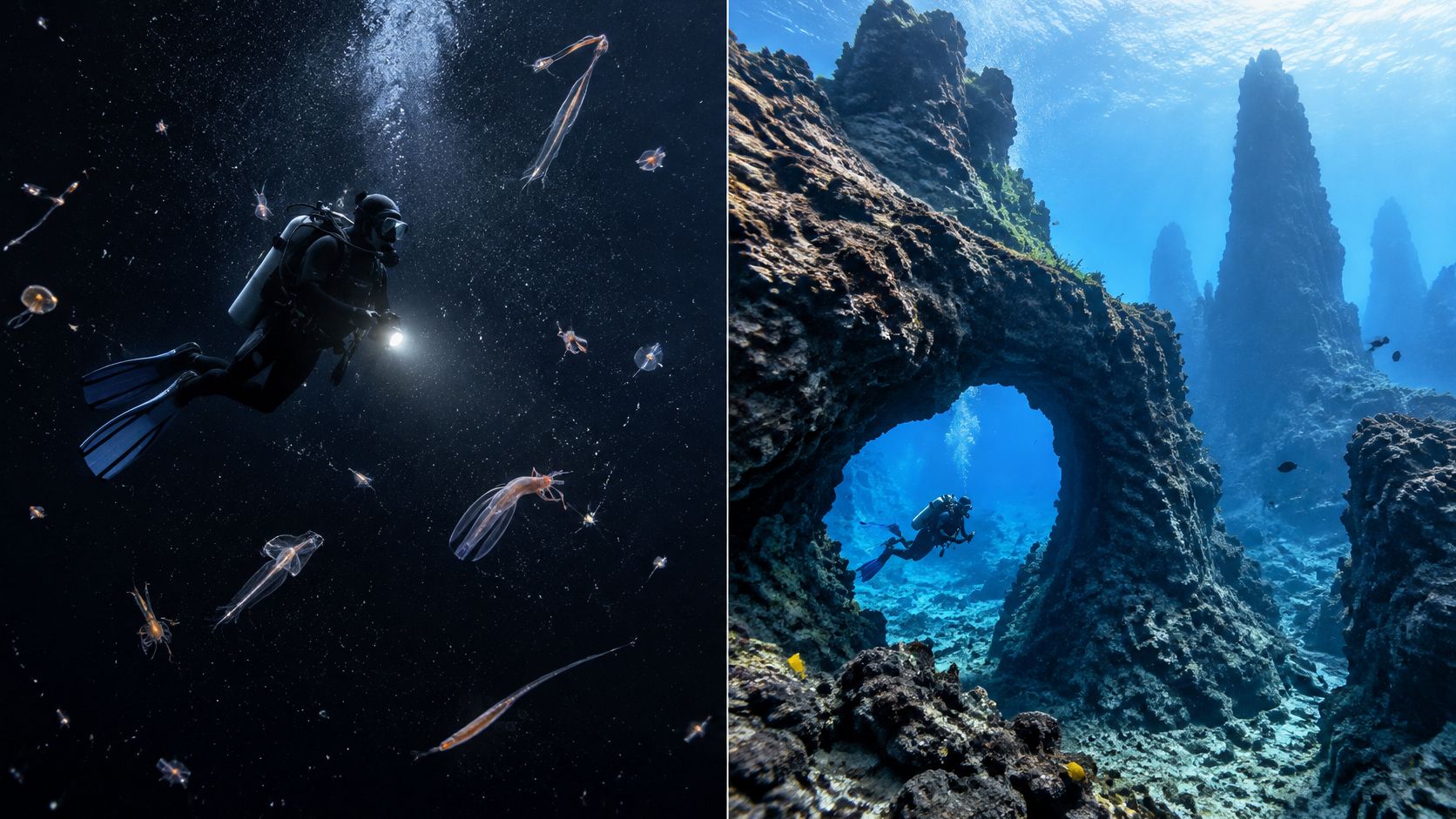
A peer-reviewed paper in Ichthyology & Herpetology defines blackwater diving as nighttime scuba in epipelagic environments, away from the seafloor, and documents larval-fish observations around Hawaiʻi Island. Researchers combined in-water photographs, collected specimens, and DNA barcoding, preserving identified larvae in 95% ethanol for laboratory comparison.
For visitors, the important distinction is the subject matter: delicate planktonic and larval animals rather than a familiar reef under a torch. Subjects may be translucent, small, and visible only briefly.
A photographer needs a focus light, restrained movements, and patience. Chasing a tiny subject usually makes framing harder while pulling attention away from depth, breathing, and the group.
Skip blackwater for now if darkness already consumes all your attention. Build comfort on a reef night first, where you can learn light handling and nighttime buddy awareness with a more familiar visual reference.
Read the Kona blackwater dive guide for the character of the experience, and review the Black Water Night Dive tour for booking suitability. Treat it as a specialized pelagic encounter, not just the next available night departure.
Lava Terrain Rewards Precise Diving
Daylight reef diving takes you around ancient lava tubes, arches, and pinnacles. Wide-angle photographers can work with rock silhouettes and natural light, while fish gather around ledges and changes in depth.
The trade-off is clearance. A diver who can hover comfortably over open sand may still struggle when a ceiling, narrow passage, or another diver limits movement.
- For swim-throughs: Enter only when the guide approves and you have the appropriate training and clearance.
- For deeper pinnacles: Establish turn pressure and ascent procedures before descent.
- For drift profiles: Know the group's separation, signaling, and pickup procedures.
- For cameras: Secure accessories so they don't catch or drag across habitat.
The premium advanced two-tank trip suits divers with recent logged dives, quiet buoyancy, and confidence managing gas while the surroundings move or deepen. Beginners should stay on shallow reefs until depth control no longer takes constant effort.
Tubes and pinnacles are reef terrain. Blackwater leaves that terrain behind on purpose.
Safety and Medical Checks Before You Dive
Fitness for a trip is a separate decision from certification. A familiar depth can become demanding when you add fatigue, congestion, unfamiliar equipment, or darkness. Complete these checks before boarding, not while the group waits at the entry.
Run the Pre-Dive Checks
- Review medical fitness. Discuss heart, lung, ear, and other relevant conditions with a physician familiar with diving medicine. Don't scuba dive during pregnancy; disclose recent illness and medications on the medical questionnaire and to the crew.
- Check ears and sinuses. Equalize early and descend slowly. Stop if you can't equalize comfortably, and skip diving with a cold or congestion rather than forcing pressure through pain.
- Protect your surface interval. Follow the no-fly guidance appropriate to your dive history and computer, commonly allowing 12 to 24 hours as a planning range. Deep, repetitive, or multi-day diving may warrant more time; include drives to altitude in the discussion.
- Agree on gas and depth. Establish reserve gas, turn criteria, and certification limits. Use nitrox only with appropriate training, cylinder analysis, and computer settings.
- Manage heat and fatigue. Drink water, use shade, and rest between dives. Hydration supports normal function but doesn't cancel decompression risk.
- Prepare for darkness. Carry working primary and backup lights. Know the crew's signals, stay close to your buddy and group, and understand the lost-buddy procedure.
- Follow entry and exit procedures. Listen to the ladder briefing and current assessment. Report discomfort immediately instead of trying to keep pace.
Recognize Symptoms That Need Help
Joint pain, numbness, unusual fatigue, dizziness, weakness, or breathing difficulty after a dive require prompt attention. They can indicate decompression illness or another serious problem, even after an apparently uneventful profile.
Seek emergency medical care and contact the crew immediately. Don't dive again to test whether symptoms improve, and don't fly or drive uphill while arranging help.
Emergency priority: Get medical help first. Sorting out the next reservation can wait.
When to Postpone or Change the Plan
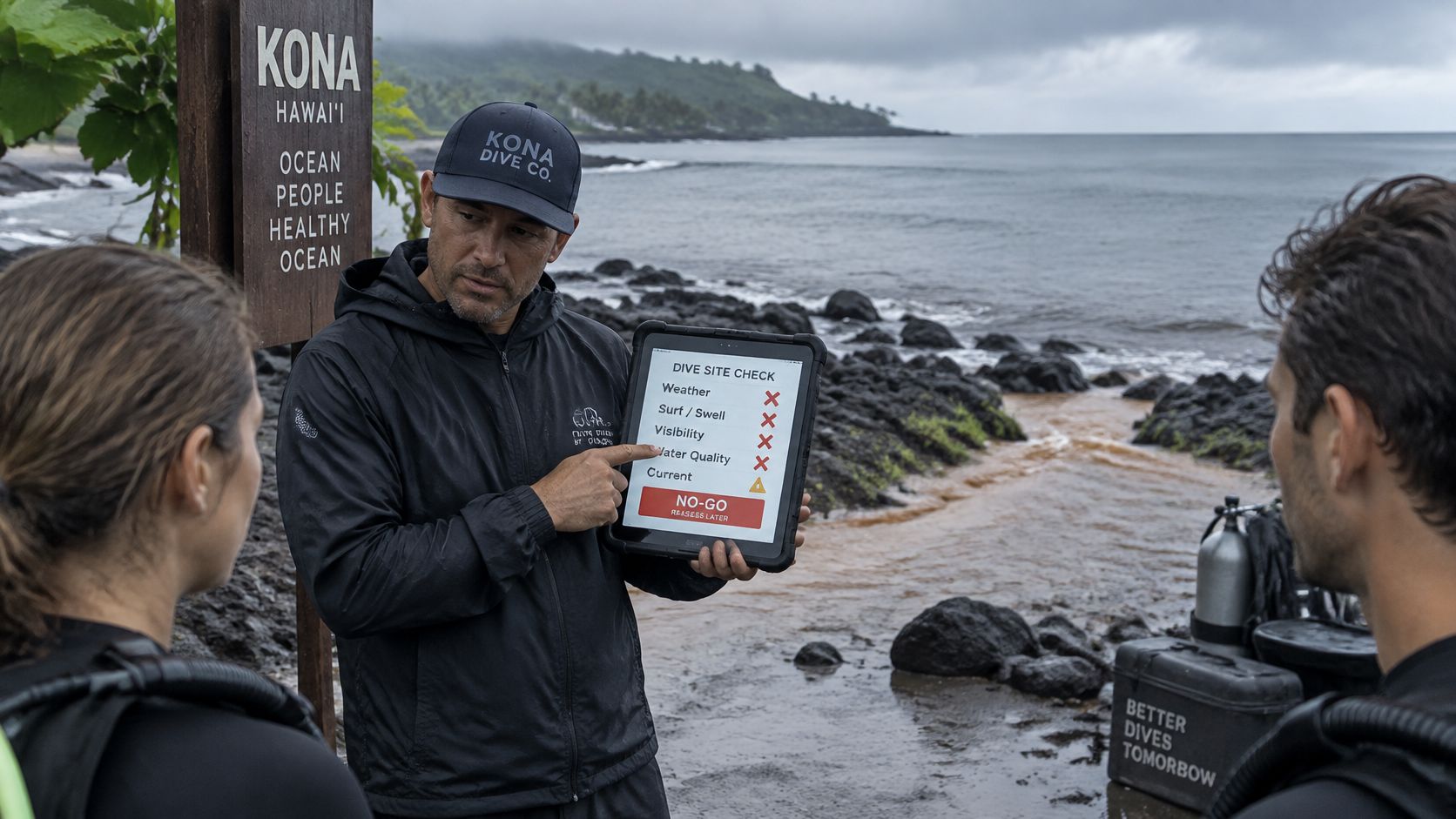
Kona isn't always calm, and sheltered doesn't mean safe under every condition. A booking confirmation tells you there's a reservation, not that the ocean has passed a safety check.
Apply Four Go or No-Go Tests
- Rain and water quality. After a Kona Low storm, Honolulu Ocean Safety guidance advised staying out of ocean water for at least 72 hours after the last rainfall because of contamination concerns. Treat that as storm-specific guidance, not permission to enter automatically when the clock expires.
- Wildlife and debris warnings. Respect exclusion advice around carcasses and floating remains. A 2026 Kona warning directed boaters, fishers, and beachgoers away from a decomposing sperm-whale carcass because of health and safety hazards. Interesting wildlife isn't a reason to enter a warned area.
- Reef condition. A 2026 monitoring report described substantial recovery and minimal mortality after September 2025 bleaching, with temperatures generally below bleaching thresholds through May 2026 and no main-island bleaching alerts at reporting time. Regional recovery doesn't establish safe access or undamaged habitat at every dive site.
- The actual entry and profile. Evaluate surge, current, visibility, debris, and the exit. Beginners should switch days rather than struggle through surge. Photographers may prefer postponing particle-filled water instead of spending the dive fighting backscatter.
Manta trips may remain workable in moderate seas when the crew approves Garden Eel Cove. Don't respond to a missed night by pushing for a more exposed site.
Shore Access Still Has Rules
At the Old Kona Airport Marine Life Conservation District, boundaries extend 500 yards seaward along the defined coastal area, and rules generally prohibit taking marine life, coral, shells, rocks, and geological features, as well as feeding or introducing attractants.
A protected district isn't an all-weather entry. Confirm the boundary, inspect the exit, and leave natural objects where they are.
Use seasonal Hawaiʻi diving guidance to choose travel timing, but let the crew's site decision override a prepaid wish list. A changed itinerary is a successful outcome when the alternative is an unsuitable dive.
Book the Right Kona Boat
For divers who want reef days, instruction, and specialty nights within one operation, Kona Honu Divers is a practical full-service choice. Compare Kona dive-shop selection criteria around the experience you need: appropriate groups, equipment support, training access, and a crew willing to change the plan.
We focus on small groups and personal attention from the moment divers step aboard. Spacious, maintained boats provide hot showers, shade, and storage, while proactively serviced rental equipment reduces the burden of traveling with a full kit.
Match Support to Your Dive Plan
Our schedule includes morning two-tank reef dives, premium advanced two-tank trips, manta night diving, blackwater nights, and morning introductory scuba, plus private tours and dive packages. Early diver discounts and free nitrox are available, including free nitrox with dive packages; enriched-air training and correct gas procedures still apply.
Training options include the PADI Scuba Certification Course, Open Water Referral, Advanced Open Water, Enriched Air Diver, Rescue Diver, Peak Performance Buoyancy, Deep Diver, Boat Diver, and Reactivate, alongside Discover Scuba for uncertified guests. That breadth matters when your best next step turns out to be skill development rather than another demanding charter.
Choose support according to your situation:
- Returning after a break: Make time for a refresher before your boat day.
- Traveling with nondivers: Consider a combined manta dive and snorkel experience.
- Planning specialty nights: Establish daytime comfort before committing to the most demanding profile.
- Building a dive-focused vacation: Leave recovery time and weather flexibility between reservations.
Weigh Credentials Alongside Fit
Kona Honu Divers won Scuba Diving Magazine's Reader's Choice Award for best dive company in the Pacific and was voted best dive operator in Kona. The shop is also the highest-rated and most-reviewed dive shop in Hawaiʻi, with thousands of five-star reviews.
Those credentials help assess an operation, but the right booking still begins with an honest account of your abilities and expectations.
Match your reservation to the trip table: introductory scuba or a refresher first when needed, Garden Eel Cove for the preferred manta setting, and advanced or blackwater diving only after the relevant comfort checks. Keep the crew informed about your recent diving and any medical or equipment concerns.
Kona Honu Divers offers guided reef trips, manta and blackwater nights, and instruction for beginners and returning divers. Visit Kona Honu Divers to choose a trip that matches your skills, plan any training you need, and leave room for responsible site decisions.