
Kona's west coast offers warm, sheltered water year-round, with nearshore temperatures from roughly 74–76°F in late winter to 82–84°F in late summer. Visibility can reach 60–100 feet on favorable days, making scuba diving on the Big Island one of the Pacific's most accessible and reliable experiences.
The counterintuitive part is that Kona's famous manta encounter depends on a relatively small local population, not an endless stream of migrating rays. The quality of a dive day also depends on swell, runoff, plankton density, diver control, and how well a boat manages people in the water. That combination of dependable geography and variable ecology is what makes scuba Big Island Hawaii rewarding for divers who plan intelligently instead of booking on a guarantee alone.
Why Kona Is Hawaii's Premier Scuba Destination
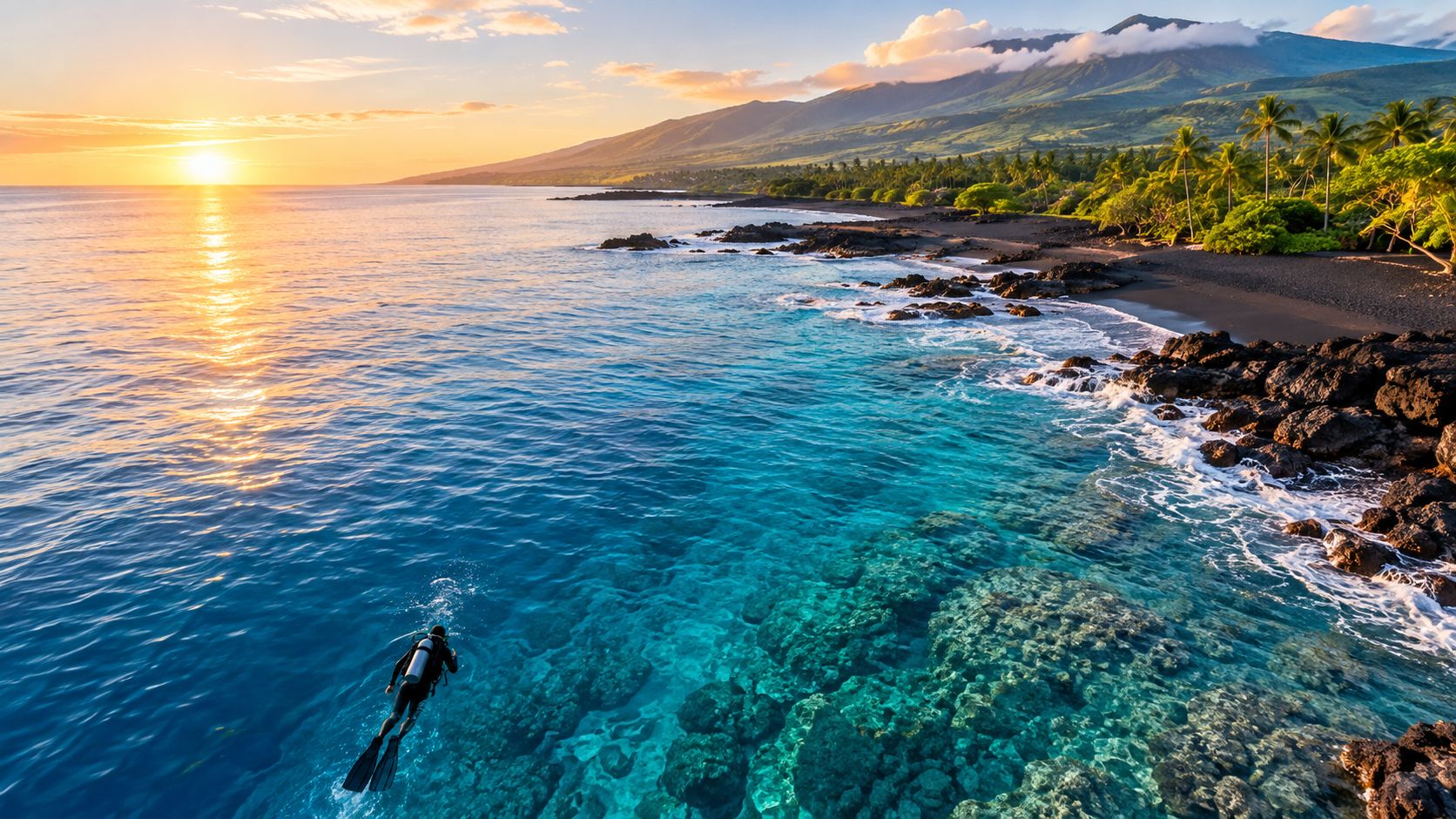
Kona's consistency comes from geography, not marketing. The west coast sits on the leeward side of Hawaiʻi Island, sheltered from much of the prevailing trade-wind exposure. Its volcanic shoreline also creates a broad range of underwater terrain, from shallow reef shelves to lava tubes, arches, ledges, and pinnacles. Deep water close to shore helps boats reach varied sites without spending the entire day in transit.
The result is a coastline where dive planning usually starts with choosing the right site for the day, not wondering whether the entire coast is diveable. Winter north swells can still reduce visibility at exposed west-side locations, while rain and runoff affect the wetter east side more strongly. The practical explanation is simple, suspended sediment creates backscatter, weakens photographic contrast, and makes distant reef structure harder to read. Kona's seasonal diving conditions reflect those trade-offs.
Warm water and volcanic structure
Nearshore temperatures range from approximately 23.3–24.4°C, or 74–76°F, during the late-winter minimum to about 27.8–28.9°C, or 82–84°F, during the late-summer peak. A 3 mm wetsuit is a sensible starting point for most visitors, although repeated dives, surface wind, and individual thermal tolerance may justify more exposure protection.
Volcanic rock gives Kona a personality that coral-only destinations can't duplicate. Lava flows cooled into irregular formations, leaving swim-throughs, overhangs, cracks, and vertical faces where Hawaiian reef fish, eels, octopuses, turtles, and invertebrates use the structure for shelter. You don't need to be an advanced diver to appreciate that terrain, but buoyancy becomes increasingly important as the bottom changes from open sand to fragile reef edges and confined passages.
Efficient access from Kailua-Kona
Most west-side dive trips depart from the Kailua-Kona area and return the same day. That makes Kona practical for travelers who want serious underwater time without relocating hotels or sacrificing an entire vacation to transport.
Morning two-tank trips are especially efficient. You can complete two reef dives, account for the surface interval, and still have the afternoon for a beach, a meal, or a drive along the coast. That schedule works for certified divers, mixed groups with snorkelers, and visitors fitting diving between other Big Island plans.
Practical rule: Choose the leeward coast for consistency, but don't treat “year-round” as a promise of identical visibility. Ask where the boat is going that morning and why.
Top Dive Sites and What You Will Encounter
Kona's sites are best understood as a range of underwater environments rather than a single uniform reef. A calm, shallow lava shelf may suit a newly certified diver, while a deeper pinnacle or cave system demands better gas planning, trim, and comfort in changing light. Site names and exact profiles can vary by operator and conditions, so use this Kona Big Island dive-site guide as a starting point, then let the crew make the final call.
Beginner-friendly reef terrain
Shallow reef areas around Kona reward slow observation. Look for Humuhumunukunukuapua'a, trumpetfish, butterflyfish, moray eels, octopuses, and Green Sea Turtles resting near ledges. Daytime manta sightings are possible, but they should be treated as a bonus rather than the purpose of a reef dive.
Fishermen's Well is the kind of site that suits divers who want abundant reef fish and a manageable introduction to Kona's volcanic bottom. It can also produce occasional turtle sightings. The best approach is to maintain a relaxed pace, keep your fins away from the reef, and let the guide point out animals that disappear when divers move too quickly.
Lava formations for confident divers
Reef Quest Aquarium appeals to divers who enjoy structure. Lava tunnels and sea caves create dramatic changes in light and navigation, but they also punish poor buoyancy. Enter only where the briefing permits, maintain a clear exit route, and avoid pushing into a passage just because it looks photogenic.
Shark's Canyon belongs in the more advanced conversation. Its appeal is the possibility of pelagic species, including reef sharks and eagle rays, rather than a guaranteed sighting. Open-water awareness matters here, especially when current, depth, and blue-water separation make it harder to use the bottom as a visual reference.
A regulated conservation area
The Old Kona Airport Marine Life Conservation District extends from offshore Old Kona Airport State Park to the Kailua Lighthouse, with a seaward boundary defined by straight lines extending 500 yards from specified shoreline points. Hawaii generally prohibits taking, injuring, killing, possessing, or removing marine life there, including live shells, ʻopihi, coral, algae, and eggs. State marine-life rules also establish the broader principle, diving and snorkeling are non-consumptive activities, not permission to touch or collect.
Humpback whale sightings are seasonal, while reef fish and turtles are regular subjects for patient divers. Your certification level should determine whether you choose an open reef, a lava structure, or a deeper pelagic-facing site, not the promise of a particular animal.
The Manta Ray Night Dive Experience
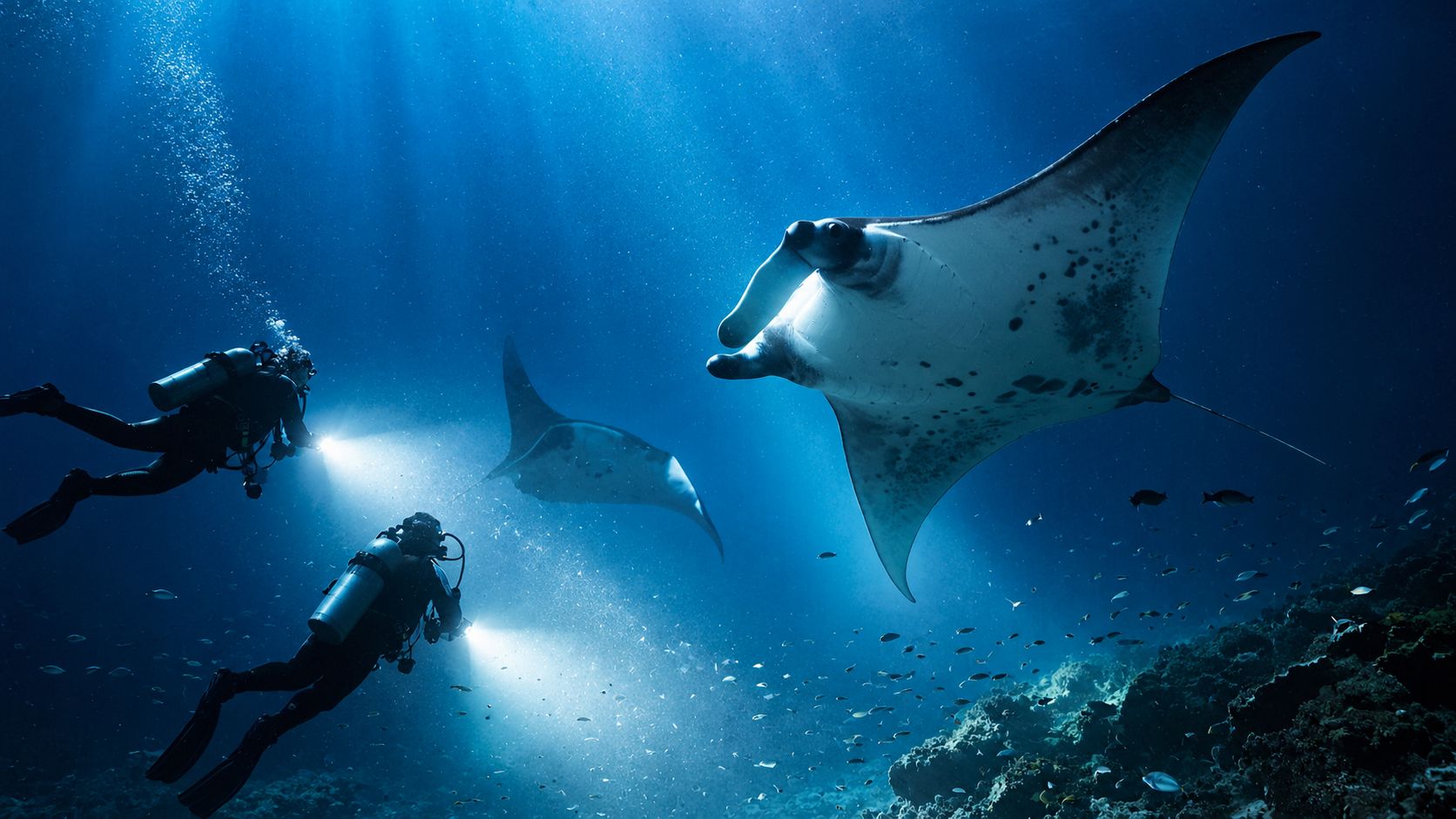
Kona's manta dive is a carefully created feeding opportunity, not baiting and not a trained-animal show. Underwater lights illuminate the water column and seafloor at approximately 10 meters, concentrating zooplankton where reef manta rays, Mobula alfredi, can filter-feed. The typical dive begins immediately after sunset and lasts about one hour, according to NOAA-repository research on Kona manta sites.
Garden Eel Cove is my preferred choice for the dive. Its more protected location, better viewing area, and stronger reef setting create a more controlled experience than choosing the site with the loudest marketing. The site also has a meaningful observation history. Mantas appeared on approximately 80% of dives at Garden Eel Cove, based on the historical record in Hawaiʻi legislative testimony.
Why Garden Eel Cove stands out
The Kona Coast supports a discrete island-associated population. Researchers identified 106 individual manta rays between 1992 and 2007, while separate testimony estimated the local population at fewer than 200 animals. The same record documented approximately 30 new pups from 1994 through 2007, roughly two pups per year, and an average of 57 unique manta rays observed annually during the preceding four-year period.
That scale changes how responsible operators should talk about the dive. These aren't anonymous animals passing through a huge migratory corridor. The historical record identifies “Lefty,” first documented as a fully grown female before 1979, as one of Kona's earliest known resident mantas. No manta was documented migrating between Kona and Maui in the cited photo-identification and acoustic-tracking studies. Repeat sightings can therefore matter scientifically, and disturbance can matter locally.
For the full encounter format, see this guide to diving with manta rays in Kona.
What divers must do underwater
NOAA guidance favors a controlled semicircle on sand, rubble, or boulder bottom. Divers should avoid sitting on live coral, leave the central water column open, hold lights above their heads, and secure loose equipment. Bubbles rising directly into a manta can alter the encounter, while dangling lights or clips can create snag hazards.
The most important skill isn't aggressive finning toward the animal. It's stable buoyancy and stillness. Mantas need room to bank, pivot, and loop through the illuminated plankton layer. The 2025 University of Hawaiʻi study analyzed more than 23,000 community-sourced sightings of 167 individual manta rays and found that aggregation size fluctuated with zooplankton density. A low-count night isn't necessarily a failed operation, and a high-count night isn't a license to crowd the animals.
Manta viewing works best when divers behave like part of the background, not part of the spectacle.
Certification, Rentals, and Nitrox Options
Kona works for both first-time divers and experienced visitors, but the correct starting point depends on what you want to do underwater. A resort or introductory course can put a non-certified guest into the ocean under direct supervision. A full Open Water course takes more commitment and gives you a certification that supports future independent diving.
Match training to the dive
New divers should look for PADI or SSI Open Water training with confined-water skill development, clear medical screening, and supervised ocean sessions. Divers who already hold Open Water certification but want more depth or structure can consider Advanced Open Water, followed by specialties such as Night Diving, Deep Diving, or Underwater Naturalist.
A refresher makes sense if you haven't dived recently, feel uneasy assembling equipment, or can't confidently demonstrate buoyancy and emergency procedures. Night diving adds darkness, light signals, navigation changes, and surface-traffic awareness, so recent experience matters more than just holding a card.
Equipment and nitrox decisions
Reputable operators should proactively service regulators, BCDs, cylinders, exposure suits, and lights. Before booking, ask whether full gear includes a computer, whether sizing happens before departure, and what happens if a piece of equipment fails on the dock.
Nitrox can be valuable on a multi-dive day because it may extend no-decompression limits and shorten required surface intervals when the profile and diver certification support its use. It doesn't eliminate decompression risk, and it still requires correct computer settings and oxygen analysis. This guide to nitrox diving benefits explains why experienced divers often prefer it for repeated profiles.
Managing seasickness
Boat comfort doesn't prevent every motion problem. If you're prone to seasickness, consider discussing options with a medical professional and bringing a method you've used safely before:
- Ship-EEZ Seasickness Patch: Ship-EEZ patch is a purchase option for travelers who prefer a patch format.
- Dramamine: Dramamine pills are widely used, but can cause drowsiness.
- Bonine: Bonine pills are another medication option.
- Sea Band: Sea Band wristbands offer a cheaper, non-drug approach.
- Ginger: Ginger chews are useful for guests who want a simple stomach-settling option.
Don't test a new medication for the first time on a dive morning. Check warnings, interactions, and driving restrictions before use.
Choosing Your Dive Trip Type
The right Kona trip depends less on the most impressive brochure photo and more on your certification, recent experience, comfort in open water, and tolerance for other people's movement. A crowded manta platform can be thrilling for one guest and stressful for another. A private charter can solve group-fit problems, but it won't make poor weather disappear.
| Trip Type | Best For | Typical Depth | Key Species |
|---|---|---|---|
| Two-tank morning dive | Certified beginners and reef explorers | Shallow to moderate reef profiles | Reef fish, turtles, eels, octopuses |
| Manta ray night dive | Divers comfortable after dark | Approximately 10 m viewing area | Reef manta rays and zooplankton-feeding visitors |
| Blackwater night dive | Experienced, self-reliant divers | Open-water descent below the boat | Pelagic and deep-sea species |
| Advanced two-tank trip | Divers seeking lava tubes, pinnacles, or shark habitat | Deeper and more structured profiles | Reef sharks, eagle rays, deep reef life |
| Private charter | Groups wanting a customized day | Selected for the group | Site-dependent marine life |
The two-tank morning dive is the practical default. It gives certified divers two chances to see different reef environments, and guides can choose sites according to swell, visibility, current, and experience. It also leaves the afternoon open.
The manta night dive requires more than basic certification. You must manage buoyancy while stationary, follow light-positioning rules, and remain calm when boats, snorkelers, and divers share the same dark operating area. The Hawaiʻi boating-safety assessment reports that congestion materially increases accident likelihood and that effective capacity controls were lacking as demand grew. Its earlier reporting also documented hazards involving anchors, moorings, lines, and vessel congestion, while noting that the activity generated about $3.4 million annually. Those facts make operator selection a safety decision, not only a comfort preference.
Advanced and specialized formats
A blackwater dive places experienced divers in open ocean after dark, where rare pelagic species and macro-photography opportunities replace the fixed reef. It requires excellent buoyancy, reliable light management, and self-reliance. Divers should confirm logged-dive and recent-dive requirements rather than assuming any night diver qualifies. Guests interested in this format can review the Kona blackwater night dive.
Advanced reef trips target lava tubes, deep pinnacles, and shark nurseries. They suit divers who can manage navigation, gas reserves, and controlled ascents without constant supervision. Review advanced Kona dive options if your experience supports more demanding profiles.
Why Choose Kona Honu Divers
Kona Honu Divers is one operator to consider when you want a broad menu, maintained equipment, and a boat set up for long days on the water. The business describes more than 200 years of combined staff experience and thousands of five-star reviews. Those claims should still be evaluated alongside current credentials, policies, and the specific trip you're booking.
The fleet details matter in practice. Spacious boats with hot showers, shaded seating, and ample storage make a difference after repeated entries, especially for photographers, families, and divers carrying exposure gear. A boat that handles equipment cleanly reduces dockside confusion and gives the crew more room to focus on briefings, buddy checks, and entry procedures.
What the operation covers
The range of trips is useful for mixed-experience groups. A beginner can pursue certification or a refresher, while a certified diver can choose a two-tank reef trip, a manta night dive, a blackwater excursion, or a more demanding lava-tube and pinnacle itinerary. Free nitrox is available for qualified divers on select boats, and rental gear is proactively serviced according to the business description.
You can review the operator's Kona dive company information before comparing schedules and requirements. Other reputable operators serve the coast too. Ask every company about insurance, maintenance, guide experience, group size, cancellation terms, and what happens when site conditions change.
Conservation should influence the booking
Kona's reefs support tourism, but they aren't an unlimited resource. The U.S. Coral Reef Task Force reports that fish biomass on the west coast of the Big Island declined by 45% from 2008 to 2018. Fish biomass is a core indicator of reef productivity, so the change represents a substantial shift in the living fish supported by that ecosystem. The task force's Hawaii data provides the broader context.
A responsible operator reinforces the behaviors that protect the reef: neutral buoyancy, no coral contact, secure equipment, controlled wildlife viewing, and compliance with marine-area rules. Those habits aren't decorative additions to a tour. They're part of preserving the conditions that make Kona worth diving.
Practical Planning and Booking Advice
Pack for the actual day, not the postcard. Bring reef-safe sunscreen, a rash guard, personal medications, a reusable water bottle, and an underwater camera with a secure lanyard. If you use prescription medication for seasickness or another condition, carry it in your personal bag rather than leaving it in checked luggage or a dry box shared with the crew.
Medical clearance deserves honest attention. Respiratory or cardiovascular conditions, recent surgery, pregnancy, or medication changes can affect dive fitness. Ask a physician familiar with diving medicine before arrival, and tell the operator about relevant limitations before you board. A crew can't plan safely around information it doesn't receive.
Book around conditions and recovery
Summer usually offers warmer water, while winter can bring different pelagic possibilities and fewer visitors. Neither season guarantees a particular animal or visibility. Check the cancellation policy, ask how the boat responds to swell, and find out whether the guide can change sites when conditions shift.
Use this short booking filter:
- Credentials: Confirm the operator, instructors, boat, and insurance arrangements.
- Experience fit: Ask whether your certification and recent dive history meet the trip requirements.
- Group management: Find out the boat capacity, guide-to-diver ratio, and surface-traffic procedures.
- Medical and logistics: Verify check-in time, equipment inclusions, exposure protection, and return timing.
- Conservation: Choose crews that prohibit coral contact, discourage chasing wildlife, and follow district rules.
Morning trips make the easiest schedule. You can complete your diving early, recover properly, and leave the afternoon for rest or another island activity. Price should be only one comparison point. Well-maintained equipment, skilled briefings, sensible capacity, and a guide who changes the plan when conditions demand it are worth more than a bargain that creates pressure underwater.
Kona Honu Divers offers two-tank morning dives, advanced trips, manta ray and blackwater night dives, certification, rentals, and private charters for different experience levels. Visit Kona Honu Divers to compare the available Kona trips, confirm requirements, and choose a dive day built around safety, reef conditions, and the kind of marine life you want to see.