
You're probably comparing Kona manta dives the way most visitors do, by trying to figure out which boat, which site, and which operator will give you the cleanest encounter instead of the busiest one. The answer starts with the biology, not the brochure. A strong Kona night manta ray dive works because the lights gather plankton, the manta rays come to feed, and the whole scene unfolds in a predictable nearshore habitat where you can watch the behavior, not disturb it.
The difference between a memorable night and a frustrating one usually comes down to site choice and discipline in the water. Garden Eel Cove, known to many divers as Manta Heaven, consistently makes more sense for a controlled, reef-based experience than a crowded, less forgiving setup, and the reason is simple, the animals, the light, and the bottom conditions all line up better when the site itself supports the encounter.
What the Kona Night Manta Ray Dive Feels Like
The first thing that changes is sound. The day's boat traffic fades, the surface goes dark, and then your focus narrows to the lit patch beneath you and the silhouettes moving through it. If you've ever done a daytime reef dive, this feels different right away, because you're not scanning a wall or drifting a reef edge, you're waiting in a spotlighted stage set for the ocean to deliver the main act.
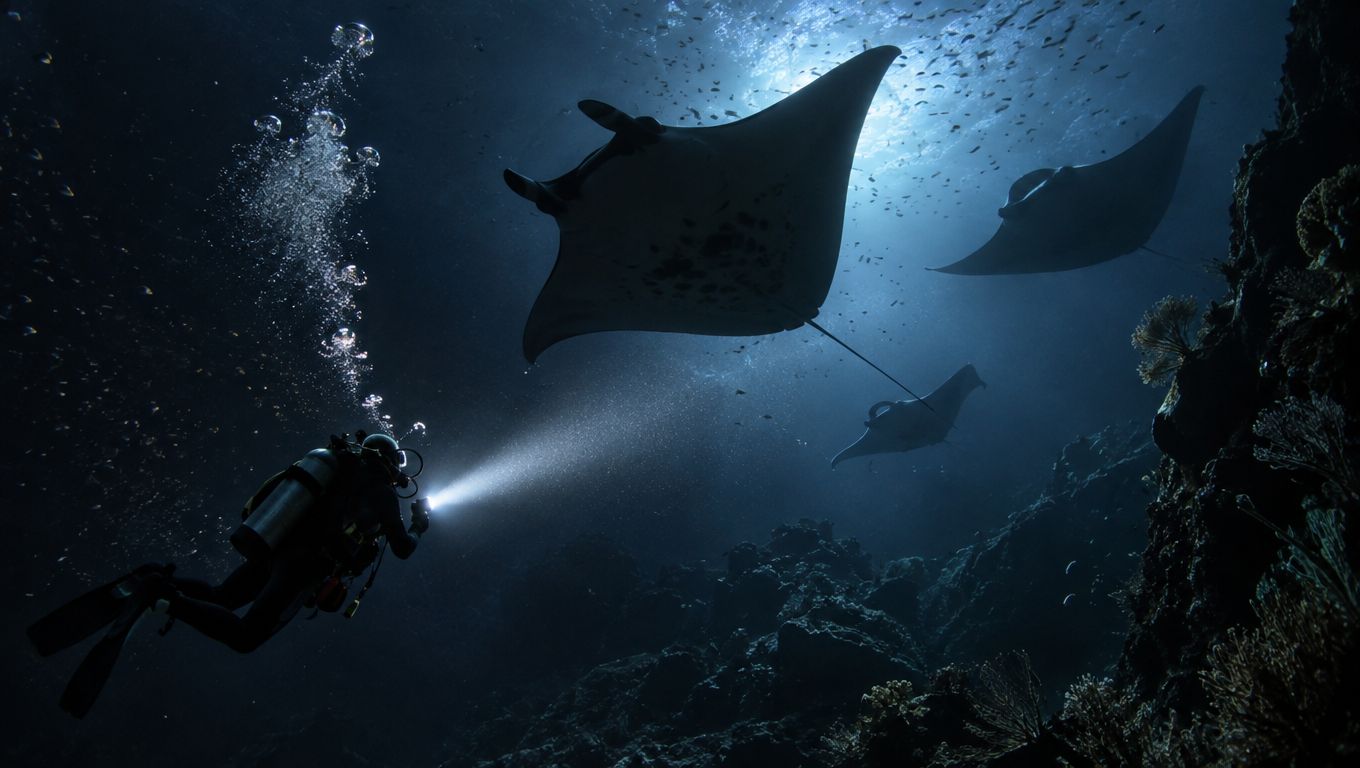
When the first manta comes in, it usually doesn't arrive like a predator. It glides, banks, and adjusts with a kind of effortless precision that makes the water feel larger than it looked a moment earlier. The animal may pass close enough that you can read the white underside and the dark patterning, then turn back through the light field as if it's tracing an invisible lane. That repeated movement is what makes the dive feel so intimate, even though everyone on the bottom is supposed to stay still.
A lot of people expect a chase. That's the wrong expectation. The better framing is a front-row seat to feeding behavior, with your job limited to holding position and letting the mantas decide how close they want to come.
Stay low, stay calm, and let the ray choose the line of approach. If you try to follow it, you ruin the corridor and lose the best pass.
The emotional arc of the dive is usually quick. Anticipation. A flash of motion. Then the realization that the biggest animal in the water is moving with complete control just above your head. That's why the Kona night manta ray dive stays with people long after the boat ride home.
Understanding the Manta Night Dive Itinerary
The logistics are straightforward once you know the rhythm. You meet the crew, gear up, and go through the briefing before the boat heads out for the site. On the water, the goal isn't to search the reef randomly, it's to set up a stable viewing zone where the lights can do their work and the mantas can find the plankton naturally. The general format is built around that idea, not around covering distance.
For the standard scuba version, the crew drops a strong light array and the divers settle on the bottom in a controlled formation. NOAA guidance is clear that divers should not descend into the water column where the mantas are feeding, should keep lights pointed upward, and should avoid sending bubbles directly into a manta overhead, because the encounter is observational, not interactive, and the lighting setup matters to the animals' feeding path (NOAA guidance on manta viewing behavior). That position on the sand or rubble gives the mantas room to maneuver while keeping the viewing lane open above you.
The site matters here, because the whole setup only works when the bottom is stable and the light circle is unobstructed. If the group crowds the center or drifts up into the water column, the animals lose the clean feeding channel that brings them back pass after pass.
- Check in and briefing, because the crew needs to assign positions and review hand signals.
- Enter the water and settle low, since the bottom position keeps the viewing lane open.
- Hold the assigned light direction, so plankton stays concentrated where the mantas expect it.
- Remain still once the rays arrive, because sudden movement breaks the corridor and encourages the animals to veer away.
- Exit together with the crew, since the return leg is when buoyancy, spacing, and control matter most.
For an example of how the timing is usually structured, the dive's night format is laid out clearly in Kona Honu Divers' night diving overview. The operator details vary, but the logic of the evening stays the same, controlled entry, controlled position, and patience while the wildlife comes to the light.
Why Garden Eel Cove is the Superior Dive Site
Garden Eel Cove, also called Manta Heaven or Makako Bay, is the better choice when you want the most controlled viewing environment. The site is one of the two established manta-viewing locations off Kailua-Kona, alongside Manta Village near Keauhou, and research documentation places Garden Eel Cove at approximately 19.736° N, 156.054° W (Kona County testimony document). That protected bay setting makes a real difference when you're trying to hold position, keep the view clean, and avoid the press of heavier traffic.
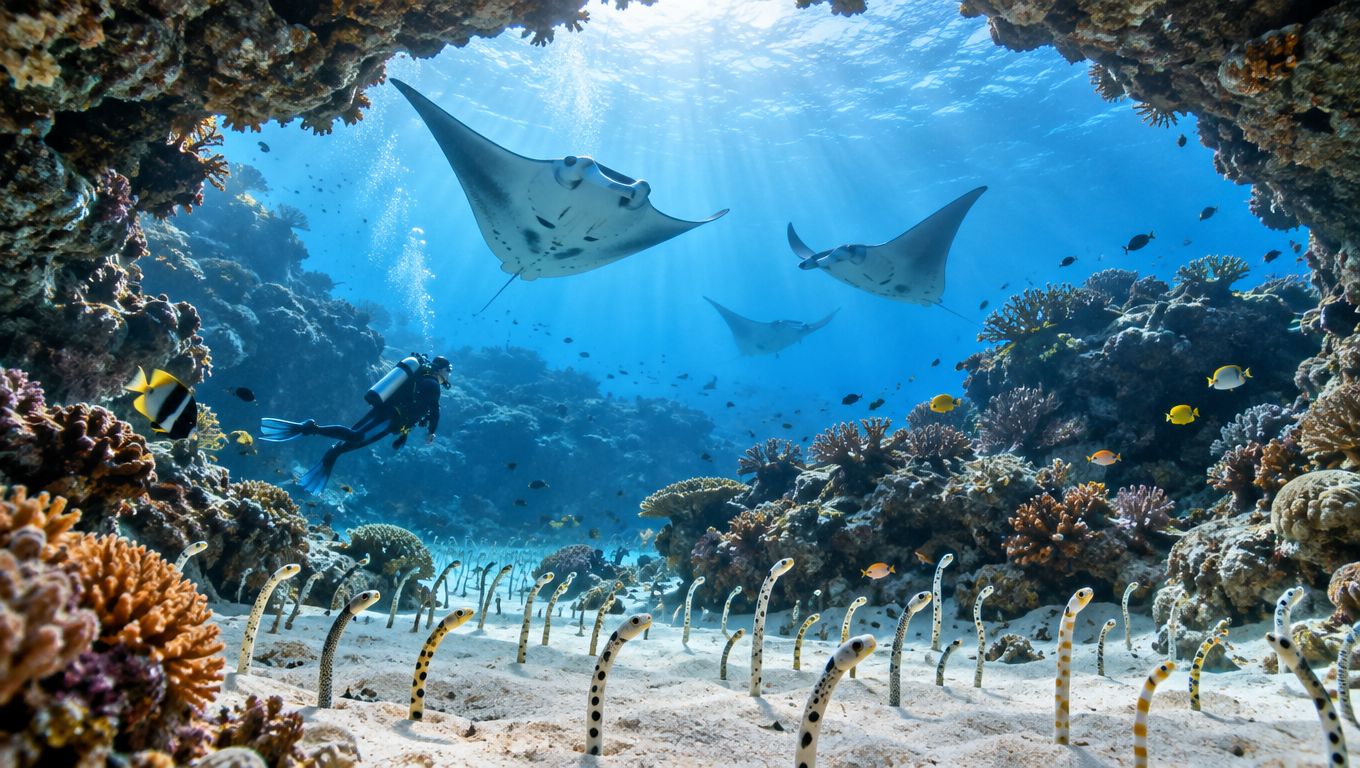
The contrast with a more congested site is practical, not theoretical. At Garden Eel Cove, the protected bay structure supports a more controlled viewing area, and the reef habitat gives the encounter more texture than a bare sand setting. Researchers also noted that viewing activity has raised concerns about overcrowding, safety, user conflicts, and environmental impacts in Makako Bay, which is exactly why a disciplined site choice matters for both the experience and the resource (Kona County testimony document).
Practical rule: choose the site that lets the mantas feed naturally over a stable bottom, not the site that forces the group to fight the water, the crowd, and the current at the same time.
That's why I steer people toward Garden Eel Cove for a premium night dive. It's not just about seeing mantas. It's about giving the animals room to move while giving yourself the best possible window into the behavior.
For more site context, Kona Honu Divers' Big Island manta site guide is worth a look before you book.
The Science Behind the Manta Feeding Behavior
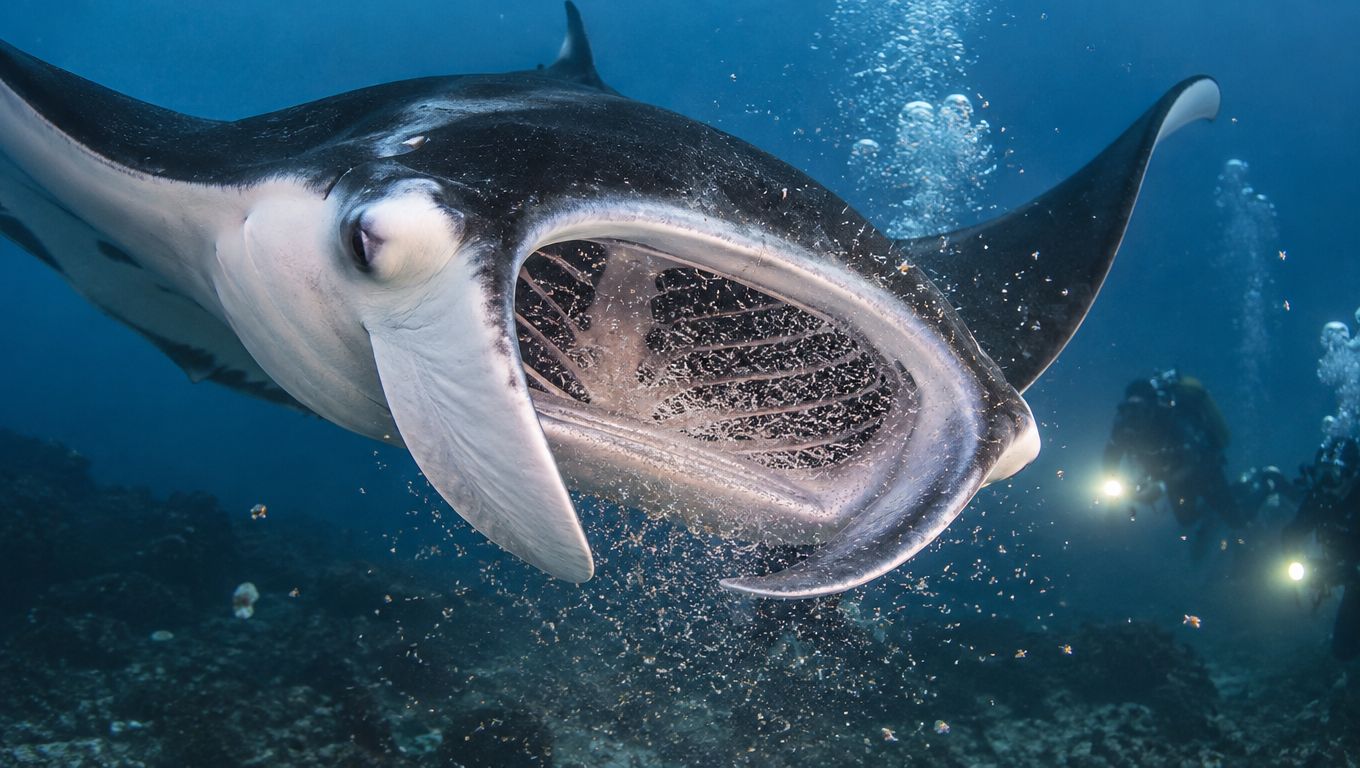
The encounter works because the lights change where the plankton is concentrated, and the mantas respond to that concentration. Reef manta rays, Mobula alfredi, feed by swimming through plankton-rich water with their mouths open and their gill rakers filtering the food from the flow. That's why they bank, roll, and circle the lit zone instead of making a single smooth pass and disappearing into the dark.
The long-term record backs up what divers see in the water. A University of Hawai'i study analyzed 13 years of community-sourced records from 2010 through 2022 at Garden Eel Cove and Keauhou, and the dataset included more than 23,000 sightings involving 167 unique reef manta rays (University of Hawai'i study). That's a real resident and visiting population, not a random offshore fluke, and it explains why the same places keep producing the same kind of nighttime feeding behavior.
The numbers from the historical six-year monitoring work tell the same story. Researchers recorded 25,444 observations of 118 individual reef manta rays at two Kona sites, with 19,841 observations at Manta Heaven and 5,603 at Manta Village, and the site difference was statistically significant (Kona Manta Ray Night Dive study). At Manta Village, they also documented 71 individuals, split between 36 males and 35 females, which shows that both sexes use the habitat (Kona Manta Ray Night Dive study).
The practical takeaway is simple. If the light stays concentrated and the divers stay out of the feeding lane, the mantas keep returning through the same patch of water. That's the biological engine behind the dive, and once you understand it, the repeated passes make perfect sense.
For a broader look at the species and its behavior in local waters, see manta rays in Hawaii.
Who Can Dive and Safety Requirements
The Kona night manta ray dive is accessible, but it isn't casual. You need a valid scuba certification if you're going underwater, and you need enough comfort in the water to follow directions without drifting, grabbing, or rising into the light field. The site setup is forgiving compared with many open-ocean dives, but the animals still need space, and your body position affects both safety and viewing quality.
Open water certification details are the right starting point if you're checking whether you're cleared for the dive. Once you're on the boat, the crew's briefing matters more than ego. Listen closely, stay with the group, and treat your assigned position as part of the wildlife protocol, not a suggestion.
A few things I tell newer divers every time:
- Keep movements slow, because abrupt finning kicks up the bottom and disturbs the lane.
- Stay low and neutral, since the feeding zone is above you, not around your shoulders.
- Keep your hands in, because reaching out invites contact and contact is exactly what you want to avoid.
- Follow the guide's spacing calls, because the group formation is designed around the animals' approach path.
If you're snorkeling instead of diving, the principles are the same, just translated to the surface. You stay where the crew puts you, keep your body flat, and let the light attract the plankton below. The encounter is for observers, not participants in the feeding.
Good manta etiquette is a safety rule as much as a conservation rule. When you respect the animal's line, the dive gets better for everyone on the boat.
Gear Essentials and Photography Tips
The right gear changes the night from awkward to smooth. A focused dive light is essential, because it helps you read the water, follow the briefing, and preserve the illuminated corridor that draws the plankton. A full 3mm or 5mm wetsuit makes sense for many divers on a stationary night dive, since you're not generating much heat once you settle on the bottom.
Photography gets easier when you stop trying to force a wide scenic shot and start thinking in tight framing. A macro lens or close-focus setup is often more useful than a broad wide-angle approach, because the most interesting details are the manta's face, eye, and feeding motion. Keep strobes low, and don't blast the water with extra light just because the scene feels dark to your eye.
A short checklist helps:
- Bring a light you trust, because weak beams make the briefed positioning harder.
- Wear thermal protection, since the stillness, not the water temperature alone, is what makes you cool off.
- Keep camera gear compact, because big housings and dangling accessories get in the way fast.
- Use low-power flash behavior, so you're not throwing unnecessary bursts into a feeding lane.
If you're prone to seasickness, plan for the boat ride before you ever step on deck. Stronger conditions make the return leg tougher than the drop-off, and a calm, prepared diver always has a better night than the person trying to improvise comfort offshore. The gear that matters most is the gear that helps you stay still, warm, and unobtrusive.
Why Choose Kona Honu Divers for Your Adventure
The operator you choose shapes the quality of the encounter as much as the site does. Kona Honu Divers runs guided nighttime scuba dives at Garden Eel Cove, also known as Manta Heaven, and offers the dive as part of a broader Kona scuba program that's built around controlled conditions and clear briefings. That matters because the manta experience works best when the crew understands both the wildlife and the field setup.
What I like about a good operator here is simple. They keep the dive organized, they respect the site, and they don't treat the mantas like props. The company background also includes a broader range of dive trips and support services, which helps if you're building a full Kona diving schedule around the manta night instead of treating it as a one-off outing (Kona Honu Divers company overview).
The main booking advantage is timing. If you're aiming for a smoother night, book early in your stay so weather changes don't ruin your only chance, and pick the site with the more controlled viewing area when you can. For this topic, that means Garden Eel Cove gets the nod because the protected bay setting supports better spacing, better control, and a cleaner watch zone.
I'd also separate this dive from every other trip you may be planning on the island. The manta night is not a generic boat ride, it's a structured encounter with a protected species, and the operator should handle it that way from check-in to final exit.
If you want the cleanest path to a respectful Kona night manta ray dive, book with Kona Honu Divers and plan your night around Garden Eel Cove. You'll get a well-run manta trip, a crew that understands site discipline, and a setup that gives you the best shot at watching the rays feed naturally in the water.