
You're lining up a Kona night manta ray dive the way a first-timer usually does: sunset time on your phone, a boat departure that might be tight, and a camera roll full of rays that look close enough to touch. What really changes the night is whether the water stays workable, the light stays put, and the animals keep feeding instead of turning off.
Calm water, site choice, and departure timing are the levers. Close passes and photos are a bonus, not the score.
Kona Night Manta Ray Dive at a Glance
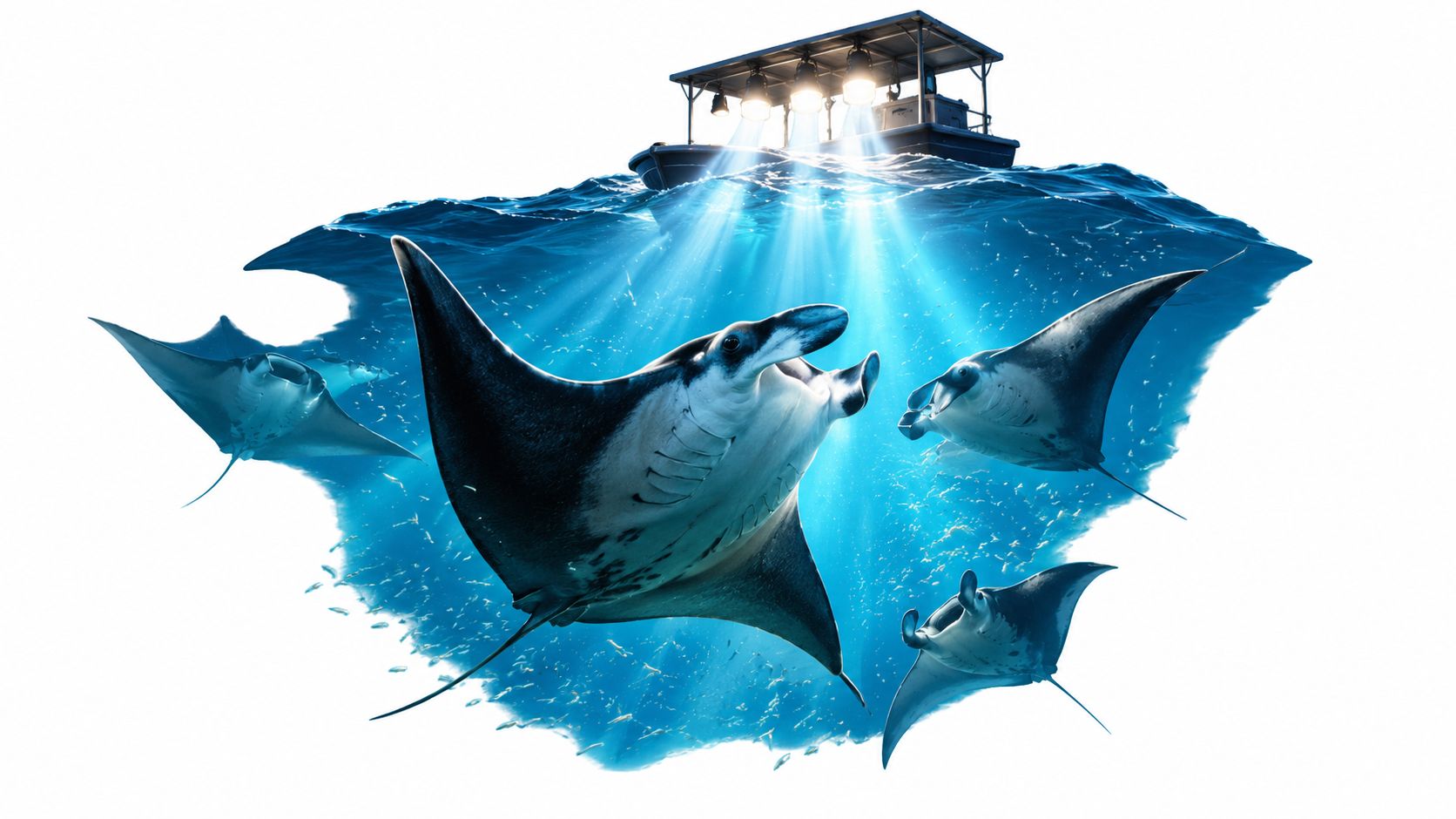
After sunset the surface goes dark, lights come on under the boat, and reef mantas start looping through the glow. You aren't hunting an animal that happened to swim past. You're sitting in a feeding lane these rays already use.
| Detail | What to Expect |
|---|---|
| Start time | Shortly after sunset, around 6:00 p.m. |
| Duration | About one hour in the water |
| Main viewing sites | Garden Eel Cove (Manta Heaven or Makako Bay) and Manta Village near Keauhou Bay |
| Diver position | On the seabed, roughly 30 to 45 feet deep; Garden Eel Cove platform near 35 feet |
| Snorkeler position | At the surface above the divers |
| Scuba requirement | Certification card required; confirm level with the operator |
| Snorkel minimum age | 5 and up |
| Encounter pattern | Repeated feeding loops over the light; sightings vary nightly |
Why the timing holds up
A six-year NOAA observation study from January 1, 2009, through December 31, 2014 logged 25,444 observations of 118 individual reef manta rays, 19,841 at Manta Heaven and 5,603 at Manta Village, with 66 males and 52 females (a 1.27-to-1 ratio that wasn't statistically different from even), on 2,017 nights at Manta Heaven (92% of nights) and 1,702 nights at Manta Village (78%). Dives in that work generally began shortly after sunset, around 6:00 p.m., and lasted about one hour. Repeated sightings of known animals are the reason this works as a wildlife dive instead of an open-ocean search. Artificial lights bunch plankton in shallow coastal water, and the rays come in to feed.
Mantas are still wild. Sea state, moonlight, current, and where the prey sits can thin a night or fill it. Watch the feeding. Don't book a head count.
How Light Draws Mantas Into a Night Feeding Show
A porch light on a summer night pulls moths into a glowing cloud, and swallows show up to eat them. In Kona the "moths" are zooplankton. The swallows are reef mantas, Mobula alfredi. They aren't coming for divers. They're coming for food the lights have packed into one patch of water.
Four beats of the feeding run
Divers and snorkelers settle, and the lights lock onto one column of water. Zooplankton rise into that glow and stay there while the beam doesn't wander.
Mantas arrive from the dark and make repeated passes. Cephalic lobes and wide mouths funnel plankton-rich water across their gill rakers. From the sand it reads as a slow ballet: a rise, a roll, another loop, then a fade back into black.
Long-term work from 2010 to 2022 recorded more than 23,000 sightings of 167 individually identified reef mantas at Garden Eel Cove and Keauhou, sites roughly 20 km apart, and aggregation size rose with zooplankton density, so prey is the driver, according to this marine science study of Kona night aggregations. Those aggregations persisted through years of tourism and artificial light. Persistence isn't permission to chase.
A good night is one where the loops don't stop. Stable light builds a feeding lane. Crossing the beam, blocking an approach, or finning after a ray breaks a low-energy path the animal was willing to repeat.
If you want the biology before you book, read how manta rays live in Hawaii and then judge your own night by whether feeding continued, not by how many frames you shot.
Why Garden Eel Cove Beats Manta Village for Viewing
Garden Eel Cove is the stronger pick for travelers with only one night to spare. The cove is protected, the viewing area is larger, and the reefs give you a better place to settle. Manta Village near Keauhou Bay still produces rays. It just asks you to trade space and shelter for a different kind of familiarity.
| Factor | Garden Eel Cove | Manta Village near Keauhou |
|---|---|---|
| Shelter | Protected location, calmer water | Less sheltered than Garden Eel Cove |
| Viewing area | Larger, better for watching loops | Smaller viewing area |
| Reef quality | Better reefs to settle near | Good, secondary to Garden Eel |
| Manta aggregation size | Consistently larger | Smaller on average |
| Female site fidelity | Lower | Stronger |
| Best for | Seeing several mantas in one night | Repeat sightings of the same females |
What each row changes for you
Shelter is the snorkeler's problem and the diver's entry. A protected cove keeps the surface easier to float on and takes some of the shove out of the descent. A wider viewing area gives mantas room to loop without a wall of bodies in the lane. Better reef means you have a real bottom to kneel or hover beside before the lights do their work, instead of milling in open sand while everyone finds a spot.
Photo-identification across those two sites found that Garden Eel Cove consistently holds larger aggregations, while Keauhou shows stronger female site fidelity, as summarized in this Kona manta night dive site comparison. Larger groups raise the odds of several rays in one hour. Stronger female fidelity suits someone who wants the same animals again, not the busiest show tonight.
The mechanism is the same at the cove: no bait and no training. Divers hold the bottom, lights pull plankton and krill into the column, and mantas rise into repeated loops, which is how Garden Eel Cove's night feed is set up. Snorkelers stay on the surface and watch the same loops from above.
If that site match is what you want, put a Garden Eel Cove departure next to a Keauhou night and take the cove when conditions allow it.
Best Times, Conditions and Crowd Levels
The in-water hour sits just after sunset. Pick a departure that lets you reach the site, gear up, and settle while there's still a little light on the ladder. A rushed entry in full dark is how lights wander and pairs get split.
Check sea state and swell the day of the trip. A calmer surface makes the snorkel float and the diver descent simpler. Prey also shifts from night to night, so the same cove can be busy or nearly empty. Moonlight, flow, and where the plankton sits all move the show. No calendar promises a packed hour.
Crowds change the score
A survey of 444 Hawaii manta-tourism participants is the clearest public read on how crowded these nights feel.
| Crowd Source | Felt Crowded | Average Tolerated Maximum | Saw More Than Their Norm |
|---|---|---|---|
| Snorkelers | 82% | 52 | 77% |
| Boats | 78% | 11 | 68% |
| Scuba divers | 69% | 32 | 67% |
Those respondents would accept, on average, 52 snorkelers, 11 boats, and 32 scuba divers. Most still saw more than their own limit: 77% for snorkelers, 68% for boats, and 67% for divers. Going past those norms lined up with lower satisfaction and a higher chance they wouldn't come back.
Earlier or less-booked departures often mean fewer boats on the site. A smaller group lets you hold a spot without being pressed into someone else's light.
Peak manta activity and a quieter schedule don't always land on the same night. Take the wildlife when the cove is workable, and take the thinner boat count when you care more about room to float. Nobody can promise an empty site. For a wider look at seasonal timing, see when to dive with manta rays in Kona. The practical goal is a managed scene: one light field, assigned spots, and enough gap that a ray can finish a pass.
Who Can Join the Dive and What Limits Apply
Split the night by the job you'll really do in the water. The feed looks different from the sand than it does from the surface, and the entry standard isn't the same.
Scuba
You need a current certification card. The operator confirms the level they want for a night dive in open water, because buoyancy and a dark descent matter more here than on a sunny reef. Ask before you pay if your last dive was a long time ago. A refresher in daylight beats discovering a weighting problem under the lights.
Snorkel
Snorkelers can start at age 5, and the role fits anyone who can float face-down after dark and follow a briefing. You stay above the divers and watch the same loops. Non-swimmers should ask what flotation is on the boat before they book. If the surface feels like work, this isn't the night to test it.
The load is a boat ride, a dim entry, an hour with gear, and the ride back. Heart, lung, or ear problems deserve a doctor's opinion first. Night adds task loading even when the depth stays modest. If you want the profile in plain numbers, read how deep the Kona manta ray dive is and match it to your recent dives, not to a photo.
Three questions before you choose a role:
- Can you enter and float calmly? If the dark water spikes your breathing, stay on the boat.
- Can you stay still for about an hour? Fidgeting is what breaks the lane.
- Can you follow a crew briefing in the dark? If you miss the plan on the boat, you'll miss it underwater.
Yes to all three means pick scuba or snorkel and commit to that spot. No means watch from the deck, or snorkel only if the crew can support you. Sitting out isn't a failed night. A panicked diver in the light field is.
Dive Rules and Photography That Keep Mantas Feeding
A close pass isn't automatically a good dive. The night worked if the mantas kept feeding on their own line. Stress shows up as a course change, a swimmer avoided, or a feeding run that just stops. Your job is to stay out of that decision.
- Settle and freeze. Take the spot you're given on the bottom and stay there.
- Aim the light up and leave it. Point into the water column. Don't sweep the animal or cut across someone else's beam.
- Don't drop toward a ray. If one climbs at you, hold your depth and let it choose the gap.
- If you move at all, come from the side. Stay at least 3 meters (10 feet) away, the buffer recommended in this Hawaii manta viewing testimony.
- Don't touch, chase, ride, or block a path. A voluntary approach still isn't an invitation.
- Own your bubbles and fins. A sudden kick or an exhale straight into the mouth line makes the ray peel off.
- Clip everything that dangles. Gauges, hoses, and camera straps hit animals that pass closer than you planned.
Manta skin carries a mucus layer that protects the surface. Contact looks harmless and isn't. The same restraint sits inside state law: Hawaiʻi has prohibited knowingly catching or killing manta rays in state waters since 2009 under Act 92, as noted in this Big Island scuba overview. Tour rules are the everyday version of that line.
Shoot without stealing the lane
Use a camera you can run on manual focus, with a steady, low-power light. Skip flash aimed at the animal. Keep the housing still and let the ray enter the frame. Frame the loop, don't swim the loop.
Practical rule: If your bubbles, your light, or your body make the next pass shorter, the photo wasn't worth it.
The same habits are spelled out in responsible diver etiquette. Read them before you pack the camera, not after a ray has already turned away.
Packing and Prep Checklist for the Night Dive
Pack the night before. A bag you can carry down a ramp beats a perfect kit you can't lift in the dark.
Gear
- Certification kit plus two lights: A primary dive light and a backup. One dead beam shouldn't end your night or shove you into someone else's.
- A mask that already fits: This isn't the hour to test a new skirt.
- Exposure that matches warm water: A shorty, a fullsuit, or a rash guard. Use this guide to which wetsuit works for Hawaii diving instead of guessing from a resort photo.
- Camera, spare battery, locked strap: If it can swing, it can hit a ray.
Comfort and paperwork
- After the dive: Towel and dry clothes for the ride back. You'll cool off faster on the boat than you did in the water.
- Before you leave the room: Reef-safe sunscreen from the daytime, a bottle of water, and a small snack a few hours before boarding. Don't eat a heavy meal on the dock.
- In a dry pouch: Certification card, booking confirmation, the meeting time, and offline directions. Harbor lots are confusing after dark.
Seasickness before the first wave
Take prevention before the boat leaves, not after you're already queasy. Options people commonly pack: the Ship-EEZ Seasickness Patch, Dramamine pills, Bonine pills, Sea Band wristbands (a cheaper generic that tends to rate better), and ginger chews. Check with a doctor before medication, especially if you're pregnant or on other drugs. Wristbands and ginger are the lower-commitment start if pills make you drowsy for a night dive.
Leave the extra "just in case" weight at the hotel. You need lights, exposure, ID, and a stomach that can handle the ride.
Book Your Garden Eel Cove Manta Dive With Kona Honu Divers
If you're certified and you want the better shot at several mantas in one night, book Garden Eel Cove with Kona Honu Divers. The operation runs custom dive boats, maintained gear, and a crew that briefs the site before you hit the water.
Start on the diving tours page, then open the two-tank manta dive and snorkel. Match the start time to sunset so you're not gearing up in a rush. Ask what still applies on your date: early-booking discounts, nitrox eligibility, rental sizes, and the cancellation line. Weather moves plans, and those details move with them.
Want a different night in the water? The Black Water night dive is the offshore alternative, a drift through open water rather than a seated manta feed.
Do mantas always appear? No. Sightings vary nightly, and a quiet hour is still a fair outcome.
Can I use flash? No. Keep lights steady and pointed up so the feeding lane stays intact.
Can I snorkel if I can't dive? Yes, if you're a comfortable floater aged 5 and up and you can hold still at the surface.
Kona Honu Divers runs Garden Eel Cove manta nights for certified divers and snorkelers who want a managed light, a protected cove, and a crew that treats uninterrupted feeding as the point. If that standard matches the night you're planning, visit Kona Honu Divers and lock a departure that gives you time to settle before the water goes dark.