
You're probably deciding between a few Kona manta tours, wondering whether the night dive is really worth planning a whole evening around, and trying to sort out what's hype versus what matters underwater. That's a fair question. A manta dive can be one of the most memorable dives in Hawaii, but only when the site, briefing, and diver behavior all line up.
For serious manta ray diving in Hawaii, those details matter more than glossy boat photos or big promises. The dive works because the Kona coast has a resident manta population, predictable feeding behavior around light, and site setups that allow divers to stay controlled while the animals move naturally overhead. The best trips feel calm, organized, and respectful from the first briefing to the final ladder climb.
An Unforgettable Encounter with Gentle Giants
You drop in after sunset, descend through the last band of blue, and watch the bottom lights come into focus. For a minute, the water feels empty. Then the first manta glides through the beam, banks over the group, and turns the whole dive from anticipation into complete attention.
That reaction never gets old. Even after hundreds of manta dives, the moment that first animal appears still changes the energy underwater. Divers stop fidgeting, breathing slows, and the group finally understands why calm positioning matters so much on this dive.
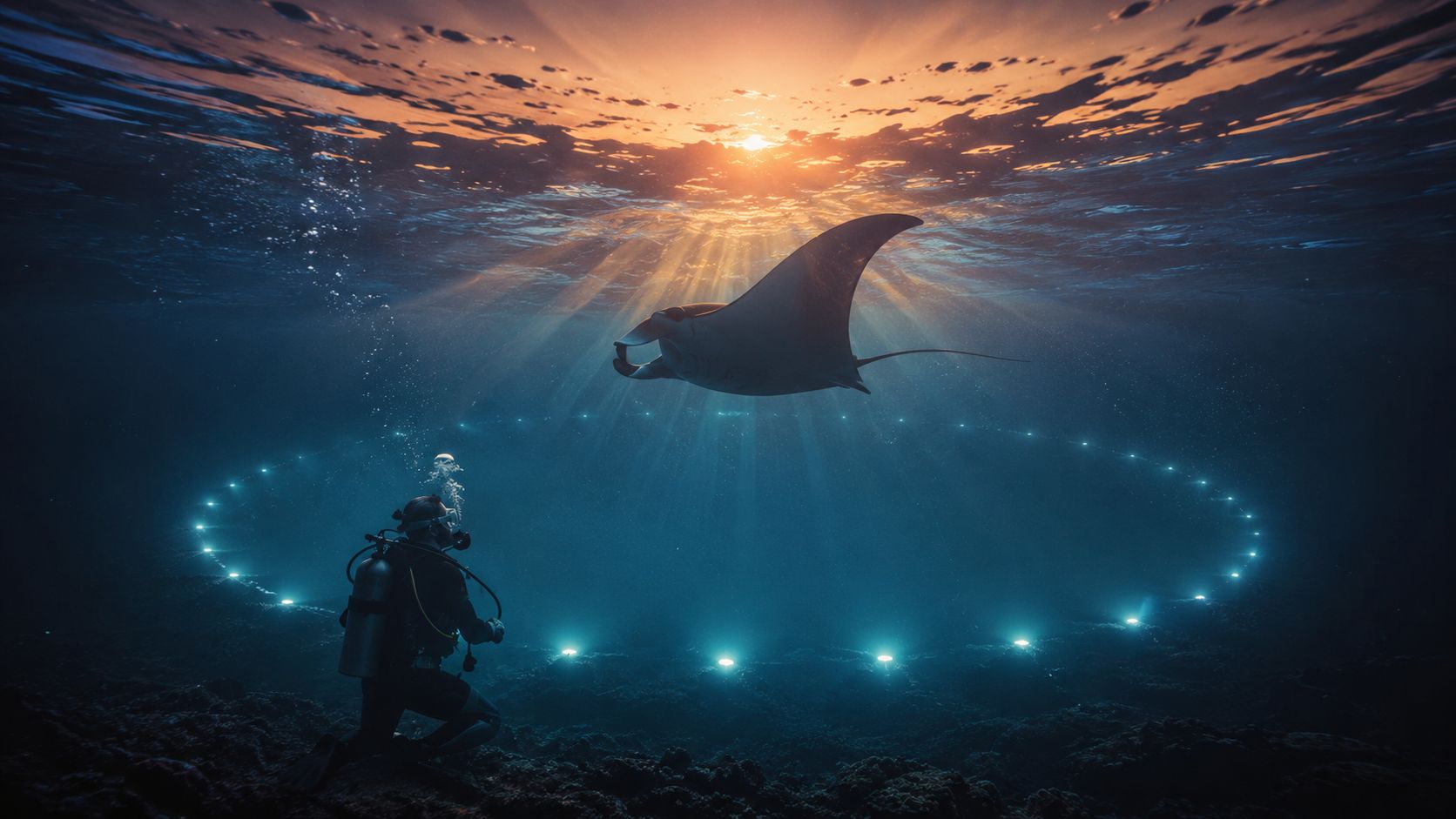
Kona has earned its reputation because the encounter is unusually consistent and unusually close, with a resident manta population that feeds naturally in the light field used by local operators. For visitors comparing tours and conditions, diving Kona on the Big Island gives useful context on the area.
What sets a strong manta operation apart is not hype. It is control. Good crews build the dive around the animals' feeding behavior instead of pushing divers all over the site trying to force an interaction. That is one reason Kona Honu Divers puts so much emphasis on small groups, careful briefings, and the Garden Eel Cove setup used later in this guide. Divers stay settled, the light pattern stays organized, and the mantas get a cleaner runway to feed overhead.
That benefits everyone.
Divers get longer, steadier views. Newer night divers have less task loading. The mantas deal with fewer stray fins, lights, and hands in their path. Those trade-offs matter more than flashy marketing because a manta dive works best when the animals remain in charge of the encounter.
Practical rule: Stay low, keep your hands in, and let the manta come to you. Chasing one usually ends the pass for you and the diver next to you.
That is the main draw of this dive. You are not watching a show someone staged for tourists. You are sitting in the dark while wild animals use the water column above you exactly the way they want to, and your job is to be skilled enough not to interrupt it.
Why Garden Eel Cove Is Kona's Premier Manta Site
Not every manta site in Kona dives the same way. Some locations can produce a good night, but Garden Eel Cove consistently gives divers the cleanest setup, the easiest viewing geometry, and a better chance at a relaxed experience.
That matters more than people think. On a manta dive, the site isn't just scenery. The site determines whether divers can settle safely, whether the light field stays organized, and whether the mantas get a clear feeding lane above the group.
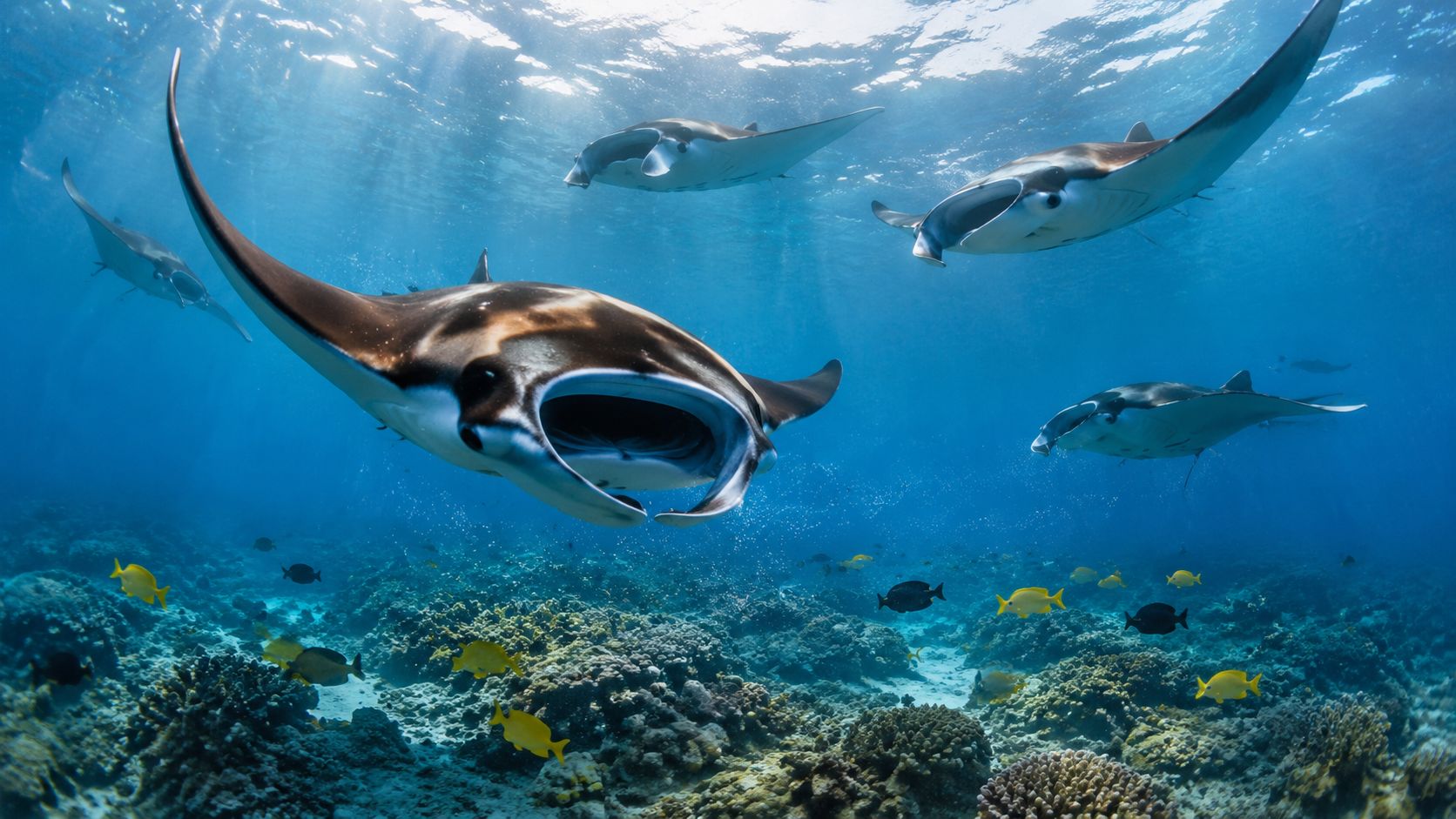
The Manta Ray Heaven site, located at Garden Eel Cove, is the most popular and superior manta ray viewing location on the Big Island due to its protected depth, layout, and bottom topography, resulting in higher manta ray concentrations than other sites, as described in this Garden Eel Cove site guide. If you want a site-by-site view, where to see manta rays in Hawaii breaks down the main options.
What works better at Garden Eel Cove
The strongest advantage is the layout. Garden Eel Cove gives crews a sandy area that works well for seated or kneeling divers, with open water above for mantas to feed. That's better than trying to run the same protocol over fragile reef or in a spot where the group gets stretched out.
A better bottom also means fewer diver mistakes. When people can settle comfortably, they're less likely to fin the sand, drift into one another, or reach upward when a manta passes close.
Why protected water matters at night
Night diving magnifies every small problem. Mild surge feels bigger. Loose trim gets sloppier. A diver who's merely average in daylight often becomes noticeably less stable after dark.
Garden Eel Cove helps by removing some of that chaos. Its protected nature makes the entire pattern cleaner, from descent to lineup to ascent. That's good for the guests and good for the animals.
The best manta site isn't the one with the flashiest name. It's the one that lets divers become quiet, predictable shapes on the bottom.
Better reefs, better viewing, fewer compromises
There's another trade-off people don't always talk about. A good manta site needs both a usable viewing area and healthy surrounding habitat. Garden Eel Cove stands out because it gives operators a practical place to stage the dive without forcing everyone onto delicate structure.
That's one reason many working divemasters prefer it. You get the amphitheater feel, a cleaner line of sight, and fewer moments where safety and reef protection are in tension with each other.
Planning Your Manta Dive Logistics and Tips
The guests who enjoy this dive the most usually look unhurried before we ever leave the harbor. They have eaten lightly, hydrated, packed one warm layer, and handled motion sickness before the boat starts to roll. The guests who struggle are usually dealing with preventable problems.
Kona conditions are often calmer in summer, and winter can bring more surge, wind, and occasional schedule changes. That does not mean winter trips are a bad idea. It means smart planning matters more. If you know boat motion can bother you, read how to avoid sea sickness before your trip and choose a remedy you already know works for you.
What to sort out before dive day
Book your manta dive early if your dates are fixed. Good operators keep these trips small for a reason. Smaller groups are easier to brief, easier to supervise in the dark, and less likely to turn the manta campfire into a crowded mess. That matters even more on a site like Garden Eel Cove, where good positioning and calm diver behavior improve both safety and the animals' feeding pattern.
Give yourself a quiet afternoon.
A manta night is not the dive to wedge in after a hard shore dive, a long hike, and two drinks at dinner. Fatigue shows up fast at night. So does dehydration. If you arrive tired and behind schedule, air consumption usually goes up and situational awareness goes down.
What to bring that actually helps
Keep your kit simple and deliberate:
- Towel and dry clothes: The ride back feels cooler than many visitors expect.
- A warm layer: Even after a comfortable dive, wind on a wet boat ride can chill you quickly.
- Minimal loose gear: Less clutter on deck means fewer dropped items and less fumbling in the dark.
- Any personal medication you already trust: Take it on time, not after you start feeling bad.
- A small water bottle and light snack for after the dive: Helpful if you are prone to nausea or finish cold.
If you are diving with Kona Honu Divers, use the briefing to your advantage. Ask where to stow gear, when nitrox analysis happens, and whether the trip includes a twilight dive first. Crews that run these details cleanly tend to run the in-water portion cleanly too.
Seasickness is easier to prevent than fix
I tell guests this all the time because it is true. Once nausea gets rolling on a night boat, the evening can turn into survival mode.
Useful options include the Ship-EEZ Seasickness Patch, Dramamine pills, Bonine pills, Sea Band wristbands, and ginger chews.
Pick one approach and use it correctly. Patches and many medications need lead time. Wristbands and ginger help some people, but they are not enough for everyone. The right choice is the one that fits your body, your tolerance for drowsiness, and how reliably you will take it before departure.
What to Expect on Your Manta Night Dive
Your first real sign that the dive will go well comes before you hit the water. The crew sets a calm pace, checks lights, confirms buddy teams, and gives a briefing that tells you exactly where to be and what to do when the mantas start feeding. On boats that run this dive often, the process feels orderly for a reason. Predictable divers create a predictable water column, and that gives mantas room to feed close.
Many trips include a twilight dive before the manta portion. I like that sequence because it solves problems early. Divers can settle their breathing, confirm weighting, and get comfortable with the site before the lights go on and everyone needs to hold position. If you still need to build those core skills, getting your Open Water certification first makes the night far more enjoyable.
The descent and the light circle
Once the boat is set up for the manta portion, divers descend to the sandy bottom and form the light circle the crew assigned. In Kona, that usually means kneeling or sitting low in a sandy area and aiming your light up into the water above the group. The goal is simple. Light gathers plankton, plankton gathers mantas, and stable divers keep that feeding lane open.
Garden Eel Cove works especially well for this because the site is set up for the behavior everyone came to see. The bottom gives divers a clear place to settle, and the open water above the lights gives mantas space to bank, roll, and make repeated passes. Small groups help here. With fewer fins, fewer lights, and less crowding, the whole setup stays cleaner.
How the encounter usually unfolds
At first, it can feel quiet. You see suspended plankton in the beams, hear regulators, and wait.
Then a shadow enters the edge of the light. One manta glides through, turns above the circle, and comes back lower on the next pass. If conditions are good and the group stays disciplined, more rays join in and the action builds fast. The best moments usually happen after everyone stops trying to improve the view and holds position.
That is the trade-off on this dive. Divers who stay still get closer encounters. Divers who chase angles, sweep lights around, or rise off the bottom often push the mantas wider and make the scene worse for everybody.
A realistic flow for the evening
| Time (Approx.) | Activity |
|---|---|
| Early evening | Check-in, gear setup, briefing, and boat departure |
| After arrival | Site orientation and entry |
| Twilight | Optional reef dive at the same site or nearby |
| Surface interval | Light reset, final instructions, and manta setup |
| Night | Descent to the sandy bottom and light circle formation |
| Main encounter | Passive observation while mantas feed overhead |
| End of dive | Controlled ascent, exit, and return to the harbor |
What strong divers do differently
The divers who have the best manta nights usually look the least busy. They keep their knees, fins, and gauges tucked in. They point their light where they were told. They avoid stirring sand, because once visibility drops inside the light beams, the whole group loses the effect that draws the mantas in.
Kona Honu Divers tends to run this well because the crew keeps the in-water plan simple and the group size manageable. Free nitrox helps on trips that include a twilight dive first, since many divers finish that portion feeling less loaded and more relaxed for the main event. It does not change the need for control, but it can make the evening more comfortable.
What usually spoils the dive
Three mistakes cause problems fast:
- Poor buoyancy: Finning into the bottom clouds the lights and reduces visibility.
- Wandering beams: Lights aimed all over the place break up the plankton concentration above the group.
- Reaching up at the mantas: That stresses the animals and interrupts their feeding path.
Stay low. Stay calm. Let the mantas own the water above you.
That is how those close barrel-roll passes happen.
Safety Rules and Certification Requirements
Your mask drops below the surface, the lights come on, and the bottom looks close enough to feel simple. It is not. A manta night dive stays comfortable only when every diver can hold position, control fins, and follow directions without hesitation. That is why operators ask for certified scuba divers rather than treating this as a first try at night diving.
Open Water certification is the usual entry point because it gives divers the baseline skills this site demands: controlled descents, steady buoyancy, clear communication, and calm problem-solving in limited light. If you are not there yet, start with a proper Open Water scuba certification course before booking the dive.
Why the requirement matters
On the manta site, a small mistake affects more than one person. A diver who kneels hard, sculls with hands, or kicks up while adjusting gear can cloud the light field and reduce the view for the whole group. More important, sudden movement changes the space the mantas are using to feed.
That is also why Kona Honu Divers keeps the plan simple and the groups small. Smaller groups are easier to brief, easier to position, and easier to supervise once the lights are on and the mantas start making close passes. Garden Eel Cove helps here too. The site's layout and typical diving profile make it easier to place divers where they can stay settled on sand instead of fighting current or chasing the action.
If you are not certified
Snorkeling is the right option.
From the surface, non-certified guests can still watch mantas feed in the lights without adding task load, gas management, and buoyancy control to an already unusual environment. That trade-off usually leads to a better experience and a safer one.
For divers who want more after the manta dive
Some divers leave the boat wanting another night experience right away. A premium advanced long-range dive trip gives experienced divers access to different sites and longer profiles. A Kona blackwater night dive is a different challenge entirely, with pelagic life suspended over deep water.
Free nitrox can also make a real difference on evenings that include an earlier dive before the manta drop. It does not replace skill or change the rules, but many divers finish the first dive feeling fresher and more focused for the main event. That is the kind of practical advantage that improves safety without changing the low-impact approach the mantas need.
Gear Tips for Photography and Using Nitrox
You settle onto the sand, look up into the lights, and a manta turns straight over your head. In that moment, long lenses, constant settings changes, and bulky accessories become a problem. Simple camera setups usually get the best results here because the animals come close, move fast, and stay in the brightest water for only a few seconds at a time.
Camera setup that works underwater
For this dive, wide-angle wins.
A fisheye or very wide rectilinear lens gives you room for the full animal, the light beam, and some sense of scale from nearby divers. Tight framing rarely pays off on a manta night dive because the ray can go from distant to overhead in one pass. By the time you zoom or recompose, the shot is gone.
A practical setup usually looks like this:
- Use your widest lens, not your longest one.
- Set exposure before descent and make small adjustments only if needed.
- Keep strobe power conservative so you do not blow out the white belly on a close pass.
- Include negative space or the edge of the light cone. It helps the image feel like Kona, not just a dark-water animal portrait.
- Stay aware of your fins, gauges, and camera arms so you do not stir sand into the lights.
The trade-off is straightforward. Bigger camera rigs can produce great images, but they also add task loading on a night dive where buoyancy and positioning matter more than tinkering. Divers who keep their setup compact usually stay more stable, block fewer sight lines, and get cleaner water in front of the lens.
Why nitrox helps on this trip
Nitrox is not about stretching limits on the manta dive itself. It is about arriving at the second half of the evening less loaded from an earlier dive and finishing the night feeling sharper. That matters more than many visitors expect, especially on a Kona schedule with several diving days in a row.
Kona Honu Divers' overview of nitrox diving benefits explains the basic value well, and their free nitrox for certified divers is a practical advantage, not a gimmick. If you are doing a two-tank day that rolls into a manta night, that lower nitrogen load can leave you feeling fresher for the briefing, the descent, and the ride home.
Small groups help here too. With fewer divers to manage, guides can confirm mixes, labels, and depth plans without rushing, then keep the bottom lineup cleaner once the lights are in place. That is good for safety, good for photos, and good for the mantas, because organized divers are less likely to drift, fin up the sand, or crowd the water column where the rays are feeding.
Dive with Aloha Be a Responsible Manta Ambassador
You are kneeling in the sand, lights pointed up, and a manta glides so close you can hear the change in the water as it banks over your head. That moment can stay wild only if divers stay disciplined.
The job is simple. Hold position, keep your hands off the animal, and let the manta control the encounter. On a well-run Kona night dive, the rays come to feed in the plankton-rich light. They do not need to be chased, called, or redirected. Divers who stay calm give them a clean flight path and keep the whole site working the way it should.
Touching a manta is out. Their skin carries a protective mucus layer, and repeated contact can strip or damage it. NOAA's guidance on responsible marine wildlife viewing supports the same basic standard. Observe closely, never harass, and never make contact.
Why passive divers get better encounters
Passive diving is not just a conservation rule. It also produces a better dive.
Mantas feed by looping through the light beam again and again. If divers reach up, fin high, or drift out of position, the rays change course. Sometimes they stay off the edge of the group. Sometimes they leave the main light entirely. You see fewer close passes, photographers lose clean angles, and the animals spend more energy avoiding people instead of feeding.
That is one reason Kona Honu Divers' small-group approach matters. With fewer divers on the bottom, guides can space people correctly, fix problems early, and keep the light field organized. Garden Eel Cove helps too. It is a reliable site with room to set up cleanly, which reduces crowding and gives mantas a more predictable place to feed.
The best manta divers I have guided are usually the quietest ones.
They settle in, control their buoyancy, keep their fins low, and watch the whole pattern instead of trying to force a single close pass. Those divers often get the strongest encounters because the mantas keep returning to the same stable column of light.
The real trade-off behind the rules
Kona's manta dive depends on repetition. The animals show up night after night because the feeding opportunity is consistent. If operators pack in too many people, allow sloppy bottom positioning, or treat the dive like a petting encounter, that consistency starts to break down.
Good operations accept a trade-off here. Smaller groups can mean fewer spots on the boat and less short-term volume. They also mean better supervision, less sand in the water, fewer accidental contacts, and a calmer feeding area for the rays. That is the kind of trade-off worth making.
As a guest, your part is straightforward:
- Stay where your guide places you: A fixed lineup gives mantas open water above the lights.
- Keep fins, gauges, and cameras tucked in: Loose gear creates obstacles in the feeding lane.
- Do not touch or chase: Close passes happen when the animals stay relaxed.
- Follow the briefing exactly: The rules are based on how mantas behave at night.
- Choose operators that keep groups manageable: Better control is better for divers and for the resident manta population.
Aloha on this dive is not just attitude. It is restraint, respect, and good judgment in the water.
If you want a well-run option for Kona Honu Divers, start with their manta ray dive tours. The right choice is the one that matches your certification, comfort in the water, and commitment to doing this dive the right way.