
A guided Kona manta ray dive is a night dive where diver lights draw plankton into the water and reef manta rays arrive to feed, usually running 3 to 5 hours at about $175 to $250 per certified diver. You're probably looking at tour pages right now, wondering whether to dive or snorkel, which site gives you the best view, and whether anyone can promise mantas on the one night you have free. They can't. What you can control is your site, your positioning in the water, and the operator you trust to run a crowded, dark-water encounter properly. Those three choices shape the night far more than any marketing claim about a guarantee.
Kona Manta Ray Dive at a Glance
A Kona manta ray dive is a stationary night dive built around feeding. Lights concentrate zooplankton in the water column, mantas come to filter that plankton, and you watch from a fixed position while they loop overhead, often within arm's reach. It isn't a swim-along tour and it isn't a show with trained animals. If the plankton doesn't gather or conditions push feeding elsewhere, you may get a quiet reef night dive instead.
Who This Suits
Certified divers kneel on the bottom and look up. Snorkelers float on the surface and look down. Both views work, so match the role to your certification and comfort in open water after dark, not to which photo looks better online. If you're torn, read this comparison of snorkeling versus diving with manta rays before you pay. Beginners can do this dive because you stay in one place, but you still need steady buoyancy so you don't drift up into a manta's path.
| Factor | What to Expect |
|---|---|
| Typical length | 3 to 5 hours including briefing and return to harbor |
| Price range | About $175 to $250 per adult for certified divers (2025 guide) |
| Main viewing sites | Garden Eel Cove (Manta Heaven) and Manta Village at Keauhou Bay |
| Group size at one site | 100 to more than 300 participants at once |
| Who can join | Certified divers and snorkelers (snorkel tours from age 5) |
| Sighting certainty | Not guaranteed; presence depends on plankton and sea conditions |
Check your certification and budget against that table first. Everything else, site, timing, safety, and price differences, gets easier to judge once you know which role you're booking.
What Happens During the Night Dive
The lights don't attract the mantas. They attract plankton, and the mantas follow the food.
That distinction explains every rule you'll hear on the boat. Follow the positioning rules and you help create the feeding column. Break them and you scatter the very thing the animals came for.
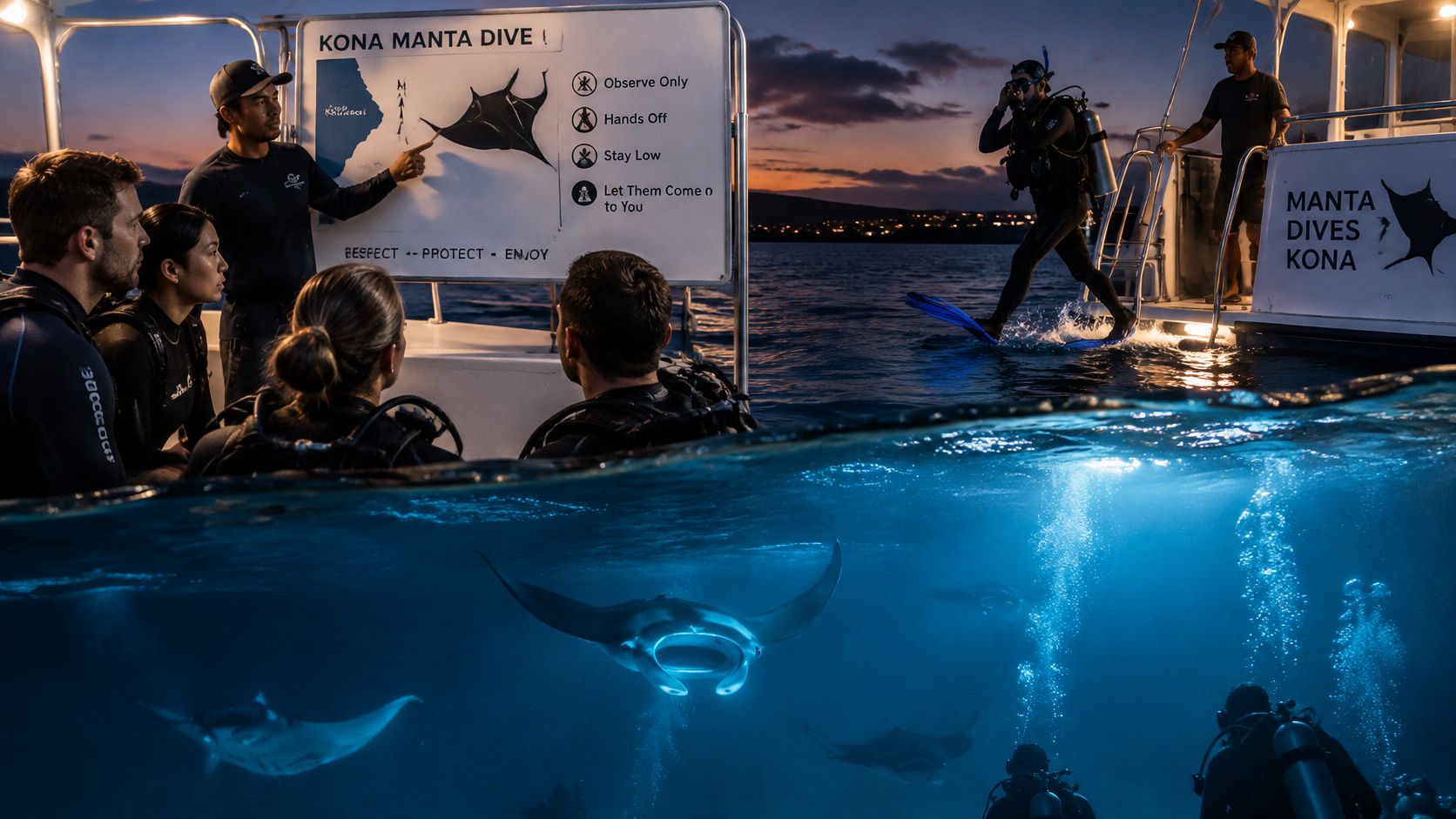
The Night in Five Stages
- Briefing on the boat. The crew covers the science of what you'll see and the rules of passive observation. Hands stay off animals, always. Listen for the exit signal and the plan if you feel anxious, because asking on deck is easier than signaling underwater.
- Entry and positioning. Divers settle low on sand, rubble, or boulders. Snorkelers stay at the surface. Get comfortable early, because shifting around later kicks up sand and clouds everyone's view.
- Lights on. Powerful dive lights create a bright circle on the seafloor, so divers are never in complete darkness. Hold your light above your head and aim it upward. That beam is what pulls plankton up into the column.
- Mantas arrive. Reef mantas, Mobula alfredi, funnel plankton into an open mouth with the paired cephalic fins beside it. When the food is dense, they loop and barrel roll through the light to keep feeding, which is why they pass so close and so often.
- Observation and exit. Stay still, keep your light where your guide placed it, and leave when signaled. Don't rush the ladder. A calm exit keeps fins and cameras clear of other divers in the dark.
The NOAA guidance on manta viewing describes this as a localized plankton-concentration mechanism, with divers remaining low on the bottom and aiming lights upward to preserve an unobstructed feeding column. It also advises snorkelers to stay at the surface and direct lights downward, and everyone to avoid contact with coral, sea urchins, and other marine life.
That vertical split matters. Divers own the bottom, snorkelers own the surface, and mantas own everything between. A snorkeler who ducks down into the column, or a diver who rises off the sand for a better angle, puts a body where a feeding manta expects open water. Contact risk goes up and feeding breaks off.
What surprises many on a kona manta ray dive is the pace. It's slow and quiet. You breathe, you watch plankton sparkle in your beam, and then a wide shadow crosses the light. When mantas settle into a feeding pattern, the passes keep coming, and the dive feels longer than the clock says because nobody is swimming anywhere.
Why Garden Eel Cove Is the Best Viewing Site
Kona's night dive runs at two main viewing areas on Hawaii Island's west coast. Manta Village sits at Keauhou Bay to the south. Garden Eel Cove, also called Manta Heaven, sits at Ho'ona Bay and adjacent Makako Bay to the north. Both draw mantas. They don't feel the same in the water.
I'd pick Garden Eel Cove, and the reason is practical, not sentimental. According to Kona Honu Divers' guide to manta ray dives in Hawaii, Garden Eel Cove is a superior choice because its protected setting can provide a more stable viewing area than more exposed alternatives, and its sheltered geography is associated with stronger surrounding reef structure. Calmer water means you hold your position without fighting surge, your light stays aimed where it should, and guides can keep divers spaced with safe separation from the animals.
The Reef Bonus
Shelter helps the mantas too. Reef mantas show strong fidelity to coastal reef habitats, feed and visit cleaning stations there, and spend most of their time at depths shallower than 50 meters. A protected reef site fits how these animals already use the coast. It also fits your night. On a slow manta night at a bare sand site, you're staring at sand. At Garden Eel Cove, you're kneeling next to living reef, so eels, reef fish, and other night life fill the gaps between passes.
How to Judge Any Site
Ask these questions before you book, whoever you book with:
- Shelter: How exposed is the site to swell tonight, and what's the backup plan?
- Viewing layout: Is there a defined area where divers kneel, clear of coral?
- Reef structure: Will you see reef habitat, or only sand and lights?
- Crowding: How many boats share this site on a typical night?
Kona Honu Divers often takes its manta ray charter to Garden Eel Cove, and divers are positioned in a specific viewing area at this well-established site. You can compare the two sites in detail in this guide to Manta Heaven versus Manta Village, and see the trip itself on the 2-tank manta dive and snorkel tour page.
Whichever operator you call, make them name their site and defend the choice. "We go where the mantas are" isn't an answer. Shelter, layout, and crowding are.
Best Times and What Changes Your Sighting Odds
No month on the calendar guarantees mantas. Kona has a resident population, but resident doesn't mean predictable nightly attendance at one patch of reef. Presence follows plankton availability and site conditions, and those shift night to night. Any page promising you a peak season with certainty is selling, not informing.
Separate two things that marketing often blends. Animal presence means a manta is somewhere in the area. Close-up interaction means a manta chooses to feed repeatedly through your light column. You can get the first without the second, a dark shape at the edge of visibility that never commits. That still counts as a sighting in some operators' language, so ask what their rebooking policy requires.
| Factor | Effect on Sightings | What to Check |
|---|---|---|
| Season | Presence varies; not a fixed calendar | Ask operator about recent sightings |
| Plankton availability | Drives whether mantas stay in the viewing area | Ask how often the site has been productive lately |
| Sea state and swell | Affects site access and how long divers can hold position | Check the forecast and operator cancellation rule |
| Moon and weather | Can change plankton and water clarity | Ask how recent nights compared under similar conditions |
| Crowding at the site | Can disturb feeding and raise contact risk | Count boats and snorkelers on the tour |
| Repeat attempts | Second night can improve the chance of a visit | Confirm rebooking terms before paying |
Crowding deserves its own warning. A county-hosted scientific report on Kona manta tourism surveyed 444 visitors and found 82% felt crowded by snorkelers, 78% by boats, and 69% by scuba divers. That's the shared reality of this dive. More lights and more bodies don't ethically improve your odds, because responsible viewing means letting wild animals approach on their own terms, not pressuring the site until something performs.
What actually helps: Book early in your trip, keep a backup night open, and treat a second attempt as part of the plan rather than a failure.
If you're flying in for a short stay, schedule the manta dive on your first or second night. That leaves room for a weather cancellation or a no-show rebooking while you're still on island. Ask how substitutions work, whether a cancelled manta night becomes a reef night dive, a refund, or a credit. Get that answer before you hand over a card, not at the harbor.
Safety, Certification and Common Concerns Answered
Most guides reassure you. I'd rather you evaluate. This is a dark, crowded wildlife site with boats overhead, and the honest hazard list includes boats, propellers, darkness, currents, diving equipment, exposure, and remoteness. None of that makes the dive unreasonable. It makes operator discipline the thing you're really buying.
The Hawaii County manta ray viewing boating operations and safety assessment notes that commercial operators must hold specific permits for state ocean waters and for harbor or launch-ramp operations. Confirm permit status before you book. Then ask how surface swimmers and scuba divers are separated, what happens if visibility or current deteriorates, how guides manage lights and entry ladders, and what emergency equipment and evacuation plan the boat carries. A serious operator answers those questions without hesitation.
| Participant | Requirement | What to Confirm |
|---|---|---|
| Certified scuba divers | Open water or equivalent certification | Recent dive experience and comfort at night |
| Snorkelers | Able to float and swim at the surface | Ages 5+ on snorkel tours; flotation support |
| Beginner divers | Certified and comfortable with buoyancy | Guide-to-guest ratio and briefing time |
| Anxious participants | Comfort in dark water | Whether a separate spot or early exit is possible |
| People with medical conditions | Medical clearance where needed | Confirm with a doctor before booking |
What Good Supervision Looks Like
The dive itself helps. It's stationary and closely supervised, with experienced guides making sure everyone is safe and comfortable, and experienced divemasters and instructors in the water with divers. You're not navigating, following a route, or keeping up with a group. You kneel, breathe, and watch. For a first night dive, that structure removes most of what makes night diving stressful. Good habits still matter, and this overview of responsible, considerate diver etiquette covers the behavior that keeps a shared site workable.
Four Questions Everyone Asks
Will a manta touch me? It might pass inches away, but contact isn't allowed and guides enforce that. Your job is to stay low and still so the animal controls the distance. Reaching out is the fastest way to end your dive.
Is a night dive scary? For the first minute, sometimes. Then the lit circle on the seafloor, the briefing you already heard, and a guide kneeling nearby do their work. You're never sitting in complete darkness, and you can signal and exit if you need to.
Can I snorkel instead? Yes. Snorkelers float at the surface with flotation support, and snorkel tours take children from age 5. Families with mixed certifications often split this way and watch the same animals from opposite sides of the light column.
What if no mantas come? Then you've done a reef night dive with excellent lights. That's why the rebooking terms and a backup night matter more than a sighting percentage on a booking page.
Finally, understand the trade-off you're part of. Kona's manta groups are relatively small and site-faithful. More guests can lower individual cost and support better viewing infrastructure, but crowding raises collision and entanglement risk and can disturb feeding behavior. Choosing an operator that enforces spacing, no-touch rules, and current limits isn't just about your safety. It protects the encounter itself.
Gear and Photography Tips for the Night Dive
You don't need much, but what you bring needs to fit and work in the dark. Fiddling with a leaking mask while kneeling in a group helps nobody.
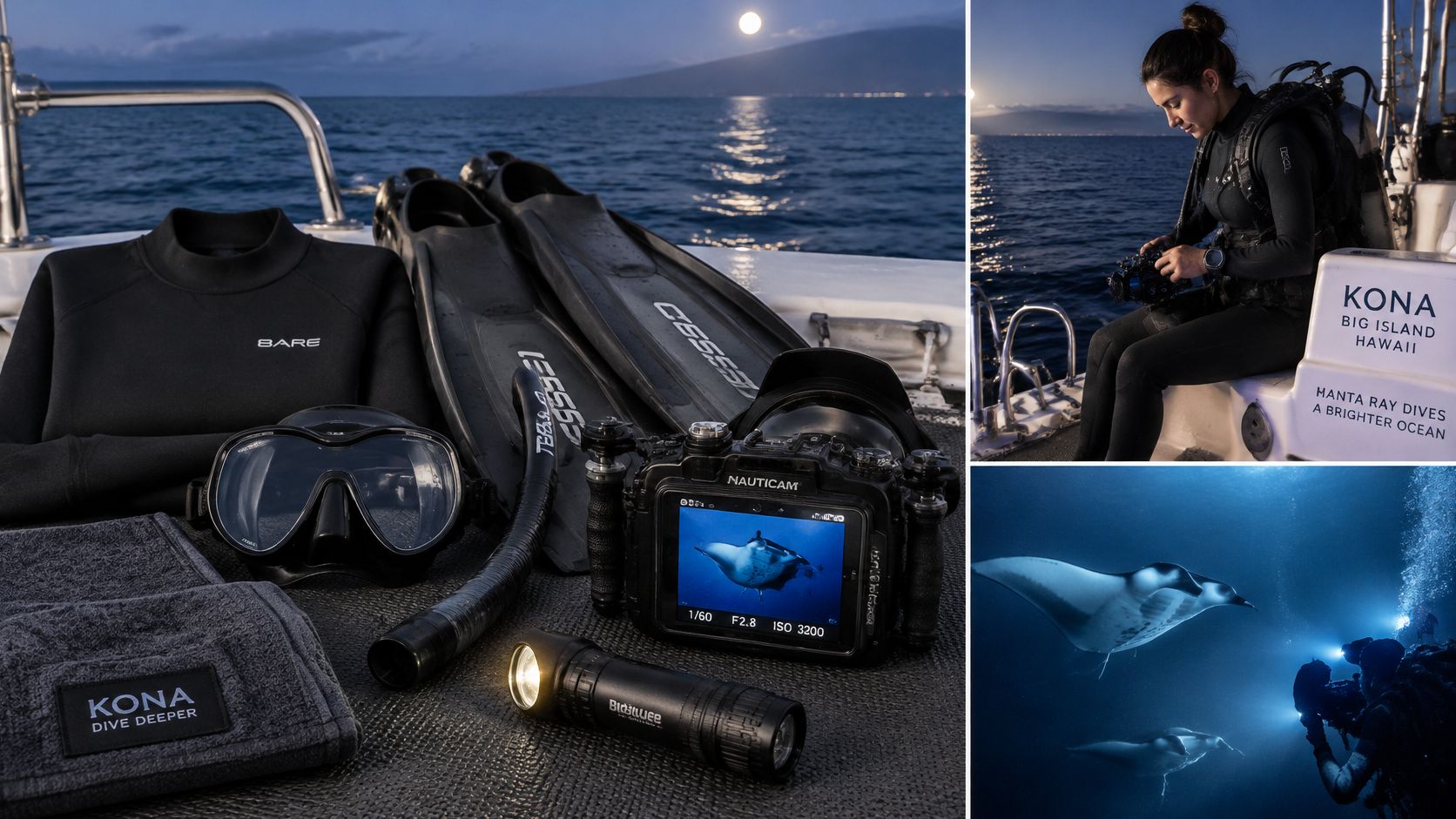
Gear Checklist
- Well-fitting mask: Test the seal on land. A night dive is the wrong place to discover a slow leak.
- Thermal layer: You sit still for a long time, so you cool down faster than on a swimming dive. Dress warmer than you think you need.
- Backup dive light: Your primary light builds the feeding column. A small backup keeps you visible and oriented if it fails.
- Fins and snorkel: Snorkelers need both for the surface swim to the viewing area, even though the watching itself is stationary.
Camera Settings That Work
Bring a wide-angle lens or an action camera with a wide field of view. Mantas are big and close, so a narrow lens gives you a wingtip and nothing else. Set a high ISO, a fast shutter speed to freeze a rolling animal, and continuous autofocus so the camera tracks passes instead of hunting between them. Browse these manta ray dive pictures from Kona and notice how many good frames are wide, bright, and shot from a diver who clearly never moved.
On strobes, ask your guide before the dive. Many guides discourage flash because it can disturb plankton and the animals, so plan to shoot with continuous light from your dive light or a video light. That's usually plenty, since the mantas come to the brightest water anyway.
Let the manta come to you. The diver who stays still gets the closest passes and the sharpest photos.
Keep your camera off the sand and your fins still. Kicked-up sand hangs in everyone's light beams and ruins photos in every direction, including yours. Worse, if you lose your kneeling position and float up, you rise straight into the feeding column. Sort your weighting during the briefing, not underwater.
Rinse everything in fresh water afterward. Salt and fine sand work into light switches, camera housings, and mask straps overnight. And rehearse before the trip. Test your settings at dusk in shallow water, change ISO and shutter speed until movement looks clean, and memorize the buttons by touch. On the night itself, you want to watch mantas, not learn your camera.
Pricing and Operator Selection Criteria
Prices for this dive spread widely because you're not buying the same product at every price. Boat size, included gear, guide numbers, and briefing time all sit inside the number.
| Option | Typical Price | What It Covers |
|---|---|---|
| Certified-diver manta night dive | $175 to $250 per adult (2025) | Night dive with guide and site visit |
| Scuba trip, per person | $190 to $320 | Varies by operator, group size, boat and included equipment |
| Average tour across operators | About $110 per person | County report average; may not reflect current pricing |
| Snorkel-only manta night tour | Confirm current rate when booking | Confirm inclusions with operator |
| Typical duration | 3 to 5 hours | Includes briefing, transport and time at the site |
A 2025 independent travel guide to manta ray night snorkeling in Hawaii reported typical adult prices of $175 to $250 for certified-diver Kona manta night dives, based on prices available in 2025. A separate 2025 guide to manta ray night dives in Kona estimated Kona manta scuba trips at $190 to $320 per person, varying by operator, group size, boat amenities, and included equipment. The county average in the table runs lower because it blends formats across operators, so treat it as context, not a quote.
Provider Checklist
Run every operator through the same questions:
- Permits and insurance: Confirmed for state ocean waters and harbor operations?
- Guide-to-guest ratio: How many divers per divemaster in the water?
- Site: Garden Eel Cove or Manta Village, and who decides on the night?
- Rule enforcement: How are lights, spacing, and no-touch rules handled with a full boat?
- Cancellation and rebooking: What happens after bad weather or a no-show night?
- Crowding: How many passengers, and how many other boats share the site?
- Reviews: Recent, specific, and mentioning guides by behavior rather than only manta counts?
Kona Honu Divers keeps divers in a defined viewing area on its manta charters, with divemasters and instructors in the water. If you're comparing several companies side by side, this breakdown of how to choose a Kona diving company lays out the same criteria in more depth.
Be wary of the cheapest seat. A low price often means more passengers per guide, a busier site, or a shorter briefing, and those costs show up underwater. Before you pay anyone, ask three things. Which site do you use and why? How many guides are in the water with my group? What exactly happens if mantas don't appear? The quality of those answers predicts your night better than the price does.
Book Your Kona Manta Ray Dive
Booking well is a short sequence. Do it in this order and you won't pay for the wrong trip.
- Confirm eligibility. Match yourself to the requirements table. Certified divers bring proof of certification. Snorkelers confirm age and flotation support.
- Pick a flexible window. Book early in your stay and keep a backup night open for weather or a no-show.
- Choose the operator by criteria, not price. I would pick a provider that uses Garden Eel Cove, keeps close supervision, and states its cancellation rule in writing.
- Book and confirm the briefing time. Arrive early. The briefing is where positioning, signals, and exits get settled.
Kona Honu Divers offers a 2-tank manta ray charter, and its go-to site for the Manta Ray Night Dive is Garden Eel Cove. If you want the biology before the dive, the PADI Manta Ray Diver specialty course covers manta biology, behavior, and conservation, and it's taken before the night dive. For the rest of your Kona diving, the diving tours page lists the other charters you can pair with it.
Check the day's weather with your operator before you drive to the harbor, and don't treat the briefing as a formality. The divers who listen on deck are the ones kneeling calmly when the first manta crosses the light.
Kona Honu Divers runs the 2-tank Manta Ray Night Dive at Garden Eel Cove, with a detailed science briefing, divemasters and instructors in the water, and a defined viewing area that keeps you clear of the feeding column. If you're ready to pick your night and hold a backup date, visit Kona Honu Divers and book the manta charter that fits your certification.