
Table of Contents
- Kona manta dive at a glance
- Manta viewing sites compared
- Season and timing
- Certification and recent diving
- Kit that has to work in the dark
- Personal readiness
You're staring at a booking page after dinner, trying to decide if a night boat on the Kona coast is the right call. Maybe your certification is current but your last night dive was a while ago. Maybe a friend wants the manta show and you want to know what you can actually control before you pay.
You can't schedule a specific animal. You can choose the site, how the lights are placed, how many people share a beam, and whether the crew will move or cancel when the ocean turns. That is the useful way to judge a Kona manta dive. If you want the wider set of boat options first, start with our diving tours, then narrow to the night trip.
What a Kona Manta Dive Is and Who It Suits
Dusk on the boat, then the lamps come on. The sand under your light goes pale, and a reef manta with a wingspan of about 12 feet rolls through the beam, mouth open, then turns and does it again. That repeated pass is the dive.
Divers sit still and aim lights up into the water column. Plankton gathers in the beam. Reef manta rays, Mobula alfredi, feed by looping through that lit water instead of holding a pose. You are not hunting a moving target across the reef. Chase the animal and you break the feeding corridor. Stay low and the corridor stays intact.
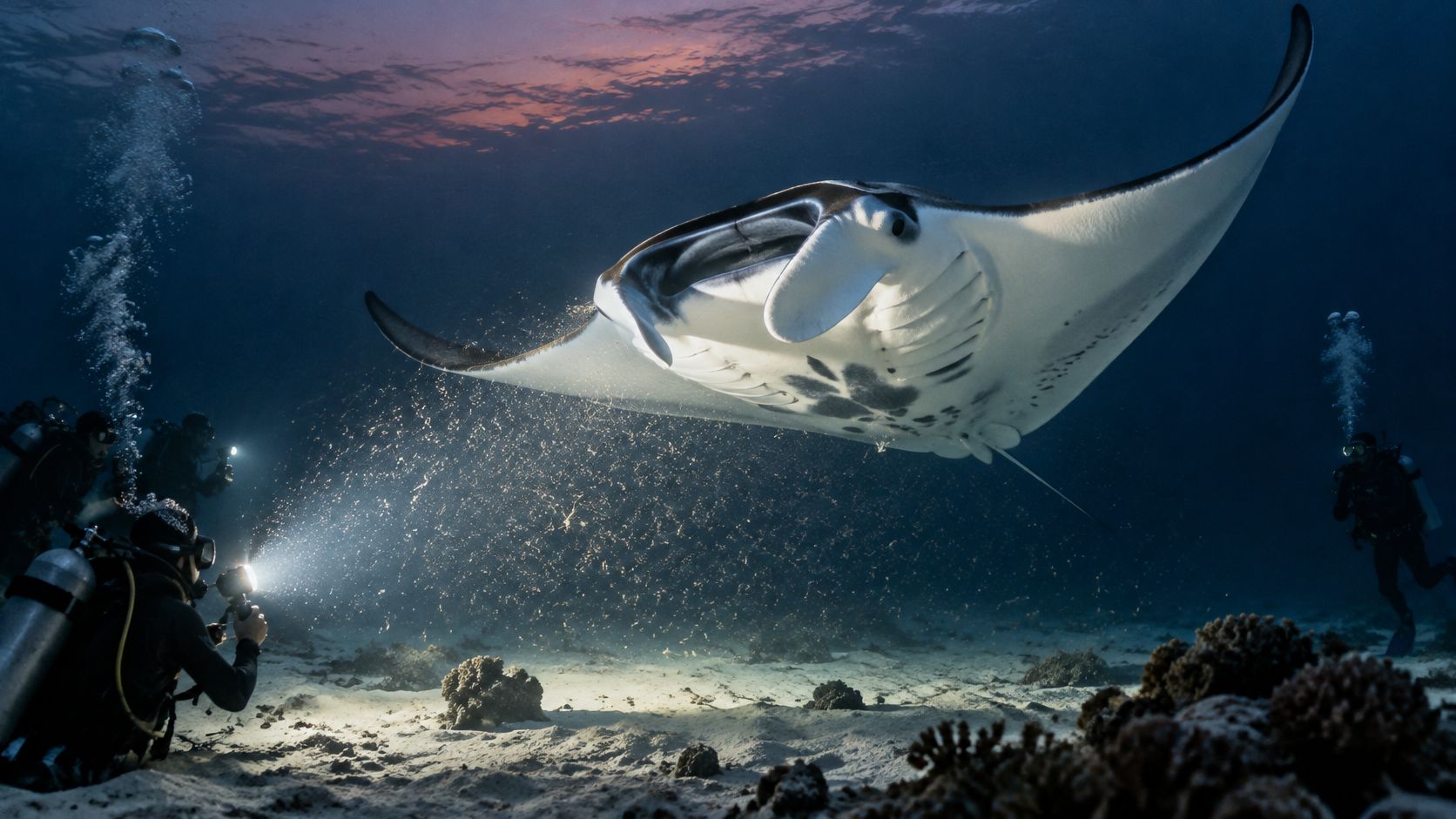
A 2025 University of Hawaiʻi study used community records from 2010 through 2022 and analyzed more than 23,000 sightings of 167 individually identified reef manta rays at Garden Eel Cove and Keauhou. Aggregation size rose and fell with zooplankton, so one night can feel busy and the next quiet even though the same animals keep coming back.
A Hawaiʻi legislative testimony record reports manta sightings on approximately 80% of dives at Garden Eel Cove between 1992 and 2007. An independent site account puts a strong night at six to twelve animals in view at once. Likely is not the same thing as guaranteed.
Kona manta dive at a glance
| Detail | What to Expect |
|---|---|
| Experience | Night scuba dive where reef manta rays feed in the light of divers' lamps |
| Start time | Shortly after sunset |
| Duration | About one hour underwater |
| Dive depth | Settle on sand at about 30-40 ft (9-12 m) |
| Manta count | Often several at once; six to twelve visible on a strong night |
| Encounter history | Mantas seen on about 80% of Garden Eel Cove dives in 1992-2007 surveys |
| Certification | Certified open-water diver; confirm the operator's minimum age and experience |
Certified open-water divers are the core audience. If your last night dive was years ago, do a daytime reef dive first so buoyancy and light handling feel automatic before you add darkness.
Readers who want a harder night should look at the Black Water Night Dive. Divers who want a longer, more demanding boat day should compare the Premium Advanced 2 Tank Trip. If you are still choosing surface or scuba, read whether it is better to snorkel or dive with manta rays.
Where and When to See Manta Rays
Garden Eel Cove, also called Makako Bay or Manta Heaven, is the site I would pick for a manta viewing dive. The bay is protected, the viewing area is more comfortable, and the adjacent reef is stronger than what you get on a more exposed shoreline. For this trip, that combination beats a slightly shorter ride.
Big Island Video News describes Garden Eel Cove as one of two established nighttime viewing areas on the Kona coast, the other being the shoreline near Sheraton Keauhou Bay at Paʻakai Point. State discussions of how to manage these sites have included prohibiting anchoring, limiting commercial operators, banning rafting, and restricting live boating.
NOAA-archived research describes mantas observed almost nightly at Manta Village near Kaukalaelae Point and at Manta Heaven in Makako Bay, with dives beginning shortly after sunset and lasting approximately one hour.
Manta viewing sites compared
| Site | Setting | Viewing and Reef | Best For |
|---|---|---|---|
| Garden Eel Cove (Makako Bay, also Manta Heaven) | Protected bay | Larger aggregations, better viewing, healthier reef | Most divers; the recommended choice |
| Keauhou (near Sheraton Keauhou Bay, Pa'akai Point) | Exposed shoreline | Stronger female visitation pattern; less protected viewing | Divers familiar with the site |
| Manta Village (near Kaukalaelae Point) | Discrete observation site | Mantas observed almost nightly in NOAA-archived research | Divers wanting an alternative site |
Garden Eel Cove wins for most first-timers and most certified divers because you spend the hour on a sheltered sand patch with reef nearby, not fighting a lumpy surface before you even descend. Keauhou can still be a good night if you already know the entry and the captain prefers it for the forecast. Manta Village is a real alternate, not a backup in name only.
Season and timing
- Summer: Generally calmer and warmer, which suits snorkelers and divers who get cold fast.
- Winter: Northwest swells can rough up the ride even while mantas stay resident along the coast.
- Any month: Nightly counts change with the food in the water. A quiet night is not proof the animals have left.
- Your calendar: Book the early evening and keep a spare night if your dates allow. Captains relocate or cancel for swell or poor visibility, and that call is the safe one.
For a fuller look at months and moon phase, see the best time to see the manta rays in Kona. Current departures and timing sit on the 2-Tank Manta Dive & Snorkel page.
Practical rule: Pick the protected site and a spare evening before you chase a "best month." Conditions you can ride out matter more than a calendar promise.
Gear and Preparation Checklist
Show up ready to hold still in the dark. The animals do the moving. Your job is a working light, a stable hover, and a buddy who knows your signals before you leave the bench.
Certification and recent diving
- Certification card and logbook: The crew needs proof you are a certified diver, and a recent entry tells them whether night skills are fresh.
- A recent night dive, if you have one: Note it. If you don't, say so at check-in so the briefing can slow down on lights and trim.
Kit that has to work in the dark
- Primary light plus a backup: Lights point up into the water. A dead primary with no spare ends your part in the feeding setup.
- Mask, fins, and a dive computer, or a confirmed rental: Don't assume the boat's spare mask fits five minutes before departure.
- Exposure suit for warm water, roughly 24-27°C (75-80°F): A thin wetsuit or rash guard is enough for the majority of divers in the water. Bring a warm layer for the ride back, because the wind on a wet suit feels colder than the ocean did.
Personal readiness
- Reef-safe sunscreen before you board: Put it on at the harbor, not on the moving deck, and skip a heavy coat that will slick the surface.
- Dry bag for phone and keys: The bench gets wet. A zip bag beats a "waterproof" pocket.
- Water for the surface interval: Night boats still dehydrate you, especially if the afternoon was hot.
- Fitness and no alcohol beforehand: Confirm you are fit to dive. Alcohol before a night descent is a bad trade for buoyancy and judgment.
- Early arrival and a buddy plan: Reach the boat with time for the briefing. Agree on hand signals and a light-off signal before you descend, so a problem doesn't become a guessing game on the sand.
Safety, Etiquette and Conservation Standards
An "eco-friendly" line on a website doesn't tell you whether the dive is well run. Kona tour standards are voluntary. A 2015 risk assessment covered by Scuba Diving treated severe accidents as inevitable under the nightly viewing conditions then in use. The useful question is what the crew manages once ten lights are in the water.
Every guest should follow the same baseline.
- Never touch or chase a manta. Contact strips the protective mucus, and a chase pulls the animal off the plankton.
- Stay on the bottom. Divers belong on the sand. Snorkelers belong at the surface.
- Keep bubbles off the animals. A vertical stack of exhaust in the feeding path is as disruptive as a fin in the face.
- Aim lights at the water, not at faces. The beam is a food cue, not a spotlight for a portrait.
- Hold a neutral, low position. If you can't stop finning, you are too active for this site tonight.
A responsible boat can describe crowd control, light placement, and a cancel rule in plain language. A slogan cannot.
Ask these questions before you pay. Vague answers are an answer.
- Buoyancy: What happens if a guest can't stay neutrally buoyant? A good crew moves that diver, or ends their dive, instead of letting them plow the sand.
- Zones: How are divers and snorkelers separated so the two groups aren't stacked on one beam?
- Density: What is the maximum group around a single light?
- Weather call: When does the captain cancel or relocate for swell or poor visibility?
- Emergencies: What is the incident plan, and what is the crew supervision ratio in the water?
Measurable practice looks like limited group size, controlled lighting, and participation in site rules such as how boats sit on the site. It does not look like a green logo. For the habits that keep a night dive considerate, read our notes on responsible diver etiquette.
What Happens Onboard and Underwater, Step by Step
The sequence is repetitive on purpose. Each step removes a decision you would otherwise make in the dark.
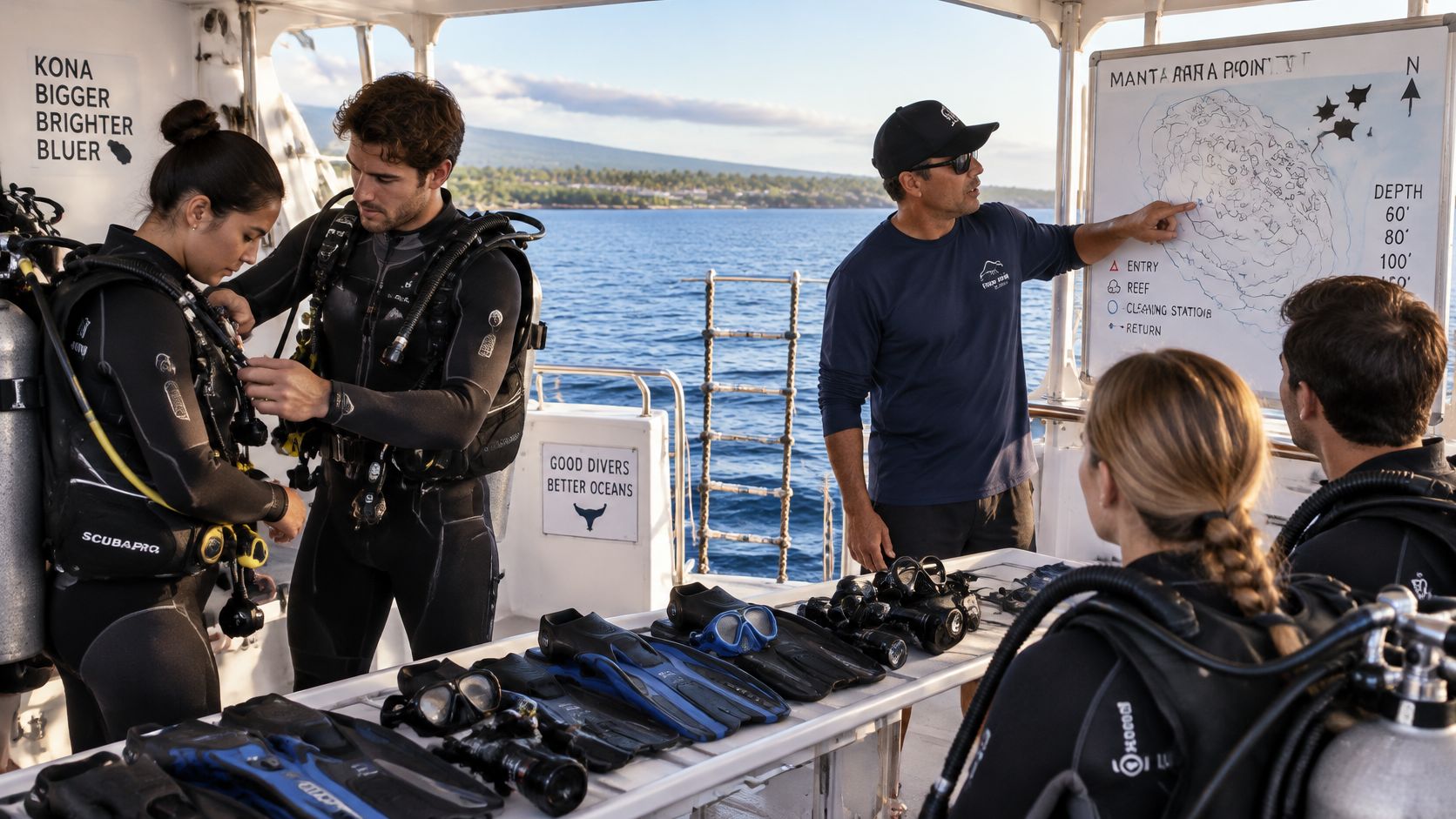
- Board and take the briefing. The crew covers the site, how lights are used, and the hand signals for the night. Skipping this to "just get in" is how buddies lose each other.
- Gear up and run a buddy check. Test both lights and repeat your buddy's signals out loud. A light that worked in the garage can fail after a rinse.
- Descend to the sand. At Garden Eel Cove you settle at about 30-40 feet (9-12 meters), as Divearoo's Kona site notes describe. Stay with the group and equalize early. The daytime reef nearby slopes toward garden eels at roughly 60 feet (18 meters), which is not your viewing depth.
- Get low and aim lights upward. Point the beam into the water column, not at the animals. That column is what concentrates the plankton above the group.
- Watch the loop without joining it. Mantas make repeated passes through the lit water. Hold your spot and let them come to you. Swimming up for a closer look collapses the pattern for everyone behind you.
- Stay for the viewing window. Plan on about one hour, and keep checking air, your buddy, and depth. A stationary hover saves gas because you aren't kicking a circuit around the bay.
- Ascend on the crew's signal. Go slowly, make a safety stop, and surface where you were told. A freelance ascent in a cluster of boats is the hazard, not the manta.
- Debrief and log the dive. Note the site, your air, and anything the crew flags about your trim. That log is what makes the next night dive easier.
Steady buoyancy protects the animals and your tank. If you are finning to stay down, you are working too hard for a dive that is supposed to be still.
Photography Tips That Protect the Mantas
The frame you want comes from stillness. A calm diver who holds position gets repeated passes. A diver who kicks into the loop gets one blurry exit and a worse night for the group.
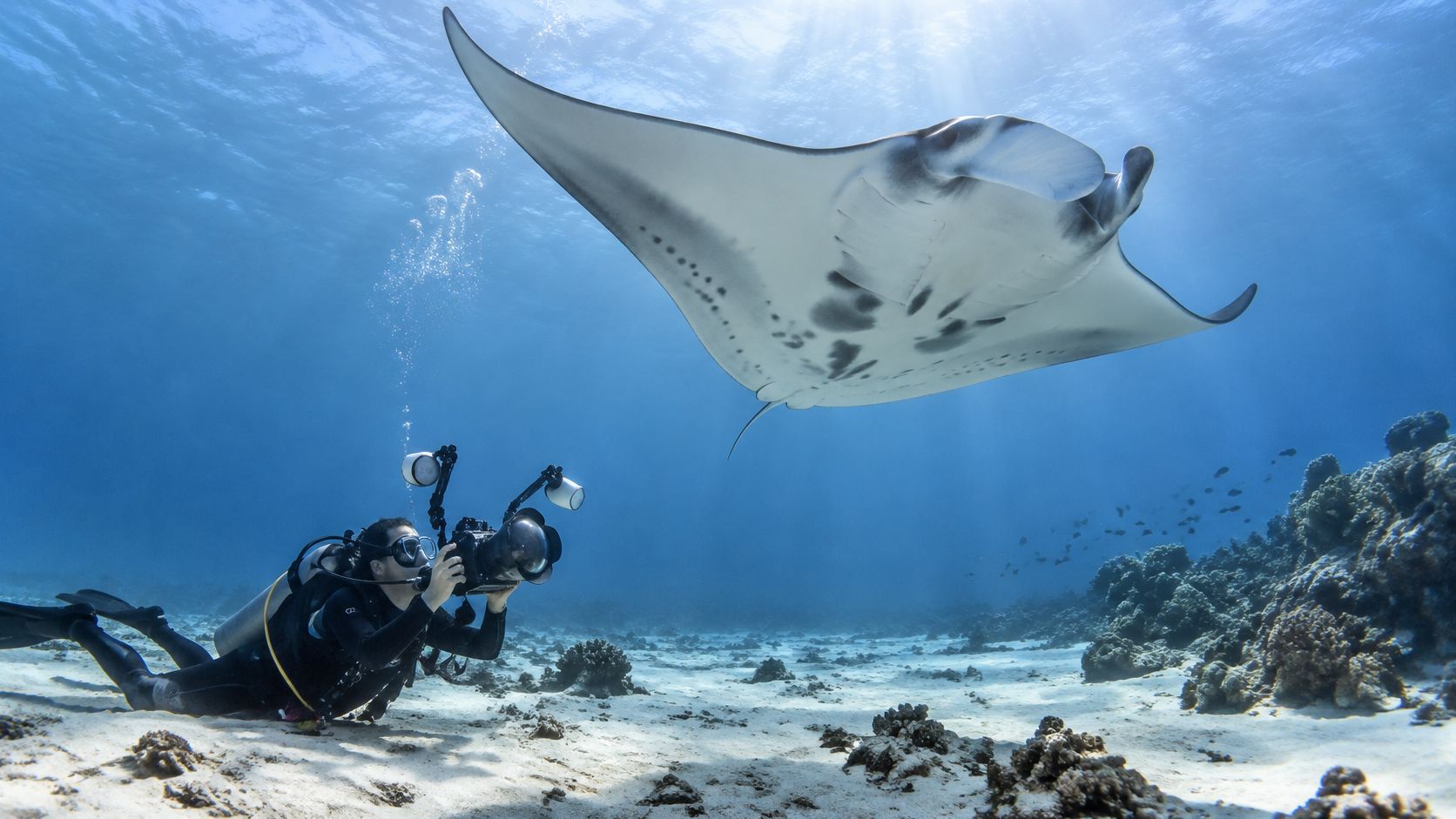
- Use a wide-angle lens. You want the animal and the lit water in the same frame. A tight lens tempts you to crowd the pass.
- Keep strobes off, or angle them away from faces. The working light stays on the water column.
- Don't block the feeding loop for a closer crop. If a manta has to veer, the shot wasn't worth it.
- Shoot from the side or from below, not from directly above the animal.
Individual reef mantas are identified by stable spot patterns on the belly, plus scars and fin injuries. The Manta Pacific Research Foundation identification program explains how diver photos and video built a regional catalogue when images are clear and tied to a place and a date. A six-year dataset at the two Kona sites recorded sightings across 2,017 nights at Manta Heaven and 1,702 nights at Manta Village, with site coverage of 92% and 78%. Typical dives in that work lasted about one hour.
Capture a clear full-belly image without chasing. Write down the site and the approximate time. Send the frame to an established identification program. Consistent photos with location and date let researchers track movement, residency, and long-term change, which turns your dive into low-impact citizen science.
If you want the camera work handled as part of the trip, look at the Kona manta night dive with photo package.
Manta Dive Questions Answered
Are sightings guaranteed? No. Plan for a likely sighting, not a promise. Prey, swell, and animal behavior all change, and a quiet night doesn't mean the mantas have left the coast. Use the encounter history row in the at-a-glance table as your baseline, then keep a spare evening so one weathered night doesn't end the trip.
Do I need certification? Yes. A valid open-water certification and recent diving are required for the scuba portion. Confirm any minimum age with the operator before you pay, especially if a teen is on the same booking.
Can families dive together? Certified teens and adults can share the trip when everyone is ready for about an hour underwater in the dark. Agree on hand signals and the light-off signal before the descent. Anyone who isn't certified belongs on the snorkel side of the same outing, not on the sand.
What if night diving feels uncomfortable? Log a daytime reef dive first. Book the manta dive once buoyancy and light handling feel automatic. Rushing a first night dive because the vacation calendar is short is how people finish the hour watching their gauge instead of the animals.
Book Your Garden Eel Cove Manta Dive
Price on a night manta dive is mostly boat and crew time, a guided briefing, in-water safety support, group size, gear hire, and the fact that the trip runs after dark. Nitrox, when it is included, belongs in that comparison too. Judge the package by what is in it, not by the headline fare. Read the cancellation terms for swell or poor visibility before you pay, because a captain who will move or scrub the night is part of what you are buying.
Our go-to site for the Manta Ray Night Dive is Garden Eel Cove. It is a protected bay with a good viewing area, a healthier reef, and generally calmer conditions than the exposed alternatives. We keep groups small and give personal attention from the moment divers step aboard, which matters when someone is handling a light at night for the first time. Early diver discounts, dive packages, and free nitrox show up in how trips are packaged, so compare those inclusions on the booking page rather than assuming last month's offer is still live. Rates and promotions change.
We were voted best dive operator in Kona and received the Scuba Diving Magazine Reader's Choice Award for best dive company in the Pacific. Those are reasons to read recent guest notes, not a reason to skip the weather clause.
Pick a date that leaves a spare evening in the schedule, book early, and confirm the cancellation policy before you pay. That spare night is the difference between a weathered cancellation and a second chance at the same protected bay.
Kona Honu Divers runs guided night trips at Garden Eel Cove so certified divers can watch reef mantas feed in a protected bay, with small groups and crew help from the moment you step aboard. If you are planning a Kona manta dive and want the site, the lights, and the group size handled with care, visit Kona Honu Divers to check dates and lock in the evening that fits your trip.