
A Kona manta dive is a wild encounter, not a show on cue. Mantas decide whether to enter the feeding area, and even a well-run trip can have a quiet night. Give them room to choose their path.
Kona's nighttime manta tourism centers on reef manta rays, Mobula alfredi. Historical monitoring identified 106 individuals along the Kona Coast and estimated the local population at fewer than 200, making careful viewing practices especially important. Hawaiʻi has protected manta rays in state waters since 2009, when state law made knowingly catching or killing one an offense (Hawaiʻi manta protection overview).
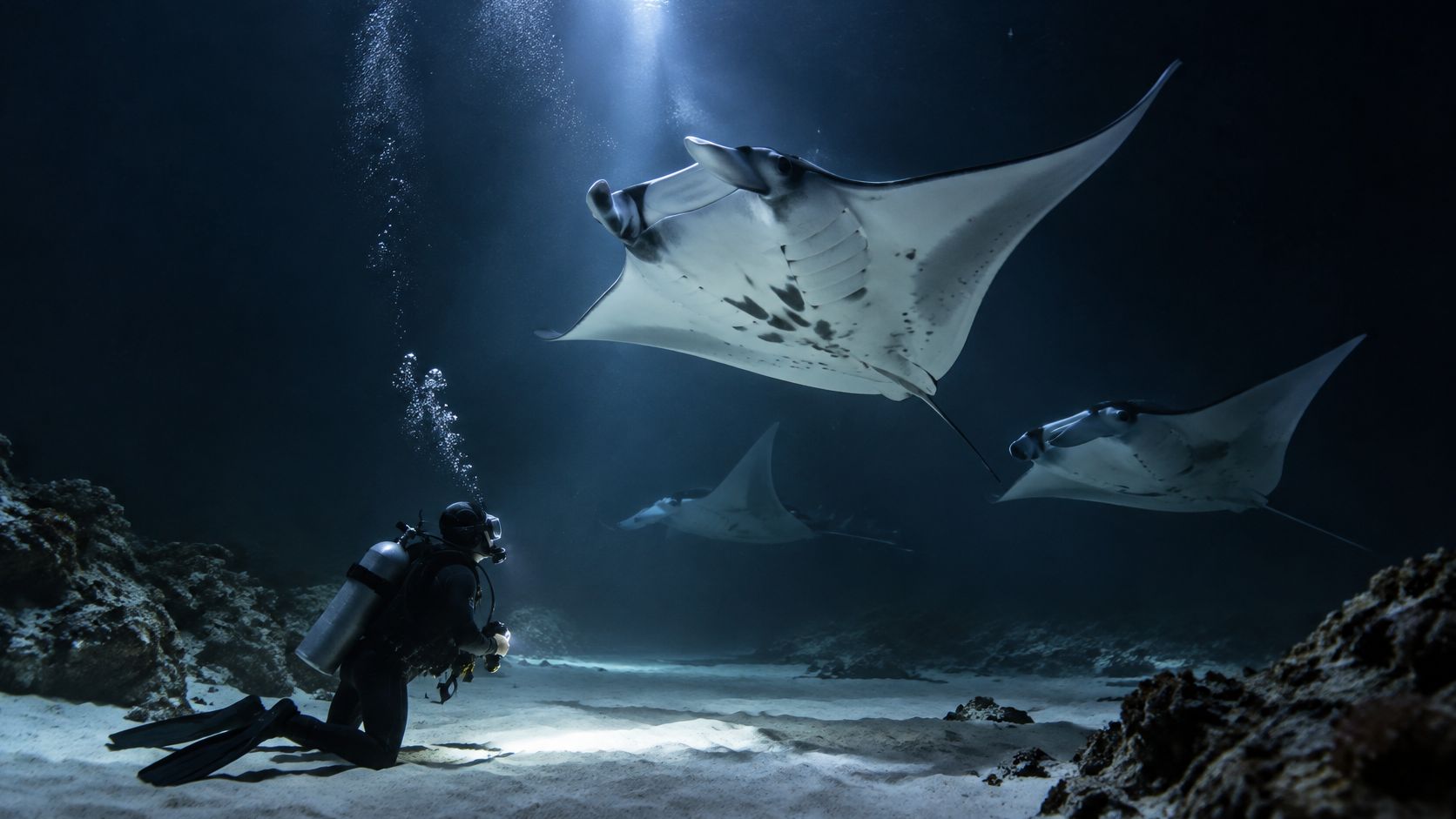
Table of Contents
- Why the Kona Manta Dive Is Unlike Any Other Night Dive
- How the Lights and Plankton Actually Attract Mantas
- Garden Eel Cove and Why It Beats Open-Water Alternatives
- What a Typical Manta Night Dive Looks Like
- Reading the Data on Sightings, Seasons, and Moon Phase
- Gear, Skills, and Packing for a Night in the Water
- Low-Impact Behavior That Improves Your Encounter
- Choosing a Tour and Booking Your Manta Night
Why the Kona Manta Dive Is Unlike Any Other Night Dive
The first thing to understand is that the lights don't call the mantas like a signal. They concentrate plankton, and feeding rays may follow that food into the illuminated area. If the plankton isn't in the right place or the mantas don't arrive, the dive can't make them appear. The right mindset is a wild encounter, not a guaranteed performance.
When mantas do come in, they often make slow, repeated passes through the light field with their mouths open. Watching a large ray bank and glide through the beam is different from a daytime reef dive, but the encounter still depends on the animals' own movement and feeding behavior.
Dive or snorkel
The choice mostly comes down to where you're comfortable spending the encounter. Certified divers descend to the viewing area and watch upward from below the feeding zone. Snorkelers stay at the surface, typically holding a flotation device or lighted platform, and look down. Neither format is a shortcut to controlling the experience. Both require guests to stay calm, hold position, and leave the animals' route clear.
A snorkel can suit confident swimmers, families with older children, and guests who don't scuba dive. A night dive suits certified divers who can manage their buoyancy and remain still underwater. If you're uneasy in the ocean after dark, don't book the dive just because it sounds closer. Choose the format that lets you follow the briefing without fighting your own comfort level.
The useful expectation: You can prepare for a good encounter, but you can't order one.
Hawaiʻi law reinforces the basic standard: this is a non-contact wildlife encounter. Don't touch, chase, block, or try to redirect a manta. Staying still isn't just courteous. It gives the ray room to feed and lets you see its natural passes without turning the dive into a moving obstacle course.
How the Lights and Plankton Actually Attract Mantas
The feeding sequence explains why your position matters. Reef manta rays filter-feed on zooplankton. Underwater lights gather plankton near the surface, creating a concentrated feeding area. The mantas may then swim through that patch repeatedly to feed.
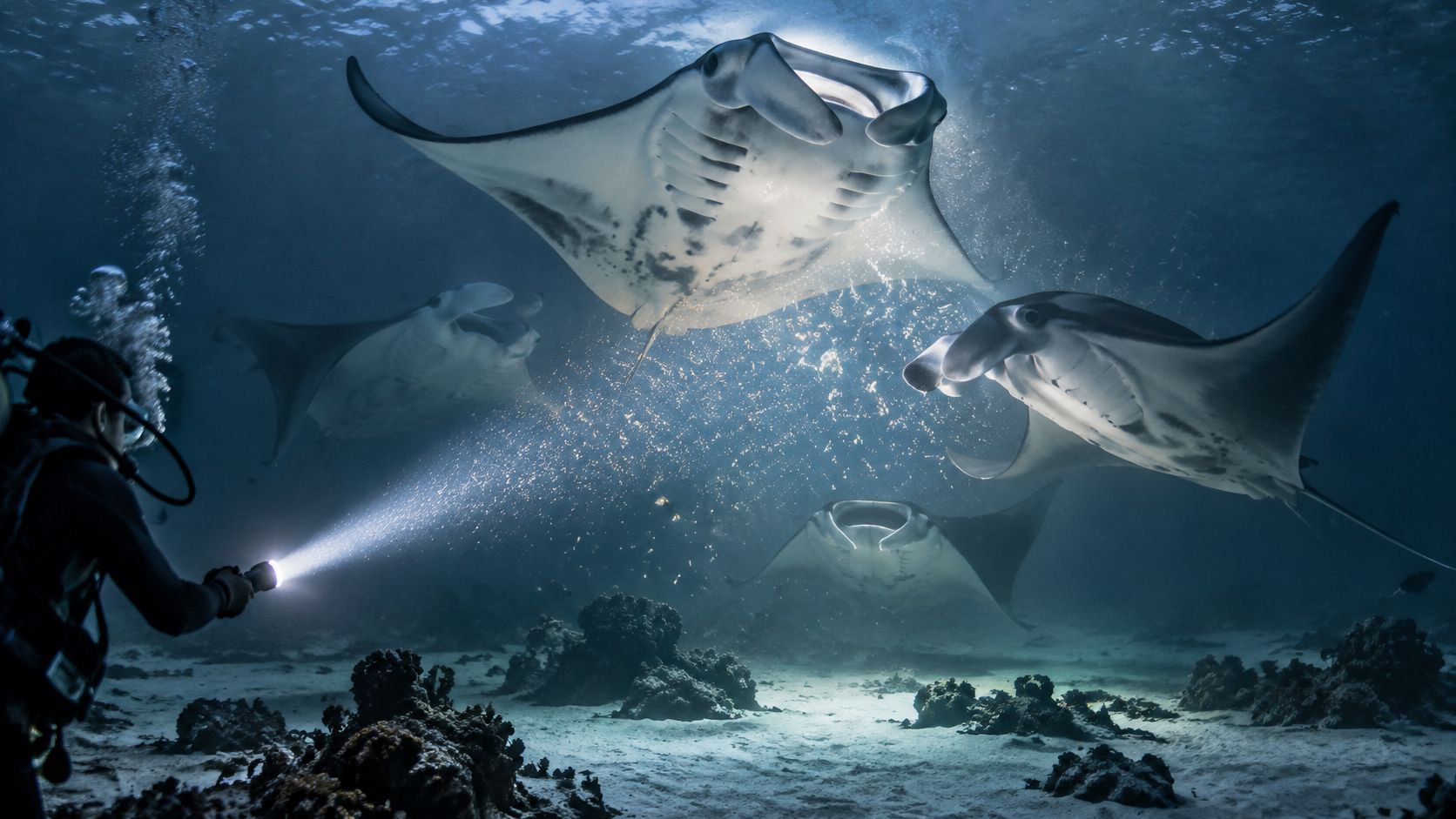
As a manta feeds, its cephalic fins help direct prey-laden water into its mouth. Gill rakers retain plankton as water passes out through the gills. The ray's turns and repeated passes are part of the feeding pattern, not an invitation for divers to move into its path.
Lights gather prey, not mantas. The rays decide whether to follow the food.
Where to hold position
The practical instruction is simple, even if it takes discipline: settle at the edge of or below the light field and stay there. A stable position preserves the feeding geometry. If divers move into the corridor, the manta may need to change course, and the group can disrupt the view for everyone.
For dive-site setup, NOAA guidance calls for lights to be placed over sand or rubble where divers have room to watch without sitting on live coral. It also calls for an open water column so mantas can maneuver, and directs divers to hold lights above their heads and shine them upward. Lights shouldn't be used to pull rays away from the viewing area or over coral (NOAA manta-viewing guidance).
The distinction between attraction and control matters. A light creates a feeding opportunity by concentrating plankton. It doesn't make the ray predictable, and it doesn't justify intercepting an animal. Observations at illuminated sites may not represent behavior at unlit aggregation areas, another reason to treat the dive as a particular, human-influenced encounter rather than a window into every aspect of manta behavior (NOAA research on light-mediated manta viewing).
Garden Eel Cove and Why It Beats Open-Water Alternatives
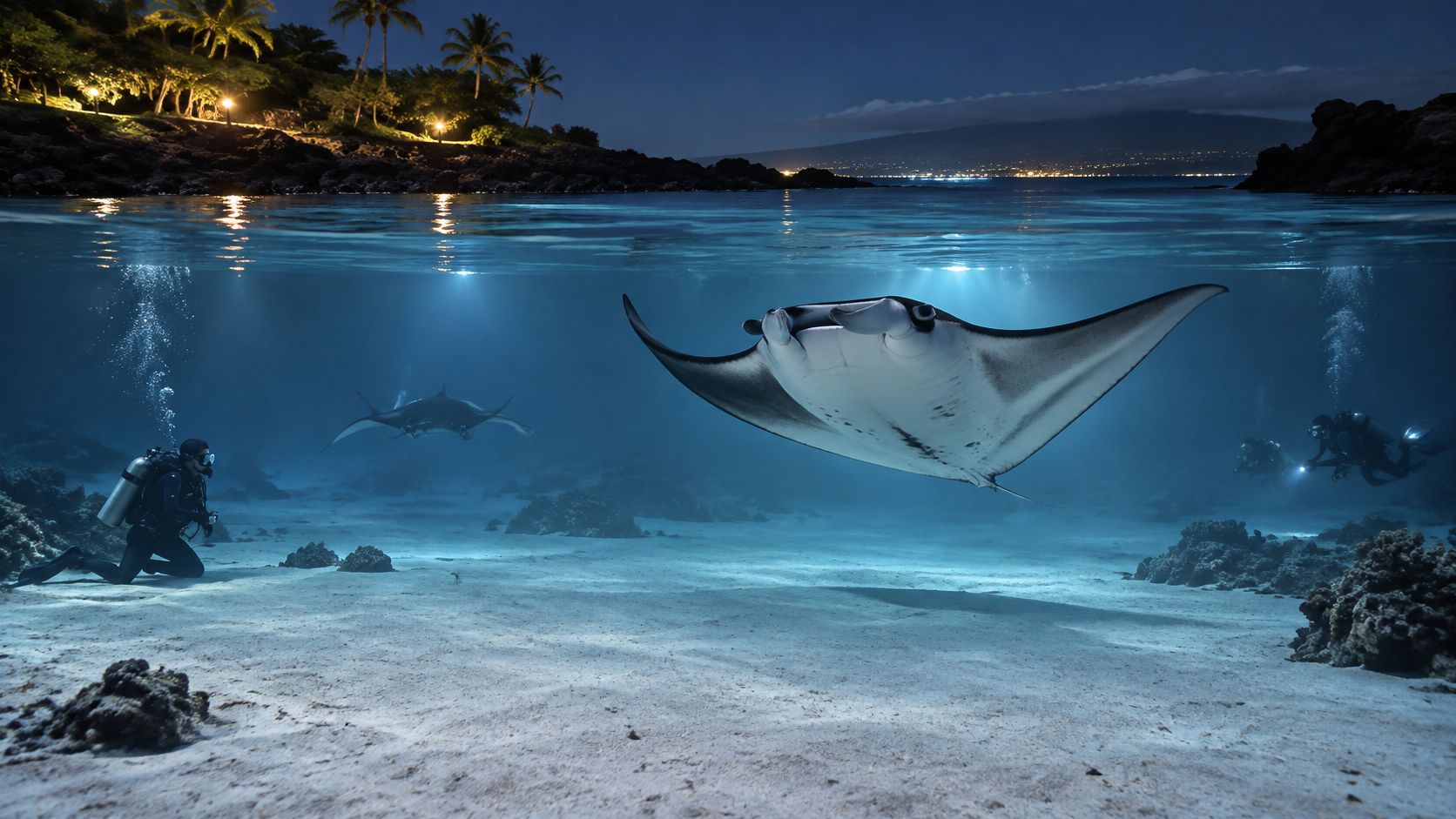
Garden Eel Cove, also known as Manta Heaven or Makako Bay, has the stronger setup for a manta dive because it combines reef habitat, sandy viewing areas, and nearby plankton-rich water. It isn't merely a spot in open water where a boat can shine lights. The surrounding structure gives the experience a defined place to happen.
By day, the reef includes squirrelfish and schools of goatfish. After dusk, lights concentrate microscopic zooplankton in the water, drawing filter-feeding mantas into the viewing area. That relationship between reef, sand, and feeding water is a practical advantage: divers can settle on sand or rubble instead of crowding onto live coral, while leaving the water column open for the rays (Garden Eel Cove site overview).
What makes a viewing area work
A protected location with a usable sandy viewing area generally offers a more controlled setup than an exposed, cramped patch of water. Swell, current, and tight positioning can make it harder for guests to stay still and for mantas to move through unobstructed. These are practical trade-offs, not a promise that one location will produce rays on demand.
Keauhou is the other principal nighttime feeding site, and both sites matter to Kona's manta population. A long-term University of Hawaiʻi analysis found that Garden Eel Cove consistently supported larger aggregations, while Keauhou had stronger female site fidelity and was visited disproportionately by females (University of Hawaiʻi manta research). That makes Garden Eel Cove the stronger choice when the priority is the combination of a protected viewing area and reef setting, not a guarantee of a particular number of animals.
When comparing tours, ask which site the operator plans to visit and how the crew manages lights and diver positions there. A promotional image won't tell you whether guests have room on sand, whether coral is protected, or whether mantas have a clear path overhead.
What a Typical Manta Night Dive Looks Like
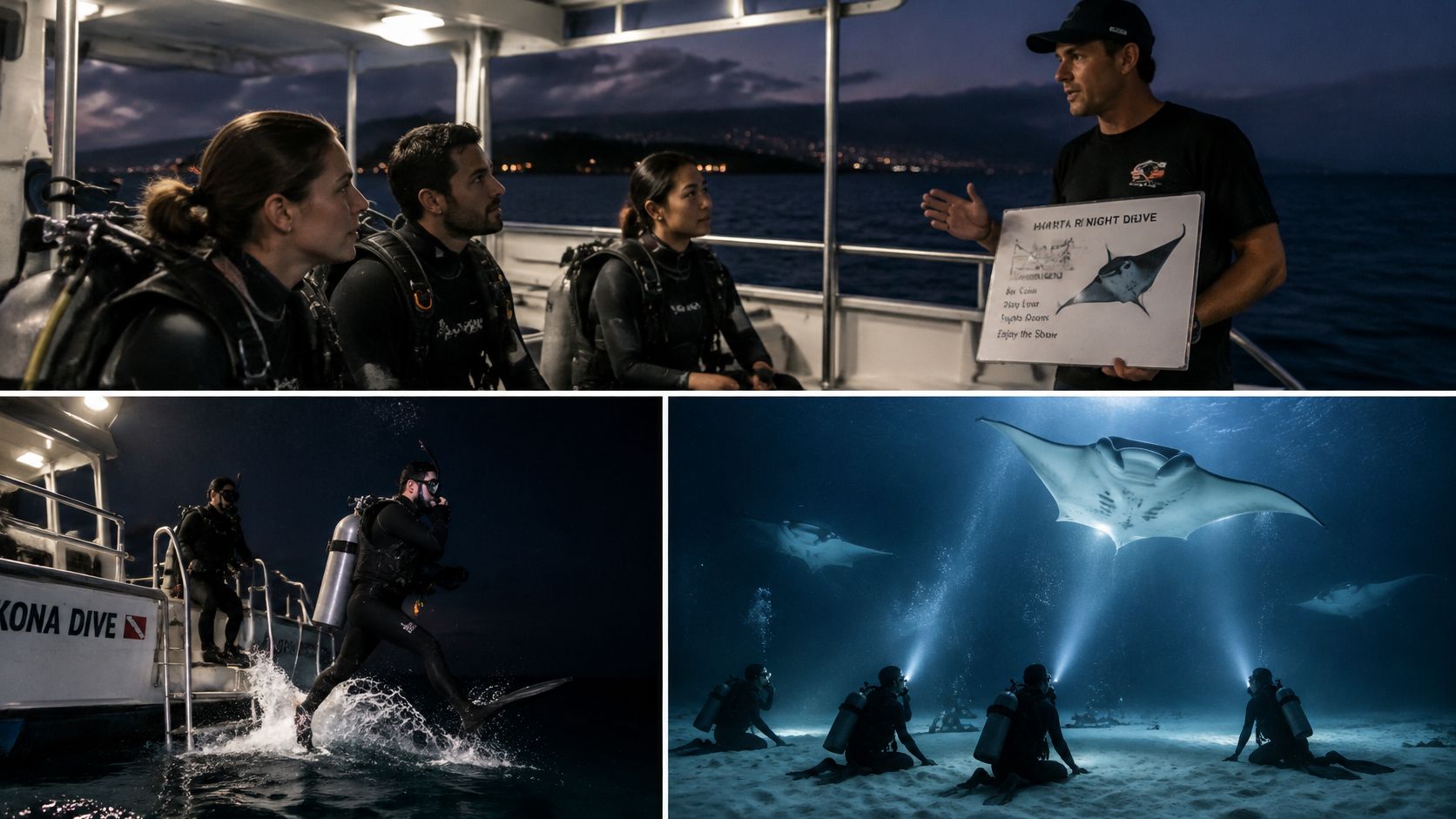
The evening starts before anyone enters the water. At check-in, the crew confirms the plan and gives a briefing on light handling, where divers should settle, and how to avoid interfering with the manta's route. Pay attention to those details, even if you've done night dives before. The manta viewing setup has specific positioning rules.
Once the boat reaches the site, divers descend to the designated viewing area and find a stable place on sand or rubble. The crew arranges lights, and guests wait while plankton gathers. Then you hold position and watch. The best passes often come when divers resist the urge to swim after a ray or adjust their spot every time one turns.
What to expect in the water
Snorkelers remain at the surface, while divers watch from below. That difference changes the risks and the positioning: a diver should stay low and clear of the feeding corridor, while a snorkeler should remain on the surface rather than diving down into the rays' path. If you're joining with someone who prefers snorkeling, ask how the operator accommodates both groups on the same trip.
The length of the underwater portion and the response to a no-show depend on the tour's actual terms. Don't assume a replacement trip or refund is included. Ask before booking what happens if no mantas appear, and whether the crew changes sites when conditions make the planned location unsuitable.
For a better sense of the underwater layout and what divers do once they reach the viewing area, see this guide to how deep the Kona manta ray dive is. Check-in location and departure time are operator-specific, so confirm them directly and arrive with enough time to complete the briefing without rushing. A night operation runs on a set departure window, and the crew needs guests ready before the boat leaves.
Reading the Data on Sightings, Seasons, and Moon Phase
Moon phase is a poor way to predict a manta sighting. A public analysis of 308 operating nights from April 13, 2025, through June 29, 2026, recorded zero to 37 mantas per night, averaging 10.6. The relationship between manta count and moon illumination was weak, with a reported correlation of 0.09 described as statistically insignificant (Kona manta sightings and moon analysis). Booking on a new moon alone does not make an encounter more likely.
Historical monitoring offers context, not a forecast. Researchers conducted 3,208 surveys from 1992 through 2007, mainly at Keauhou and Hō'ona Bay. They identified 106 individual mantas along the Kona Coast and estimated the local population at probably fewer than 200. Mantas appeared on approximately 80% of dives at Garden Eel Cove during that monitoring period. Treat that figure as a historical record, not a promise for your night.
| Metric | Figure | Period or site |
|---|---|---|
| Monitoring surveys | 3,208 | 1992 through 2007, primarily Keauhou and Hō'ona Bay |
| Identified individual manta rays | 106 | Kona Coast, historical monitoring |
| Estimated local population | Probably fewer than 200 | Historical estimate |
| Dives with manta observations | Approximately 80% | Garden Eel Cove, historical monitoring |
| Average count per operating night | 10.6 | Public analysis, April 13, 2025, through June 29, 2026 |
| Correlation with illumination | 0.09, statistically insignificant | Public analysis of manta counts |
The University of Hawaiʻi analysis found aggregation size closely tracked zooplankton density. Food availability, manta movement, and differences between sites can all shape what divers see; the moon phase is only one part of a much less predictable picture. Plan separately for manta abundance, sea conditions, and trip cancellation risk. A low-count night can still operate, while rough seas may prevent a boat from going out even when mantas are in the area.
If your schedule allows, book early in your stay so you have another night available if conditions or sightings disappoint. Choose dates around your travel flexibility rather than relying on a lunar calendar. For practical timing considerations, see this guide to the best time to see manta rays in Kona.
Gear, Skills, and Packing for a Night in the Water
A manta night dive is mostly a test of control, not distance. Good buoyancy lets you stay still at the edge of the light field without touching sand, coral, or another diver. If you haven't dived recently, consider a refresher before booking rather than using a crowded wildlife dive to relearn trim and buoyancy.
Bring a primary dive light and a backup, and make sure your mask fits securely. You may need to hold a light overhead, so a mask that shifts when you move your hand becomes a needless distraction. Use exposure protection that suits a long, relatively stationary dive, and carry a surface marker or signaling device as required by the operator.
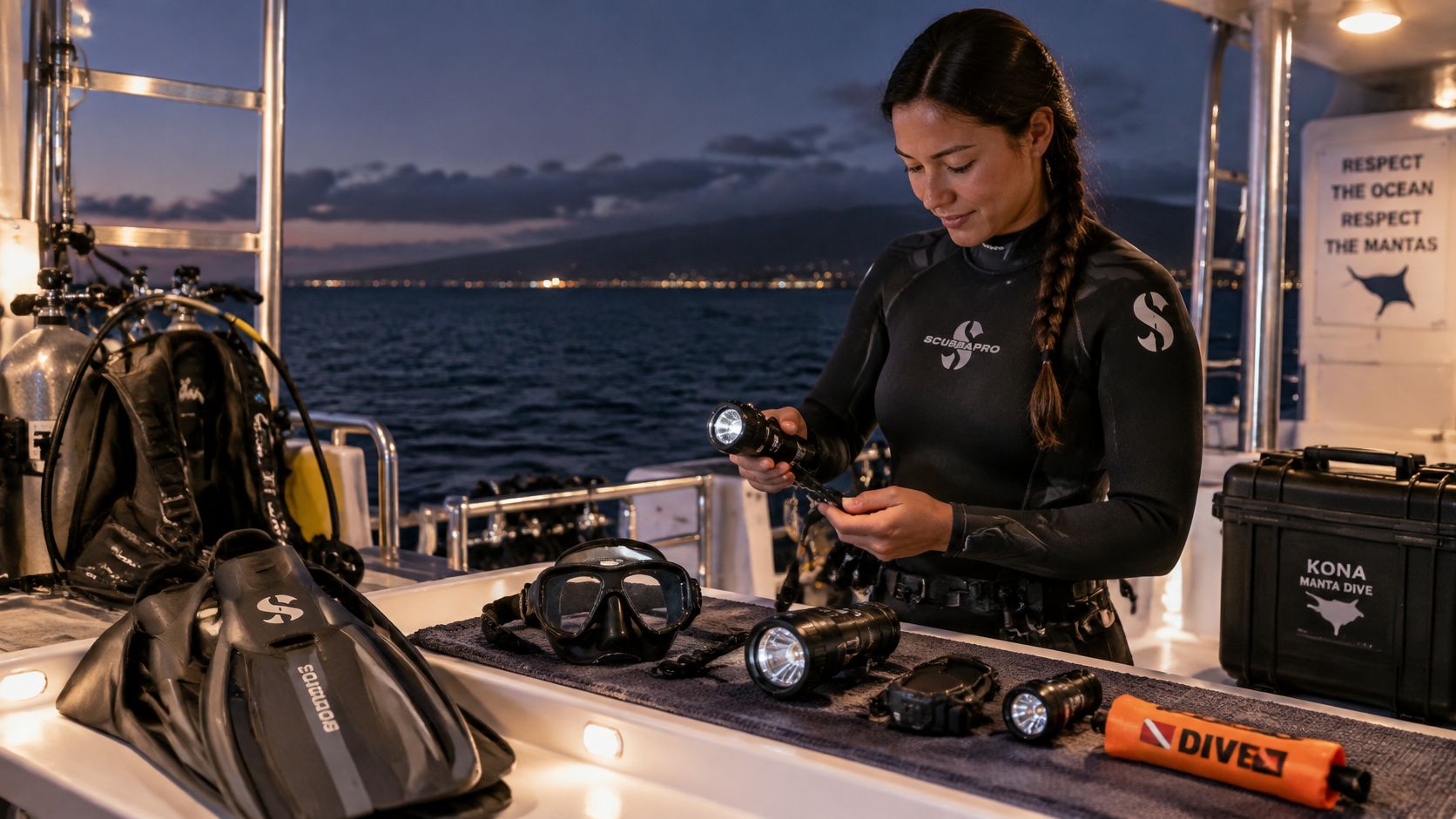
A practical pack-and-check list
- Dive light and backup: Check that both work before leaving shore, and follow the crew's instructions for where to aim them.
- Mask and exposure protection: Bring familiar gear where possible, and choose thermal protection for a stationary night in the water.
- Warm layer and towel: Keep something dry and warm for the boat ride back.
- Snorkel flotation: If you're snorkeling, ask what flotation is provided and whether you'll need to hold a lighted float.
- Comfort and motion-sickness plan: A nighttime boat trip can feel different from a daytime outing. If you're prone to seasickness, discuss suitable preventive options with a healthcare professional and follow product directions.
- Certification and recent experience: Confirm the operator's certification requirements. If your last dive was a while ago, a refresher is a sensible choice.
Before booking, ask whether the tour provides lights and exposure protection, or expects you to bring your own. If you want to review the broader skills involved, read this guide to scuba diving at night. Snorkelers should focus on surface comfort and calm breathing; divers should be confident enough to settle, hover, and leave the feeding lane open.
Low-Impact Behavior That Improves Your Encounter
A manta can pass close to a group and still be experiencing an interruption. Marine-conservation guidance reports that studies at manta-tourism sites in four countries have documented rays changing direction, avoiding swimmers, or stopping feeding during encounters (marine-conservation guidance on manta tourism). A successful view for a guest doesn't automatically mean the animal's behavior was unaffected.
That's why low impact means minimizing interruption, not avoiding physical contact. Stillness keeps the viewing area more predictable for the manta and often gives guests a clearer, longer look. Chasing a ray usually makes the encounter worse: the animal controls the route, and the swimmer adds pressure without improving the view.
A simple encounter-impact checklist
- Stay in your assigned position. Divers should remain low and clear of the feeding corridor; snorkelers should stay at the surface.
- Keep the route open. Don't swim underneath a manta, block its path, or intercept a turn.
- Let the ray choose the distance. Don't reach, chase, or swim after an animal that moves away.
- Use fewer movements. Hold your position and follow the crew's directions instead of adjusting to every pass.
- Protect the reef. Keep fins, hands, and equipment away from coral and other marine life.
Surface snorkelers and divers don't share the same position or collision risks, so their instructions differ. A snorkeler who dives beneath the float enters the water column where mantas are feeding; a diver who rises into the feeding lane can do the same from below. For a fuller guide to responsible, considerate diver etiquette, focus on the principle behind each rule: leave the animal room to feed and choose its own path.
Choosing a Tour and Booking Your Manta Night
A tour listing should tell you more than the departure time and a close-up manta photo. Ask which site the crew visits, whether it's the protected Garden Eel Cove viewing area, how guests are positioned, what equipment is included, and what happens if mantas don't appear. Clear answers matter more than confident promises about wildlife.
Group size and diver-to-guide ratio also affect how easy it is to hold a position without crowding the viewing area. Check whether the trip includes snorkelers as well as divers, and how the crew keeps each group in the right part of the water. If you're traveling with family or friends who prefer different formats, confirm that the operator can accommodate those preferences before you pay.
Kona Honu Divers offers a two-tank manta dive and snorkel trip to Garden Eel Cove, pairing an afternoon reef dive with the nighttime manta viewing experience. Its Kona manta night dive and photo package is another option to review when comparing what's included. Regardless of operator, plan flexibly and treat a sighting as possible, not guaranteed.
Build a backup night into your itinerary if you can, and verify cancellation and no-show terms before booking. Then compare the site, safety briefing, gear, and group arrangements against what you want from the evening.
Kona Honu Divers offers a guided manta night experience that visits Garden Eel Cove, where the protected reef and sandy viewing area support a more organized way to watch the rays feed. Check availability for your preferred night, and leave room in your schedule for a backup date by visiting Kona Honu Divers.