
So, is it worth it? The short answer is an enthusiastic yes. Scuba diving in Hawaii is one of those bucket-list adventures that truly lives up to the hype. This isn't just another dip in the ocean; it's a chance to explore a volcanic underworld, swim with ancient sea turtles, and come face-to-face with creatures found nowhere else on Earth.
Why a Hawaiian Dive Trip Is an Adventure of a Lifetime
From the world-famous Kona Manta Ray Night Dive to bumping into a rare monk seal, Hawaii delivers incredible moments for divers of all stripes. But what really makes it worth the trip? It's the powerful combination of unique geology, thriving marine life, and consistently great conditions that sets these islands apart. You’re not just looking at fish—you’re immersing yourself in a living ecosystem built on submerged lava tubes and ancient craters.
The islands' reputation isn't just hype. Hawaii supports over 1.5 million scuba dives every year across more than 215 licensed dive shops. That volume speaks for itself, proving the islands have the infrastructure and the incredible encounters to back up their fame.
What Makes Hawaiian Diving So Special?
A few key factors come together to make Hawaii a world-class diving destination. Knowing what they are can help you figure out if it's the right spot for your next underwater trip.
- Unique Marine Life: A staggering 25% of Hawaii's reef fish are endemic. That means you literally cannot see them anywhere else on the planet.
- Volcanic Topography: Forget flat, sandy bottoms. Here, you'll explore dramatic underwater landscapes like lava tubes, towering arches, and sunken craters carved by volcanoes.
- Iconic Encounters: Hawaii is one of the few places in the world where you can reliably dive with majestic manta rays on a night dive. It's a truly surreal experience.
- Ideal Conditions: The water is almost always warm and clear. Visibility often stretches past 100 feet, making for comfortable and visually spectacular dives any time of year.
To give you a clearer picture, here's a quick rundown of the pros and what you should keep in mind.
Hawaii Scuba Diving At a Glance
| Factor | Why It's Worth It | What to Consider |
|---|---|---|
| Marine Life | 25% of fish are endemic. Encounters with turtles, mantas, and sharks are common. | Some reefs are still recovering from past bleaching events. |
| Topography | Dive sites feature lava tubes, arches, and volcanic craters—a unique underwater landscape. | Shore entries can be challenging with rocky, volcanic coastlines. |
| Costs | Wide range of options from budget-friendly shore dives to luxury boat charters. | It's a premium destination, so costs can be higher than in Mexico or the Caribbean. |
| Conditions | Warm water (75-80°F) and excellent visibility (often 100+ feet) year-round. | Winter can bring larger swells, especially on north-facing shores. |
| Accessibility | Flights are plentiful from the mainland US, and a robust dive industry exists. | Inter-island travel adds time and expense if you want to dive multiple islands. |
Ultimately, Hawaii delivers an experience that is both profoundly unique and accessible.
This guide will break down everything you need to know, from the real costs and conditions to the can't-miss encounters that make Hawaiian diving an incredible investment in adventure. And for those curious about how Hawaii stacks up against other spots, see how it ranks in our guide to the top 10 scuba diving destinations in the United States.
Exploring Hawaii’s Unique Underwater Landscapes
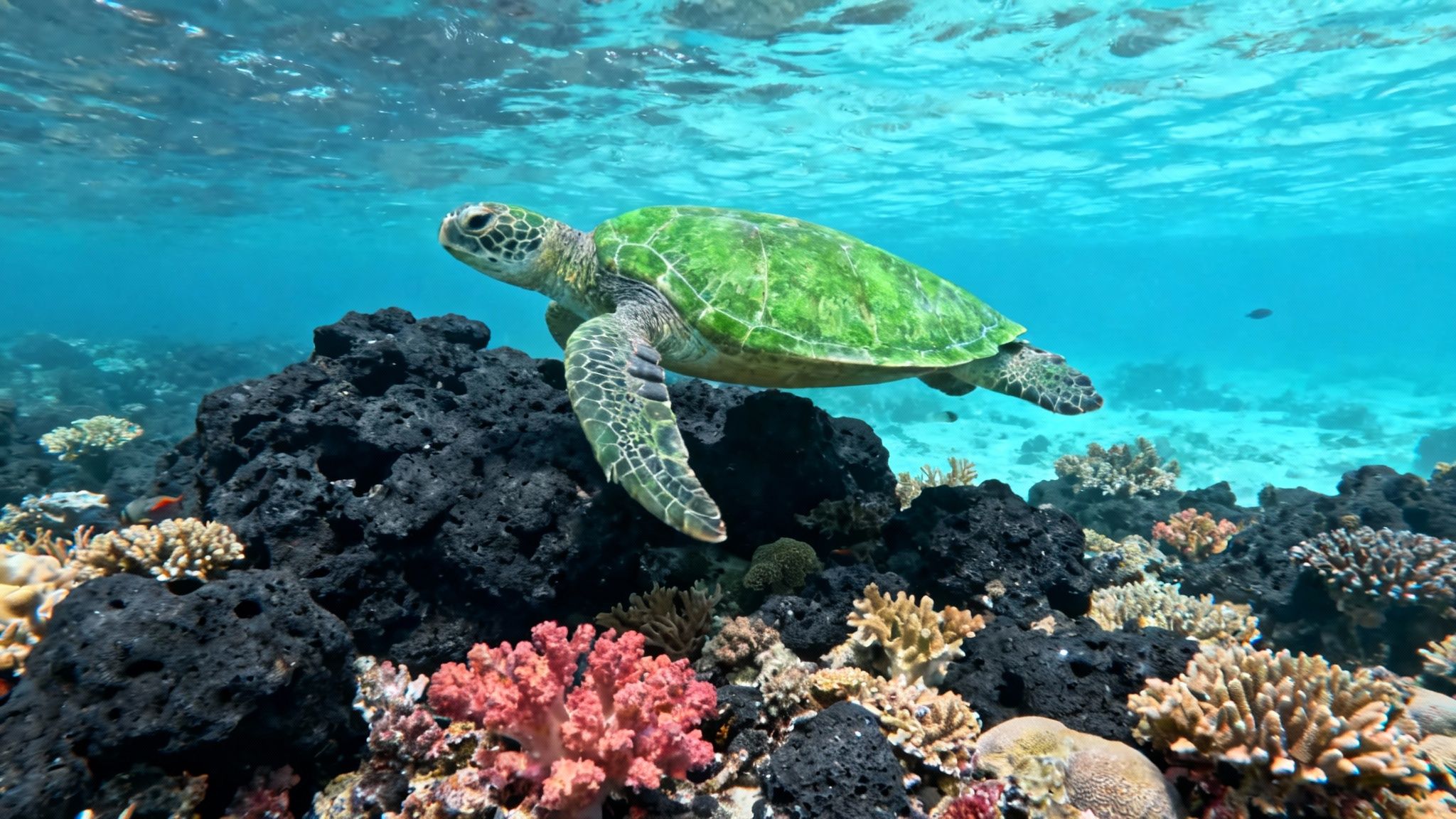
Picture this: you descend into an underwater world literally sculpted by volcanoes. Diving in Hawaii isn't just about the fish; it's about exploring a dramatic, otherworldly topography you simply won't find anywhere else. The islands' fiery origins have left behind a stunning seascape of submerged craters, ancient lava tubes, and massive archways.
This unique geology creates a foundation that's completely different from your typical Caribbean reef. Instead of endless sandy bottoms, vibrant corals cling to black volcanic rock, creating a beautiful, stark contrast. You'll find yourself navigating intricate structures that serve as natural apartment complexes for a huge variety of marine life. This alone makes diving in Hawaii worthwhile.
The A-List of Hawaiian Marine Life
What truly sets Hawaii apart, though, is the sheer amount of life you can only see here. Over 25% of Hawaii's marine species are endemic, which means they are exclusive to these waters. Every dive genuinely feels like a voyage of discovery.
You're almost guaranteed an encounter with a majestic green sea turtle, or honu, as they glide effortlessly through the water. They are a common and beloved sight for pretty much every diver who visits.
But the cast of characters goes much deeper. Here’s a little of what you can expect:
- Playful Spinner Dolphins: You'll often see them from the dive boat, and their acrobatics are a fantastic bonus to any day on the water.
- Reef Sharks: White-tip reef sharks are frequently spotted resting in underwater caves or cruising along the reef's edge. They're usually quite chill.
- Colorful Endemic Fish: Keep an eye out for the Milletseed Butterflyfish, Saddle Wrasse, and the Hawaiian cleaner wrasse—you won't see them anywhere else on the planet.
- Hawaiian Monk Seal: Catching a glimpse of one of these critically endangered animals is a rare and truly unforgettable privilege.
Unbeatable Conditions for Diving
On top of the incredible scenery and wildlife, Hawaii offers consistently fantastic diving conditions. The warm, clear Pacific waters make for a comfortable dive pretty much year-round, with water temperatures usually sitting between 75-80°F (24-27°C).
And the visibility? It's often spectacular, frequently exceeding 100 feet. This kind of clarity lets you fully appreciate the grand scale of the volcanic landscapes and all the life teeming within them. These reliable conditions take a lot of the guesswork out of planning your trip.
If you're heading to the Big Island, the calm, protected waters of the Kona coast offer some of the most consistent and rewarding experiences you can find. It’s a major hub for top-tier operators like Kona Honu Divers, who know these unique sites like the back of their hand.
Exploring these underwater marvels is a huge part of why so many divers feel a Hawaiian trip is absolutely worth it. The combination of unique geology, rare wildlife, and superb conditions creates a sensory feast that few other destinations can match.
A Practical Breakdown of Hawaii Diving Costs
Let's get right to it and talk numbers. Yes, Hawaii is a dream destination, and that can sometimes mean higher prices. But when it comes to world-class diving, you might be surprised at how accessible an adventure can be with a little planning. Knowing what to expect helps you budget smart and really see the value packed into a Hawaiian dive trip.
Hawaii is a huge draw for divers, and for good reason. It’s a cornerstone of the U.S. diving tourism market, which was valued at around USD 1.1 billion in 2025. The islands' unique marine life and perfect water temperatures make them a magnet for underwater explorers, which in turn helps fund the sustainable practices needed to protect these incredible ecosystems. If you're curious about the bigger picture, you can discover more insights about U.S. diving tourism here.
What a Typical Dive Trip Costs
So, what should you actually budget for? For most certified divers, the main expense will be guided boat dives.
A standard two-tank morning boat dive will typically set you back somewhere between $175 and $225 per person. This almost always covers your tanks, weights, an experienced guide who knows all the best spots, and some snacks to recharge between dives.
If you're new to diving, a "Discover Scuba" experience is the perfect way to get your fins wet. These introductory sessions include a basic lesson and a closely supervised shallow dive, usually costing between $195 and $250. Loved it? Getting your full Open Water Diver certification in Hawaii generally runs from $600 to $800.
Pro Tip: Always ask about multi-day packages. Booking three or four days of diving upfront with the same operator can often knock down the daily price, giving you some nice savings.
Gear Rental vs. Bringing Your Own
The next big question is gear: do you haul your own equipment across the ocean or just rent it when you arrive? There are pros and cons to both.
- Renting Everything: A full kit—BCD, regulator, wetsuit, mask, and fins—will typically cost $50 to $75 per day.
- Bringing Your Gear: If you're an avid diver with your own setup, you’ll save on rental fees. Just don't forget to factor in airline baggage fees, which can run $30 to $60 each way for that extra gear bag.
Here’s a good rule of thumb: if you plan on diving for four or more days, bringing your own gear often starts to make financial sense. For a shorter trip, though, the convenience of renting high-quality, well-maintained equipment is tough to beat. Plus, you won't have to deal with rinsing and drying all your gear before you fly home. Once you map out your budget, it becomes much easier to see that the answer to "is scuba diving in Hawaii worth it?" can be a resounding yes.
Choosing the Best Hawaiian Island for Your Dives
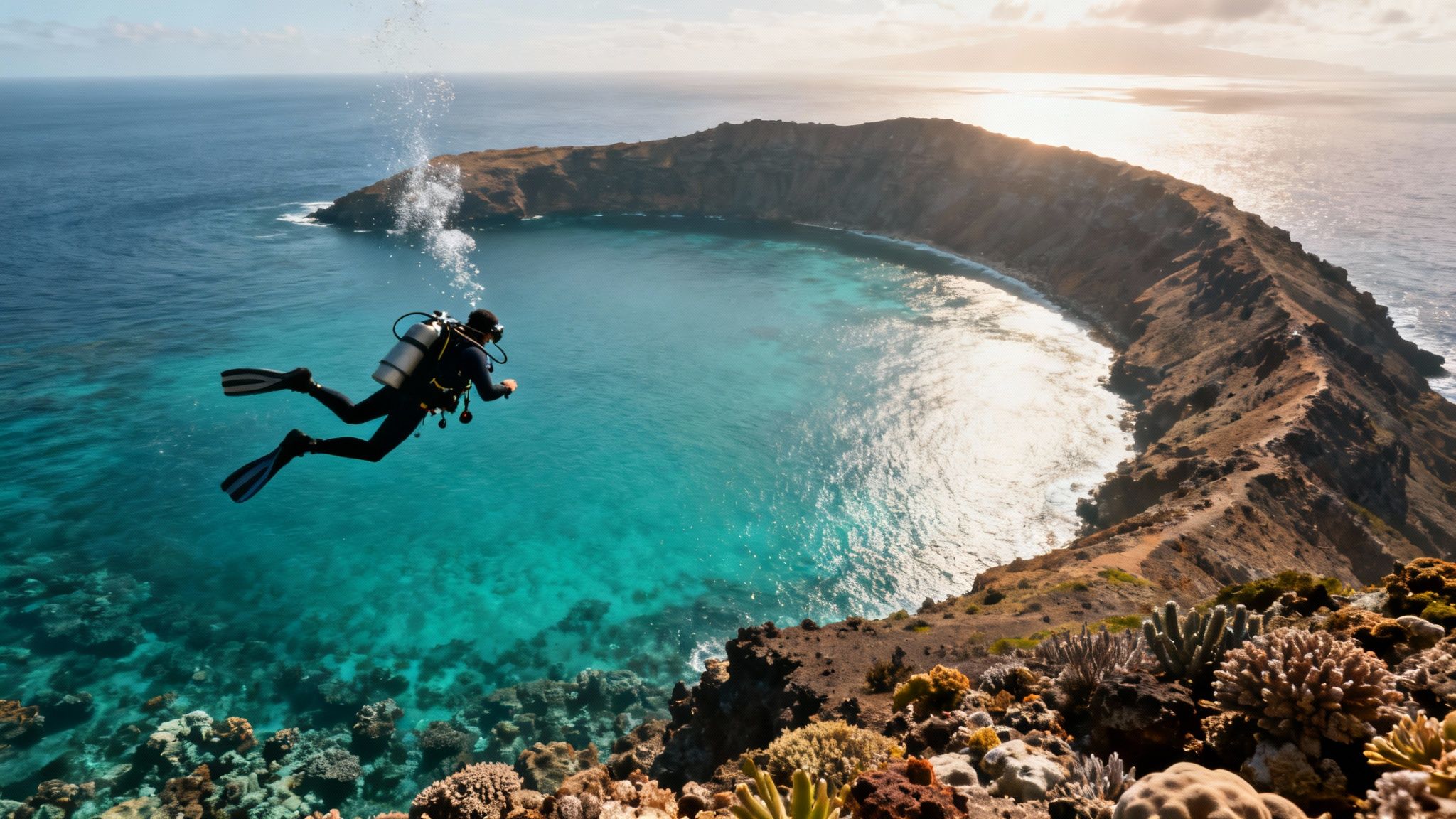
Okay, so you've decided to take the plunge in Hawaii. That was the easy part. The real question is, where? Each island offers a completely different underwater world, with its own unique personality and set of adventures.
Think of it like this: the Big Island is the all-star quarterback. Specifically, the Kona Coast. Thanks to the massive volcanoes blocking the trade winds, the water here is almost always calm and incredibly clear. This makes it a fantastic spot for everyone, from your very first open-water dive to your hundredth.
Kona is where you’ll find the world-famous manta ray night dive and the mind-blowing blackwater dives—experiences that are truly in a class of their own. If you want to dig deeper, our full guide on which Hawaii island is best for scuba diving breaks it all down.
Comparing the Top Dive Islands
While Kona might get most of the attention, the other islands have plenty to offer. It just comes down to what you’re looking for.
-
Maui: The star attraction here is Molokini Crater, a volcanic crescent that’s basically a natural aquarium. The visibility is insane, and it's a great place for spotting reef sharks and huge schools of fish. Many of the dives are drift dives, so you just relax and let the current do the work.
-
Oahu: If you love exploring sunken treasures, Oahu is your spot. The waters around the island are a graveyard for ships and even planes, all now thriving artificial reefs. It's not uncommon to see squadrons of eagle rays cruising past these incredible wrecks.
-
Kauai: The "Garden Isle" is just as wild underwater as it is on land. The topography is dramatic, with caverns and lava tubes to explore. But be warned: the currents can be strong, so it’s a destination better suited for divers with more experience under their belt.
Key Takeaway: For the biggest variety of iconic dives and the most reliable, calm conditions, you just can't beat the Kona coast on the Big Island. It truly has something for every diver.
So, what's your priority? Do you dream of dancing with giant mantas, exploring historic shipwrecks, or navigating rugged underwater canyons? Choosing the right island is the first step to planning the perfect dive trip.
Which Hawaiian Island is Right for Your Dive Trip?
To make it even simpler, here's a quick cheat sheet comparing what each of the main islands brings to the table for divers. Use this to match your skill level and interests with the perfect destination.
| Island | Best For | Key Dive Sites | Skill Level |
|---|---|---|---|
| Big Island (Kona) | Manta rays, blackwater dives, calm conditions, lava tubes | Manta Heaven, Golden Arches, Turtle Pinnacle | Beginner to Advanced |
| Maui | Crater diving, reef sharks, clear visibility | Molokini Crater, Cathedrals | Intermediate |
| Oahu | Wreck diving, eagle rays | YO-257, Sea Tiger, Corsair Plane | Intermediate to Advanced |
| Kauai | Advanced dives, dramatic topography, strong currents | Sheraton Caverns, Tunnels Reef | Advanced |
Ultimately, whether you're a brand new diver or a seasoned pro, there's an underwater paradise in Hawaii waiting for you. It's all about picking the one that calls to you the most.
Iconic Dives You Can Only Do in Hawaii
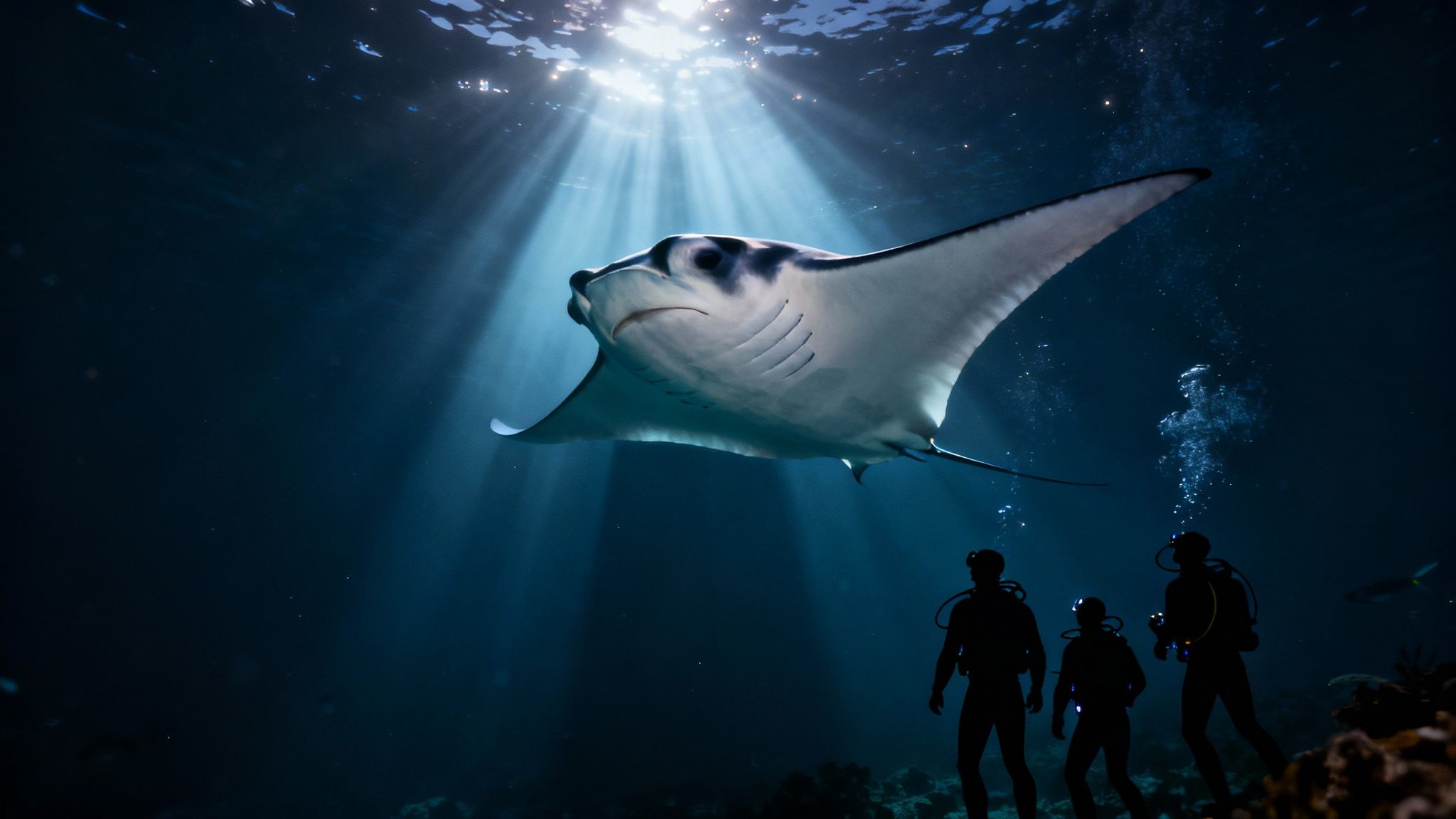
Some dive experiences are so special they completely define a destination. In Hawaii, this means coming face-to-face with marine life in ways you simply can't find anywhere else on the planet.
These signature dives are a huge part of the answer to the question, "Is scuba diving in Hawaii really worth it?" They have the power to turn a great vacation into a legendary one.
At the very top of that list is the world-famous Kona Manta Ray Night Dive. Picture this: you descend into the warm, dark ocean, settling on the sandy bottom. Your guide sets up powerful lights in the middle of the group, creating a brightly lit stage that quickly attracts swarms of plankton.
And then, the show begins.
Giant manta rays, some with wingspans stretching over 12 feet, materialize out of the darkness. They glide, swoop, and perform effortless barrel rolls just inches above your head, gracefully scooping up the plankton gathered in the light. It's a silent, mesmerizing ballet that feels completely surreal. This isn't just a dive; it’s an intimate encounter with one of the ocean's most majestic creatures.
The Kona Manta Ray Night Dive
When it comes to this experience, the Kona coast of the Big Island is, without a doubt, the best place in the world to do it. The entire operation is incredibly well-organized and safe, which makes it accessible even if you're a relatively new diver. Local operators have perfected the art of attracting these gentle giants, which means you're in for a reliable and consistently mind-blowing show.
- What to Expect: Divers kneel on the seafloor as powerful lights draw in plankton, which in turn attracts the mantas for an up-close feeding spectacle.
- Best Location: The Kona coast has several established sites like "Manta Heaven" and "Manta Village," famous for their consistent sightings.
- Why It's a Must-Do: There is truly nothing else like it. The sheer size and grace of these animals, combined with how close they get, creates a memory that will stick with you for a lifetime.
If you want to be part of this unforgettable underwater performance, you can check out the Kona Manta Ray Dive tours run by local pros.
The Kona Blackwater Dive
For divers with a taste for adventure, Hawaii offers something that feels like a trip to another planet: the Kona Blackwater Dive. Forget the reef. On this dive, you’re taken miles offshore at night, tethered to the boat, and sent to drift over thousands of feet of pitch-black ocean.
What you're here to see is the largest migration on Earth. Strange, bioluminescent creatures rise from the abyss to feed near the surface under the cover of darkness. You'll see things that look like they belong in a sci-fi movie—translucent larval fish, pulsating jellies, and alien-looking squid. Many of these animals are rarely, if ever, seen by human eyes. It’s a thrilling, humbling experience that brings you face-to-face with the true mysteries of the deep sea, and it's one of the most unique diving tours on the Big Island you can possibly find.
Ready to explore this mysterious world? You can learn more about the Blackwater Dive tour and see what's really lurking in the deep. For those seeking other high-adrenaline challenges, there are also incredible advanced dive tours that explore deep lava tubes and remote volcanic pinnacles.
How to Select the Right Dive Operator
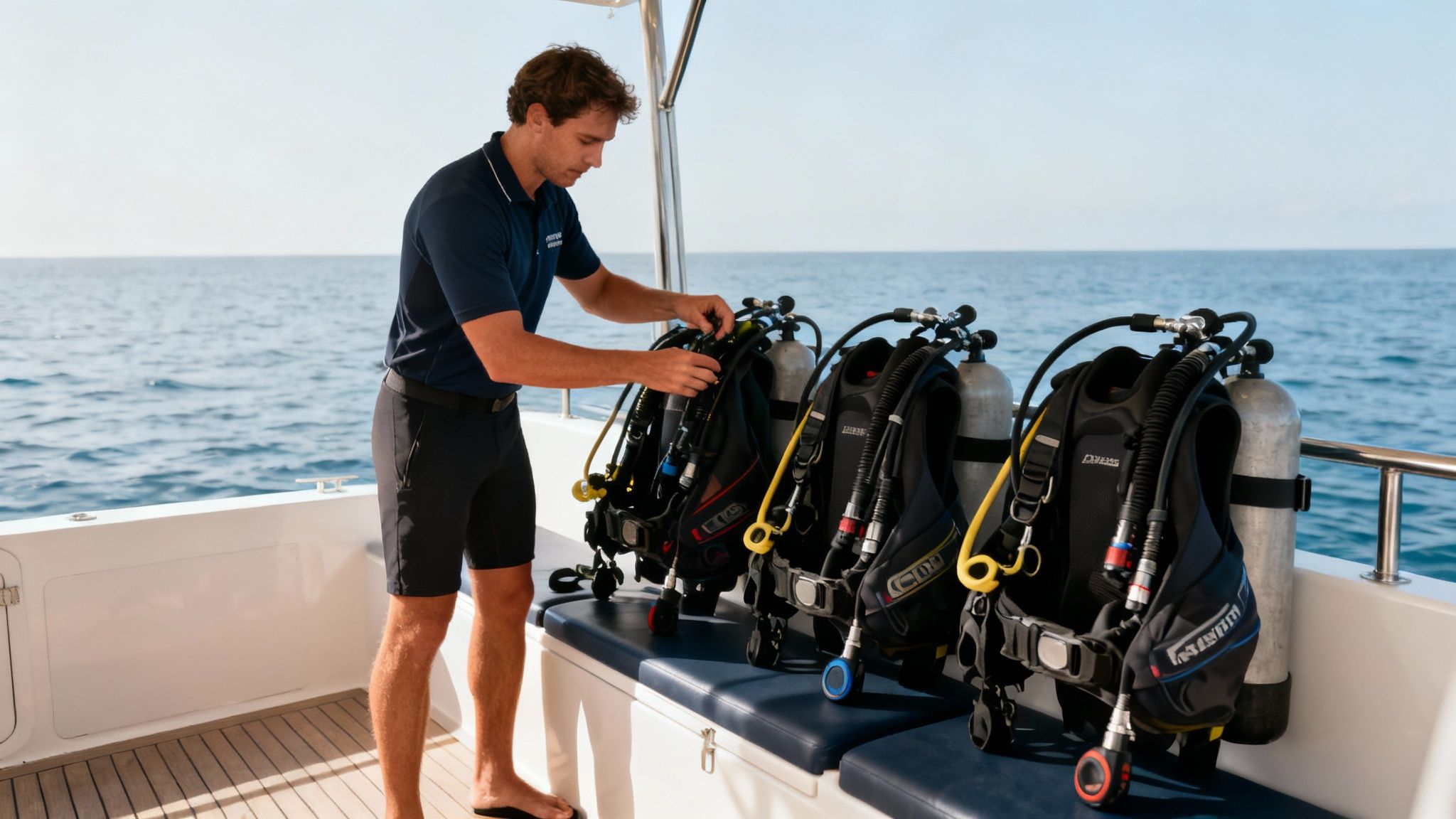
Choosing the right dive operator is probably the most important decision you'll make for your Hawaii trip. It’s the difference between a truly unforgettable experience and one you'd rather forget. A great dive shop doesn't just get you in the water; they ensure you’re safe, have an amazing time, and do it all while respecting the incredible marine life you came to see.
When you're looking at different companies, start with the basics. Check to see if they're affiliated with a major training agency like PADI or SSI. This is a non-negotiable, as it tells you they follow internationally recognized standards for safety and training. After that, hit the recent online reviews to see what other divers are saying about their actual, day-to-day trips.
Key Questions to Ask Before Booking
Don’t ever hesitate to ask a few direct questions before putting your money down. A professional operation will be happy to answer, and their responses will tell you everything you need to know about their priorities.
- What is your guide-to-diver ratio? You're looking for a low number here. A ratio of 6 divers per guide is a good benchmark. It means you’ll get more personal attention and better supervision.
- What's the maximum number of divers on the boat? Some boats feel like crowded cattle cars, which can be a stressful way to start a dive. Smaller groups almost always make for a more relaxed and personal day on the water.
- Can you walk me through your safety protocols? A good shop will have no problem talking about their emergency oxygen, first aid supplies, and what they do in an emergency. If they're vague, that's a red flag.
A great sign of a quality dive shop is a real commitment to sustainability. Ask them if they're involved in reef conservation or follow eco-friendly practices. Choosing an operator that actively protects the very reefs you're there to explore is a fantastic way to give back.
If you're heading to the Big Island, it's hard to go wrong with Kona Honu Divers. They have a stellar reputation for a reason—amazing guides, a deep commitment to protecting the ocean, and top-notch customer service that shows in their endless five-star reviews. Making a smart choice like this is how you make sure your investment in a Hawaiian dive adventure truly pays off. We break it down further in our top 10 Kona diving companies ranked.
Your Hawaii Diving Questions, Answered
Planning a dive trip to Hawaii for the first time? You've probably got a few questions floating around. Let's clear up some of the most common ones so you can focus on the adventure ahead.
What Is the Best Time of Year to Scuba Dive in Hawaii?
You can have a great dive in Hawaii any day of the year, but the seasons do offer different experiences. For the calmest, clearest, and warmest water, you can't beat the summer months from May to October.
But winter has its own kind of magic. From December through March, you might hear the haunting songs of humpback whales echoing through the water on your dive. It's an absolutely unforgettable trade-off for slightly cooler water.
Do I Need to Be Certified to Scuba Dive in Hawaii?
Not at all! If you're new to diving, you're in luck. Nearly every dive shop here offers an introductory program, often called a "Discover Scuba Diving" experience.
It’s a fantastic way to dip your toes in. You'll get a quick, easy-to-understand lesson on the basics and then head out for a shallow dive with an instructor right there with you. It’s the perfect test drive before committing to a full certification.
What Is Hawaii’s Most Famous Dive?
Oh, that's an easy one. It’s the Manta Ray Night Dive off the Kona coast, hands down. This dive isn't just famous in Hawaii; it's consistently ranked as one of the best night dives on the entire planet.
Imagine giant, gentle manta rays gliding gracefully through the water, feeding on plankton illuminated by your lights, sometimes just inches away. It’s a surreal, bucket-list experience that you'll be talking about for the rest of your life. If you're heading to the Big Island, looking into manta ray dive tours is non-negotiable.