
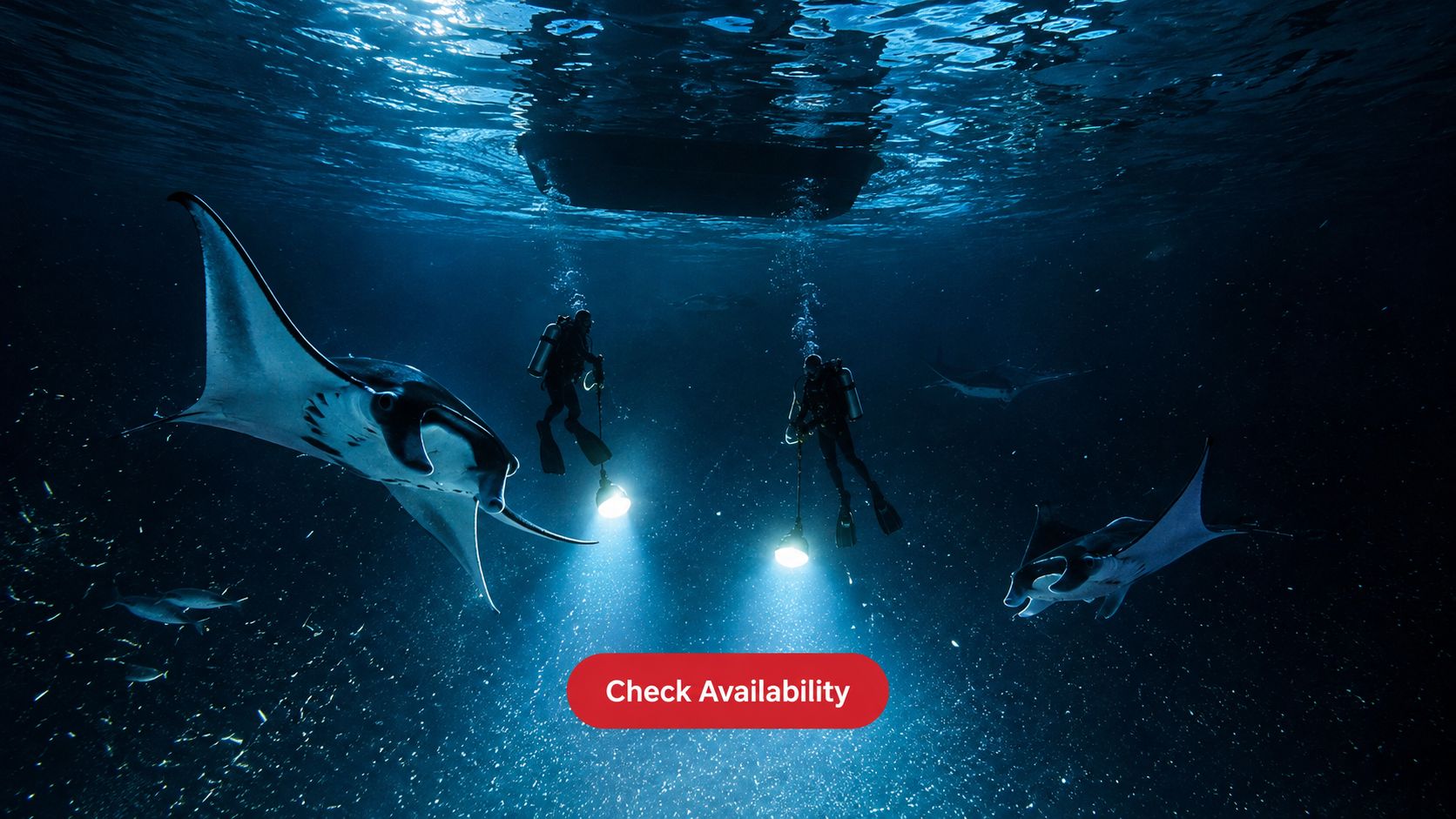
You've probably seen the photographs: a diver kneeling in black water while a giant manta ray rolls through a cone of light overhead. The experience itself is quieter and more disciplined. You enter the Pacific after sunset, settle into your position, and wait while the lights gather plankton. Then a broad shadow appears, turns toward the beam, and passes close enough for you to see the markings on its underside.
A successful Hawaii night manta ray dive depends on more than finding a boat and jumping in. Site choice, ocean conditions, buoyancy, equipment management, and your willingness to remain a passive observer all shape the encounter. The mantas are wild animals, not performers, and the best dives happen when divers work with their feeding behavior rather than trying to control it.
The Magic of the Hawaii Night Manta Ray Dive
The first minutes underwater can feel almost empty. Your regulator is loud in the darkness, the reef fades beyond the light, and the illuminated water seems full of drifting dust. That dust is zooplankton, gathering where the lights create a concentrated feeding zone.
Then the darkness moves. A manta ray enters the edge of the beam, banks across the light, and turns its white belly toward the divers. It may loop back through the same area, sometimes rolling as it filters the plankton-rich water. Your job is to stay still and let the animal decide how close it wants to come.
A resident encounter with a long history
Kona's manta experience isn't a recent discovery or a lucky meeting with a passing animal. The modern activity traces its origins to 1991 on the west coast of Hawaiʻi Island, when a local operator noticed manta rays repeatedly gathering near illuminated shoreline water and began scheduling regular nighttime viewing trips. Historical accounts describe the activity growing from approximately one boat visiting about once a week to as many as five boats and roughly 50 people in the water by 1993. Hawaii Ocean Watch documents the development of Kona's viewing sites.
A second major viewing location opened near Keahole Point in 1999, helping turn a small local activity into one of Kona's internationally recognized marine-wildlife experiences. The original site later went inactive from 2000 through 2004 after the Kona Surf Hotel closed. When floodlights were reinstalled in 2004, the mantas returned, showing how closely the aggregation followed predictable nighttime plankton concentrations.
That history changes how you approach the dive. You're not searching for an animal that happened to wander past the boat. You're visiting an established feeding area used repeatedly by resident reef mantas. The encounter is still wild and variable, but it's grounded in decades of observation and animal site fidelity. Learn more about the manta rays of Hawaiʻi before entering the water, especially if you want to understand why passive viewing matters.
How the Plankton and Light System Works
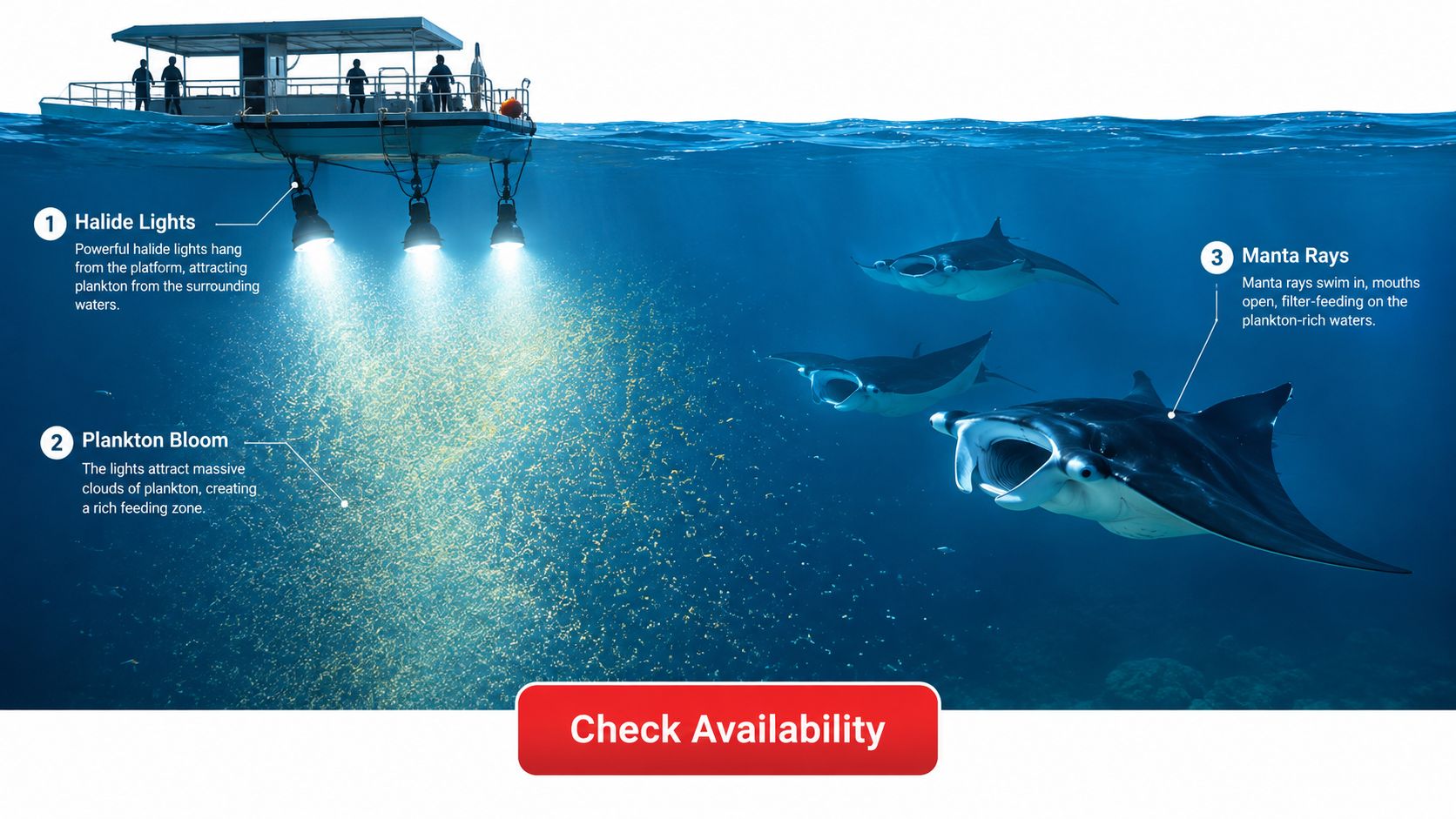
The lights don't feed the mantas directly. They concentrate naturally occurring plankton, and the mantas arrive to filter-feed. That distinction matters because divers sometimes assume the animals are baited or given food. They aren't.
After dark, zooplankton moves upward through the water column. NOAA describes reef mantas as primarily nocturnal feeders because their prey migrates upward at night, while Hawaiʻi's Division of Aquatic Resources identifies plankton as the mantas' primary food. The animals direct water into their mouths with their cephalic fins, filtering out the small organisms as they swim.
Why the light zone needs stability
Operators illuminate the water from the surface, the seafloor, or both. The resulting light column attracts phototactic zooplankton and creates a dense patch that mantas can work efficiently. An adult reef manta can process approximately 60 cubic meters of seawater per hour while feeding, so it needs a stable, productive zone rather than a diver or boat chasing it. The feeding mechanics and water volume are described in this account of Kona manta dives.
That's why hard finning causes more trouble than many new divers realize. Strong kicks create turbulence, scatter the plankton patch, and make the feeding area less predictable. A diver who swims toward a manta can also interrupt its line, forcing it to turn away instead of completing a pass.
Practical rule: The light attracts the food, but calm divers help keep the food concentrated.
Your equipment matters for the same reason. Gauges, camera handles, dangling clips, and strobes can extend beyond your body profile and create collision hazards. Keep your hoses routed, secure loose accessories, and point your camera without reaching into the manta's path.
The best position is usually stationary, neutral, and slightly out of the main feeding lane. Let the manta make the pass. You'll see more natural behavior, and the animal won't have to alter its route to avoid you.
Choosing the Best Location in Kona
Kona's major viewing locations don't offer identical conditions. The choice affects shelter, reef surroundings, current exposure, and how controlled the viewing area feels once divers enter the water.
Garden Eel Cove, also called Manta Heaven, is the superior choice for a manta-ray dive tour when the priority is a protected, organized view over a reef environment. The site lies near Kona International Airport and has an established viewing area where divers can settle near the light instead of pursuing wildlife through open water. This location guide describes Garden Eel Cove's protected setting and designated viewing area.
Garden Eel Cove compared with open-water viewing
Garden Eel Cove's structure gives the crew a clearer place to position divers and lights. That doesn't eliminate current, surge, or changing visibility, but it supports a more predictable viewing layout. The surrounding reef also gives the dive a genuine underwater setting instead of reducing the encounter to animals passing through featureless open water.
Keauhou and other locations can produce memorable encounters, but conditions and group behavior vary. A site that receives more offshore movement may sometimes attract larger groups, while exposed water can also bring more surge or reduced visibility. A sheltered site is valuable because divers can focus on buoyancy and observation rather than constantly correcting their position.
A University of Hawaiʻi-linked analysis of community observations from 2010 through 2022 found that changes in manta group size closely matched changes in zooplankton density, and that Garden Eel Cove supported larger groups more consistently than Keauhou. The Frontiers in Marine Science analysis explains the relationship between prey distribution, group size, and site use.
| Site consideration | Why it matters underwater |
|---|---|
| Protected setting | Makes it easier to hold position and follow the briefing |
| Designated viewing area | Keeps divers organized around the feeding lights |
| Reef environment | Provides structure and context without chasing animals |
| Variable plankton supply | Means group size can still change from night to night |
No responsible captain should promise a fixed number of mantas. Garden Eel Cove improves the viewing framework, but it doesn't override weather, visibility, circulation, or prey distribution. For a tour designed around controlled observation, however, its protected layout and reef setting make it the clear choice. The Kona manta ray dive guide provides additional planning context before you reserve.
In-Water Mechanics and Diver Etiquette
The dive is simple in concept, but the details determine whether the experience feels calm or chaotic. Divers generally descend to the designated viewing area, establish neutral buoyancy, and remain near the light while the mantas choose their own routes.
A typical Kona manta night-snorkel or night-dive viewing period keeps guests in the water for approximately 30 to 45 minutes, during which reef mantas may make repeated loops and barrel rolls through the illuminated plankton zone. This practical guide describes the typical viewing period and low-impact behavior.
What to do once you're settled
Descend with control. Use your buoyancy compensator and breathing to avoid dropping onto the bottom or drifting upward into the feeding lane.
Take your assigned position. Divers may kneel on the bottom or hover near the light, depending on the site and briefing. Don't spread out or move into another diver's space.
Keep your fins quiet. Small corrections are better than continuous kicking. If you're unstable, fix the cause slowly rather than swimming after a manta.
Contain your equipment. Secure gauges, camera straps, lights, and accessories inside your body profile. A manta can approach from an angle you can't see in the dark.
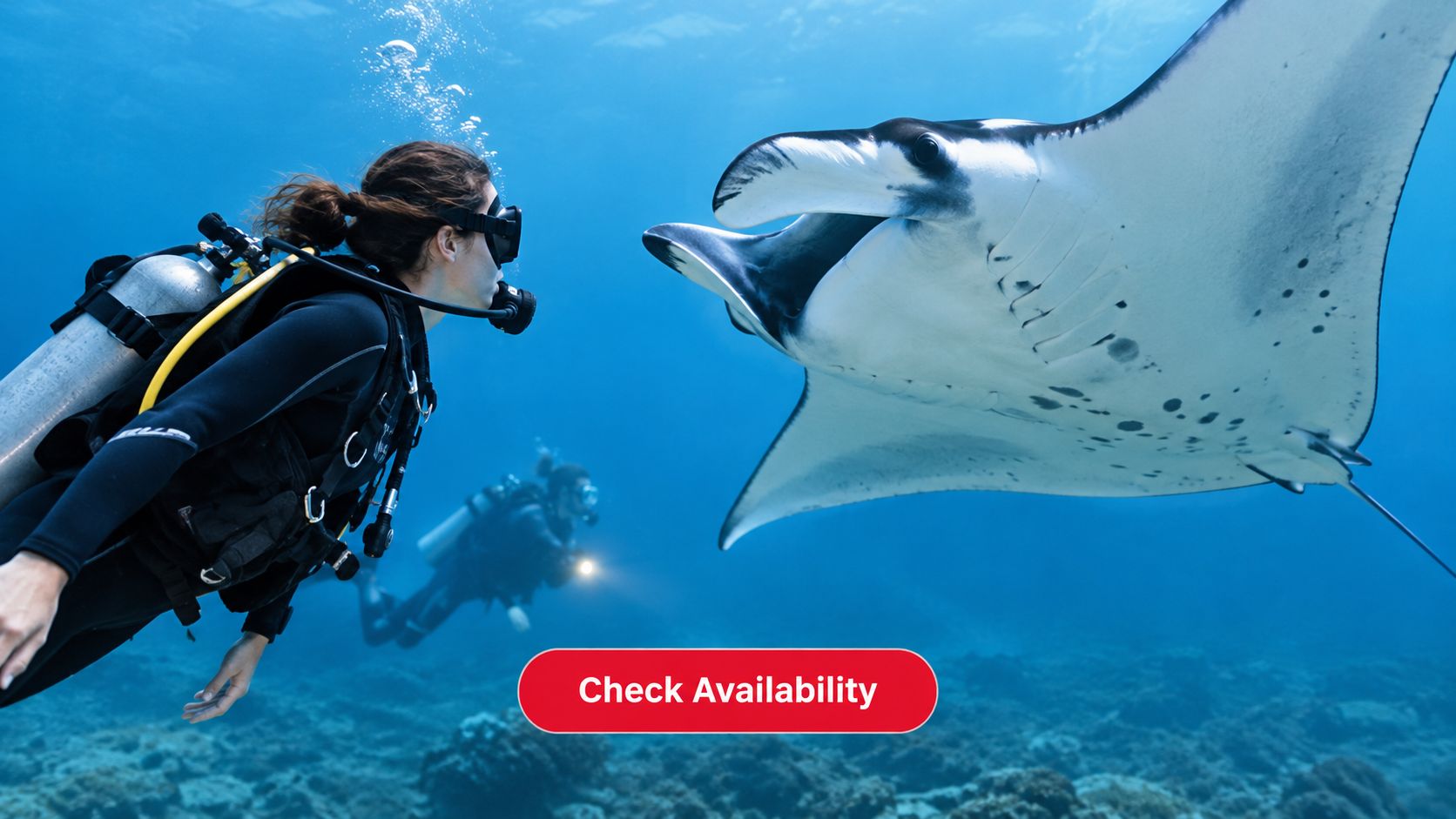
Let the animal pass. Never touch, block, pursue, or dive down toward a manta. If one approaches closely, hold position and allow it to turn away on its own.
Mantas aren't there for interaction. They're there to feed, and the closest encounters happen when divers stop trying to make them happen.
A manta's skin and movement deserve particular respect. Your hands, fins, or camera can strike the animal if you reach into its route, and chasing it can interrupt feeding. Passive positioning protects the encounter for the entire group because each manta can continue making repeated passes through the light.
Use your light exactly as the crew instructs. Don't sweep it across another diver's mask, aim it into a manta's eyes, or create a competing beam that confuses the viewing pattern. Your guide's signals matter more at night, so review them before entering the water and stay with the group if visibility or current changes. These practices are also covered in this guide to responsible and considerate diver etiquette.
Essential Gear and Seasickness Prevention
The dive itself doesn't require an elaborate personal kit, but night conditions expose poor preparation quickly. Bring a swimsuit, towel, warm layer, and any personal medication you may need. A wetsuit helps with comfort, while a hood or extra layer can be useful for divers who chill during a long stationary observation.
Camera discipline matters more than camera price. A compact camera or small action camera is easier to manage than a bulky rig with loose arms and straps. Use a red focus light only if your crew permits it, keep the housing close to your torso, and avoid chasing a manta to fill the frame. A stable diver with a modest camera usually gets better footage than an unstable diver with a large setup.
Prepare for the boat, not only the water
The boat ride can be the hardest part for guests who rarely spend time offshore. Eat lightly before departure, avoid arriving dehydrated, and sit where the crew recommends if you're sensitive to motion. Don't wait until nausea is severe before using a remedy you already know is suitable for you.
Common products available for purchase include a Ship-EEZ Seasickness Patch, Dramamine pills, Bonine pills, Sea Band wristbands, and ginger chews. Check product directions, possible drowsiness, and medical suitability before using any medication. If you're unsure what's appropriate, speak with a healthcare professional rather than combining remedies casually.
Boat-tested habit: Keep your eyes on the horizon during the ride, stay in fresh air when possible, and tell the crew early if you feel unwell.
Manta numbers can change because aggregation size follows prey distribution. A recent analysis links seasonal and annual changes in group size to zooplankton density and notes that some individuals stay within roughly 6 kilometers of shore while using different areas during daylight and nighttime. The movement and aggregation analysis explains why established sites can still vary.
That variability is part of the gear decision too. Don't build your expectations around a guaranteed performance or plan to compensate with aggressive camera movement. Pack for comfort, listen to the briefing, and treat the dive as wildlife observation.
For additional motion-prevention guidance, see this practical resource on the best sea sickness medication.
Conservation and Ecological Trade-Offs
“Don't touch the mantas” is necessary advice, but it doesn't answer every conservation question. The encounter depends on artificial light, repeated boat traffic, concentrated plankton, and many people gathering around the same feeding zone. A responsible visitor should ask what that setup changes for the animals, not only whether a guide prevents physical contact.
A NOAA-hosted study documents that Kona operators illuminate the water column from both the surface and the seafloor, creating dense zooplankton patches that attract reef manta rays. The study also raises questions about light intensity, exposure duration, habituation, and differences in how individual mantas and sexes use the major sites. Read the NOAA-hosted study on manta viewing and site use.
A successful sighting isn't proof of zero impact
Mantas returning to a lighted area shows that the feeding opportunity remains useful to them. It doesn't prove that unlimited visitation, unrestricted lighting, or careless diver behavior is harmless. Long-term observations also show substantial variation among individuals, so one manta's repeated use of a site shouldn't be treated as evidence that every manta responds the same way.
Operators can reduce disturbance through practical choices:
- Keep divers in assigned positions: A fixed viewing pattern limits chasing, blocking, and unnecessary fin movement.
- Control equipment and lights: Secure cameras and aim lights as directed rather than adding visual clutter.
- Cancel or alter the dive when conditions deteriorate: Poor visibility, current, or weather can create safety and wildlife concerns.
- Explain the ecological reason behind each rule: Guests follow procedures more consistently when they understand the feeding system.
Hawaiʻi's Department of Land and Natural Resources reported in 2022 that no laws or rules then specifically regulated manta-ray diving or viewing activities. Its proposed framework included 24 commercial viewing permits in each of two designated zones, a 60-passenger vessel cap within a 24-hour period, and assigned two-hour shifts. It also proposed viewing hours from 4:00 p.m. to 4:00 a.m., an 8-to-1 guide-to-customer ratio, and safety requirements involving vessel lighting, propeller guards or a lookout, and a capital “M” displayed on participating vessels. Those were proposed controls, not rules already in force. The DLNR announcement distinguishes the proposed framework from existing regulation.
Choose operators that communicate these trade-offs clearly. A good briefing won't promise that your presence has no effect. It will show you how to reduce disturbance, accept changing conditions, and leave the animals room to feed.
Why Choose Kona Honu Divers for Your Trip
The operator matters because the manta dive is a coordination problem. The crew has to manage boat positioning, surface and underwater lighting, diver spacing, entry and exit procedures, buoyancy support, and changing ocean conditions while protecting a feeding area used by wild animals.
Kona Honu Divers offers a guided manta night dive from Kona that can include a two-tank itinerary with a twilight reef dive followed by the nighttime manta encounter. The company also offers a manta snorkel option for guests who aren't participating in the scuba dive. Its custom dive boats, maintained equipment, knowledgeable crew, early diver discounts, and free nitrox are practical considerations when comparing trips. Review the Kona diving company and why divers choose Kona Honu Divers before making a decision.
What to evaluate before booking
Ask where the tour plans to view mantas, how the crew handles poor conditions, and what the briefing covers. If Garden Eel Cove is the priority, confirm that the itinerary targets the site when conditions and operations allow. A responsible captain won't treat the location as an unconditional promise because currents, visibility, weather, and plankton availability can change.
Equipment support also affects the experience. Well-maintained regulators, buoyancy systems, lights, and exposure protection reduce distractions during a stationary night dive. Free nitrox and an early diver discount may improve the value of a package, but they shouldn't replace questions about safety procedures, guide supervision, and wildlife etiquette.
Long-term monitoring reinforces why a calm, repeatable encounter matters. During a six-year monitoring period from January 1, 2009, through December 31, 2014, reef mantas appeared on approximately 92% of monitored nights at Manta Heaven. The same observations recorded 39 rays appearing on more than 10% of study nights, 15 appearing on more than 25%, and one individual appearing on more than 56% of nights. These monitoring results are summarized in Kona's manta dive research information.
Those figures describe recurring use, not a promise for your specific evening. The right trip combines a suitable site, disciplined divers, experienced crew, and enough humility to accept that the ocean makes the final decision.
Check AvailabilityKona Honu Divers offers guided scuba and snorkel options built around the Kona manta encounter, with custom boats, maintained gear, experienced crew, early diver discounts, and free nitrox. Visit Kona Honu Divers to check availability and reserve a Garden Eel Cove-focused night on the water.