
The first manta of the night never arrives with drama. It appears as a moving shadow at the edge of the light, then turns white underneath and sweeps over the group so cleanly that everyone forgets to breathe for a second.
The Night of the Gentle Giants An Introduction
I have watched this site go quiet a thousand times. Divers check gauges, clip off lights, and settle onto the sand. Then one broad shadow slides through the glow, the white belly flashes, and the whole group understands why people talk about a manta ray dive in Kona for years after they leave.
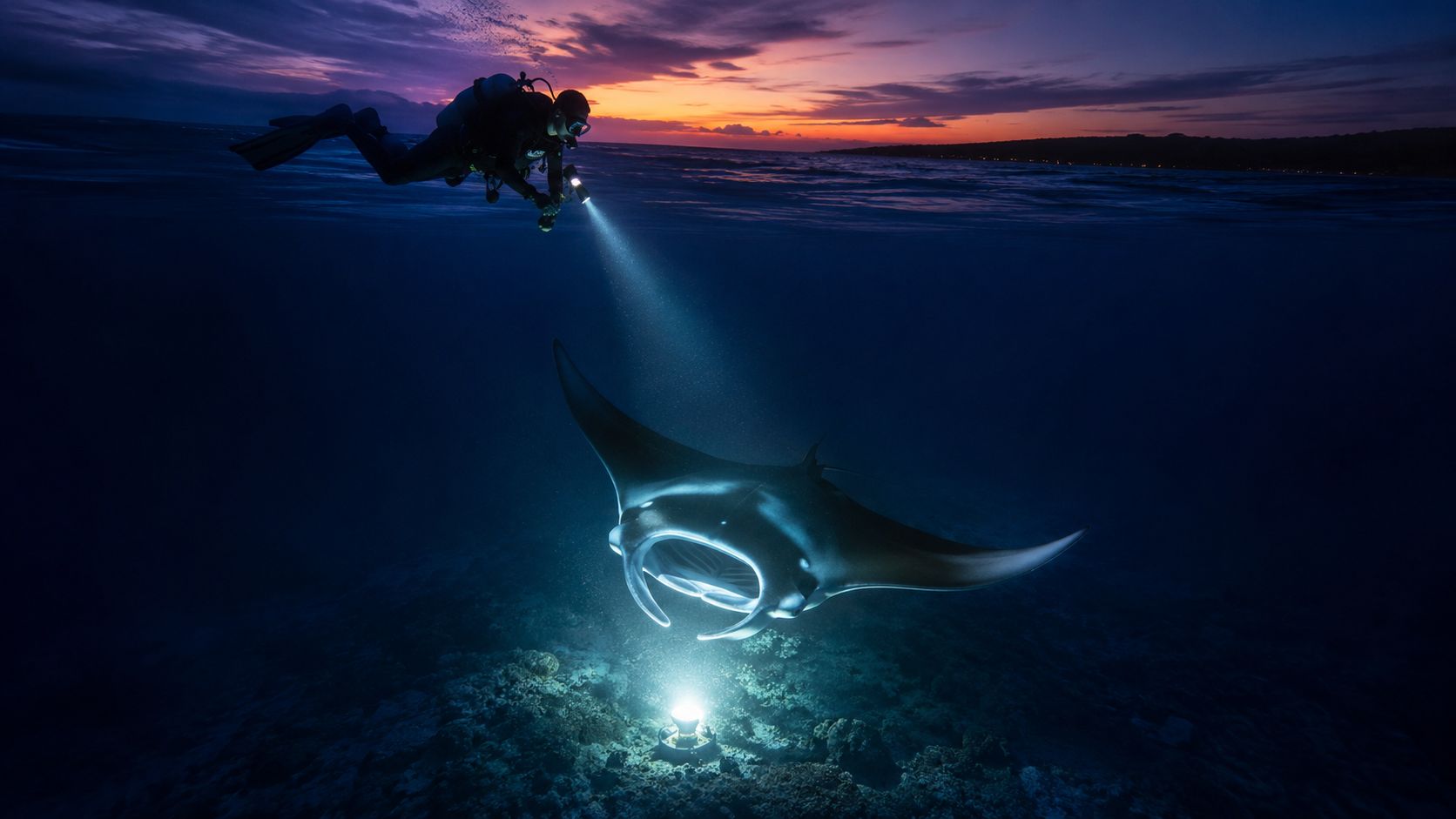
What makes the experience special is not just the animal. It is the way the encounter is set up. Done properly, the lights create a focused plankton buffet above the group, and the mantas choose to feed there on their own terms. That matters. The method is observation, not feeding, and good operators keep it that way because natural behavior gives guests a better show and puts less pressure on the animals.
The feeling underwater is hard to overstate. You are stationary, calm, and looking up while a wild manta turns overhead with complete control. There is no chasing, no crowding, and no need to swim after the action if the group is positioned correctly. The manta does the work. Your job is to stay still, keep your light where the guide tells you, and let the passes come to you.
A few parts of the encounter catch even experienced divers off guard:
- The scale: A close pass changes your sense of distance fast.
- The control: Mantas feed with precision, not chaos.
- The calm: The best groups are quiet, settled, and easy for the animals to work around.
That calm is not accidental. It comes from site choice, briefing quality, and crews who enforce the rules every time. I prefer operations that run the dive with discipline, because the trade-off is simple. Tighter control in the water gives guests better viewing and gives the mantas a clean, predictable feeding lane.
For travelers building a full dive trip, the broader mix of Kona Big Island diving options also matters. It helps to dive with one crew that knows your experience level, your weighting, and how you handle yourself in the water before you ever drop in for a manta night dive.
That is the main draw of this experience. You are not trying to force a wildlife encounter. You are entering a well-run underwater theater where the reef, the light, the current, and the mantas line up for a few extraordinary minutes. When the crew gets the details right, the result feels effortless. It never is.
What Makes the Kona Manta Ray Dive So Reliable
Reliability starts with a simple truth. Kona's manta dive is built around natural feeding behavior, not luck.
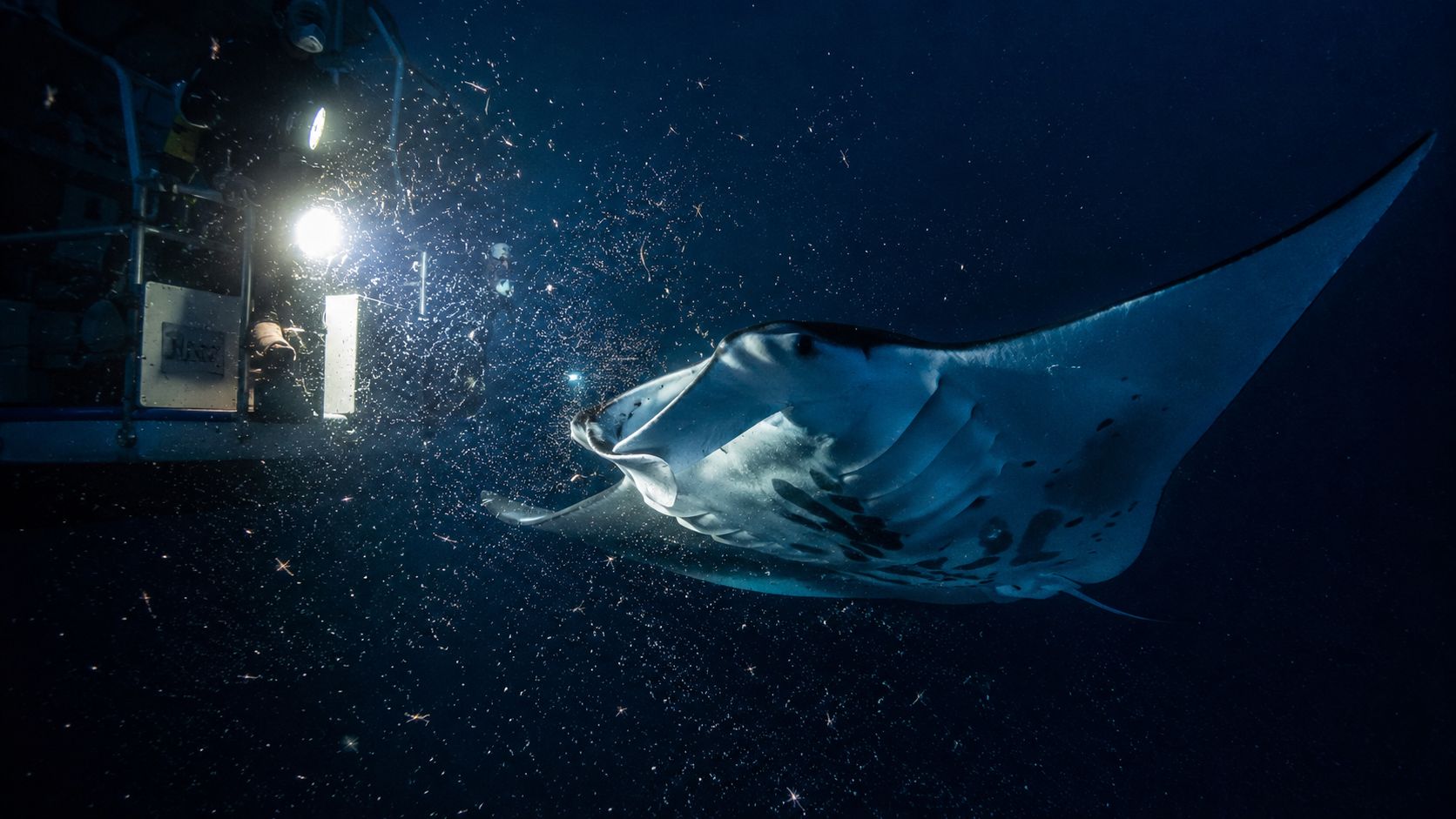
At night, plankton gathers in light. Mantas follow the plankton. A good crew uses that pattern to create a stable viewing area where divers and snorkelers can stay put while the animals feed above and around them. That is why the encounter is repeatable here. The biology is consistent, and the operation is designed around it.
The setup matters. So does discipline.
Operators use underwater lights in a “campfire” arrangement to concentrate plankton into a bright column. The mantas are not being fed by people. No one is handing them food or training them to approach guests. The lights draw in microscopic prey, and the mantas respond the same way they do anywhere food collects. That distinction matters for ethics and for safety, because the goal is to watch wild feeding behavior without interrupting it. If you want a clear picture of how the surface version works, Kona Honu Divers lays it out on their manta ray snorkel experience page.
Kona also has the right coastal conditions for this kind of dive. The leeward side is often calm after dark, which gives the plankton cloud time to build and gives the group a controlled place to stay organized. Good conditions alone are not enough, but they make proper execution possible.
Here's what keeps the dive dependable night after night:
| Factor | Why it matters on the dive |
|---|---|
| Light concentration | Pulls plankton into a feeding column that mantas can work repeatedly |
| Defined site layout | Keeps guests out of the flight path and reduces confusion underwater |
| Sheltered conditions | Helps the group hold position instead of drifting through the action |
| Resident manta patterns | Local reef mantas return to productive feeding areas again and again |
I have seen this dive go flat when a group is poorly briefed, lights are scattered, or guests keep reaching upward. Mantas feed with momentum and precision. They need a clean lane. Crews that hold a tight formation usually deliver the better show because the animals can keep feeding instead of adjusting to chaotic human movement.
That is also why Garden Eel Cove has such a strong reputation, which we'll examine in the next section. The site supports the method. The method supports the mantas. And when both are handled correctly, guests get a calm, close encounter that feels extraordinary without pushing the animals into it.
Choosing Your Adventure Scuba Dive or Snorkel
A lot of guests ask which is better. The honest answer is that scuba and snorkel give you two different shows. One isn't automatically superior. The right choice depends on your certification, your comfort after dark, and whether you want an upward theater view or a top-down view.
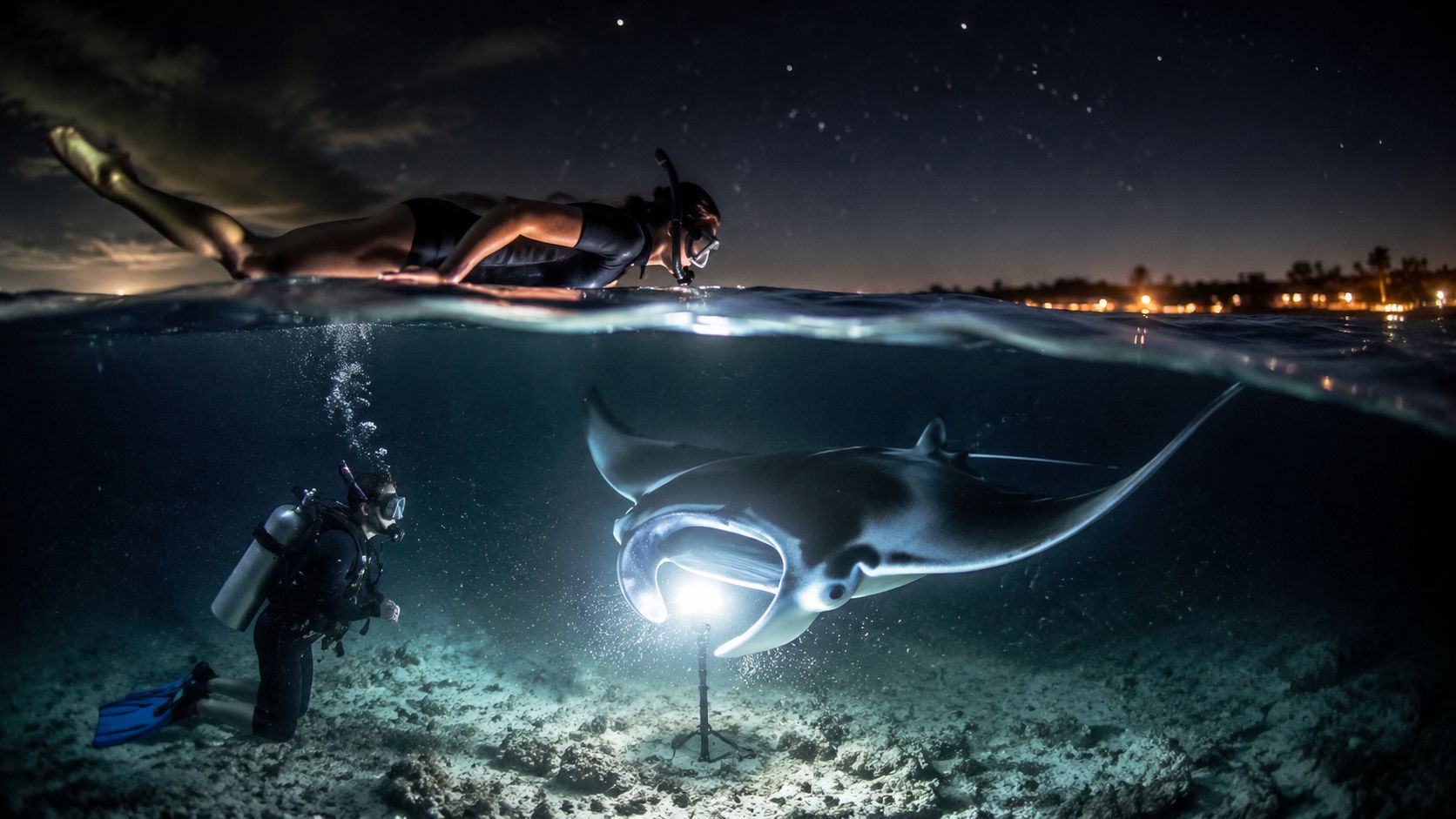
Kona's resident reef mantas typically reach a 14-foot wingspan. Each animal carries a unique belly spot pattern that works like a fingerprint for identification. Despite their size, they're harmless to people, with no teeth or stingers, and they're widely regarded as the most intelligent fish because of their large brains.
The side by side choice
| Experience | Best for | What you see | Main trade-off |
|---|---|---|---|
| Scuba dive | Certified divers | Mantas overhead from the seafloor | Requires certification and solid buoyancy |
| Snorkel | Families, non-divers, mixed groups | Full-body views from the surface | Less immersive if you want the underwater seat |
Why divers love the bottom view
On scuba, you descend, settle onto the sand, and look up into the lights. When a manta sweeps overhead, it fills your field of view. That perspective is hard to beat because the animals appear to fly directly above you.
This option works best for divers who are already comfortable with night procedures, mask clearing, regulator recovery, and neutral control in a group. The dive itself isn't physically demanding, but it punishes sloppy habits. If you can't hold position without kicking sand or drifting upward, your view gets worse and so does everyone else's.
Why snorkel often makes more sense
Snorkelers hold onto a light board at the surface while the mantas feed below. The view is broader. You can track the whole approach, turn, and exit of each pass instead of only the underside as it crosses above.
That makes snorkeling a strong choice for:
- Families: Mixed ages and mixed skill levels fit better on the same outing.
- Non-divers: No certification barrier.
- Guests uneasy underwater at night: Surface support helps.
- Travelers who want simplicity: Less gear, less task loading, faster learning curve.
If you want a dedicated surface option, snorkeling with manta rays in Kona gives a strong sense of how the light-board experience differs from the dive.
Practical rule: Pick the format that lets you stay calm. Relaxed guests notice more, breathe better, and follow directions cleanly.
The wrong decision usually comes from ego. Certified divers sometimes force themselves into the scuba option even when they haven't dived in a while or dislike night conditions. Non-divers sometimes assume snorkeling is the lesser experience. Neither is true. Choose the version that matches your real comfort level, and the encounter will feel much bigger.
The Premier Location Why We Dive at Garden Eel Cove
Site choice matters more than most visitors realize. A manta dive isn't just about being somewhere off Kona at night. It's about being in the specific place that gives mantas a reason to show up and gives guests a clean, protected way to watch.
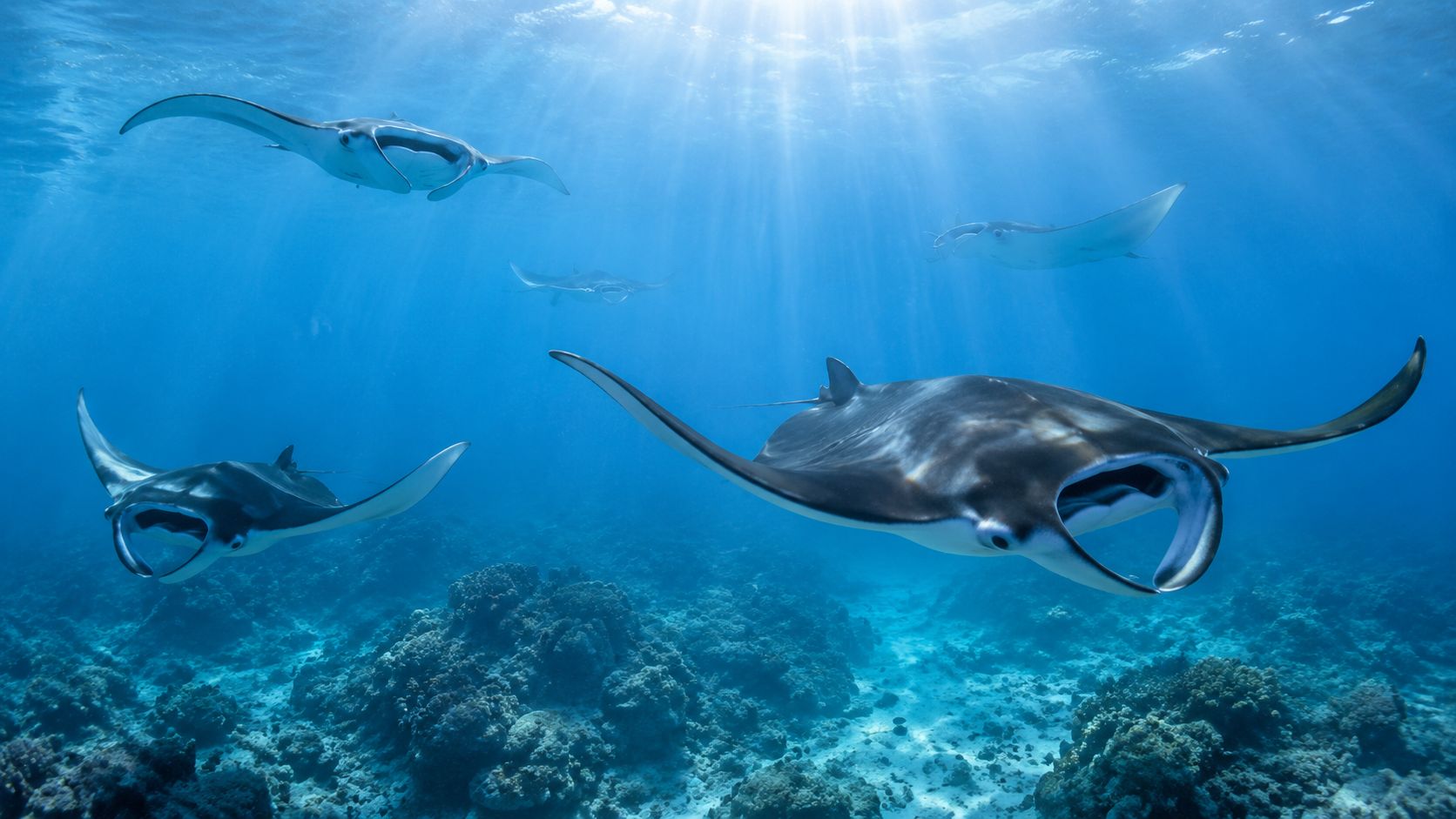
Garden Eel Cove is the superior manta dive site in Kona because its topography resembles an underwater amphitheater, and its coral heads function as cleaning stations where small fish remove parasites from mantas, creating a more predictable spectacle, according to Kona Honu Divers' Garden Eel Cove overview.
Why the amphitheater layout matters
From a divemaster's perspective, the site layout does half the work. You want a broad viewing area, room to place divers without stacking people on top of each other, and enough structure around the edges to help define the action without pinching it.
Garden Eel Cove gives you that. Divers can settle into a clear observation zone instead of hovering in scattered positions. That makes the site feel calmer and safer, and it gives mantas room to circle through the light repeatedly.
Why the reef quality matters
The better reefs around the cove do more than make the dive prettier. They help create a richer environment around the viewing area. When coral heads act as cleaning stations, mantas have another reason to return to the site beyond the plankton in the lights.
That combination matters. A site with only open water and a light source can produce passes. A site with structure, cleaning behavior, and a usable viewing bowl gives you a more complete encounter.
Here's what works in practice:
- Protected location: More comfortable conditions on many nights.
- Better viewing area: Easier diver placement and cleaner sight lines.
- Healthier reef backdrop: More engaging dive even before the mantas arrive.
- Cleaning stations: Natural manta behavior adds to the reliability of the site.
Good manta sites aren't equal. The best one is the site where the animals already want to spend time, not just the site where people shine the brightest lights.
Historical records also support the cove's reputation. Sightings at Garden Eel Cove have reached 28 mantas in a single night, while broader Kona records show an average of six rays per night and peak sightings above 36 at major sites including Garden Eel Cove and Manta Heaven. Those records reinforce what many local crews already know from repeated operations. When conditions line up, this site can put on a remarkable show.
If you want a broader sense of how site selection affects Big Island diving as a whole, where to dive on the Big Island gives useful local context.
Garden Eel Cove also rewards discipline. Because the viewing zone is so defined, poor positioning stands out fast. Divers who stay low, keep their light stable, and avoid wandering get the payoff. The mantas work the lanes. The group watches. The site does what it's built to do.
A Step-by-Step Timeline of Your Manta Night Dive
The evening usually settles into memory at one exact moment. Everyone is on the bottom, lights angled up, the water above the group turns white with plankton, and a dark shape appears out of the black. Then the first manta banks over the circle and the whole plan makes sense.
A well-run manta dive feels smooth because every step has a job. The timeline is simple. The discipline behind it is what makes the encounter work.
1. Harbor check in and gear setup
You check in, confirm gear, and get squared away before the boat leaves the harbor. If anything feels off, speak up then. A mask that leaks a little in daylight becomes a real distraction at night, and a diver who is uneasy before departure rarely relaxes once the lights go out.
Good crews solve small problems early because offshore is the wrong place to discover them.
2. The ride out and the first briefing
The boat ride is not downtime. It is where the crew builds the dive. You will get entry instructions, light procedures, hand signals, bottom positioning, and the order of exit.
Pay attention to the details. On manta dives, the guest who misses one instruction often creates the same problems every divemaster sees over and over. Silted visibility, wandering lights, crossed swim lanes, and a weaker show for the whole group.
3. Twilight reef dive first
On the two-tank schedule, the first dive happens around dusk. That first immersion does more than add bottom time. It settles breathing, confirms weighting, and gives divers a chance to slow down before the main event.
I like this format for a reason. Divers who enter the manta portion already trimmed out and relaxed are easier to place, easier to brief, and much more likely to hold still once the rays start working the light column.
4. Surface interval and manta briefing
Back on board, everyone resets. Warm up, drink water, eat a small snack, and listen carefully to the site briefing.
This part is more exact than many guests expect, especially at Garden Eel Cove. You will hear where to kneel or sit, where to point your beam, how to keep your fins out of the water column, and what to do when a manta passes inches over your head. The reason is straightforward. The campfire method only works if divers create a stable circle of light and then leave the feeding lane alone.
That is also the ethic of the dive. We are not feeding mantas by hand or pulling them into chaotic contact. We are concentrating plankton with light and letting the animals choose the interaction on their own terms. The same kind of responsible and considerate diver etiquette matters here even more because one careless diver can disrupt the entire pattern.
5. Descent into the dark
The second entry always feels different. The reef is darker, the boat lights are brighter, and every sound seems sharper.
Divers descend as a group to the designated viewing area, settle onto the sand or rubble, and aim their lights upward. Then the waiting starts. Some nights a manta shows up almost immediately. Some nights the site takes a few extra minutes to build. The correct response is the same every time. Stay low, stay calm, and keep the beam steady.
6. The first pass changes the mood
The first close pass usually quiets the whole group. You can feel the tension leave as soon as divers realize how controlled the encounter is. The manta is not crashing through the group. It is flying a feeding route that the light column makes easy to use.
Once that rhythm starts, the best thing a diver can do is nothing. Do not reach, do not pivot all over the bottom, and do not chase the better photo. At Garden Eel Cove, the viewing area rewards patience. Hold position and the mantas often come back across the same lane, closer and cleaner than any diver could force.
Stable divers create a stable show. The mantas keep feeding. The group gets the full overhead passes everyone came for.
7. Exit and ride back
When the dive ends, the crew brings the group up in an orderly sequence and gets everyone back aboard without rushing. After that, the boat ride home usually has a different energy. Wet gear is piled at your feet, people compare markings and passes, and the quiet guests from the ride out are suddenly talking over each other.
Snorkel trips follow a similar flow, just with the viewing platform at the surface instead of a seated circle on the bottom. The structure stays tight for the same reason. Predictable people make for better manta behavior, better visibility, and a much better night in the water.
Check Availability Check AvailabilitySafety Etiquette and Essential Preparation
The manta dive is easy to enjoy and easy to ruin. It works when guests understand one thing early. This is a passive observation activity. The mantas aren't there for contact. They're there to feed.
The ethical part matters as much as the safety part. The use of lights to aggregate plankton sits in a conservation gray zone, and that means the rest of the operation has to stay disciplined. No touching and no chasing are critical rules if the encounter is going to remain sustainable and non-disruptive to manta behavior, as explained in this guide to diving with manta rays responsibly.
The non negotiable in water rules
A safe manta site has clean lanes. Divers stay on the bottom. Snorkelers stay at the surface with the board. Nobody cuts across the feeding path.
That creates predictability for both people and animals.
- Stay in your zone: Divers remain settled. Snorkelers hold position at the board.
- Keep hands off: Touching can interfere with the manta's protective surface layer.
- Don't pursue: Chasing usually pushes animals off the line they were already using.
- Control your fins: Poor finning stirs sand and narrows visibility for everyone.
If you want a broader standard for ocean manners beyond this one dive, responsible and considerate diver etiquette is worth reviewing before the trip.
What to bring and what people forget
Night trips feel colder on the ride back than many guests expect. Pack for the boat, not only for the water.
A short checklist helps:
- Swimsuit and towel: Keep it simple and easy to change around.
- Light jacket or hoodie: The run home can feel chilly after dark.
- Reusable water bottle: Hydration helps more than people think.
- Certification card if diving: Don't assume a phone photo will solve every check-in issue.
- Dry bag: Handy for phone, keys, and extra layers.
Seasickness is a real issue on night boats
Even guests who never get motion sick during the day can feel it at dusk or after dark. If you know you're prone to it, prepare before boarding. Practical options include the Ship-EEZ Seasickness Patch, Dramamine pills, Bonine pills, Sea Band wristbands, and ginger chews.
What works best in practice is early prevention, not last-minute reaction. Take or apply whatever you trust with enough lead time to work.
Skill level and honest self assessment
The manta dive isn't deep or fast-moving, but that doesn't make it a beginner free-for-all. You still need decent buoyancy, comfort with darkness, and the ability to follow instructions without hesitation.
Some guests are better served by building skills first, then coming back for the manta night. Others are ready for more demanding local diving after the manta experience. For advanced profiles, options like the premium advanced long-range dive tour or the Blackwater night dive offer a very different kind of challenge.
The safest diver on a manta night dive isn't the one with the most dives logged. It's the one who knows their limits and stays disciplined.
Book Your Unforgettable Dive with Kona Honu Divers
I've watched this night change people in under ten minutes. The lights settle on the bottom, the plankton gathers, and the first manta comes in low and steady out of the dark. The whole dive works only when the crew sets it up correctly and the group holds position. That is why operator choice matters so much on a manta night in Kona.
Kona Honu Divers runs this trip the way it should be run. The briefing is clear. Entries and exits stay organized. In the water, the group forms a controlled campfire around the light source so the mantas can feed naturally in the beam without divers chasing them through the water column. That approach protects the encounter for the animals and gives guests a better view.
Garden Eel Cove is the right place to do it. The site is reliable, the layout suits the light-based viewing method, and experienced crews know how to keep the feeding lane open instead of turning the dive into a traffic jam.
What to look for before you book
Price matters, but it should not be the deciding factor on this dive. Ask a harder question. Will this crew give you a calm, disciplined, well-run manta experience?
Look for:
- A precise pre-dive briefing: Guests need to know exactly where to be, where not to be, and why those boundaries matter.
- Strong in-water supervision: Good guides correct drifting, light control, and spacing before small mistakes become problems.
- Respect for manta behavior: The goal is observation, not pursuit. The campfire method works because it invites mantas into a predictable feeding pattern.
- The right fit for your skill level: Some guests will enjoy the full dive. Others will have a better night snorkeling.
Kona Honu Divers also offers a full schedule of diving tours on the Big Island, which makes it easy to pair the manta night with reef dives, advanced charters, or a longer dive itinerary. If you want honest guidance on whether this trip fits your comfort level, schedule, or certification, contact the Kona Honu Divers team directly.
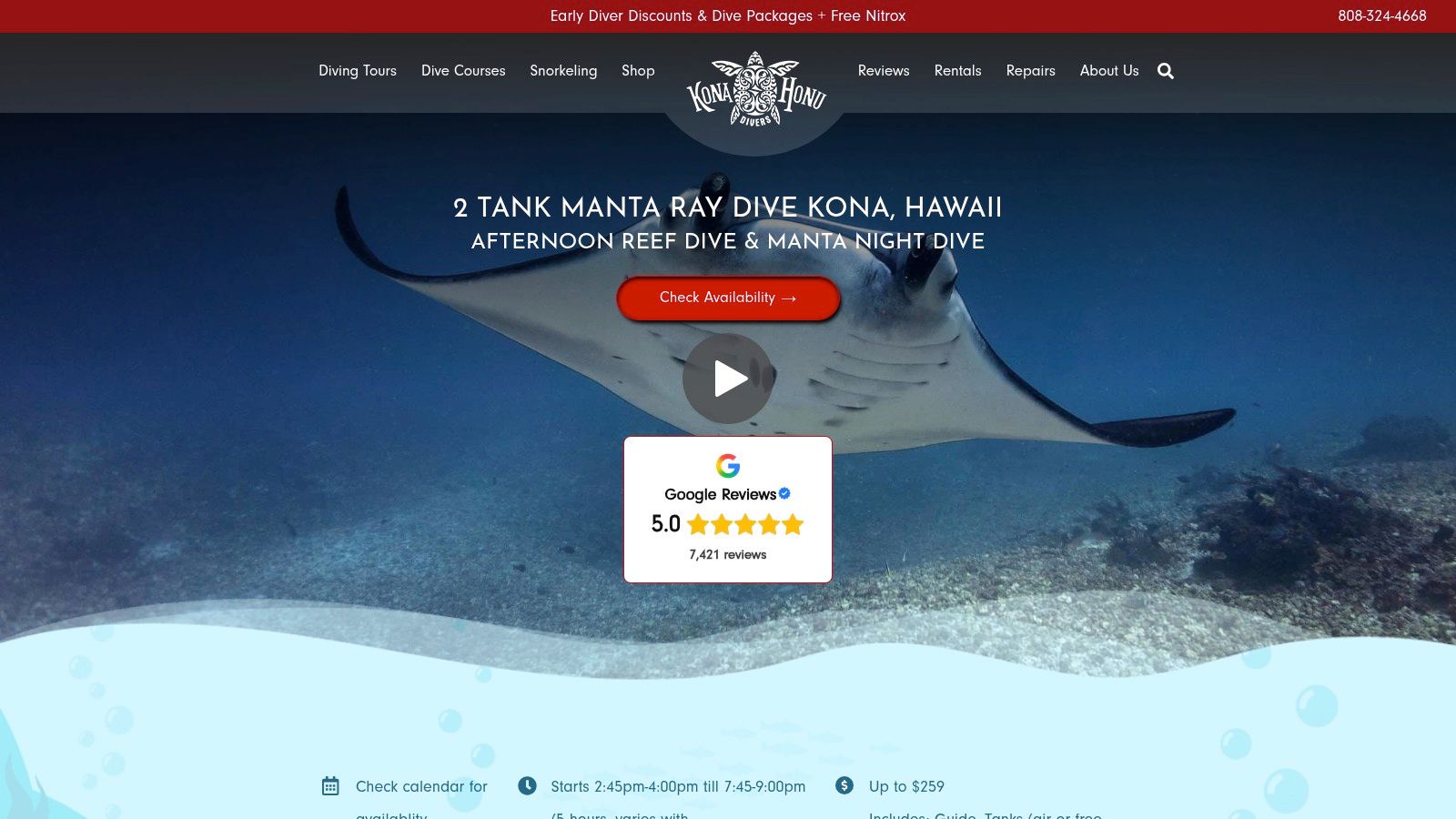
If the manta ray dive is the reason you're coming to Kona, book the charter built for that experience. As noted earlier, Kona Honu Divers offers a dedicated two-tank manta dive and snorkel trip designed around this site, this method, and this style of wildlife interaction.
Check AvailabilityKona has several manta operators. Very few consistently combine site choice, clean boat procedures, disciplined in-water control, and real respect for the animals. That combination is what makes the night memorable for the right reasons.