
Table of Contents
- Match the format to your actual comfort
- Why the bottom layout matters
- What to confirm before departure
- From boarding to the viewing area
- Prepare the camera before the action
- Set yourself up before settling
- Let a close pass remain the manta's choice
- Recognize congestion rather than counting heads alone
- Ask questions an operator can answer honestly
- Follow the food, not a calendar promise
- Individual animals use the coast differently
- Can I join if I'm not certified?
- What hours do manta tours run?
- Do I need my own light?
- Will I definitely see mantas?
- Can I touch or ride a manta if it comes close?
- Is the trip suitable for families?
- Reserve the right itinerary
- Check available departures
You've got an evening free in Kona, and the manta photos look extraordinary. Now you're comparing trips that sound almost identical, wondering whether you should dive or snorkel, whether the viewing site matters, and what happens if the mantas don't show up.
A Hawaii Big Island manta ray night dive is worth planning carefully because the wildlife is only part of the experience. Your position in the water, the crew's group management, the number of people sharing the site, and your expectations all affect how the night feels. Choose for those details, not just the closest-looking photograph.
Choose the Right Manta Night Experience
Choose your viewpoint before choosing your trip. Scuba puts you below the feeding activity, looking up. Snorkeling keeps you at the surface, looking down, without the equipment or responsibilities of scuba.
Manta and night options compared
| Experience | Best For | Where You Are | Requirement |
|---|---|---|---|
| Manta Ray Night Dive | Certified divers from beginner to advanced | Kneeling on the sandy bottom in a semicircle | Certified scuba diver |
| Manta Ray Night Snorkel | Non-divers and families comfortable entering the ocean at night | Floating at the surface | No scuba certification |
| 2-Tank Manta Dive and Snorkel | Divers and snorkelers wanting a daytime outing plus the manta encounter | Reef and bottom viewing area for divers; surface for snorkelers | Certification for scuba; no scuba certification for snorkeling |
| Black Water Night Dive | Experienced divers wanting open-ocean night diving | Open water away from the reef | Experienced certified divers |
The Manta Ray Night Dive is Kona's most popular dive. Powerful lights on the seafloor attract plankton, and feeding mantas can pass just inches away. That closeness is something the animals choose, not something a diver should try to create.
Certification makes you eligible, but comfort makes the experience enjoyable. A beginner who can control buoyancy, follow signals, and remain settled may be better suited than a frequent diver who dislikes stationary diving or darkness.
Match the format to your actual comfort
The night snorkel lets guests watch from the surface and is available for ages 5 and up, subject to the trip's participation requirements. It removes the scuba equipment, not the need for ocean comfort, listening skills, or appropriate supervision for children.
The 2-Tank Manta Dive and Snorkel combines a reef outing with the nighttime encounter. For a mixed group, distinguish the itinerary from participation: a snorkeler doesn't join a scuba dive just because both activities share a charter description.
The Black Water Night Dive is an open-ocean night dive for experienced certified divers, not another version of the stationary manta encounter. Divers seeking a more demanding daytime itinerary can consider the premium advanced two-tank trip.
Decision rule: If you're certified and comfortable settled on the sandy bottom, choose the dive; if you're not certified or don't want scuba gear, choose the snorkel.
Use this comparison of snorkeling versus diving with manta rays to settle any remaining uncertainty about perspective. Neither option needs to be a test of courage.
Garden Eel Cove Versus Keauhou
Garden Eel Cove is the superior choice for the manta dive tour because of its protected location, better viewing area, and better surrounding reefs. For a stationary dive, having a defined place to settle matters more than a site name that sounds appealing.
The Garden Eel Cove site guide places Manta Heaven off Kona International Airport and Manta Village off Keauhou Bay, and describes Garden Eel Cove's sheltered setting and viewing zone over reef and sandy bottom. That layout helps divers hold position while mantas feed overhead.
Garden Eel Cove and Keauhou compared
| Site | Setting | Typical Aggregation | Best For |
|---|---|---|---|
| Garden Eel Cove (Manta Heaven) | Protected northern site off Kona International Airport | Generally larger aggregations | Maximizing opportunities to see multiple mantas and using a consistent viewing area |
| Keauhou (Manta Village) | Off Keauhou Bay | Smaller aggregations, used more by females | Divers comparing site character; not the top pick for multiple-manta viewing |
A University of Hawai'i analysis available through Hawai'i DLNR found that Garden Eel Cove generally supported larger aggregations, while Keauhou was used disproportionately by females and the sites were ecologically connected. Those are patterns across observations, not a forecast for your booking.
Why the bottom layout matters
A good viewing area gives the crew room to arrange divers without spreading them into the feeding corridor. It also makes it easier to avoid live reef, settle without constant finning, and watch without repeatedly adjusting your position.
The reef quality matters for the broader outing, too. A manta charter shouldn't be judged only by the busiest moment under the lights; nearby habitat adds value to the reef portion of the experience.
Our go-to site at Kona Honu Divers is Garden Eel Cove because it's generally calmer and more protected from open-ocean swell, with a good viewing area and healthier reef. Protected doesn't mean weatherproof, though, and a captain's assessment of that evening's conditions takes priority over a preferred site.
What to confirm before departure
Ask which site the trip is scheduled to use on your booked evening, rather than assuming every Kona manta charter visits the same place. Also establish how you'll be notified if conditions require a change.
For our manta dive, Garden Eel Cove is the planned destination. What still needs checking is the ocean forecast and departure status, not whether a favorable site description guarantees a calm crossing or a crowded feeding session.
How the Night Encounter Unfolds and What to Bring
Plan to arrive with enough time to assemble your equipment without rushing. Before-dusk check-in is a useful expectation for an evening itinerary, but follow the departure instructions for your particular booking rather than arriving at sunset by assumption.
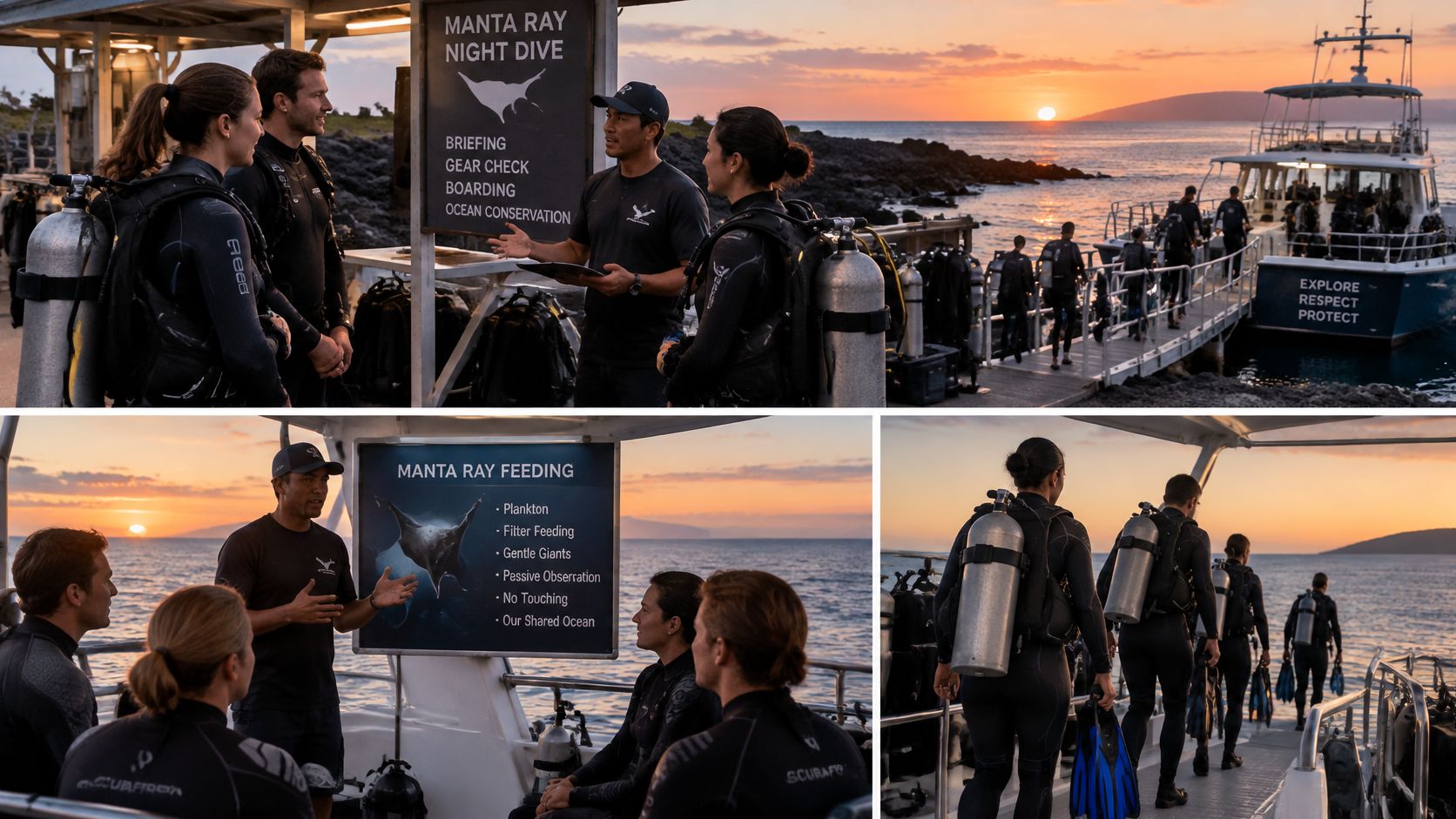
The crew briefing explains the feeding behavior and the golden rules of passive observation. Listen especially for the entry procedure, descent route, assigned viewing position, low-air signal, and how the group will leave the site.
Our experienced divemasters and instructors are in the water managing the group. Tell them before boarding if you're anxious about darkness, have trouble equalizing, or haven't used your equipment recently, rather than trying to explain a preventable problem after descent.
From boarding to the viewing area
Once the boat is secured and the crew has assessed conditions, you'll enter when directed and move to the designated area. Don't descend independently toward whichever light looks brightest, because neighboring groups may have separate arrangements.
The encounter is stationary and closely supervised. A bright circle of seafloor lights means the viewing area isn't completely dark, although you still need to manage your equipment and stay aware of your guide.
The Hawai'i Guide explanation of nighttime manta operations describes a commercial viewing window of 4:00 p.m. to 4:00 a.m., with vessels using commercial moorings and live boating restricted to entering and leaving the viewing area. Your departure is therefore a scheduled operation, not an invitation to search the coast indefinitely.
After settling, resist the urge to scan everywhere at once. Watch the illuminated water, keep breathing normally, and let your eyes adjust. A manta may make repeated feeding passes, disappear beyond the lights, or leave altogether.
Prepare the camera before the action
A wide-angle lens is a practical choice because it lets you frame a large animal without moving closer. Set a shutter speed fast enough for the movement and available light, then test your controls before entering.
Keep your camera tucked within your own space. Don't extend an arm or housing into a passing manta's route, and follow the crew's lighting instructions rather than using flash that could disturb the encounter.
If you'd rather concentrate on the dive than camera settings, review the manta night dive photo-package information before deciding what to carry.
Pack the night before:
- Warm layer and dry clothes: The ride home can feel cool after immersion, even when the afternoon felt hot.
- Appropriate exposure protection: A stationary dive can feel colder than an active daytime reef dive.
- Primary light and backup: Check batteries, switches, and attachment points; confirm what the charter supplies.
- Ready-to-use camera: Fit the lens, charge the battery, clear the card, and secure the housing.
- Certification details and personal equipment: Bring the items specified in your booking instructions.
- Towel and drinking water: Keep them accessible for the return, not buried under dive gear.
Ground Rules for Divers and Snorkelers
Vertical separation is the central rule. Divers stay on or near the bottom, snorkelers stay at the surface, and mantas get the open water between them.
The NOAA voluntary wildlife-interaction standard recommends this arrangement, along with upward-facing diver lights, no pursuit, and no positioning directly in a manta's path. It's a practical way to leave animals the three-dimensional space they need for repeated feeding passes.
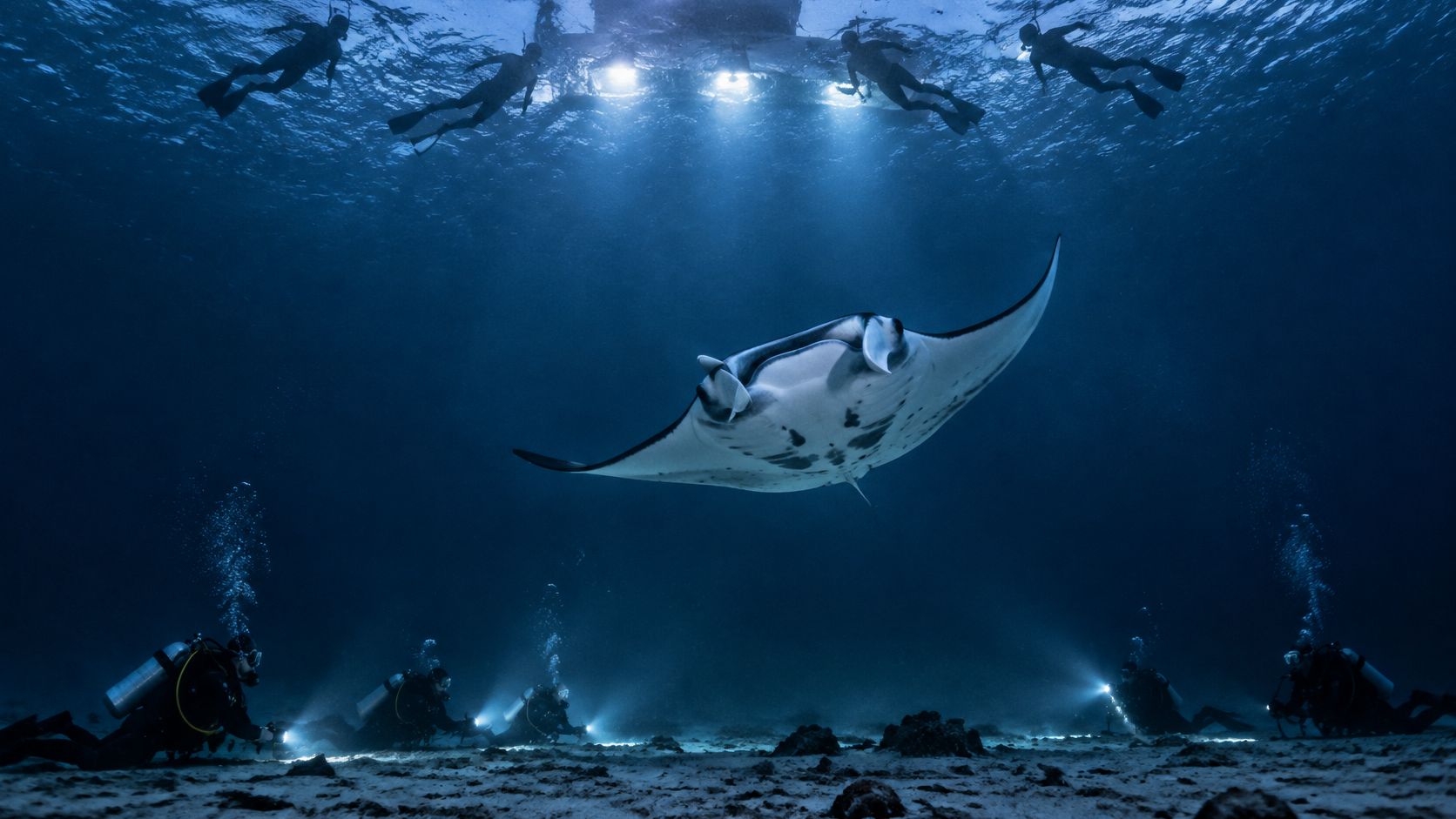
Positioning and light rules by role
| Role | Position | Light Use | Avoid |
|---|---|---|---|
| Scuba diver | On or near the bottom, in a semicircle | Light held above the head and aimed upward | Chasing, touching, vertical swimming, entering the feeding path |
| Snorkeler | At the surface | Light aimed downward | Freediving into the feeding column, touching |
| Photographer | Holding a steady position while shooting | Steady light aimed upward when diving, without sweeping | Moving into the path to get a closer frame |
Set yourself up before settling
Secure an alternate air source, pressure gauge, camera lanyard, and other dangling equipment before entry. A tidy configuration is easier to manage in low light and less likely to drag across the bottom or catch another diver.
At the viewing area, follow the guide's placement instructions. Use the designated sandy patch if directed to kneel, never live coral, and maintain enough buoyancy control that you aren't heavily planted or unexpectedly rising into the water column.
Hold your light above your head and aim it upward. Don't wave it across other divers' faces, track an animal with frantic movements, or use it to encourage a manta toward your camera.
Let a close pass remain the manta's choice
A body, rising diver, stream of bubbles, or swinging light in the feeding corridor can change a manta's approach and increase the chance of contact. If you need help or want to leave, signal your guide rather than swimming vertically through the center.
The manta encounter conduct guide specifies no touching, chasing, grabbing, riding, or harassment, and explains that contact can affect the animal's sensitive protective mucus layer. Snorkelers shouldn't freedive into the feeding column, even if a gap appears below them.
A close pass isn't permission to reach out. Keep your hands, camera, and fins within your own space.
For families, rehearse the response before entry: stay in position, keep hands in, and follow the guide. Children and excited adults both benefit from knowing what to do before an animal fills their view.
Apply the same responsible diver etiquette to neighboring guests. Don't block someone's view to improve your own, and don't kick backward without checking behind you. Stillness matters more than proximity.
Crowding and Quieter Nights Worth Considering
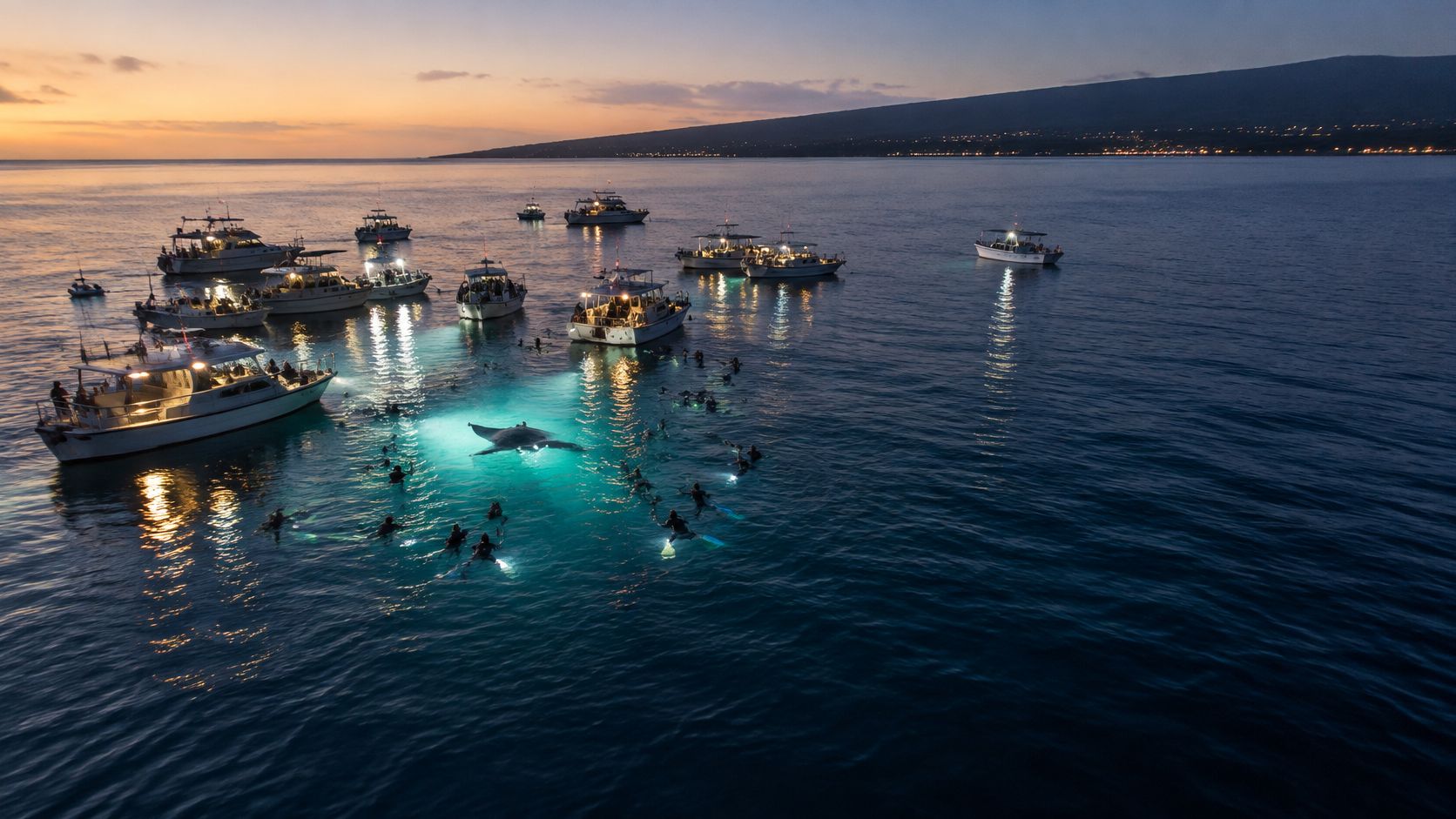
More mantas don't necessarily mean a better dive. A busy feeding session can still feel cramped if you're watching around other divers, keeping clear of fins, or struggling to follow your guide through a crowded entry.
A survey of 444 manta-viewing participants found that 82% felt crowded by snorkelers, 78% by boats, and 69% by scuba divers; respondents said they would accept averages of no more than 52 snorkelers, 32 divers, and 11 boats at one time.
Those responses describe visitor tolerance, not legal capacity or a proven ecological safety threshold. They're useful because they show that an encounter can be memorable and overcrowded at the same time.
Recognize congestion rather than counting heads alone
A packed surface, divers pressed together on the bottom, several vessels waiting to use the area, and guides repeatedly repositioning groups are reasons to pay attention. None proves a session is unsafe by itself, but together they can indicate limited room for comfortable observation.
The important question is whether people can hold their assigned positions without blocking animals or one another. A group that repeatedly spills into the feeding lane is a more useful warning sign than boat numbers viewed from a distance.
The same visitor-management literature identifies boat strikes, diver contact, and concentrated human activity as concerns. Experts disagree about whether attraction lights themselves cause significant harm, so don't treat either “lights are harmless” or “lights are the entire problem” as a settled answer.
Ask questions an operator can answer honestly
Use these questions before committing:
- Expected diver-to-manta ratio: “How many divers are planned for our group, and how do you manage the viewing area if few mantas arrive?” Nobody can promise the animal side of that ratio.
- Boats sharing the site: “What boat traffic do you expect, and what happens if the preferred viewing area is already congested?”
- Group limits and supervision: “How are participants grouped, and how do guides keep people from spreading into the feeding corridor?”
Our in-water divemasters and instructors manage the dive group, but no crew can promise that other operators won't also visit the site. Clear supervision is an operational commitment; an empty ocean is not.
Choose a quieter available session or alternative itinerary when your family needs more space, your photography depends on an unobstructed position, or you know crowded water will make you tense. Accepting fewer sightings can be a sensible trade for a calmer encounter.
Why Mantas Come and Go on Some Nights
Kona's night-dive phenomenon developed in the early 1990s, when artificial lights concentrated plankton near shore and created predictable feeding opportunities, according to the historical manta monitoring testimony submitted to the Hawai'i Legislature. That earlier monitoring estimated a local population of fewer than 200 animals and recruitment of roughly 4.27 new pups per year.
Those historical estimates describe a small resident aggregation, not an unlimited supply of animals passing through. They also shouldn't be mistaken for a current population census.
Follow the food, not a calendar promise
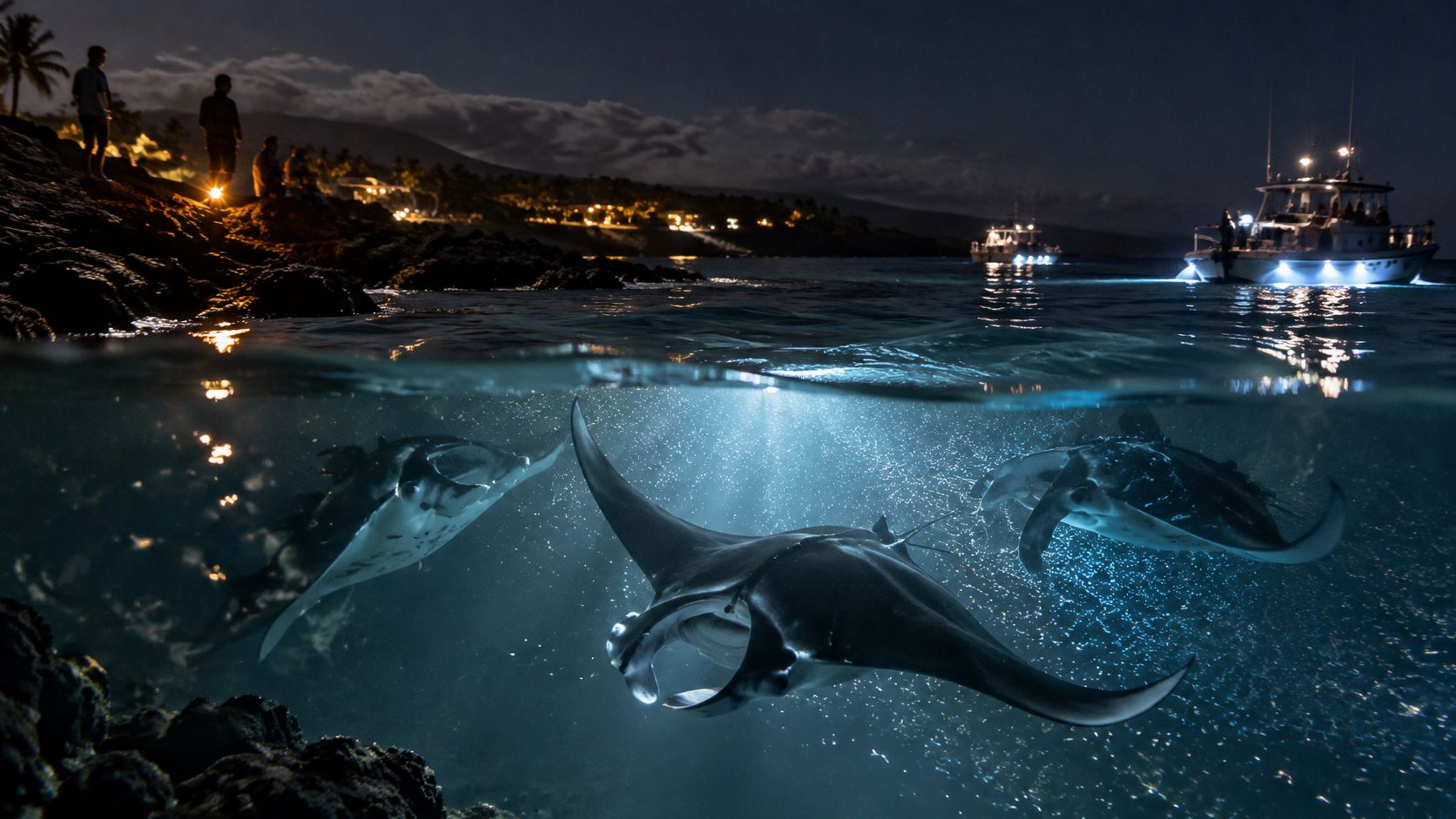
The mechanism is straightforward: lights concentrate zooplankton in illuminated water, and mantas filter-feed by passing through that prey patch. The lights create an opportunity, not an obligation for a manta to appear.
A University of Hawai'i analysis of Kona's feeding aggregations examined more than 23,000 observations involving 167 individually identified reef mantas from 2010 through 2022, finding that aggregation size tracked zooplankton density. Food availability is therefore more useful than the idea of a fixed manta season for explaining encounter intensity.
Researchers recognize individuals by the distinctive spot patterns on their undersides. Photo-identification allows them to follow repeat visitors without capturing the animals, and helps explain why an apparently similar gathering can involve different individuals.
Individual animals use the coast differently
The Hawaiian reef manta population and movement assessment hosted by NOAA describes relatively small island-resident populations and differences in movement, with some animals, especially females, showing resident patterns while more mobile individuals have longer gaps between sightings.
That makes a sparse evening biologically plausible. Local prey conditions may be less favorable, familiar animals may be elsewhere, or visitors may feed briefly and move on.
Plan for uncertainty: Reserve your preferred evening early enough in your stay that another suitable night remains available.
A safety cancellation and a completed trip with sparse wildlife are different outcomes. Before paying, read how the booking handles weather cancellation, rescheduling, and low-sighting evenings; don't assume those situations trigger the same remedy.
For timing decisions, use the guide to the best time to see Kona's manta rays alongside your actual travel flexibility. Choose Garden Eel Cove as the preferred dive site, leave a backup evening, and avoid making the encounter your final possible activity.
A second opportunity improves your flexibility, not your entitlement to wildlife. If the mantas stay away, observe other nocturnal marine life within the guide's plan rather than turning the dive into a pursuit.
Manta Night Dive FAQs
Can I join if I'm not certified?
Yes, through the surface snorkel option, available from age 5 and up under the applicable participation requirements. The scuba night dive requires certification; enthusiasm or previous snorkeling doesn't substitute for it.
What hours do manta tours run?
Commercial viewing takes place within the nighttime operating window, but your booking gives the check-in and departure time you should follow. Don't confuse the broader permitted window with the duration of an individual tour.
Do I need my own light?
Prepare a primary dive light and backup, and establish which equipment is supplied before packing. Underwater, use the light according to the briefing rather than improvising a different arrangement.
Will I definitely see mantas?
No. A backup night is the most useful scheduling safeguard, but it still can't guarantee an encounter. Read any return-trip terms carefully rather than assuming a no-sighting evening automatically includes another charter.
Can I touch or ride a manta if it comes close?
No. Keep your hands to yourself, don't grab or ride, and let the animal pass without interference. Snorkelers must also stay out of the feeding column.
Is the trip suitable for families?
It can be, when each person meets the participation requirements and feels comfortable entering dark ocean water. Certified family members may dive, while non-divers use the surface option.
- For parents: Discuss darkness, flotation, and following a guide before booking.
- For certified divers: Be candid about recent experience and comfort, not just certification level.
- For mixed groups: Confirm which activities each person is joining so nobody expects a scuba experience without certification.
A willing child and a relaxed adult usually make a better starting point than a reluctant guest being persuaded at the dock. Choose the format for the least comfortable participant, not the most enthusiastic one.
Book Your Manta Ray Night Dive with Confidence
Book around certification, site choice, and controlled observation. Those decisions give you something useful to evaluate before departure, unlike a promise about how many wild animals will appear.
At Kona Honu Divers, our signature manta ray night dive is open to all certified divers, from beginner to advanced. Experienced divemasters and instructors are in the water with the group, and Garden Eel Cove is our go-to site for its protection, good viewing area, healthier reef, and generally calmer conditions.
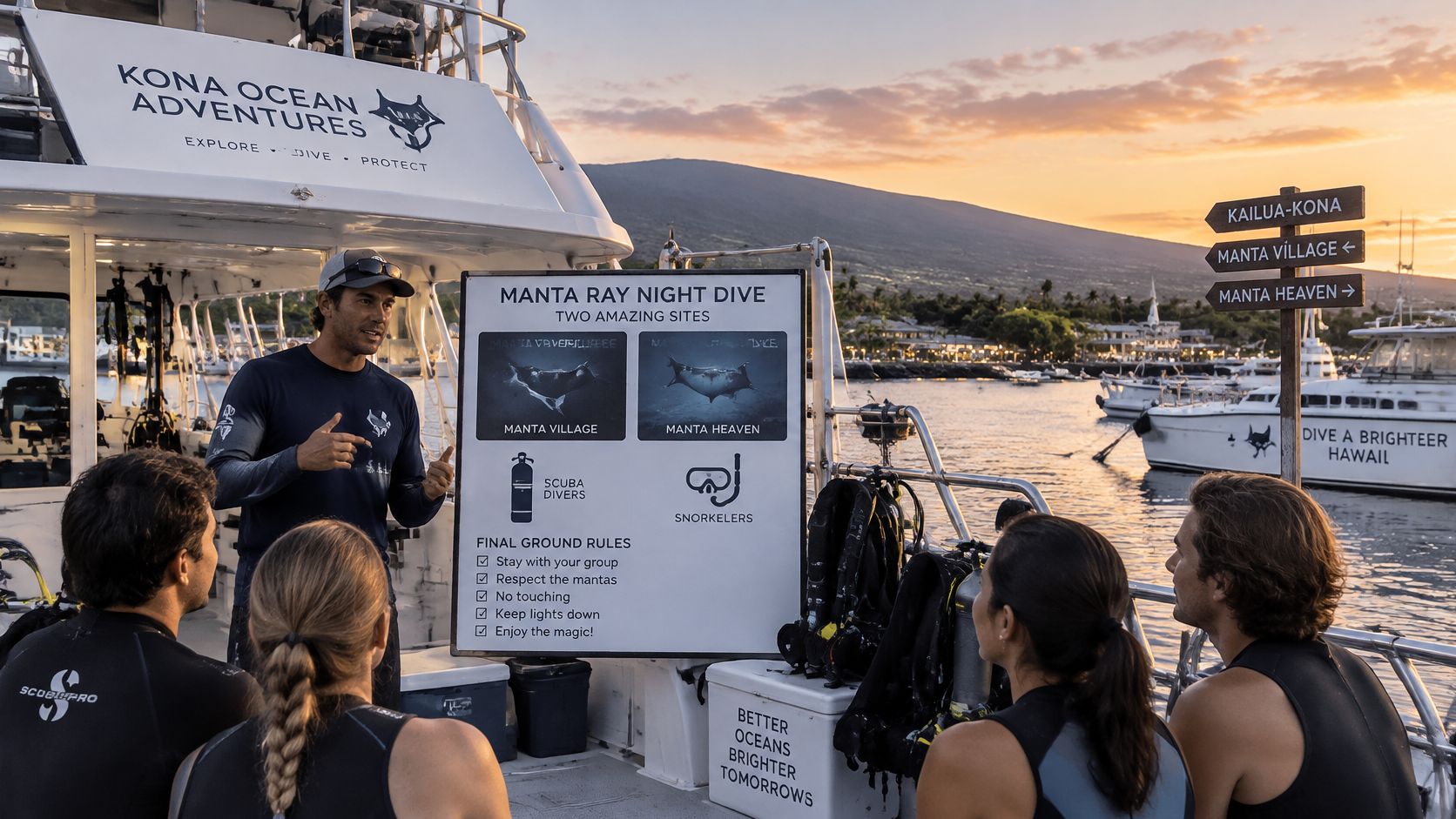
Our manta trips have had encounter rates as high as 92%. Treat that as a record of reliability, not a guarantee for your evening, and keep enough flexibility in your itinerary to respond to weather or a quiet night.
Reserve the right itinerary
The two-tank manta itinerary suits certified divers who want the reef portion and nighttime encounter together. A separate snorkel-only manta option is available for non-divers who want the surface perspective without scuba equipment.
For a broader look at what fits your visit, browse our diving tours overview. Experienced divers considering blackwater should choose it for its open-ocean setting, while advanced daytime divers should match the premium itinerary to their experience rather than treating either trip as an upgrade everyone needs.
Use the guide to choosing a Kona diving operator to evaluate communication and operational fit. Useful answers concern where you'll go, how you'll be supervised, and what happens when conditions change.
Before reserving, make sure your group agrees on the essentials:
- Participation: Each diver is certified, and every snorkeler understands the surface-only experience.
- Comfort: Nobody is hiding concerns about darkness, equipment, or entering the ocean.
- Scheduling: Your preferred date leaves a realistic backup opportunity.
- Expectations: Everyone understands that wildlife numbers and proximity remain outside the crew's control.
Check available departures
Use the dive booking calendar for scuba departures. If your group is choosing the separate surface-only encounter, use the manta snorkel calendar instead so you're reserving the correct activity.
Manta snorkel-only availability
Guest reviews can help you assess whether the crew's communication and approach suit your group. Read them for those operational details, not as evidence that your night will have the same wildlife.
Kona Honu Divers offers guided manta ray night dives at Garden Eel Cove, with in-water supervision and a viewing setup built around passive observation. Visit Kona Honu Divers to choose the trip that matches your certification, check sea conditions before departure, and reserve a date with a backup night available.