
Table of Contents
- Big Island manta ray night dive at a glance
- A recurring feeding opportunity
- Attraction isn't the same as proven harm
- Garden Eel Cove compared with Keauhou
- Check the operating zone before booking
- Who can join and what to bring
- Assemble gear around control, not accessories
- Before leaving for the harbor
- At the boat and underwater
- Why repeat visits make stewardship important
- Starting camera settings for night manta photos
- Technique matters more than a preset
- What if no mantas appear?
- How long does it last and when does it start?
- Is the viewing site legal?
- Can I move closer for a better view?
- Questions worth asking before paying
You've got an evening open in Kona, a scuba certification, and a question that's harder to answer from tour photos: what's it like to wait underwater in the dark for a manta ray? The useful answer starts with the setup, not the animal. A good Hawaii Big Island manta ray night dive depends on a suitable site, an organized crew, and divers who can hold position without getting in the way.
The mantas remain wild. Operators create an illuminated feeding opportunity, but they can't schedule an arrival or promise a close pass.
What the Big Island Manta Ray Night Dive Involves
Divers settle low over a designated sandy area while powerful lights shine upward into dark water. If a manta arrives, its pale underside becomes visible as it glides through the glow, turns, and approaches the illuminated water again.
Your job isn't to swim alongside it. It's to maintain control, leave the water column open, and observe. This is wildlife observation, not a guaranteed show.
Big Island manta ray night dive at a glance
| Detail | What to Know |
|---|---|
| Species | Reef manta ray, Mobula alfredi |
| Who dives | Certified scuba divers who are comfortable in open water after dark |
| Recommended site | Garden Eel Cove |
| Light setup | Divers occupy assigned positions low around strong operator lights |
| Manta identity | Unique belly markings identify individuals; more than 300 have been named near Kona |
| Certification | Open Water is the usual minimum; confirm the operator's requirements |
| Season | Sightings vary with plankton density. There's no established month-by-month pattern in the research discussed here, so ask about recent sightings and typical dive times |
| Viewing guarantee | None; the animals choose whether to visit |
The appeal is the perspective. Instead of searching a reef while swimming, you watch a large filter feeder maneuver through open water above you. That stationary format can feel surprisingly calm, provided you're comfortable managing scuba equipment after dark.
Start with the manta ray dive tour details to understand the trip format. Compare the broader Big Island diving tours if you'd also like a reef-focused outing.
Planning rule: Choose the trip for its site management and your own readiness, not a photograph of the closest possible encounter.
Why Manta Rays Gather Under Dive Lights
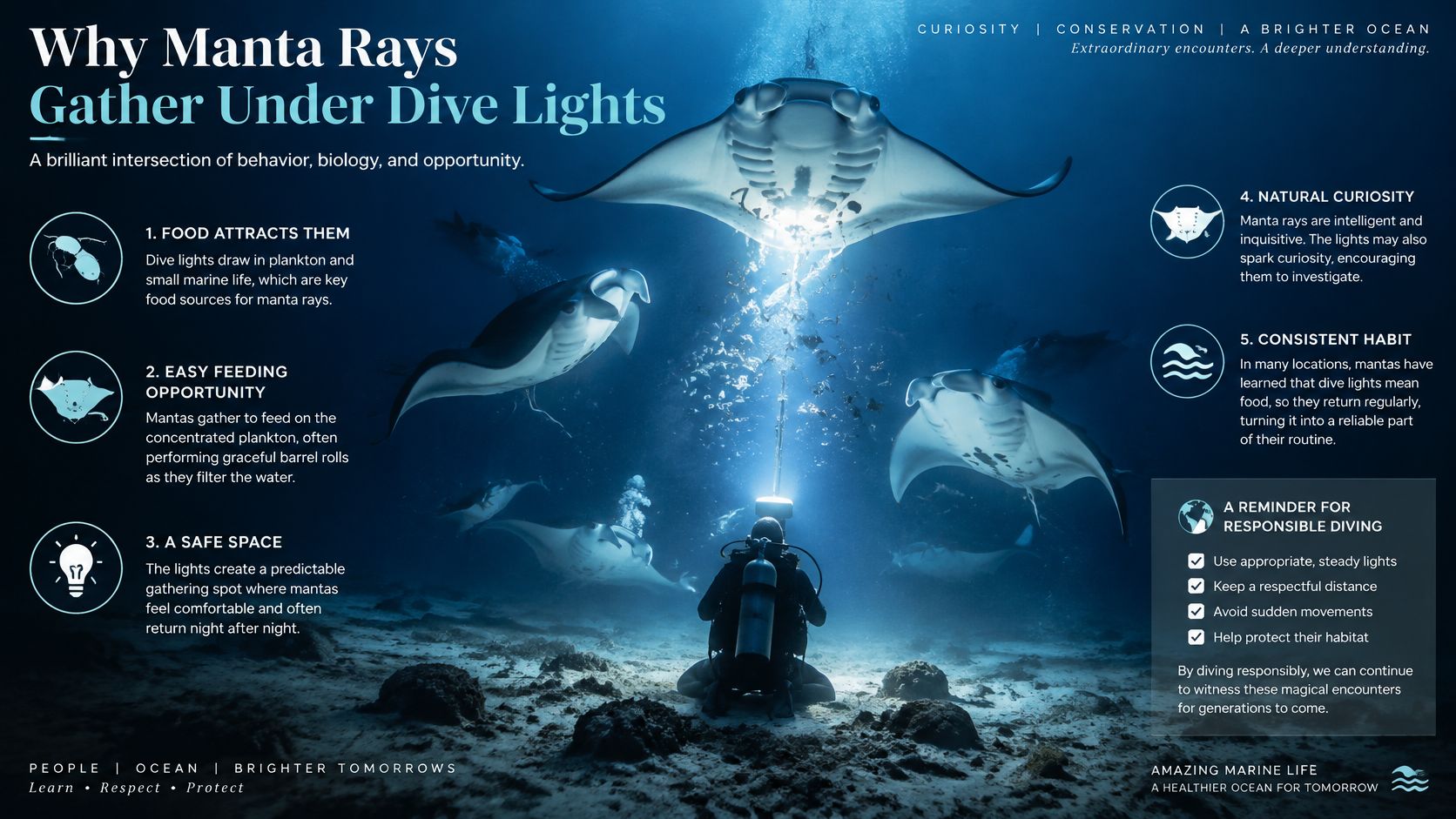
A porch light draws moths on a summer evening. Kona's dive lights draw light-responsive plankton, and manta rays follow that concentrated food.
Reef mantas are suspension feeders. They open their mouths and use cephalic fins to direct water inward, while gill rakers retain zooplankton. The lights don't deliver food directly to a manta's mouth; they help concentrate prey already in the water.
A recurring feeding opportunity
The encounter's history reaches back to artificial lighting near Keauhou in the late nineteen-seventies. Researchers subsequently documented repeated visits by an identified female later known as Lefty, helping establish that these animals could return to particular feeding locations rather than merely pass through.
Photo-identification made those repeated visits trackable. A manta's belly pattern works as an individual identifier, letting observers distinguish familiar animals from new arrivals.
The scale of monitoring is substantial. A University of Hawaiʻi study published in 2025 examined more than 23,000 sightings of 167 individuals across 2010–2022 at Garden Eel Cove and Keauhou, linking aggregation changes closely to zooplankton availability.
Attraction isn't the same as proven harm
Calling this an untouched natural spectacle leaves out the operator's role. People place the lights and determine where participants wait, shaping the feeding opportunity and the space available around it.
The research on manta-viewing tourism and management provides useful context for evaluating this human-created aggregation. It doesn't establish that lights alone damage the population.
The practical conclusion is narrower and more useful: light placement, timing, and participant density matter. A responsible encounter acknowledges that human influence instead of promising an entirely unmodified wildlife experience.
Choosing Garden Eel Cove for Your Night Dive
Garden Eel Cove is the superior choice for this dive, particularly when you value a protected location, an organized viewing area, and better surrounding reefs. Those advantages support the part of the experience you can plan: where you'll wait and how comfortably you can remain there.
Protection isn't a promise of flat water. The captain still needs to assess the actual swell and conditions, and a sheltered site doesn't excuse poor positioning.
Garden Eel Cove compared with Keauhou
| Site | Shelter | Typical Aggregation | Viewing Area and Reef |
|---|---|---|---|
| Garden Eel Cove | Protected location | Consistently larger aggregations in the monitoring study discussed above | Better viewing area and better reefs |
| Keauhou | Not established by the cited comparison | Smaller aggregations; disproportionately more female visits | Comparative reef condition isn't established; check with the operator |
The study also found some connectivity between these locations. That doesn't mean they're interchangeable for planning, or that an individual animal will appear at either site on your chosen night.
The marine-life viewing guidance describing this arrangement emphasizes leaving the animals' maneuvering space open. Garden Eel Cove's favorable viewing area makes that practical: guests can watch without moving into the feeding corridor, while careful placement helps protect the surrounding habitat.
Check the operating zone before booking
The DLNR commercial manta-viewing rules specify designated operating areas and allow commercial scuba operations only within the Makako Bay manta-ray viewing zone. Ask the operator to confirm that its Garden Eel Cove dive position falls within that zone.
That's a better question than just asking whether a boat goes to a popular site name. Also ask about recent sightings, expected departure arrangements, and what happens if conditions require a change.
A protected location helps. A captain willing to change or cancel a plan helps more than a fixed promise to visit it.
Certification, Gear and Who Should Dive
Certification gets you considered for the trip. Comfort, recent practice, and the ability to manage equipment in darkness determine whether it's a sensible choice tonight.
Who can join and what to bring
| Participant | Certification or Experience | Gear to Bring | Notes |
|---|---|---|---|
| Certified Open Water diver with recent dives | Certification and logbook | Mask, fins, exposure protection, dive computer | Standard candidate, subject to operator approval |
| Newly certified diver with few dives | Certified and comfortable in open water | Properly fitted rental gear and backup light | Ask about pairing and supervision |
| Advanced or night-certified diver | Relevant training and current skills | Familiar gear and spare light | Training helps, but doesn't replace buoyancy control |
| Guest with a medical question | Medical review or clearance where required | Completed medical form | No universal minimum dive count is established here; confirm directly |
If you're still working toward certification, review the Open Water certification course rather than treating a manta excursion as an introductory scuba lesson.
Assemble gear around control, not accessories
Start with exposure protection, then check your BCD and regulator assembly before adding smaller equipment. A rash guard or appropriately fitted wetsuit should match your comfort and the operator's advice; don't assume you'll stay comfortable just because you're in Hawaii.
- Mask and fins: Bring familiar equipment where possible, or check rental fit before departure.
- BCD and regulator: Confirm operation, alternate air source placement, and hose routing with your buddy.
- Dive computer: Know how to read its display in darkness.
- Primary and backup lights: Make sure both work and that you can reach the backup easily.
The key skill is maintaining a stable, low position without uncontrolled contact with the bottom, coral, or animals. If the crew uses a designated sand-only kneeling area, follow that specific instruction rather than assuming any bottom contact is acceptable.
Leave elaborate camera equipment behind if managing it would compete with basic dive control. A calm, attentive diver is better prepared than an overloaded one.
How to Prepare for Your Night Dive, Step by Step
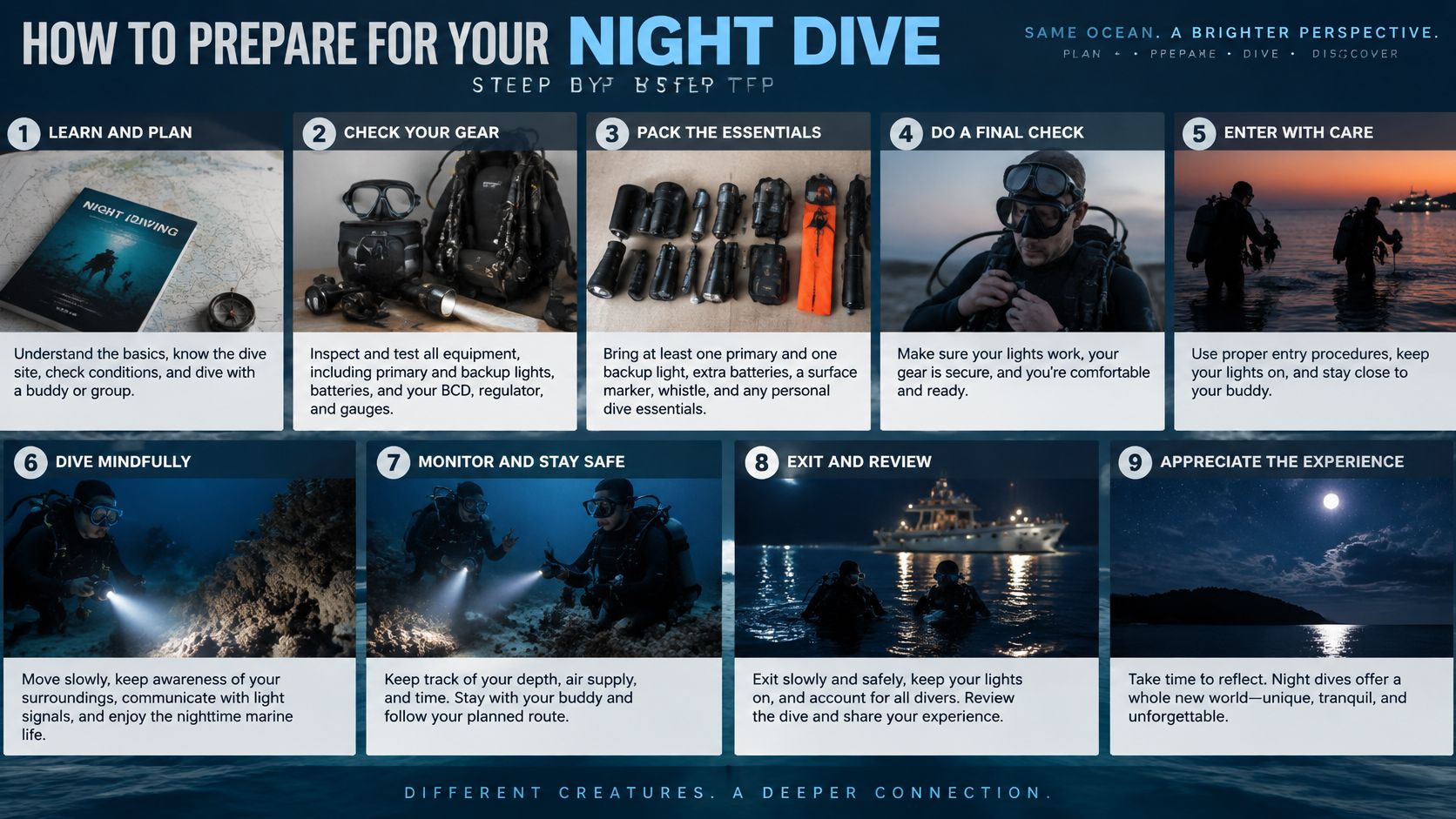
Preparation should remove decisions you'd otherwise have to make in dark water. Use this sequence alongside the operator's briefing and its practical introduction to scuba diving at night.
Before leaving for the harbor
Confirm eligibility and complete the medical questionnaire. Tell the operator when you last dived and disclose relevant medical questions before committing. A preventable slip is assuming a certification card answers every readiness question.
Check conditions and cancellation arrangements. Ask how the crew assesses swell and what happens if the trip can't operate. Don't interpret a pleasant afternoon on shore as confirmation of suitable offshore conditions.
Skip alcohol and arrive rested. Treat this as a dive requiring attention, not an extension of an afternoon celebration. The avoidable mistake is showing up tired and expecting excitement to compensate.
Eat sensibly and hydrate beforehand. Choose a manageable meal rather than boarding immediately after heavy food. Don't leave all your preparation until check-in.
At the boat and underwater
Pack a working backup light and appropriate spare batteries. A dead primary light can end a dive early, and testing it beforehand is straightforward. Don't bury the backup where you can't retrieve it while wearing your gear.
Listen for the complete plan. Learn the hand signals, entry procedure, assigned viewing position, exit route, and emergency arrangements. If you missed something while assembling equipment, ask the crew to repeat it.
Test equipment before entry. Check the mask, regulator, BCD, computer, and both lights with your buddy or guide. Switching a torch on briefly isn't a substitute for checking its condition and attachment.
Descend as directed and establish control first. Find your assigned area, settle your breathing, and adjust buoyancy before concentrating on the water overhead. Repositioning excitedly when a manta approaches is precisely what you're trying to avoid.
A good start looks uneventful: you can find your buddy, read your instruments, and see open water without unnecessary fin movement. If you can't get comfortable, signal the guide early rather than trying to conceal the problem.
Before the first pass: Sort yourself out while there's nothing demanding your attention.
Staying Safe and Protecting Kona’s Mantas
Use this in-water checklist to keep the encounter controlled:
- Aim lights into open water. Keep beams elevated and away from other people's faces, preserving the intended illuminated feeding space.
- Never touch, chase, or grab. These are no-contact encounters; don't turn an animal's approach into an attempted interaction.
- Control your position. Avoid drifting into coral, the seafloor, or an approaching manta.
- Manage bubbles thoughtfully. NOAA guidance recommends timing exhalation when possible to avoid discharging bubbles directly into a manta overhead. Never hold your breath to get a cleaner pass.
- Respect the assigned spacing. Stay where the crew positions you so participants don't block the feeding corridor.
- Keep equipment contained. Hands, fins, hoses, and cameras need to stay clear of the animals.
These practices follow the DLNR manta-ray species guidance. Review the broader responsible diver etiquette recommendations before boarding, not while an animal is approaching.
Why repeat visits make stewardship important
Long-term Hawaiian manta research on residency and site fidelity documents repeated use of local aggregation areas and indicates island-associated populations. Disturbance therefore affects animals that may return to these same places, rather than an endlessly interchangeable stream of visitors.
The appropriate response is low-impact behavior on every outing, not an unsupported claim that any illuminated encounter causes harm. If a manta changes direction, hold your position instead of following.
Photographing Mantas Without Disturbing Them
The operator's lights provide the scene's main illumination, but brightness changes as animals move through the beams. Your first task is to stay steady and keep the housing outside their path, not to force every pass into a photograph.
Starting camera settings for night manta photos
Treat these as adjustable photographic suggestions, not guaranteed exposure settings.
| Setting | Starting Point | Why It Matters |
|---|---|---|
| ISO | Low to moderate, increasing only as needed | Balances image noise against available light |
| Aperture | Moderately stopped down if illumination permits | Provides more depth of field, but requires more light |
| Shutter speed | Fast enough for the movement you're seeing | Helps limit blurred wingtips |
| Flash | Off initially; follow crew rules before using it | Reduces intrusive lighting and potential backscatter |
Check a test frame before the encounter becomes busy. If it's too dark, adjust deliberately rather than repeatedly firing while changing several controls at once.
Technique matters more than a preset
Practice reaching camera controls while holding your assigned position. Use a wide-angle view if available, and let the animal move into the composition rather than extending the camera toward it.
- Frame the illuminated water: Leave space for the manta's turn instead of filling every edge with its body.
- Photograph belly markings opportunistically: Capture them from your existing position rather than pursuing an identification shot.
- Secure the housing: Use a suitable tether, keeping the tether itself tidy and away from animals.
- Know when to stop: Lower the camera if it interferes with buoyancy, instrument checks, or awareness of your buddy.
Look through these Kona manta-ray dive photographs for composition ideas before boarding. Study perspective and framing rather than assuming you'll receive the same distance or lighting.
A sharp image taken without interference is more valuable than a dramatic frame made by abandoning your position. Sometimes the right decision is to watch the pass without recording it.
Night Manta Dive Questions Answered
What if no mantas appear?
There's no guaranteed sighting because food conditions and animal choices vary. Ask about recent activity and the operator's no-sighting policy before paying, and choose a trip whose reef setting and supervision you'll still appreciate.
How long does it last and when does it start?
There isn't a universal schedule established by the research discussed here. Confirm check-in, departure, planned underwater time, surface arrangements, and return expectations; the guide to manta-viewing timing in Kona provides additional planning context.
Is the viewing site legal?
Under the DLNR rules linked earlier, commercial viewing must occur inside designated zones or at least 7 nautical miles from a designated zone boundary. Those rules also restrict a supporting vessel from leaving its viewing-zone boundary while participants or guides remain in the water, so confirm the operator's arrangements rather than relying on a familiar site name.
Can I move closer for a better view?
No. Stay in the assigned area and let the manta determine its route. If another guest blocks your view, signal the guide instead of swimming into the feeding corridor.
Booking Your Manta Night Dive With Kona Honu Divers
Evaluate the operation before comparing the promise of animal encounters. A well-managed trip explains how vessels and people are separated, who controls boat movement and lighting, where divers wait, and who can pause the activity.
A Hawaii County manta-viewing safety assessment identifies capacity, navigation, mooring, and competing uses as management concerns. A crowded site isn't automatically unsafe, but numerous mantas don't prove that navigation and supervision are working well.
Questions worth asking before paying
- Site and conditions: Is Garden Eel Cove planned, and what would make the captain change that plan?
- Supervision: How will the guide help if you can't maintain position or feel uncomfortable?
- Emergency arrangements: What are the recall signal, exit procedure, and response plan?
- Equipment and pricing: What's included, what needs renting, and which package terms apply?
Kona Honu Divers is one option for a guided manta night dive and other local scuba trips. Ask about its boat arrangements, equipment maintenance, crew support, early-diver offers, and nitrox eligibility rather than assuming every inclusion applies to every booking.
For a different outing, compare the Kona blackwater dive. Divers with suitable experience can also review the premium advanced long-range trip; confirm prerequisites separately.
Choose a date, check the forecast, confirm the planned site and legal zone, and reserve early enough to resolve equipment or eligibility questions without rushing.
Kona Honu Divers offers guided manta-ray night dives for certified divers seeking the Big Island's underwater nighttime perspective. Visit Kona Honu Divers to check dates, discuss your recent diving experience, and confirm the Garden Eel Cove plan before booking.