
Ever wondered what it's like to explore outer space? Blackwater diving is the closest you'll ever get, but instead of stars, you're surrounded by a living galaxy of bizarre and beautiful creatures. It's a surreal experience, totally unlike anything else in the scuba world.
What Is Blackwater Diving
Forget everything you know about a typical night dive. This isn't about exploring a reef. On a blackwater dive, we head miles offshore, shut off the engines, and drift over thousands of feet of inky-black ocean. You're not going to the bottom; instead, you’ll be safely suspended in the top 40-60 feet of the water column, attached to a specially-lit tether system that hangs from the boat.
Your world becomes the beam of your dive light, cutting through the darkness to illuminate a universe of life you’ve never seen before.
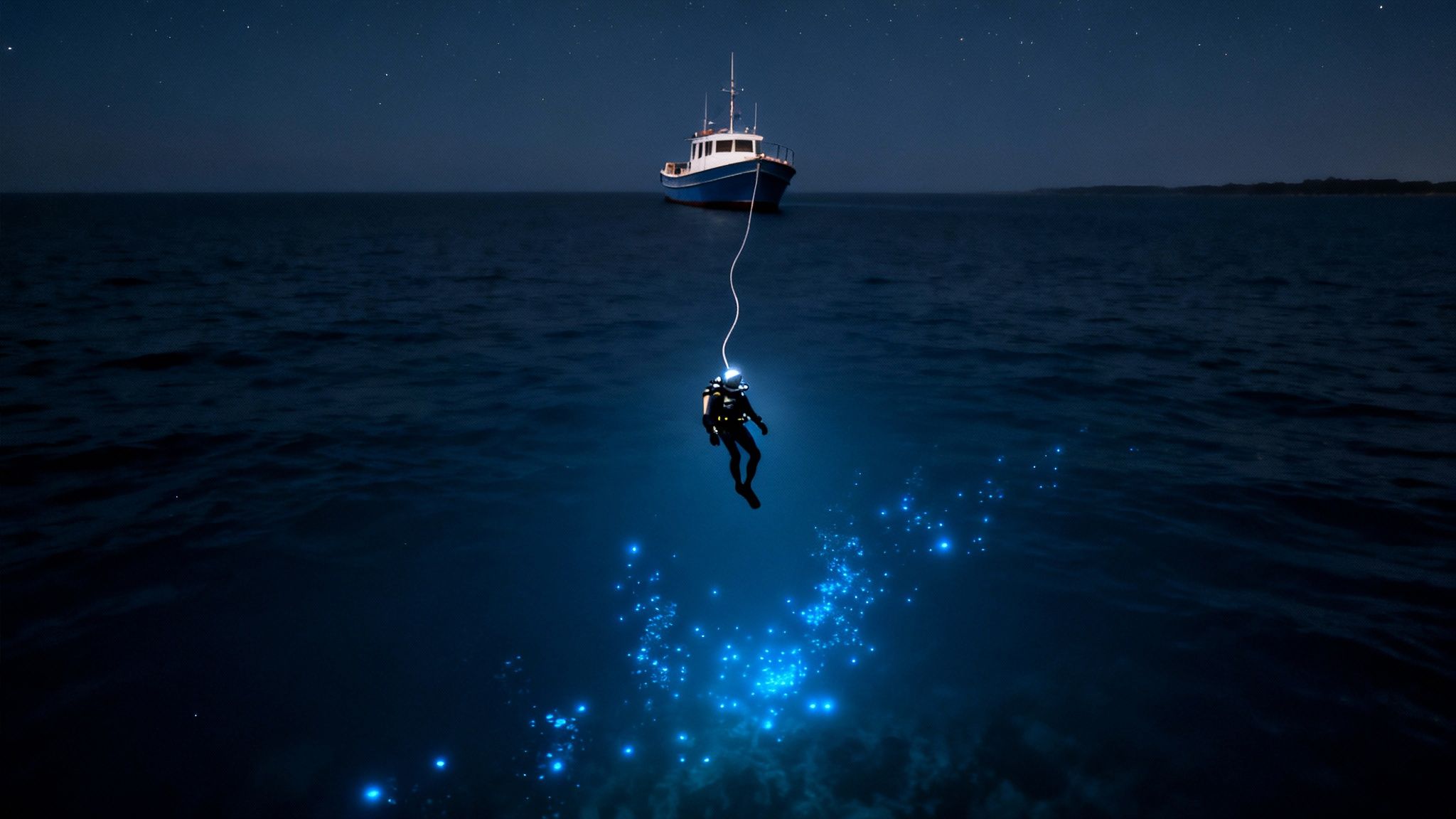
So, what's going on out there in the dark? You’re witnessing the largest migration on planet Earth, the diel vertical migration. Every single night, a countless mass of deep-water organisms—trillions of them—rises toward the surface to feed under the protection of darkness, only to retreat back into the abyss before sunrise.
A blackwater dive puts you right in the middle of this incredible nightly spectacle. You're literally hanging in the pathway of this massive migration, getting a front-row seat to see creatures that most people don't even know exist. Many of these animals are in their larval stages, looking like alien glass sculptures, completely different from their adult forms.
An Underwater Safari in the Dark
On a reef dive, you generally know what you might find. You're visiting a neighborhood with established residents. Blackwater diving is a treasure hunt where you have no idea what the current will bring you. It’s completely different every single time.
You're likely to encounter:
- Larval Creatures: See tiny, see-through larval fish, eels, and crustaceans that look nothing like they will as adults.
- Unique Cephalopods: You might cross paths with strange deep-water squid, octopuses, and if you’re really lucky, the stunning paper nautilus.
- Bioluminescent Wonders: The water comes alive with pulsing ctenophores (comb jellies) and long, stringy siphonophores that glow and sparkle in your light beam.
To put it simply, here’s a quick comparison to understand how these two types of night dives stack up.
Blackwater Diving Vs Traditional Night Diving
| Feature | Blackwater Diving | Traditional Night Reef Diving |
|---|---|---|
| Environment | Drifting in the open ocean (pelagic zone) over deep water. | Exploring a fixed reef structure, like coral or rock formations. |
| Depth | Suspended at a shallow depth (40-60 feet) on a tether. | Varies, but you follow the reef's contour, often near the bottom. |
| Navigation | No navigation needed; you drift with the boat and tether system. | Active navigation is required to explore the site and return to the boat. |
| Marine Life | Strange, often larval or bioluminescent deep-water migrators. | Familiar reef dwellers: eels, octopus, sleeping fish, crustaceans. |
| The "Feeling" | Like being an astronaut in "inner space"—unpredictable and alien. | Like visiting a familiar city after dark—seeing the nightlife. |
Ultimately, a night dive on a reef is like exploring a familiar forest after sunset. A blackwater dive is like being dropped into an entirely new dimension.
This is an experience you can only have in a few special places around the globe, and Kona is right at the top of that list. The Big Island's unique underwater geography, with the seafloor plummeting to incredible depths just a stone's throw from the coast, makes it one of the best and most accessible places on Earth for this unforgettable adventure.
What’s Really Happening Down There?
At the heart of every blackwater dive is a silent, epic event known as the diel vertical migration. This isn't just a random collection of deep-sea critters floating by; you're witnessing the single largest migration of life on Earth. It's a pulse that beats every single night, completely hidden from the world above.
Think of it as a massive, invisible elevator. By day, trillions of organisms hide out in the deep, dark, and safe waters of the twilight zone—hundreds, sometimes thousands, of feet down. They're avoiding predators that hunt by sight in the sunlit layers of the ocean.

But as soon as the sun dips below the horizon, that all changes. The fading light is the trigger, and this enormous biological curtain begins its slow, silent ascent toward the food-rich surface waters.
The Ocean's Great Commute
This nightly journey is absolutely essential to the ocean's food web. The travelers making this incredible commute include a mind-boggling variety of life:
- Zooplankton: The microscopic animals that are the foundation of nearly everything in the sea.
- Larval Creatures: The baby versions of fish, eels, crabs, and squid, often looking nothing like their adult forms.
- Small Predators: Bizarre gelatinous comb jellies and deep-water squid that follow their dinner upward.
They rise to the surface to graze on phytoplankton (the tiny plants that need sunlight) and, of course, to prey on each other. As soon as the first hint of dawn appears, the whole process reverses. Everyone heads back down into the crushing darkness to hide before daylight returns.
Blackwater diving drops you right into the middle of this monumental parade. You're basically a spectator on the side of a cosmic highway, watching a hidden universe drift by for a few short hours.
Ecologically, this is a huge deal. Every single night, billions of animals and larvae rise from depths of 500–1,000 meters (or more!) into the upper 0–200 meters of the ocean. This massive movement is what brings deep-sea life within reach of recreational divers for just a little while after dark.
It's More Than Just a Dive
Once you understand this migration, a blackwater dive becomes so much more than just a cool night swim. You’re not just seeing weird animals; you’re witnessing a fundamental process that fuels the entire ocean. This constant vertical movement acts like a massive engine, cycling nutrients and carbon from the surface to the deep sea, which in turn plays a role in regulating our planet's climate.
The timing and what you'll see can be influenced by things like the moon phase, currents, and water temperature. While the migration is a nightly guarantee, the specific conditions on any given evening are what make each dive completely unique. Learning about these variables can really enhance the experience, and you can get a head start by reading our guide on how to check ocean conditions for the Big Island.
On your dive, you’re not just an adventurer—you're a temporary visitor to one of nature’s most magnificent and hidden events.
The Otherworldly Creatures You Might Encounter
Get ready to meet some of the most alien-like lifeforms on the planet. A blackwater dive is like opening a portal to a hidden universe, where the creatures you find look like they swam straight out of a sci-fi movie. Forget the reef fish you know; this is about discovering beings that few people, if any, have ever laid eyes on.

Many of the animals that rise from the deep are in their larval stages—tiny, transparent, and beautifully intricate versions of what they’ll one day become. You’ll find yourself floating face-to-face with larval fish that look absolutely nothing like their parents, ethereal ctenophores (comb jellies) that pulse with hypnotic rainbow light, and mysterious cephalopods that seem to dance in the beam of your light.
The real magic of blackwater diving is the pure unpredictability. Every single dive is a lottery. The currents deliver a completely new cast of characters each night, turning you from a simple diver into an explorer on the edge of a great abyss.
A Field Guide to the Abyss
The sheer diversity is staggering, and every encounter feels like a genuine discovery. While you never know what you'll get, some of the recurring stars of the show are truly unforgettable.
- Larval Fish and Eels: Think of these as the ghosts of the open ocean. You might spot the paper-thin, ribbon-like leptocephalus stage of an eel, so clear you can see right through it. Or maybe you'll cross paths with a larval tripod fish, a bizarre creature that will eventually live on the deep seafloor, propped up on its fins like a lunar lander.
- Mysterious Cephalopods: The cephalopod family puts on a great show during the nightly migration. Keep an eye out for tiny, jewel-like squid and otherworldly pelagic octopuses. If you’re incredibly lucky, you might even spot the legendary paper nautilus—a female octopus that creates a delicate, paper-thin shell for her eggs.
- Gelatinous Wonders: Comb jellies drift by like living light shows, their rows of cilia refracting your dive light into shimmering rainbows. You might also see siphonophores, strange colonial animals made of thousands of individual organisms working together. In fact, some species of siphonophore are thought to be the longest animals on Earth, potentially stretching longer than a blue whale.
This unique type of diving has also become incredibly valuable to science. Blackwater photographers are documenting gelatinous zooplankton in ways that would be impossible or prohibitively expensive with traditional research methods. For instance, one multi-year study in the Gulf Stream used hundreds of blackwater dives to catalog siphonophores, ultimately identifying 22 different species, including one that was completely new to science. You can read more about these amazing scientific discoveries in Frontiers in Marine Science.
The Ultimate Treasure Hunt
Unlike the structured beauty of a reef, where you can find magnificent animals like those in our guide on where to see manta rays in Hawaii, blackwater diving is all about pure, unadulterated discovery. The creatures here are often tiny—we’re talking millimeters—but they are some of the most fascinating life forms you will ever see.
Every little flicker of movement in the corner of your eye could be a new species or a life stage that has never been photographed before. This is where recreation and real scientific discovery collide, creating an adventure you'll never forget.
Why Kona Is a World-Class Blackwater Destination
You can technically go blackwater diving in a handful of spots around the world, but Kona is on another level entirely. The Big Island's unique blend of geography, near-perfect ocean conditions, and top-tier dive operators makes it one of the absolute best places on the planet for this strange and wonderful adventure.
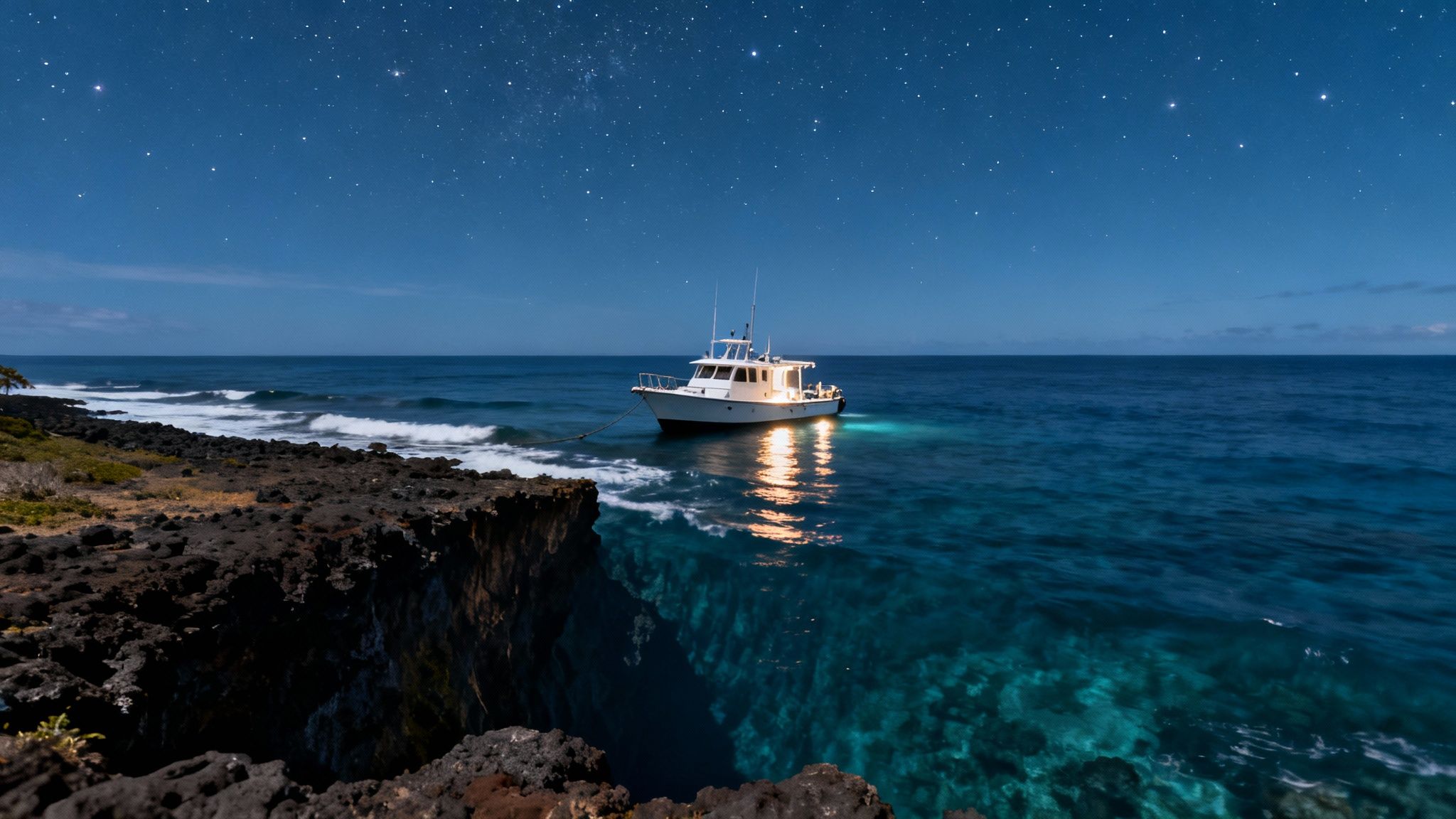
The real magic behind Kona's reputation is its underwater landscape. Unlike most coastlines that gently slope into the sea, the seafloor here drops off a cliff. It plummets to thousands of feet deep just a few miles from shore, giving us incredibly easy access to the deep-ocean environment.
This means we don't need a long, bone-rattling boat ride to get to the action. A quick, comfortable trip puts our boat right over the abyss, giving you maximum time in the water with the bizarre creatures rising from the depths for their nightly migration.
Ideal Diving Conditions
Deep water is only half the story. Kona’s position on the sheltered, leeward side of the Big Island is the other critical piece of the puzzle. The colossal volcanoes of Mauna Kea and Mauna Loa act as a natural shield, blocking the trade winds and leaving the ocean remarkably calm and clear most of the time.
Those predictable, glassy conditions are a game-changer for a dive that happens in the open ocean after dark. It makes for a much safer, more comfortable, and more successful blackwater diving experience, with a stable drift and fantastic visibility. That's a combination you just won't find anywhere else.
The Kona Honu Divers Difference
Of course, the right location needs the right team. Having experienced guides who live and breathe this stuff is what takes a dive from "cool" to "unforgettable." Here in Kona, the Kona Blackwater Dive offered by Kona Honu Divers has truly perfected the art of this unique experience.
Their custom-built boats are kitted out specifically for this, with powerful lighting systems and a secure tether rig. But more importantly, their guides are seasoned pros. They're not just passionate about the weird critters you'll see; they are rigorously trained in the specific safety protocols this unique environment demands.
From the moment you step on board for the detailed briefing to the expert supervision in the water, everything is geared toward making your adventure both mind-blowing and completely safe. The crew’s intimate knowledge of the local currents means they know exactly where to drop anchor for the best chance at incredible encounters each night.
But don't just take our word for it—see what fellow divers have to say.
When you put it all together—Kona’s deep-water access, calm seas, and a world-class operator like Kona Honu Divers—you have the perfect recipe for one of the most amazing underwater experiences of your life.
How To Prepare for Your Blackwater Dive
Getting ready for a blackwater dive with us is as much about mental preparation as it is about packing your dive bag. This isn't your typical reef tour; it's a completely different kind of underwater experience that demands solid dive skills, great buoyancy control, and a cool head.
This is an advanced dive, and for good reason. We're drifting over thousands of feet of open ocean in the dark, so we have some firm requirements to make sure everyone is safe and has an amazing time. To join us, you’ll need an Advanced Open Water certification (or an equivalent) and at least 50 logged dives. These prerequisites ensure you have the experience to comfortably manage your depth and gear in a truly unique environment.
Understanding the Specialized Setup
Our blackwater setup is built from the ground up for safety and to maximize your encounter with the creatures of the deep. It’s a pretty slick system.
Here's how it works:
- The Downline: First, we drop a heavily weighted line from the boat. This line is rigged with powerful lights that act like a beacon, attracting all sorts of fascinating animals migrating up from the abyss.
- The Tether: You'll be connected to this main downline with your own shorter tether line. It’s your lifeline, keeping you safely with the group and the boat so you can't drift off into the dark.
- Controlled Drift: The best part? The entire rig—the boat, the downline, and all of us—drifts together on the current. You don't swim to the action; the adventure floats right past your mask.
We run an extremely thorough pre-dive briefing. Our guides will walk you through every single detail, from how you'll get in the water to managing your tether and signaling in the dark. Your safety is our absolute priority, and we make sure you feel confident and secure before you even hit the water.
Photography in the Abyss
Photographing the abyss is one of the most rewarding challenges you can take on, but it's tough. Your subjects are often tiny, see-through, and moving in and out of view in a heartbeat.
Success in blackwater photography is all about patience and control. You’re shooting in a pitch-black, three-dimensional space where your subjects can vanish in an instant. Getting your lighting and camera settings dialed in before the dive is key.
Here are a few pointers to get you started:
- Fast Shutter Speed: This is non-negotiable. You need it to freeze the motion of the critters (and yourself!) as you drift.
- A Snoot or Diffuser is Your Best Friend: Harsh, direct strobe light will just blow out the details on these delicate, translucent animals. A snoot helps you pinpoint your subject, while a diffuser gives you a much softer, more flattering light.
- Use a Red Focus Light: A bright white focus light will send most of these shy creatures scattering. Red light is far less spooky for them, giving you a much better chance to get the shot.
For a complete rundown of what to bring, check out our guide on the gear you will need for your Kona diving adventure.
It's exciting to see how scuba diving is growing. PADI reported that women earned 40% of all certifications in 2024, a fantastic trend that brings more skilled divers into unique experiences like this one. It’s a clear sign that the community of divers ready for the next big challenge is bigger than ever. You can explore more about these global diving statistics to see how the community is evolving.
Here at Kona Honu Divers, our crew is dedicated to running this bucket-list dive with the highest safety standards, so you can just relax and soak in the wonder of the deep.
More Unique Diving Adventures On The Big Island
While a blackwater dive is an absolute must for any adrenaline-loving diver, you can't come all the way to the Big Island without experiencing its other world-class underwater attractions. Kona’s volcanic coast has sculpted a mind-blowing playground for divers of all stripes, and we’ve got a full menu of incredible trips to show you the best of it. Think of the blackwater dive as the grand finale to an epic dive vacation.
A perfect example? The legendary Manta Ray Night Dive. It's an experience so otherworldly it's consistently ranked as one of the best night dives on the planet. Just as the sun dips below the horizon, you'll slip into the water and watch as giant, graceful manta rays perform an underwater ballet, swooping and somersaulting through light beams to feed on plankton.
The World-Famous Manta Ray Night Dive
We run our manta ray tours at Garden Eel Cove, and for good reason—it’s hands-down the superior choice for the dive tour. The cove is naturally shielded from the open ocean swell, offering a protected location that means a much smoother and more pleasant experience.
Even better, the seafloor forms a natural amphitheater, which creates a better viewing area for the action. This setup lets you get incredibly close to these gentle giants without ever getting in their way. Plus, the surrounding reefs are just gorgeous, making the entire dive better.
Ready to see it for yourself? You can grab a spot on the world’s most famous night dive right on our Manta Ray Dive Tours page.
Diving for the Experienced Adventurer
For those of you with a few more dives under your weight belt, the Big Island has plenty of challenges that come with massive rewards. If you're itching to explore some truly dramatic underwater terrain, our advanced dive tours are built for you. We head out to deeper, more remote sites that put the raw, volcanic power of Kona on full display.
These aren't just deeper dives; they're a whole different side of Kona's underwater world. We're talking about navigating complex lava tubes, hovering over sheer pinnacles that drop into the abyss, and discovering the unique critters that call these wild formations home.
You’ll encounter marine life you just don't see on the shallower reefs, from huge schools of pelagic fish cruising by to sharks resting in ancient lava caves. It’s a chance to see the untamed side of Hawaii. If that sounds like your kind of adventure, check out the details on our premium advanced dive tour page.
By mixing a blackwater dive with the manta ray spectacle and an advanced lava tube trip, you can craft a dive vacation you’ll be talking about for years. See everything we offer on our main Kona diving tours page and start planning an adventure that hits every amazing angle of Big Island diving.
Your Blackwater Diving Questions Answered
Let's be honest—even for the most experienced divers, the thought of dropping into the deep, dark open ocean at night brings up a few questions. It’s an adventure unlike any other, and it's completely normal to want to know what you’re signing up for.
Here are the questions we hear most often from divers getting ready for their first Kona blackwater diving trip with us.
How Safe is Blackwater Diving, Really?
We get it. The environment is extreme, but the dive itself is surprisingly calm and controlled. Your safety is our absolute top priority, and we’ve built our entire operation around making this an incredibly secure experience.
Every single diver is connected to a primary downline using a personal tether. Think of it as your own secure lifeline to the boat. This simple system makes it impossible to drift away into the darkness and keeps everyone within a safe, managed area. Our professional guides are right there in the water with you, keeping a close eye on everything and making sure you’re comfortable from start to finish.
What Kind of Certification Do I Need?
This is definitely an advanced dive, so we require an Advanced Open Water certification (or an equivalent from another training agency). We also ask that you have at least 50 logged dives under your belt.
These requirements aren't meant to be exclusive; they're in place to make sure you have the skills to truly enjoy the dive. You need to have rock-solid buoyancy control and be comfortable in the dark to manage your position on the tether. This experience is all about subtle movements and observations, and having that solid foundation lets you relax and focus on the incredible creatures around you.
Are We Going to See Sharks?
While anything is possible in the open ocean, seeing sharks on a blackwater dive is actually pretty rare. The real stars of this show are the tiny, otherworldly creatures—often in their larval stage—that migrate up from the deep.
Could a curious oceanic whitetip or silky shark swing by to investigate our lights? It's a possibility, but it's not a regular occurrence. Our guides are always on the lookout and are prepared for any kind of marine life encounter, big or small.
What Should I Pack for the Trip?
Packing for this dive is easy. The main thing is to plan for your own comfort, especially staying warm before you get in and after you get out of the water.
Here’s a quick list of what to bring:
- A warm jacket or hoodie: The boat ride back can feel brisk after a night dive.
- A towel: Obvious, but essential!
- A reusable water bottle: Hydration is always key.
- Your dive certification card and logbook.
- Any personal dive gear you feel most comfortable using.
We'll handle the rest, from the specialized tether system to the expert guidance. Just bring your sense of adventure—it’s the only other piece of gear you’ll need for this unforgettable experience.
Check Availability