
Picture this: you're weightless, suspended in impossibly clear blue water. Sunlight filters down from above, illuminating a dramatic underwater landscape sculpted by volcanoes. Ancient lava tubes become swim-through cathedrals, and vibrant coral reefs pulse with a kaleidoscope of life.
This isn't a dream—it's just another day of scuba diving on the Big Island. The Kona coast, in particular, offers some of the most protected and breathtaking diving tours in the world, perfect for your very first breath underwater or your hundredth logbook entry.
Why Kona Is a World-Class Diving Paradise
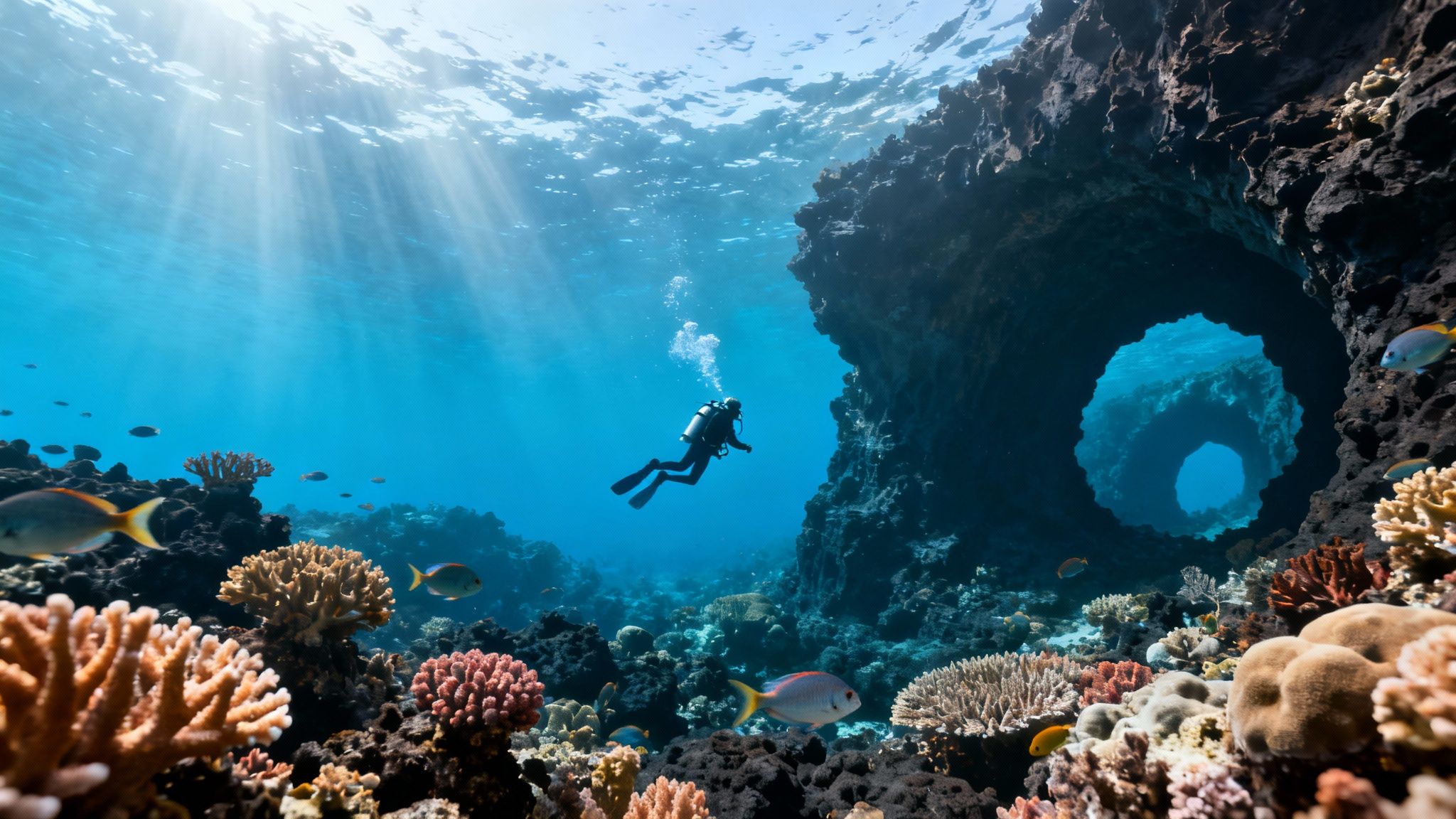
So, what’s Kona’s secret? It all comes down to geography. The immense volcanoes of Mauna Loa and Hualalai act as giant shields, blocking the gusty trade winds that hit the rest of the island. This natural barrier creates a calm, protected leeward coast.
The result is exceptionally clear and tranquil water, turning the ocean into an ideal playground and classroom for divers. With minimal current and surge, the delicate corals are left undisturbed, allowing them to grow into the sprawling, intricate gardens that support an incredible amount of marine life.
The Kona Underwater Landscape
Diving in Kona means exploring a world shaped by fire and water. Millennia of volcanic activity have created a submerged topography you won't find anywhere else.
- Lava Tubes & Arches: You can literally swim through ancient pathways where molten rock once flowed. These formations are now quiet havens for resting reef sharks, turtles, and schools of colorful fish.
- Pinnacles & Craters: Underwater volcanic cones, or "pu'u," rise from the depths, creating cleaning stations for large pelagics and complex hideouts for smaller critters.
- Vibrant Coral Gardens: The solid lava rock provides the perfect foundation for coral to take hold, resulting in some of the healthiest and most extensive reef systems in Hawaii.
The visibility here is legendary, often exceeding 100 feet, which is why divers travel from all over the globe to experience it. And of course, there's the island's most famous dive: the Manta Ray Night Dive, which boasts an incredible 85% to 90% success rate for spotting these gentle giants. You can learn more about the unique diving opportunities on the Big Island to see what awaits.
Your Gateway to Kona Diving
To get the most out of this underwater wonderland, you need to go with people who know it best. An experienced, top-rated local operator is non-negotiable, and Kona Honu Divers consistently sets the standard. Their focus on small groups, impeccable safety, and marine conservation makes every trip both amazing and responsible.
With guides who have an encyclopedic knowledge of the local sites and their inhabitants, you'll be led to the most stunning underwater scenes Kona has to offer. Whether you’re looking to get certified for the first time or are an advanced diver craving a new adventure, they have fantastic diving tours for every skill level.
Exploring the Best Big Island Dive Sites
The Kona coast is basically a diver's treasure map, with dozens of world-class sites tucked along its shores. Each spot tells a different story, carved out by ancient lava flows and brought to life by a staggering amount of marine life.
To get the most out of your Big Island scuba diving adventure, it helps to know which sites are right for you. We can break them down by experience level to make sure every diver—from the newly certified to the seasoned pro—finds their perfect underwater playground.
Gentle Dives for Beginners
Just getting your fins wet? Or maybe you're just looking for a calm, relaxing dive. Kona has plenty of protected bays that are perfect for you. These spots are usually shallow and sheltered from any strong currents, so you can really focus on your breathing and buoyancy while taking in the incredible scenery.
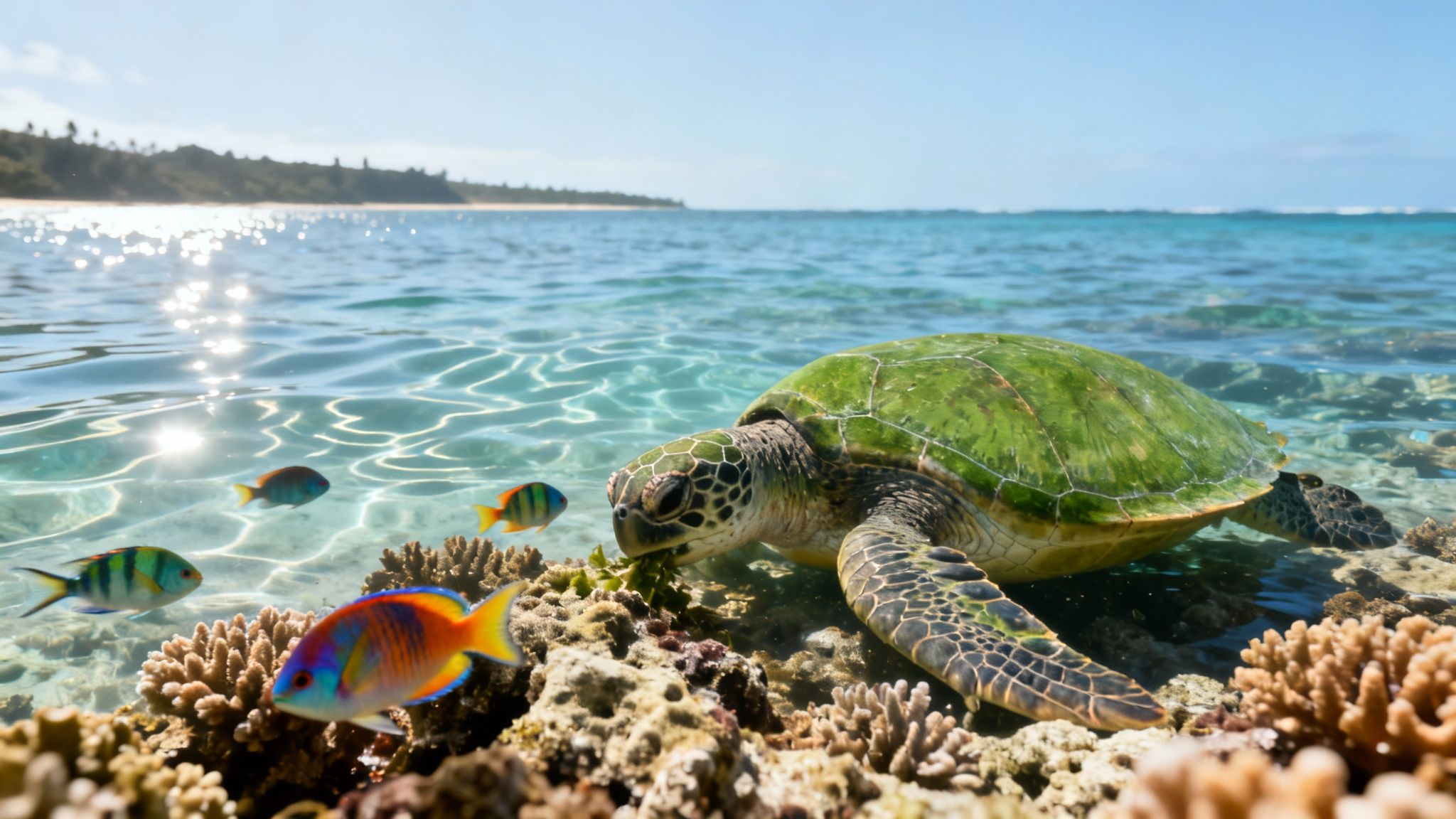
A favorite for new divers is Pawai Bay. It’s a series of coves with beautiful, shallow reefs starting around 20 feet. This is the spot to see Hawaiian green sea turtles (honu) munching on algae. The whole area is buzzing with colorful reef fish; it’s like swimming in a perfectly kept aquarium.
Thrills for Intermediate Divers
Once you've got a few dives in your logbook and you're feeling comfortable in the water, a whole new world of Kona diving opens up. These sites often have more dramatic topography and are a bit deeper, rewarding you with some truly spectacular underwater landscapes.
A classic example is Golden Arches, named for the incredible series of lava arches you can swim right through. Gliding through these natural formations is a genuine thrill, especially when you see the sunlight filtering through from above. You'll often spot whitetip reef sharks resting on the sand below or huge schools of goatfish swirling around. It’s an iconic Kona experience.
Challenges for Advanced Divers
For the seasoned divers out there with advanced training, the Big Island offers some truly epic adventures. These dives demand rock-solid buoyancy control and air management, but the payoff can be huge.
We're talking about deeper pinnacles and ledges that attract pelagic species from the open ocean. This is where you have a shot at seeing eagle rays glide by, schools of barracuda, or even the occasional shark cruising in the deep blue. These sites will test your skills and reward you with some of the most exciting Big Island scuba diving around. If you're interested in tackling some of these adventures from shore, check out our guide on where to go shore diving on the Big Island. For more experienced diving opportunities, check out the advanced dive tour page.
Kealakekua Bay: A Protected Sanctuary
You can't talk about Kona diving without mentioning Kealakekua Bay. This historic spot is a protected Marine Life Conservation District, which basically makes it a pristine sanctuary for everything that lives there.
Because fishing and other activities are restricted, the coral reefs are ridiculously healthy and the fish populations are thriving. This protection also leads to insane visibility, often clearing 100 feet! It’s an unreal environment.
Kealakekua Bay is more than just a dive site; it's a living museum. Swimming over its vibrant coral gardens while knowing you're in a place of such profound historical and ecological importance adds a unique depth to the experience.
To help you map out your underwater adventures, here’s a quick look at some of Kona's most popular dive sites.
Top Kona Dive Sites At A Glance
| Dive Site | Key Features | Common Marine Life | Best For |
|---|---|---|---|
| Pawai Bay | Shallow reefs, calm coves, easy access. | Green sea turtles, butterflyfish, moray eels. | Beginners |
| Golden Arches | Impressive lava tubes and archways. | Whitetip reef sharks, schools of goatfish, octopuses. | Intermediate |
| Kealakekua Bay | Protected marine sanctuary, pristine coral. | Spinner dolphins, diverse reef fish, turtles. | All Levels |
| Au Au Crater | Sunken volcanic crater, unique topography. | Eagle rays, frogfish, large schools of jacks. | Intermediate/Advanced |
| Suck 'em Up | Lava tube with a surge effect (skylight). | Nudibranchs, shrimp, unique invertebrates. | Advanced |
This table is just a starting point, of course. Each site has its own personality, and the only way to truly know them is to get in the water and explore.
Witnessing the Kona Manta Ray Night Dive
Some dives are memorable, but then there's the Kona Manta Ray Night Dive. It’s an experience that completely redefines what an underwater encounter can be. This isn't just another stop on a Big Island scuba diving tour; it's a world-famous, bucket-list spectacle that brings you face-to-face with one of the ocean's most majestic creatures.
The whole thing is a brilliant bit of synergy between nature and human ingenuity. It all started decades ago when a hotel’s lights along the shore attracted swarms of plankton. The local manta rays quickly figured this out and started showing up for an easy meal. Dive operators saw an opportunity and perfected the setup.
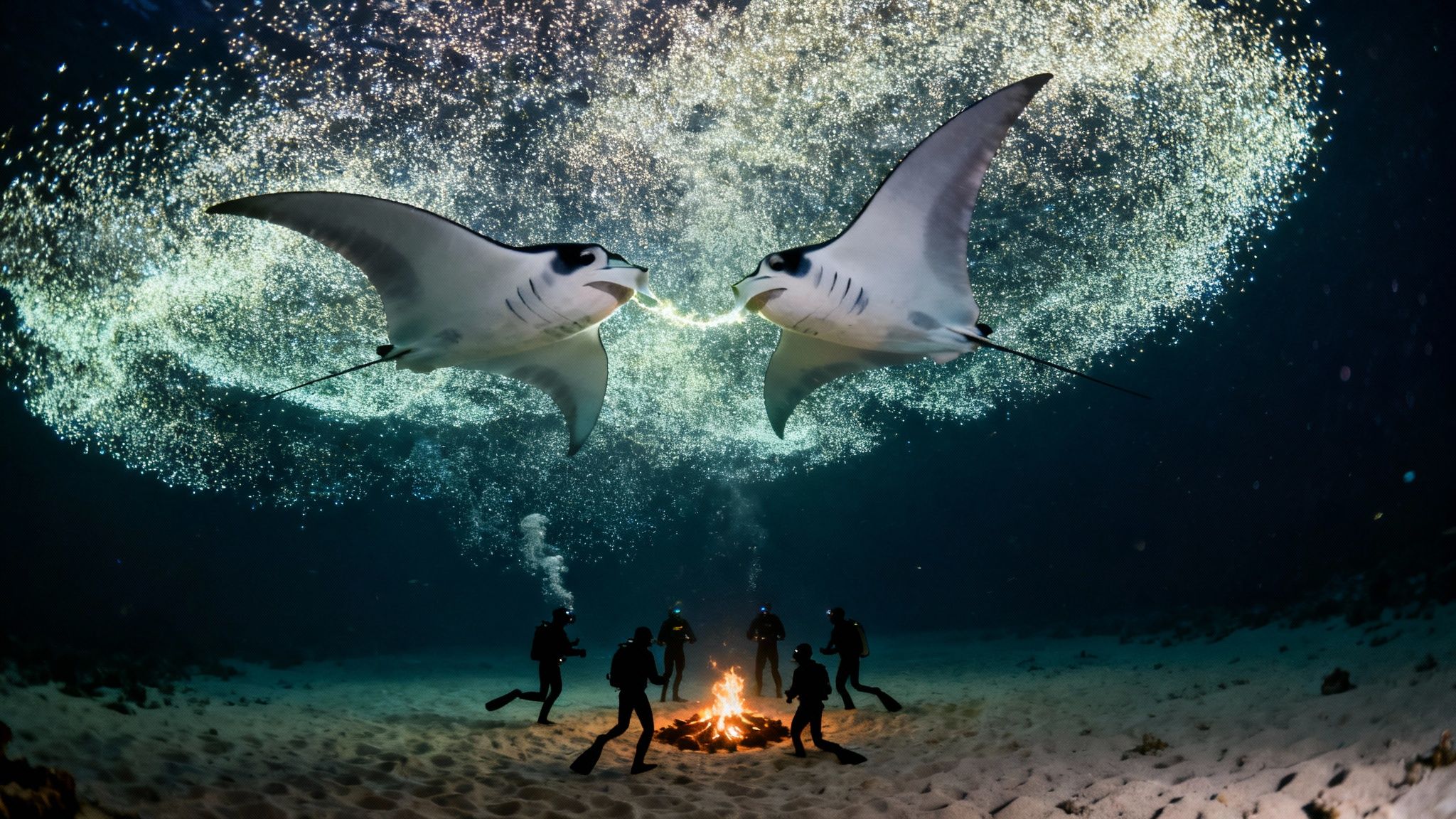
Today, guides set up powerful, stationary lights on the ocean floor, creating what’s affectionately called an "underwater campfire." This light creates a concentrated buffet of plankton that's irresistible to the mantas. Divers settle in a circle around the lights, pointing their own dive torches upward, adding to the allure. And then, the show begins.
The Underwater Ballet Begins
They emerge from the deep blue like silent ghosts. The manta rays glide effortlessly into the beams of light, their massive mouths open to filter the plankton-rich water. It's a breathtaking sight.
With wingspans that can stretch over 12 feet, their sheer size is awe-inspiring. They perform a mesmerizing, silent ballet, swooping and barrel-rolling through the water column just inches above your head. It's a profound experience to have one of these gentle giants soar right over you, their massive form silhouetted against the glow from the surface. They are completely harmless—unlike stingrays, they have no barbs—and are only interested in the feast.
Why Garden Eel Cove is the Premier Choice
While a couple of spots host manta dives, Garden Eel Cove (also known as Manta Heaven) is the superior choice for your dive tour. Tucked away just north of Kona, the site's protected location means the water is almost always calmer, leading to a more comfortable and enjoyable dive.
The real magic of Garden Eel Cove is its setup. The main viewing area is a big sandy patch at the perfect depth. This lets divers get settled on the bottom comfortably without damaging any coral, giving everyone a front-row seat for the show.
The surrounding reefs are also much healthier here, so the first dive before sunset is a fantastic experience on its own. This combination of a better viewing area, calmer conditions, and a superior reef makes it the definitive spot for this once-in-a-lifetime dive. To really get a feel for what it's like, you can learn more about the Kona Manta Ray Night Dive.
What to Expect on Your Tour
Your adventure starts with a boat ride out to the site as the sun dips below the horizon, lighting up the sky. On the way, your divemaster will give a thorough briefing, covering the science behind the dive, manta ray behavior, and the strict rules for interacting with them safely. The number one rule? Never, ever touch the mantas.
Once you descend to the sandy bottom, you'll find your spot around the "campfire" and wait. The anticipation in the dark water is absolutely electric. When that first giant shape glides into view, it’s a moment of pure wonder that leaves even the most seasoned divers completely speechless. Scuba diving offers the most immersive experience, but if you're curious about other ways to see them, you can check out Kona's Manta Night Snorkel tours.
Ready to see this incredible natural wonder for yourself? The 2 Tank Manta Dive Tour is an experience you will carry with you forever.
Advanced Diving and Specialty Adventures
So, you're a certified diver with a logbook full of memories from colorful reefs and ghostly shipwrecks. You love the sport, but you're starting to feel that familiar itch—the desire for something new, something that pushes the envelope.
While Kona’s reefs are absolutely world-class, the real cutting edge of adventure is found far from the sunny, shallow coral gardens. For divers ready for a true challenge, the Big Island delivers with specialty dives that can fundamentally change how you see the ocean.
These aren't your everyday reef tours. They're unique, highly focused experiences for divers who crave a thrill or have an insatiable curiosity about the ocean's deeper mysteries. If you're ready to elevate your Big Island scuba diving game, two adventures in particular should be at the top of your list: the mind-bending Kona Blackwater Dive and advanced charters to the island's wild, remote coastlines.
Plunge into the Abyss on a Kona Blackwater Dive
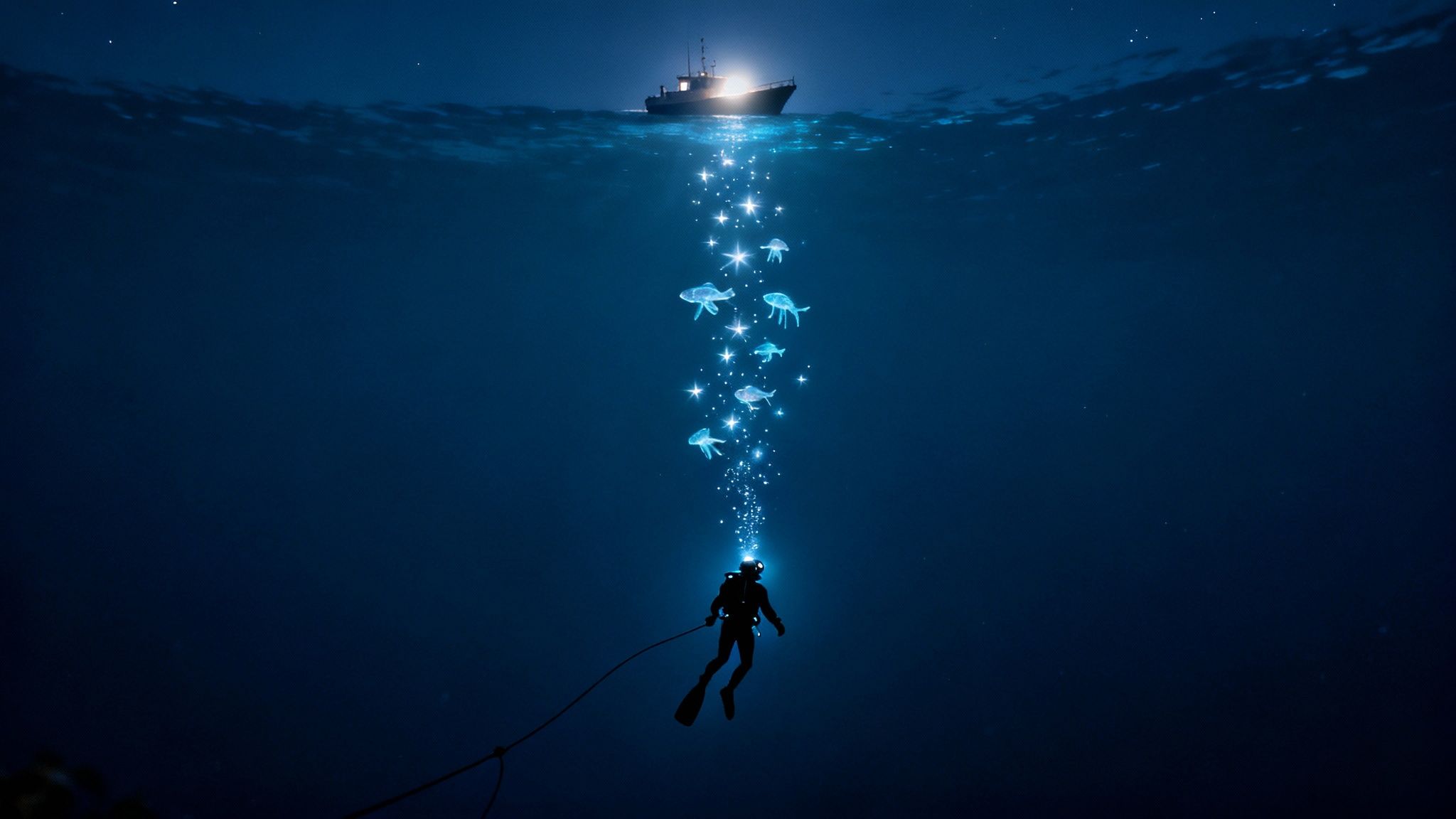
Picture this: you're miles offshore, floating in the pitch-black of the open ocean. The seafloor is thousands of feet below you, and you're tethered to a boat, suspended in a seemingly infinite void. This isn't a scene from a sci-fi movie; it's the Kona Blackwater Dive, easily one of the most surreal diving experiences on the entire planet.
This dive has nothing to do with exploring the bottom. It's all about witnessing the largest migration on Earth. Every single night, countless deep-water organisms rise from the abyss toward the surface to feed, using the darkness as their cover. And the best part? Many of them are bioluminescent, creating their own light.
As you drift in the darkness, your dive light reveals a parade of life forms so bizarre and beautiful they look like they were dreamed up for a Hollywood film.
- Peculiar Pelagic Larvae: You'll see the baby stages of familiar reef creatures—like tiny, translucent larval lobsters and octopuses—that look nothing like their adult forms.
- Bioluminescent Wonders: Prepare to be mesmerized by glowing siphonophores and comb jellies that pulse with shimmering, iridescent light as they float past.
- Deep-Sea Oddities: You’ll get a rare glimpse of creatures adapted to a life of total darkness, organisms few humans ever get to see.
Divers often compare the experience to floating through outer space. You're completely surrounded by darkness, with strange, glowing organisms drifting by like alien stars and nebulae. It's a humbling and utterly unforgettable adventure.
A dive like this demands excellent buoyancy control and being completely at ease in the dark. But for those who are ready, it’s a journey into one of the planet's last true frontiers. If you want to see what rises from the deep, the Blackwater Dive tour is an absolute must.
Conquer Remote Coastlines with Advanced Charters
Beyond the popular, well-charted dive sites lie rugged stretches of Kona's coastline. These areas are more exposed to the open ocean and feature much more complex underwater terrain, reserving them for divers with the skills to handle more challenging conditions. This is exactly where advanced charters come in.
These trips head out to remote pinnacles, sheer drop-offs, and intricate lava tube systems that you just can't get to on a standard tour. The reward for making the extra effort is huge. Because these sites see far fewer divers, the marine life is often more prolific, and the encounters can be truly spectacular. One day you might be exploring a deep ledge patrolled by sharks, and the next you could be navigating a labyrinth of ancient volcanic caves.
To get on one of these charters, your Open Water card isn't enough. Dive shops will want to see proof of your experience. Typically, they require:
- An Advanced Open Water Certification to show you have deep diving and navigation skills.
- A solid number of logged dives that prove you've been diving recently and in varied conditions.
- Excellent buoyancy and air management skills to safely handle potential currents and tricky environments.
For seasoned divers looking to challenge themselves, these charters represent the pinnacle of Big Island scuba diving exploration. To see what lies off the beaten path, look into a premium advanced dive tour.
How to Get Scuba Certified in Paradise
If you've ever wondered what it's like to breathe underwater, there's no place on earth quite like Hawaii to find out. The Big Island, with its calm, warm, and crystal-clear waters, is the perfect natural classroom. It turns the whole process of getting certified from something that might feel a little intimidating into an incredible part of your vacation. Forget learning in a chilly local quarry—your first dives will be on vibrant coral reefs, surrounded by life.
The gold standard for getting started is the PADI Open Water Diver course. Think of it as your passport to the underwater world; once you have this certification, it’s recognized by dive shops everywhere, for life. The course is designed to build your skills and confidence one step at a time, making sure you become a safe, competent diver who's ready for adventure.
Breaking Down the Certification Process
The beauty of the PADI Open Water course is how it's broken down into three manageable parts. You can even get a head start before you leave home.
- Knowledge Development (eLearning): This is the textbook stuff, but you can do it on your couch in your pajamas. PADI’s online system lets you learn all the important principles—from dive physics to safety protocols—at your own pace. Getting this done beforehand means you can jump right into the fun stuff when you get to Kona.
- Confined Water Dives: Once you arrive, we’ll head to a pool or a calm, shallow spot in the ocean that’s just like a pool. This is where you get hands-on. Your instructor will walk you through everything from putting your gear together to clearing water from your mask and getting the hang of your buoyancy. It’s all about building muscle memory in a relaxed, stress-free environment.
- Open Water Dives: Now for the grand finale! This is where it all comes together. You'll complete four dives on some of Kona’s incredible reefs with your instructor right by your side. You’ll practice the skills you mastered in the pool, but this time, you’ll be doing it while watching sea turtles glide by and exploring amazing underwater lava formations.
Learning in Kona is a real treat because the conditions are just about perfect all year. The calm, protected coastline takes a lot of the usual stress out of learning, letting you focus on your skills and just enjoy the magic of Big Island scuba diving. To see how it all works, you can learn more about the PADI Open Water certification in Kona.
Not Ready for a Full Course? Try a Discover Scuba Dive
Curious about diving but not quite ready to commit to the full course? No problem. The Discover Scuba Diving (DSD) experience was made for you. It's a fantastic one-day introduction that lets you experience the underwater world without any long-term commitment.
Think of the Discover Scuba program as a test drive for diving. An instructor gives you a quick and easy lesson on the basics, gets you comfortable with the gear in shallow water, and then personally guides you on a real dive on a beautiful, shallow reef.
It’s an incredible way to see if scuba is your thing. So many people try it and get hooked on the feeling of weightlessness and the amazing sights. The best part? If you love it, your DSD often counts as a credit toward the full Open Water Diver course. It’s a fun, low-pressure way to take your very first breath underwater.
Your Big Island Scuba Diving Questions, Answered
Planning a dive trip to Hawaii should be exciting, not a headache filled with guesswork. To cut through the noise, we've put together some straight-shooting answers to the questions we hear most often about Big Island scuba diving. Think of this as your practical guide to getting ready for an incredible underwater adventure.
We'll cover everything from the best season to visit to the amazing critters you'll meet, so you can stop worrying about the details and start dreaming about the dive.
What’s the Best Time of Year to Dive the Big Island?
Here's the great thing about diving in Kona: it's fantastic pretty much 365 days a year. The island's colossal volcanoes act as a natural shield, protecting the Kona coast from the gusty trade winds. This geography creates a diver's paradise with consistently calm, clear water.
That said, there are a few seasonal quirks you might want to consider:
- Summer (May to October): This is when the ocean is at its flattest and warmest. Water temps often climb to a luxurious 80°F (27°C), perfect for those who get chilly easily.
- Winter (November to April): The water might dip to around 75°F (24°C), which is still incredibly comfortable. The real draw for this season is the humpback whales—hearing their songs underwater is a haunting, beautiful experience you’ll never forget.
No matter when you come, visibility is almost always stellar, often stretching out past 100 feet. You really can't lose.
Do I Need to Be Certified to Scuba Dive in Kona?
Not at all! If you've always wanted to try diving, Kona is one of the best places on the planet to do it. The Discover Scuba Diving (DSD) program was created for this exact reason—to give you a taste of the underwater world without needing to commit to a full course.
It's a simple process. A certified instructor will walk you through the basic safety rules and skills in calm, shallow water. Once you've got the hang of it, they'll be right by your side as you go on a genuine dive on a beautiful Kona reef. It's a completely supervised, safe, and exhilarating way to take your first breaths underwater. And the best part? If you fall in love with it (and you probably will), the experience can often count toward your full PADI Open Water Diver certification.
Think of the Discover Scuba Diving experience as the ultimate "try before you buy." It's all about the pure joy of breathing underwater for the first time, surrounded by a world of color and life.
What Kind of Marine Life Will I See in Kona?
Kona’s volcanic underwater landscape is a magnet for an incredible variety of marine life. While no two dives are ever the same, you can count on seeing a few local celebrities.
You are almost guaranteed to encounter Hawaiian green sea turtles, known as honu, cruising by or just chilling on the reef. The reefs themselves are absolutely buzzing with vibrant fish like yellow tangs, butterflyfish, and parrotfish. Look closely in the nooks and crannies, and you might spot a moray eel peeking out or an octopus perfectly camouflaged against the rock. And keep an eye on the blue for elegant eagle rays soaring past.
Of course, for many divers, the manta ray is the main event. On the world-famous Manta Ray Night Dive, your chances of a close encounter with these gentle giants are incredibly high. Depending on the time of year and a bit of luck, you could also run into playful spinner dolphins or, as mentioned, hear the distant calls of humpback whales.
What Should I Pack for a Big Island Diving Trip?
Good news: packing for a Kona dive trip is a breeze. Reputable dive shops like Kona Honu Divers provide all the heavy gear—your BCD, regulator, tanks, and weights—so you don't have to lug it across the Pacific.
Here’s a quick list of what you should toss in your bag:
- Swimsuit and towel (of course!)
- Reef-safe sunscreen to protect yourself and the coral
- A rash guard for a little extra sun protection or warmth
- Your personal gear if you have it, like a favorite mask, snorkel, or fins
- An underwater camera to capture all the action
- A reusable water bottle to stay hydrated
With just these essentials, you'll be set for a fantastic day of Big Island scuba diving. Getting everything in order is part of the fun. For those curious about how local businesses like dive shops reach travelers, there's a lot that goes into their online presence, which you can learn more about through resources on Hawaii Search Engine Marketing for Marine Businesses.
At Kona Honu Divers, our passion is sharing the magic of Kona's underwater world with you. With a top-notch fleet and a crew of experienced dive pros, we're all about creating adventures that are safe, fun, and totally unforgettable. Whether you're a seasoned diver or just starting out, we have a range of diving tours that will show you the absolute best of what this marine paradise has to offer.