
Picture this: you're sinking slowly into warm, impossibly clear water. Sunlight streams down from above, lighting up a wild, underwater landscape carved by ancient volcanoes. You're not just on any dive; you're exploring the Big Island of Hawaii, where vibrant coral gardens meet dramatic lava tubes, and the marine life is unlike anywhere else on Earth.
This is a world-class destination for divers, and for good reason. It offers something for everyone, from the freshly certified to the seasoned pro.
Your Essential Guide to Big Island Diving
Think of this guide as your first mate for navigating the island’s aquatic wonders. We'll cover everything from the calm, sheltered coves of the Kona coast to the most thrilling, talked-about dive sites. We’ll break down what makes scuba diving the Big Island so special and show you exactly how to get in the water.
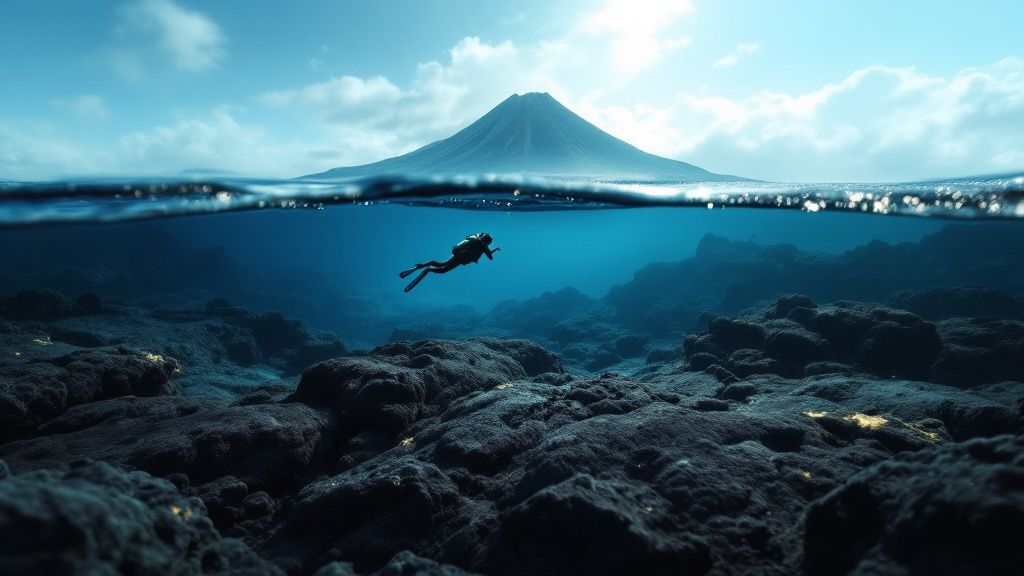
The Big Island’s underwater world is a direct reflection of its fiery volcanic past. Over thousands of years, lava flows have cooled to create a stunningly complex ocean floor. We're talking massive arches, hidden caves, and intricate reef structures you just won't find anywhere else. This unique geology is the perfect foundation for a thriving, diverse ecosystem.
What Awaits You Underwater
When you slip beneath the waves here, you’re not just a visitor; you're stepping into a vibrant, living world. The island's isolation way out in the Pacific has led to a high number of endemic species—that means critters you can only find right here in Hawaii.
So, who might you run into?
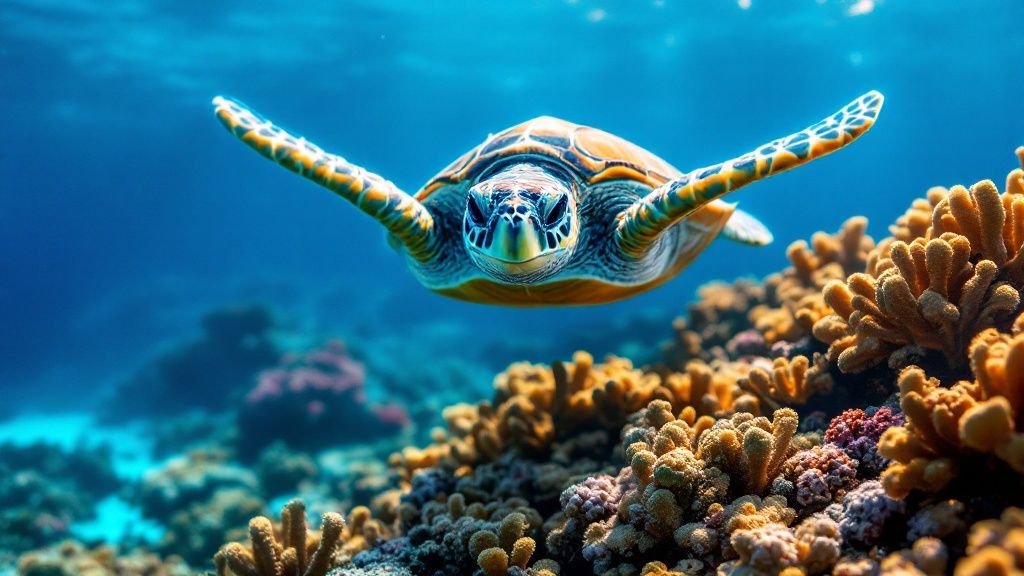
- Honu (Green Sea Turtles): It's almost a guarantee you'll see these gentle giants. They're a common and beloved sight, often found munching on algae or just chilling out on the reef.
- Manta Rays: The Kona coast is famous for its manta ray population. The night dive with these gentle giants is a bucket-list experience for divers across the globe.
- Vibrant Reef Fish: Prepare for a color explosion. Huge schools of bright yellow tang, intricate butterflyfish, and powerful parrotfish paint a dazzling scene against the dark volcanic rock.
- Unique Invertebrates: Keep your eyes peeled! You’ll find octopuses masterfully camouflaged, moray eels peeking out from their dens, and all sorts of cool crustaceans scuttling about.
Diving on the Big Island is like exploring another planet. The contrast between the dark lava rock and the brilliant colors of the marine life is something every diver should experience at least once.
Of course, the key to an amazing dive trip is finding the right people to take you out. At Kona Honu Divers, we're obsessed with providing safe, respectful, and genuinely unforgettable diving tours. We live and breathe this stuff, and we love showing people the very best our island has to offer. Whether it's your hundredth dive or your first, your adventure starts with us.
What Makes Kona a Premier Diving Destination
So, why do divers from all over the world flock to the Big Island? It all starts with the island's volcanic soul. The same fiery geology that created this paradise also sculpted an underwater world you won't find anywhere else. Think dramatic seascapes formed by ancient lava flows—arches, collapsed lava tubes, craters, and endless swim-throughs that have become a natural playground for marine life.
This unique volcanic topography is the perfect foundation for a rich and thriving ecosystem. The dark, porous rock creates a stunning backdrop that makes the vibrant colors of the coral and the shimmering schools of fish just pop. It’s a landscape that tells a story of creation, with a new discovery waiting around every corner.
Ideal Conditions for Every Dive
Beyond the breathtaking scenery, the actual conditions for Big Island scuba diving are about as good as it gets. The Kona coast, in particular, is blessed with consistently warm water and jaw-dropping clarity. Seriously, imagine sinking into a world where visibility often stretches well beyond 100 feet, making every little detail of the reef sharp and vivid.
The Big Island’s dive environment is really defined by two things: stable, bathtub-warm water and that incredible visibility. Water temperatures stay in a comfortable range, hovering around 75°F (24°C) in the cooler months and climbing past 80°F (27°C) in the summer. This makes for fantastic year-round diving. For a deeper dive into the island's climate, the Big Island Hawaii Travel Guide offers some great insights.
The combination of volcanic underwater architecture and crystal-clear water is what truly sets Kona apart. It’s not just about what you see, but how clearly and vibrantly you see it.
This reliability is a huge plus. It means you can plan your trip for just about any time of year and be confident you’ll have great conditions. Less time worrying about the weather means more time to focus on the incredible underwater world in front of you.
Why the Kona Coast Reigns Supreme
While the Big Island is, well, big, the dive scene is almost entirely concentrated on one side—and for a very good reason. The colossal volcanoes of Mauna Kea and Mauna Loa act as a massive shield, creating a "rain shadow" that protects the western Kona coast from the trade winds and storms that batter the eastern Hilo side.
This natural protection results in much calmer seas, almost no river runoff to cloud the water, and the legendary visibility Kona is famous for. Trying to dive on the Hilo side is a different story; it's often a battle against rougher waters and murky conditions caused by all that freshwater pouring into the ocean. It’s no contest—the protected Kona coast is the undisputed heart of the island’s world-class diving.
To put it simply, here’s a quick look at how the two sides of the island compare for diving.
Kona Coast vs. Hilo Coast Diving Conditions
| Feature | Kona Coast (West) | Hilo Coast (East) |
|---|---|---|
| Ocean Conditions | Typically calm and protected | Often rough with strong currents |
| Water Visibility | Excellent, frequently 100+ feet | Poor to moderate due to runoff |
| Rainfall | Minimal, dry climate | High, receives significant rain |
| Dive Site Access | Abundant and easily accessible | Limited and weather-dependent |
When it comes down to it, choosing where to dive on the Big Island is a pretty straightforward decision. The sheltered, clear, and life-rich waters of the Kona coast deliver that premier experience that keeps divers coming back again and again. It’s the perfect environment to explore everything this underwater paradise has to offer.
Exploring the Top Big Island Dive Sites
Alright, with a plan in hand, it’s time for the fun part: exploring the incredible underwater world that makes Big Island scuba diving a bucket-list destination. The Kona coast is absolutely peppered with amazing sites, each with its own personality.
You’ll find everything from calm, sunny coral gardens perfect for your first few dives to dramatic volcanic ledges and lava tubes that will excite even the most seasoned diver. There really is a dive here for every logbook.
The Big Island is a truly premier diving destination, offering over 1,000 unique dive sites for all skill levels. And when people think of diving here, one experience often comes to mind: the Manta Ray Night Dive. This world-famous encounter is so powerful that for about 15% of scuba tourists, it's the main reason they book their trip to Hawaii.
So, let's gear up and take a closer look at a few of the must-see spots that should be on every diver’s radar.
The World-Famous Manta Ray Night Dive
You can't talk about Big Island diving without starting with the legendary Manta Ray Night Dive. Honestly, calling it just a "dive" doesn't do it justice—it's more like a breathtaking underwater ballet.
Here's how it works: after sunset, crews submerge powerful lights on the seafloor. These lights attract swarms of plankton, which in turn rings the dinner bell for the area's resident gentle giants.
As a diver, you get a front-row seat. You settle on the sandy bottom, point your dive light up, and just watch. Soon, massive manta rays, some with wingspans up to 16 feet, begin to swoop and glide in effortless loops just inches above your head. They perform an acrobatic dance, barrel-rolling through the beams of light to scoop up the plankton. It's a surreal, humbling, and utterly unforgettable experience.
The experience of having a giant manta ray glide silently over you, close enough to see every detail, is profoundly moving. It’s a moment of pure magic that stays with you long after you surface.
Crescent Beach (Honokohau Harbor)
Just a stone's throw from Honokohau Harbor, Crescent Beach is a fantastic, crowd-pleasing dive site. It's known for consistently calm conditions and an absolute explosion of marine life, making it a reliable favorite.
The site is built around a gorgeous, sprawling reef system with coral fingers stretching out into the sand. This layout creates tons of little nooks and crannies where marine critters love to hide.
So what makes Crescent Beach a must-do?
- Turtle Central: This spot is a legitimate hotspot for Hawaiian green sea turtles (honu). It's not uncommon to see several on a single dive, either snoozing on the reef or cruising by.
- Varied Scenery: The dive isn't monotonous. You'll drift over sandy flats, explore vibrant coral gardens, and navigate small lava rock formations.
- Tons of Fish: Keep your eyes peeled for huge schools of yellow tang, moray eels poking their heads out, and the occasional whitetip reef shark patrolling the edges.
Thanks to its relatively shallow depth and protected location, Crescent Beach is a perfect choice for divers of all skill levels, especially those who are new to the sport.
Pu'uhonua O Honaunau (Place of Refuge)
Diving in the waters off the Pu'uhonua O Honaunau National Historical Park feels like swimming through history. The underwater terrain is a direct result of the island's volcanic past, creating a spectacular maze of arches, swim-throughs, and caverns that are just begging to be explored.
While snorkelers know this area as "Two Step," the real adventure for divers is a bit further from shore. The intricate volcanic structures are the perfect habitat for an incredible diversity of life. You'll find yourself navigating through natural archways and peering under ledges teeming with fish. The sense of discovery here is off the charts; a new underwater passage or a hidden creature is waiting around every corner.
To see what makes this and other locations so special, dive into our guide on the best Big Island scuba diving spots.
Challenging Dives for the Experienced Adventurer
For those with a few more dives in their logbooks, the Big Island has plenty of sites to put your skills to the test. These deeper, more complex dives are where you can truly appreciate the raw, volcanic power that formed this island.
Sites like Au Au Crater and Turtle Pinnacle are perfect examples of more experienced diving opportunities. Au Au Crater is literally a submerged volcanic crater featuring a collapsed lava tube that creates some seriously dramatic swim-throughs. Turtle Pinnacle is a classic cleaning station where turtles gather, but getting there often means navigating stronger currents and deeper water.
These spots are ideal for certified divers looking to push their boundaries and see something truly spectacular. For those ready to explore these more demanding sites, check out our advanced dive tours.
The Unforgettable Manta Ray Night Dive Experience
There are certain dives that stick with you forever, and then there's the Manta Ray Night Dive. It’s consistently ranked as one of the best underwater encounters on the entire planet, and for good reason. This isn't just another dive—it’s a truly magical experience and, for many, the main reason they come for Big Island scuba diving in the first place.
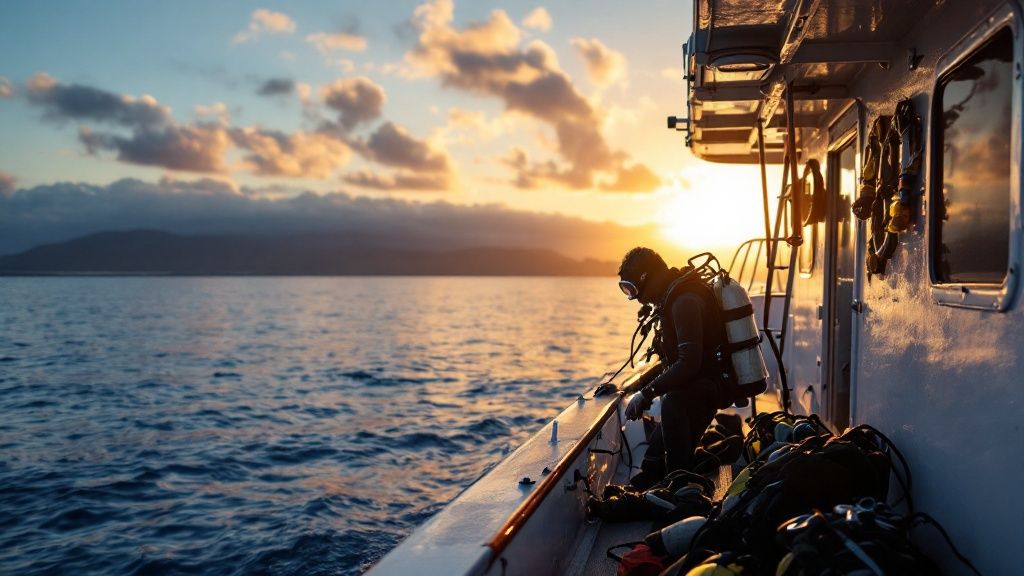
The whole adventure kicks off with a boat ride as the sun dips below the horizon, painting the sky with classic Hawaiian sunset colors. As you cruise toward one of Kona's special manta sites, the air is buzzing with anticipation. Your divemaster will walk you through the plan, explaining the incredible natural phenomenon you’re about to be a part of.
The Science Behind the Spectacle
So, what's the secret to this nightly gathering? The concept is actually quite simple, yet brilliantly effective. Dive operators have set up powerful, eco-friendly lights on the ocean floor in a few specific locations.
These lights act like giant bug zappers in reverse—they attract a massive cloud of phytoplankton, the microscopic critters that form the base of the ocean's food chain. This shimmering plankton soup creates an irresistible all-you-can-eat buffet for the main attraction: the majestic Pacific reef manta rays. The mantas you'll meet are locals; they don't migrate far and have figured out that these lights mean an easy, reliable dinner.
"Diving with mantas is one of the most satisfying things a person can do in the water. It’s impossible to describe the feeling of watching a massive fish the shape of a stealth bomber coming into vision." – Samuel Beckett, Planet Dive
As a diver, your job is to simply be a respectful audience member. You’ll descend to a designated spot on the sandy bottom and shine your dive light straight up, adding to the glow and getting a front-row seat for the show of a lifetime.
An Underwater Ballet
Once everyone is settled on the seafloor, the real magic starts. First, a single shadow glides out of the darkness, then another, and then another. Before you know it, you're in the middle of a silent spectacle, with giant manta rays—some with wingspans stretching up to 16 feet—soaring effortlessly through the water.
They perform a kind of underwater ballet, swooping and barrel-rolling just inches over your head. With their huge mouths wide open, they filter the plankton from the water in graceful, looping patterns. The whole experience feels surreal and is deeply humbling. The only sounds are the bubbles from your regulator and the quiet gasps of awe from the divers around you. It's peaceful, mesmerizing, and utterly unforgettable.
Safety and Sustainability First
An encounter this special requires a deep commitment to protecting these gentle giants. Manta rays have a delicate, protective mucus layer on their skin that acts as a shield against infection. Touching them can strip this coating away, making them vulnerable.
That's why responsible operators like Kona Honu Divers are so passionate about manta conservation. We follow strict guidelines to make sure the interaction is safe and respectful for both the divers and the wildlife.
A few key rules we live by:
- Observe Only: Never touch, chase, or attempt to ride a manta ray. Let them come to you.
- Maintain Your Position: Divers stay on the bottom, keeping the water column open so the mantas have plenty of room to maneuver.
- Light Discipline: Keep your lights pointed up toward the surface to attract plankton, not into the mantas' eyes.
Choosing a reputable operator is the single most important decision you'll make for this dive. To learn more about how it all works, check out our complete guide to the Kona Manta Ray Night Dive.
Here at Kona Honu Divers, we're dedicated to sharing this bucket-list adventure in the most respectful way possible. Our experienced crew will guide you every step of the way, ensuring your dive is safe, inspiring, and absolutely unforgettable.
Unique Diving Adventures Beyond the Reef
Sure, the colorful reefs and world-famous manta ray dives are incredible. They're what bring most people here. But for some of us, the most unforgettable moments happen where the reef ends—out in the deep, dark, mysterious corners of the ocean.
If you're looking for a thrill that goes way beyond the usual, the Big Island has a couple of specialized dives that feel more like exploring another planet than just going for a swim. These aren't about pretty coral gardens; they're about pushing your own boundaries and seeing life forms most people don't even know exist.
The Kona Blackwater Dive: An Otherworldly Experience
Picture this: you're floating in the vast, inky blackness of the open ocean at night. You're miles from shore, suspended over thousands of feet of water with nothing below you. The only thing you can see is what’s illuminated by your dive light.
Then, slowly, the magic begins. Impossibly strange creatures start to rise from the abyss. This is the Kona Blackwater Dive, and it’s often called a trip to inner space for good reason.
This is not a reef dive. It’s a highly specialized pelagic drift dive where you get a front-row seat to the largest migration on Earth. Every single night, countless bizarre and often bioluminescent organisms travel from the deep ocean to feed near the surface, and you're right there in the middle of it.
You'll see things that look like they're straight out of a sci-fi movie:
- Larval Creatures: You'll spot the baby versions of familiar reef fish, which often look completely alien compared to their adult forms.
- Jellies and Siphonophores: Expect to encounter pulsating, glowing jellyfish and long, stringy siphonophores that can trail on for several feet.
- Tiny Cephalopods: Keep an eye out for jewel-like squid and octopuses hunting in the darkness.
"The Blackwater Dive is a humbling, mind-bending experience. You’re not just an observer; you're a tiny satellite in a vast, living universe, witnessing a secret world that only reveals itself after dark."
Given its advanced nature, this dive isn't for everyone. You need to be completely comfortable in the dark, have rock-solid buoyancy control, and be okay with the idea of deep water below you. That's why going with a specialized Blackwater Dive tour is essential. They use a tethered system for safety and have guides who are absolute masters at spotting these tiny, elusive creatures.
Navigating Lava Tubes and Caverns
The same volcanic forces that forged the Big Island also created an amazing underwater network of lava tubes and caverns. For certified divers with the right training, exploring these formations feels like swimming through the very arteries of the island.
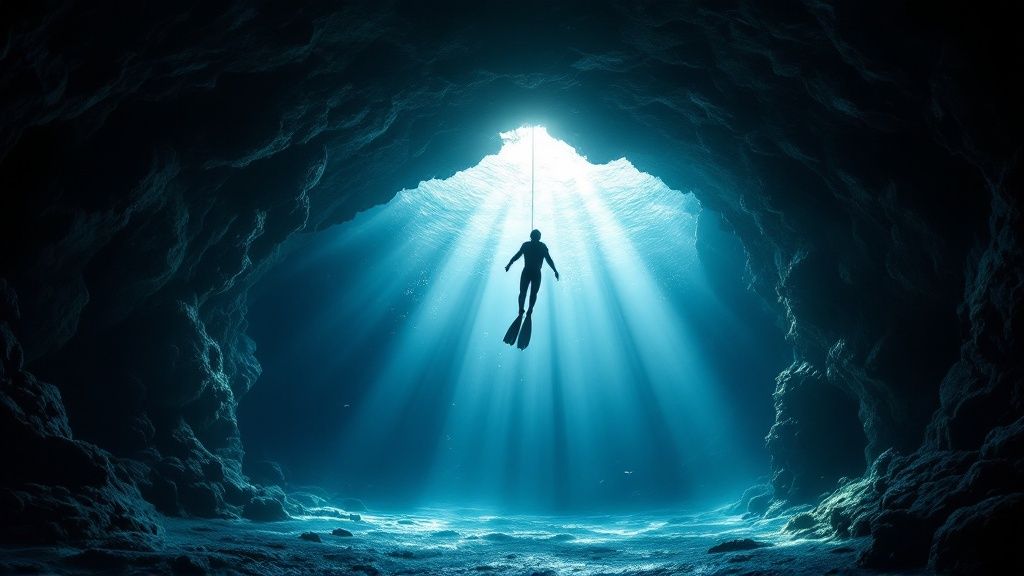
Dropping into a lava tube is an incredible feeling. Sun filters through cracks in the ceiling, shooting dramatic beams of light through the darkness, like something out of a movie. The walls are often home to unique crustaceans and sponges that have adapted perfectly to life with little light.
These dives are a fantastic challenge for confident divers, as they demand real skill and precision. You have to be on top of your game, managing your buoyancy in an overhead environment and navigating what can sometimes be tight spaces. The reward, though, is a sense of discovery you just can't get anywhere else.
There's something powerful about exploring these ancient volcanic conduits—it connects you to the raw, creative force of the island. For divers who are ready to take that next step, check out our advanced diving page for trips that explore these incredible formations.
How to Plan Your Big Island Diving Trip
So, you're ready to turn that dream of Big Island scuba diving into a reality? Awesome. A little bit of planning goes a long way in making sure your trip is smooth from the moment you book your flight to your first giant stride off the boat.
Let's talk about timing. One of the best parts about diving in Kona is that there really isn't an "off-season." The water stays warm and the visibility is fantastic pretty much year-round. You can't go wrong.
The real question isn't when to come, but how far in advance you should book. If you have your heart set on something like the Manta Ray Night Dive, those spots fill up fast. Planning ahead is the secret to avoiding any "sold out" signs.
To Bring Gear or to Rent?
This is the classic diver's dilemma. Should you haul all your own kit across the Pacific, or just rent when you get here? There's no single right answer—it really boils down to what matters most to you on a dive trip.
- Bringing Your Own Gear: The biggest plus here is familiarity. It's your gear. You know how the regulator breathes, how the BCD fits, and where every clip and D-ring is. That comfort can make a huge difference underwater. The downside? Packing, lugging it through airports, and paying potential baggage fees.
- Renting Gear: Convenience is king. You just show up, and professionally maintained, high-quality gear is waiting for you. No rinsing, no packing, no hassle. Reputable shops like ours keep their rental fleet in top-notch condition, so you can dive with total peace of mind.
A lot of seasoned divers find a middle ground. They'll pack their personal items like their mask and dive computer but rent the heavier stuff like the BCD and tanks. It's the best of both worlds.
Choosing the Right Dive Operator
This is easily the most important decision you'll make for your trip. The right crew can turn a good dive into an unforgettable one. You want to find an operator that’s obsessed with safety, passionate about protecting the reefs, and keeps their groups small for a more personal and relaxed experience.
At Kona Honu Divers, that's exactly what we're all about. Our entire crew is dedicated to showing you the absolute best of Kona's underwater world, safely and responsibly. We handle all the heavy lifting and logistics so you can just relax and enjoy the incredible marine life.
We always recommend booking your diving tours well in advance, especially for popular charters or if you're visiting during peak season. The same goes for your lodging; check out our guide on the best places for divers to stay on the Big Island to make sure you're close to the dive docks. A little bit of planning now means you can just kick back and enjoy the adventure when you get here.
Your Kona Diving Questions, Answered
Got questions about your first scuba trip to the Big Island? You're not alone. Planning the perfect underwater adventure is half the fun, so let's clear up a few of the most common things divers wonder about before they get here.
What’s the Best Time of Year to Dive the Big Island?
Honestly, there’s no bad time to dive in Kona—it’s fantastic year-round. The water stays remarkably comfortable, hovering around a pleasant 75°F in the winter and warming up to over 80°F in the summer.
If you're looking for the absolute calmest, glassiest ocean conditions, you’ll typically find them during the summer months. But winter has its own special magic. You might just be treated to the haunting songs of humpback whales echoing through the water on your dive—an unforgettable experience. No matter when you come, the visibility along the Kona coast is almost always spectacular.
Do I Need a Lot of Experience to Dive in Kona?
Not at all. Kona is one of the most welcoming places for divers of all stripes, from absolute beginners to seasoned pros. The island has tons of calm, shallow reef sites that are perfect for your very first breaths underwater on an introductory dive.
If you’re already certified but still building your confidence, there are countless beautiful, easy-to-navigate spots to explore. And for the advanced crowd? You'll find plenty to keep you busy, from deep lava tubes and dramatic drop-offs to the one-of-a-kind Kona Blackwater Dive. Great local operators like Kona Honu Divers run a wide variety of diving tours designed for every skill set.
Is the Manta Ray Night Dive Really Safe?
Absolutely. When you go with a professional, certified dive company, the Manta Ray Night Dive is an incredibly safe and well-managed experience. Safety is the number one priority for this world-famous dive.
The whole operation is a well-oiled machine. You'll get a detailed safety briefing beforehand, and once in the water, powerful lights create a bright, controlled "campfire" environment. Experienced divemasters are with you every step of the way. The manta rays themselves are gentle giants, completely used to the presence of divers. The golden rule is simple: just watch, enjoy, and never touch them. Following that ensures a magical and safe night for both you and the mantas.