
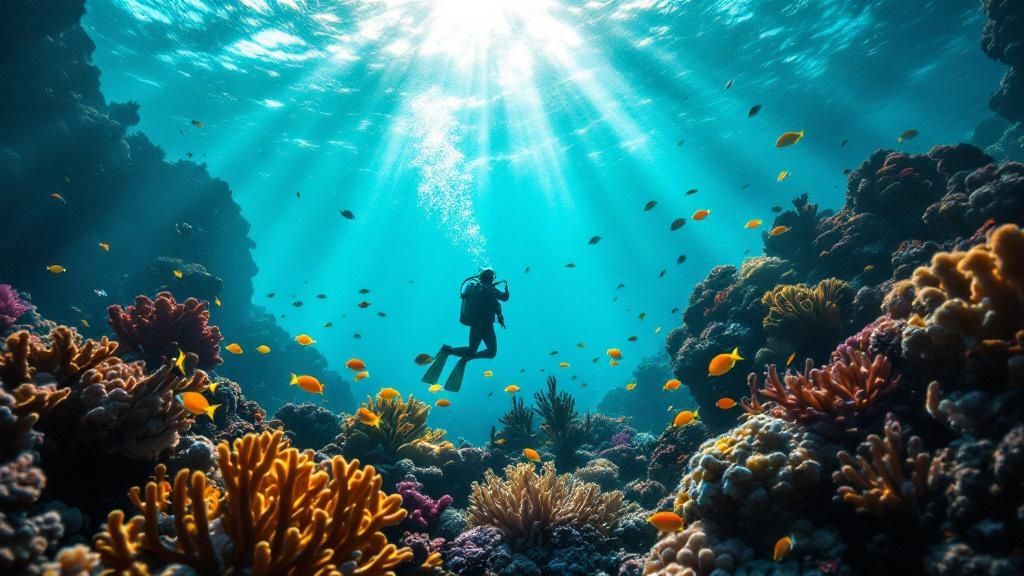
Picture this: you're slowly descending into warm, impossibly clear turquoise water. All around you are dramatic underwater landscapes—arches, caves, and canyons—all sculpted from ancient volcanic rock. That's the real magic of Big Island scuba diving. This isn't just another pretty spot in the tropics; it's a genuine underwater frontier.
Why The Big Island Offers World-Class Diving Adventures
So, what makes this place so special? It's all about the island's unique geology. The massive volcanoes that formed the Big Island also created an underwater world unlike any other. Combined with protected coastlines, especially along the Kona coast, the conditions are just incredible for divers of any skill level.
You can be exploring deep lava tubes one day and then kicking back in a shallow, sun-drenched coral garden the next. It’s this variety that makes every dive feel like a new adventure. We’ll get into all of it—from choosing between a boat or shore dive to can't-miss experiences like the famous manta ray night dive.
It's amazing to think how much has changed. Back in 1981, a shop called Jack’s Diving Locker opened its doors, really helping to put the island on the map for divers. Around the same time, organizations like PADI and SSI were making training more accessible and standardized, turning scuba from a niche hobby into a global passion. Today, the island sees over 100,000 certified dives every year, which tells you just how incredible the experience is. If you're a history buff, you can read more about the evolution of Big Island scuba diving on konahonudivers.com.
In this guide, we'll point you toward the best diving tours and experiences in Kona. Think of this as your personal roadmap to exploring one of the planet's absolute top-tier diving destinations.
Choosing Your Dive Style: Boat vs. Shore Diving
So, you're ready to explore the underwater world of the Big Island. How you get there—by boat or from the shore—is one of the biggest decisions you'll make, and it completely shapes your adventure. Each approach has its own vibe and set of advantages. The two main types of diving available on the Big Island are shore diving and boat diving, each offering a distinct way to experience the incredible marine environment.
The choice really boils down to what you’re looking for in a dive day. Do you want convenience and access to the island's premier, remote sites? Or are you craving flexibility and a do-it-yourself kind of day? Let's break it down.
The All-Inclusive Boat Diving Experience
For most divers, especially those visiting, boat diving is the way to go. Think of it as the key that unlocks the Big Island's most spectacular and untouched underwater treasures. It's about letting the experts handle all the logistics so you can focus purely on the magic of the dive.
When you book a trip with a top-tier crew, you're signing up for a seamless experience. They navigate to the best spots, handle the gear, and provide professional oversight. You just show up, relax, and get ready to be amazed. Honestly, it’s the definitive way to experience Kona diving.
Not all boat charters are built the same, though. Kona Honu Divers consistently comes out on top as the highest rated and most reviewed of all Kona diving companies, and for good reason. They've won multiple awards for being the best in the Pacific because their whole operation is centered around one thing: the diver. Their trips are suitable for both new and experienced divers.
A huge part of their philosophy is a strict no-snorkelers-on-scuba-boats policy. This might sound small, but it makes a massive difference. It means the entire trip is laser-focused on divers' needs—from the dive site selection to the safety briefings and surface intervals. This dedicated approach is perfect for new divers who need a little extra attention and for seasoned pros who just want a smooth, efficient day on the water.
By creating a snorkeler-free environment on their boats, Kona Honu Divers ensures that everything is optimized for the best possible scuba Big Island experience.
What if you're traveling with family who don't dive? No problem. Their sister company, Kona Snorkel Trips, happens to be the best snorkel company on the Big Island. This is the perfect setup—your non-diving companions get their own incredible adventure while you get the dedicated, world-class dive trip you came for.
The Freedom and Flexibility of Shore Diving
On the flip side, shore diving Big Island offers a totally different kind of thrill. It’s all about freedom, spontaneity, and being your own guide. For certified divers who are confident managing their own gear and dive plan, it’s a fantastic option. You can wake up, check the ocean conditions, and head out to a great spot on your own time.
This approach definitely requires more self-sufficiency. You’ll be responsible for researching entry and exit points, understanding the local currents and surge, and navigating your own dive. While it's incredibly rewarding, you are limited to sites accessible from the coast. This means you’ll likely miss out on the more dramatic offshore reefs, pinnacles, and lava formations that make Big Island diving so legendary.
If you want to learn more about the pros and cons, we've put together a full guide on boat vs. shore diving on the Big Island.
How to Start Scuba Diving in Kona
Ever dreamed of exploring the underwater world but don't have a certification? You’re in luck. The diving Big Island scene is incredibly welcoming to beginners, and you can absolutely experience a real scuba dive without committing to a full course. The potential to try scuba diving without a certification exists through introductory programs.
The perfect gateway is a program often called 'Try Scuba Diving' or Discover Scuba Diving. It’s a fantastic way to test the waters—literally—and see if you get bitten by the scuba bug. This is how so many people get their first taste of Kona diving.
From Beginner to Certified Diver
If that first taste of scuba Big Island leaves you hungry for more, the next logical step is to take a scuba course and get your full Open Water Diver certification. And let me tell you, learning to dive in Kona is a world away from practicing in a cold, murky quarry or a sterile swimming pool back home. Here, your classroom is the warm, crystal-clear Pacific Ocean.
Choosing the right guide for this journey is everything. For both your first dive and a full certification course, Kona Honu Divers really is the gold standard among Kona diving companies. They've earned their reputation as the highest-rated and most-reviewed operator by sticking to a simple formula: small groups, personalized instruction, and an unwavering commitment to safety.
Kona’s Signature Dives You Can’t Miss
Every world-class dive destination has those one or two dives that are just legendary. For anyone planning their Big Island diving adventure, there are a couple of experiences that aren't just great—they're genuinely life-changing. These are the dives people travel across the globe for.
First up is the world-famous Manta Ray Night Dive. Picture this: you descend into the warm, dark ocean, find a spot on the sandy bottom, and then simply watch. Huge, graceful manta rays, some with wingspans wider than you are tall, swoop and barrel-roll just inches over your head. It’s a silent, underwater ballet, lit up by dive lights that attract clouds of plankton for the mantas to feed on. This is a true bucket-list dive and a major reason the Big Island is on every diver's map.
Journey to the Deep on a Blackwater Dive
The other can't-miss experience is the Kona Blackwater Dive, and it’s about as close as you can get to floating in outer space. On this dive, you’re tethered to a boat miles from shore, suspended in the inky blackness of the open ocean. It’s here you’ll witness one of nature's greatest migrations as bizarre and beautiful bioluminescent creatures rise from the depths. This is one of the more experienced diving opportunities available.
Exploring Volcanic Landscapes for Advanced Divers
Beyond these two iconic night dives, the scuba diving Big Island offers is incredibly diverse, particularly for those with a bit more experience under their weight belt. The coast here is a direct result of volcanic activity, leaving behind a dramatic underwater world of lava tubes, massive archways, and deep, winding canyons.
Exploring these structures is a thrill, but it demands skill. This is where partnering with one of the best Kona diving companies becomes essential, ensuring you can explore these advanced sites safely. Kona Honu Divers offers an advanced dive tour designed for seasoned divers who want to see the most spectacular and challenging sites the Kona coast has to offer.
Frequently Asked Questions
Is there good diving on the Big Island?
Absolutely. The Big Island offers some of the best and most unique scuba diving in the world. Its volcanic underwater landscape is dramatic, with incredible lava tubes and arches to explore. The water has fantastic visibility, often over 100 feet, and it's teeming with marine life—over 20% of its fish species are endemic, meaning you can only see them in Hawaii.
What are the best months to scuba dive in Hawaii?
You can have an amazing dive on the Big Island any time of year. If you want the calmest ocean conditions, aim for the summer months from May to September. But if you visit in the winter from December to March, you get the unforgettable experience of hearing humpback whale songs during your dives.
Is Kona good for scuba diving?
Kona is, without a doubt, the center of the scuba diving Big Island Hawaii universe. Because it's on the island's west coast, it’s sheltered from the strong trade winds. This results in consistently calm, clear, and predictable diving conditions that are perfect for divers of every skill level.
Is it better to snorkel or scuba dive in Hawaii?
That really comes down to what you want to see. Snorkeling gives you a great bird's-eye view of the shallow reefs. But scuba diving lets you go deeper, explore intricate volcanic structures like lava tubes, and get up close with a much wider variety of marine animals that don't hang out near the surface.
Which Hawaiian island is best for scuba diving?
While all the islands have beautiful spots, the Big Island—specifically the Kona coast—is widely considered the best. This is because of its superior water clarity, unique underwater volcanic terrain, and access to world-famous dives like the Manta Ray Night Dive.
When to dive Kona?
Kona delivers excellent diving 365 days a year. For the warmest water and flattest seas, plan your trip between May and October. For the added thrill of hearing humpback whale songs underwater, come between December and March.