
Table of Contents
- Start with the easiest environment
- Add darkness or depth deliberately
- Plan for exposure, not just temperature
- Reliable wildlife is still wildlife
- Keep the feeding lane open
- Blackwater rewards patient observation
- Walls and reefs ask different questions
- The exit can be the deciding factor
- Don't ignore boat tolerance
- Build the schedule backward
- Plan road travel as carefully as air travel
- Use nitrox for the planned profile
You've got a short stay on the Kona coast, a certification card, and more dive options than open slots on your calendar. A manta night dive sounds essential, the lava tubes look tempting, and someone in your group wants a relaxed reef morning before driving across the island.
The best Big Island diving plan starts with that calendar, not a wildlife checklist. Choose dives you can comfortably complete, leave room for weather changes, and work backward from your flight and any high-altitude sightseeing.
Big Island Dive Sites at a Glance
Big Island Dive Sites by Type, Access and Best-Fit Diver
| Site or Area | Dive Type | Access | Best For |
|---|---|---|---|
| Garden Eel Cove (Makako Bay) | Manta night dive | Boat from Honokohau Harbor | Night divers wanting a protected manta site |
| Keauhou Bay (Manta Village) | Manta night dive | Boat | Divers wanting a second manta site |
| Kona coast lava tubes | Daytime swim-throughs | Boat | Certified divers interested in volcanic passages |
| Kona coral gardens | Morning reef dive | Boat | Certified divers on a first Kona trip |
| Kona wall and drop-offs | Wall dive | Boat | Experienced divers comfortable with depth |
| Open-ocean blackwater | Night dive over deep water | Boat | Experienced night divers |
| Kona shore reef entries | Shore reef dive | Short walk and swim | Budget divers and those avoiding boats |
Start with the easiest environment
Coral gardens make a sensible first Kona dive. Daylight, visible terrain, and a straightforward route let you settle your weighting and breathing before adding darkness or depth. A morning reef charter also gives the crew a useful opportunity to assess your comfort.
Shore diving removes the boat ride, not the physical work. You still need to carry equipment over uneven ground, assess surge, and finish with enough energy for the exit. Use this Big Island shore-diving guide to narrow your options, then confirm current access and entry conditions locally.
Lava formations add another consideration: overhead clearance. Divers Alert Network's Kona guide explains that lava tubes form when an outer crust hardens while molten lava continues flowing inside, leaving tunnels that can be as wide as a truck and several hundred yards long. Sponges, corals, flatworms, and small reef animals occupy these structures.
A recreational swim-through isn't permission to explore a cave. Stay within your training, keep the exit visible, and skip any passage that feels restrictive.
Add darkness or depth deliberately
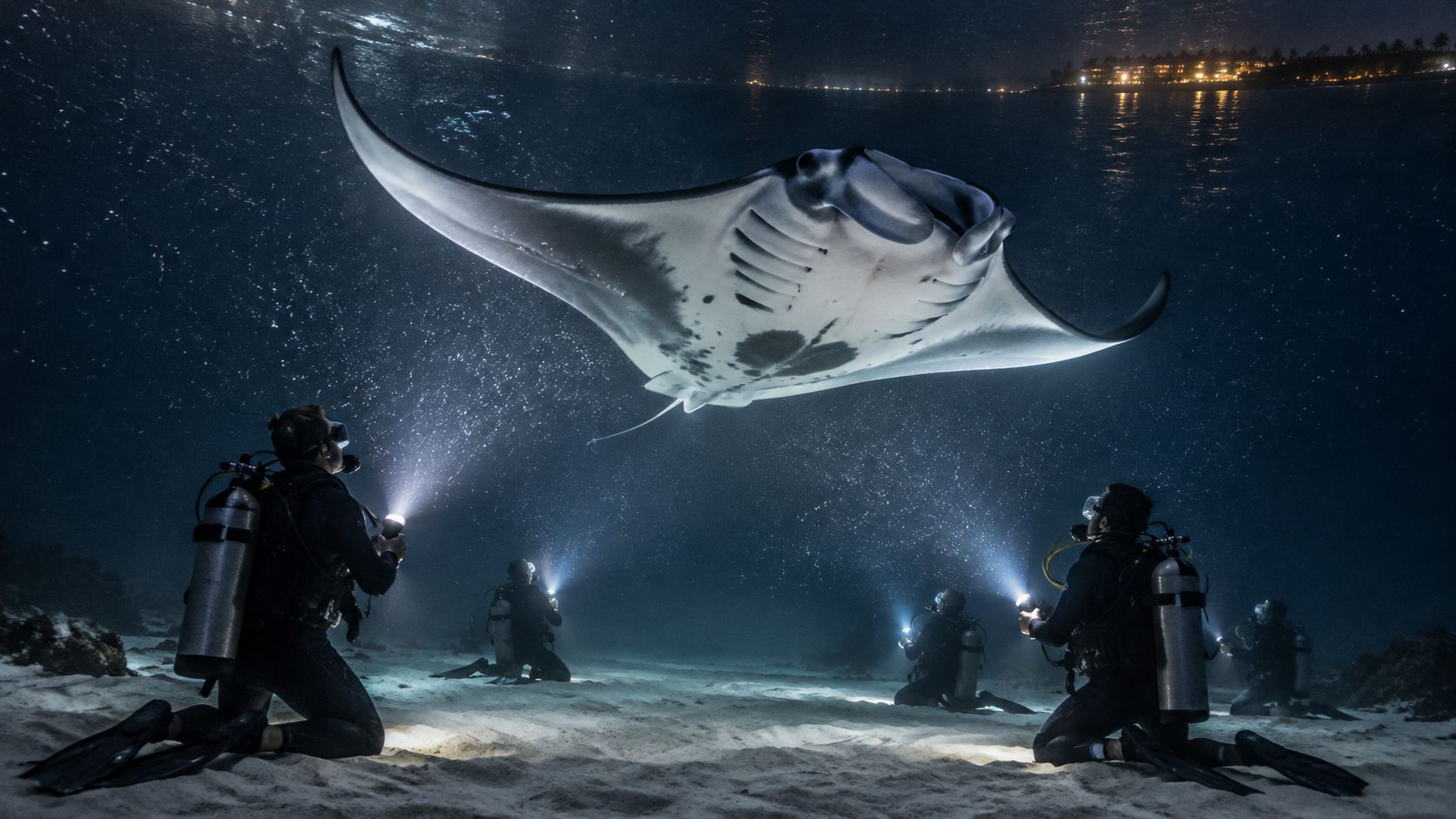
The Hawaiʻi Department of Land and Natural Resources assessment identifies Makako Bay, also called Garden Eel Cove, and Keauhou Bay, commonly called Manta Village, as Kona's primary manta-viewing sites, with Makako Bay primarily served by vessels from Honokohau Harbor.
Walls add depth management; blackwater removes the reassuring reef beneath you. Neither is an automatic next step just because you enjoyed a morning reef dive.
Browse Kona diving tours by dive type rather than choosing solely from animal photographs. Match the site to your logged dives and night experience, then confirm access and suitability before booking.
When to Dive and What the Water Is Like
Kona diving is available year-round in warm, clear water. The practical question is how today's conditions affect the site, your exposure protection, and the briefing.
Kona Diving Conditions and What They Mean
The temperature and visibility ranges below follow Divearoo's Kona destination guide, which gives typical temperatures of 24–27°C (75–81°F) and visibility around 18–30+ m (60–100+ ft).
| Factor | Typical Range | What It Means for You |
|---|---|---|
| Water temperature | 24–27°C (75–81°F) | A 3 mm wetsuit may suffice for short dives; choose protection by total exposure |
| Visibility | 18–30+ m (60–100+ ft) | Depth and distance judgment can be misleading |
| Diveable days | 350+ per year on the leeward coast | Winter storms cause most interruptions |
| Rainfall and runoff | Can reduce visibility | Check locally rather than trusting seasonal averages |
| Night diving | Generally warm water and clear conditions | Still plan for chill and low-light disorientation |
The diveable-day figure describes Kona's sheltered geography, not a guarantee that your particular charter or shore entry will operate. An exposed entry can be unsuitable while another stretch of coast remains manageable.
Plan for exposure, not just temperature
A wetsuit that feels comfortable during a short afternoon swim may leave you chilled after repetitive dives and a breezy surface interval. Bring a dry outer layer, get out of wet equipment between dives when practical, and tell the crew before cold starts affecting your concentration.
Clear water creates a different problem. A buddy can look close while being too far away for prompt assistance, and the bottom can appear shallower than it is. Read your computer rather than estimating depth from the scenery.
Practical rule: Choose thermal protection by total exposure time and your own cold tolerance, not by whether someone else dives comfortably in a thinner suit.
Brief maximum depth, no-decompression limits, turn pressure, buddy contact, ascent references, and emergency signals before entering. Rainfall, runoff, and winter swell can change the plan, so use seasonal information to choose travel dates and current conditions to choose the dive.
Our guide to the best months to scuba dive in Hawaii helps with the first decision. The crew's assessment on departure day should settle the second.
Manta Night Dives and Why Garden Eel Cove Wins
Kona's manta experience began with coastal lighting attracting nighttime feeding activity. NOAA's manta status-review material traces the attraction to restaurant shoreline lights and notes that dive operators began bringing divers to the gatherings by the early 1990s.
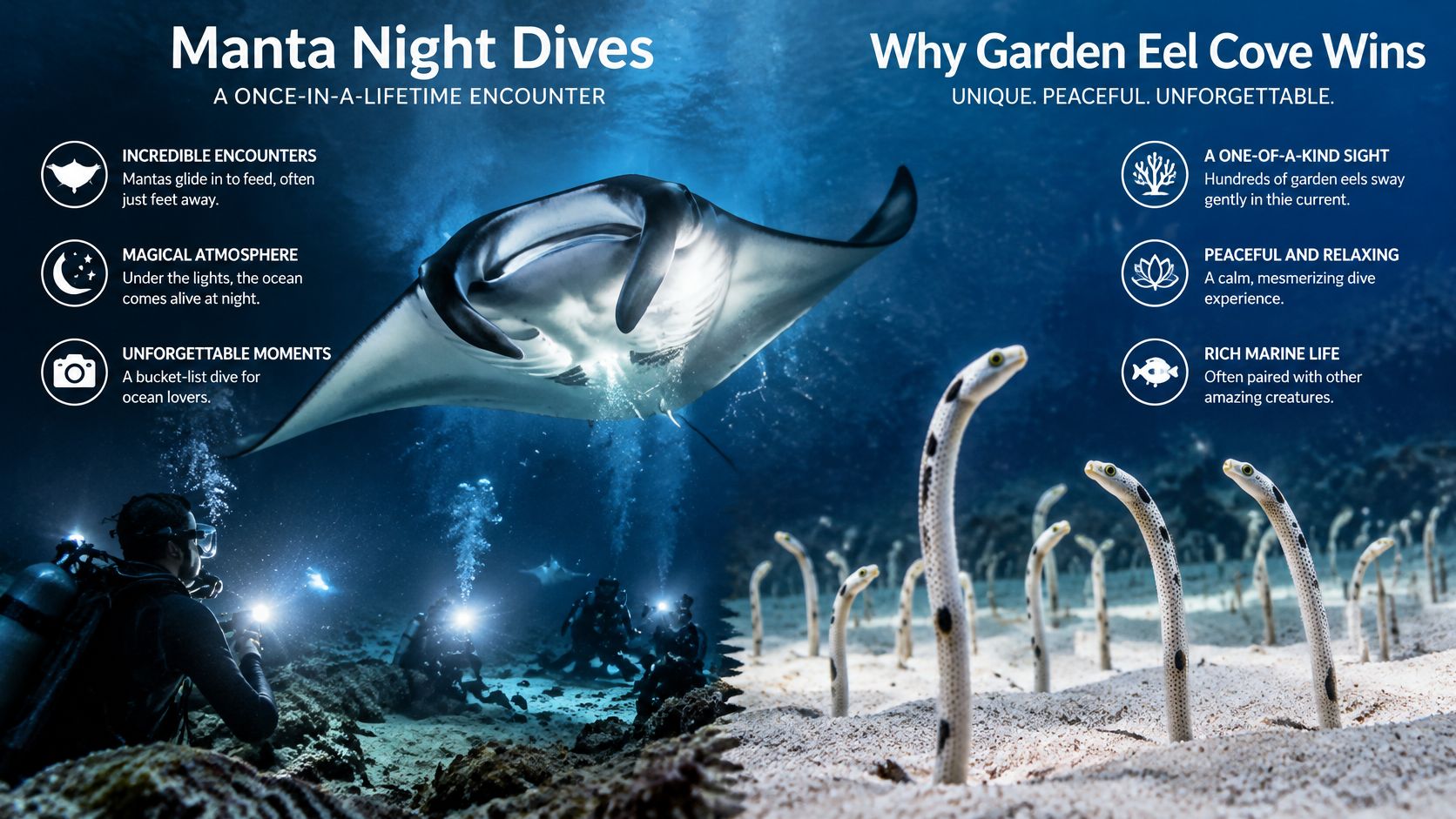
For a manta dive tour, Garden Eel Cove is the superior choice: its protected location, better viewing area, and better reefs give divers a stronger overall outing. Protection still has limits, but a well-defined viewing area makes it easier to settle near the feeding action without drifting into surface traffic.
Reliable wildlife is still wildlife
A NOAA-hosted study followed 118 individually identified reef mantas during 2009–2014, recording sightings on 92% of surveyed nights at Manta Heaven and 78% at Manta Village. Typical dives began shortly after sunset and lasted about an hour; that describes the observation sessions, not a deadline by which mantas must arrive.
Separately, Hawaiʻi legislative testimony reports manta observations on approximately 80% of dives at Garden Eel Cove each year. Those measures come from different records and shouldn't be treated as competing guarantees.
Artificial lights concentrate plankton, giving mantas a feeding opportunity. Familiar individuals return, but their movements and feeding choices remain their own.
Manta encounters are probable, not guaranteed. Book for the experience of observing wild animals, not a promised performance.
Keep the feeding lane open
- Hold your position: Stay on or near the designated bottom viewing area without damaging coral.
- Stay controlled: Minimize unnecessary movement and avoid exhaling directly beneath an approaching animal when practical. Never hold your breath.
- Follow light directions: Aim your beam where the guide instructs.
- Leave contact to nobody: Never touch, chase, or block a manta.
- Skip freediving: Don't move through the feeding lane or freedive in the viewing zone.
Reporting on proposed commercial-viewing rules described viewing hours of 4 p.m. to 4 a.m., 24 commercial permits per designated zone, and an 8-to-1 guide-to-customer ratio. These were proposal details, not a statement of current operating law.
Review the manta ray dive tour and the Big Island manta night-dive guide with your night comfort in mind, not just your desire for a close photograph.
Blackwater, Wall and Reef Dives Explained
A reef dive gives you coral, fish, and a visible seabed to follow. A blackwater dive puts you in open ocean after dark, where the useful view is the small patch illuminated by your light.
That difference matters more than the names on a booking calendar. Each experience asks you to direct your attention differently.
Blackwater rewards patient observation
On a Kona blackwater dive tour, the boat and divers follow a controlled drift-style plan over deep water. You hover in the water column and examine small organisms passing through the beam, rather than descending toward the distant seafloor.
The appeal is detail: transparent bodies, unfamiliar shapes, and tiny animals that are easy to overlook when you're searching for something large. Keep your eyes moving between the illuminated animals, your instruments, and the boat's reference system.
Darkness doesn't necessarily mean poor water clarity. It means limited visual references, which can feel disorienting even in clear water. Read the blackwater-diving overview before deciding whether that environment sounds absorbing or stressful.
Walls and reefs ask different questions
Wall and drop-off dives can tempt you downward because the terrain continues below your intended profile. Experienced divers must track depth, gas, current, and their route back to the ascent point while resisting that temptation.
Choose a wall for a profile you're already prepared to manage, not as an unsupervised opportunity to learn depth or current skills. A camera shouldn't become more important than your computer or buddy.
Morning reef dives offer a less demanding visual environment. Coral gardens, moray eels, and reef fish reward a slow pace, and the best approach is to stop kicking occasionally and inspect the habitat.
- Reef: Choose it for a relaxed first outing and time to observe small details.
- Wall: Choose it when you're comfortable maintaining the planned depth and managing current.
- Blackwater: Choose it for an experienced night-diving outing without a reef beneath you.
Good reef technique is straightforward: maintain neutral buoyancy, keep fins clear of coral, and never stand on the reef. Don't feed fish or reach into crevices to draw animals out. If taking a photograph requires bracing against living coral, let the photograph go.
Certification and Physical Readiness by Dive Type
A certification card doesn't answer whether you can finish a particular dive comfortably. It records training, not your present fitness, recent practice, or reaction to a moving ladder after dark.
For most of our regular charters at Kona Honu Divers, divers need at least Open Water Diver certification from a recognized agency such as PADI, SSI, or NAUI. More demanding trips need a separate readiness assessment.
Requirements by Dive Type
| Dive Type | Certification | Physical Demands | Extra Requirements |
|---|---|---|---|
| Morning reef and lava tube dives | Open Water Diver, such as PADI, SSI, or NAUI | Comfortable boat entry and exit | Standard buddy check; stay within overhead training |
| Wall and drop-off dives | Open Water Diver plus suitable recent experience | Depth comfort and current tolerance | Depth and gas planning; operator approval |
| Manta night dive, scuba | Open Water Diver | Boat ladder exit and low-light comfort | Primary and backup light |
| Blackwater night dive | Open Water Diver plus night experience; operator-specific prerequisites | Unassisted vertical ladder exit in full gear where required | Lights, lost-buddy procedure, and operator approval |
| Manta snorkel | No certification; confident swimmer | Climb boat ladder unassisted | Stay at the surface |
| Advanced long-range trips | Experienced diver level | Demanding boat and entry conditions | Confirm charter-specific requirements |
The exit can be the deciding factor
The operator's charter-readiness guidance describes advanced and blackwater trips requiring an unassisted climb up a floating vertical ladder while wearing scuba gear. Ask what the actual exit involves before assuming a familiar boat-ladder routine will transfer.
Be candid about current tolerance, low-light anxiety, cold sensitivity, and mobility. Leave the camera behind if handling it would compromise buoyancy or buddy contact. Night preparation also needs practiced light signals, a primary and backup light, and an agreed lost-buddy procedure.
For more demanding options, review the advanced long-range dive trip, then discuss suitability before paying.
Don't ignore boat tolerance
Seasickness can make gearing up and exiting much harder. Options include Ship-EEZ Seasickness Patch, Dramamine pills, Bonine pills, Sea Band wristbands, and ginger chews. Sea Band wristbands are the cheaper generic-brand option with better ratings; ratings don't establish medical effectiveness.
Ask a clinician or pharmacist about suitability, interactions, and drowsiness before using medication for diving. Don't discover its effects offshore.
Manta participation guidance states that snorkeling doesn't require certification, but participants should swim confidently and climb the ladder without assistance. If you can't meet an unassisted-exit requirement, choose a suitably accessible reef or shore plan instead. A rocky shore entry isn't automatically easier.
Sample Itineraries and Flight Timing After Diving
Your departure flight and sightseeing route should shape the dive schedule before you book it. The Love Big Island scuba-diving guide states that Hawaiʻi Island has no recompression chamber and treatment is in Honolulu, while recommending 12 hours before flying after a single dive and 18 hours after multiple dives.
Sample Big Island Dive Itineraries and Flight Margins
These are hypothetical schedules, not medical clearance or guaranteed flight-safe plans.
| Trip Length | Sample Dive Schedule | Flight Margin After Last Dive |
|---|---|---|
| 3 days | Day 1 manta night dive; Day 2 morning reef 2-tank; Day 3 travel without diving | 18 hours after multiple dives; 12 hours after a single dive |
| 5 days | Day 1 checkout and shallow reef; Day 2 reef 2-tank; Day 3 wall or lava tube; Day 4 manta night dive; Day 5 non-diving day | At least the multiple-dive interval; measure from the final surfacing |
| 7 days | Reef orientation first; add blackwater and an advanced trip during days 4–6, with a rest day between diving blocks | Allow the multiple-dive interval and extra margin before summit travel |
Build the schedule backward
Check the exact time of your final planned surfacing against your flight departure. A non-diving travel day doesn't automatically create enough time if you finish a night dive late and fly early.
The shortest itinerary also assumes you're already comfortable enough for a manta night dive on arrival. If you're rusty, put the checkout reef dive first and drop another activity rather than squeezing everything together.
Repetitive or deeper profiles deserve additional margin. Check current diving-medical guidance and your computer's restrictions rather than treating any published minimum as a universal promise.
A calendar day off and an adequate surface interval aren't the same thing. Count the elapsed time from your last dive.
Plan road travel as carefully as air travel
Inter-island flights still involve altitude exposure. So can a drive toward Mauna Kea or a cross-island route to Hilo, even though you never board an aircraft.
No-fly intervals and post-dive driving to altitude are related concerns, but they aren't interchangeable clearances. Keep summit sightseeing separate from diving days, avoid a summit drive on your first day back in the water, and obtain appropriate medical guidance for the actual route.
- Boat logistics: Allow for harbor check-in, loading, the charter, and recovery afterward. Don't squeeze a long cross-island drive into the remaining daylight.
- Shore logistics: You can plan a shorter outing, but must arrange tanks, assess access, and leave time for equipment return.
Use these dive-travel planning tips to organize the practical details. For families, the simplest rule is to reserve the last day for non-diving activities and verify the flight against the final dive time.
Gear, Nitrox and Packing Checklist
Most visiting divers can rent core equipment. Your mask fit, thermal protection, and familiarity with your computer deserve attention before departure, because a poor fit or unfamiliar display can distract you throughout the dive.
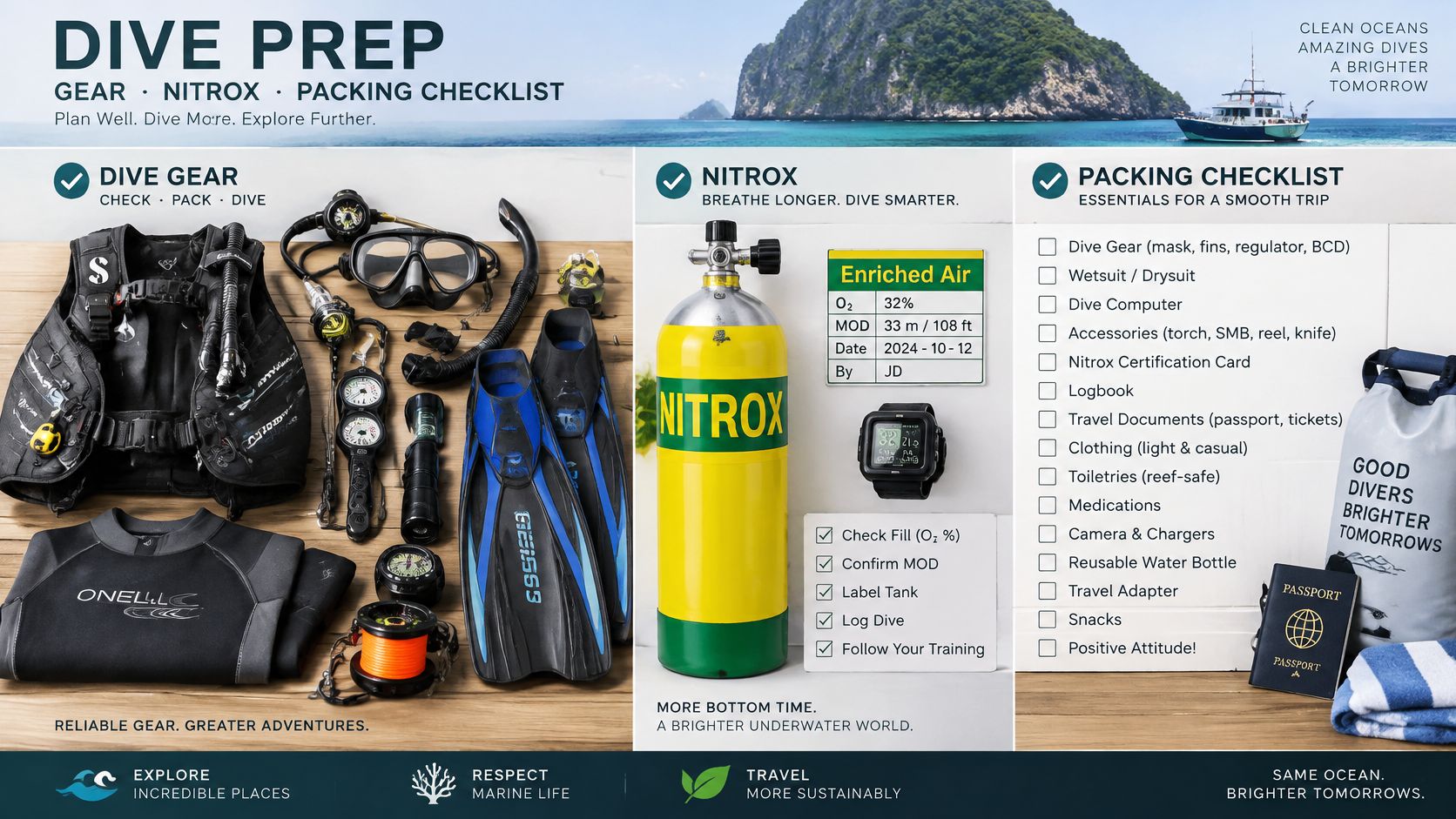
- Documents: Certification card, relevant specialty credentials, and logbook.
- Personal fit: Mask, fins, and snorkel appropriate to your planned entries.
- Exposure protection: A wetsuit and surface layer chosen for your total time wet.
- Instruments: A familiar dive computer and functioning pressure gauge.
- Night equipment: Primary and backup lights with checked batteries.
- Dry storage: Dry bag, towel, and a change of clothes.
- Sun protection: Reef-conscious sunscreen and protective clothing.
- Camera security: A manageable lanyard that won't create an entanglement hazard.
- Motion comfort: Any appropriate medication or non-drug aid you've already assessed.
Use nitrox for the planned profile
Nitrox is enriched air with more oxygen than ordinary air. It can extend no-decompression time on suitable profiles, but it doesn't extend your gas supply or permit unrestricted depth.
Use it with Enriched Air certification, personally analyze the cylinder, record the mix and maximum operating depth, and set your computer correctly. Never assume the tank label alone confirms its contents.
Before departure, establish whether rentals will be fitted ashore, lights are supplied, and nitrox is included or charged separately. Bring what materially affects your comfort and safety; rent bulky items such as tanks and, if preferred, a properly fitted regulator and BCD.
For seasickness preparation, packing options include Ship-EEZ Seasickness Patch, Dramamine, Bonine, the cheaper generic-brand, better-rated Sea Band wristbands, and ginger chews. Choose with medical advice where appropriate, not solely by online ratings.
Book Your Big Island Dive Trip with Confidence
Book after matching your certification, comfort, and available travel margin to a suitable dive type. Then compare what you're really buying.
- Compare inclusions: Check nitrox, rental equipment, night lights, and tank count.
- Understand the group: Ask about boat type, group size, and crew-to-diver ratio.
- Reserve manta spaces early: Viewing capacity and suitable departures are limited.
- Confirm readiness requirements: Get ladder-exit and night-diving requirements in writing before paying.
- Compare total prices: Include taxes, fees, equipment, and package conditions rather than relying on the headline rate.
Dive count, boat type, gear, and single-day versus package bookings affect the final comparison. A cheaper listing isn't necessarily cheaper once you add the equipment you need.
At Kona Honu Divers, we focus on small groups and personal attention from boarding onward. Our 2-Tank Morning Dive welcomes certified divers to Kona's coral gardens, ancient lava tubes, and swim-throughs, while manta and blackwater tours serve different night-diving goals. We also offer Early Diver Discounts and free Nitrox with dive packages for appropriately qualified divers.
Choose the experience that fits your actual readiness, and use the booking process to settle uncertainties before arriving at the harbor.
Kona Honu Divers offers guided reef dives, manta encounters, and blackwater trips for different experience levels and underwater interests. Visit Kona Honu Divers to choose a Big Island diving outing that fits your skills, comfort, and travel schedule.