
Table of Contents
- The fleet at a glance
- What the names do and don't tell you
- The one boat with a detailed public record
- How to read underwater time
- Matching the trip to the diver
- How the dive works
- The honest caveat
- One blackwater dive, step by step
- Advanced long-range trips
- Ordinary discomfort versus warning signs
- Your pre-trip checklist
- Seasickness on a short ride
- Book in this order
Olapa, Luu and Kahanuola are three 36-foot Big Island Divers boats that depart from Kailua-Kona and each carry up to 18 guests. If you've seen Big Island Divers Olapa Luu Kahanuola written as one long phrase, you might wonder whether you're looking at a dive site, a trip name or a single boat. What if the confusion isn't about diving at all, but about reading your booking correctly? Once you know these are vessel names, the rest becomes practical. Which hull will you board, what kind of trip is it running that day, and what should you plan for after you're back on shore?
Which Boats the Olapa Luu Kahanuola Name Covers
The direct answer is simple. Olapa, Luu and Kahanuola are boats, not dive sites and not trip types. When one of those names appears on your confirmation, it tells you which hull you're boarding in Kailua-Kona.
That distinction matters because first-time visitors often search the full phrase expecting a single experience. You don't book "Olapa Luu Kahanuola" as a tour. You book a morning dive, a manta night dive or another charter, and the operator assigns a vessel to run it.
The fleet at a glance
The company's published operational information describes three principal 36-foot dive boats associated with the names Moana Olapa, Moana Luu and Kahanuola, each accommodating up to 18 guests for a combined maximum of 54 passengers when all three run full, as detailed in Big Island Divers private charter information. Those numbers give you the scale right away. These are small to medium working dive boats, not large excursion ships.
| Vessel | Length | Guest capacity | Notes |
|---|---|---|---|
| Moana Olapa | 36 ft | Up to 18 guests | Named in the company's published operational information |
| Moana Luu | 36 ft (28 ft variant in some listings) | Up to 18 guests | Naming and length vary across published listings |
| Kahanuola | 36 ft Lightning Radon | Up to 18 guests | Built 1988; U.S. Coast Guard-inspected passenger vessel |
| Combined fleet | Three boats | 54 guests | Maximum when all three boats run at full capacity |
Read the table with one caution. The broader fleet also lists a 28-foot Moana Luu in some published listings, which creates naming and vessel-description variation. Don't assume length or layout from the name alone. Check the exact vessel named on your confirmation and ask the operator if the listing you saw doesn't match it.
Practical rule: Your confirmation boat name is the hull you board. If it doesn't match what you expected, ask before you travel to the harbor, not at the dock.
What the names do and don't tell you
Olapa is informally translated as agile or nimble and Luu as diving or plunging, but you should confirm Hawaiian meanings with a Hawaiian-language dictionary or the operator rather than treating a casual translation as definitive. Names help you identify a boat at the harbor. They don't tell you the dive site, depth or difficulty of that day's trip.
That's a common point of confusion. A guest might hear "Kahanuola tomorrow" and think it describes where they're diving. It doesn't. The trip name on your booking describes the plan. The boat name describes the transport and the working platform you'll gear up on.
The one boat with a detailed public record
Kahanuola has the clearest documented history of the three. It's a 36-foot Lightning Radon built in 1988, documented as a U.S. Coast Guard-inspected passenger vessel, which makes it approximately 38 years old in 2026 according to Big Island Divers contact and vessel information.
The same documentation identifies it as a Hawaiian Lightning Radon built by Lightning Fiberglass Company, with a fiberglass-reinforced-plastic hull, a modified-V planing design and an 11-foot beam. It lists gross and net tonnage of 13 and 10, fuel capacity of 170 gallons, freshwater capacity of 40 gallons and holding-tank capacity of 20 gallons.
Don't read age as a safety verdict by itself. A 1988 build date places Kahanuola in the mature era of fiberglass commercial dive-boat construction, and purpose-built Hawaiian dive boats can remain in service for decades when they're maintained and adapted to local conditions. Age alone doesn't signal safety or risk. What matters is current inspection status and maintenance, so ask the operator directly about both if that's important to you.
A separate fleet page also identifies Kahanuola as a 36-foot Lightning Radon and one of the company's primary boats alongside vessels such as Moana Olapa and Luʻu, as shown on the Big Island Divers boats page. That consistency on length and type is useful. It lets you picture a compact, open working deck designed for moving divers, tanks and crew efficiently rather than for sightseeing comfort.
That compact scale fits Kona diving. The operator reports its typical dive sites are no more than a 25-minute boat ride from the harbor and no more than one-quarter mile from shore. Short transits mean the boat's job is frequency and access, not long offshore travel for most standard trips. You're spending your time gearing up, diving and returning, not crossing open ocean for hours.
For you as a guest, the trade-off is clear. A boat carrying up to 18 guests won't feel like a private six-pack charter, but it's also not a large excursion vessel. Expect a working deck, close seating and a crew routine built around getting divers in and out of the water in an orderly way. If group size matters to you, ask how many guests are booked on your specific departure rather than relying only on maximum capacity.
Dive Trips the Olapa Luu Kahanuola Fleet Runs
| Trip | Departure window | Underwater time | Best for |
|---|---|---|---|
| Morning dive | Morning departure from Kailua-Kona | Up to 60 min or 700 psi | Certified divers wanting classic Kona reef dives |
| Advanced morning dive | Morning departure | Standard dive limits as briefed | Experienced divers wanting more demanding reef sites |
| Long-range dive | Longer boat ride than the nearest sites | Standard dive limits as briefed | Experienced divers wanting less-visited sites |
| Manta night dive | After dark, Garden Eel Cove | About 45 min | Guests seeking the manta encounter |
| Blackwater dive | After dark, deep open water | About 45 min | Experienced divers comfortable diving at night |
The fleet runs five broad trip types. Morning, advanced-morning and long-range departures happen in daylight and suit divers who want reef diving while they can see the coastline and the reef structure clearly. Manta and blackwater departures run after dark and are built around animals and behavior you don't see the same way during the day.
How to read underwater time
Standard dives may run to 700 psi or 60 minutes, while manta and blackwater dives spend about 45 minutes underwater according to Chamber of Commerce information on Big Island Divers Olapa Luu Kahanuola. That doesn't make a night dive lesser. It's shorter by design because the activity, lighting and animal behavior are concentrated into a tighter window.
Think of a morning reef dive as a swim across varied seabed. You cover ground, watch your air and end when you reach the briefed limit. A manta dive is closer to sitting still in one viewing area while the action comes to you. The value isn't measured only in minutes.
Choose by certification and recent comfort in the water, not by which trip sounds most dramatic.
Matching the trip to the diver
Use one decision rule. If you're newly certified or you haven't dived recently, start with a standard morning trip. Reserve advanced-morning and long-range trips for experienced divers who've logged recent dives and are comfortable managing themselves if there's current or a longer surface swim.
A longer boat ride to long-range sites is normal. Plan for it rather than treating it as a surprise. That means sun protection, water and seasickness preparation before you board, covered later in this guide.
Kona Honu Divers runs comparable morning, manta and blackwater trips in Kona, so it's sensible to compare schedules, group sizes and boat type before you book with any operator. You can compare the general range of Kona diving tours and the specific Kona Honu Divers diving tours page side by side with your dates and certification level. The right comparison isn't only price. It's departure time, expected group size, guide routine and whether the trip matches your recent experience.
Don't let a boat name decide for you. Olapa, Luu or Kahanuola tells you the platform. Morning, long-range, manta or blackwater tells you the dive itself. Match the second one carefully and the first one becomes a straightforward logistics detail.
Manta Night Dives From Garden Eel Cove
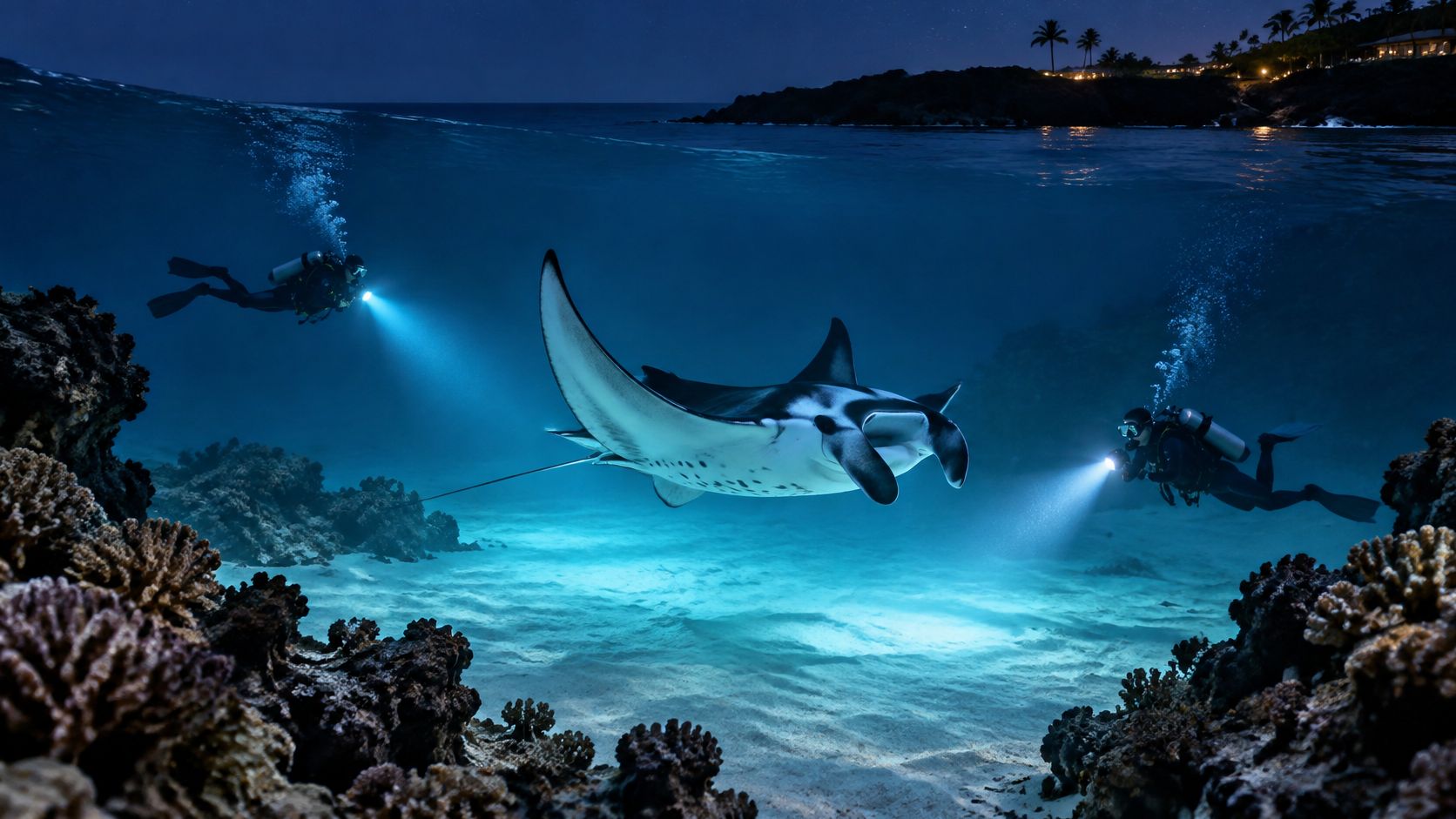
Garden Eel Cove, also called the northern Airport site, is the primary location for the manta night dive and the stronger choice because it's a protected location with a better viewing area and better reefs. That protected setting matters at night, when you want a settled place to kneel or hover low, watch and avoid stirring up the bottom.
How the dive works
Divers use lights to attract plankton. Mantas come to feed on that plankton in the light. Your job is unglamorous and important. Stay low, stay still, keep your light pointed in the direction the crew briefs rather than into a manta's face, and never touch the animals.
When mantas arrive, you see large wingspans passing close overhead, often with other fish moving through the light. You're not chasing them. The encounter works because guests hold position and let the mantas choose how close to swim. If you kick up sand or surge upward, you make viewing worse for yourself and everyone behind you.
The honest caveat
This is a wild-animal encounter, so sightings can't be guaranteed. The operator states Garden Eel Cove is the primary location but may change sites when ocean conditions or manta sightings make another location preferable, and conditions, seasonal changes and the amount of food in the water can affect manta presence, as explained on the Big Island Divers Kona manta ray night dive page.
Accept that flexibility before you book. A site change isn't the crew being vague. It's the crew responding to swell, visibility and recent sightings. If you need a guaranteed animal, a night dive in the open ocean is the wrong promise to ask for.
Three habits improve your odds of a good night, even though none creates a guarantee.
- Arrive rested: You're diving after dark, so a full day of sun and travel makes buoyancy and listening harder.
- Bring a backup night plan: If mantas don't show, you still have a night reef dive, so set that expectation in advance.
- Ask about recent sightings: Ask the crew what they've seen lately and why they've chosen that night's site.
If you're comparing operators for this specific dive, look at how each one briefs site choice and guest positioning. You can read more about the Hawaii Big Island manta ray night dive and compare it with a two-tank manta dive and snorkel tour before you commit. Garden Eel Cove's protected location, better viewing area and better reefs make it the superior choice when conditions allow the crew to use it.
Blackwater and Advanced Long-Range Dives Explained
Blackwater diving is like night hiking in an open field with no visible ground. You're not over a reef you can reference. You're hovering in deep open ocean in the dark, and the animals arrive through your light beam.
One blackwater dive, step by step
You board after dark and ride away from the reef environment that defines a morning dive. The crew briefs the descent, the guide line or reference system for that night, light signals and how close to stay to your buddy. Listen for the specific routine on your boat rather than assuming a routine you used elsewhere.
Once you're in the water, you descend or hover as your guide has instructed and let your eyes adjust. Lights draw plankton. Animals that feed on plankton, such as jellies, squid and fish, move into the beam. You're watching small, often translucent life drift past rather than following a reef wall.
The dive lasts about 45 minutes underwater. That time passes differently without a bottom reference. Divers who depend on looking down to judge depth can feel unsettled. Divers who can hold a hover, check their computer calmly and breathe slowly usually settle in.
Three skills matter most.
- Stay close: Remain near the guide line and your buddy at all times, because there's no reef to reorient you.
- Control buoyancy: Make small adjustments and avoid repeated up-and-down movement in open water.
- Manage your light: Keep movements slow so you don't blast animals or your buddy and lose what you came to see.
Experience bar: Choose blackwater only if you've logged night dives and you're already comfortable in dark water. It isn't the dive to test whether you like darkness.
If that description sounds appealing and you meet the experience bar, compare how operators run the briefing and group. Details for a Kona blackwater dive tour and a black water night dive show the format you should expect to be briefed on in person.
Advanced long-range trips
Advanced long-range diving trades a longer boat ride for less-visited sites. That can mean different reef structure and fewer other groups, but it also means more time on the surface in sun and swell. Suited divers are experienced, have recent logged dives and are conditioned for current and longer days on a boat.
Plan those trips more carefully. Eat and hydrate before boarding, prepare for seasickness and protect yourself from sun between dives. Fatigue isn't a minor detail on a demanding dive. It affects air use, buoyancy and decision making.
Experienced divers comparing options should look at a premium advanced two-tank long-range trip alongside the standard morning schedule. Ask what recent experience the crew expects, what conditions would cause a site change and how long the ride is on your date. A calm, specific answer tells you more than a promise of an epic site.
Safety, Seasickness and Planning for Emergencies
A low local incident rate doesn't reduce the severity of the rare serious case when specialized treatment is far away. Hawaiʻi Island has no recompression chamber, and treatment requires transfer to Honolulu. That distance makes emergency logistics and insurance planning part of the dive plan, not an afterthought.
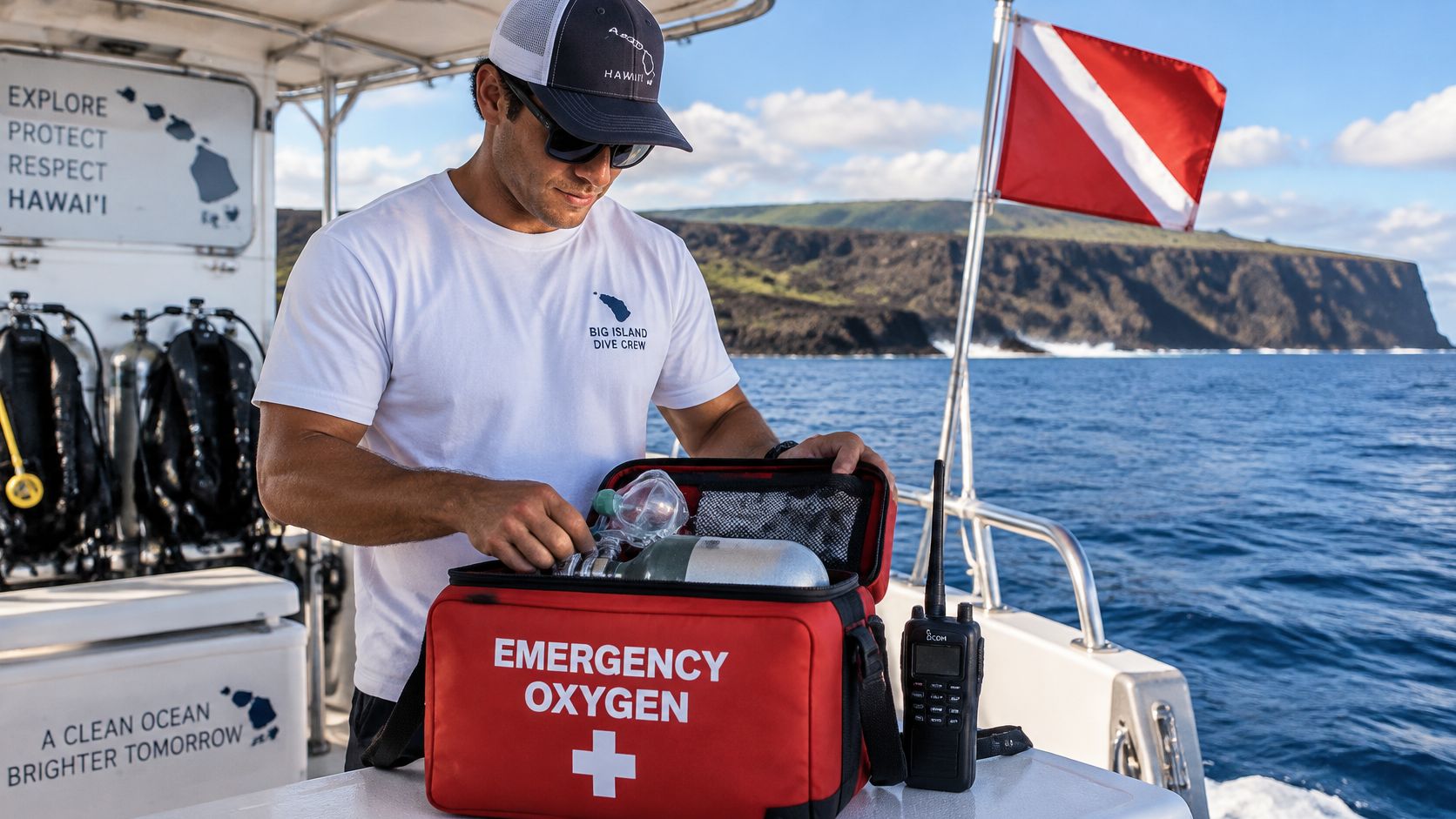
Standard trip pages emphasize schedules and underwater duration. They give less visitor-focused guidance on what happens if symptoms appear hours after you return to shore. The smarter questions aren't only about whether diving is safe. They're about how far definitive treatment is, who coordinates evacuation, what you should do if symptoms appear later, how you should schedule flights after repetitive or deeper dives and whether your insurance covers inter-island medical transport.
Ordinary discomfort versus warning signs
Don't self-diagnose after a dive. Separate mild issues that clear quickly from symptoms that need immediate emergency evaluation, and err toward evaluation when you're unsure.
| Symptom | Action |
|---|---|
| Mild ear or sinus discomfort that clears quickly | Rest, hydrate, note it and tell the crew |
| Joint pain, numbness, tingling, dizziness or weakness | Seek emergency evaluation immediately; do not self-diagnose |
| Unusual fatigue or confusion after diving | Seek emergency evaluation immediately |
| Seasickness during the boat ride | Use a preventative taken before boarding and rest on deck in fresh air |
Tell the crew early, even if you feel embarrassed. Crews would rather assess a minor problem on the boat than hear about worsening symptoms after you've driven away from the harbor. If symptoms appear later at your hotel, seek emergency help immediately and tell responders you've been diving, when you surfaced and what kind of dives you did.
Your pre-trip checklist
- Certification history: Bring proof and be ready to state your recent dive experience truthfully.
- Current medications: Know what you take and whether any medication affects diving or seasickness choices.
- Emergency contacts: Keep them accessible to someone traveling with you, not only on a locked phone.
- Insurance: Confirm travel and dive coverage includes inter-island medical transport if you need transfer to Honolulu.
- Flight timing: Confirm post-dive flight timing with the operator, especially after repetitive, deeper or night dives.
Seasickness on a short ride
Seasickness can start during the 25-minute run to typical dive sites, and longer-range rides give it more time to build. Take preventatives before boarding as directed rather than waiting until you feel ill. Reading how to avoid sea sickness before your trip helps you choose a method you've already tested on land.
Options guests commonly buy in advance include the Ship-EEZ Seasickness Patch, Dramamine pills, Bonine pills, Sea Band wristbands, which is a cheaper generic brand with better ratings, and ginger chews. Test medication before your dive day if you've never used it, because drowsiness on a dive boat creates its own problem.
Book Your Kona Dive Trip and Prepare Well
Booking is easier when you treat it as a sequence rather than a single click. Each step removes one common source of confusion at the harbor.
Book in this order
- Match the trip to your experience: Use the trip table to align certification, logged dives and comfort with night or current, because the wrong trip level creates stress underwater.
- Pick a date and check the forecast: Swell changes which sites the crew can use, so keep your site expectations flexible.
- Confirm the boat and time: Note the vessel name, departure time and Kailua-Kona harbor location on your booking so you board the right hull.
- Reserve and file your documents: Keep your confirmation with insurance details and emergency contacts where you can reach them offline.
- Finish the safety preparation: Complete the checklist and seasickness plan from the safety section before boarding, not in the harbor parking area.
- Arrive early and ask the plan: Check in with the crew and ask which site they plan for the day and why, so changes feel informed rather than abrupt.
Good preparation also includes general travel planning for gear, sun exposure and scheduling dives around flights. These dive travel tips and tricks are worth reading before you pack, especially if you're combining diving with inter-island travel.
Kona Honu Divers is the operator to contact for manta, blackwater and advanced trips in Kona when you're comparing who runs the dive you want on your dates. Experienced divers should review the advanced long-range dive tour for expectations before reserving a more demanding trip. Ask direct questions about group size, recent experience requirements and site flexibility, and book the trip that matches the diver you are now, not the diver you plan to become later in the week.
If you're ready to choose between a morning reef dive, the Garden Eel Cove manta night dive or a blackwater or advanced long-range trip, Kona Honu Divers runs those Kona experiences with briefings built around your certification and recent experience. Check availability for your dates, confirm the boat and departure details on your booking, and arrive with your insurance, emergency contacts and seasickness plan already sorted.