
So, you're trying to figure out which Hawaiian island has the absolute best scuba diving? Ask any seasoned diver, and you'll likely hear the same answer: the Big Island, especially the Kona coast, is in a league of its own. While you can find incredible dives across the archipelago, Kona's unique mix of calm seas, crystal-clear water, and legendary signature dives makes it the hands-down winner for most divers.
Comparing Hawaii’s Top Diving Islands
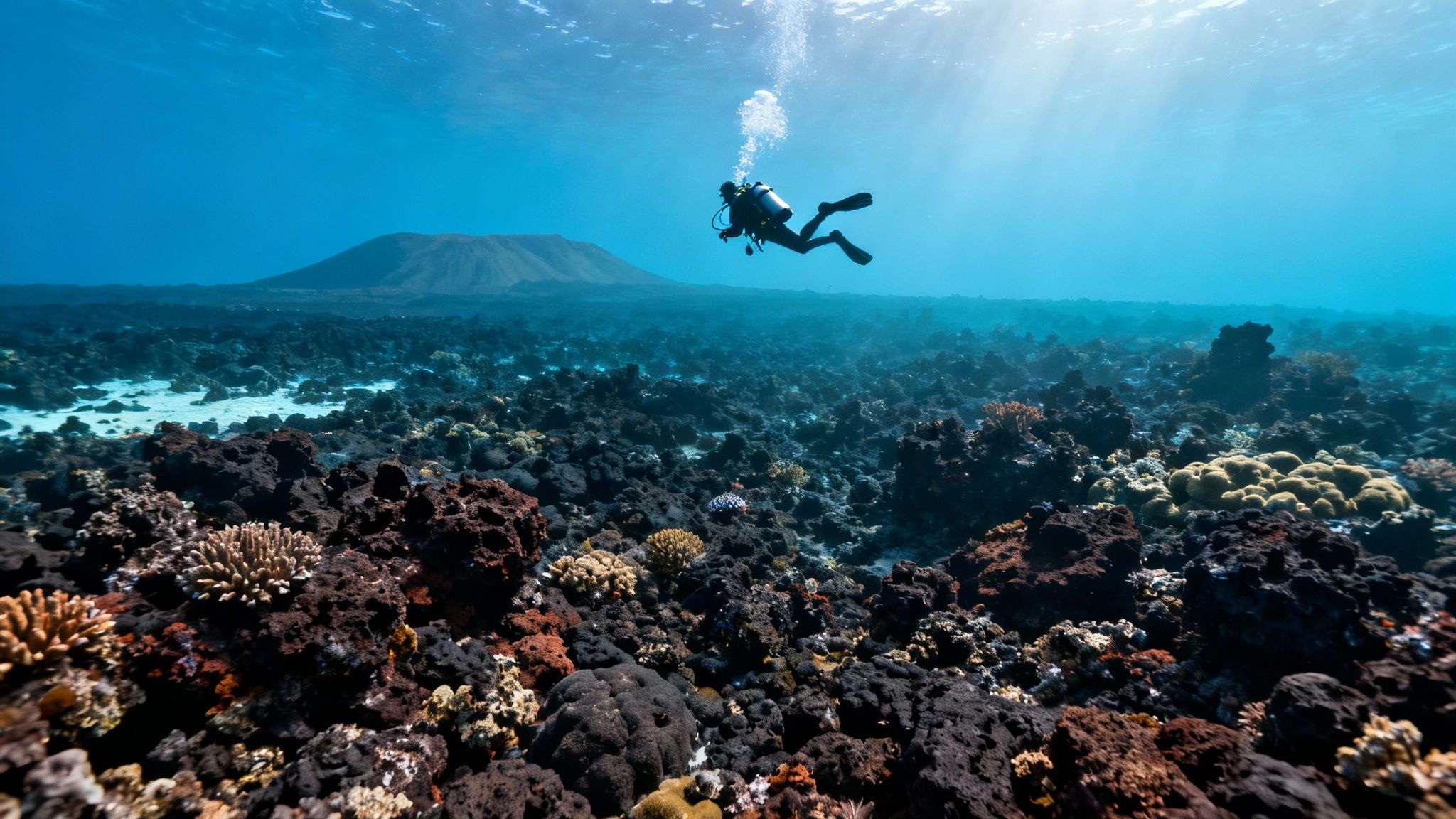
Why does the Big Island consistently get the nod? It's not just hype. The island’s massive volcanoes, Mauna Loa and Hualalai, act as a natural shield, protecting the western Kona coast from the gusty trade winds. The result is almost unbelievably calm and clear conditions, making for phenomenal diving nearly every day of the year. It's a diver's dream.
This protected coastline is also home to more dive sites than anywhere else in Hawaii—we're talking over 50 distinct spots. Ancient lava flows have sculpted an incredible underwater playground of tunnels, dramatic arches, and collapsed craters. These underwater volcanic landscapes are magnets for a dizzying array of marine life.
To help you see how the islands really compare, let's break down what makes each one special.
Hawaiian Islands Scuba Diving At-a-Glance
This table gives you a quick snapshot of the top contenders, highlighting what each island is truly known for in the diving community.
| Island | Best For | Visibility | Key Marine Life | Signature Dive |
|---|---|---|---|---|
| Big Island (Kona) | Overall Variety & Signature Dives | Excellent (100+ ft) | Manta Rays, Dolphins, Turtles, Endemic Fish | Manta Ray Night Dive |
| Maui | Unique Topography & Clear Water | World-Class (150+ ft) | Reef Sharks, Octopus, Eagle Rays | Molokini Crater |
| Oahu | Wreck Diving & Accessibility | Good (60-100 ft) | Turtles, Eels, Large Fish Schools | YO-257 Wreck |
| Kauai | Advanced & Remote Adventures | Excellent (100+ ft) | Monk Seals, Pelagics, Sharks | Ni'ihau Island |
While every island offers something special, you can see why the Big Island consistently comes out on top. It’s not just about having one or two great sites; it's about offering a complete, world-class diving experience that caters to everyone, from your very first open-water dive to your hundredth.
Why the Big Island Is in a League of Its Own
Sure, every Hawaiian island has beautiful diving. But if you're asking a seasoned diver where to go, they'll almost always point you to one place: the Big Island. The secret lies with the Kona coast, which is perfectly tucked away behind the massive volcanoes Mauna Loa and Hualalai.
This unique geography acts as a natural shield, blocking the powerful trade winds that can churn up the water elsewhere. The result? Exceptionally calm, clear conditions year-round, which allows some of the healthiest and most complex coral reef systems in Hawaii to thrive. For us divers, that means a world sculpted by volcanic history, full of incredible lava tubes, dramatic archways, and hidden caverns just waiting to be explored.
The World-Famous Manta Ray Night Dive
Talk to any diver about their bucket-list trips, and the Kona Manta Ray Night Dive will inevitably come up. It's more than just a dive; it's a world-renowned spectacle that you can only reliably experience right here. Picture this: you're kneeling on the sea floor as darkness falls, and suddenly, giant manta rays with wingspans over 15 feet are gliding, swooping, and somersaulting just inches from your face.
They're drawn in by the plankton that gather in the glow of dive lights, creating a silent, graceful underwater ballet. It’s a humbling, almost surreal encounter that stays with you long after you surface.
The Big Island’s Manta Ray Night Dive is consistently ranked among the best night dives on the planet. It’s an incredibly reliable and magical experience that pulls in divers from every corner of the globe.
The Thrilling Blackwater Dive
If you're an adventurer looking for something truly unique, Kona has an answer: the Blackwater Dive. This is about as far from a typical reef dive as you can get. You'll head miles offshore into the deep, open ocean at night. Tethered to the boat, you descend into thousands of feet of inky black water.
Down there, you'll witness the largest migration on Earth as strange, bioluminescent creatures rise from the abyss to feed. You’ll come face-to-face with alien-like larval fish, translucent squid, and jellies that pulse with their own internal light. It's often called an "oceanic spacewalk," and it’s a profound experience that reveals a part of the marine world very few people ever see.
Unbeatable Conditions and Biodiversity
Beyond these two iconic night dives, the sheer variety of scuba diving on the Big Island is staggering. Visibility often pushes past 100 feet, making the conditions perfect for spotting the incredible diversity of life here.
- Endemic Species: A huge percentage of Hawaii's marine life is found nowhere else. Keep an eye out for the milletseed butterflyfish, Potter's angelfish, and the Hawaiian cleaner wrasse.
- Big Animal Encounters: It's not uncommon to be joined by pods of spinner dolphins, cruise alongside green sea turtles (honu), or spot whitetip reef sharks resting on the sand. During the winter, you might even hear the songs of migrating humpback whales.
Whether you're a brand-new diver looking for a calm, beautiful reef or a veteran seeking a new challenge, the dive sites along the Kona coast have something to offer.
Exploring Maui’s Volcanic Craters and Caverns
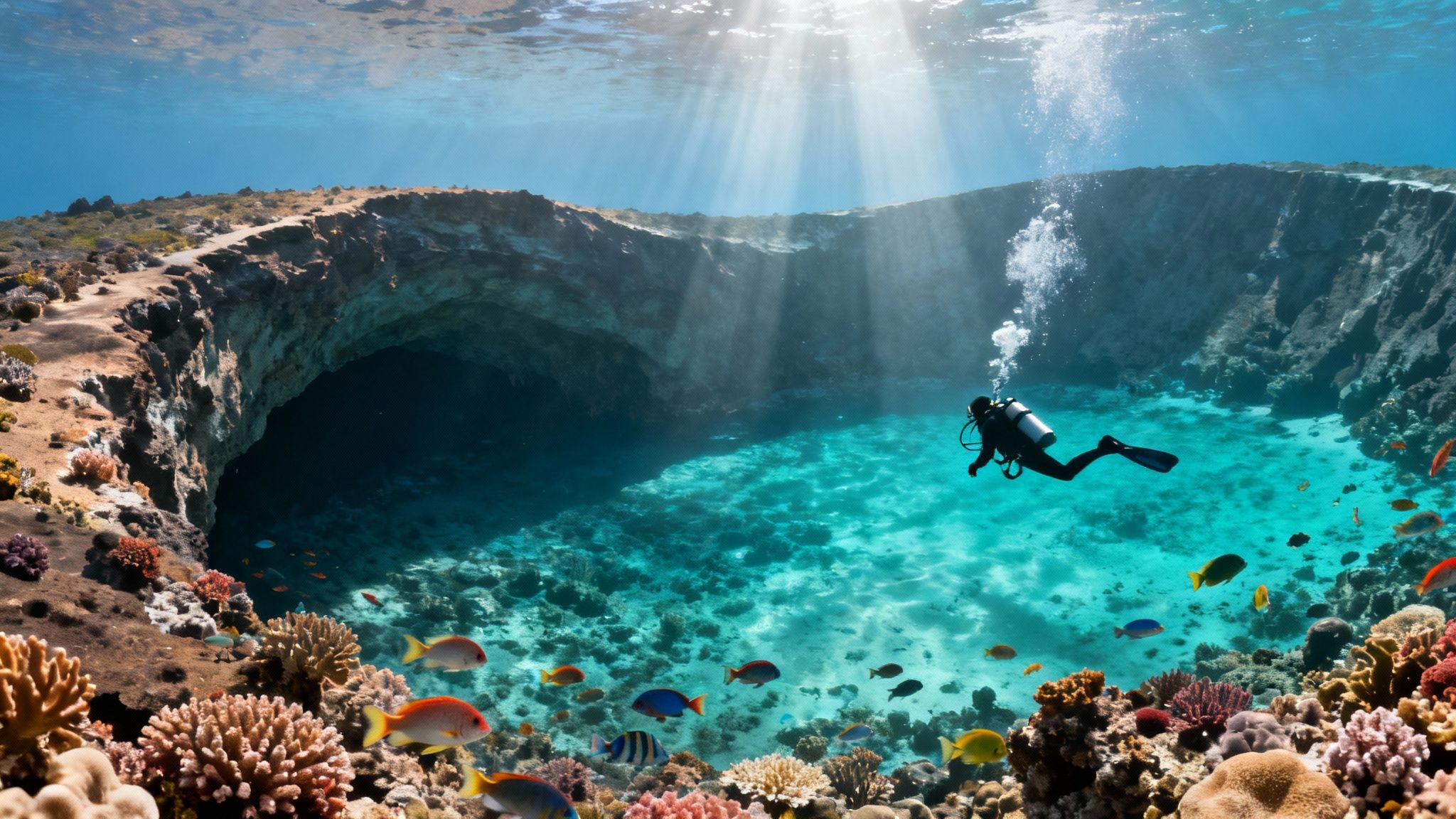
While the Big Island might have the edge in sheer variety, Maui brings something truly special to the table: spectacular underwater geology and some of the best visibility on the planet. There's one site, in particular, that puts Maui on every diver's map: the one and only Molokini Crater.
This crescent-shaped volcanic caldera isn’t just a dive site; it’s a protected Marine Life Conservation District. What that means for divers is an almost impossibly pristine environment. Tucked inside the crater's arms, you're sheltered from the open ocean, resulting in calm, pool-like conditions. The water clarity is legendary, often pushing past an incredible 150 feet. Sunlight pours in, lighting up a brilliant reef that's absolutely buzzing with schools of fish, eels, octopus, and the occasional whitetip reef shark chilling on the sandy bottom.
But for more seasoned divers, the real magic happens on the other side.
The Legendary Molokini Back Wall
Venture outside the crater's protective curve and you’ll find the "back wall," a breathtaking vertical drop that disappears more than 300 feet into the deep blue. This is a serious drift dive. The current carries you along a sheer cliff face decorated with corals, sponges, and gorgonian fans. You spend the whole dive with one eye on the wall and the other gazing out into the blue, hoping for a fly-by from eagle rays, sharks, or even the elusive manta ray.
The Big Island’s Kona coast might offer more reliable encounters with big animals, but the Molokini back wall is a world-class drift dive. Nothing quite compares to that feeling of flying along a seemingly bottomless wall in crystal-clear water.
Lanai's Underwater Cathedrals
Just a boat ride away from Maui lies the island of Lanai, home to another bucket-list dive: the Cathedrals. This isn't one cavern, but a network of massive underwater chambers formed by collapsed lava tubes.
When you swim into the main "cathedral," you'll see exactly how it got its name. Huge shafts of light beam down from openings in the ceiling, creating an awe-inspiring, church-like atmosphere. It’s a photographer’s playground and a genuinely moving experience.
So, how does Maui stack up? It boasts a couple of truly iconic, world-class sites that deliver unforgettable structure and clarity. But when it comes to the title of "best scuba diving," the Big Island pulls ahead with its sheer volume of diverse sites and guaranteed specialty dives like the Manta Ray Night Dive. Think of it this way: Maui offers a few phenomenal, must-do experiences, while the Big Island delivers a more comprehensive, week-long diving adventure.
Diving Oahu’s Historic Wrecks and Vibrant Reefs
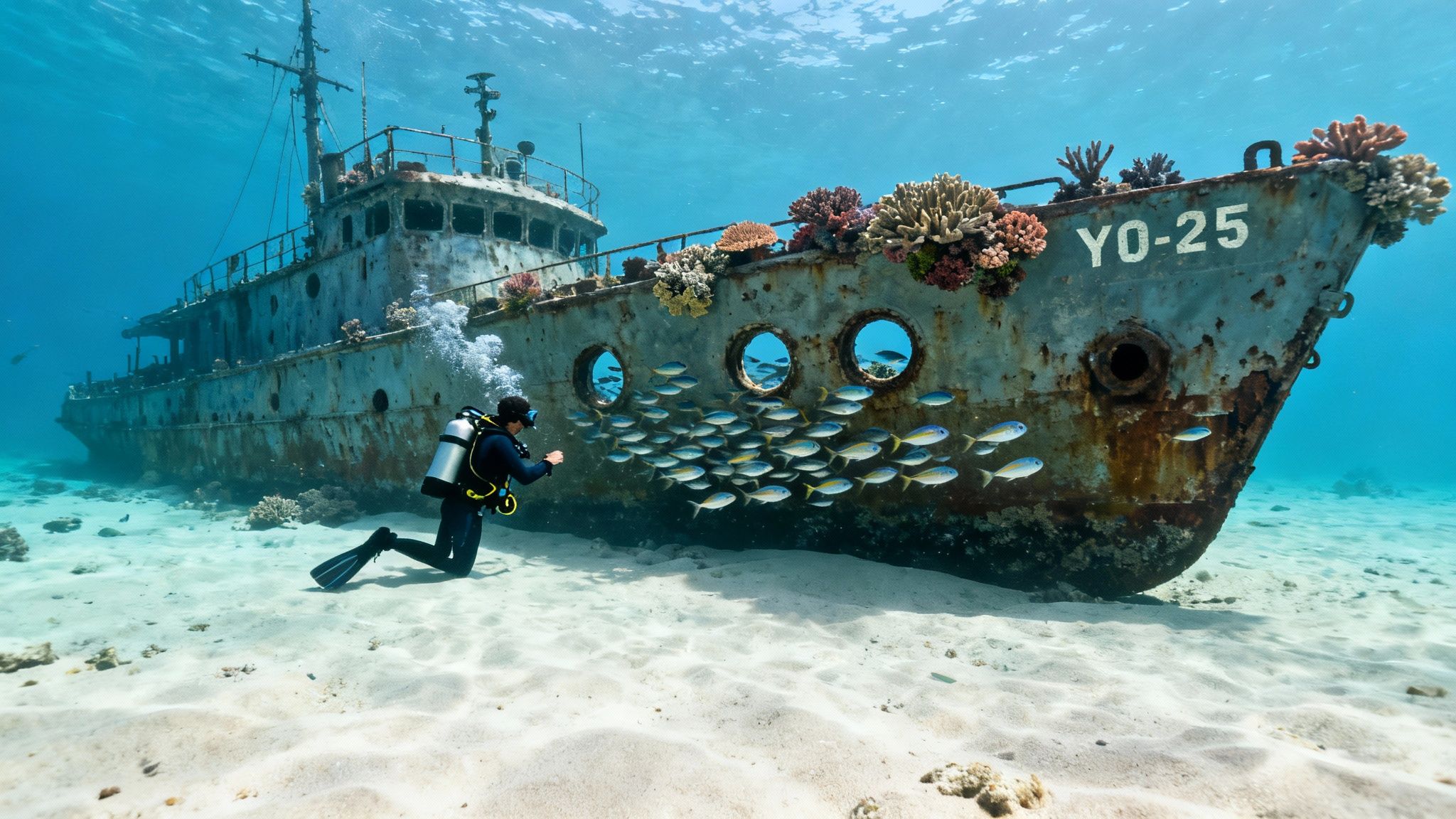
While the Big Island has its volcanic drama and Maui has its iconic crater, Oahu has carved out a special niche for itself as Hawaii's undisputed wreck diving capital. If you're the kind of diver who gets a thrill from history and seeing how nature reclaims what we've left behind, Oahu delivers an experience that’s truly in a class of its own.
Its biggest advantage? Convenience. Being right off the coast of Honolulu means these world-class sites are incredibly easy to get to. The south shore, just a quick boat trip from Waikiki, is dotted with an amazing collection of artificial reefs. These ships were sunk on purpose decades ago and have since blossomed into complex, thriving ecosystems that draw in marine life like a magnet.
Iconic Wrecks Turned Artificial Reefs
The heart and soul of Oahu diving are its legendary shipwrecks. Each one has a story, and descending onto these sunken giants feels like entering an underwater museum where marine biology and human history collide. With the right training, you can even penetrate them.
- The YO-257: This is the wreck everyone talks about. A former Navy oiler sitting at around 100 feet, it's one of Oahu’s most requested dives. Its large, open structure makes for safe exploration, and it's not uncommon for the Atlantis Submarine to glide by, creating a truly surreal photo op.
- The Sea Tiger: A bit deeper at 120 feet, this former fishing vessel sits perfectly upright and acts as a gathering place for spotted eagle rays, green sea turtles, and huge schools of fish. For advanced divers, exploring its accessible cargo holds is a major highlight.
- The Corsair: It's not every day you get to dive a WWII fighter plane. This Corsair ditched in the 1940s, and its intact cockpit and wings resting on the sand offer a unique, poignant glimpse into the past.
These aren't just hunks of rusting metal; they are full-blown vertical reefs teeming with life. Diving them provides a completely different feel from the lava tubes of Kona, appealing to a different kind of underwater explorer. To get out to these amazing sites, see our guide on the best dive shops on Oahu.
North Shore's Seasonal Thrills
Once you look past the wrecks, Oahu's legendary North Shore offers a wilder side of diving—but only when the conditions are right. During the calm summer months, this coastline opens up, revealing dramatic lava tubes, massive caverns, and stunning underwater ledges. Sites like the famous Shark's Cove become accessible, showing off incredible clarity and topography.
While the Big Island's Kona coast offers calm, predictable diving pretty much year-round, Oahu's North Shore is a different beast. Its incredible summer dive sites are best left to experienced divers comfortable with potentially challenging conditions, as the massive winter swells make the area completely undivable.
In the end, Oahu presents a pretty clear choice. If your passion is exploring historical shipwrecks and you appreciate the convenience of flying into a major hub, this island is your clear winner. But for divers searching for pristine natural reefs, unmatched biodiversity, and that once-in-a-lifetime Manta Ray Night Dive, the Big Island still holds the crown as the superior all-around diving destination.
Discovering Kauai’s Wild and Remote Diving Frontier
If you're looking for a true diving adventure—the kind that feels raw, remote, and untamed—then Kauai is your island. They call it the "Garden Isle," and that wild, lush beauty plunges right into the ocean. Forget calm, predictable reef dives; Kauai is all about a high-stakes, high-reward experience that's really meant for confident, seasoned divers.
The ocean calls the shots here. Conditions can shift in a heartbeat, and that very unpredictability is what keeps its dive sites so pristine. While you can find more accessible spots on the South Shore, like the popular Sheraton Caverns with its classic lava tubes and resident green sea turtles, the real magic of Kauai diving lies offshore.
The Legendary Ni'ihau Dive Trip
The undisputed crown jewel of Kauai diving is the trip to Ni'ihau, the "Forbidden Isle." This isn't just a dive; it's an all-day, open-ocean expedition that can only happen when the summer seas are calm enough to make the channel crossing. The journey itself is an adventure, but the payoff is something else entirely.
Visibility around Ni'ihau is often phenomenal, frequently pushing past 100 feet. The underwater landscape is pure drama—think sheer vertical walls, gigantic archways, and deep, dark caverns carved from ancient volcanic rock. But the real draw is the marine life that thrives in this isolated sanctuary.
A dive trip to Ni'ihau is one of Hawaii's ultimate underwater pilgrimages. It’s your single best shot at an encounter with a critically endangered Hawaiian monk seal, a truly unforgettable and humbling experience.
A High-Reward Experience for the Right Diver
Diving off Kauai and Ni'ihau means you're swimming with the big guys. It's not unusual to spot Galapagos sharks, sandbar sharks, and even the occasional tiger shark patrolling the deep blue. It’s a thrilling environment, but it demands that you're comfortable and skilled in challenging, open-ocean conditions.
Kauai offers an incredible adventure, but it's a specialist's destination. Its seasonal limitations and the advanced skill set required mean it can't match the consistent, year-round diving for all levels that you'll find on the Kona coast. For divers craving a wild, challenging, and truly memorable expedition, Kauai is hard to beat. But when it comes to the overall best scuba diving in Hawaii, the Big Island’s sheer diversity and reliability keep it in the top spot.
Choosing the Right Island for Your Diving Style
So, which Hawaiian island truly has the best scuba diving? The honest answer is, it really depends on what you're looking for. Every island offers a completely different underwater world, and the key is matching the destination to your personal dive style.
Are you hoping to explore sunken history on a wreck dive, or is the thrill of a remote, wild coastline calling your name?
If you’re chasing iconic volcanic formations and unbelievable visibility, Maui's Molokini Crater is a world-famous bucket-list dive. For wreck diving fanatics, Oahu is the undisputed champion, boasting a fleet of artificial reefs just a short boat ride from Honolulu. And if you’re an experienced diver looking for a true expedition, the trip from Kauai to the forbidden island of Ni'ihau delivers encounters you simply can't find anywhere else.
But when you weigh everything—the sheer variety of sites, consistent conditions, and truly unique signature dives—one island pulls ahead of the pack.
Finding Your Perfect Dive Destination
To help you zero in on the perfect spot, let's break it down by what kind of diver you are. Think of this as a matchmaking guide for your next underwater adventure.
Which Hawaiian Island Matches Your Diving Profile?
| Diver Profile | Recommended Island | Why It's a Match |
|---|---|---|
| Beginners & Photographers | Big Island (Kona) | You get calm, crystal-clear water with almost no current. The vibrant, shallow reefs make for stress-free dives and stunning photos. |
| Wreck Enthusiasts | Oahu | This is Hawaii's wreck capital. It's home to famous sites like the YO-257 and Sea Tiger, where history and marine life collide. |
| Advanced Thrill-Seekers | Kauai (Ni'ihau) | This trip is the real deal. Expect challenging drifts along deep walls with a great shot at seeing endangered monk seals and big pelagic species. |
| Divers Seeking Variety | Big Island (Kona) | With over 50 distinct dive sites, you can explore everything from lava tubes and pristine coral gardens to the legendary Manta and Blackwater night dives. |
While you can have an amazing time diving on any of the islands, the Big Island consistently delivers the most complete and dependable world-class diving adventure in Hawaii. It just ticks all the boxes for the widest range of divers.
For a much deeper dive into what each island offers, check out our complete guide to the best scuba diving in Hawaii.
Your Hawaii Scuba Diving Questions, Answered
Planning a dive trip always brings up a few key questions. Here are the answers to some of the most common ones we get about diving in Hawaii, so you can plan your adventure with confidence.
When Is the Best Time to Dive?
You can find great diving in Hawaii any time of year, but the absolute best season is summer, from May to September. During these months, the seas are usually at their calmest, and the water is wonderfully warm.
Winter, from December to March, can bring some big swells to the north shores of islands like Oahu and Kauai. But don't let that stop you. The Big Island's Kona coast is perfectly sheltered from those swells, making it a reliable, world-class diving destination year-round.
What Is the Water Temperature?
Hawaii’s water temperatures are a diver’s dream, hovering between a comfortable 75-80°F (24-27°C) all year long.
For most people, a simple 3mm wetsuit is all you need for summer dives. If you're planning multiple dives in a day or visiting in the slightly cooler winter months, a 5mm wetsuit will keep you perfectly comfortable.
Do I Need an Advanced Certification?
Not at all. Hawaii is a fantastic place for divers of every skill level, from beginners to seasoned pros.
Many of the most spectacular reefs, especially along the Kona coast, are found in calm, shallow waters that are perfect for Open Water divers. While there are certainly deeper wrecks and challenging drift dives for those with advanced certifications, you absolutely won't miss out on Hawaii's underwater magic if you're newly certified.
Ready to see why the Big Island has the best diving in Hawaii? The crew at Kona Honu Divers is ready to show you an unforgettable underwater experience.