
A scuba safety stop is a simple but vital pause divers take before coming all the way up to the surface. The standard practice is to hang out for 3 to 5 minutes at a depth of about 15 feet (5 meters).
Think of it as a brief intermission—a moment to decompress, both literally and figuratively, between your underwater adventure and the world above. This one small step dramatically lowers your risk of decompression sickness by giving your body a chance to safely off-gas the extra nitrogen it absorbed during the dive.
Understanding the Scuba Safety Stop
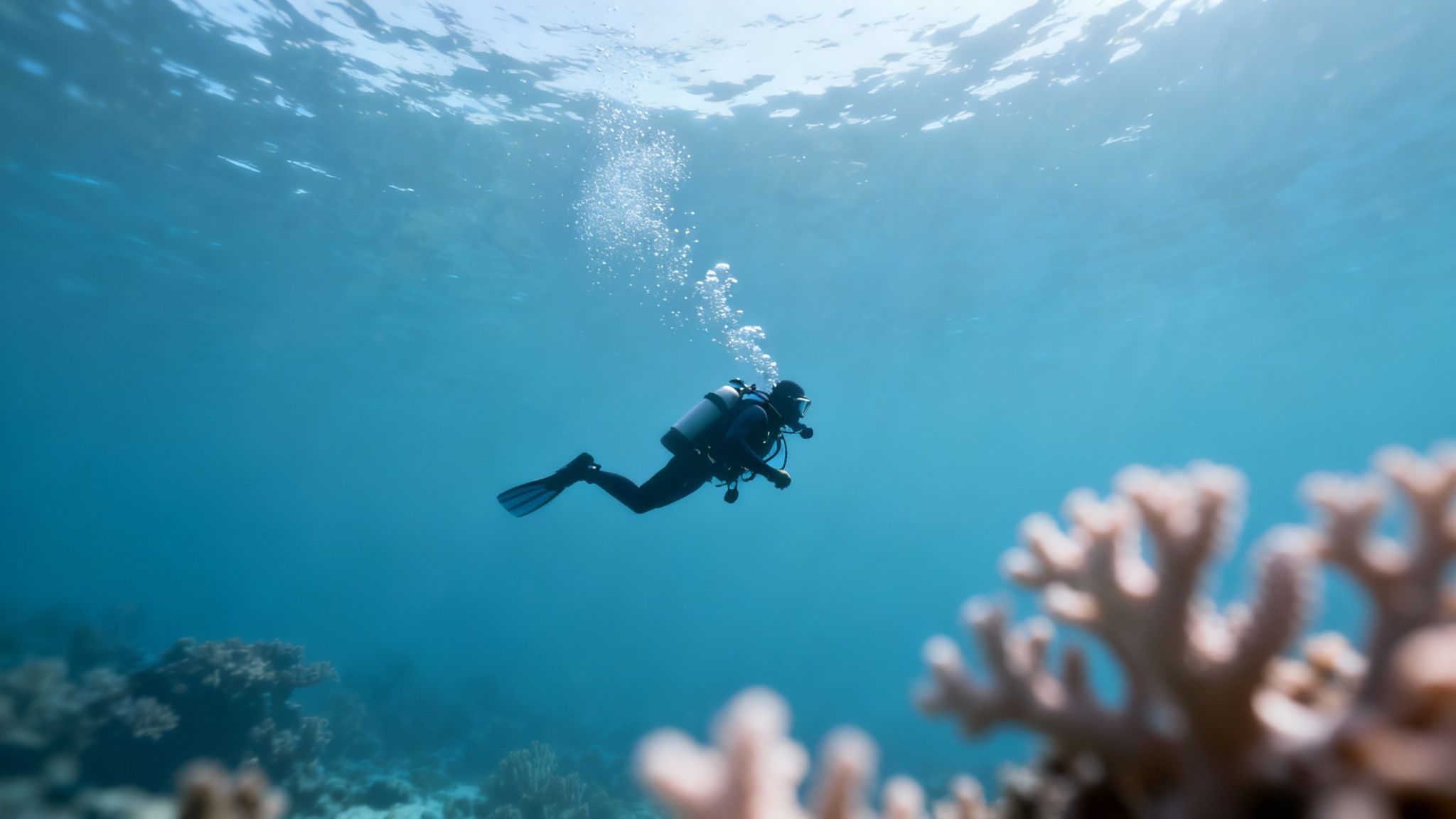
The classic analogy for a safety stop is opening a shaken-up bottle of soda. If you just pop the top right away, you get a fizzy, explosive mess as all the dissolved gas rushes out at once. But if you open it slowly, pausing to let the pressure release gradually, the gas escapes gently without making a mess.
Your body does something similar with nitrogen. The deeper you dive, the more pressure you're under, and the more nitrogen from the air you breathe dissolves into your body's tissues. As you head back to the surface, that pressure decreases, and the nitrogen needs a way out.
Ascending too quickly is like yanking the cap off that soda bottle—it can cause the nitrogen to come out of solution too fast, forming tiny, dangerous bubbles in your bloodstream and tissues. This is what causes decompression sickness (DCS), often called "the bends." The safety stop is your way of slowly and carefully unscrewing that cap. By pausing at a shallow depth, you give that dissolved nitrogen enough time to be carried harmlessly to your lungs, where you can simply breathe it out.
The Core Components
This isn't just a friendly suggestion; it's a foundational part of safe, modern scuba diving. Intentionally skipping a safety stop when one is called for is a major procedural error and can have serious health consequences.
In fact, the Divers Alert Network (DAN) points to fast ascents and missed stops as key contributing factors in many diving incidents. Their research makes it clear that while diving is overwhelmingly safe, many of the injuries that do occur are tied to preventable mistakes like ignoring established safety protocols. If you're interested in the data, you can read the detailed findings on dive safety statistics.
To help you lock in the essentials, let's break down the key parameters of a standard safety stop.
Standard Scuba Safety Stop At-A-Glance
Here’s a quick summary of what a typical safety stop looks like. It’s a simple recipe for a safer dive.
| Parameter | Recommendation | Reason |
|---|---|---|
| Depth | 15 feet (5 meters) | This depth offers the perfect pressure gradient—shallow enough for effective off-gassing but deep enough to keep it controlled. |
| Duration | 3 to 5 minutes | This gives your body enough time for the circulatory system to transport and exhale the excess nitrogen safely. |
| When to Perform | On every dive deeper than 33 feet (10 meters) | It's simply best practice. While not technically required for every profile, it's a smart habit for virtually all recreational dives. |
| Execution | Maintain neutral buoyancy and relax | The goal is to be still and calm. Physical exertion can actually increase nitrogen uptake and interfere with off-gassing. |
Think of these guidelines as your baseline for every dive. They’re easy to remember and make a world of difference in your long-term diving health.
The Science of Bubbles and Bends
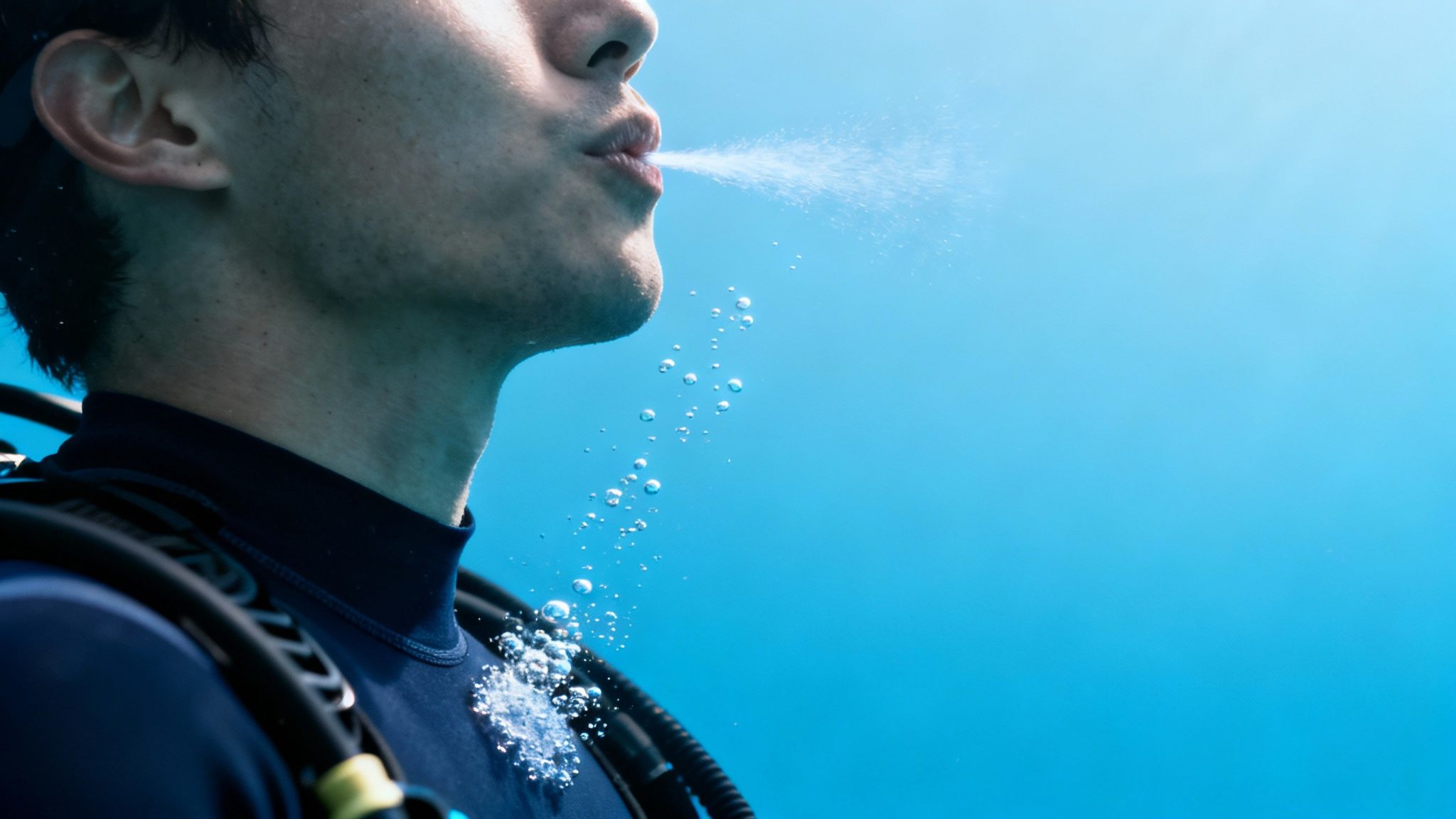
To really get why a safety stop is so crucial, we need to talk about what’s happening inside your body on a dive. It boils down to physics and pressure—specifically, a concept known as Henry's Law. But don't worry, you don't need a science degree to understand it.
Think of it this way: as you dive deeper, the surrounding water pressure essentially "squeezes" nitrogen gas from the air you're breathing into your body's tissues. It dissolves into your system, much like CO2 is dissolved into a soda bottle before it's sealed. While you're enjoying the reef at depth, this absorbed nitrogen is perfectly harmless.
The tricky part is the ascent. As you swim back toward the surface, the pressure around you decreases. This allows all that dissolved nitrogen to come back out of your tissues and turn back into tiny gas bubbles.
Managing the Microbubbles
This is precisely where the scuba safety stop becomes your best friend. A slow, controlled ascent that finishes with a deliberate pause at a shallow depth gives your body a chance to off-gas that nitrogen gracefully.
This pause allows the microbubbles to form slowly and remain small enough for your bloodstream to carry them to your lungs. Once there, you simply breathe them out. It’s a beautifully simple and effective process.
Without that pause, the pressure change can be too abrupt. The nitrogen comes fizzing out of your tissues all at once, creating bubbles that are too big and too numerous for your body to handle safely.
The Dangers of Decompression Sickness
When those bubbles grow too large or form too quickly, they can get stuck, blocking blood flow and even damaging tissue. This is a serious medical condition called Decompression Sickness (DCS), often known as "the bends." The nickname comes from the joint pain that would cause early divers and caisson workers to literally bend over in pain.
DCS isn't a single thing; it can show up in a variety of ways, ranging from mildly concerning to life-threatening. This is why preventing it is always the goal.
- Mild Symptoms: You might feel unusually tired, see a strange skin rash, or have aching joints and muscles.
- Serious Symptoms: More severe cases can cause dizziness, tingling, numbness, paralysis, or confusion.
- Life-Threatening Conditions: In the worst cases, DCS can impact the brain, spinal cord, or heart, requiring emergency treatment in a hyperberic chamber.
The scuba safety stop is your number one defense against this entire chain reaction. It’s not just a guideline in a textbook; it's a critical safety procedure based on how our bodies interact with pressure. It's also worth noting how different gas blends affect this process. You can learn more about the benefits of Nitrox diving in our guide on the topic.
How to Perform a Perfect Scuba Safety Stop
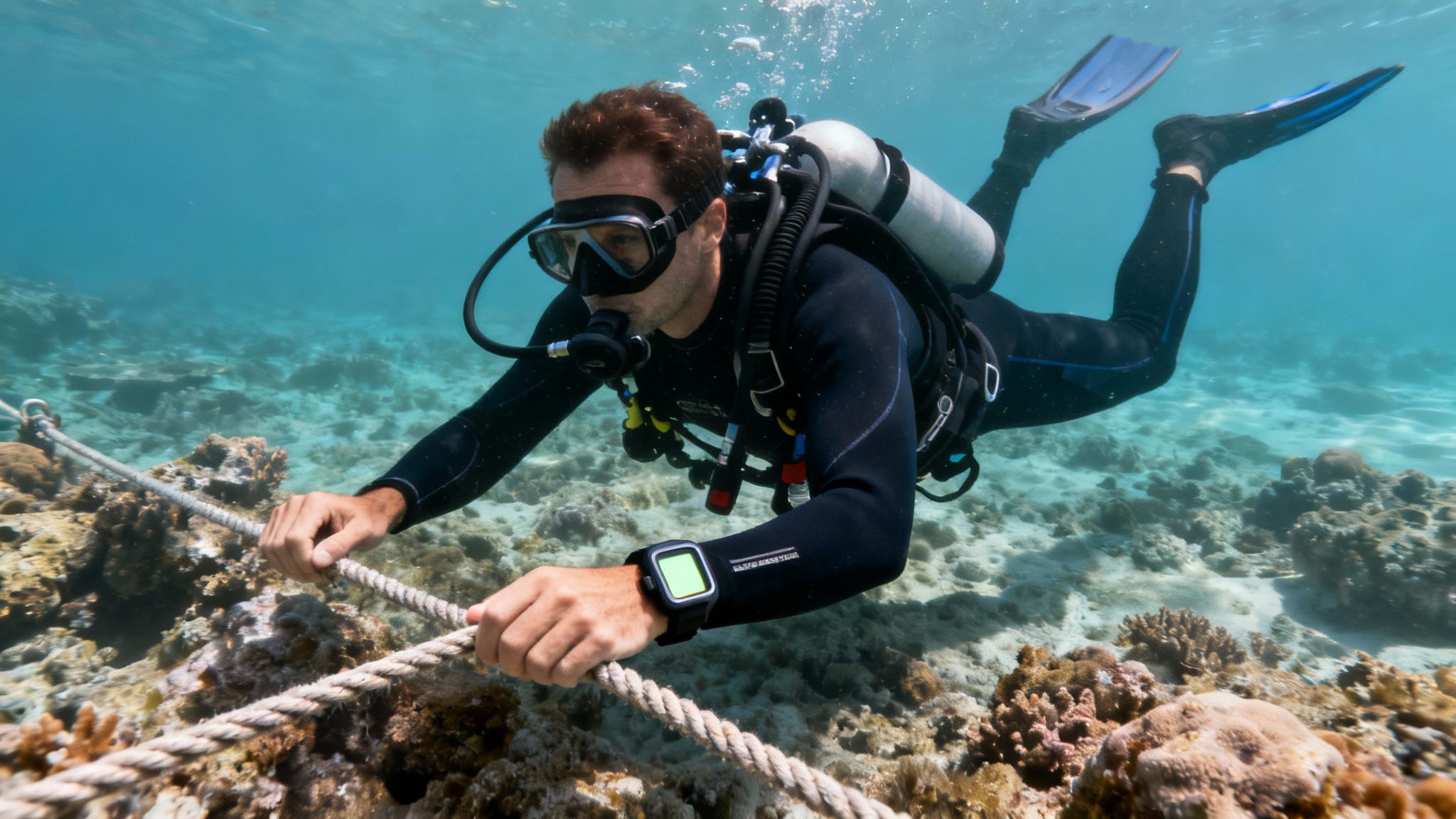Getting the hang of a scuba safety stop is one of those skills that separates novice divers from experienced ones. It's a true test of control, patience, and understanding what's happening inside your body. It isn’t just about killing time for three minutes; the real goal is to hang perfectly still, effortlessly, at 15 feet (5 meters).
When you nail it, you're perfectly neutrally buoyant. You’re not kicking, sculling, or drifting up and down. You’re just… there.
A lot of divers make the mistake of constantly finning to maintain their depth. That little bit of exercise gets your heart pumping and circulation moving, which isn't what you want during this crucial off-gassing phase. The idea is to be completely relaxed and let your body slowly and safely release that dissolved nitrogen.
This is where your dive computer becomes your best friend. As you make your final ascent, it'll beep or vibrate to let you know you've hit the safety stop depth. Then, it will start a countdown—usually for three minutes—taking all the guesswork out of the equation so you can focus on your buoyancy.
Mastering Your Position and Depth
Let’s be honest, staying put at exactly 15 feet can be a challenge, especially if there's a bit of surge or a current trying to push you around. But don't worry, there are a few tried-and-true techniques to make it easy.
- Hold Onto a Reference Line: This is the simplest method by far. The boat's anchor or mooring line is perfect. Just a light grip is all you need to stay at the right depth with zero effort.
- Use Your Surface Marker Buoy (SMB): If you're on a drift dive or there's no fixed line, an SMB is your go-to tool. Once deployed, you can use the thin line from your reel as your own personal ascent line, keeping you at depth while also telling the boat crew exactly where you are.
- Gauge from Your Surroundings: In calm, clear conditions, you can often use the bottom of the boat, the dive ladder, or a shallow part of the reef as a visual guide. This takes a bit more practice with buoyancy control, but it's a fantastic skill to develop.
The Art of the Slow Ascent
The stop itself is important, but how you get there—and how you leave—matters just as much. Your ascent should always be slow and deliberate. Think of it as a leisurely stroll, not a race. Most dive computers will scream at you if you go too fast, but a great visual cue is to never ascend faster than your smallest exhaust bubbles.
The golden rule for ascent speed is no faster than 30 feet (9 meters) per minute. And that rule applies to the entire ascent, both before and after your stop. Bolting from 15 feet to the surface ruins all the good work you just did.
When done right, a scuba safety stop is the most peaceful part of the dive. It’s a quiet moment to check your remaining air, take a mental snapshot of the incredible world you just visited, and ensure you end your dive as safely as you started it.
When a Safety Stop Is Absolutely Critical
We always say a safety stop is a good idea on any dive deeper than **33 feet (10 meters)**, but there are times when it goes from being “highly recommended” to “absolutely, positively mandatory.” It’s like the difference between wearing a seatbelt on a quiet suburban street versus on a six-lane highway during rush hour. Both are smart, but one is non-negotiable.Certain dive profiles push your body to absorb a lot more nitrogen, making that slow, final off-gassing period during your ascent incredibly important. Knowing when you're in one of these higher-stakes situations is just part of being a smart, responsible diver.
High-Stakes Scenarios
Think of these as the big three. If your dive plan involves any of these, that scuba safety stop isn't just a suggestion; it's a critical part of your ascent.
- Deep Dives: The logic is simple: the deeper you go, the more nitrogen your body sponges up under pressure. A dive to 100 feet (30 meters) saturates your tissues far more than a shallow poke around at 40 feet (12 meters). That safety stop is your best tool for safely managing that higher gas load.
- Repetitive Dives: On your second or third dive of the day, you're not starting with a clean slate. You're still carrying residual nitrogen from your earlier dives. This stacking effect puts you closer to your limits much faster, and a proper safety stop becomes essential for helping your body catch up on off-gassing.
- Pushing Your No-Decompression Limits (NDLs): Ever watched your dive computer's no-stop time tick down? That's a direct signal that your tissues are getting loaded with nitrogen. When you dive right up to that limit, the safety stop is no longer just a buffer—it's your primary defense against stepping over the line.
Decompression Stops vs. Safety Stops
This is a really important distinction to make, so let's be crystal clear. A precautionary safety stop and a mandatory decompression stop are not the same thing. Not even close.
A safety stop is a pause you choose to make while you are still safely within your no-decompression limits. A decompression stop is a required pause you must make because you have already exceeded your NDLs. Recreational diving is all about planning to avoid ever needing a decompression stop.
Blowing past your NDLs without making the required stops sends your risk for DCS through the roof. That's the realm of technical diving, which demands a whole different level of training, gas planning, and equipment. For us recreational divers, the game is to stay well inside the lines and use the safety stop as an extra layer of protection.
You'll notice modern dive computers are getting smarter about this. After a deep dive, your computer might suggest a 5-minute stop instead of the standard 3. It might even prompt you for a "deep stop"—a quick, 1-minute pause around half your maximum depth. This isn't a replacement for your shallow stop; it's an extra precaution to help manage microbubble formation early on. Studies have shown these conservative approaches are great at reducing the risk of decompression sickness, which thankfully only affects about 1 to 4 out of every 10,000 recreational dives. If you're curious about the theory, you can learn more about the science behind deep stops and why they work.
How Kona Honu Divers Puts Your Safety First
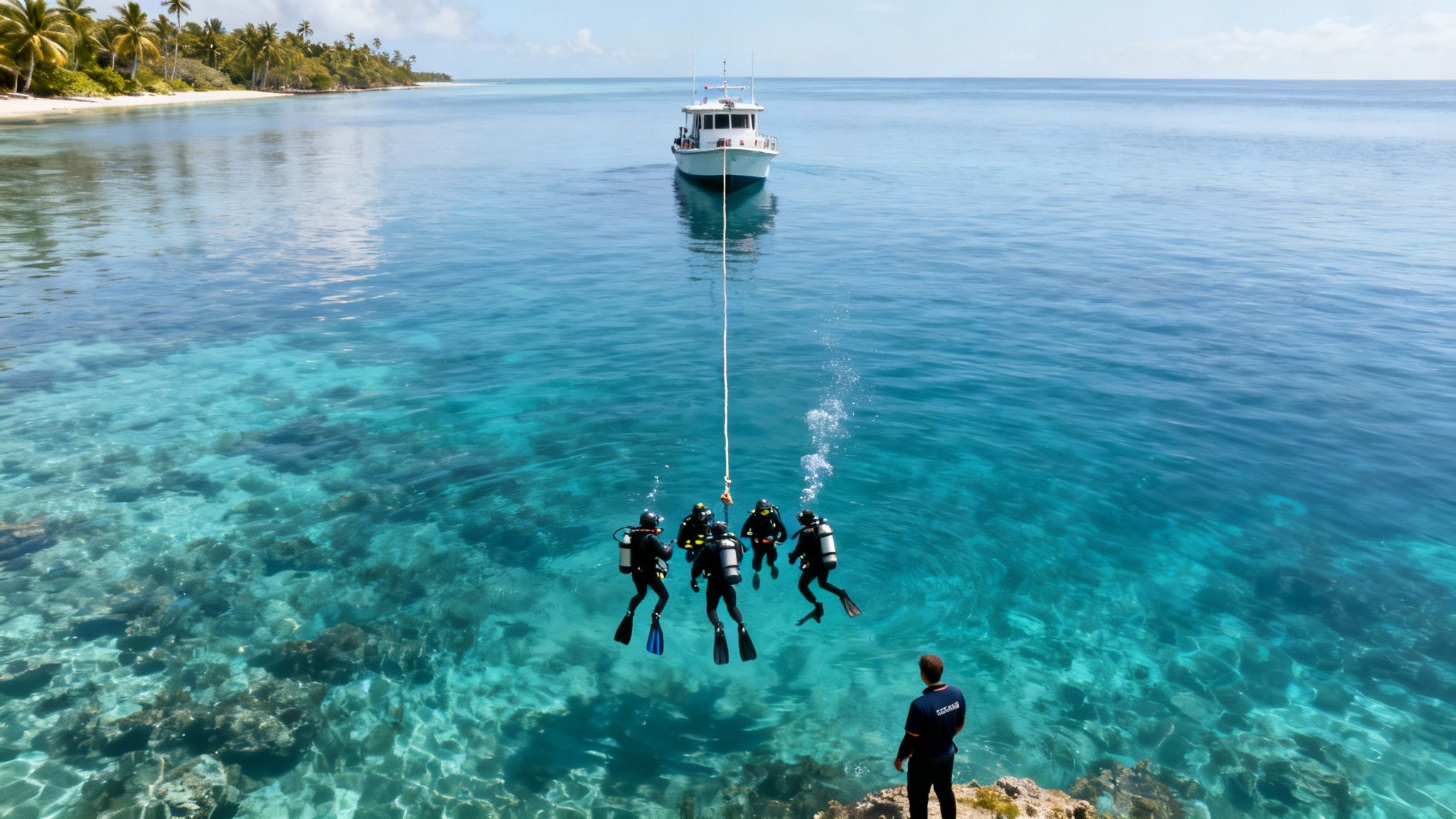Knowing the theory behind a scuba safety stop is one thing, but actually seeing it put into practice by a professional crew makes all the difference. Here at Kona Honu Divers, we build safety protocols into the very fabric of every dive, making them a seamless and natural part of the adventure.
Our commitment to your well-being starts long before your fins hit the water. During our pre-dive briefings, the divemaster walks everyone through the complete dive plan. We cover the ascent procedures, how we’ll stay together as a group, and exactly how we'll conduct the safety stop. This way, everyone from a seasoned pro to a newer diver knows the plan and feels completely comfortable.
A Structured Approach to Safe Ascents
We take the guesswork out of hitting that perfect safety stop depth. One of the trickiest parts of any ascent is holding steady at 15 feet, especially if there's a bit of current or your buoyancy is still being dialed in.
To make it easy, our boats use mooring and descent lines that provide a fantastic physical reference. You can simply hold onto the line and relax without having to constantly kick or adjust. This calm, stable position is the best way to let your body off-gas effectively. On drift dives where there’s no fixed line, our guides deploy a Surface Marker Buoy (SMB) to give the group a clear, reliable reference to gather around.
Our philosophy is simple: a relaxed, confident diver is a safe diver. By providing clear guidance and physical tools like reference lines, we help you master your scuba safety stop and enjoy a stress-free ascent on every dive.
Safety on Every Dive Tour
This careful attention to the final phase of the dive is something we do on all our diving tours. It doesn't matter if you're on a morning two-tank charter, the world-famous manta ray night dive, or an advanced trip—the safety stop is an non-negotiable part of our plan.
Our divemasters are always right there in the water, watching the group to make sure everyone completes their stop correctly and offering a hand if needed. This dedication is a cornerstone of our operation, and you can learn more by reading our complete Kona Honu Divers safety policies.
When you dive with us, you’re placing your trust in a team that puts your safety above everything. It allows you to relax and focus on what you came here for: the incredible underwater world of the Big Island.
Common Questions About the Safety Stop
Even when you know the rules, real-world diving can throw you a curveball. It’s totally normal to have those "what if" questions pop into your head. Let's tackle some of the most common ones so you can feel confident and prepared on your next dive.
What if I Accidentally Miss My Safety Stop?
First things first: don't panic. We've all been there—maybe a current picked up, or you were distracted by a passing manta ray. While skipping a safety stop isn't ideal and does bump up your risk of DCS, it doesn't automatically mean you'll get bent.
The smartest move is to call it a day for diving. Once you're back on the boat or shore, drink plenty of water, take it easy, and skip any heavy lifting or intense exercise. You’ll also want to wait a full 24 hours before getting on a plane. The pressure drop in an airplane cabin is exactly what you want to avoid. We dive deeper into this topic in our guide on why you can't fly after diving.
Can I Skip the Stop if I Am Diving with Nitrox?
This is a huge and potentially dangerous myth. The short answer is no. Diving with Enriched Air Nitrox is a fantastic tool for reducing your overall nitrogen loading, which adds a great conservative buffer to your dive. But it doesn't mean you're absorbing zero nitrogen.
Your body is still on-gassing, just at a slower rate. The safety stop is still a crucial part of a safe dive plan, no matter what gas you're breathing. Always follow your computer and your training.
Is a Stop Needed on Very Shallow Dives?
For those really shallow dives that stay above 33 feet (10 meters), training agencies generally don't require a formal 3-minute safety stop. At that depth, your nitrogen absorption is pretty minimal.
That said, ending every dive with a slow, controlled ascent is just good practice. Think of it as building muscle memory. Making a slow ascent a habit on shallow dives ensures you’ll do it without thinking on the deeper ones where it matters most.
What Is the Difference Between a Safety and Decompression Stop?
This is one of the most important distinctions in recreational diving, so let’s make it crystal clear.
- A safety stop is a precaution. It's something we do as a best practice to be more conservative, even though we are well within our no-stop limits. Think of it as an extra buffer zone.
- A decompression stop is mandatory. This is only required when a diver has gone beyond their no-decompression limit (NDL). Missing one of these carries a very high and immediate risk of DCS.
As recreational divers, our goal is to always plan our dives to stay comfortably within our NDLs. Mandatory decompression stops are for technical divers who have the specialized training, gear, and gas blends to manage that kind of diving safely.