
Ever shaken a can of soda and then popped the top? That explosive fizz is a great way to picture what can happen to nitrogen in your blood if you ascend from a dive too quickly. A scuba safety stop is the simple, crucial pause that keeps that from happening.
Think of it as a 3 to 5-minute break you take at a shallow depth—usually around 15-20 feet (5-6 meters)—just before you surface. This short pause gives your body the time it needs to safely and slowly release the nitrogen it absorbed during the dive.
Why the Scuba Safety Stop Is Your Best Friend Underwater
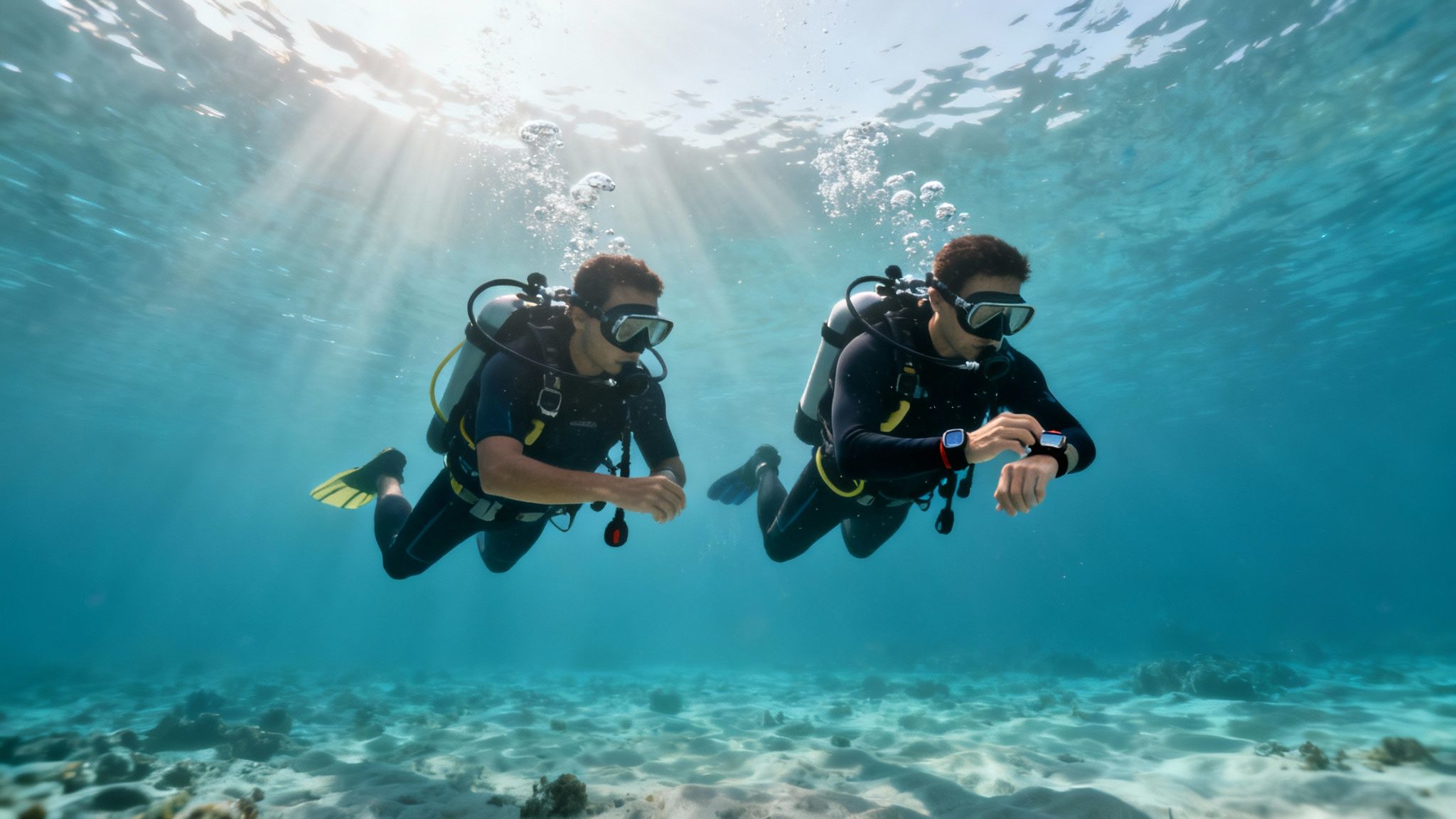
At its heart, a safety stop is all about managing risk. While it might feel like you're just hovering and waiting, those few minutes are one of the most proactive things you can do to protect yourself from Decompression Sickness (DCS), also known as "the bends." It’s a tiny investment of time for a massive return in safety and peace of mind.
This isn't just a procedure for deep, technical dives. It's a best practice for pretty much every dive you do. By making the safety stop a non-negotiable part of your routine, you build a powerful habit that will serve you for your entire diving life.
The Nuts and Bolts of the Safety Stop
To get a better handle on this, let's break down the key components of a standard safety stop. The whole idea is to give the dissolved nitrogen a gentle, managed exit route from your body.
Here’s a quick summary of what that looks like in practice.
The Scuba Safety Stop at a Glance
| Component | Standard Procedure |
|---|---|
| Depth | 15 to 20 feet (5 to 6 meters). This is the sweet spot—shallow enough for off-gassing, but deep enough to prevent nitrogen bubbles from forming too fast. |
| Duration | 3 minutes is the most common standard. Some computers and agencies might suggest 5 minutes, especially after deeper or longer dives. |
| Timing | It’s done at the very end of your dive, after ascending from your maximum depth but before you break the surface. |
This simple pause is far more than just a box to check on your dive plan. It's the mark of a smart, responsible diver.
A safety stop transforms the final minutes of your dive from a race to the surface into a calm, controlled process that puts your health first. It's the difference between opening a shaken soda bottle carefully versus just popping the top.
More Than a Suggestion, It’s a Standard
While we'll cover when a safety stop is technically "optional" later on, treating it as a standard part of every single dive is the hallmark of an experienced and cautious diver. It adds a thick layer of conservatism to your dive profile, which is always a good thing.
This habit is especially important when you're diving in new environments, like the incredible waters off Kona's coast. The unique topography and marine life here are breathtaking, and building safe habits ensures you can enjoy them for years to come.
Here at Kona Honu Divers, every dive plan we create incorporates this crucial step. Your safety is the foundation of every amazing underwater adventure we lead. We live by a simple rule: a great dive is a safe dive, from the moment you descend to the moment you're back on the boat.
Ready to see how our expert team makes safety a seamless part of an unforgettable dive? Check out our world-renowned Kona diving tours.
How Physics Protects You from the Bends
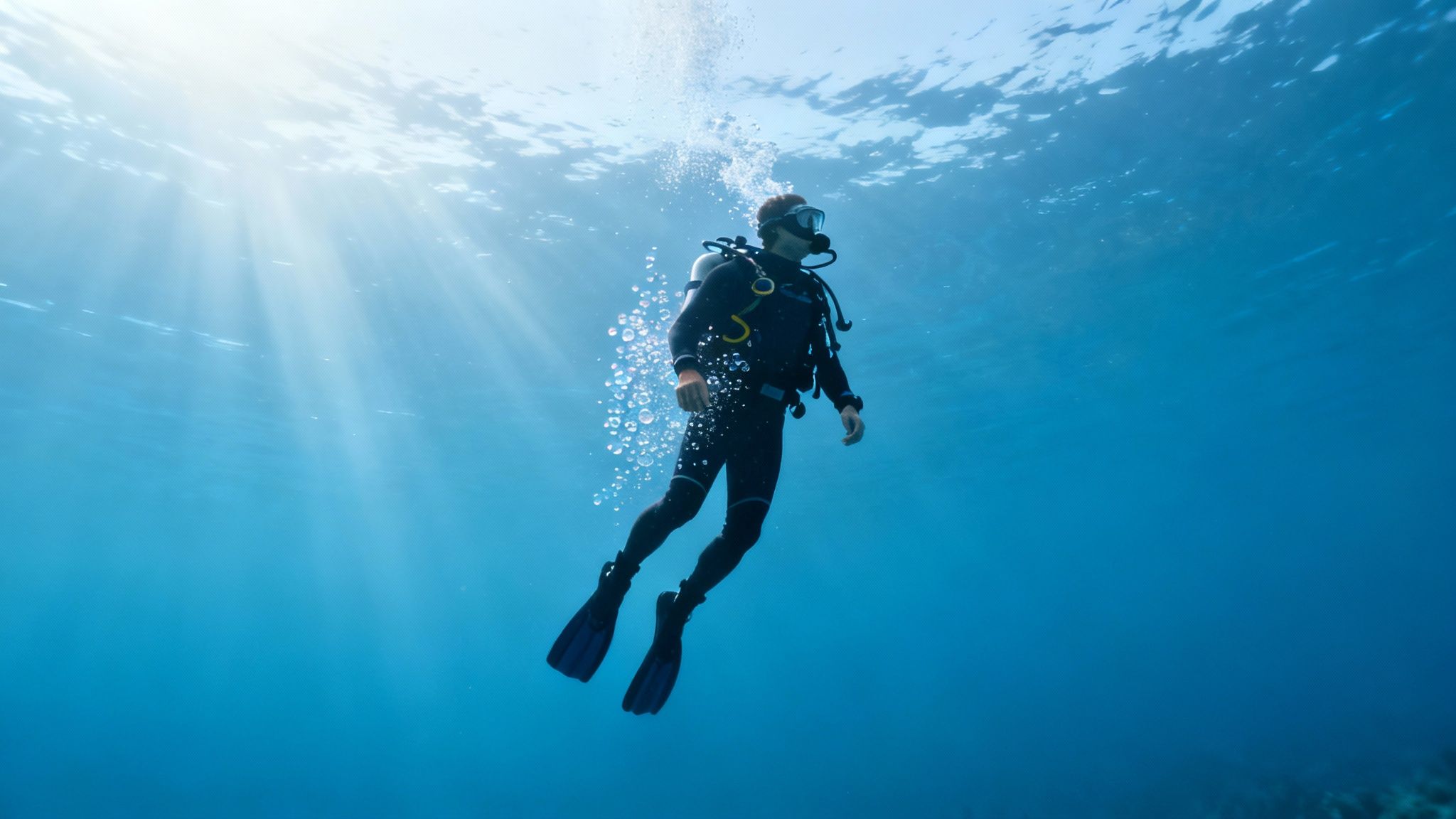
Every single dive is a real-world physics lesson, and the scuba safety stop is probably the most important part of that class. It all boils down to a simple concept: as you go deeper, the water pressure around you increases. This added pressure convinces the nitrogen gas from the air you're breathing to dissolve into your body's tissues.
Think about it like making a bottle of soda. High pressure is used to force carbon dioxide gas into the water. While you're enjoying the view at depth, your body is doing something very similar with nitrogen, which makes up about 79% of the air in your tank. This process of your body absorbing nitrogen is often called "on-gassing."
This is all perfectly fine and harmless as long as you're under pressure. The tricky part begins when it's time to head back to the surface.
The Science of the Soda Bottle
When you ascend, the water pressure around you drops. This is just like twisting the cap off that soda bottle—the sudden drop in pressure lets the dissolved gas come out of the liquid and form bubbles. If you ascend too quickly, those nitrogen bubbles can form inside your tissues and bloodstream, leading to a painful and potentially life-threatening condition called Decompression Sickness (DCS), or "the bends."
This is exactly where the safety stop becomes your best friend. It essentially acts as a controlled, slow-release valve for your body.
By pausing your ascent at a shallow depth, typically around 15-20 feet, you give that absorbed nitrogen a chance to safely and gradually come out of your tissues. From there, it can enter your bloodstream, travel to your lungs, and be exhaled without a problem.
Without this crucial pause, you're basically shaking the soda bottle and popping the top, creating a chaotic fizz of bubbles where you definitely don't want them. A safety stop lets you open that bottle slowly, allowing the gas to escape gently without causing any harm.
Not All Tissues Are Created Equal
Another important piece of the puzzle is understanding that different parts of your body absorb and release nitrogen at different speeds. Some tissues are known as "fast tissues," meaning they on-gas and off-gas nitrogen very quickly.
- Fast Tissues: This includes your blood and central nervous system. They get saturated with nitrogen fairly quickly during a dive.
- Slow Tissues: Think of denser materials like your fat, bones, and cartilage. They take much longer to absorb nitrogen, but they also take much longer to release it.
This is why a single, short dive might seem fine, but doing multiple dives in a day or over several days can lead to a serious buildup of leftover nitrogen, especially in those slower tissues. Making a diligent scuba safety stop on every single dive helps manage the off-gassing process for all of your body's tissues, adding a critical layer of protection. It ensures that even the slowest-releasing parts of your body get a head start on safely venting that stored nitrogen.
This grasp of physics and physiology is what makes diving in a place like Kona, Hawaii, both incredible and safe. The dramatic underwater terrain, from ancient lava tubes to deep reefs, offers some truly unforgettable experiences. Applying these safety principles is what allows you to explore it all with confidence. The expert divemasters at Kona Honu Divers don't just point out cool stuff; they ensure every part of your dive profile, especially your ascent and safety stop, is managed with precision and care.
Ready for an adventure built on a foundation of safety?
Knowing When a Safety Stop Is Recommended vs Required
So, is a safety stop a non-negotiable part of every single dive? The short answer is: it really should be. While your dive computer and training agency have specific rules that make a stop mandatory, the most seasoned divers I know treat it as standard procedure on pretty much every dive they make. The key is to understand when it's a smart precaution versus when it's an absolute requirement.
For most fun dives, that 3-minute pause at 15 feet is technically a recommended or "precautionary" stop. This just means you’re well within your no-decompression limits (NDLs), and skipping it wouldn't send you straight into an emergency. But that recommendation comes from decades of dive science, and it’s all about adding a huge safety buffer to your dive profile.
Honestly, treating every safety stop as essential—whether your computer is beeping at you or not—is the hallmark of a smart, responsible diver.
When a Recommendation Becomes a Requirement
There are definitely times when that safety stop shifts from "good idea" to "you must do this." Your dive computer is your best friend here, and it will let you know when you've crossed a line. Ignoring these alerts is a surefire way to increase your risk of DCS, and nobody wants that.
A safety stop typically becomes mandatory under these conditions:
- Going Deep: Most computers and agencies flag any dive deeper than 100 feet (30 meters) as requiring a stop.
- Pushing Your Limits: If you’re getting close to your no-decompression limit (NDL)—say, within a few minutes of it—your computer will almost always demand a stop on the way up.
- Entering Decompression: Accidentally blow past your NDL? You're now officially in "deco." That stop is no longer precautionary; it's a required decompression stop. This is a more serious situation, and your computer will dictate the exact depth and time you need to complete it.
The logic is simple: the deeper you go and the longer you stay, the more nitrogen gets dissolved into your body. A mandatory stop is your dive computer’s way of saying, “Hey, you’ve got a serious nitrogen load, and this pause is now critical for off-gassing safely.”
Why Stops Are Crucial on Multi-Dive Days
That line between recommended and required gets even more important when you're doing multiple dives in a day. Even after a good surface interval, your body is still carrying some residual nitrogen from the last dive. This is especially true in your "slow tissues," like cartilage and fat, which take a long, long time to release that nitrogen.
Because of this build-up, a safety stop on your second or third dive is absolutely vital. You're starting each new dive with more nitrogen already in your system, which makes a slow, controlled ascent and a solid safety stop even more critical for keeping DCS at bay.
This is also where using different gas mixes can help. Diving with Enriched Air Nitrox, for instance, means you're breathing less nitrogen to begin with, which helps lower your overall nitrogen load throughout the day. You can learn all about the benefits of diving with Nitrox in our guide. But even when you're on Nitrox, that safety stop is still an indispensable best practice. The goal is always to make every dive as safe as possible, and that 3-minute pause is one of the easiest and most effective ways to do it.
How to Perform a Flawless Safety Stop
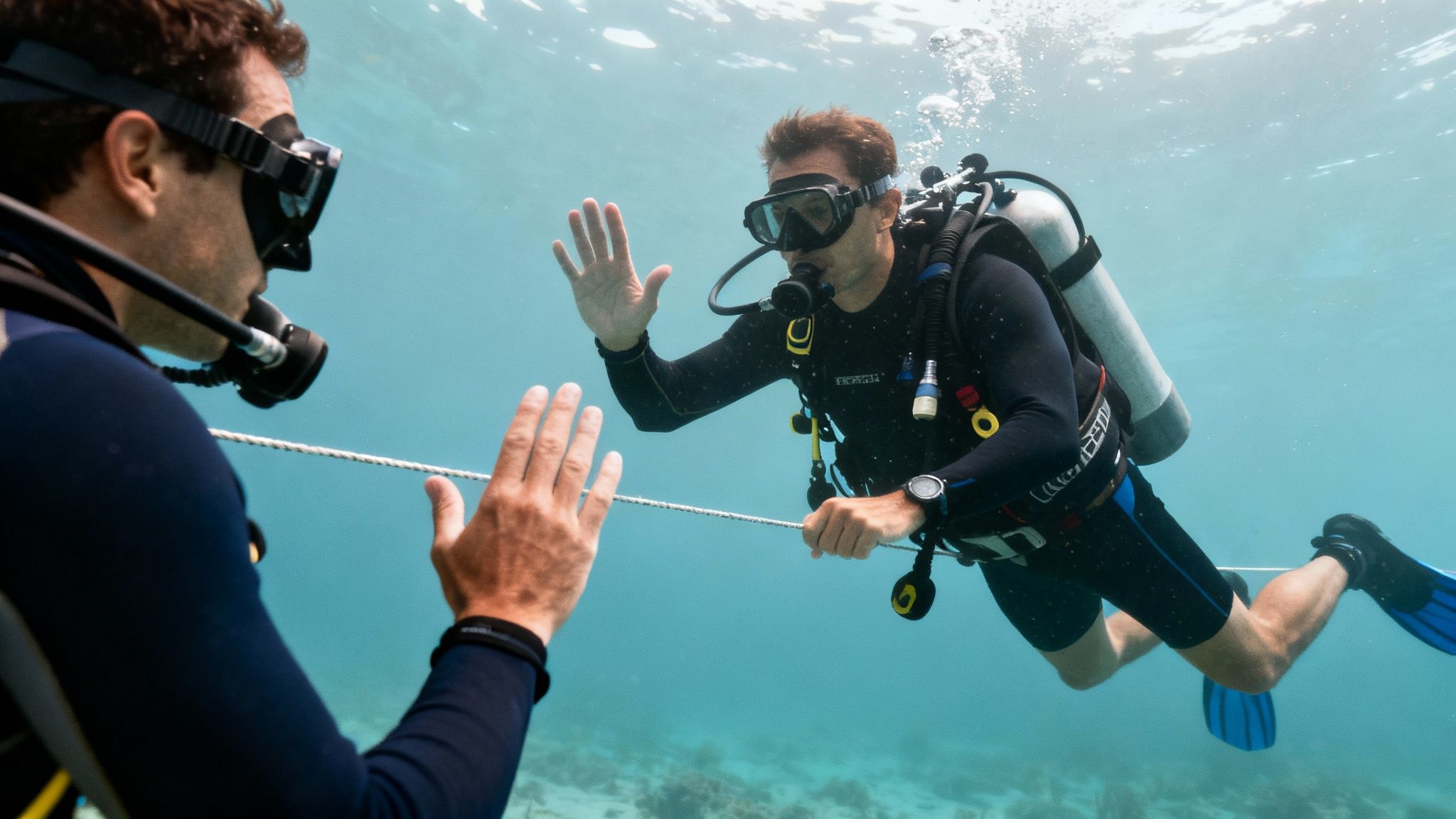
Nailing a perfect scuba safety stop is a thing of beauty. It's less about just pausing and more about showing you've truly mastered your buoyancy. Anyone can dump air into their BCD and shoot up, but holding your position effortlessly at 15 feet? That’s the sign of an experienced, confident diver.
This isn't something that just happens at the end of the dive; it starts with good planning. As you near the end of your bottom time, you should already be checking your air and getting on the same page with your buddy. A simple "thumbs up" and a point to the surface makes sure you both begin that slow, controlled journey upward together.
The Step-by-Step Checklist for Your Stop
A great safety stop is methodical, not magical. It’s a calm, deliberate process that gets you from the bottom to the surface safely. Think of it as a graceful final chapter to your dive, not just a box to tick.
Here’s a simple checklist that works every single time:
- Signal Your Plan: Catch your buddy's eye. Give the "up" signal. It’s a simple gesture that says, "I'm ready to head for our stop."
- Start Your Slow Ascent: Remember the golden rule: ascend no faster than your smallest bubbles. Your computer will likely yell at you if you break the 30 feet (9 meters) per minute limit, but this visual cue is a classic for a reason.
- Nail Your Depth: As you drift up to that 15-20 feet (5-6 meters) zone, start making small adjustments. A long, slow exhale should be enough to halt your ascent. Now, you’re ready to fine-tune with your breath.
- Hold Steady: This is where the real skill comes in. Your lungs are your best tool here. A slow, deep breath will lift you an inch or two; a full exhale will gently sink you. Try to avoid fidgeting with your BCD inflator.
- Watch the Clock (and Your Air): Your computer will count down the 3 minutes for you. Meanwhile, keep an eye on your air gauge. You should always arrive at your stop with more than enough air to hang out comfortably and handle any little surprises.
- The Final Stretch: Once your computer gives you the all-clear, do one last check. Look up, slowly turn 360 degrees to make sure the coast is clear, and then continue your easy ascent all the way to the surface.
Pro Tips for Common Challenges
Of course, the ocean doesn’t always cooperate. Strong currents or a big group of divers can quickly turn a peaceful pause into a wobbly mess. Knowing how to adapt is what separates good divers from great ones.
The whole point of a safety stop is to be relaxed and still. If you're kicking and fighting to stay in one place, you're burning through air and stressing your body—basically undoing all the good the stop is supposed to do.
If you’re caught in a current, your best friend is a reference line. The boat’s anchor or mooring line is perfect for this. A light grip is all you need to stay put, letting you focus entirely on your breathing and timing. No line available? Try to face directly into the current; it minimizes your drag and makes it easier to hold your spot.
And what about surge, that back-and-forth sloshing motion common in shallower water? Don’t fight it. The trick is to relax and move with it. Widen your fin stance a bit for stability and just let the ocean sway you. Instead of a battle, it becomes a kind of gentle, underwater dance.
Applying Safety Stops in Unique Kona Dive Conditions

Diving in Kona is a world apart. The volcanic landscapes and incredible marine life create scenarios you just don't find anywhere else. Knowing how to do a perfect scuba safety stop here isn't just about following the book; it's about adapting your skills to an environment that can be as challenging as it is beautiful.
From the inky abyss of a Blackwater dive to the hypnotic ballet of the Manta Ray Night Dive, Kona's unique conditions make every safety procedure that much more important. When the dive itself is an adventure, mastering your buoyancy and nailing a calm, controlled stop is absolutely critical.
Safety Stops on the Manta Ray Night Dive
Picture this: you're hovering in the dark as giant manta rays, some with wingspans wider than you are tall, swoop and glide inches from your face. It's the magic of Kona's world-famous Manta Ray Night Dive, and it’s an experience that will stay with you forever. It also demands exceptional buoyancy control, especially when it’s time for your safety stop.
Holding your position at 15 feet while these gentle giants put on a show is a real test of skill. Our divemasters at Kona Honu Divers are pros at managing this. We constantly remind our divers to stay calm, maintain a horizontal trim, and use their breath to stay perfectly neutral. This lets you enjoy the final moments of the show without drifting, ensuring you complete your stop flawlessly as the mantas swirl around you. Luckily, the site at Garden Eel Cove is naturally protected, so conditions are usually calm, making for a steady and unforgettable stop. It's a superior choice for the dive tour because of its protected location, better viewing area, and healthier reefs.
For divers looking for another kind of after-dark thrill, the Kona blackwater dive takes things to the next level. On that dive, holding your depth precisely in open, deep water is the entire game.
Advanced Diving and Deep Lava Tubes
Kona also offers incredible adventures for more experienced divers, like exploring ancient submerged lava tubes or descending along dramatic deep-water pinnacles. These dives often take you deeper, which makes a slow, controlled ascent and a mandatory safety stop a non-negotiable part of the dive plan. Any time you’re in an overhead environment or exploring deeper reefs, you’re managing a higher nitrogen load on your way back to the surface.
Did you know that skipping the scuba safety stop is one of the most common mistakes linked to serious diving incidents? Reports from the Divers Alert Network (DAN) consistently show that rapid ascents and missed stops are significant factors in diving accidents. You can learn more about the critical importance of these procedures in diving safety research.
This is exactly why our briefings for advanced dive tours are so meticulous. We make sure every single diver understands the ascent plan and the critical role their safety stop plays in off-gassing safely. With over 200 years of combined experience, our crew has the expertise to guide you through these amazing sites with an unwavering commitment to safety. To get a better feel for what you might encounter, check out our guide on scuba diving visibility on the Big Island.
Our team's goal is to ensure your Kona diving memories are breathtaking for all the right reasons.
Dive with Confidence and Comfort in Kona
For us, safety isn't just a box to check—it's the bedrock of every single dive we run. Here at Kona Honu Divers, a proper scuba safety stop is a non-negotiable part of a much bigger culture of safety that we live and breathe on every charter. It's in the design of our spacious, custom-built boats, the meticulous care we put into our rental gear, and our offer of complimentary nitrox for certified divers looking to build in extra conservative margins.
We’ve learned over the years that a comfortable diver is a safe diver. It's hard to focus on your dive plan or your buoyancy when you're shivering or feeling crammed in. That's why we built our boats with you in mind, with creature comforts like hot showers for a post-dive warm-up and plenty of shade to relax in between dives. When you're physically and mentally at ease, you can truly enjoy the incredible marine life around you.
Experience Kona's Best Dives with an Expert Crew
Whether you're exploring the vibrant coral gardens on our 2-tank morning dives or gearing up for the world-famous Manta Ray Night Dive, you're in good hands. We take our manta groups to the premier spot, Garden Eel Cove, and for good reason. It's naturally shielded from the open ocean swell, which means a calmer, more enjoyable experience with better visibility and a healthier reef than you'll find at other locations.
This protected environment is key. It allows divers to comfortably hold their position on the bottom while the massive mantas swoop and glide just inches overhead. It's a magical experience that demands your full attention, and our expert crew makes sure the conditions are as perfect as possible so you can soak it all in.
This same dedication to safety and planning goes into our more specialized trips, too. For the truly adventurous, the Kona Blackwater Dive is an experience like no other. It’s an open-ocean dive in the dead of night, where precise buoyancy is everything, and our guides are there to ensure every procedure is followed to the letter. Likewise, when we head out on our advanced trips to explore deep lava tubes and remote pinnacles, we plan them with a conservative approach, always putting safety first.
"The staff at Kona Honu Divers are exceptional. Their attention to detail, professionalism, and commitment to safety are evident in everything they do. From the pre-dive briefing to the post-dive hot chocolate, they ensure every aspect of the experience is top-notch."
This focus on doing things the right way is why we’ve earned thousands of five-star reviews. Our guests tell us again and again that they feel safe and looked after, which frees them up to have the time of their lives exploring the Big Island’s underwater world. We'd love for you to come see the difference for yourself.
Ready to explore? You can learn more about our range of amazing adventures, from our classic Kona diving tours and the unforgettable Manta Ray Night Dive to the one-of-a-kind Blackwater Dive and our exciting Advanced Dive Trips.
Common Questions About the Scuba Safety Stop
Once you've got the basics down, a few common questions almost always pop up about safety stops. It’s one thing to know the procedure, but it's another to feel confident handling real-world situations.
Let's clear up some of the most frequent ones I hear from divers.
Safety Stop vs. Decompression Stop
This is probably the biggest point of confusion for new divers. It’s easy to mix them up, but they are fundamentally different.
Think of a safety stop as a "just in case" measure. It's a precautionary pause you make on dives that are well within your no-decompression limits. You'll typically hang out for 3-5 minutes at around 15-20 feet to give your body a little extra time to off-gas. It's a best practice, not a hard requirement.
A decompression stop, on the other hand, is mandatory. This is what your computer will demand if you’ve actually exceeded your no-decompression limits. Skipping one of these is a serious emergency and dramatically increases your risk of decompression sickness (DCS).
What if I Miss a Safety Stop?
First things first: don't panic. If you accidentally pop up to the surface without doing your safety stop, it's a procedural error, not a catastrophe.
The best course of action is to stay calm, rest, and avoid any heavy lifting or exercise. If you have 100% oxygen available on the boat, breathing it is a great idea. Just monitor yourself closely for any unusual symptoms. This situation is also a good reminder of the underlying principles behind why there are crucial surface intervals and restrictions, like why you can't fly right after diving.
Do I Still Need a Safety Stop with Nitrox?
Yes, you absolutely do. This is a common misconception.
While diving on Enriched Air Nitrox means you're absorbing less nitrogen, you're still absorbing some. The physics of off-gassing don't change just because you adjusted your gas mix. The safety stop is an essential habit that provides that extra buffer, and it’s just as important for nitrox divers as it is for those on air. Think of it as cheap insurance for your long-term diving health.