
A scuba safety stop is a simple but critical pause every diver makes on their way back to the surface. For three to five minutes, you hang out at about 15 feet (5 meters), giving your body a chance to safely off-gas excess nitrogen. Think of it as a built-in buffer, a pressure-release valve that makes your ascent much safer and dramatically lowers your risk of Decompression Sickness (DCS).
Why The Scuba Safety Stop Is Non-Negotiable
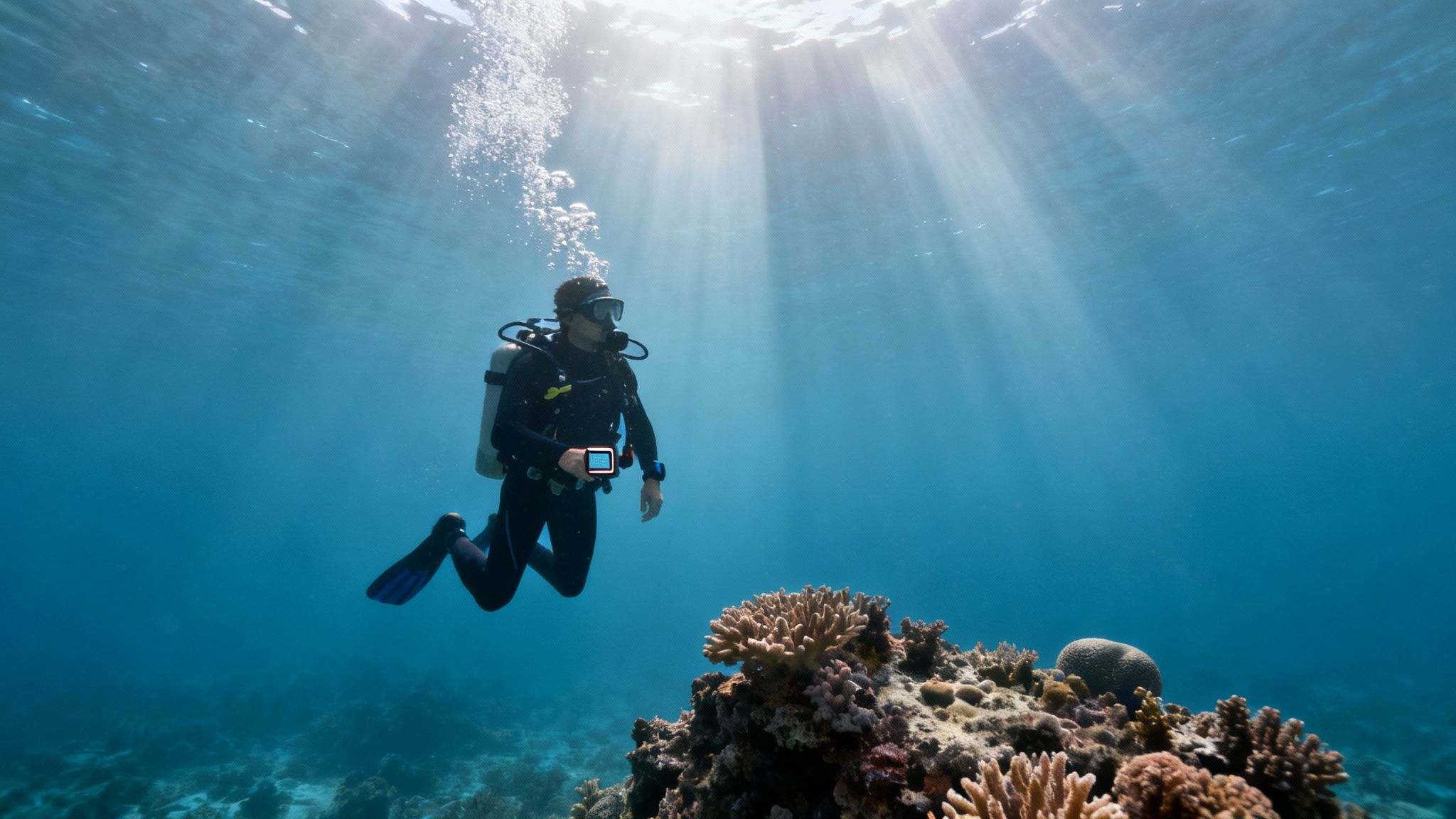
Here's an easy way to think about it: imagine shaking a bottle of soda. If you just pop the top open immediately, you get a fizzy, explosive mess. But if you twist the cap slowly, letting the pressure release gradually, the gas escapes without any drama. A safety stop does the exact same thing for the nitrogen absorbed in your body.
This isn't just a casual suggestion—it's a proven, industry-standard practice baked into modern dive planning for a very good reason. That short pause gives your body the time it needs to catch up and readjust to the massive pressure changes that happen as you return to the surface. It turns a complex physiological event into a calm, controlled, and routine part of every single dive.
A Proven Buffer Against DCS
The number one job of a scuba safety stop is to tackle the risk of Decompression Sickness, famously known as "the bends." The science is clear on this. Studies have shown that making this stop can slash the risk of DCS by as much as 50%. It provides a crucial window for the excess nitrogen that your tissues absorbed at depth to slowly and safely work its way out of your system.
While the odds of DCS for recreational divers are relatively low—somewhere between 1 to 4 cases per 10,000 dives—the consequences can be serious and often require medical intervention. You can read more about the research on DCS risk reduction to see why it's a precaution worth taking. This is exactly why professionals, like our team here at Kona Honu Divers, make the safety stop a mandatory part of all our scuba diving tours in Kona, Hawaii.
By consistently performing a safety stop, you are not just following a rule—you are actively managing your nitrogen load and giving your body a crucial advantage against potential injury. It’s an easy habit that pays massive dividends in safety and peace of mind.
Key Elements Of A Standard Safety Stop
For most recreational dives, the rules for a safety stop are refreshingly simple and easy to remember. The whole idea is to pause your ascent just before you break the surface, allowing for one last period of off-gassing in the zone where pressure changes are the most dramatic.
Here's a quick look at the core components of the safety stop.
Quick Guide To The Standard Safety Stop
This table breaks down the essentials for a standard safety stop, which applies to the vast majority of recreational dives.
| Parameter | Standard Recommendation |
|---|---|
| Stop Depth | 15 feet (5 meters). This is shallow enough for effective off-gassing but deep enough to easily maintain position. |
| Stop Duration | A minimum of three minutes. Many dive computers and agencies now recommend five minutes for an extra safety margin. |
| When to Perform | Mandatory on any dive deeper than 33 feet (10 meters). It is considered best practice to perform one on every dive. |
These simple parameters form the foundation of safer diving and are easy to build into every dive plan.
The Science Of Preventing The Bends
To really get why the scuba safety stop is so important, we need to talk about what’s happening inside your body on a dive. It’s all about physics, specifically a little something called Henry’s Law.
Basically, the deeper you go, the more pressure the water exerts on you. This pressure forces the nitrogen from the air in your tank to dissolve into your blood and tissues. Think of it like a sponge—under pressure, your body soaks up a lot more nitrogen than it normally would on the surface.
This isn't a problem while you're cruising along the reef. The real issue starts when it's time to head back up.
From Dissolved Gas To Dangerous Bubbles
As you ascend, the pressure around you decreases. All that nitrogen you absorbed now wants to come out of your tissues and turn back into a gas.
A slow, steady ascent gives your body a fighting chance. It allows your blood to shuttle the excess nitrogen to your lungs, where you can simply breathe it out. It’s a clean, safe process when you take your time.
But if you rocket to the surface? You don't give your body enough time to off-gas properly.
A rapid ascent is just like shaking a soda bottle and then popping the top. The pressure drops instantly, and all the dissolved CO2 erupts into a fizzy mess of bubbles. The same thing happens in your body, and those nitrogen bubbles are what cause Decompression Sickness (DCS), aka "the bends."
This is exactly why the safety stop is a non-negotiable part of diving. We do it at a shallow depth, usually 15 feet (5 meters), because the biggest pressure change happens in the last 30 feet before the surface. This pause gives your body a critical final window to let that absorbed nitrogen sneak out of your system before those tiny, harmless "micro-bubbles" have a chance to clump together and cause real damage. This same principle is also the reason for crucial post-dive rules, like why you can't fly immediately after diving.
The Power Of A Simple Pause
So, that three-to-five-minute pause isn't just about killing time. It’s an active part of your dive profile, a powerful tool you’re using to take control of your own safety.
You’re not just waiting—you’re giving your body the time it needs to finish the job of off-gassing. It's the final, essential step that ensures all that nitrogen makes a quiet, uneventful exit, and you end your dive as safely as you started it.
How To Perform A Perfect Safety Stop
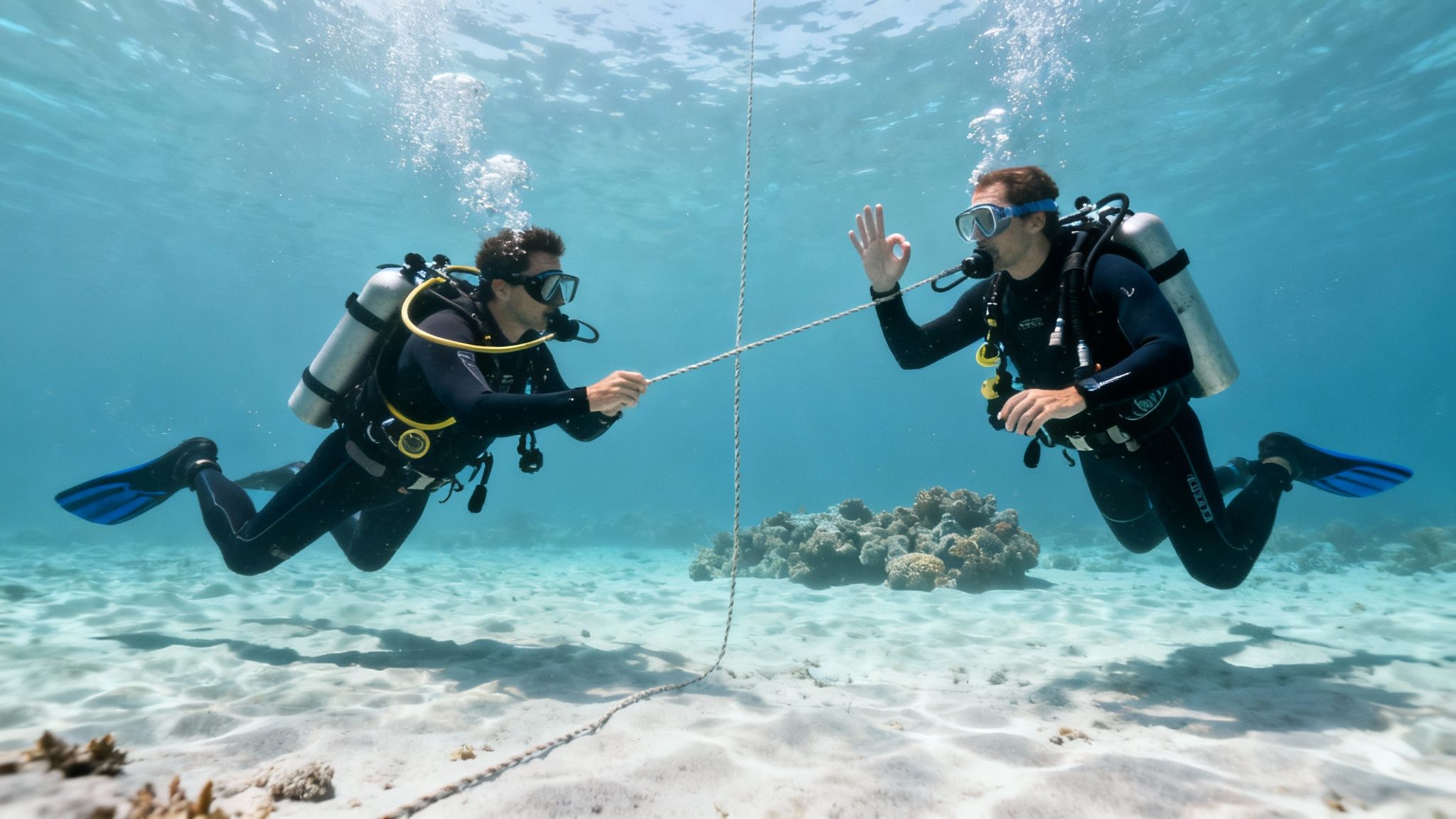
Executing a flawless scuba safety stop is one of those fundamental skills that really separates good divers from great ones. It's so much more than just hanging out for three minutes. This is your chance to demonstrate real control, awareness, and pinpoint buoyancy. When you nail this final part of the dive, it builds massive confidence and makes safety feel completely second nature.
The whole process actually starts before you even think about leaving the bottom. Once you and your buddy give the "up" signal, your ascent begins, and it needs to be slow and controlled. The rule of thumb is no faster than 30 feet (9 meters) per minute. Think of this slow ascent as the first and most important step in safely managing that nitrogen off-gassing we talked about.
Getting Into Position
As you drift up toward the 15-foot (5-meter) mark, your number one job is to get perfectly neutral. This is where your training really pays off. The easiest way to do this is to find a stable reference point so you’re not fighting to stay at one depth.
Here are a few great ways to hold your position:
- A descent/ascent line: This is the gold standard. Lightly holding onto the boat's anchor or mooring line makes staying put a breeze.
- Reef topography: You can also hover over a shallow section of the reef or a big rock. Having a solid visual cue below you helps you know if you're drifting up or down.
- Your dive computer: Keep a close eye on that depth gauge. This is where your breath control becomes your best friend—tiny, controlled adjustments are the key to staying locked in at 15 feet.
Perfecting your buoyancy here is everything. A small, gentle inhale will make you rise just a bit, while a slow, complete exhale will let you sink. Mastering these little micro-adjustments is what allows you to hover effortlessly. If you really want to dial in this skill, the PADI Peak Performance Buoyancy specialty course is a game-changer for becoming a true hovering expert.
What to Do While You Wait
Once you're stable at 15 feet, your dive computer will start its three-to-five-minute countdown. Now's the time to just relax and take it all in. Look around for tiny critters you might have missed on the way down, or just soak in that incredible feeling of weightlessness one last time.
Pro Tip: Try not to stare at your computer the whole time. Glance at it every so often, but spend most of the stop just enjoying the last few moments of your dive. Keeping your body relaxed and your breathing calm and even is great for both your buoyancy and the off-gassing process.
So, what if you accidentally float up to 12 feet or sink to 18? Don't panic. It happens. Just exhale fully to stop yourself from going up, or add a tiny puff of air into your BCD to halt your descent. The goal is to make calm, deliberate corrections, not big, jerky movements.
By following these steps, you turn what could be a boring wait into a true demonstration of skill, ending every single dive with confidence and control.
Adapting Your Safety Stop to Dive Conditions
A truly experienced diver understands that a scuba safety stop isn't a rigid, one-size-fits-all rule. The real art of diving lies in adapting this critical pause to the specific environment you're in. Different conditions demand different techniques, transforming a simple three-minute wait into a dynamic display of skill and awareness.
Let's say you're on our world-famous manta ray dive tour here in Kona. It's dark, you're surrounded by majestic, gentle giants, and staying with your group is paramount. Maintaining your buoyancy requires extra focus. In this case, our underwater light setup on the seafloor becomes your best reference point, allowing you to hover effortlessly while the incredible spectacle unfolds all around you.
Handling Current and Drift Dives
Now, what if you're on a drift dive, letting the current carry you along a vibrant reef? Fighting that current just to stay in one spot for your safety stop is a pointless waste of energy. This is precisely when a Surface Marker Buoy (SMB) becomes your best friend.
By holding onto the line from your deployed SMB, you create a perfect vertical reference that moves right along with you. This makes it a breeze to hold your depth at 15 feet. You simply drift with the flow for your three-to-five-minute stop, and the boat crew can easily track your bright orange buoy on the surface.
The Photographer's Advantage
For underwater photographers, the safety stop is far from dead time—it's a productive final chapter of the dive. Instead of just hanging out, you can use these minutes to your advantage.
- Review your shots: Take a moment to peek at your last few photos on your camera's LCD screen.
- Tweak your gear: Make small adjustments to your strobe positions or camera settings for the next dive.
- Hunt for macro critters: Scan the shallow reef for tiny treasures like nudibranchs or cleaner shrimp that often hang out at that depth.
This pause is a fantastic way to multitask, potentially capturing some unique images without ever compromising the safety protocols of your ascent. It really makes every minute of your dive count.
The Role of Nitrox and Safety Stops
We often get asked if using enriched air nitrox means you can skip the safety stop. It's a fair question. Since nitrox has less nitrogen than standard air, your body absorbs less of it during the dive, which is a massive plus for safety. You can dive deeper into this topic in our complete guide to nitrox diving benefits.
However, diving with nitrox does not eliminate the need for a safety stop. We can't stress this enough. It’s still a crucial best practice. Think of it as an extra layer of conservatism that further reduces your risk of DCS—an added safety buffer, not a free pass to skip proper ascent procedures.
Here's an interesting bit of insight into diver habits: one survey showed that while most divers are good about doing safety stops, a surprising number also admit to pushing past recommended recreational depth limits. This just goes to show how important it is to follow all safety protocols, because one good habit doesn't cancel out a risky one.
The Divers Alert Network (DAN) has consistently logged incidents that happen during the final ascent—the exact part of the dive where a safety stop provides the most protection. At Kona Honu Divers, our guides are masters at managing all of these varied situations, making sure your focus can stay right where it belongs: on Kona's spectacular marine life.
Deep Stops vs. Safety Stops: What’s the Difference?
Once you start logging more dives, you'll inevitably hear the term "deep stop" pop up in conversation or see it as an option on your dive computer. It's really important to know that a deep stop is a completely different animal from the standard scuba safety stop we've been talking about. They serve different purposes, and one absolutely does not replace the other.
So, what is a deep stop? Think of it as a very brief pit stop on your way up from a deep dive, usually lasting only a minute or two. The general guideline is to pause at about half your maximum depth. For a dive to 100 feet, you might hang out for a minute around the 50-foot mark before continuing your ascent.
The Theory Behind Pausing Deeper
Why would anyone do this? The idea is rooted in how different parts of your body handle nitrogen. Some body tissues, often called "fast" tissues, soak up nitrogen very quickly on the way down. The theory behind a deep stop is that by pausing at a deeper point during your ascent, you give these fast-saturating tissues a head start on off-gassing.
This early off-gassing could, in theory, help prevent the formation of tiny micro-bubbles that might otherwise expand as you ascend into the much lower pressure near the surface. It's an extra conservative measure that some technical divers and experienced recreational divers build into their profiles.
Let's be crystal clear on this: A deep stop is an additional precaution, never a replacement for the mandatory 3-5 minute shallow safety stop at 15 feet. The shallow stop is still the undisputed gold standard for recreational diving safety.
The Science is Still Evolving
Honestly, the diving world is still debating the real-world effectiveness of deep stops. The science has been a bit of a mixed bag. Some studies have shown that adding a deep stop—like a 60-second pause at 50% of your max depth on dives deeper than 40 feet—can help divers surface with noticeably less nitrogen in their system.
On the other hand, some research has found that for certain dive profiles, deep stops might actually increase the risk of DCS compared to a traditional ascent with only a shallow stop. It's a complex topic, and you can definitely read more about the ongoing research into deep stop effectiveness to dive into the details.
For most recreational divers, sticking to the standard ascent rate and the shallow safety stop is the proven best practice. But if you're interested in exploring these more advanced techniques, our premium advanced dive tours are a great place to learn. You'll be in the water with seasoned guides who can walk you through these concepts in a practical, real-world environment.
Diving With Confidence In Kona
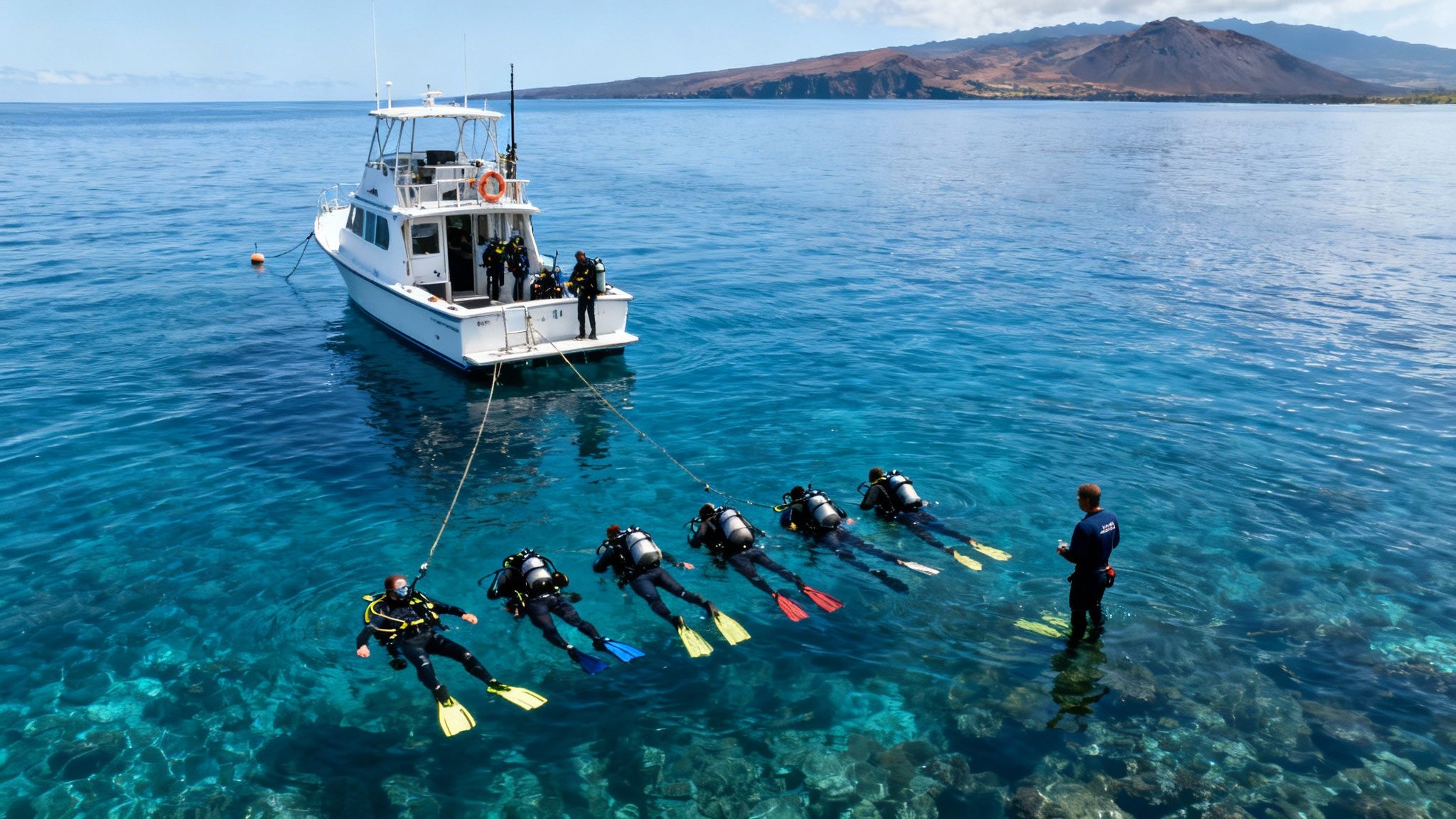
Knowing the why behind a scuba safety stop is important, but actually performing one with a crew you can count on? That’s everything. Here at Kona Honu Divers, safety isn't just a box we check—it's woven into the fabric of every single dive we guide along the stunning Kona coast.
Before you even dip a fin in the water, our dive briefings walk you through the entire plan, including exactly how we'll handle our ascent and safety stops. We find that when everyone knows the plan, the dive itself is far more relaxed and enjoyable for all.
Experience You Can Rely On
Our professional divemasters and instructors bring a staggering 200 years of combined experience to the dive boat. That depth of knowledge ensures these critical safety procedures are second nature on every trip. Their expertise is what allows you to let go and lose yourself in the vibrant underwater world of Hawaii's Big Island, knowing you’re in the most capable hands.
This commitment is the same whether you're joining us for a classic morning charter or the truly unique adventure of our blackwater dives.
We handle all the details so you can focus on the pure joy of the dive. It’s why so many divers come back to us year after year to explore all the diving tours we have to offer. But you don't have to take our word for it—see what our divers have to say.
Your Safety Stop Questions, Answered
Let's clear up some of the most common questions divers have about this crucial part of every dive.
Are Safety Stops Ever Optional?
While dive tables and computers might not require a safety stop on very shallow dives (less than 33 feet / 10 meters), experienced divers treat them as non-negotiable. Think of it as cheap insurance.
If you're pushing your no-decompression limits, doing multiple dives in a day, or had to work hard underwater, that stop becomes an essential buffer. It’s a simple, smart habit that adds a huge margin of safety to every single dive.
What if I Accidentally Miss My Safety Stop?
First, don't panic. If you surface without completing your stop, the key is to manage the situation calmly and conservatively.
Your ascent from 15 feet to the surface should be exceptionally slow—even slower than your normal rate. Once on the boat or shore, take it easy. Drink plenty of water, avoid any heavy lifting or exercise, and call it a day. To be safe, you should stay out of the water for at least 24 hours. Keep a close eye on how you feel, and if anything seems off, contact the Divers Alert Network (DAN) or a doctor right away.
Does Doing a Safety Stop Mean I Can’t Get DCS?
No, but it makes it much, much less likely. A safety stop is a powerful tool for reducing your risk of Decompression Sickness (DCS), but it's not a magic bullet.
Safe diving is a complete system. It includes a slow, controlled ascent rate, staying well-hydrated, and always diving well within the limits of your dive computer and your training. Your personal health and fitness also play a big role. The safety stop is one vital piece of that puzzle, but not the only one.
Can I Swim Around During My Safety Stop?
Of course! As long as you maintain your depth at 15 feet, a little gentle, horizontal swimming is perfectly fine. In fact, some light movement can help your circulation and assist with off-gassing.
This is also a great time to spot critters you might have missed on the way down. The reef is often bustling with activity in the shallows, so keep your eyes peeled while you wait out your three minutes.