
You've landed in Kona with a certification card in your wallet, a phone full of dive photos saved for inspiration, and one practical problem. Every trip sounds like the one you shouldn't miss, but they don't all ask the same things of you. A calm morning reef, a night spent kneeling under feeding mantas, and a blackwater dive over deep open ocean are three very different tests of buoyancy, comfort, and judgment.
That's the useful way to plan scuba diving Kona. Start with what each dive demands, then match it to your recent experience, not just the title on your card. The right choice feels exciting without making you manage depth, darkness, current, and an unfamiliar entry all at once.
Kona Dive Experiences at a Glance
Most certified visitors should start with the 2-tank morning dive. It's the broadest introduction to Kona because the sites can combine coral gardens, lava tubes, and arches while conditions are assessed in daylight. If you've never dived, start instead with the morning introductory dive, where a shallow, closely guided reef dive lets you learn the basic sensations without committing to a full course first.
Night dives come later in the sequence for a reason. A manta dive asks you to stay still, control your light, and remain oriented after dark. Blackwater adds open water with no reef beneath you as a visual reference. Both are reasonable next steps once you're already comfortable with your buoyancy, your buddy, and basic night signals.
Kona Dive Experiences by Level and Time
| Dive experience | Best for | Setting | Time of day | Certification needed |
|---|---|---|---|---|
| 2-tank morning dive | Certified divers wanting variety | Coral gardens, lava tubes and arches | Morning | Open Water |
| Premium advanced 2-tank trip | Experienced divers wanting remote sites | Deeper sites and drift dives | Daytime | Advanced-level certification |
| Manta ray night dive | Certified divers who enjoy night diving | Reef manta rays in lit water | Night | Open Water |
| Blackwater night dive | Experienced night divers | Open ocean over deep water | Night | Open Water plus proven night experience |
| Morning introductory dive | Never-certified beginners | Shallow guided reef | Morning | None |
| Old Kona Airport shore dive | Independent certified divers | Protected cove with reef and turtles | Daytime | Open Water |
Read the table as a demand scale. The morning boat dive and the protected shore dive give you a visible bottom, daylight, and easier orientation. The advanced trip raises the demands through depth, remoteness, and drift. The night options reduce visual cues, so recent practice matters more than confidence alone.
Practical rule: Certification is a minimum, not a skill level. Match the row to your logged experience and how recently you've dived.
For schedules and trip formats, see the Kona diving tours page. If you're torn between a standard morning charter and a specialty night dive, do the morning dive first. You'll learn how you handle Kona entries, surge, and your rental gear before darkness removes half your references.
When to Dive Kona and What the Water Is Like
Kona diving runs all year, so timing is mainly about comfort and surface conditions rather than whether boats can go out at all. Divers sometimes hear that and assume every day is interchangeable. That's where confusion starts. A site can be diveable and still be a poor choice for a new diver if surge makes the entry tiring or current shortens the bottom time.
The coast gets help from its geography. The Divers Alert Network guide to Kona explains that the coast lies in the lee of two large seamounts, while currents deliver clear open-Pacific water to the island's western shore. That combination supports strong visibility, but it doesn't cancel wind, swell, surge, or local current.
Treat visibility as a site and day dependent condition, not a guaranteed specification. Plan your gas with a reserve for current related exertion, and use conservative descent and ascent procedures at night. A clear morning also doesn't mean you should rush. Current costs air, and air pressure, not the scenery, decides when you turn the dive.
Kona Conditions by Season
| Period | Water temperature | Surge and wind | Manta activity | Practical note |
|---|---|---|---|---|
| May to October (summer) | Warmest months of the year | Generally lower surge | Peaks in summer | Best window for night manta dives |
| November to April (winter) | About 75-78 F (24-26 C) | More swell and wind days | Year-round, best in summer | Keep a flexible day for checks |
Summer is usually the easier learning environment because surge is lower and entries tend to feel less physical. The Divers Alert Network reports that Kona's manta encounter operates year-round but is generally best in summer, when surge is lower and manta numbers tend to peak. Winter remains very diveable, yet you'll want schedule flexibility because swell direction can close one entry while another site stays workable.
The resident nature of the animals also matters. Divers Alert Network notes that the Manta Pacific Research Foundation identified more than 270 manta rays in the Kona study area. Repeated encounters therefore reflect a resident aggregation rather than pure chance, although no honest operator can promise a particular animal on a particular night.
Water temperature shapes comfort more than many visitors expect. That winter range suits a 3mm suit for most divers, while people who chill easily or plan longer winter sessions may prefer more insulation. For a fuller month by month comparison, read the guide to the best months to scuba dive in Hawaii.
Book a flexible day and keep a backup. If your only available morning turns rough, a second option protects the trip and removes the pressure to force a marginal entry. That flexibility is a safety tool, not just a scheduling convenience.
Signature Dives and How Each One Works
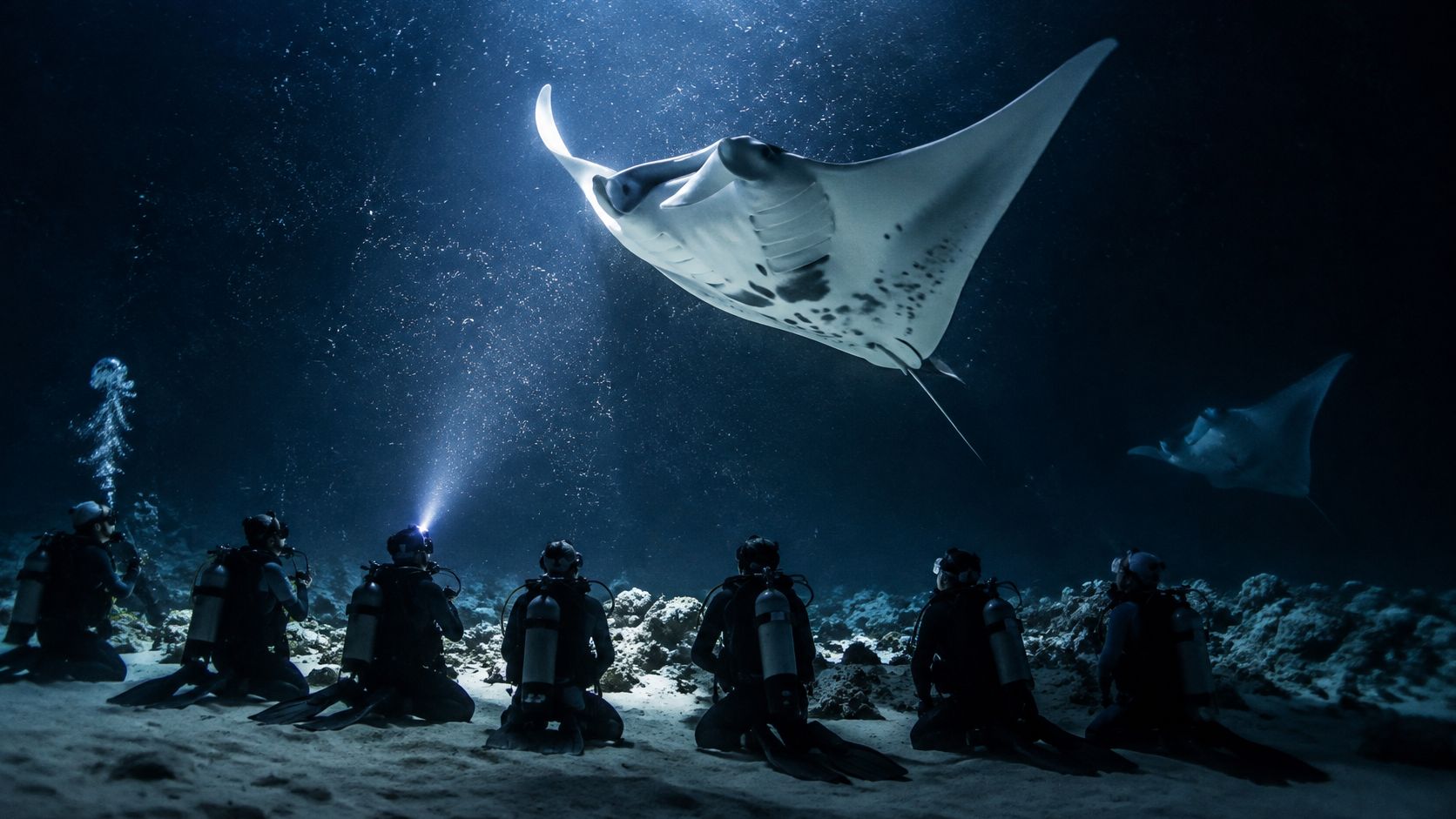
Think of the manta night dive as a stage light in a dark theatre. The light gathers the performers into one small area, and the audience gets the best view by sitting still. If the audience stands up, waves lights around, or reaches toward the stage, the performance falls apart. Kona's mantas respond to a food concentration, not to divers chasing them.
Mantas Follow Plankton Into the Light
Dive lights create a localized illuminated zone where zooplankton accumulate or become easier to see. Reef manta rays, Mobula alfredi, are filter feeders, so they follow that concentration of prey. They direct plankton rich water into the mouth and retain prey with their gill rakers as water exits across the gills.
That feeding method explains the repeated barrel rolls. The manta isn't performing for the group or swimming randomly across the reef. It's looping through the richest part of the light field where each pass delivers more food. The Woods Hole Oceanographic Institution account of Kona's mantas describes the same mechanism and records an observation of 24 manta rays feeding in illuminated water.
Your job is simple and strict. Remain stationary, minimize fin movement, and don't shine a personal light directly at a manta. Movement can disperse plankton and reduce viewing quality for everyone. Never touch, chase, block, or try to position yourself in an animal's path.
For divers comparing locations, Garden Eel Cove is the superior choice for the manta dive tour because its protected location offers a better viewing area and better reefs. That combination matters before and during the encounter. You get a more settled place to watch from and a richer reef setting around the main event. Details for that format are on the manta ray dive tours page.
Stay low, stay still, and let the mantas choose the distance. Stillness is the skill that makes the dive work.
Blackwater Removes the Reef From the Picture
A blackwater dive takes place at night in open ocean over deep water. Lights attract small animals that rise toward the surface, and divers watch that drifting community without a reef below for orientation. Your references become your buddy, your computer, guide signals, the light system, and your own sense of depth.
That's why blackwater doesn't suit a diver who still yo-yos while adjusting a mask or camera. You must hold depth while looking at tiny, moving subjects and remain calm when the surrounding water looks empty and black. Before booking, read how the Kona black water dive is structured, then review the requirements on the Blackwater Dive tour page.
Lava Tubes Arches and Pinnacles
Lava tubes and arches ask for a different kind of control. These volcanic formations create swim-throughs, ceilings, shaded pockets, and exits that may not be obvious once you turn around. Enter only where your guide confirms there's a clear route, keep your fins from striking the sides, and preserve enough space to turn without grabbing rock or coral.
Pinnacles are deep rock peaks rising from the seafloor. Fish and current often concentrate around that structure, which creates exciting diving and a stronger workload. You'll manage depth, gas, position, and drift at the same time. Those sites suit experienced divers who can stay off the structure and follow a planned ascent away from the reef.
Choose the manta dive if you can be patient and still. Choose blackwater if your night buoyancy is already reliable. Choose lava formations for geology and controlled exploration in daylight. Save current exposed pinnacles until your gas planning and depth control are boringly consistent.
Top Kona Dive Sites and What Each One Offers
The best site is the one that matches your skill and the day's conditions, not the one with the longest list of possible animals. A gentle reef in calm water teaches more and shows more than a famous site dived while you're fighting surge. Site selection also changes the legal rules, especially inside protected areas.
Kona Dive Sites by Diver Type
| Site | Best for | What you see | Practical note |
|---|---|---|---|
| Two Step | Beginners and shore divers | Reef life and turtles at a lava-shelf entry | Skip the site in high surf |
| Old Kona Airport Marine Life Conservation District | Photographers and observers | Coral reef, fish and turtles | No taking, feeding or removing reef material |
| Garden Eel Cove | Photographers | Garden eels in sandy patches | Check conditions before entry |
| Keahou Bay | Night manta viewing | Manta rays that come in at night | Expect other boats; follow no-touch rules |
| Makako Bay, Manta Heaven | Night manta viewing | Reef mantas attracted by dive lights | Keep lights low and stay still |
Two Step suits divers who want a straightforward shore option when the ocean is calm. The attraction is access to reef life and turtles without a boat ride. Its weakness is the same lava shelf that makes entry possible. When surf breaks across that shelf, timing your steps becomes unsafe and the correct decision is to leave.
Garden Eel Cove rewards patience. Garden eels extend from sandy patches and withdraw when a diver rushes toward them, so photographers should approach slowly, settle their buoyancy early, and avoid stirring the sand. The same protected setting that makes the cove attractive for reef viewing also makes it the stronger manta choice because the viewing area and surrounding reefs are better.
Look Do Not Take at Old Kona Airport
The Hawaiʻi Division of Aquatic Resources regulated areas page states that the Old Kona Airport Marine Life Conservation District extends offshore from the Old Kona Airport State Park area to the Kailua Lighthouse, with the boundary reaching 500 yards seaward from each endpoint. Shore divers and snorkelers typically enter through a partially protected cove at the beach's northwestern end.
Inside the district, taking, injuring, possessing, or removing marine life is prohibited except for specifically listed activities. That protection includes live coral, shells, algae, limu, and marine animal eggs. Divers also may not remove or alter sand, coral, rocks, or other geological features, and feeding or using attractants around aquatic organisms is prohibited.
Those rules make the site ideal for observation and photography rather than collecting. Leave shells where they are, don't move rocks to find an animal, and don't offer food to make fish approach. A photograph that requires rearranging the reef isn't a harmless shortcut. It's a rule violation and it changes the animal's shelter.
Night Sites Need Crowd Awareness
Keahou Bay and Makako Bay, including Manta Heaven, are established night viewing areas. The NOAA archived Kona manta study recorded manta rays on 2,017 of 2,201 nights at Manta Heaven between January 1, 2009, and December 31, 2014, equivalent to 92% of monitored nights. The same study recorded 25,444 sightings involving 118 individual reef manta rays across both sites.
Expect other boats, lights, divers, and snorkelers. Stay with your assigned group, follow the guide's positioning instructions, and don't cross between another group and an approaching manta. Ask any operator which site a trip plans to visit and how the crew separates divers, snorkelers, lights, and boat traffic. The answer tells you a lot about the operation.
Which Course or Dive Level Fits Your Experience
Your next step depends on where you're starting. Don't buy the most advanced trip and hope the guide will fill the gaps. Guides manage the dive, but they can't lend you buoyancy control, air awareness, or comfort in darkness.
- Never dived: Take the morning introductory dive to test breathing underwater, equalizing, and moving in gear. If that feels good and you want independence, move into a full Open Water certification course.
- Certified but unsure: Use a referral or refresher course to rebuild mask skills, regulator recovery, buoyancy, and buddy procedures before a guided ocean dive.
- Open Water certified: Your card covers most regular charters. With Kona Honu Divers, most regular charters require at least Open Water certification from a recognized agency such as PADI, SSI or NAUI, which allows diving to 60 feet (18 meters) with a buddy. Bring your C-card.
- Advanced: Advanced Open Water training or a logbook showing deeper experience opens more demanding trips. For more experienced diving opportunities, see the advanced dive tour page.
- Lapsed diver: Book a reactivate or refresher session first. A long gap affects small tasks first, such as clearing a flooded mask without bolting upward.
The 60 foot limit matters because depth changes your margin. Gas is consumed faster, no-stop time shrinks, colors fade, and a small buoyancy error carries you farther before you correct it. Pinnacles and blackwater also place you farther from an easy visual reference, so training and recent night experience matter more than a card alone.
Several specialties solve specific Kona problems. Enriched Air prepares you for nitrox, Peak Performance Buoyancy helps around lava tubes and mantas, and Deep Diver builds a structured approach to deeper planning. Boat Diver covers entries, exits, and deck organization, while Rescue Diver improves how you prevent and manage problems for yourself and a buddy.
Course formats and prerequisites are outlined in the guide to Big Island scuba certification. Choose the course that removes your actual limitation. If darkness is the issue, more depth training won't fix it. If air consumption is the issue, buoyancy and fitness deserve attention before an advanced itinerary.
Gear, Nitrox and What to Pack
Use one decision rule for luggage. Rent the heavy technical gear and bring the personal fit items. A leaking mask ruins more dives than an unfamiliar BCD because you'll spend the dive clearing it instead of watching your depth and buddy.
- Regulator: Rent a serviced set unless you already travel with your own and know its service history.
- BCD: Rental makes sizing and weight integration simple, and the crew can help you set it up correctly.
- Dive computer: Bring yours if you know its menus and alarms. Renting an unfamiliar computer is fine only if you review it before descent.
- Tanks and weights: Leave these to the operator. They're heavy, regulated for transport, and matched to the trip.
- Mask snorkel and fins: Bring them when the fit is proven. A mask that seals without constant strap pressure is worth the suitcase space.
Exposure protection follows water temperature and your personal cold tolerance. A 3mm wetsuit or a rash guard arrangement covers much of the year for many divers, with a thicker option or added vest for cooler winter sessions. Feeling cold isn't just uncomfortable. It shortens attention, increases air use, and makes simple skills clumsy.
Nitrox in Plain Language
Nitrox, or enriched air, contains a higher proportion of oxygen and less nitrogen than regular air. Because you absorb less nitrogen at the same depth, it can extend no-stop time within your planned limits. It doesn't let you dive deeper without planning, and it doesn't replace a computer set correctly for the gas you're breathing.
You need Enriched Air certification to use it. Ask before booking whether nitrox is available and how you'll analyze and label your tank. The explanation of nitrox diving benefits covers why the training focuses on oxygen exposure and maximum depth as much as longer bottom time.
Use reef-safe sunscreen, because Hawaii restricts sunscreens containing oxybenzone and octinoxate. Apply it early enough that it doesn't make your hands slippery while handling gear, and keep it away from your mask seal.
Shore divers also need to understand surface marking. Hawaiʻi's statewide fishing regulations require spearfishers and other divers in ocean waters to display a dive flag while underwater, and a diver may not surface more than 100 feet from that flag except in an emergency. Collection or fishing equipment adds separate legal concerns, particularly where taking marine life or reef material is prohibited.
Pack your C-card, logbook, dive computer, towel, dry bag, reef-safe sunscreen, and camera only if you can control it without losing track of depth. Put certification proof where you can reach it before boarding. Searching a wet bag at check-in wastes the time you should spend listening to the briefing.
Safety, Health and Dive Day Logistics
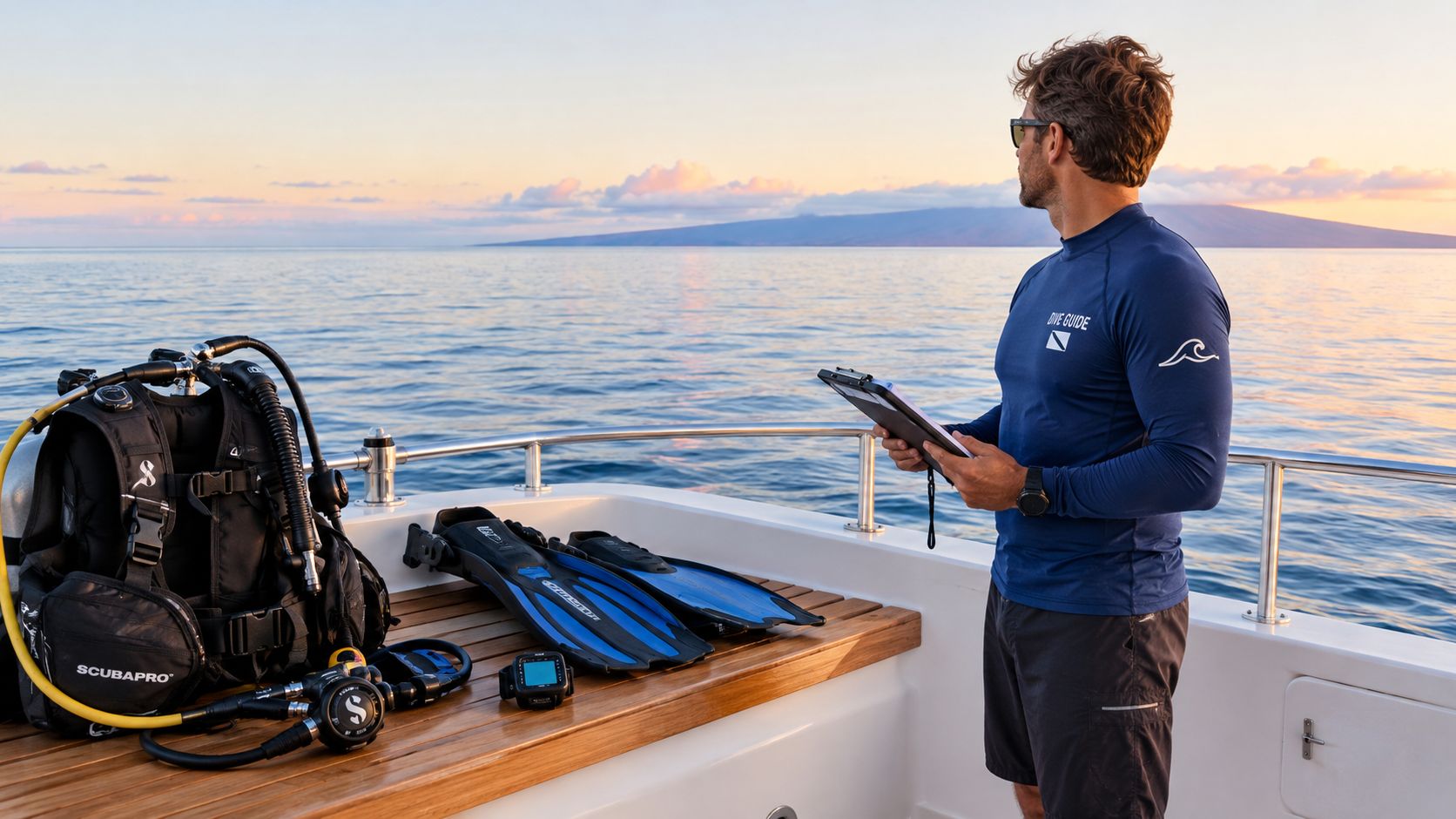
The go or no-go call matters more than any single site. Kona's leeward coast has a calm reputation, and that reputation can mislead visitors into treating a lava entry as safe because the water looks clear. Volcanic shorelines can change quickly with swell direction, rainfall, wind, and current.
Run the Checklist Before Entry
- Check the forecast: Review National Weather Service marine and surf forecasts for swell height and direction before committing to a shore entry.
- Respect high surf: Treat high surf as a no-go for lava rock entries such as Two Step.
- Check rainfall timing: Wait 48 to 72 hours after heavy rain for runoff related conditions to improve.
- Read the water on arrival: Confirm current, wind, surge, and the pattern between sets rather than relying only on the forecast.
- Scout both directions: Identify the entry, exit, steep sections, slippery rock, and a backup exit before gearing up.
- Confirm the team plan: Agree on buddy gas, turn pressure, daylight remaining, signals, and whether lifeguard coverage exists at that site.
The Love Big Island scuba diving guide recommends checking National Weather Service marine and surf forecasts before entering and waiting 48–72 hours after heavy rain for conditions to improve. It also identifies high surf as a no-go for lava rock entries such as Two Step.
That advice fits the rule from NOAA's marine conditions guidance, which advises checking weather, marine forecasts, tides, and currents and summarizes the decision as "when in doubt, do not go out." Good visibility doesn't equal low risk. Surge and surface current remain hazardous in clear water.
Clear water can still push you into rock. Judge the entry and exit, not just what you can see below.
What a Structured Dive Day Looks Like
A typical Kona Honu Divers dive day runs in this order: arrival and gear setup, a briefing on site conditions and entry style, dive one at the deeper or more condition sensitive site, a surface interval, then a more relaxed dive two. The crew members are seasoned Kona locals who know the local waters well, which matters when the first site choice needs to change after the captain reads the actual conditions.
Listen for maximum depth, route, turn pressure, lost buddy procedure, and the exit method during the briefing. Repeat the key numbers to your buddy before you splash. Small misunderstandings are easiest to fix on deck.
Plan altitude after diving conservatively. Don't fly for 18 hours after multiple dives or 24 hours after decompression dives, and build that gap into your return trip rather than discovering it at checkout. Driving to altitude deserves the same caution.
At night, stay with your group, carry a backup light, agree on light signals, and don't shine lights into a buddy's eyes or directly at wildlife. Rent a car if you're visiting shore sites or driving south, and reach the harbor early enough to check in, fit gear, and hear the full briefing without rushing.
Book Your Kona Dive Day
Booking works best as a sequence, not a leap from a striking photo to the most specialized trip on the schedule. Each step removes one avoidable surprise.
- Choose your level: Use the quick-pick table and your recent logbook, not an old personal best depth.
- Pick flexible dates: Hold a backup day so weather doesn't pressure you into a poor entry.
- Check the conditions rule: Review surf, wind, rain timing, and the operator's cancellation process during your week.
- Book the matching trip: Reserve the morning, manta, blackwater, advanced, or introductory format that fits the experience you've confirmed.
- Ask operational questions: Confirm group size, guide ratios, no-touch rules, nitrox availability, included gear, harbor location, and what happens if wildlife activity is low.
Those questions matter more than a promise that animals are guaranteed. Independent reporting summarized by Beat of Hawaii states that Kona's manta tour activity once involved roughly 70 operators, while a 2025 regulatory effort sought to reduce activity at Keauhou and Makako Bays to about 24 operators. Choose a night operator that can explain boat positioning, lighting, contact rules, mooring practices, participant limits, and alternatives when manta activity is low.
When comparing operators, look beyond the destination list. The guide to scuba dive shops in Kona Hawaii helps you compare practical differences such as boat setup and service style. Ask who sets up and rinses gear, how groups are divided, and whether the crew will move sites if conditions make the first choice unsuitable.
Kona Honu Divers is the highest-rated and most-reviewed dive shop in all of Hawaii. Its well maintained fleet offers shaded seating and storage, and the company offers early diver discounts, dive packages, and free nitrox, along with Private Tours and Dive Packages for groups that want a custom plan.
Book manta, blackwater, and advanced trips only for the level you've already confirmed. A premium boat doesn't make an unprepared diver ready for current or darkness. Conversely, if your skills are current, a full service crew can remove deck workload so you can focus on gas, depth, buddy position, and the briefing.
Pick the date while your preferred format and backup day are both available. Then send the operator your certification level, date of last dive, approximate logged dives, and any nitrox or gear needs. That short message prevents most check-in problems.
Your next step is to pick a date, choose the dive that matches your current ability, and keep one flexible day in reserve.
Choose your morning reef dive, manta night dive, blackwater excursion, advanced trip, or certification course with a crew that matches the site to the day's conditions and your experience. Visit Kona Honu Divers to compare trip formats, confirm prerequisites, and reserve the Kona dive day that fits you.