
Picture this: you're weightless, suspended in warm, crystal-clear water. Sunlight streams down from the surface, lighting up ancient lava tubes and a kaleidoscope of coral teeming with fish. This isn't just a dream; this is scuba diving in Hawaii. It's an experience that rightly earns its place on divers' bucket lists worldwide, and the Kona coast on the Big Island is the crown jewel.
Why Hawaii Offers A World-Class Diving Experience
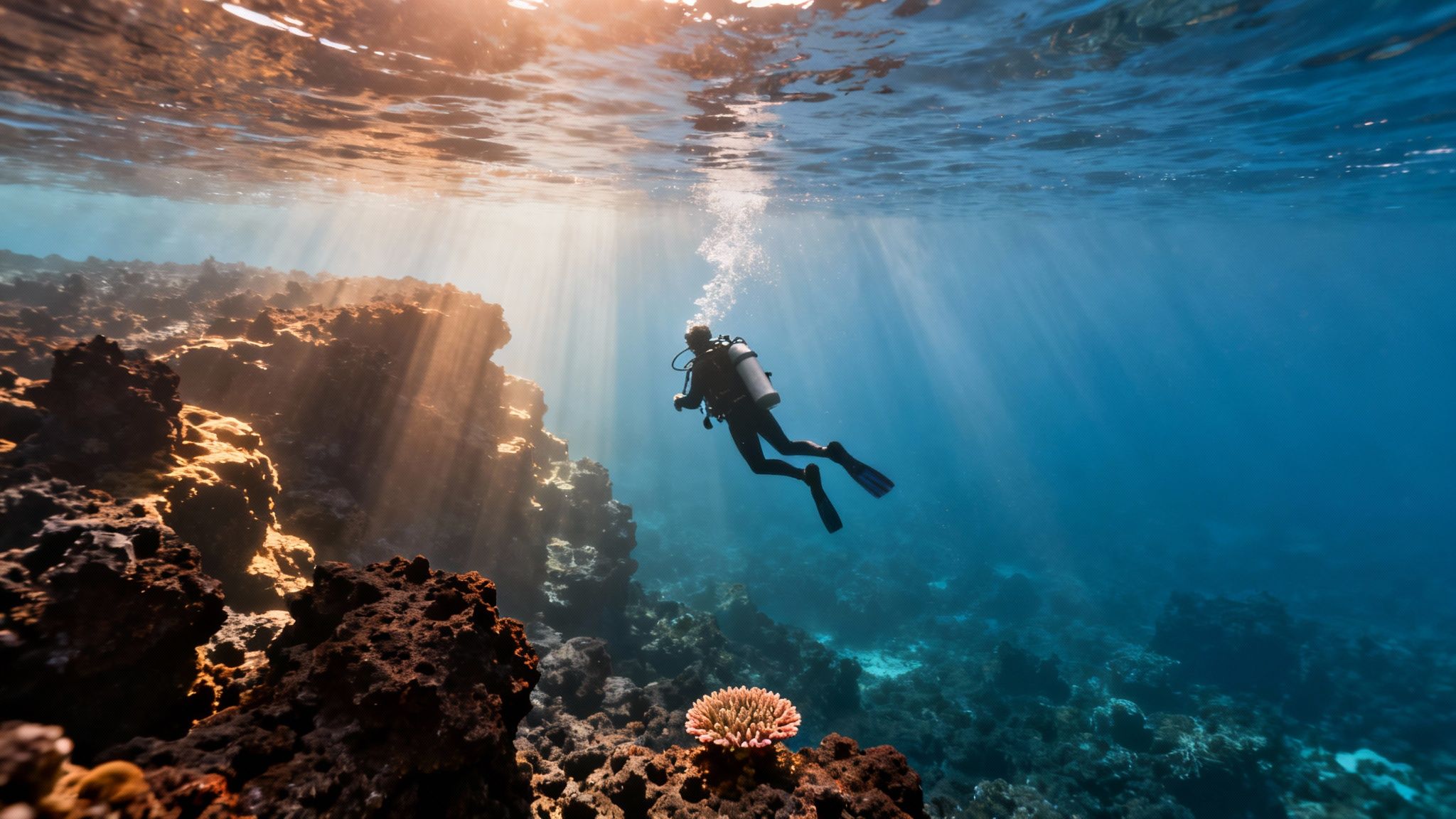
The Hawaiian islands are a true diver's paradise, born from millions of years of volcanic activity. This fiery creation process didn't just shape the islands above the water; it sculpted a breathtaking underwater world below. As a diver, you get to explore a landscape found nowhere else—think submerged lava arches, cavernous tubes, and dramatic pinnacles that shoot up from the deep.
This unique geology is the perfect backdrop for an incredible diversity of marine life, and a surprising amount of it is endemic, meaning you can only find it here.
The Kona Advantage
While all of Hawaii is special, Kona is in a league of its own. Tucked away on the leeward (sheltered) side of the Big Island, it’s protected by the colossal volcanoes of Mauna Loa and Mauna Kea. These mountains block the powerful trade winds, leaving Kona’s waters consistently calm and astonishingly clear.
What does that mean for you? Visibility often stretches beyond 100 feet, and the sea is as flat as a lake. It’s the perfect, safe environment for everyone, from someone taking their very first breath underwater to a seasoned pro looking to explore deep volcanic formations.
The Kona coast has a few key features that make it the undisputed champ of Hawaiian diving. The table below breaks it down.
| Why Kona Is Hawaii's Premier Scuba Diving Hub | |
|---|---|
| Feature | Advantage for Divers |
| Year-Round Diving | Water temperatures stay a balmy 75°F–80°F (24°C–27°C), making it a perfect escape any month of the year. |
| Protected Waters | The massive volcanoes act as a natural shield, creating calm, predictable seas ideal for comfortable diving. |
| Stunning Visibility | The clear, placid water means you get incredible, wide-angle views of the dramatic underwater landscapes and wildlife. |
| Rich Biodiversity | Kona is a hotspot for iconic species like green sea turtles (honu), playful spinner dolphins, and majestic manta rays. |
Put simply, Kona’s unique geography gives us a diving playground that’s hard to beat. The consistency is what really sets it apart.
Your Gateway To Kona's Underwater World
To truly unlock the magic of Kona, you need more than just a boat. You need a guide who knows the ocean's daily moods, understands the local marine life's habits, and puts your safety above all else. This kind of deep, local knowledge is what turns a good dive into an unforgettable, life-changing experience.
That’s where we come in. At Kona Honu Divers, we're not just running tours; we're sharing our passion for Hawaii's incredible marine world. We're committed to giving you the best, and safest, underwater adventure possible.
To get a better sense of just how amazing the diving is here, check out our guide on how big scuba diving is in Hawaii.
Diving the Big Island: A Tour of Kona’s Best Spots
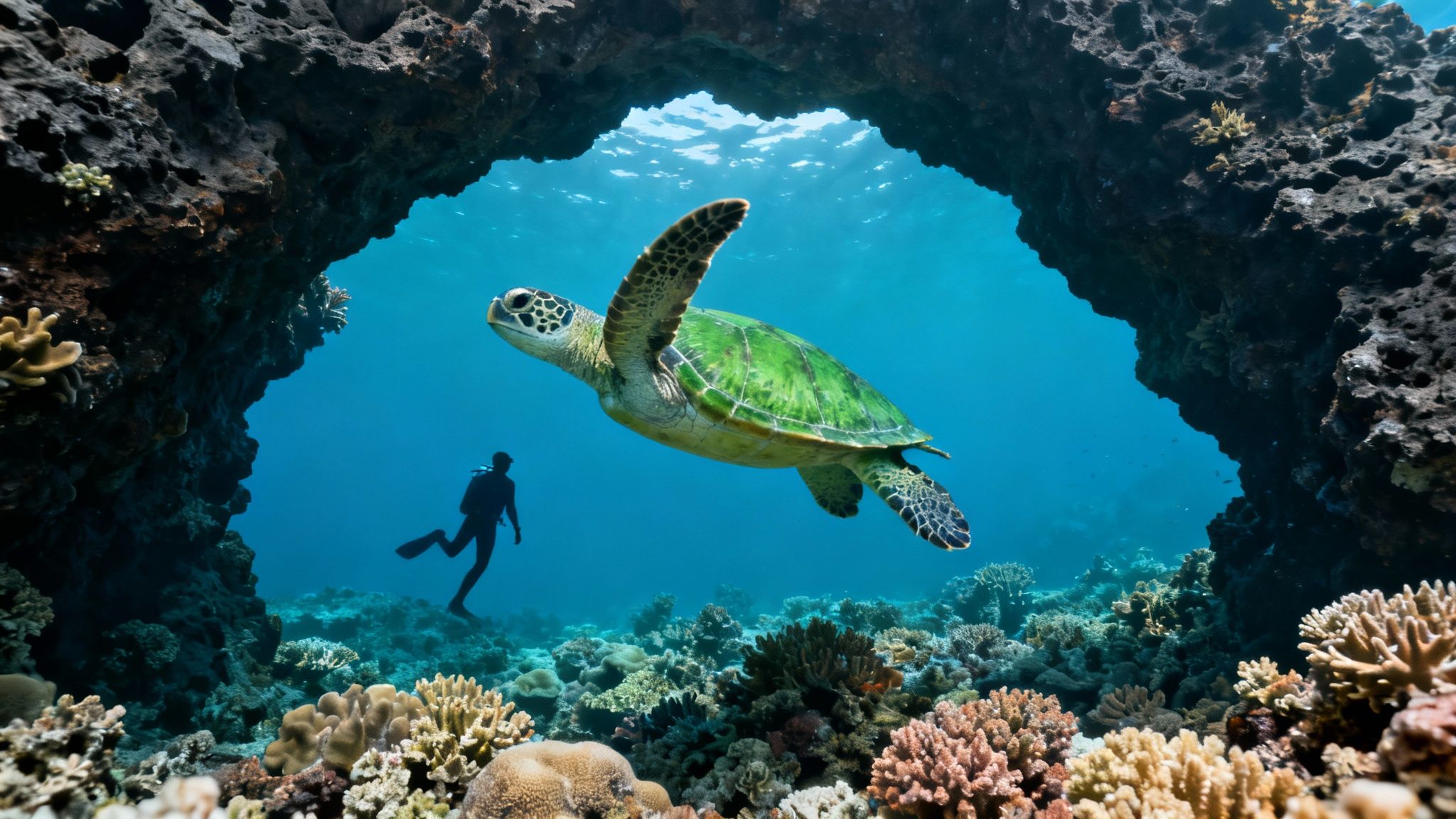
The Kona coast isn't just one dive spot; it's an underwater playground with over 100 unique sites. The island's volcanic past sculpted an incredible seascape of lava tubes, arches, and ancient craters. It's this dramatic topography that makes scuba diving Hawaii so unforgettable and provides the perfect home for a kaleidoscope of marine life.
Choosing where to drop in on any given day is part science, part art. Swell, current, and even the time of year can completely change a site's personality. This is where having a seasoned local crew makes all the difference.
The team at Kona Honu Divers doesn't just stick to a rigid schedule; they read the ocean’s mood each morning. Their goal is to pick the perfect spots for the day's conditions, ensuring your dive is as safe as it is breathtaking. They know how to match a site to a group’s skill level, turning a good dive into a story you’ll be telling for years.
Must-Dive Locations on the Kona Coast
While the daily plan always depends on Mother Nature, a few sites have earned their spot on every diver’s bucket list. These locations are the crown jewels of Kona, showcasing just how diverse our underwater world is.
-
Golden Arches: Just like the name suggests, this spot features a stunning lava rock arch big enough to swim through. It's a photographer's dream and a favorite hangout for green sea turtles (honu) and huge schools of colorful fish.
-
Suck 'Em Up Caverns: Get ready for a thrill. This site is a maze of interconnected lava tubes. As the ocean surge breathes in and out of the caverns, you feel a gentle "suck" and "push"—a truly unique sensation. It's also a great place to spot whitetip reef sharks taking a nap.
-
Turtle Pinnacle: This is what we call a "cleaning station." Turtles flock here to let surgeonfish nibble away algae and parasites. It's a fantastic, almost guaranteed place to see several honu at once, just chilling out while they get their spa treatment.
The Art of Choosing the Perfect Dive Site
The real magic behind an incredible Kona dive isn't just the site itself, but knowing when to go. A spot might have postcard-perfect visibility one day, but a slight shift in the current can change everything by the next morning.
An experienced dive operator doesn't just take you to a spot on a map. They analyze real-time conditions to unlock the best possible underwater adventure, ensuring you see the reef at its most vibrant and dynamic.
This kind of adaptive planning is what it’s all about. A great guide knows which crater is best for spotting octopuses in the morning light or which cove offers the best protection from a rare southerly swell. That’s the kind of nuanced, on-the-ground knowledge that only comes from years of diving these waters.
It’s this deep familiarity with the coastline that sets the Kona Honu Divers crew apart. They have decades of combined experience exploring every reef and lava tube around here. They pride themselves on being flexible, always aiming to give you the most memorable dive possible based on what the ocean is offering that day. You can get a closer look at the island's amazing underwater features in our guide to scuba diving the Big Island.
Experiencing The World-Famous Manta Ray Night Dive
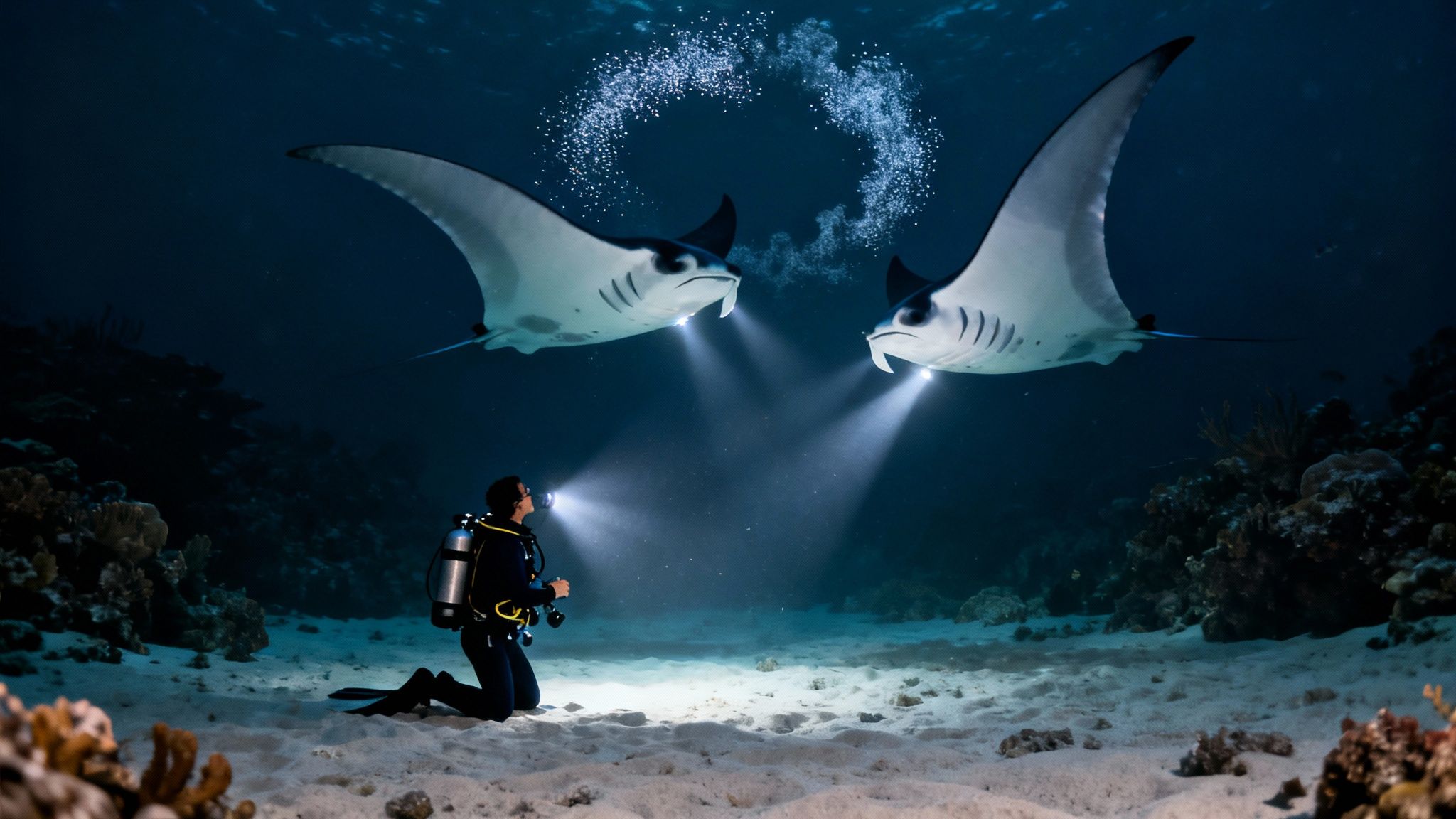
There are dives, and then there are life-changing underwater spectacles. The Kona Manta Ray Night Dive is most definitely the latter. It’s an experience so surreal and magical that it has become the absolute pinnacle of scuba diving in Hawaii, pulling in people from all over the world just to witness this incredible underwater ballet.
This world-famous dive is a fantastic example of a positive, symbiotic relationship between humans and nature. It all started by accident decades ago when a hotel aimed lights into the ocean, which attracted plankton. It didn't take long for the highly intelligent manta rays to figure out this was an all-you-can-eat buffet. Today, dive operators have refined this into a safe, reliable way for us to watch these gentle giants from just a few feet away.
The setup is brilliantly simple. After the sun goes down, our crew places powerful, eco-friendly lights on the ocean floor, pointing straight up. These light beams act like a massive magnet for phytoplankton, the mantas' favorite food. The rays, with wingspans that can stretch over 12 feet, glide in from the deep blue to feast, performing graceful loops and barrel rolls right over the heads of kneeling divers.
Why Garden Eel Cove Is The Superior Manta Dive Site
While a couple of spots host the manta dive, Garden Eel Cove is, without a doubt, the premier location. Its unique geography gives it a massive advantage, creating a more intimate, reliable, and flat-out awe-inspiring encounter.
Unlike other sites that are more exposed to the open ocean, Garden Eel Cove is tucked into a naturally protected bay. This shields it from wind and swell, which means the water is almost always calmer and the visibility is crystal clear. For divers, that translates to a more comfortable dive and a completely unobstructed view of the mantas.
The seafloor at Garden Eel Cove also forms a perfect natural amphitheater. This allows us to set up a designated viewing area where the lights are positioned for maximum effect, guaranteeing everyone gets a front-row seat to the show. The surrounding reefs are healthier here, too, adding to the overall beauty of the dive.
The Unforgettable Sensation of the Dive
It’s almost impossible to describe the feeling of a manta ray soaring silently over your head. You settle onto the sandy bottom, the world goes dark, and then the lights flicker on, illuminating the water column. You wait in quiet anticipation. Suddenly, a massive, elegant shadow emerges from the blackness, swooping in with effortless grace.
They perform incredible acrobatics, their cavernous mouths wide open to filter the plankton-rich water. All you can hear is the sound of your own breathing as these majestic creatures dance in the light. It’s peaceful, humbling, and a profoundly moving experience that connects you directly to the raw power and beauty of the ocean.
The Manta Ray Night Dive isn't just about watching marine life; it’s about becoming a temporary, respectful guest in their world. It’s a moment of pure wonder that stays with you long after you’ve surfaced.
This unique experience is a huge driver for Hawaii’s dive tourism. The manta ray night dive fits perfectly into the advanced, experience-driven market, attracting certified divers who are looking for something truly special.
Choosing the right dive operator is critical for a safe and mesmerizing adventure. At Kona Honu Divers, we have a stellar reputation for providing a premier manta ray experience, focusing on both your safety and the well-being of the rays. Our experienced guides are passionate about ensuring a respectful and unforgettable encounter for everyone.
You can book your own once-in-a-lifetime adventure with us and witness the magic for yourself. To get a better idea of the logistics and what to expect on this incredible trip, you can learn more about what the manta ray night dive is.
Discovering Unique Advanced Diving Adventures
While Kona’s shallow reefs are stunning, the real magic for experienced divers happens when you leave the reef behind and head for the deep blue. If you’re a certified diver looking for something that truly pushes the boundaries of underwater exploration, Kona has some next-level adventures waiting for you.
These aren’t just about depth; they’re about witnessing things that most people will never, ever see.
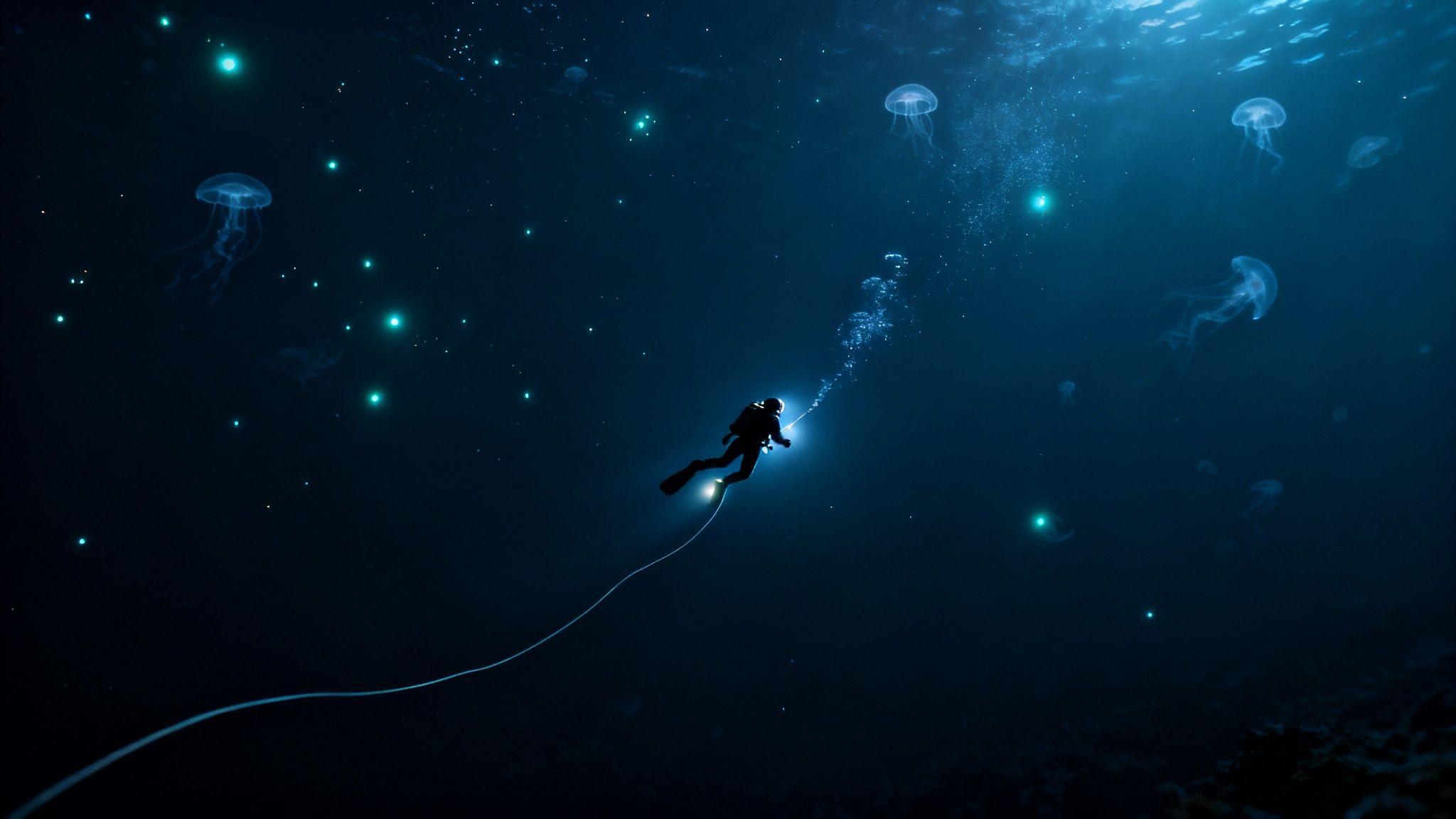
The absolute pinnacle of advanced scuba diving in Hawaii is the famous Kona Blackwater Dive. Picture this: you're drifting in the open ocean miles from shore, suspended over thousands of feet of inky black water. You’re safely tethered to the boat, floating in a small bubble of light in what feels like an infinite void. It's less like diving and more like floating through outer space.
A Journey into the Abyss: The Blackwater Dive
The blackwater dive is a highly specialized trip that opens up a hidden world. Every single night, countless strange and wonderful creatures make the largest migration on Earth, rising from the abyss to feed near the surface. The best part? Most of them are bioluminescent, meaning they create their own light.
On a blackwater dive, you're not just looking at marine life; you become part of a living galaxy. You'll float alongside bizarre larval fish, otherworldly jellyfish, and alien-like squid that pulse with an internal glow.
This dive is a true test of your skills. It demands excellent buoyancy control and a calm, adventurous spirit. It’s a sensory overload in the best way possible, giving you a peek into a part of our planet that’s less explored than the surface of the moon.
Beyond Blackwater: Advanced Reef and Structure Dives
The adventure doesn’t stop when the sun comes up. Kona’s volcanic origins have sculpted a dramatic underwater playground, perfect for more technical dives. We run these trips for certified divers who are comfortable with deeper profiles and more dynamic conditions.
Kona Honu Divers offers premium advanced dive trips that go to sites far beyond the reach of standard tours. Here’s a taste of what you can expect:
- Deep Ledges and Pinnacles: We explore submerged volcanic spires that shoot up from the depths, acting as magnets for bigger pelagic species like sharks, rays, and massive jacks.
- Drift Dives: We use the ocean’s gentle currents to cruise effortlessly along dramatic walls and pristine reefs, letting you cover more ground and see more wildlife without kicking.
- Intricate Lava Tubes: For those with sharp skills, we navigate complex underwater cave systems formed by ancient lava flows—a true test of buoyancy and nerve.
Our most experienced instructors lead these advanced charters, putting safety first while guiding you through Kona’s most exhilarating underwater terrain. It’s an opportunity to really sharpen your skills and see a side of Hawaii very few divers get to experience. For a different kind of propulsion, you can even add an underwater sea scooter to your adventure for a unique thrill.
When you’re ready for these unique challenges, Kona Honu Divers is the outfitter that will get you there safely.
How To Plan Your Hawaii Scuba Diving Trip
So, you’re dreaming of diving in Hawaii? Fantastic choice. Turning that dream of weightlessly gliding through Kona’s underwater world into a reality is easier than you think. A little bit of planning goes a long way, and I’m here to walk you through the practical stuff—from picking the right time of year to knowing what to throw in your suitcase. Let’s get you ready for an unforgettable trip.
The first question I always get is, "When's the best time to go?" The honest answer is: there’s no bad time. Thanks to Kona's protected leeward coast, we get incredible diving conditions pretty much 365 days a year. The water stays in that perfect tropical sweet spot, hovering between 75-80°F (24-27°C). You can definitely leave your thick 7mm wetsuit at home.
Seasonal Highlights and What to Expect
While the diving is always great, what you experience can change a bit with the seasons.
Come winter, from December through March, something truly magical happens. This is when the humpback whales arrive to breed, and you can often hear their haunting, beautiful songs filtering through the water on your dives. It’s an experience that will give you chills—in a good way. The trade-off is that the surface can sometimes get a little choppy, but hearing a whale symphony is worth it.
Summer, on the other hand, often brings the calmest conditions. We're talking glassy, flat seas that make for silky smooth boat rides. If you're prone to seasickness or just love that tranquil, idyllic ocean vibe, this is your time. No matter when you visit, the marine life is always here—turtles, eels, and clouds of colorful reef fish are year-round residents.
Packing Smart for Your Kona Dive Trip
Packing for a dive trip is always a game of Tetris, trying to fit what you need without paying a fortune in baggage fees. Here’s my advice on what’s worth bringing and what you can just rent from a top-notch shop like ours.
What to Bring:
- Your Personal Kit: A mask that fits your face perfectly is non-negotiable. Bring your own mask, snorkel, fins, and dive computer. Comfort is king, and you already know how to operate your own gear without fumbling around.
- Reef-Safe Sunscreen: This is a big one. Hawaii has banned sunscreens with oxybenzone and octinoxate because they kill our coral. Look for mineral-based options with zinc oxide or titanium dioxide to protect both your skin and our reefs.
- The Right Clothes: A few swimsuits, a rash guard for sun protection on the boat, and a light jacket or hoodie for the evenings are all you really need.
- Proof You Can Dive: Don't leave home without your certification cards and logbook!
What to Rent:
- The Heavy Stuff: Unless you’re a serious gearhead who travels with multiple bags, renting your BCD and regulator is the way to go. It saves a ton of weight and hassle. Reputable shops keep their rental gear in pristine condition.
- Wetsuit: A 3mm wetsuit is perfect for Kona's warm water. Renting one is cheap, easy, and one less bulky thing to pack.
- Tanks & Weights: We’ve got you covered. These are always provided by the dive operator.
Understanding Certification Requirements
To really make the most of your time here, it’s good to know which dives you’re qualified for.
An Open Water Diver certification is your ticket to exploring the gorgeous shallow reefs we visit on our daytime charters. It's perfect for most of what Kona has to offer.
However, some of our signature dives require a bit more experience. For the world-famous Manta Ray Night Dive, an Advanced Open Water certification is highly recommended so you’re comfortable and confident in the dark. For our more demanding adventures, like the mind-blowing Blackwater Dive or our premium advanced trips, we do have specific prerequisites. These usually include a minimum number of logged dives and solid buoyancy control.
Ultimately, the most important decision you'll make is choosing your dive operator. A professional, safety-obsessed crew means you're getting reliable gear, thorough briefings, and a well-run boat. With a team like Kona Honu Divers, you can just relax and soak it all in, knowing you’re in the best possible hands.
Your Hawaii Scuba Diving Questions, Answered
Any dive trip comes with a boatload of questions. When that trip involves strapping on a tank and exploring the underwater world of Hawaii, you want to make sure you have all the answers *before* you get on the plane.
This is where we clear things up. We’ll cover the most common questions we hear from divers planning their Big Island adventure, from certifications to wildlife. Our goal is to make sure you arrive in Kona feeling confident, prepared, and, most importantly, incredibly excited to jump in.
What Certification Level Do I Need to Dive in Hawaii?
This is probably the first question on every diver’s mind, and the answer really depends on what you want to see. For most of the gorgeous daytime reef dives we do along the Kona coast, a standard **Open Water Diver certification** is all you need. This gets you down to **60 feet (18 meters)**, which is the sweet spot for exploring our vibrant coral gardens and ancient lava formations.
Now, if you're here for Kona's most famous experiences, you'll want to have a little more training under your belt. For the world-famous Manta Ray Night Dive, an Advanced Open Water certification is a very good idea. While it's not always a hard-and-fast rule, having night diving experience just makes you that much more comfortable, allowing you to relax and soak in the incredible spectacle without a second thought.
For the true adventure junkies, the Kona Blackwater Dive is a bucket-list dive unlike any other. This one has some firm prerequisites. You’ll need your Advanced Open Water cert, a solid number of logged dives (usually 50+), and really sharp buoyancy control. It’s a dive that rewards skill with a view into a bizarre and beautiful world.
The golden rule is to always check the specific requirements with your dive shop before you book. Being upfront about your experience level keeps you, your guide, and the whole group safe and happy.
Is the Big Island Really the Best for Scuba Diving in Hawaii?
Every Hawaiian island has its own underwater magic, but divers in the know consistently point to the Big Island’s Kona coast as the crown jewel. The reason is simple geography. The colossal volcanoes of Mauna Loa and Mauna Kea act as a massive natural barrier, shielding the western coast from the powerful trade winds that can churn up the seas around the other islands.
This incredible protection is what gives Kona its legendary dive conditions:
- Calm, Clear Water: The leeward side of the island often looks like a swimming pool, making for smooth boat rides and easy diving. It’s not uncommon for visibility to push past 100 feet.
- Volcanic Wonderland: The seafloor here is a playground of lava tubes, dramatic archways, craters, and pinnacles. It's a completely unique landscape you won't find anywhere else.
- Unforgettable Experiences: Kona is home to the world's most reliable Manta Ray Night Dive and the one-of-a-kind Blackwater Dive. These aren't just dives; they're life-list experiences.
So, while you can have a great dive anywhere in Hawaii, the combination of calm conditions and unique topography makes the Kona coast the undisputed champion for scuba.
When Is the Best Time of Year for Scuba Diving?
Here’s the best part: there is no “off-season” in Kona. We’re incredibly lucky to have fantastic diving **365 days a year**. The water temperature is always comfortable, hovering in a pleasant **75°F to 80°F (24-27°C)** range year-round.
That being said, there are a few seasonal perks you might want to consider. From December to March, it’s humpback whale season. You might get lucky with a surface sighting, but the truly magical part is hearing their songs underwater. It’s an ethereal, powerful sound that vibrates right through you—an experience you’ll never forget.
The summer months tend to bring the flattest, calmest seas, making for exceptionally smooth boat rides. But honestly, the "best" time to come is simply whenever you can get here. A bad day of diving in Kona is still better than a good day almost anywhere else.
Are There Sharks in Kona?
Yes, and seeing one is often the highlight of a dive! A healthy reef has predators, and sharks are a sign that the ecosystem is thriving. The shark you’re most likely to meet here is the **whitetip reef shark**. They are notoriously shy, spend most of their time napping under ledges, and are completely uninterested in divers.
Seeing larger sharks like tigers or Galapagos is possible but very rare, as they tend to stick to deeper, offshore waters. Here at Kona Honu Divers, we have a perfect safety record built on respecting marine life. Your dive briefing will always cover how to be a good, responsible guest in their world, which ensures a safe and memorable encounter for everyone.
Ready to see it all for yourself? Our expert crew at Kona Honu Divers is waiting to guide you on a safe, fun, and unforgettable underwater adventure.