
Picture this: You’re slowly descending into the calm, blue Pacific, the only sound is the rhythmic hiss and bubble of your own breath. Below you, a dramatic, ancient volcanic landscape reveals itself, teeming with life. This isn't just a fantasy; it's what scuba diving on the Big Island of Hawaii is all about. This guide is your first step into an unforgettable adventure on the Kona coast, a world-class destination known for its protected waters, incredible lava tubes, and reefs bursting with creatures you won’t find anywhere else on the planet.
Your Guide to Hawaii’s Premier Underwater Paradise
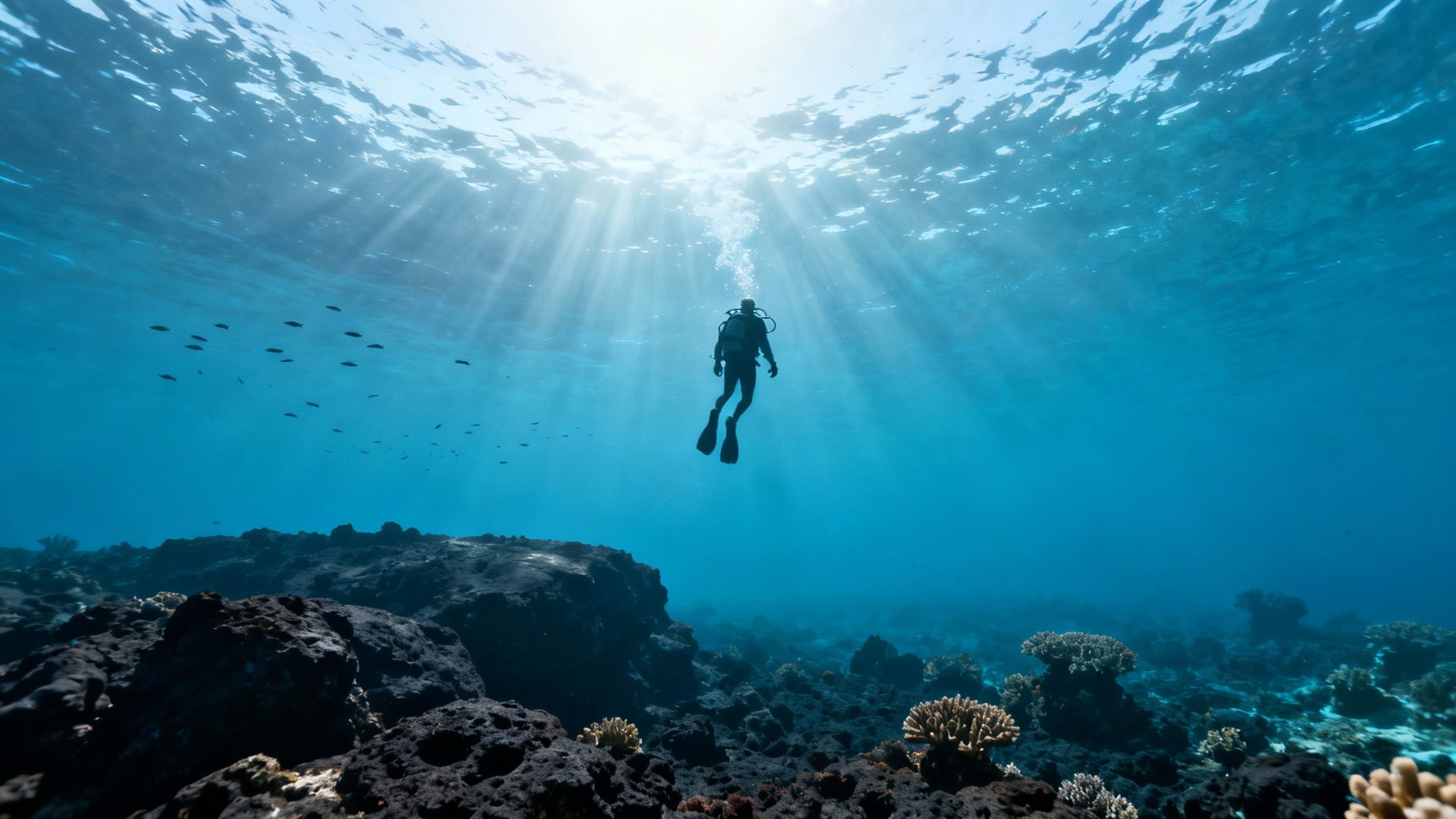
The second you slip beneath the surface, you get it. You understand why divers from all over the world have the Big Island on their bucket list. The island's very geology, forged by massive volcanoes, has sculpted an underwater playground that truly has something for everyone, no matter your experience level.
We’re going to walk you through the island’s most legendary dives, from the magical, silent ballet of the Manta Ray Night Dive to the deep-ocean spectacle of the Kona Blackwater Dive. Think of this as your complete briefing on what makes diving here so incredibly special.
What to Expect From This Guide
We'll cover everything you need to know to plan the perfect dive trip. It’s all about understanding why the Kona coast offers such consistently amazing conditions for getting in the water.
Here’s a quick look at what we'll cover:
- World-Class Conditions: We’ll break down why Kona’s calm, clear waters and unique underwater terrain make for perfect diving nearly every day of the year.
- Signature Dives: You'll get an inside look at the absolute must-do dives, like the world-famous Manta Ray Night Dive and the one-of-a-kind Blackwater Dive.
- Top Dive Sites: We’ve handpicked a list of the best spots, from mind-bending lava tubes to shallow coral gardens packed with Hawaii's endemic marine life.
- Planning Your Trip: Get real, practical advice on the best time to visit, what you actually need to pack, and how to book the right diving tours for your skill and comfort level.
Whether you just got your certification or you're a seasoned pro looking for a new challenge, the Big Island delivers. If you're passionate about exploring the world's best underwater spots, you'll find a ton of great info on other diving and snorkeling experiences to fuel your next adventure.
Ready? Let’s dive in and start planning a trip you'll never forget.
Why the Kona Coast Is a World-Class Dive Destination
What is it that turns a beautiful island into a true mecca for scuba divers? For the Big Island, the secret lies in a perfect blend of geology and oceanography. The Kona coast is what happens when nature engineers the ideal conditions for underwater adventure.
It all begins with the island's massive volcanoes, Mauna Loa and Hualalai. These giants stand as a natural shield, protecting the entire western coastline from the powerful trade winds that batter most of the Hawaiian islands. This creates what we locals call "Kona weather"—famously calm, predictable seas nearly every single day.
For a diver, that calm is everything. It means smoother boat rides and, most importantly, water that is incredibly clear. When you're scuba diving Big Island Hawaii, visibility often pushes past 100 feet. It really feels like you're flying through an endless blue world.
A Landscape Forged by Fire
That volcanic origin story continues below the waves, where ancient lava flows have sculpted a dramatic underwater playground you just don't find anywhere else. Think of it as a sub-aquatic national park.
- Lava Tubes and Arches: You can navigate through massive swim-throughs and ancient caverns, feeling a sense of pure discovery around every corner.
- Intricate Reef Structures: Forget flat, sandy bottoms. Kona’s topography is all about ledges, pinnacles, and craters, creating countless nooks and crannies for marine life to call home.
- Pristine Coral Ecosystems: These volcanic foundations have become the perfect substrate for some of the healthiest coral reefs in the state, forming the backbone of a vibrant underwater city.
This one-of-a-kind geology is what makes diving here so special. At Kona Honu Divers, we've spent years exploring these spots, and our diving tours are designed to show you the very best of this volcanic wonderland.
A Haven for Endemic Marine Life
Of course, the incredible structures and calm water are only half the picture. The real magic of Kona is the life that flourishes here. Because Hawaii is so isolated in the Pacific, about a quarter of its reef fish are endemic—they exist here and absolutely nowhere else on Earth.
When you dive in Kona, you're not just seeing pretty fish; you're seeing creatures unique to these islands. Keep an eye out for the vibrant Milletseed Butterflyfish, the striking Potter's Angelfish, or the well-camouflaged Hawaiian Lionfish. It’s this incredible biodiversity that truly sets Kona apart.
Kona's unique combination of calm seas, dramatic volcanic topography, and a high concentration of endemic species makes it more than just a great dive spot—it's a living laboratory of evolution and a premier global destination for underwater adventurers.
This natural appeal has also become a major engine for the state's economy. A study from the University of Hawaii found that visitor spending now tops $11 billion annually, making tourism Hawaii's number one industry. Scuba diving is a huge piece of that puzzle, drawing explorers from all over the world who want to witness the Big Island's marine life firsthand. If you're curious, you can learn more by checking out the full study from NOAA's library.
It's this combination of natural wonder and world-class conditions that has cemented the Kona coast's reputation as a destination that belongs on every diver's list.
Experiencing the World-Famous Manta Ray Night Dive
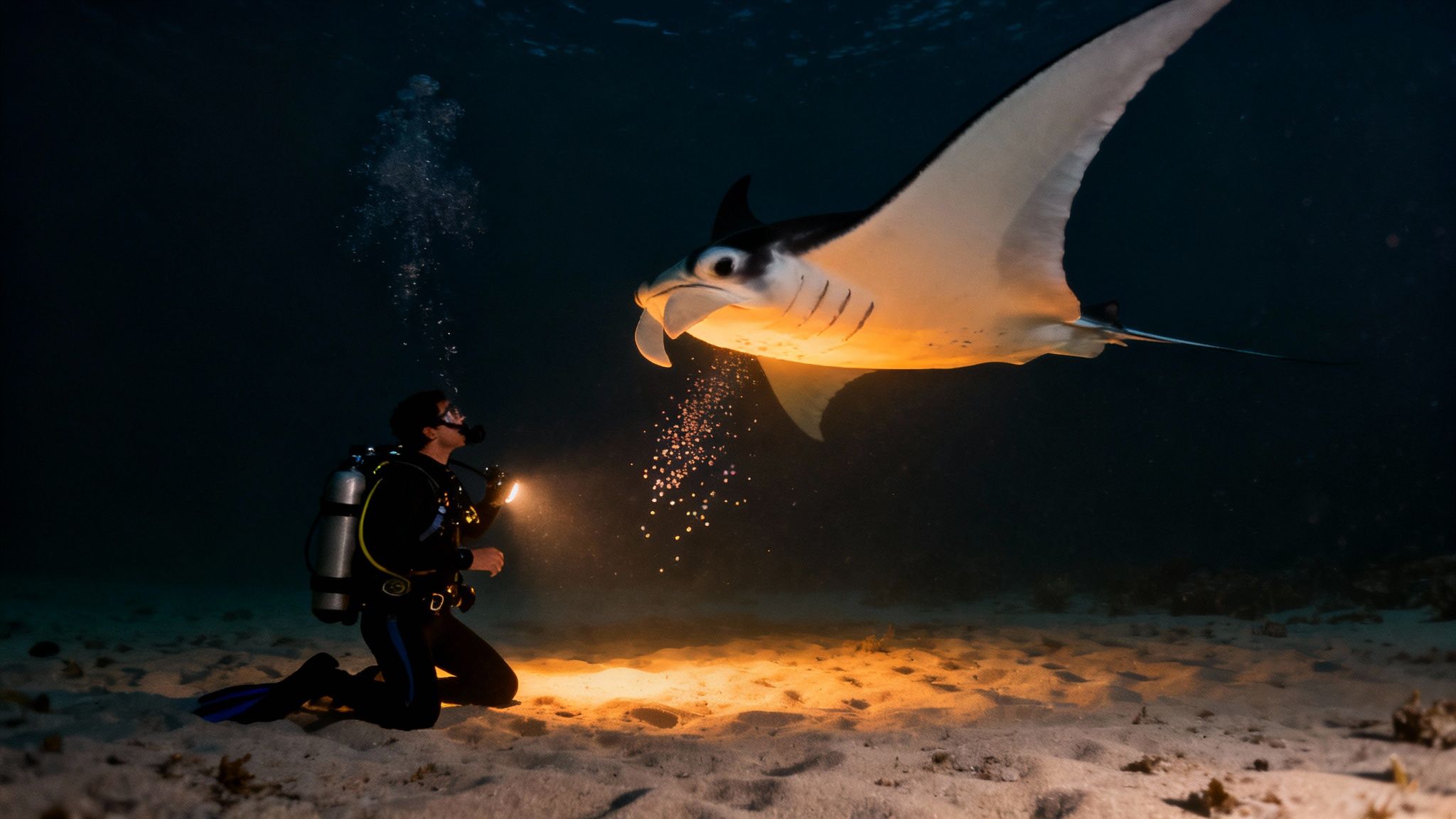
If there's one dive on the Big Island that everyone talks about, it’s this one. The Manta Ray Night Dive isn't just a dive; it's pure, unforgettable magic and the island's signature underwater experience for a reason.
Picture this: you descend into the dark, calm ocean, find your spot on the sandy bottom, and then wait. Soon, massive, graceful giants with wingspans stretching up to 16 feet appear, gliding silently just inches over your head. It’s a surreal, underwater ballet that you have a front-row seat for.
We set up powerful lights on the ocean floor, which act like magnets for clouds of plankton—the mantas' favorite meal. As the plankton gathers, the rays arrive to feast, performing effortless loops and barrel rolls. It’s a breathtaking, silent show that feels like it’s from another planet.
Why Garden Eel Cove Is the Premier Choice
While you can see mantas at a couple of spots, one place consistently delivers a better, more reliable experience: Garden Eel Cove. Manta Village is another popular site and a great dive, but Garden Eel Cove has a few key advantages that, in our experience, make it the superior choice for this bucket-list adventure.
For starters, its location is more protected, which usually means calmer seas and a more comfortable dive. More importantly, the underwater viewing area is shaped like a natural amphitheater. We call it the "campfire," where divers gather in a semi-circle. This setup gives everyone an amazing view without getting in the mantas' way.
On top of that, the surrounding reef at Garden Eel Cove is simply healthier and more vibrant, making the whole dive more scenic. The combination of calmer water, a better layout for watching the show, and a richer ecosystem makes it the clear winner. This is exactly why Kona Honu Divers runs its tours to Garden Eel Cove—to give our guests the best possible encounter.
A Reliable and Sustainable Encounter
What makes this dive truly special isn't just its beauty, but how incredibly reliable it is. This is a world-renowned experience, and for good reason. Operators here in Kona report a manta sighting success rate of 85-90%, making this one of the most dependable big-animal encounters on the planet. I’ve been on dives where we’ve seen up to 23 different mantas in a single night.
This incredible consistency is no accident. It's the result of decades of sustainable, respectful practices developed by the local dive community. We’ve established strict guidelines to protect the rays and ensure they keep coming back.
- Observe Only: Touching the mantas is strictly forbidden. It can strip away their protective mucus coating, leaving them vulnerable to infections.
- Stay on the Bottom: Divers are asked to remain on the sand, creating a clear "dance floor" above for the mantas to maneuver.
- Light Positioning: We aim our dive lights straight up, creating beams that attract the plankton and allow the mantas to feed naturally.
These rules create a safe, predictable environment for the resident manta population, ensuring they return to the "campfire" night after night. By following these simple guidelines, you become part of a conservation effort that protects these majestic animals for generations to come. To get a better feel for the whole experience, you can learn more about what the Manta Ray Night Dive entails.
Discovering Kona’s Top Dive Sites
Sure, the Manta Ray Night Dive gets a lot of the spotlight, and for good reason. But that famous dive is just the beginning of what the Kona coast has to offer. The Big Island’s volcanic past has left us with a spectacular underwater playground full of dramatic lava tubes, massive craters, and vibrant reefs just waiting to be explored.
Getting out to see these other spots is key to a full scuba diving Big Island Hawaii adventure. We run a whole range of diving tours designed to show off the best of our underwater world. Let’s take a look at a few must-see sites that should be on every diver’s list.
Golden Arches: A Photographer’s Dream
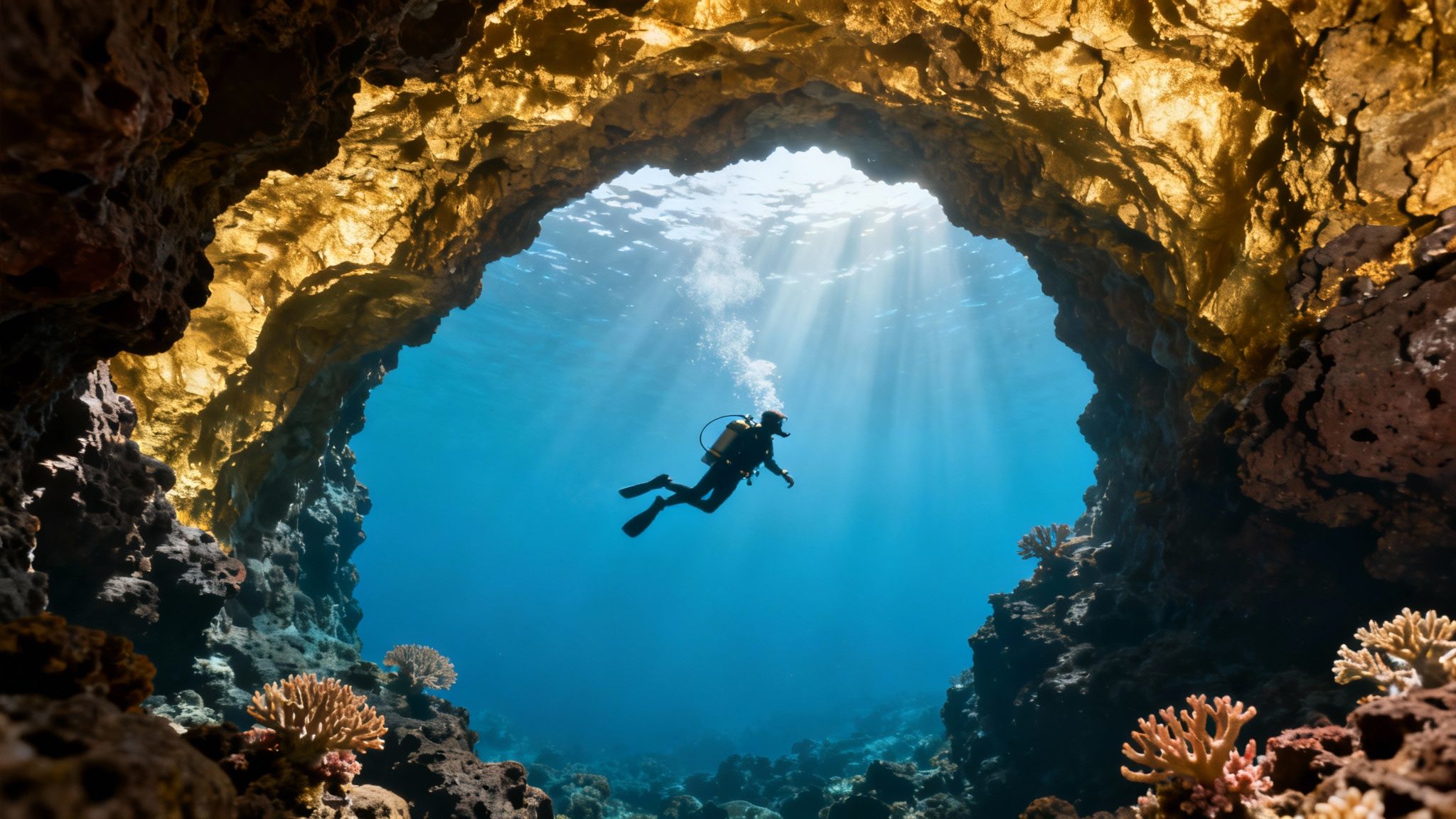
This is easily one of Kona’s most iconic sites, famous for its incredible lava tube formations. Dropping down to a max depth of about 50 feet (15 meters), you’ll find yourself weaving through a series of huge, interconnected arches and swim-throughs. The way sunlight filters through the openings in the rock, creating those classic "god rays," is just stunning.
The site is also a fantastic spot for finding macro life, and you'll be surrounded by vibrant reef fish, including some of our local endemics like the Milletseed Butterflyfish. The swim-throughs are nice and wide, making it a perfect dive for intermediate divers wanting to experience topography you can only find in a place shaped by volcanoes.
Turtle Pinnacle: A Bustling Cleaning Station
Picture this: you descend onto a giant coral pinnacle and find Hawaiian Green Sea Turtles (Honu) lined up, patiently waiting for their turn at the spa. That’s Turtle Pinnacle. This spot is a natural "cleaning station," where the turtles come to let smaller reef fish pick algae and parasites right off their shells.
With a max depth of around 60 feet (18 meters), it's a fantastic dive for all skill levels. Watching this symbiotic relationship happen right in front of you is something truly special. And it's not just about the turtles—the pinnacle itself is covered in healthy coral and is always buzzing with schools of fish.
Au Au Crater: A Submerged Volcano
If you’re looking for a dive that feels like you’ve landed on another planet, Au Au Crater is it. This partially submerged volcanic crater offers a unique and absolutely dramatic underwater landscape. The crater walls form a semi-protected bowl that draws in an incredible variety of marine life.
The max depth here is only 45 feet (14 meters), so it's easily accessible for intermediate divers. You’ll want to keep a lookout for eagle rays gliding along the crater rim or whitetip reef sharks resting on the sandy bottom. The sheer scale of the geology here is what makes it a dive you won't soon forget.
To help you get a better sense of the incredible variety Kona offers, here’s a quick rundown of some of our premier sites.
Kona's Premier Dive Sites at a Glance
| Dive Site | Key Features | Max Depth | Best For |
|---|---|---|---|
| Golden Arches | Lava tube swim-throughs, dramatic light rays, macro life | 50 ft / 15 m | Photographers, Intermediate Divers |
| Turtle Pinnacle | Honu (turtle) cleaning station, vibrant coral pinnacle | 60 ft / 18 m | All Skill Levels, Turtle Lovers |
| Au Au Crater | Submerged volcanic crater, eagle rays, unique geology | 45 ft / 14 m | Intermediate Divers, Adventure Seekers |
| Kona Blackwater | Pelagic night dive, bioluminescent creatures, deep ocean life | 50 ft / 15 m | Advanced Divers, Thrill Seekers |
Each site offers a completely different window into the underwater world of the Big Island, showcasing just how diverse the diving is here.
The Kona Blackwater Dive: A Journey into the Abyss
For the true adventurer, the Kona Blackwater Dive is an experience you won't find anywhere else. Forget the reef—this is a pelagic night dive miles offshore, where you're tethered to the boat in the deep, dark ocean. Descending to about 50 feet (15 meters), you simply drift and witness one of the largest migrations on the entire planet.
Every single night, countless strange and often bioluminescent creatures rise from the abyss to feed near the surface. You'll see things that look like they're straight out of a sci-fi movie—translucent squids, otherworldly larval fish, and shimmering siphonophores. This is a genuinely advanced dive, but it offers a humbling and mesmerizing glimpse into a hidden world.
Advanced Diving for the Experienced Explorer
If you've got a well-stamped logbook and you're looking for a genuine adventure, the Big Island has a wilder side that’s calling your name. While Kona is rightfully famous for its beautiful and accessible reef dives, there’s a whole different world waiting for divers with an Advanced Open Water certification or higher.
This is where your scuba diving Big Island Hawaii experience transforms from beautiful to truly breathtaking. We're talking about exploring deeper profiles, handling potential currents, and navigating the kind of complex underwater landscapes that are simply off-limits to beginners. These sites are often tucked away in more remote locations, rewarding those who make the journey with pristine coral gardens and a much higher chance of running into large pelagic species.
Picture yourself descending onto a remote pinnacle, completely surrounded by a swirling vortex of jacks, or drifting along a deep ledge where sharks and eagle rays patrol the blue. That’s the heart and soul of advanced diving in Kona.
Trips Built for Seasoned Divers
To get to these exclusive spots, you really need to be on a charter that’s specifically for experienced divers. Most standard tours have to cater to a mix of skill levels, which means they understandably stick to the shallower, easier sites. An advanced-only trip changes the game entirely—it means everyone on the boat has the training and confidence to handle more demanding conditions.
This is precisely why we run the Premium Advanced 2-Tank Trip here at Kona Honu Divers. We keep the group small, taking only seasoned divers to those incredible, off-the-beaten-path locations. This approach gives us the flexibility to choose the day's best sites based on conditions and what the group is excited to see, making for a much more personal and rewarding dive.
What to Expect on an Advanced Dive
- Deeper Profiles: We’ll explore depths well beyond 60 feet, where you’ll find entirely different marine life and incredible geological features.
- Big Animal Encounters: Getting away from the main crowds seriously ups your odds of seeing larger animals like sharks, rays, and sometimes even dolphins.
- Real-World Navigation: Put your skills to the test as you navigate through intricate lava tubes, arches, and sprawling reef systems.
- Untouched Environments: Diving in areas with less boat traffic means healthier reefs and more natural, undisturbed animal behavior.
Ready to take on a bigger challenge? Our Premium Advanced 2-Tank Trip is designed from the ground up to show you Kona's most exciting and remote dive sites, far from the usual crowds.
How to Plan Your Big Island Dive Adventure
Turning that dream of scuba diving Big Island Hawaii into a reality is actually a lot simpler than you might think. With just a little bit of smart planning, you can make sure your trip is seamless, fun, and filled with incredible moments under the waves. This is your practical guide to getting everything squared away.
One of the absolute best things about diving in Kona is that it's a year-round sport. The island’s massive volcanoes act as a natural shield for the coast, which means we get consistently calm and clear conditions pretty much any day of the year. The water is always inviting, ranging from a comfortable 75°F (24°C) in the winter to a beautifully warm 82°F (28°C) in the summer.
While any time is a good time to visit, the winter months from December to March offer a truly spectacular bonus. This is when humpback whales migrate here to breed and give birth, and hearing their haunting songs reverberate through the water on a dive is an experience you will never, ever forget.
Gearing Up and Getting Here
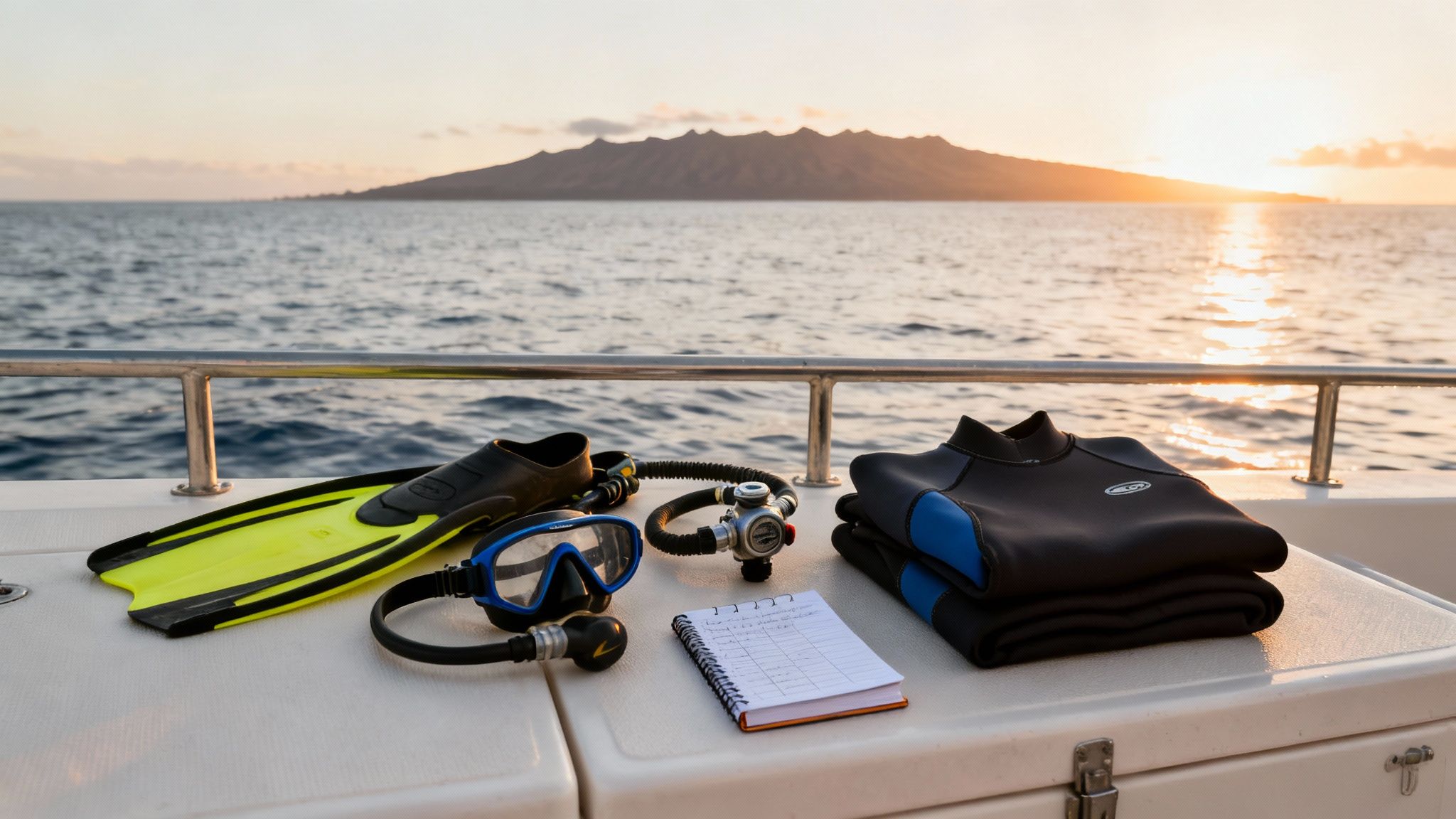
Packing the right gear makes all the difference. For Kona’s water temperatures, a 3mm or 5mm full wetsuit is usually the sweet spot, depending on how warm you like to be. We have top-notch rental gear, but many divers find that bringing their own mask, fins, and computer adds a layer of comfort and familiarity to their dives.
As you pack, please remember how vital our reefs are. Sun protection is a must, but choosing a reef-safe brand is just as important. It’s worth looking into the best sunscreens and toxic ones to avoid to help protect our delicate marine life.
Pro Tip: Toss a reusable water bottle in your bag, along with a light jacket or windbreaker. It can get surprisingly cool on the boat ride back after a night dive!
Getting here is easy—just fly into Kona International Airport (KOA). For your stay, I’d recommend finding a place in or near Kailua-Kona. It’s the most convenient base, putting you close to the dive boat harbors and right in the middle of all the action.
The Most Important Step: Booking Your Dives
If you take only one piece of advice from this guide, let it be this: book your dive charters well in advance. Kona is a world-renowned destination, and the best boats—especially the smaller, more personal charters—fill up fast. This is doubly true for peak seasons like winter holidays, spring break, and summer.
I've seen too many divers show up on the island hoping to book a trip, only to find everything is sold out. Locking in your spot on the boat weeks or even months ahead of time is the only way to guarantee you won't miss out on iconic dives like the Manta Ray Night Dive or exploring our underwater lava tubes. This is especially true if you're new to the sport; you can learn all about taking the plunge with our guide to beginner scuba diving on the Big Island.
Planning ahead isn't just about securing a spot. It's about giving yourself peace of mind so you can relax and focus on the incredible adventure waiting for you beneath the surface.
Common Questions About Diving in Kona
As you plan your big scuba diving trip to Hawaii's Big Island, you're bound to have a few last-minute questions pop up. We get it. Getting those details sorted is the final step before the real excitement kicks in. Here are the answers to some of the most common things we're asked by divers gearing up for their Kona adventure.
What Certification Level Do I Need to Dive in Kona?
One of the best things about diving here is the sheer variety. Kona's dive sites are incredibly diverse, with amazing spots for divers of every skill level. In fact, many of our most stunning reefs, and even the world-famous Manta Ray Night Dive, are perfect for anyone with an Open Water certification.
If you're looking to go a little deeper or explore some of the more intricate lava tube systems, having an Advanced Open Water certification will definitely open up more doors. And if you’re not certified yet? No problem. Kona’s calm, warm waters are an absolutely ideal classroom.
What Is the Best Time of Year for Scuba Diving?
Honestly, there’s no bad time to dive in Kona. The diving is spectacular all year long. Our massive volcanoes shield the coastline, keeping the waters calm and clear most of the time. The water temperature is always comfortable, hovering around 75°F (24°C) in the winter and getting up to a balmy 82°F (28°C) in the summer.
While any month is a great choice, there's a special kind of magic here between December and March. During these winter months, you can often hear the haunting songs of humpback whales echoing through the water on your dives. It’s an experience you'll never forget.
Do I Need to Bring My Own Dive Gear?
You're more than welcome to bring your own gear if you have it, but you certainly don't have to. Kona Honu Divers has a complete inventory of high-quality, professionally maintained rental equipment, from BCDs and regulators to wetsuits and fins. Renting from us is an easy way to lighten your luggage and simplify your travel plans.
For those bringing their own equipment, a 3mm or 5mm wetsuit is usually the sweet spot for our water temperatures, depending on how warm or cool you tend to run.
Are the Kona Dive Sites Crowded?
With over 50 moored dive sites scattered along the coast, the boats and divers naturally spread out, which is great for everyone. Here at Kona Honu Divers, we specifically focus on smaller group trips. It’s important to us that every diver gets a personal, high-quality experience without ever feeling like they're in a crowd.
You’ll find that popular spots like the Manta Ray Night Dive do attract several groups, but the sites are well-managed to make sure everyone gets a front-row seat. The key is choosing a good operator that keeps groups small, so you can truly lose yourself in the moment.
Ready to see it for yourself? Take a look at our complete list of diving tours and find the perfect adventure for your trip.